What Is Revenue Optimization? a 2026 Guide
August 3, 2026
Revenue optimization is a system for setting the right nightly and weekly room price while coordinating marketing, inquiry response, move-in, and retention so total net operating income improves, not just headline rent. What is revenue optimization in plain terms, it's the discipline of making all those room-by-room decisions work together instead of letting price, occupancy, and operations pull in different directions.
If you host a PadSplit-style house, you've probably felt this already. A vacancy opens, two inquiries come in, and the question isn't just “What should I charge?” It's “What choice fills the room fastest, protects cash flow, and keeps the member who moves in likely to stay?” Revenue optimization is the answer to that whole decision, not just the price tag.
The Real Question Behind Revenue Optimization
A Tuesday vacancy creates pressure fast. One inquiry asks about price first, the other sounds ready to book, and you're left deciding whether to hold rate, soften it, or add a move-in incentive to get the room filled.
That moment shows why revenue optimization is bigger than pricing alone. It's a system-level discipline that combines pricing, demand forecasting, inventory allocation, and channel management so the best decision is the one that fits the demand curve and still protects profitability, not just the one that looks highest on paper (Vendavo).
Practical rule: if a higher rate slows the move-in enough to create extra vacancy days, the “better” price may actually lower total income.
For a co-living host, that system includes how fast you answer inquiries, how you sort leads, when you offer flexibility, and how well you reduce churn after move-in. Older revenue-management thinking also points to overlooked areas such as transactional flexibility, omni-channel and real-time pricing, and after the invoice execution, which is a good reminder that money leaks happen after the listing is published too (Forgotten Areas of Revenue Management).
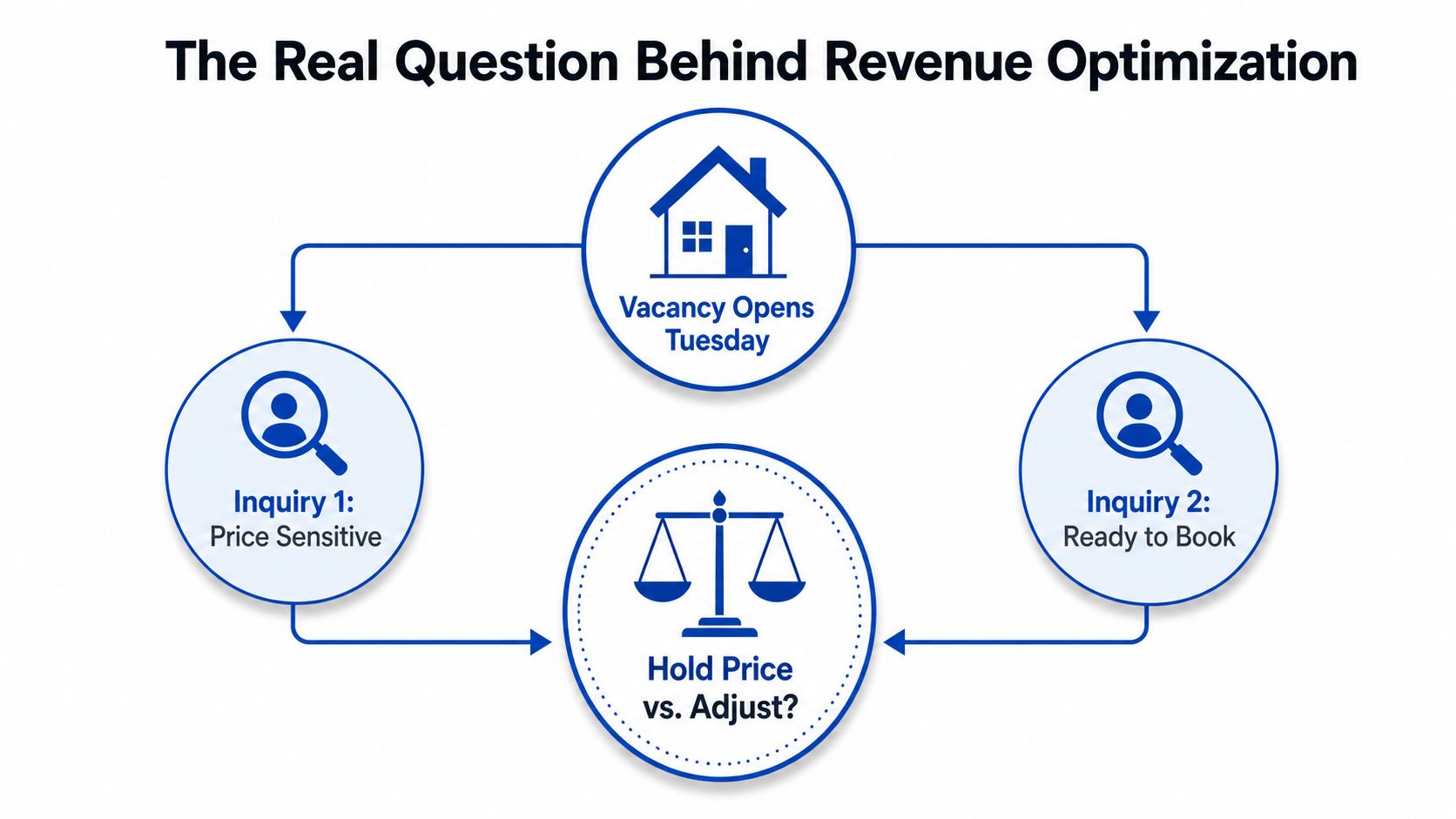
The easiest way to think about it is this. Revenue optimization is the operating system behind the room price, the inquiry process, the move-in experience, and the retention plan. If any one of those pieces is weak, the “right” rate won't save the week.
The Five Pillars of Revenue Optimization in Co-Living
A good co-living revenue system doesn't lean on one lever. It runs on five connected pillars, and each one changes the others.
Pricing strategy
Pricing strategy is the visible part, but it's not the whole engine. In a PadSplit-style house, that means deciding whether a room should sit at a steady weekly rate, move up during a demand spike, or stay flexible when lease-up is slow. Stripe's guidance is useful here, because it frames revenue optimization as maximizing income without hurting customer satisfaction or long-term financial health (Stripe).
Demand forecasting
Forecasting asks a simple question, how many people are likely to inquire, tour, and move in soon? If you know demand is thin next week, you can respond with faster follow-up, a more attractive listing, or a targeted concession instead of waiting too long and losing time.
Segmentation
Not every lead behaves the same. One person wants the cheapest room, another wants speed and certainty, and a third cares about move-in timing more than rate. A host who groups leads by need can tune the offer instead of blasting everyone with the same response.
Distribution and channel management
You decide where the room is marketed and how consistently it's presented. If one channel brings ready-to-book leads and another brings price shoppers, your mix affects both occupancy and yield. Channel management matters because the source of the inquiry changes the economics of the room.
Yield management
Yield is the art of choosing the best outcome from the inventory you have left. In a shared house, that can mean protecting a stronger weekly rate for a better-fit member or accepting a small concession when the cost of waiting is higher than the discount.
A useful way to remember the five pillars is to treat them like parts of one lock. Turn one too hard, and the others shift. BigCommerce, Mindtickle, and Revenue.io all frame revenue optimization as cross-functional across acquisition, retention, expansion, and pricing, which lines up with the reality of room-by-room housing, where sales, operations, and member experience all affect revenue (BigCommerce).
Key Metrics Every Host Should Track
The fastest way to make revenue optimization feel real is to watch the numbers that show whether your room is earning well or just staying busy. For a small co-living house, four metrics are enough to start: RevPAR, ADR, occupancy rate, and marginal revenue per room.
| Metric | What It Measures | Simple Formula | What a Change Signals |
|---|---|---|---|
| RevPAR | Revenue earned per available room | Total room revenue divided by available rooms | Whether the room inventory is being used well |
| ADR | Average rate paid per occupied room | Total room revenue divided by rooms sold | Whether pricing is moving up or down |
| Occupancy rate | How full the house is | Rooms sold divided by rooms available | Whether demand and lease-up are keeping pace |
| Marginal revenue per room | Extra revenue from one more occupied room | Additional revenue from one added booking | Whether a rate cut or concession is worth it |
How the tradeoff shows up
A host can raise ADR and still end up with weaker total revenue if occupancy falls enough. That's why RevPAR matters, because it shows what each available room produced, not just what the occupied rooms were billed at. A clean explanation of these metrics and how they work together is also useful in the broader property-management context, as outlined in this PadPulse metric guide.
Operator takeaway: watch occupancy and rate together, not separately. A strong rate with long vacancy gaps is still a weak result.
For a six-bed co-living house, a daily glance at occupancy and inquiries is usually enough, while ADR and RevPAR make more sense in weekly review. Marginal revenue per room is the decision metric before a rate change, because it tells you whether the extra booking is worth the lower price or added concession.
The Occupancy Versus Price Tradeoff in Practice
Two identical rooms in the same neighborhood can produce very different outcomes depending on how fast they move. If one room sits empty for several extra days while the other fills quickly at a slightly lower rate, the room with the “higher” price may still be the weaker business decision.
That tradeoff is the heart of occupancy elasticity in co-living. A small weekly discount can make sense when it shortens vacancy, speeds lease-up, or brings in a member who stays longer. A rate cut only becomes a problem when it gives away income without recovering enough occupancy to justify it.
A host can see this most clearly in a soft month. One room may need a small adjustment to keep inquiries turning into move-ins, while another room can hold rate because demand is already healthy.
A simple rule for deciding
Use this sequence when the room is soft:
- Hold price first if inquiries are steady and the room is likely to lease soon.
- Offer a targeted concession if the room is sitting too long and the lead quality is decent.
- Cut rate more broadly only when the demand pattern shows the room is overpriced for the current market.
That order matters because some hosts discount too early and train the market to wait for lower prices. Others hold too long and lose the next move-in entirely.
The question is which choice produces more net operating income after vacancy, turnover, and timing are included. That is why pricing has to be paired with the rest of the revenue system, including how a room is marketed, how fast inquiries are answered, and how quickly the right lead can move from interest to move-in. A clear explanation of dynamic pricing and how it fits into that system is available in this PadPulse guide on dynamic pricing, and Salesforce takes a similar view by treating revenue optimization as a full process, not just a closing tactic.
A host who understands the tradeoff stops reacting to the posted rate alone. They start asking how fast the room is likely to fill, what the lead quality looks like, and whether a small concession will save more money than waiting.
A Worked Example for a Six-Room Co-Living House
A six-room house makes this easier to see because the numbers are small enough to follow without a spreadsheet full of noise. Here's a simple quarter-long pattern for a fictional host.
The host starts with a room that's priced too confidently for a softer month. Inquiries come in, but they're slower to convert because the listing is stale and the response time is lagging. The room eventually fills, but not before vacancy drags the month down.
Month-by-month choices
- Month one: The host holds rate too long. The room stays empty longer than expected, so total revenue lags even though the sticker price looks strong.
- Month two: The host lowers the weekly price a bit and replies to inquiries faster. The room fills sooner, and the lower rate is partly offset by shorter vacancy.
- Month three: Demand improves, so the host raises the rate modestly and keeps response time tight. The room still leases, and the stronger rate improves NOI.
That pattern is the point. Revenue optimization isn't one decision, it's a sequence of corrections.
What the host checks each week
- Comp rent movement from nearby similar rooms.
- Inquiry quality to see whether leads are price-sensitive or ready to move.
- Days vacant so the host can judge whether the current rate is holding too long.
- Move-in friction, such as slow replies or delayed access coordination.
The workflow only works if each change is measured against the last one. Otherwise, the host can't tell whether a rate adjustment, a faster response, or a better concession did the heavy lifting.
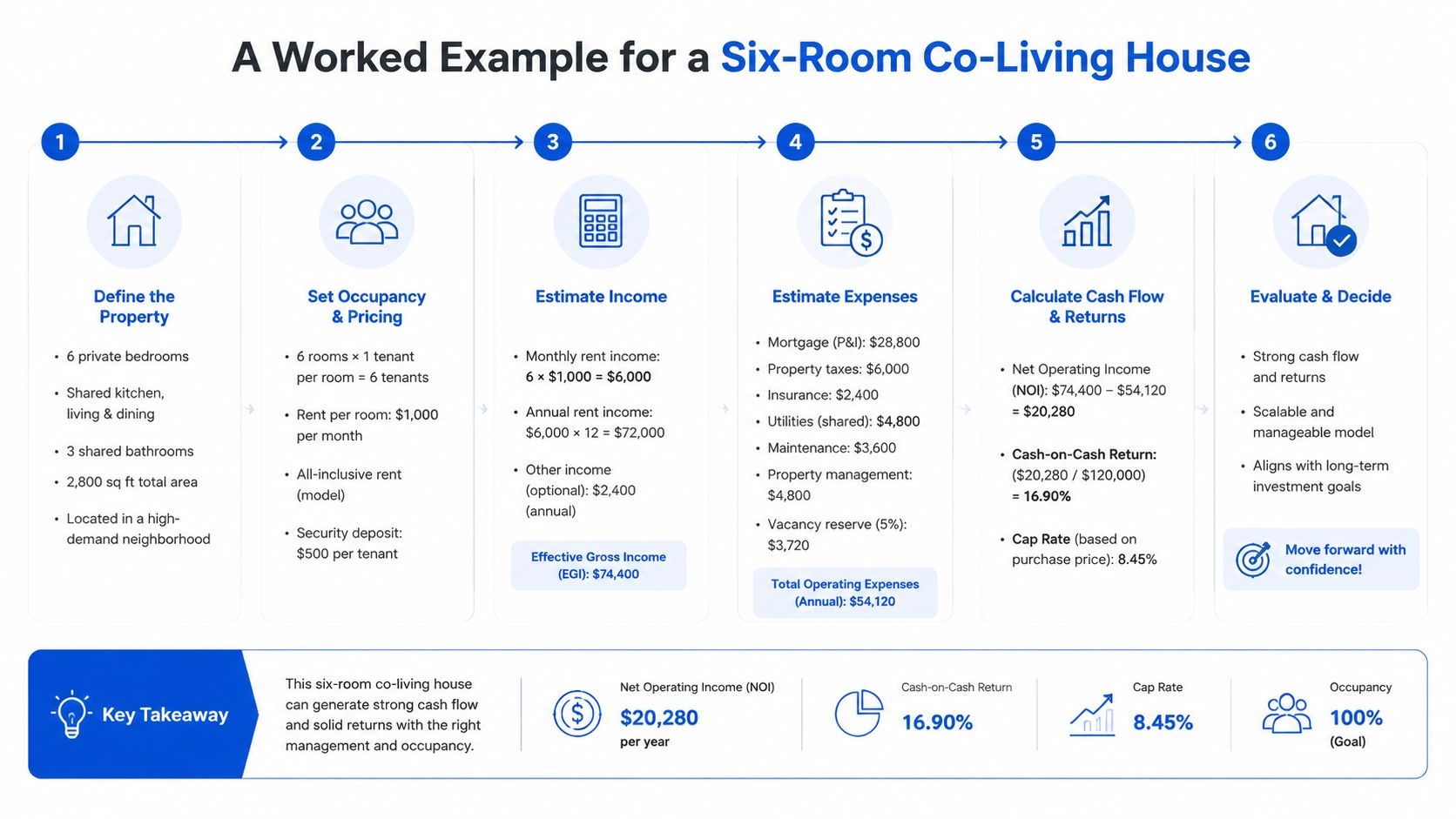
A room-by-room house gets better results when the host treats pricing as a weekly operating habit, not a once-a-month guess. Small edits, made consistently, usually beat dramatic changes made too late.
Building the Revenue Optimization Workflow and Stack
Once the decisions are clear, the next job is making them repeatable. A useful weekly workflow starts with comparable rent data, moves into demand forecasting for the next short window, then checks inquiry response speed, listing quality, and portfolio-level NOI.
That workflow usually needs more than a spreadsheet. Dynamic pricing engines, AI-assisted messaging, smart-lock access, and P&L dashboards work better together than separately, because each tool solves a different bottleneck. One handles rate changes, one speeds replies, one reduces move-in friction, and one shows whether the economics improved.
A platform can help if it brings those pieces into one place. PadPulse is one example of a tool designed to centralize pricing, messaging, access, and reporting for PadSplit-style operators.
A practical weekly stack
- Comparable rent tracking to keep the room priced against reality.
- Forecasting tools to estimate near-term demand.
- Messaging automation to reduce lead response delays.
- Access and smart-home integrations to keep move-ins smooth.
- Analytics dashboards to see whether changes improved NOI.
Useful mindset: a better tool stack doesn't replace judgment. It gives you faster feedback so your judgment gets sharper.
The main point is that revenue optimization is operational, not just analytical. If the pricing engine is strong but the inquiry workflow is slow, the system still leaks revenue. If the room price is right but billing, access, or follow-up is sloppy, the full cycle still underperforms.
Common Misconceptions That Hold Hosts Back
A lot of hosts stall because they misunderstand the job. The first mistake is thinking revenue optimization is just dynamic pricing. It's not. Pricing is one lever, but the full system also includes lead handling, move-in flow, and retention.
The second mistake is assuming the highest price is always the best price. A room that sits vacant for too long can earn less than a room priced slightly lower and filled sooner.
The third mistake is treating occupancy as the only number that matters. Full rooms can still be weak rooms if the rate is too low or the turnover is too high.
The last mistake is thinking this only applies to hotels or big portfolios. A single shared house has the same basic problem, how to match room price, demand, and operations so the property produces better income over time.
Revenue optimization is small-operator work as much as enterprise work. The scale changes, but the logic doesn't.
Your Next Steps as a Co-Living Host
Start with the numbers you can see this week. Track RevPAR alongside ADR, pull a simple comp-rent sheet, and watch whether inquiries are turning into move-ins quickly enough to justify your current rate.
Then tighten one part of the workflow. That could mean faster inquiry replies, a clearer move-in process, or one small concession rule for soft weeks instead of random discounting.
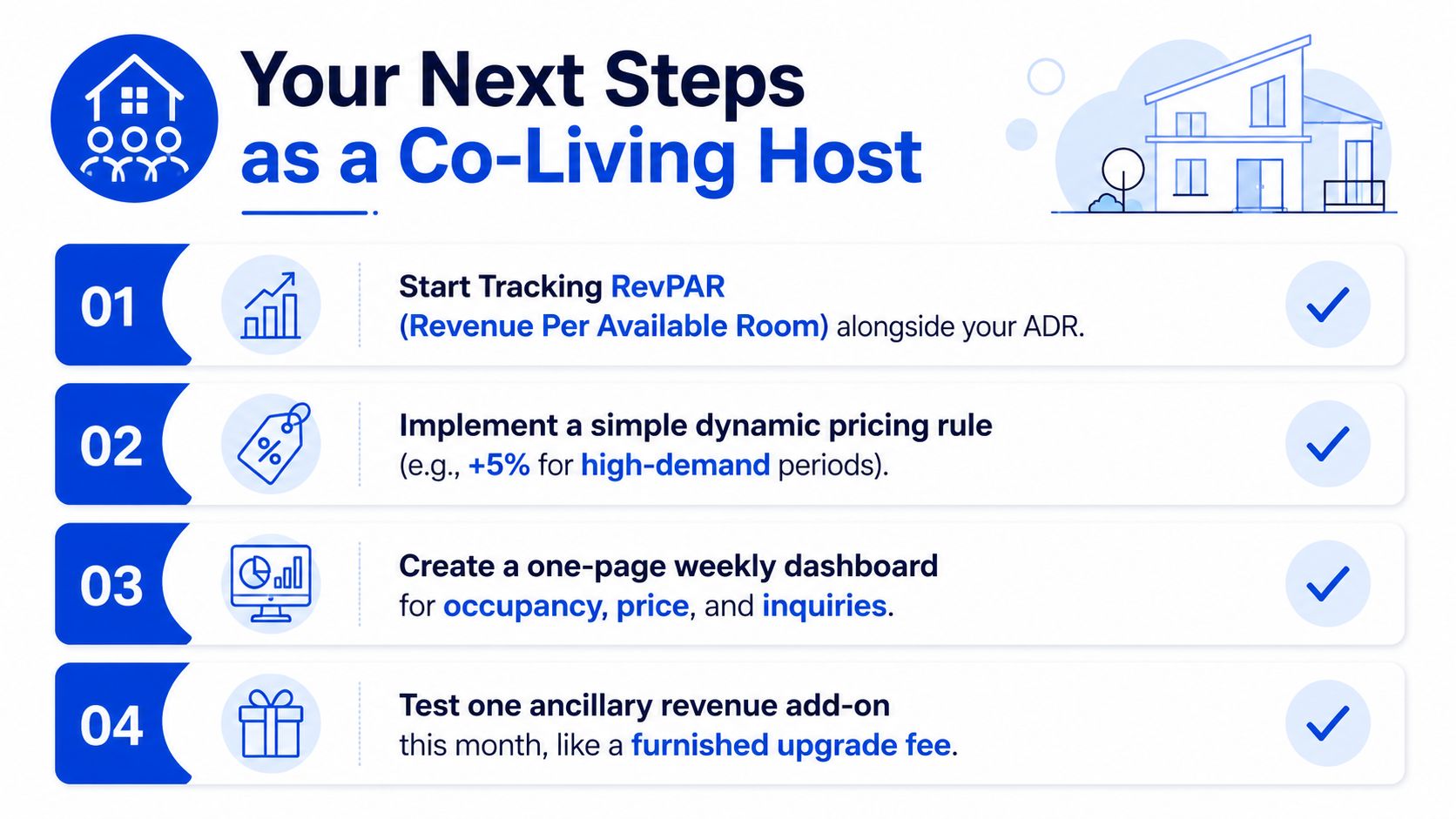
A good next move is to set one weekly review habit and stick to it for a month. If you want a system that centralizes pricing, AI messaging, smart-home integrations, and portfolio analytics for PadSplit-style operations, take a look at PadPulse and join the interest list for early access updates.