How Does Dynamic Pricing Work for Co-Living?
June 2, 2026
You've probably lived this already.
One room sits empty for weeks because the rent feels just a little too high for the market. Then another room gets claimed almost immediately, and your first thought is that you priced it too low. In co-living, that gap matters. Every vacant room drags on cash flow, but every underpriced room chips away at NOI in a way that's easy to miss.
That's why more operators are asking a basic question: how does dynamic pricing work, and can it help room-by-room rentals? The short answer is yes. Instead of posting one fixed rent and hoping it fits every market condition, dynamic pricing adjusts based on what's happening right now, including demand, inventory, timing, and nearby competition.
For co-living operators, that shift is practical, not theoretical. You're not managing identical hotel rooms with nightly stays. You're managing different room sizes, lease lengths, house-level occupancy risk, and renter demand that can change fast.
Why Your Room Prices Should Never Be Static
A static pricing model sounds clean on paper. Set the small room at one rent, the larger room at another, update every so often, and move on. The problem is that the market doesn't stay still.
A co-living house can have two vacancies at the same time and need two different pricing decisions. One room might be move-in ready, furnished, and available during a high-demand period. Another might have an awkward layout, a later availability date, or competition from several similar listings nearby. Charging both the same way often leads to one of two problems: lost revenue or extra vacancy.
That's why static pricing breaks down in room-by-room rentals. It treats pricing like a yearly decision when it's really an operating decision.
A vacant room and an underpriced room are different problems, but they both come from the same root issue. The price didn't match the moment.
Dynamic pricing fixes that by replacing fixed rate cards with a live pricing approach. The system takes in current signals, applies rules or algorithms, and updates prices when conditions change. Companies using dynamic pricing see about a 5% average increase in profit margin per product or service sold, according to Zuora's overview of dynamic pricing. For a co-living operator, that kind of improvement shows up as stronger cash flow and better property yield.
What static pricing misses in co-living
Static pricing usually ignores a few realities:
- Room differences matter: A basement room, a private bath, and a corner room near transit shouldn't always move together.
- Timing matters: Demand can strengthen or soften quickly depending on season, local hiring cycles, or school schedules.
- Vacancy risk matters: A room that has been open too long needs a different response than a room that just became available.
If you're weighing fixed pricing vs dynamic pricing for rentals, the practical question isn't which model is simpler. It's which model helps you react before vacancy becomes expensive.
Understanding the Core Concept of Dynamic Pricing
Many individuals already understand dynamic pricing. They just know it from other industries.
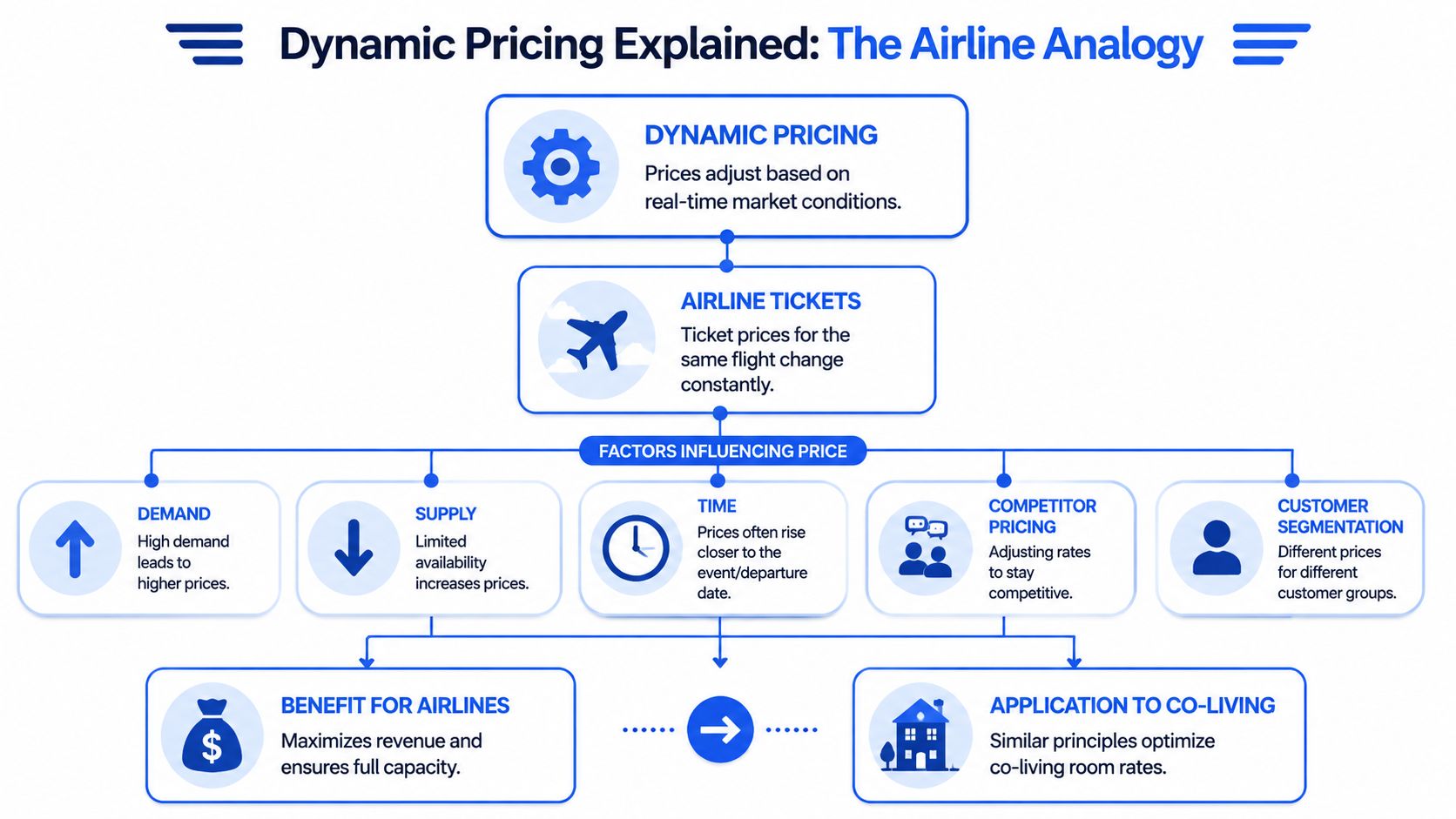
Airline tickets are the classic example. A seat on the same route can cost more or less depending on demand, how many seats remain, and how close the flight is. Ride-hailing works similarly. Prices rise during busy periods and ease when demand slows. Co-living follows the same logic, even though the lease terms are longer and the asset is housing, not transportation.
The simple version
Dynamic pricing means your rent isn't locked into one number for long periods. Instead, the price changes when market conditions change.
That could mean:
- Raising rent when multiple renters are inquiring about the same room
- Holding rent steady when demand is healthy and occupancy is stable
- Lowering rent when a room has been sitting and the cost of vacancy is rising
This is very different from static pricing, where you might list every similar room at the same monthly rate year-round and only revisit pricing once in a while.
Why speed changes everything
Digital pricing became much more powerful once platforms could update prices instantly. Brookings notes that online prices can now fluctuate day-to-day, hour-to-hour, or even minute-to-minute in contrast to older static systems that were often revised far less often, as explained in Brookings' article on dynamic pricing and consumer protections.
In co-living, you probably won't want room rents swinging every minute. But the broader lesson matters. You no longer have to wait for a quarterly review to react.
Bringing the airline analogy back to rooms
Here's how the analogy maps over:
- Airline seat availability becomes room availability in your house
- Days until departure becomes days until move-in date or days vacant
- Travel season becomes local rental seasonality
- Competing fares becomes comparable room rents nearby
Practical rule: Dynamic pricing isn't about charging more whenever possible. It's about finding the best available rent for the conditions you're facing right now.
For a co-living operator, that means asking a better question than “What should this room rent for?” Ask, “What should this room rent for today, given this house, this room type, this vacancy situation, and this market?”
The Key Data That Feeds a Pricing Engine
A pricing engine is only as useful as the information going into it. If you want smart pricing decisions, you need the right signals.
For co-living, I'd group the inputs into four buckets. Not because the software needs tidy categories, but because operators do. When people ask how does dynamic pricing work, they usually aren't confused by the idea of changing price. They're confused by what the system is looking at.
Your internal operating data
Start with your own house.
This includes the basics: which rooms are occupied, which ones are vacant, how soon upcoming move-outs will hit, how long your typical lease runs, and which room types fill fastest. Your own portfolio often tells you more than the broader market because it reflects your product, your neighborhood, and your renter profile.
A few examples make this concrete:
- Occupancy pattern: If one house stays full while another struggles, the second one may need more aggressive pricing.
- Vacancy timing: A room opening in two weeks gives you time to test a stronger rent than one that's already been sitting.
- Room performance: If rooms with private baths lease faster than standard rooms, they deserve separate pricing logic.
When operators want a better framework for this, pricing rooms for rent by house and room type is usually a better starting point than using one blanket market number.
Market comps nearby
Internal data tells you how your inventory performs. Comparable listings tell you what renters are seeing besides you.
This isn't just “what's the average rent in the area.” It's much more specific. A shared room, a furnished private room, and a room with an en suite bath compete in different lanes. If you compare the wrong products, your pricing engine learns the wrong lesson.
Look for comps that match on:
- Room type and privacy level
- Furnishing and utility inclusion
- Transit access and neighborhood feel
- Lease flexibility
If nearby operators cut rents on similar rooms and your leads slow down, your price may no longer be competitive. If competing rooms disappear quickly while yours lingers, your rent may be too ambitious for current demand.
Seasonality and demand cycles
Some demand shifts are predictable even if they don't show up on your bookkeeping calendar.
Back-to-school periods, internship seasons, major employer hiring waves, and summer turnover all affect room demand. In co-living, these patterns often matter more than broad annual averages because renters search in bursts. A house that fills easily in one month can feel stubborn the next.
That's one reason dynamic pricing works well. It reacts to current conditions instead of assuming April should look like January.
Local events and short-lived demand spikes
The last input is often overlooked. Local events can temporarily change renter behavior, especially in urban markets.
A major conference, festival, sports event, or temporary employer influx can raise interest in flexible housing. In some neighborhoods, even a nearby construction project or hospital staffing cycle can create bursts of demand.
The lesson isn't to chase every headline. It's to notice that demand isn't always smooth.
Good pricing systems don't just watch the room. They watch the context around the room.
When you combine internal operations, local comps, seasonality, and event-driven demand, you get something far better than guesswork. You get a current market view that helps the next pricing decision make sense.
How Dynamic Pricing Algorithms Decide the Best Price
Once the data is collected, the next question is what the pricing system does with it.
At a high level, the algorithm is trying to balance demand and supply. From an optimization standpoint, the key technical lever is demand elasticity. In plain language, algorithms raise prices when demand is strong relative to available rooms and lower them when demand softens to attract renters and protect occupancy, as described in DealHub's definition of dynamic pricing.
That's the core logic. The main difference between pricing systems is how they express that logic.
Rule-based pricing
Rule-based pricing is the most intuitive model for operators because it works like a policy manual.
You define conditions, then tell the system what to do. For example, you might decide that if a room has been vacant for a certain stretch, the price should step down. Or if the house is nearly full and inquiries are strong, the system can hold firm or test a higher rate.
This approach is useful when you want tight control.
Typical rule categories include:
- Vacancy rules: Change price when a room has sat too long
- Occupancy rules: Price differently in a nearly full house than in a half-full one
- Lease rules: Offer one rate for longer leases and another for shorter terms
- Room rules: Separate logic for premium rooms, shared rooms, or rooms with private baths
Machine learning pricing
Machine learning pricing is less about hard-coded instructions and more about pattern recognition.
Instead of relying only on fixed rules, the model studies historical outcomes and current signals to estimate which price is most likely to meet your objective. That objective might be maximizing occupancy, protecting revenue, or balancing both.
The advantage is that machine learning can spot interactions a human operator might miss. Maybe a certain room type performs well at a higher rent only during specific demand windows. Maybe shorter lease availability changes the best price more than you realized. A machine-learning system can learn from those patterns over time.
The trade-off is visibility. Operators often feel less comfortable when they can't trace every decision back to a simple if-then rule.
Rule-Based vs. Machine Learning Pricing at a Glance
| Factor | Rule-Based Pricing | Machine Learning Pricing |
|---|---|---|
| Control | High operator control through explicit rules | More automated, with less direct manual logic |
| Transparency | Easy to explain why a price changed | Harder to explain each decision in plain terms |
| Setup | Faster to start if you know your rules | Needs stronger data history and system design |
| Adaptability | Good for known scenarios | Better at finding patterns across many signals |
| Best fit | Operators who want predictability and guardrails | Operators who want automation and ongoing optimization |
What about reinforcement learning
Some advanced systems go further and test pricing decisions continuously, learning from outcomes as they go. Operators don't need to master the math to use these tools well. What matters is understanding that the system is trying to improve its decisions based on real leasing results.
If a pricing engine feels like a black box, ask a simpler question. What goal is it optimizing for?
That question matters because the same data can produce different pricing choices depending on the target. A system built to maximize top-line rent may behave differently from one built to reduce vacancy risk. In co-living, the best answer usually sits somewhere in the middle.
A Practical Implementation Plan for Co-living Operators
The hardest part of dynamic pricing in co-living isn't understanding the concept. It's deciding how to use it without losing control.
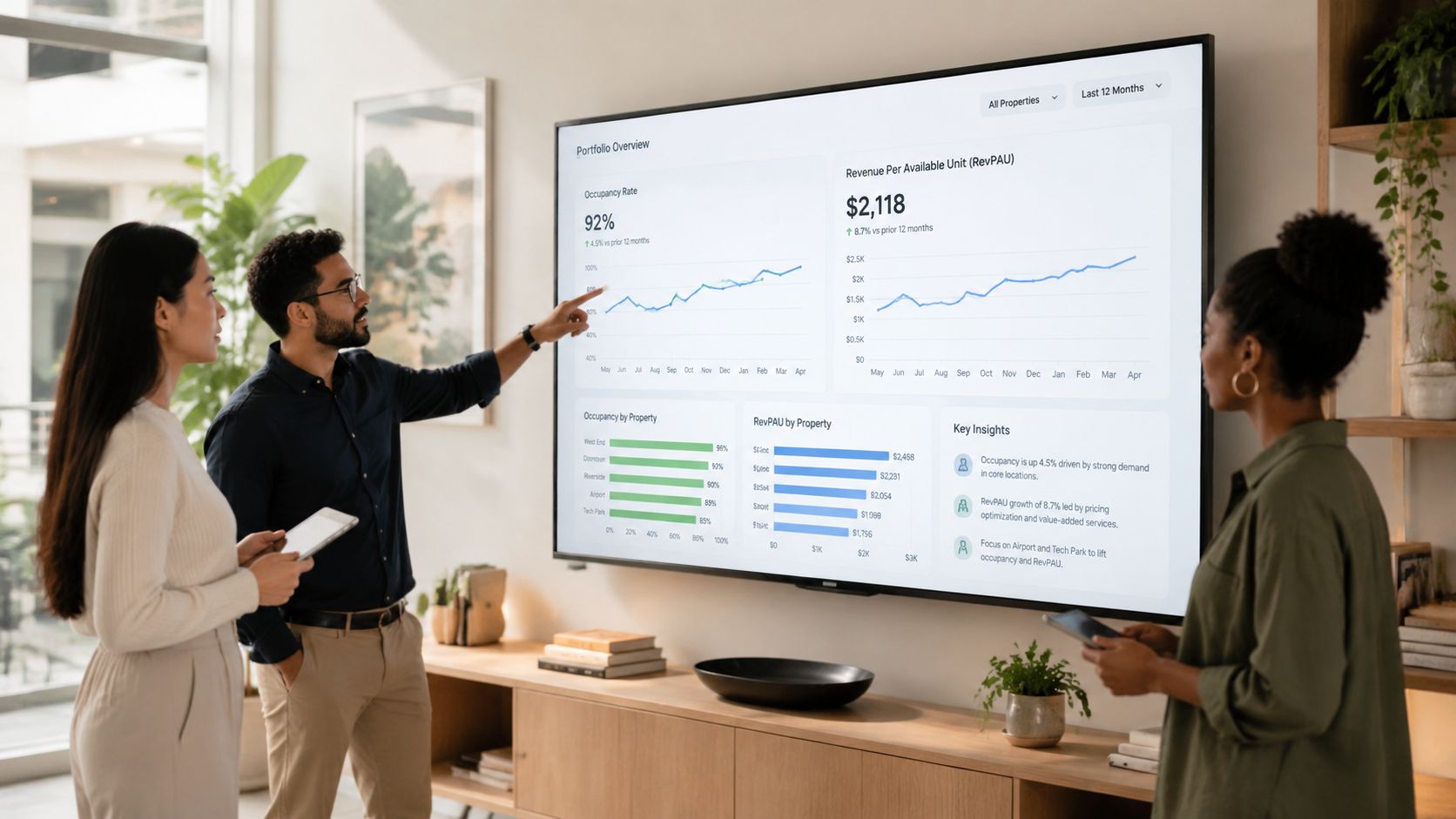
Most generic guides talk about hotels, flights, or e-commerce. Room-by-room rentals need different operating rules. Co-living operators have to account for lease length, room type, vacancy exposure at the house level, and the need to protect NOI rather than chase one headline rent. Salesforce highlights this gap and notes the need for guardrails like minimum rent floors, vacancy-risk thresholds, and rules tied to lease length or room type in its discussion of dynamic pricing implementation.
Start with the real objective
Many operators frame pricing as a fight between occupancy and revenue. That's too narrow.
A full house at lower rents might look good until you realize you gave away too much pricing power. On the other hand, holding out for the highest possible rent can leave rooms empty long enough to hurt overall performance. What you really want is better NOI.
That means your pricing system should answer questions like these:
- How much vacancy risk can this house absorb?
- Which rooms deserve premium positioning?
- When does protecting occupancy matter more than pushing rate?
- How should shorter leases be priced against longer ones?
Set guardrails before you automate
Many operators get into trouble. This happens when they turn on dynamic pricing before deciding what the system is allowed to do.
Guardrails keep pricing disciplined.
A workable setup usually includes:
- Minimum rent floors: The lowest acceptable rent for each room type, based on your costs and target return.
- Reasonable ceilings: Limits that protect brand trust and keep you from overshooting what the market will accept.
- Vacancy-risk thresholds: Rules that make pricing more flexible after a room has been open beyond your comfort level.
- Lease-length logic: Different rates for month-to-month flexibility versus longer commitments.
- Room segmentation: Separate treatment for premium rooms, standard rooms, and harder-to-fill layouts.
If you're evaluating dynamic pricing software for room-by-room rentals, this is the feature set to pay attention to. The best tool isn't the one that changes prices fastest. It's the one that lets you define clear operating boundaries.
Three co-living examples
Here's what implementation looks like on the ground.
Local festival pressure
A house sits near a district that gets unusually active during a local festival period. Inquiry volume rises and comparable listings tighten. Instead of manually guessing at a new rent, the operator lets pricing move upward within preset limits for rooms with immediate availability. After the event window closes, pricing returns to normal logic.
Competitor price change
A nearby operator drops rates on similar furnished rooms. Leads soften for your standard rooms but not for your premium layouts. A smart system doesn't slash every room in response. It adjusts only the segment facing direct pressure and leaves stronger inventory alone.
To see the kind of workflow operators often need, this walkthrough is helpful:
Long-term vacancy problem
One room has sat longer than expected. Instead of making one dramatic cut, the operator uses a controlled sequence. The price eases in stages, paired with lease-length options and updated positioning, until the room becomes competitive again. That preserves discipline and avoids panicked discounting.
A simple rollout plan
If you're introducing dynamic pricing for the first time, keep it narrow.
- Pick one house or one room segment with clear demand patterns.
- Set floors, ceilings, and vacancy thresholds before any automated changes go live.
- Separate room types so premium rooms don't get dragged down by weaker inventory.
- Review leasing outcomes weekly and adjust rules that feel too loose or too rigid.
The best implementation usually starts small, learns fast, and expands only after the guardrails prove they work.
Monitoring Your Success and Getting Smarter Over Time
Dynamic pricing isn't a one-time setup. It's an operating habit.
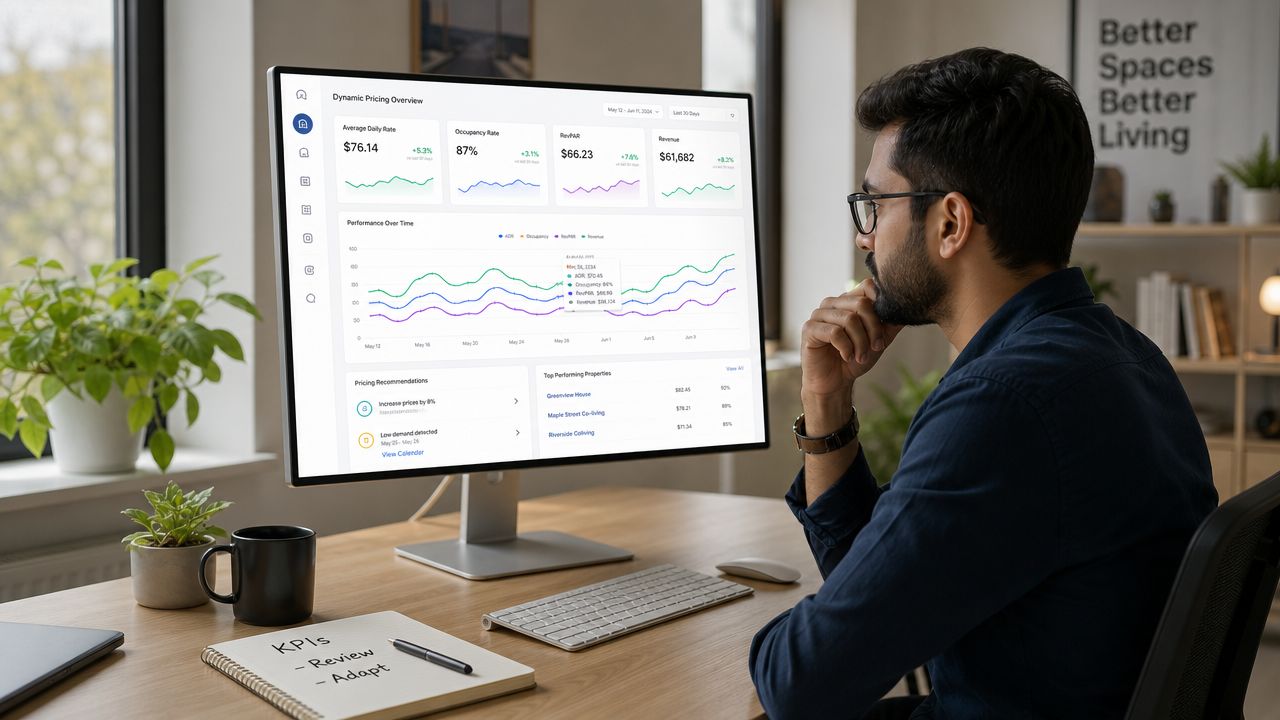
Once your rules or models are live, you need to watch whether they're improving performance. For co-living, that usually means keeping a close eye on occupancy, leasing velocity, revenue per available room, and overall NOI. You don't need to stare at dashboards all day, but you do need a regular review rhythm.
What to look for after pricing changes
A pricing strategy is moving in the right direction when you see patterns like these:
- Occupancy stays healthy: Price increases aren't creating avoidable vacancy.
- Lease-up time improves: Problem rooms fill more predictably.
- Revenue quality improves: You're not relying on broad discounts to keep rooms moving.
- House-level results make sense: Better room pricing translates into stronger NOI, not just prettier listing numbers.
Why review matters
Sometimes the price is fine but the listing, photos, room condition, or response speed is the main issue. Dynamic pricing works best when operators interpret it as one tool inside a larger leasing system.
That's also why modern platforms matter. They can automate the pricing work, but they also make it easier to monitor outcomes, compare houses, and spot where your assumptions were off. For independent operators, that closes the gap with larger revenue-management teams.
Good operators don't ask whether the algorithm changed the price. They ask whether the change improved the business.
If you stay disciplined, dynamic pricing becomes less stressful over time. You stop guessing. You start learning. And your portfolio gets more resilient because each pricing decision is tied to actual operating conditions, not habit.
PadPulse is building an all-in-one platform for PadSplit hosts and co-living operators who want to fill vacancies faster, save time, and improve NOI. If you want updates on its planned dynamic pricing, AI messaging, smart-home integrations, and portfolio reporting tools, join the PadPulse interest list.