How to Price Rooms for Rent: Maximize Your Income
April 30, 2026
Pricing rooms in a shared house usually starts with a deceptively simple question. You’ve got a property, a mortgage, a few bedrooms, and a listing draft open on your laptop. Then the hard part hits. Should every room cost the same? Should the bigger room get a premium? What do you do with the room near the front door, or the one with the private bath?
Most new operators answer that question like roommates do. They try to make the split feel fair. That mindset leaves money on the table.
If you want to learn how to price rooms for rent as an operator, not just as a homeowner filling space, you need a different lens. Each room is its own product. Each vacancy has a cost. Each pricing decision affects occupancy, churn, and NOI.
Moving Beyond Equal Slices of the Pie
A four-bedroom house can fool you.
On paper, it looks like one rental. In practice, it’s four separate revenue units sharing one roof. That difference matters. The owner who divides the total house rent by four usually undercharges the best room, overcharges the weakest room, and creates avoidable vacancy.
Take a common setup. One bedroom has an en-suite bath. Another is larger and gets great natural light. A third sits near the kitchen and gets more foot traffic. The smallest room has no real workspace. Pricing those rooms equally feels tidy, but it ignores how renters actually choose.
The better approach is to stop thinking like a roommate and start thinking like an operator. Premium rooms should carry premium pricing. Standard rooms should anchor the property. Value rooms should move fast and protect occupancy.
That shift changes the whole business.
Instead of asking, “What’s fair?” ask:
- What does this specific room compete with in the local market?
- What vacancy risk does this room carry at a given price?
- What rent mix gives the house the best NOI, not just the nicest spreadsheet?
Equal pricing is simple. Simple pricing is often expensive.
That’s why room-by-room operators who grow sustainably treat the property like a small portfolio. They track each room’s demand, features, and leasing speed. They also tighten operations around that model, which is where strong co-living property management systems start to matter.
If you price each room intentionally, the house starts behaving less like a spare-bedroom side hustle and more like a revenue engine.
Laying the Foundation with Market Research
Most pricing mistakes happen before the listing goes live. Owners either copy a nearby listing blindly or anchor to what they hope the property should earn.
Neither method holds up.
According to rental pricing guidance on comparable properties and seasonal demand, comps analysis is the foundation for setting rent. The practical version is straightforward. Find similar properties in the same or comparable neighborhoods, compare size, layout, and features, and adjust for differences like furnishing, finishes, and amenities. The same guidance also notes that operators should look at who rents rooms locally, how long they tend to stay, and what they value, while factoring in stronger spring and summer activity.

Start with room-level comps, not city averages
If you’re pricing a room, broad metro rent averages won’t save you. You need hyper-local room comps.
Use listing platforms that show room rentals and shared housing inventory. Search for rooms, not whole apartments. Then narrow the field to listings that resemble your setup:
- Match the housing type. A private room in a shared house should compete with similar shared-house inventory first.
- Stay close geographically. Same neighborhood is best. Comparable nearby neighborhoods are acceptable if inventory is thin.
- Filter for similar features. Furnished versus unfurnished, private bath versus shared bath, included utilities versus separate bills.
- Watch the surrounding alternatives. Renters also compare your room to studios and one-bedrooms, especially if your premium room approaches that pricing band.
A basic spreadsheet does the job. Track the address area, asking rent, whether utilities are included, furnishing, bathroom setup, photo quality, lease terms, and anything notable about the listing.
Read the listing, not just the number
A room listed at the highest price in your area doesn’t mean you should match it. It might be sitting there because the operator missed the market.
The actual work is in the details:
- Photos tell you how well the room presents online.
- Amenity packaging tells you what’s bundled into the price.
- Lease language shows whether the listing is flexible, strict, furnished, or targeting a narrow renter profile.
- House condition often explains why two rooms with similar square footage lease at different rates.
Practical rule: A comp is only useful if you understand why it’s priced that way.
That’s especially true in room rentals, where small differences carry more weight than owners expect. A cleaner kitchen, better light, easier parking, or a furnished setup can move demand meaningfully even when the room size looks similar.
A short explainer can help if you’re newer to rental analysis:
Build a market view you can actually use
Once you’ve gathered enough listings, sort them into practical buckets instead of staring at one blended average.
Try these categories:
Premium comps
Best condition, strongest amenities, nicest presentation, or best location within your submarket.True peers
Listings that look like your real competition. Similar house style, room type, and target renter.Discount inventory
Weaker rooms, poor presentation, older interiors, or listings that appear priced to fill quickly.
This gives you a usable pricing frame. You’ll know where your rooms belong before you get emotional about the number.
A final point that beginners often miss. Seasonal timing matters. The same room can support stronger pricing when local activity picks up, and it may need sharper positioning when demand cools. Good operators don’t ignore seasonality. They build around it.
Calculating Your Base Costs and Target Profit
Market rent matters. Your cost structure matters just as much.
A room that looks “competitive” can still be a bad business decision if the house isn’t covering its real operating load. New operators usually count the mortgage, maybe utilities, and stop there. That’s too thin for room-by-room rentals, where turnover and shared-house wear are part of the model.
Start with the full property picture. Include mortgage, taxes, insurance, utilities, internet, cleaning, repairs, supplies, lawn care, pest control, turnover work, and reserves for larger replacements. Then convert those property-level costs into a room-level baseline so you know the minimum revenue the house needs before it produces acceptable NOI.
All-inclusive pricing needs honest math
Room rentals often win by being simpler for the resident. One payment. Utilities included. Wi-Fi included. Sometimes cleaning included too.
That convenience helps leasing, but only if you price it correctly. If you treat included services like free perks, your margins will drift downward without you noticing.
Use a simple internal breakdown like this:
- Fixed housing costs such as mortgage, taxes, and insurance
- Shared operating costs such as internet, utilities, and cleaning
- Turnover-related costs such as repainting, lock resets, and make-ready supplies
- Reserve allocation for the things that aren’t monthly, but still happen
Then divide those costs across the house in a way that reflects how the property operates. Some costs are spread across all rooms. Others should weigh more heavily on premium rooms if those rooms consume more value and carry stronger pricing power.
Smart amenities can improve both rent and operations
Operators often underprice shared amenities because they think renters only pay for square footage. That’s not how room renters shop.
According to guidance on rent splits and amenity value in co-living, smart-home co-living properties can achieve 10% higher rents and lower tenant churn, 15% versus 25%, and smart thermostats can cut utility bills by 15%. That combination matters because it affects both sides of the equation. Higher achievable rent and lower operating drag.
That’s why features like these deserve a line in your pricing model:
- Keyless smart locks for simpler access control
- Smart thermostats for HVAC efficiency and easier monitoring
- Reliable Wi-Fi because many residents work or study from home
- Regular cleaning of shared areas because it protects reviews and reduces friction
- Furnished rooms when your local renter profile values move-in-ready housing
If an amenity helps leasing speed, supports retention, or lowers operating costs, it belongs in your pricing logic.
For the financial side, it helps to keep these assumptions and allocations in one place. Even a small operator benefits from better tracking. If you need a cleaner back office, this roundup of accounting software for rental properties is a useful starting point.
Set a target, not just a floor
Once you know your costs, don’t stop at break-even. Break-even pricing fills rooms and still leaves you wondering why the property feels busy but not profitable.
Set a target NOI range for the house. Then ask whether each room contributes appropriately to that target based on its quality and leasing risk. A premium room should do more heavy lifting. A weaker room may need to protect occupancy.
That’s the trade-off. Some rooms maximize rate. Some rooms maximize stability. Good pricing respects both.
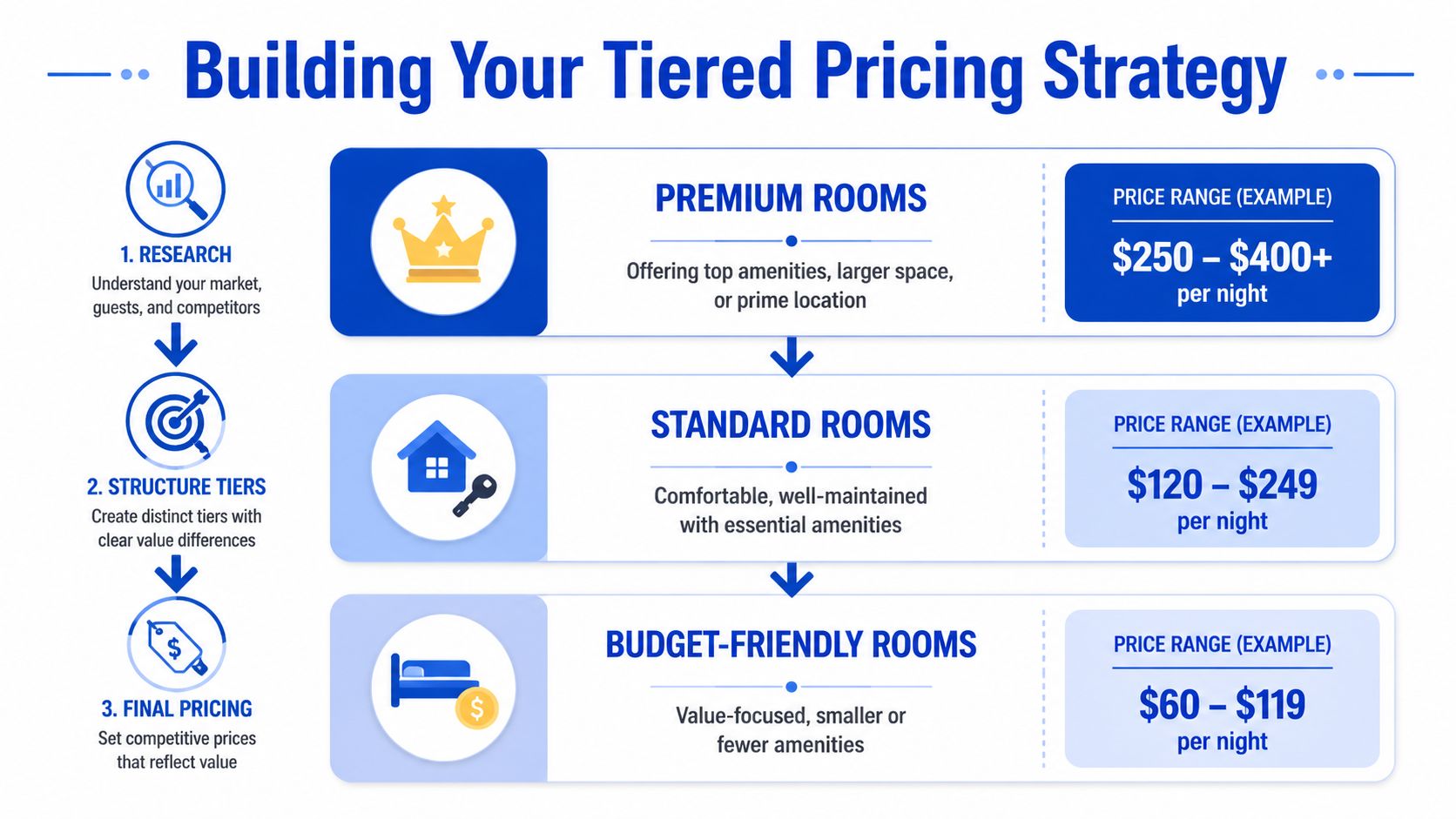
Building Your Tiered Pricing Strategy
At this stage, room pricing becomes operational.
Flat splits ignore value differences inside the house. Tiered pricing turns those differences into a repeatable system. You’re no longer guessing what the big room should rent for. You’re assigning value based on measurable features and then checking that result against the market.
According to Azibo’s rental rate guidance, a room-specific pricing formula starts with surface area plus a utility factor. The room’s share of total private square footage creates the base allocation, then you apply premiums such as +10% to 20% for a private bath and +5% for better window size or light. That same source notes this method can produce 12% to 18% higher per-room revenue versus flat splits because it captures the value of premium features.
Build the base rent by room size
Start with only the private rooms. Don’t include common areas in this step.
Measure each bedroom and calculate each room’s share of the total private bedroom square footage. That gives you a rational base split before adjustments.
Example workflow:
- Estimate what the house needs to earn overall.
- Total the square footage of all rentable bedrooms.
- Divide each room’s square footage by that private-room total.
- Apply that percentage to your target gross room revenue.
This doesn’t finish the job. It gives you the baseline.
Add modifiers for real renter preferences
Next, apply room-specific modifiers that reflect actual demand.
Common positive modifiers include:
- Private bathroom because privacy changes willingness to pay
- Better natural light if the room feels larger and photographs better
- Furnishing package if your market prefers move-in-ready rooms
- Better layout such as space for a desk or easier furniture placement
Possible negative modifiers include:
- High noise exposure near living areas or the street
- Weak storage
- Shared bathroom with more residents
- Awkward shape or limited usability
Not every modifier needs to be formalized in the same way. Some operators use fixed dollar adjustments. Others use percentage lifts. The important thing is consistency.
The tenant doesn’t compare your rooms to each other first. They compare each room to every other option they can rent.
That’s why I prefer a tier system after the formula. It keeps the pricing legible for both the operator and the renter.
Turn the formula into pricing tiers
Once you’ve scored the rooms, group them into tiers. This makes your listings cleaner and your pricing easier to manage.
A simple house-level structure might look like this:
Premium rooms
Largest rooms, strongest privacy, best light, en-suite bath, or superior layout.Standard rooms
Solid rooms with no major weakness and no standout premium feature.Budget-friendly rooms
Smaller rooms or rooms with location or layout drawbacks that should lease faster at a sharper price.
Here’s a sample framework you can adapt.
| Room | Base Rent % | Features | Modifier | Final Monthly Rent |
|---|---|---|---|---|
| Room A | Based on private square footage share | En-suite bath, best light, largest layout | Upward modifier for premium features | Set at top of your validated comp range |
| Room B | Based on private square footage share | Standard size, shared bath, good layout | Minimal adjustment | Set near middle of peer comp range |
| Room C | Based on private square footage share | Smaller footprint, near common area | Downward modifier for weaker positioning | Set to lease quickly against discount comps |
| Room D | Based on private square footage share | Furnished, strong storage, shared bath | Upward modifier for furnishing and function | Set above standard tier if comps support it |
Validate before you publish
After the internal formula, go back to the market. Compare each room to your comp buckets. If your premium room prices above what the local market rewards, trim it. If your best room is priced like average inventory, raise it.
What works is a blend of three things:
- your cost floor
- your room-level value logic
- your real comp validation
What doesn’t work is choosing a house total first and forcing each room to fit the math.
Optimizing and Adjusting Your Rental Rates
A good initial price is only a starting point.
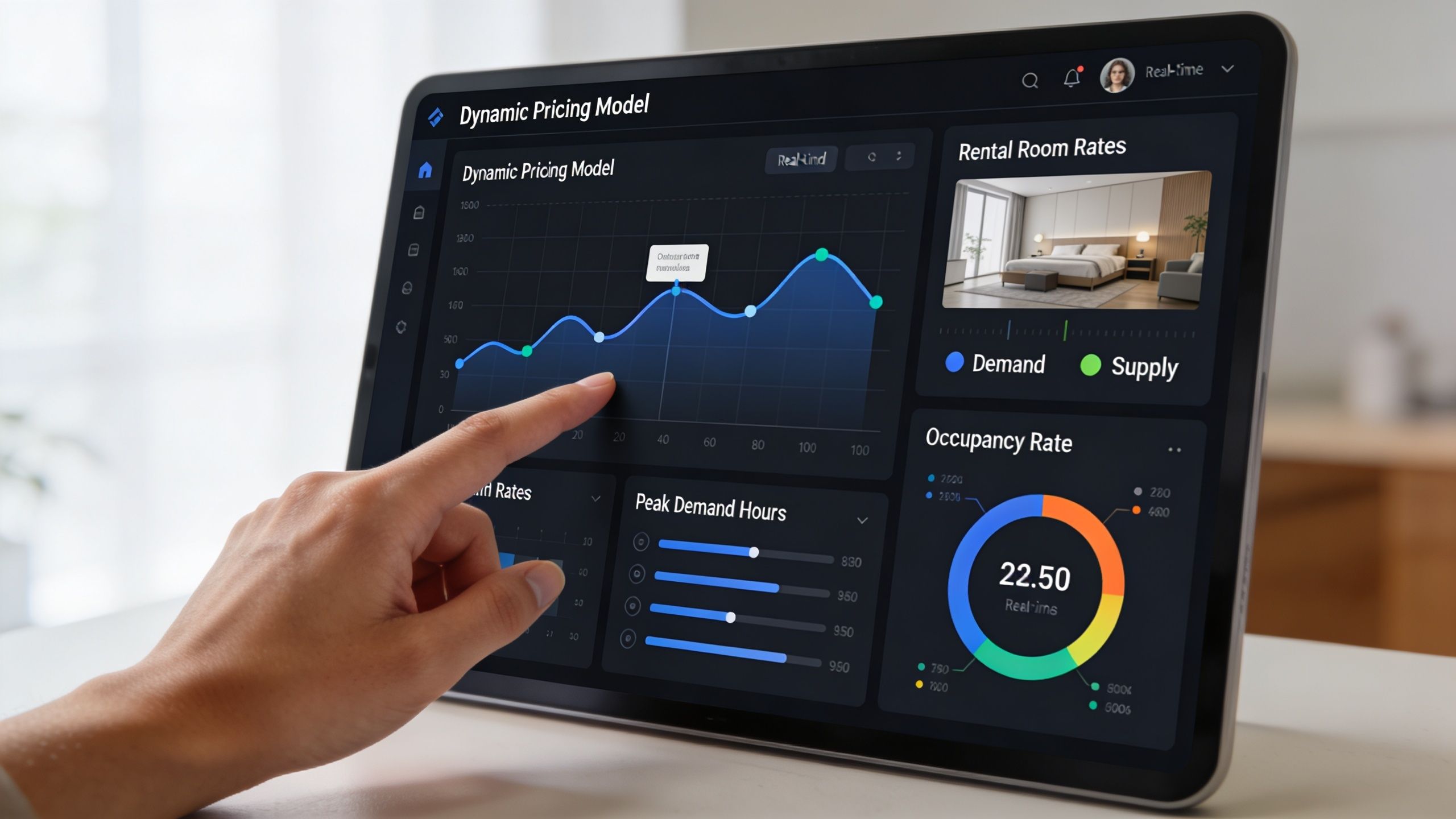
Room rentals move faster than many traditional leases. Turnover is higher, renter demand shifts quickly, and room-level performance tells you when your pricing is off. Operators who leave rates untouched for months usually learn about pricing problems through vacancy, not through data.
According to PadSplit room pricing examples and co-living occupancy guidance, pricing rooms requires dynamic, weekly adjustments to maximize NOI. That source notes that maintaining 70% to 80% occupancy via dynamic pricing can lift NOI by 15% to 25%, and it also presents a contrarian strategy of pricing 10% to 20% below market to support near-90% occupancy. It further notes that vacancy can cost hosts $200 to $500 per week per room in major U.S. markets.
Watch the right signals
Most owners focus on one metric. Asking rent.
Operators watch a cluster of signals instead:
- How quickly new listings generate inquiries
- How many tours each room gets
- Which room types stall
- How long a room sits compared with the rest of the house
- What happens after a price change
A premium room can sit longer and still be fine if the margin justifies it. A weak room cannot. That room needs velocity.
Use weekly pricing reviews
Weekly review cycles are practical for room-by-room rentals because the leasing feedback arrives fast. You don’t need a complicated revenue-management department. You need a habit.
A strong weekly review asks:
- Did this room get enough attention?
- Are inquiries turning into tours?
- Are tours turning into applications?
- Is this room priced correctly for today’s demand, not last month’s?
If the property is full and incoming demand stays strong, test increases on the next opening. If multiple rooms drag, your market has spoken. Respond early.
Decide whether you want peak rate or stronger occupancy
Pricing gets strategic.
Some operators chase the highest possible rent on every room. Others price a bit below the market ceiling to keep occupancy steadier. Neither is universally right. It depends on your house, turnover profile, and management capacity.
The practical trade-off looks like this:
| Approach | Best for | Main risk |
|---|---|---|
| Higher asking rents | Premium inventory, low-vacancy submarkets, standout properties | Longer vacancy if demand softens |
| Slightly below top-of-market pricing | Faster fills, smoother occupancy, simpler operations | Leaving some upside on the table |
| Frequent micro-adjustments | Operators who track data closely | Requires discipline and systems |
Price is not a badge of honor. Price is an operating decision.
If you want help managing that process at scale, especially across multiple rooms or houses, it’s worth reviewing dedicated short-term rental pricing tools and repricing workflows. The tooling is evolving, but the principle is stable. Fast feedback beats stubborn pricing.
Marketing Your Rooms to Attract the Right Tenants
A strong price still fails if the listing doesn’t explain the value.
At this stage, many operators break the chain. They research the market, build a good rate sheet, then publish a weak listing with dim photos, vague copy, and no clear explanation of why Room A costs more than Room C. Renters won’t do that work for you.
Sell the package, not just the room
If a room is premium, say why. If it’s value-priced, say what makes it practical.
Good room listings usually do four things well:
- Lead with the strongest differentiator such as private bath, furnished setup, or included utilities
- Describe the living experience including shared spaces, storage, parking, or workspace
- State what’s included clearly so renters understand the total offer
- Match the target tenant profile without crossing legal lines
Write plainly. “Private furnished room with strong natural light, shared kitchen access, and utilities included” works better than fluffy language.
Let early response guide your pricing
One of the best anti-vacancy rules is brutally simple.
According to this data-driven rent pricing method, the First Week Rule says that if you don’t secure 2 to 3 tours in the first week, you should drop the price by 5% to 10% immediately. The same source says 70% of owners overprice initially and end up renting 20% to 30% below their original target after suffering 2 to 4 weeks of vacancy.
That’s the cost of waiting for the market to “come around.”
If a room gets little traction in the first week, the listing is usually telling you the truth about the price.
Protect yourself while you market
Pricing strategy also needs legal discipline.
Don’t create modifiers tied to protected classes. Price the room based on features, condition, and market position. Then make sure the lease states exactly what the rent includes, how shared amenities work, and what house rules govern common areas.
That combination matters. Clear pricing attracts better-fit applicants. Clear terms reduce disputes after move-in.
If you treat marketing like part of pricing, not something separate, your rooms fill faster and with less drama.
PadPulse is building an all-in-one platform for PadSplit hosts and co-living operators who want tighter pricing, faster leasing, and clearer NOI tracking. If you want updates on its Winter 2026 launch, dynamic pricing tools, smart-home integrations, and early beta access, join the interest list at PadPulse.