Master Co Living Property Management 2026
April 24, 2026
If you're running a co-living house with a spreadsheet for rent, text threads for maintenance, and a bowl of spare keys by the door, you're not alone. Most small operators start there. It works for a while, right up until one room turns over, another resident has a guest issue, a thermostat gets changed, and someone wants to move in this weekend.
That's when co living property management stops feeling like regular landlording and starts feeling like operations. You're not managing one lease and one household. You're managing multiple residents, shared spaces, staggered move-ins, room-level pricing, and a constant flow of communication.
The opportunity is real, which is why more operators are moving into this model. The global co-living market was valued at approximately USD 10.95 billion in 2024 and is projected to reach USD 27.90 billion by 2030, driven by urbanization, higher urban living costs, and remote and hybrid work demand for flexible shared housing, according to Next Move Strategy Consulting's co-living market outlook.
The operators who do well aren't always the ones with the nicest homes. They're the ones who build repeatable systems. They price rooms intentionally, onboard residents cleanly, enforce house rules early, and use the right tools to cut down the manual work.
The New Rules of Co-Living Property Management
Traditional rental management rewards stability. Co-living rewards coordination.
With a standard rental, you can afford a slower rhythm. One tenant signs, pays, stays, and maybe renews. In a co-living house, everything happens at room speed. One resident moves out while another tours. A bathroom issue affects three people, not one. A bad fit between housemates can become an occupancy problem if you ignore it.
Why this model feels harder at first
Most new hosts underestimate the operational density. The property may be the same building, but the management load changes fast.
A few examples show the difference:
- Leasing gets fragmented: You're filling rooms individually, often on different timelines.
- Communication multiplies: One appliance issue can generate messages from several residents.
- Turnover becomes routine: Move-ins and move-outs happen more often than they do in a whole-home lease.
- Shared spaces need active management: Kitchens, bathrooms, laundry, and quiet hours don't run themselves.
Practical rule: If a process depends on you remembering it, it will eventually fail during turnover.
The new rule is simple. Treat the house like a small operating business, not a passive rental.
What actually changes for the operator
The shift isn't just about workload. It's about where the risk lives.
In a traditional rental, vacancy is mostly unit-level. In co-living, risk moves into the gaps between your systems. Weak screening creates conflict. Slow response times create churn. Manual access handoffs create delays. Flat pricing leaves money on the table in strong demand periods and slows fills in weak ones.
That means good co living property management is less about heroic effort and more about controlled workflows. The best small operators get disciplined about a few things early:
- One source of truth for occupancy
- Clear resident communication rules
- A standard onboarding routine
- Documented turnover steps
- Room-level financial tracking
What beginners usually get wrong
The most common mistake is managing a co-living property like a slightly busier single-family rental. It isn't.
Another mistake is over-focusing on branding and under-focusing on operations. Nice furnishings matter. Community matters. But if your room listings are inconsistent, your move-in instructions are unclear, and your maintenance follow-up is sloppy, residents will feel that long before they appreciate your decor.
Co-living succeeds when residents experience clarity. They need to know how to pay, how to enter, how to report issues, what the rules are, and what happens next.
That operational clarity is what protects occupancy, reduces friction, and makes the model scalable.
Understanding the Co-Living Business Model
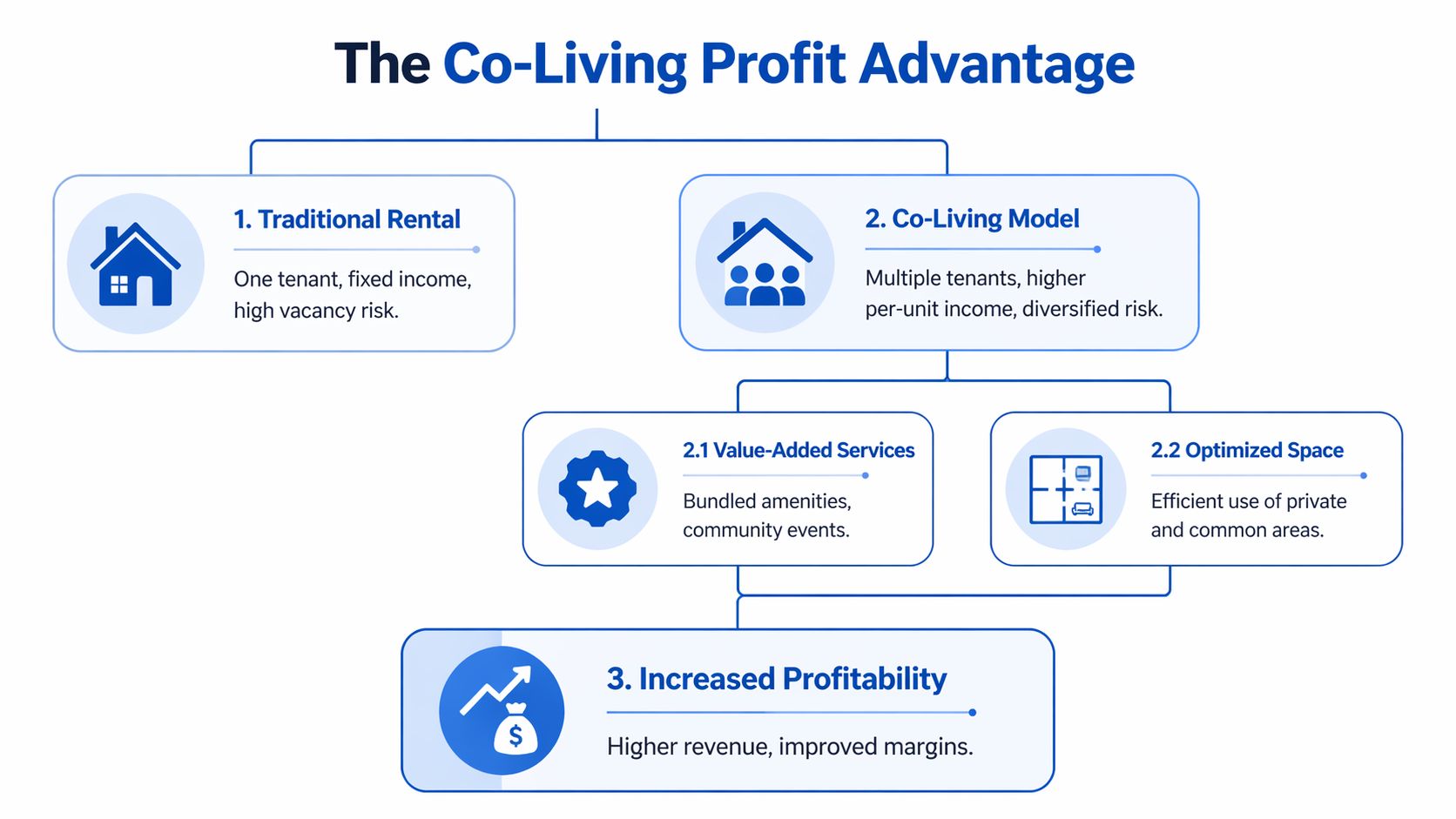
The easiest way to understand co-living economics is this. A traditional rental sells the house in one large piece. Co-living sells it by the slice.
When you rent a house to one household, you have one income stream. If that tenant leaves, the whole property goes vacant. In a co-living setup, you rent rooms individually. One resident can move out without shutting off all income from the property. That one change is why the model attracts so much attention from operators.
Co-living properties can produce an average annual ROI of 22.3%, which is 35% higher than conventional investments, with outperformance tied to renting rooms individually and capturing 25% to 40% higher per-square-foot rents, according to this co-living investment ROI analysis.
Why room-by-room leasing changes the math
In practice, the business model has three strong advantages.
First, income gets diversified. A vacant bedroom hurts, but it doesn't zero out the house. That gives the operator more resilience and more time to refill the room without panic pricing.
Second, revenue rises at the property level. The house may be the same square footage, but the income strategy changes. A furnished bedroom in a well-run shared home often supports more total revenue than a single whole-home lease.
Third, bundled living commands a premium. Residents aren't only paying for a room. They're paying for a simple, ready-to-live setup that often includes utilities, internet, furnishings, and shared amenities.
Where the premium comes from
Beginners sometimes assume co-living earns more only because there are more tenants. That's incomplete. The premium comes from convenience and packaging.
Residents value:
- Predictable monthly costs: All-inclusive pricing reduces bill splitting and household friction.
- Move-in speed: Furnished rooms and flexible terms lower the barrier to signing.
- Usable shared spaces: A well-managed kitchen, living area, and laundry setup make the house feel functional rather than crowded.
- Built-in community: Not every resident wants events, but most want a house that feels orderly and socially livable.
A co-living house earns more when it feels easier to live in than the alternatives nearby.
The trade-off most hosts learn later
Higher gross revenue doesn't automatically mean easy money. Co-living usually brings more leasing activity, more resident coordination, and more turnover touchpoints. If you don't tighten operations, the extra revenue can get eaten up by vacancy gaps, cleaning delays, poor pricing, or management time.
That trade-off matters. The model works best when the operator respects both sides of the equation:
| Model | Revenue pattern | Vacancy exposure | Operational load |
|---|---|---|---|
| Traditional rental | One lease, fixed income | Whole property at risk | Lower |
| Co-living | Multiple room incomes | One room at a time | Higher |
For small and mid-sized operators, that's the main opportunity. You're not just buying a property. You're building a room-by-room income system.
Mastering Core Operational Workflows
A co-living house usually does not get into trouble because of one big mistake. It slips because five small tasks get handled differently every time. A showing gets booked by text, the house rules sit in an email nobody reads, the cleaner is called too late, and the next resident cannot get in on time. That operational slippage shows up in the numbers fast. More vacant days. More refund requests. More management hours for the same property.
For small and mid-sized operators, the job is to turn daily activity into a system. Every core workflow should do two things at once: keep the house stable and protect NOI. If a process does not reduce vacancy, cut labor, prevent damage, or improve retention, it probably needs to be simplified.
Attracting and onboarding the right residents
Bad fit is expensive.
The first operational filter is the listing itself. A strong room listing does more than fill inquiry volume. It pre-qualifies the right resident by making the living setup clear. Show the room, but also spell out the house rhythm: furnished or not, what is included, how shared spaces are used, guest expectations, cleaning norms, parking, work-from-home suitability, and lease flexibility. Ambiguity gets you more messages. Clarity gets you better applications.
Screening in co-living also has a different objective from standard leasing. Income and credit still matter, but so do communication habits, schedule fit, and willingness to follow shared-house rules. One difficult resident can push out two good ones. That is not a soft issue. It affects occupancy and re-leasing speed.
A clean onboarding sequence closes the gap between signed lease and stable move-in. We want every resident to receive the same information in the same order so nothing relies on memory.
| Step | Task | Status |
|---|---|---|
| 1 | Confirm room selection and lease details | Pending / Complete |
| 2 | Collect required documents and signatures | Pending / Complete |
| 3 | Send house rules and shared-space expectations | Pending / Complete |
| 4 | Confirm move-in date and arrival window | Pending / Complete |
| 5 | Provide access instructions | Pending / Complete |
| 6 | Share utility, Wi-Fi, and amenity information | Pending / Complete |
| 7 | Introduce maintenance request process | Pending / Complete |
| 8 | Document room condition at move-in | Pending / Complete |
That checklist does more than keep the admin tidy. It reduces move-in friction, cuts avoidable questions, and lowers the odds of a resident starting their stay confused or frustrated.
Running the house day to day
Daily operations need a rhythm residents can predict. Houses run better when communication, cleaning, maintenance, and rule enforcement happen through one repeatable system instead of scattered messages and exceptions.
A practical operating baseline looks like this:
- Shared-space standards: Set simple rules for kitchen cleanup, trash, storage, quiet hours, and guests.
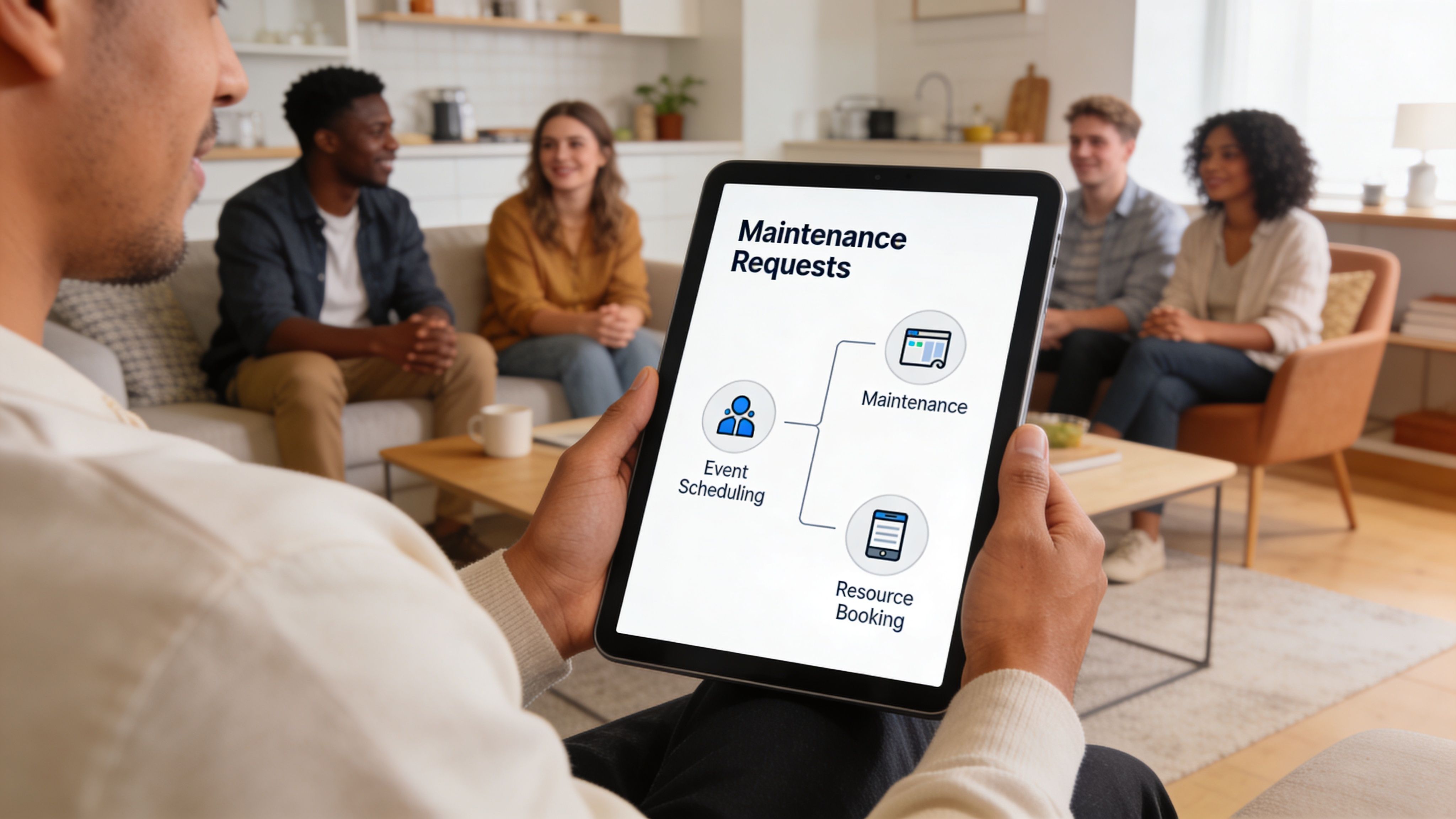
- Maintenance intake: Use one request channel so issues are tracked, assigned, and closed.
- Routine checks: Walk common areas on a schedule and catch drift before residents complain.
- Consistent messaging: Send short, clear updates only when action is required.
The trade-off is real. Over-managing creates friction. Under-managing creates disorder, which is more expensive. The middle ground is visible standards and quick follow-through.
Residents usually accept firm house rules. They get frustrated by uneven enforcement.
This is also where disconnected tools start to hurt. If leads live in one inbox, leases in another app, locks in another dashboard, and maintenance in text threads, the operator becomes the integration layer. That works at one house for a while. It breaks at two or three. The better model is centralized control, the same logic used in systems that synchronize inventory and availability across channels. If you want a useful parallel, this explanation of how an Expedia channel manager centralizes rates and bookings shows why one source of truth matters once you are managing multiple units or room types.
Handling turnover without chaos
Turnover is where co-living profit gets protected or lost. Every extra day between residents pulls down RevPAR. Every delayed clean, missed inspection, or slow listing refresh eats into NOI.
The workflow has to start before the room is vacant.
- Get notice in writing early. Verbal heads-up is not enough for scheduling and remarketing.
- Pre-market the room before move-out if your rules and local laws allow it. That shortens vacancy gaps.
- Book cleaning and inspection before the resident leaves. Vendor delays are one of the easiest ways to lose days.
- Reset access immediately after move-out. Old credentials create risk and confusion.
- Repost and update the listing as soon as the room is rent-ready. Stale listings cost inquiry momentum.
Operators who treat turnover like a project instead of a checklist usually lose time in handoffs. Leasing assumes ops booked the clean. Ops assumes access was reset. Nobody confirms the room is ready to show.
Later in the process, video can help operators visualize where these handoffs tend to break.
Access control deserves special attention because it touches leasing speed, security, and labor at the same time. Self-showing and remote credential management can remove a lot of dead time, but only if they are tied to the rest of the workflow. The National Multifamily Housing Council has reported broad adoption of smart home technology across rental housing, including electronic access control, because operators use it to improve both resident experience and property operations, as covered in its research on renter preferences and smart apartment technology.
The practical lesson is simple. Faster handoffs win. The operators who fill rooms quickly are usually not better salespeople. They are better at turning notice, cleaning, access, listing updates, and follow-up into one controlled process.
Advanced Strategies to Maximize Occupancy and Revenue
Once the house is stable, the next step is to stop treating every room like the same product. They aren't the same. A larger room, a quieter room, and a room with a private bath shouldn't all be priced by habit.
Static pricing is one of the easiest ways for small operators to underperform. It feels simple, but it ignores demand swings, room differences, and booking speed. In co living property management, rate discipline matters because a vacant room isn't just empty space. It's lost revenue that often drags into the next leasing cycle.
Price rooms like distinct inventory
Think more like a hospitality operator than a traditional landlord. Each room has attributes, timing, and demand conditions.
A practical pricing approach includes:
- Room-based premiums: Charge more for en-suite baths, better light, corner rooms, or larger layouts.
- Seasonal adjustments: Don't assume the same demand in every month.
- Lead-time decisions: If a room hasn't moved, the market may be telling you the price is wrong.
- House-level balance: Sometimes filling the last hard-to-place room protects total income more than holding out for a perfect rate.
This is the same logic channel managers use in travel and short-term inventory. If you want a simple parallel, this overview of how an Expedia channel manager works is useful because it shows why centralized pricing and availability matter when inventory moves quickly.
Add revenue without pushing base rent too hard
Not every gain has to come from headline rent. Good operators build optional, useful add-ons that fit the house.
Common examples include:
- Reserved parking
- Storage space
- Premium furnishings in select rooms
- Guest stay policies with clear fees where permitted by your model
- Small convenience upgrades tied to specific rooms
The point isn't to nickel-and-dime residents. It's to separate core housing from optional value. That protects affordability on your standard rooms while still letting you monetize demand where it exists.
If every revenue problem gets solved by raising rent, you're probably ignoring the rest of your product mix.
Occupancy beats stubbornness
Many hosts get emotionally attached to an asking price. The market doesn't care. If a room sits, your real competitor isn't the last rent you charged. It's the next available option a prospect can move into today.
Strong operators review pricing in context. They look at inquiries, time-to-fill, room features, and competing inventory. Then they adjust. That's how you protect occupancy without giving away value.
Leveraging Technology for Efficiency and Security
Technology helps in co-living only when it removes a real operational bottleneck. Buying devices without a workflow behind them usually adds complexity. The useful stack is the one that cuts manual steps, reduces resident friction, and gives you cleaner control over the house.

Smart locks solve more than key problems
Physical keys are one of the first things small operators outgrow. They slow down self-showings, create access risk during turnover, and make staff coordination harder.
Smart locks are useful because they let you control access by person and by timing. That matters when different residents move in on different days, cleaners need temporary entry, or vendors need one-time access.
They also pair well with faster leasing workflows. Instead of coordinating every showing manually, you can support guided access with tighter control.
Smart thermostats and messaging systems remove repeated work
Shared housing creates utility waste when nobody owns the whole bill psychologically. Residents leave windows open, change temperatures, or heat and cool empty rooms. Smart thermostats give operators more visibility and more consistent control.
Messaging is the other major drag. Co-living generates a lot of repetitive communication. Prospects ask the same questions. New residents need the same move-in details. Existing residents need reminders about payments, maintenance, and house rules.
A specialized co-living PMS can connect those pieces. According to this research on specialized co-living property management software, these systems enable dynamic per-bed pricing and can result in 25% to 40% higher NOI. The same research notes integrations for smart locks and thermostats, says thermostats can reduce HVAC costs by 30%, and reports that AI messaging workflows can resolve 70% of inquiries autonomously, freeing 10 to 15 hours of operator time per week.
The goal isn't more software. It's one operating system for pricing, communication, access, and property control.
Centralization is what makes the stack work
Many operators encounter this issue. They have one app for locks, another for thermostat settings, spreadsheets for pricing, and text messages for resident communication. Each tool works on its own. The portfolio still feels messy.
A centralized platform matters because co-living problems overlap. Pricing affects occupancy. Occupancy affects access setup. Access setup affects onboarding. Onboarding affects resident experience and retention.
If you're already stitching together calendars across systems, it's worth understanding the operational logic behind calendar sync for rental operations. The same principle applies in room-by-room housing. One source of truth reduces mistakes.
Platforms built for this category are starting to reflect that reality. PadPulse is one example being developed for PadSplit hosts and co-living operators, with a focus on dynamic pricing, AI messaging, smart-home integrations, and portfolio analytics in one workflow.
Financial Tracking and Key Performance Indicators
Most beginner hosts track one thing. Did rent come in or not?
That isn't enough in co-living. A house can look busy and still underperform. You need metrics that show whether your rooms are priced well, your costs are controlled, and your operations are improving profit.

The three numbers that matter most
For co living property management, start with RevPAR, CPOR, and NOI.
RevPAR means Revenue Per Available Room. It tells you how much revenue each available room is producing over a period, whether occupied or not.
CPOR means Cost Per Occupied Room. It shows how much it costs to support each occupied room, which is useful in shared housing where utilities, cleaning, supplies, and maintenance move with occupancy.
NOI means Net Operating Income. It shows what the property earns after operating expenses, before financing and taxes.
Top co-living operators reach monthly RevPAR of $800 to $1,500 by using dynamic pricing, keep CPOR below $400, and often improve NOI with energy-efficient upgrades that cut utility bills by 25% to 40%, according to Coliving.com's guide to co-living economics.
How to use these KPIs in plain English
Think of the metrics this way:
| KPI | What it tells you | Why it matters |
|---|---|---|
| RevPAR | How well your inventory is earning | Catches underpricing and vacancy drag |
| CPOR | What each occupied room costs to run | Exposes waste in utilities and operations |
| NOI | What the property actually produces | Ties revenue and expenses into one profit view |
If RevPAR is soft, look first at pricing, occupancy, room positioning, and listing quality.
If CPOR is climbing, review utilities, vendor costs, consumables, cleaning patterns, and maintenance habits.
If NOI isn't improving even though the house is full, your problem is usually expense leakage or weak room pricing.
A simple dashboard beats a complicated one
You don't need an institutional reporting stack to manage one to several houses well. You need a dashboard you will review.
Track these items every month:
- Occupied rooms versus available rooms
- Rent collected by room
- Days vacant by room
- Utility and maintenance costs
- Turnover events and related expenses
- Add-on revenue such as parking or storage
- Net operating income by property
A co-living operator should be able to answer two questions quickly. Which room type earns the most, and which recurring cost keeps rising?
Software offers valuable assistance, particularly when you seek room-level visibility rather than a single property total. If you're comparing tools, PadPulse pricing gives a useful example of how operators are starting to evaluate platforms by features tied to repricing, analytics, and operational control.
The discipline matters more than the software, though. Review the same metrics on the same cadence. That's how you spot whether a pricing change worked, whether a utility upgrade paid off, or whether a specific property needs tighter house management.
Navigating Legal and Compliance Hurdles
A profitable co-living house can still become a bad business if the legal foundation is sloppy. This is the part many beginners rush through because it doesn't feel operational until something goes wrong.
A standard residential lease often doesn't cover shared living well enough. In co-living, the contract needs to reflect how the property functions. That usually means room-specific occupancy terms, clear common-area rules, guest policies, conduct expectations, cleaning responsibilities, notice procedures, and how violations are handled.
Your lease has to match the model
If you're renting by the room, your paperwork should reflect that reality.
Review your documents for practical gaps such as:
- Room assignment language: Which room does the resident control, and what spaces are shared
- House rules incorporation: Rules should be attached and enforceable, not informal
- Guest and quiet-hour policies: Shared housing needs clarity here
- Maintenance reporting process: Residents should know exactly how to submit issues
- Access and device terms: If you use smart locks or smart thermostats, disclose their use properly
Don't copy a generic lease template and hope your house rules fill the gaps. They often don't.
Zoning and occupancy are not side issues
You also need to understand local rules before you scale. Shared housing can trigger questions about occupancy limits, unrelated adults in one dwelling, parking requirements, fire safety, or classifications such as rooming house or boarding house depending on the market.
That means asking direct questions locally:
- Is this use allowed in the zoning district?
- Are there limits on unrelated occupants?
- Are there licensing or inspection requirements?
- Do parking, egress, or safety standards change under shared occupancy?
- Do your lease terms align with local landlord-tenant law?
Compliance work feels slow until it prevents a forced operational reset.
Treat compliance as part of operations
Good operators don't separate legal compliance from day-to-day management. The lease, the house rules, the occupancy plan, and the actual resident experience should all match. If your documents say one thing and your property runs another way, you'll create unnecessary risk for yourself.
This is not legal advice. It's an operator's warning. Get local counsel involved before you standardize documents across multiple houses.
Your Co-Living Scaling Playbook
The operators who scale co-living well usually make the same shift. They stop managing from memory and start managing from systems.
Keep the model simple. Fill the right rooms at the right rates. Standardize onboarding. Tighten shared-house rules. Remove key handoffs and repetitive messaging. Track room-level performance, not just total rent collected. Review your costs often enough to catch drift before it becomes a margin problem.
If you're still doing most of this manually, don't try to fix everything at once. Start with the pressure points that hit NOI first:
- Slow turnover
- Weak room pricing
- Scattered resident communication
- Poor visibility into room-by-room performance
Co living property management gets easier when each workflow supports the next one. Better pricing helps occupancy. Better onboarding reduces resident confusion. Better access control speeds turnover. Better reporting helps you decide what to improve next.
If you're preparing to run a tighter co-living operation, PadPulse is inviting early adopters to join its interest list. It's being built for PadSplit hosts and room-by-room operators who want centralized pricing, messaging, smart-home controls, and portfolio reporting without stitching together disconnected tools.