Fixed Pricing vs Dynamic Pricing: Maximize Co-living Revenue
May 31, 2026
A room sits empty longer than expected, and the question starts to nag at you. Did you price it too high, or did demand just soften this month?
That's the daily reality in co-living. You're not pricing one whole unit on a long lease. You're pricing individual rooms, often in a house where one vacancy can throw off the feel of the property and chip away at NOI at the same time. A room that lingers vacant doesn't just cost revenue. It creates more inquiries to manage, more tours to coordinate, and more pressure to react fast.
Most new hosts end up choosing between two basic approaches. Fixed pricing means you keep room rates stable for a defined period. Dynamic pricing means you adjust rates as demand changes. Neither approach is automatically better. The right choice depends on what you're trying to optimize.
In room-by-room rentals, that decision carries extra weight. You're not only balancing price and occupancy. You're also protecting resident trust, reducing turnover friction, and keeping operations manageable.
Is Your Room Pricing Leaving Money on the Table
A common host scenario looks like this. One standard room leased quickly last month at a healthy rate. Another similar room opens up this month, gets interest, but no one commits. You start second-guessing everything. Maybe the room is overpriced. Maybe your market cooled off. Maybe prospects are comparing your rate against cheaper options nearby and waiting.
Then the opposite happens. A room gets a rush of inquiries the same day it goes live. You realize you probably could've asked more.
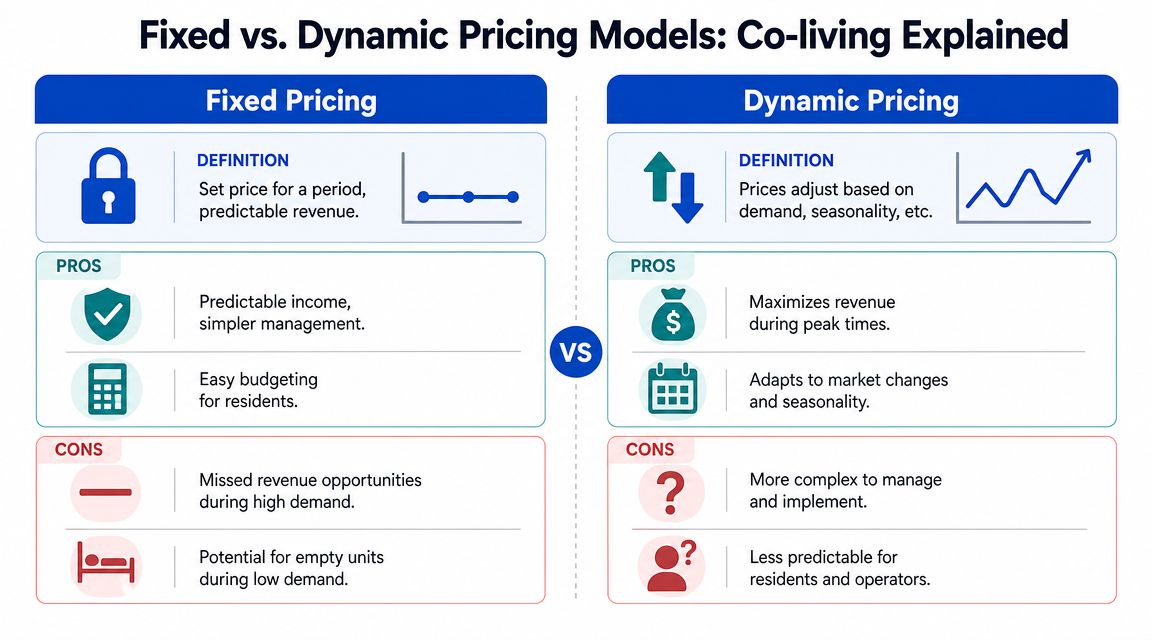
That's where fixed pricing vs dynamic pricing becomes a practical business choice, not just a theory. Fixed pricing keeps your rate steady. You might decide that a room is priced at one monthly amount and hold that rate unless you do a periodic review. Dynamic pricing changes the asking rate based on signals like current demand, local competition, booking timing, seasonality, or how long the room has been vacant.
For a co-living operator, both models solve a real problem.
- Fixed pricing helps with consistency. Residents understand the price structure, your team answers fewer pricing questions, and you don't spend all week tweaking listings.
- Dynamic pricing helps with responsiveness. You can raise rates when demand is hot and lower them when a room starts aging on the market.
- Both can fail if used blindly. Fixed pricing can leave revenue behind. Dynamic pricing can create friction if price changes feel random or too frequent.
A good pricing strategy doesn't just answer “What can I charge?” It answers “What price helps me fill the room with the right resident, at the right speed, with the least friction?”
In co-living, that last part matters more than many new hosts expect. A slightly higher asking price isn't always better if it creates longer vacancy, more back-and-forth, and weaker conversions. A slightly lower rate isn't always smarter if you're discounting rooms that would have filled anyway.
Fixed and Dynamic Pricing Models Explained
Before choosing a strategy, it helps to define both models in plain language.
| Model | How it works | Best fit | Main trade-off |
|---|---|---|---|
| Fixed pricing | You set a stable room rate for a defined period | Stable demand, smaller portfolios, simpler operations | Easier to manage, but less responsive |
| Dynamic pricing | You adjust room rates based on demand and market conditions | Volatile demand, larger portfolios, active revenue management | More revenue upside, but more complexity |
What fixed pricing looks like in co-living
With fixed pricing, you decide what each room type should rent for and keep that number stable until your next review.
A host might set one rate for a small interior room, another for a larger furnished room, and another for a room with a private bath. Those prices stay in place unless the host intentionally changes them. Residents and applicants see a clear structure, and your team doesn't need to explain why one prospect saw a different price yesterday.
Fixed pricing works well when your priorities are operational simplicity and resident confidence. If you're still learning your market, this model is often easier to run cleanly.
What dynamic pricing looks like in co-living
With dynamic pricing, the rate isn't locked. It moves based on market conditions.
That might mean raising the price for a room when nearby inventory tightens, or lowering the rate when a vacancy sits too long without applications. It can also mean adjusting for seasonal demand, local events, or booking pace. In hospitality, modern dynamic pricing systems can issue a new recommended rate every day for every future date, a shift that turned pricing into a data-driven revenue function after dynamic pricing became especially visible in airlines following U.S. deregulation in 1978.
That history matters because it shows dynamic pricing isn't a gimmick. It's a management system. The operator uses data, guardrails, and automation to make pricing more responsive than a static monthly review ever could.
If you're still getting grounded in local comps, it also helps to understand what market rate apartments mean, since room pricing often sits in relation to broader rental pricing expectations in your submarket.
The mindset difference
The biggest difference isn't just whether the number changes. It's how the operator thinks about pricing.
With fixed pricing, you're asking, “What's a fair and sustainable rate for this room?”
With dynamic pricing, you're asking, “What rate best matches current demand while still protecting occupancy and resident trust?”
Fixed pricing treats rate-setting as a scheduled decision. Dynamic pricing treats it as an ongoing operating function.
That's why the tools and habits behind each model look different. Fixed pricing rewards discipline in market review. Dynamic pricing rewards discipline in monitoring, rule-setting, and communication.
Comparing Pricing Models Across Key Business Metrics
For co-living operators, the wrong comparison is “Which model makes more money?” The better question is “Which model improves revenue without creating new problems somewhere else?”
Here's the scorecard most room-by-room hosts should use.
| Metric | Fixed Pricing | Dynamic Pricing |
|---|---|---|
| Revenue potential | More predictable, but can miss demand spikes | Higher upside when demand moves quickly |
| Occupancy and vacancy risk | Stable offer, but slower to respond when rooms linger | Can help stimulate demand when vacancies age |
| Operational workload | Lower effort, easier to explain and maintain | Requires rules, monitoring, and cleaner data |
| Member experience | Consistent and easy for residents to understand | Can feel less fair if changes seem abrupt |
| Retention impact | Supports stability and fewer pricing questions | Needs careful handling in trust-sensitive housing |
Revenue potential and NOI
Dynamic pricing's strongest argument is revenue capture. In hospitality, independent tools report 15–30% RevPAR uplift compared with static pricing periods, according to PriceLabs on dynamic pricing vs fixed pricing for hotels. That matters because RevPAR combines occupancy and rate, so the lift reflects more than just charging more. It reflects better matching of price to demand.
For co-living, the lesson is clear even if your exact setup differs from a hotel. If your market has meaningful swings in demand, a fixed rate won't fully capture strong periods and won't react quickly during weak ones.
Still, NOI is where operators should stay disciplined. A higher advertised room rate doesn't help if it leads to more vacancy days, more concessions behind the scenes, or more time spent managing stale listings.
Operator lens: Don't confuse top-line asking rent with better performance. In room-by-room rentals, filled beds and lower friction often matter more than winning the highest possible list price.
Occupancy and vacancy risk
Fixed pricing creates a cleaner market signal. Prospects know what to expect, and your leasing process stays straightforward. That can support conversion when your market is stable and your rooms are already competitively priced.
The weakness shows up when demand shifts. If a room has been vacant for too long, fixed pricing forces you into a manual decision. You either hold the line and hope demand catches up, or cut the rate after valuable time has passed.
Dynamic pricing is better at reacting early. Instead of waiting for a vacancy problem to become obvious, you can lower price strategically when booking pace slows or when local competition heats up. In practice, that makes dynamic pricing more useful in markets with event-driven, seasonal, or uneven demand.
A room-by-room operator should watch for these warning signs that fixed pricing is becoming too rigid:
- Rooms are filling inconsistently. One room type leases quickly while another sits, even when the amenities are similar.
- You keep making manual exceptions. If you're negotiating around your list price every week, your “fixed” rate probably isn't really working.
- Vacancy decisions feel late. You're adjusting only after the room has been idle longer than you're comfortable with.
Operational complexity and workload
Many hosts often underestimate the trade-off.
Fixed pricing is simpler by design. You set the rate, update listings, and review performance on a slower cycle. There's less communication overhead, fewer edge cases, and less need for software logic or pricing rules.
Dynamic pricing asks much more from the operator. As Prospyr's pricing comparison notes, fixed pricing is operationally simpler, while dynamic pricing requires better data, automation, and monitoring of pricing accuracy and system responsiveness. In co-living, that means you need confidence in your comp data, vacancy tracking, listing freshness, and the rules that trigger price changes.
If you don't have that discipline, dynamic pricing turns into chaos. Rates bounce around, your team can't explain them, and prospects lose confidence.
Member experience and retention
This is the part many revenue discussions miss.
In housing-like rentals, pricing doesn't just affect conversion. It affects trust. Brookings notes that rapid, hard-to-predict price changes can feel unfair or opaque to buyers, especially when prices can shift frequently and when systems infer willingness to pay from behavior, in its analysis of dynamic pricing and consumer protections.
That warning is highly relevant in co-living. Residents aren't buying a plane ticket. They're choosing where to live. If pricing feels arbitrary, applicants may hesitate longer, ask more questions, or move on. Existing members may also compare what newer residents are paying and form conclusions about fairness.
In room-by-room rentals, pricing strategy doesn't stop at lease-up. It shapes the tone of the house, the clarity of your messaging, and the trust residents place in management.
For that reason, many operators do best with moderated dynamic pricing, not aggressive dynamic pricing. The point isn't to squeeze every possible dollar from every vacancy. The point is to improve revenue while preserving a leasing experience people can understand.
How to Choose Your Ideal Pricing Strategy
The best pricing model depends on what kind of operation you run today, not what works in a completely different asset class.

Choose fixed pricing if simplicity is your edge
Fixed pricing usually makes sense for hosts who want stable operations and fewer moving parts.
That often includes:
- Smaller portfolios. If you only manage a few houses, manual pricing reviews may be enough.
- Steady submarkets. Some neighborhoods don't swing much month to month.
- Community-first operations. If your brand depends on transparency and straightforward pricing, fixed pricing supports that.
- Lean teams. If you don't have time to monitor rules and market shifts, don't force a more complex model.
Fixed pricing also helps when you're still learning your product. New hosts often need a clean baseline before they start optimizing. In many cases, a strong fixed system beats a sloppy dynamic one.
Choose dynamic pricing if demand is uneven
Dynamic pricing fits better when your rooms face real changes in demand and you have the ability to manage those changes intentionally.
This can be the right move when:
- Your market is seasonal. Demand clearly changes throughout the year.
- Local events matter. Nearby employers, campuses, hospitals, or event venues can create temporary demand spikes.
- You manage many rooms. More inventory gives you more reason to optimize continuously.
- You already track leasing signals closely. Good data makes dynamic pricing safer and more useful.
The key is to keep the model readable. If someone on your team can't explain why the room costs what it costs today, the strategy is too messy.
Use a hybrid approach if you want control without churn
Many co-living operators land here, and for good reason.
A hybrid model keeps a stable pricing structure by room type, then allows limited adjustments inside clear boundaries. You might hold a normal target rate most of the time, increase modestly when demand is exceptionally strong, and reduce the rate when a room stays open longer than expected.
That approach usually works better in housing-like rentals because it respects the human side of the transaction. Brookings highlights an important issue here: rapid and unpredictable price shifts can feel unfair, and the key question is when incremental revenue gets offset by inquiry friction, slower decisions, or member churn. If you want a practical framework for your own listings, this guide on how to price rooms for rent is a useful companion.
Decision check: If price changes create confusion faster than they create conversions, your pricing strategy is hurting NOI instead of helping it.
A simple way to decide
Ask yourself four questions:
- How volatile is demand for my rooms? If demand barely moves, fixed pricing often wins.
- How much vacancy pain can I tolerate? If every open room hits hard, responsiveness matters more.
- Can my operation support active pricing? Dynamic pricing needs clean execution.
- How sensitive is my resident base to fairness and predictability? In co-living, that factor matters a lot.
If you answer “stable, simple, trust-sensitive,” fixed pricing is probably the right default.
If you answer “variable, competitive, actively managed,” dynamic pricing deserves a serious look.
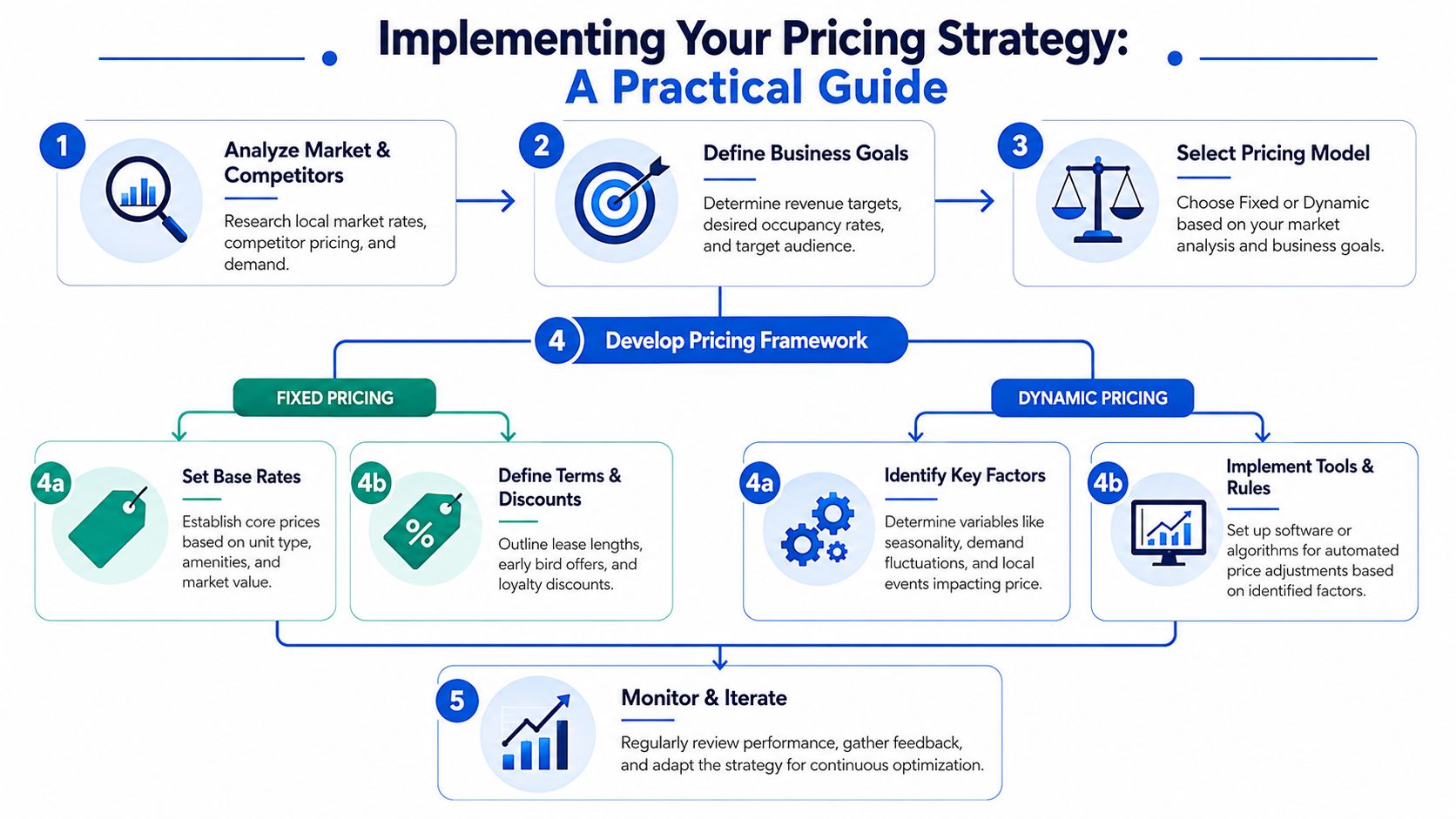
A Practical Guide to Implementing Your Pricing Strategy
Good pricing strategy falls apart when operators skip the setup work. Whether you choose fixed pricing or dynamic pricing, start with inputs that are useful.
If you use fixed pricing
Start by building a room-level pricing map for each house.
Include:
- Room differences. Size, furnishing level, bathroom access, floor location, and privacy all matter.
- House differences. Transit access, parking, neighborhood perception, and shared amenities affect willingness to pay.
- Comparable listings. Don't compare your largest room with the cheapest bare room nearby. Match like with like.
Then define a review cadence. Fixed pricing doesn't mean never changing prices. It means changes happen deliberately, not constantly.
A practical fixed-pricing routine often looks like this:
- Set a base rate by room type
- Review listing performance regularly
- Adjust when market conditions clearly change
- Keep your public pricing easy to explain
If you use dynamic pricing
Dynamic pricing needs rules before it needs software.
You need to know:
- What signals matter most. Vacancy age, inquiry volume, competitor pricing, seasonality, and local demand drivers are the common ones.
- How far rates are allowed to move. Floors and ceilings protect you from overreacting.
- Who approves changes. Even automated systems need oversight.
With technology, distractions give way to assistance. Dynamic pricing is more responsive, but it also requires quality data, automation, and monitoring, while fixed pricing remains simpler for operators who prioritize consistency over ADR and RevPAR optimization, as outlined in this breakdown of dynamic pricing tools and trade-offs.
Build a pricing framework you can actually manage
A strong framework is usually simple enough to audit.
Try this operating checklist:
- Create a base price for every room type. This is your anchor.
- Set guardrails. Define minimum and maximum acceptable rates.
- Choose trigger conditions. Decide what should cause a review or an adjustment.
- Write response rules. If a room is aging, what happens next? If demand spikes, how much flexibility do you allow?
- Track outcomes. A pricing rule is only useful if it improves results.
Keep your first version boring. A pricing system with a few clear rules is better than a complicated model nobody trusts.
Common implementation mistakes
Some errors show up again and again in room-by-room operations.
- Copying apartment pricing logic. Co-living has more turnover, more inquiries, and more sensitivity around fairness.
- Changing prices too often. If applicants see constant movement, they may wait instead of committing.
- Ignoring non-price causes of vacancy. Sometimes the issue is the listing photos, house standards, response time, or move-in friction.
- Running dynamic pricing without monitoring. Automation helps, but it doesn't remove operator responsibility.
The best setup is the one your team can explain, audit, and maintain without creating daily confusion.
Monitoring and Adjusting Your Pricing for Success
Pricing isn't a one-time decision. It's an operating habit.
What to watch
A co-living host should monitor a small set of metrics consistently:
- Occupancy rate. Are rooms filling fast enough?
- Vacancy duration. How long does each room sit before lease-up?
- RevPAR or room-level revenue output. This helps you evaluate price and occupancy together.
- Average length of stay. Short stays can create more turnover pressure.
- Member churn rate. If residents leave frequently, pricing may be part of a larger experience problem.
- Inquiry-to-move-in conversion. If interest is strong but commitments are weak, the advertised price may be misaligned.
Use different review rhythms for different models
Fixed pricing usually works with slower review cycles. You might evaluate room performance monthly or quarterly, especially if your market is stable.
Dynamic pricing needs tighter supervision. Weekly reviews are often more realistic because rates can drift away from market reality faster, and operational mistakes surface sooner.
What matters most is consistency. The same operator who carefully inspects a turnover should review pricing with the same discipline.
What adjustment looks like in practice
Say a premium room sits vacant for an extended period. Don't jump straight to the conclusion that demand disappeared.
Check the basics first:
- Is the room positioned correctly?
- Are comparable rooms leasing faster?
- Did inquiries drop, or did conversions drop?
- Has the market shifted, or is this a listing problem?
If the problem is clearly price, adjust with intent. A measured reduction is usually better than repeated small edits that make the listing look unstable. If the problem is presentation or friction, fix that first.
The best pricing operators don't react to every slow week. They look for patterns, make one smart change, and measure the result.
A strong pricing strategy should make your business calmer over time. If your pricing model creates more confusion than clarity, it needs work, even if the advertised rates look good on paper.
PadPulse is building an all-in-one platform for PadSplit hosts and co-living operators who want better pricing, faster vacancy fill, and clearer portfolio visibility. If you want updates on its planned dynamic pricing, messaging automation, smart-home integrations, and reporting tools, join the early interest list at PadPulse.