What Is a Market Rate Apartment?
May 9, 2026
A market-rate apartment is a rental unit priced by local supply and demand, not by government subsidy or rent restriction. As of May 2026, the national median rent for market-rate apartments is $1,370, which tells you the concept is simple but the pricing moves with the market.
If you're a new co-living host, this usually becomes real the moment you try to price a room and realize there isn't one obvious number to use. You look at nearby listings, compare finishes, think about transit access, and wonder whether your place should be priced like a standard apartment, a shared house, or something in between.
That uncertainty is normal. Market rate isn't a special housing program. It's the default way most rentals are priced. For a PadSplit host or room-by-room operator, understanding that difference matters because your rent strategy directly affects occupancy, leasing speed, and net operating income.
What a Market Rate Apartment Actually Is
A market-rate apartment is a non-subsidized rental unit leased at the going rate that renters in that area are willing to pay. The price is shaped by local demand, nearby comparable rentals, the property's condition, and what the unit offers.
If you've ever asked, what is a market rate apartment, the shortest answer is this: it's a rental where the owner sets rent based on the market rather than a government formula.
The easiest way to think about it
Say you own a clean four-bedroom house near jobs and transit, and you're renting the rooms individually. You don't look up a government chart to decide the rent. You study competing listings, compare bedroom size, parking, shared bathroom setup, laundry, furnishings, and lease terms. Then you set a price that matches what the local market will bear.
That's market rate.
By contrast, subsidized or income-restricted housing follows rules tied to public programs, eligibility, or regulated rent structures. Market-rate housing doesn't come with that pricing framework. It's driven by the same forces that shape most private rentals.
According to CommonBond's explanation of market-rate housing, the national median rent for market-rate apartments was $1,370 as of May 2026, with a 1.7% year-over-year decline even as it posted a third straight monthly increase. For operators, that matters because it shows rents can soften and still rise seasonally at the same time.
Practical rule: Market rate is not "whatever you want to charge." It's what a qualified renter will actually pay when they can compare your property against real alternatives.
Why new hosts often get this wrong
Beginners usually make one of two mistakes:
- They price from their mortgage payment. Your debt cost matters to you, but tenants don't rent based on your loan terms.
- They copy the nicest comp nearby. If your house doesn't match that property's location, condition, or amenities, the market won't support the same rent.
- They ignore the rental format. A room in a shared home is not the same product as a full private apartment, even if both are market-rate.
The main takeaway is simple. Market rate describes how rent is set, not whether the housing is luxury, affordable, co-living, or traditional multifamily.
The Key Factors That Determine Market Rent
Landlords don't arrive at market rent by guessing. They compare the property against real alternatives and test whether the rent supports leasing activity.
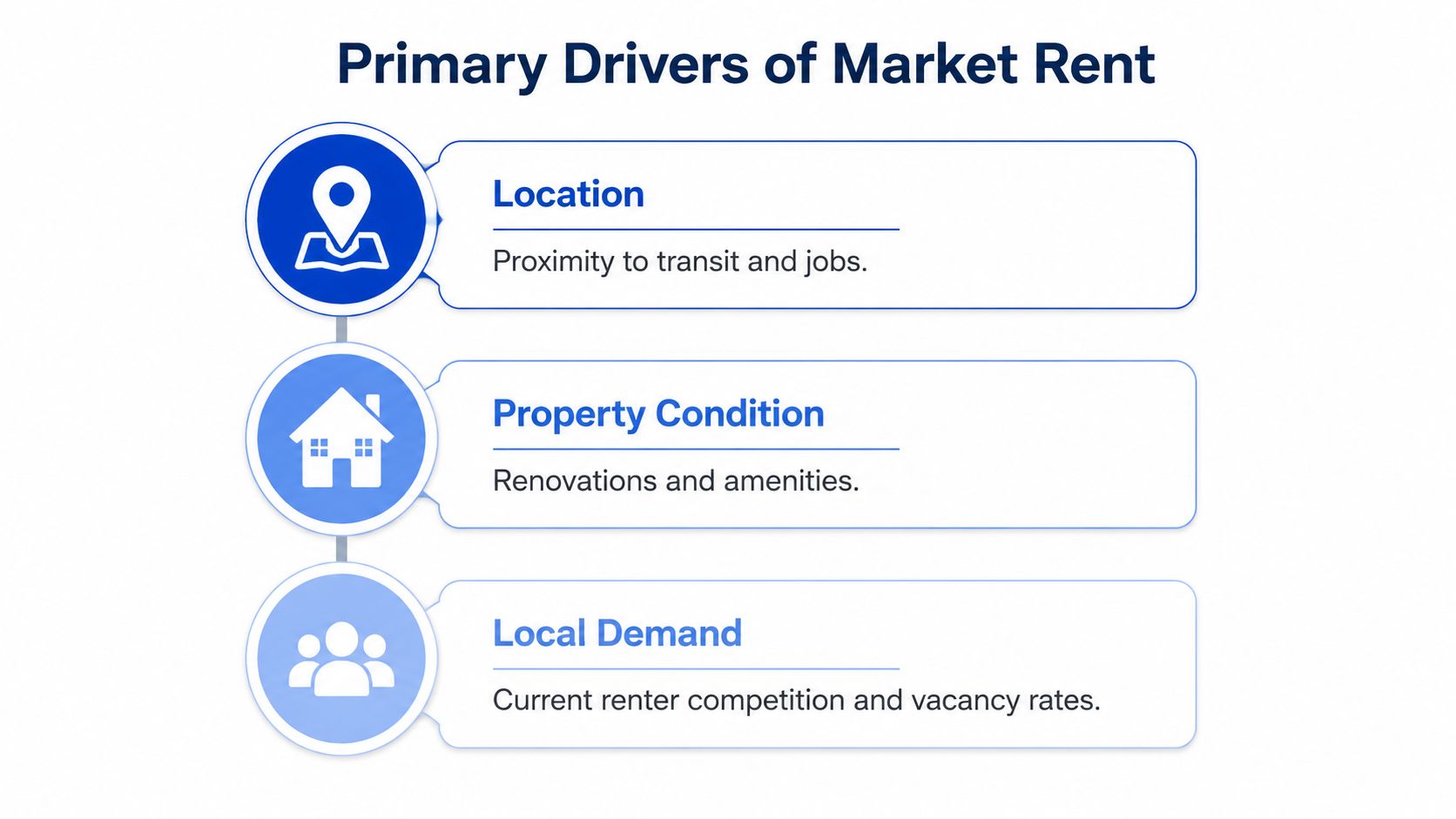
Location and comps come first
Start with comparable properties, often called comps. For apartments, that means nearby units with similar size, age, condition, and access to jobs, schools, and transportation. For co-living, you need a narrower filter. A furnished room with utilities included should be compared to other room rentals with similar house rules and shared-space quality, not only to full apartments.
A property two streets over can still be in a different rental tier if it's closer to transit, in a more stable block, or attached to a stronger school zone. New hosts often underestimate how much micro-location affects pricing.
If you want a more tactical framework for room-by-room pricing, this guide on how to price rooms for rent is a useful companion.
Condition and amenities change what renters will pay
Not every upgrade moves rent the same way. A renovated kitchen, in-unit laundry, off-street parking, strong Wi-Fi setup, and clean common areas usually matter more than cosmetic touches alone. In co-living, operational details also influence price. Fast maintenance response, simple move-in processes, and clear house expectations make a room easier to lease.
What doesn't work is pricing based on money spent rather than renter value. Owners often overvalue fresh paint and undervalue layout problems, awkward bathrooms, or poor storage.
Tenants compare utility, convenience, and friction. They don't reward every dollar you put into the property.
Demand, capture rate, and lender logic
Professionals also look at demand more formally. According to Rent.com's definition of market value rent, operators may use a capture rate metric to gauge demand, and lenders may require a Debt Service Coverage Ratio of at least 1.15x for market-rate properties. In plain English, your rent has to be strong enough to cover the property's debt obligations with a margin of safety.
That matters for co-living operators because room pricing isn't just about filling the house. It's about producing reliable income that holds up under underwriting and real operating costs.
A practical way to think about market rent is:
- Comps tell you the range
- Condition tells you where you sit in that range
- Demand tells you whether the market will absorb that price
- Your numbers tell you whether the deal still works
Seasonality is real, but it won't save bad pricing
Rental demand often shifts through the year. Some periods bring more movement and faster decisions. But seasonality should fine-tune rent, not excuse poor positioning. If your rooms sit because they're overpriced, the problem usually isn't the calendar alone. It's that renters found better options.
Market Rate vs Subsidized and Below Market Units
A lot of confusion comes from using "market rate" as the opposite of "affordable." In practice, these are different categories with different rules, and some of them can overlap in how people talk about them.
The practical difference
Market-rate housing is private housing priced at the going local rate. Subsidized and below-market programs involve some degree of public policy, eligibility, or pricing restriction. Rent-stabilized or rent-controlled units add another layer, because the unit may still be privately owned while the rent increase process is regulated.
For a co-living operator, this distinction matters because it affects what you can charge, how you screen, what paperwork may apply, and how much pricing flexibility you have.
Rental housing types compared
| Attribute | Market Rate | Rent Stabilized/Controlled | Subsidized (e.g., Section 8) | Below-Market Rate (BMR) |
|---|---|---|---|---|
| How rent is set | Based on local supply, demand, comps, and property features | Subject to local rules that limit or regulate increases | Influenced by program rules and subsidy structure | Priced below prevailing market levels under program or policy rules |
| Tenant eligibility | Generally no income restriction tied to the unit type itself | Depends on local law and unit status | Usually tied to income or voucher eligibility | Usually tied to income limits or specific program criteria |
| Landlord pricing control | Broadest flexibility, subject to general law | Limited by regulation | Limited by program participation and compliance requirements | Limited by affordability requirements |
| Government oversight | Lower on rent-setting itself, though general housing laws still apply | Higher on rent adjustments and tenancy rules | Higher due to program rules, inspections, and compliance | Higher because affordability terms must be maintained |
Why the distinction matters operationally
If your property is market rate, you usually have more freedom to adjust pricing when demand changes. That's useful in co-living, where one vacant room can drag income down faster than many new hosts expect.
If your property is subsidized, stabilized, or BMR, your pricing decisions may be constrained even when the market moves quickly. That can reduce flexibility, but it may also create a different risk profile and tenant pipeline.
A lot of owner mistakes come from copying advice meant for conventional apartments without first confirming what legal category the unit actually falls into.
The label affects more than rent. It shapes operations.
Why Market Rate Matters for Co-Living Operators
For a co-living host, market rate isn't just a definition. It's the base layer of your revenue model. You don't lease one unit. You lease a collection of rooms, each with slightly different demand, privacy, layout, and perceived value.

Room pricing is a micro-market problem
A front bedroom with better light, a larger closet, and a bathroom nearby may support a higher rent than the smallest interior room. That's still market-rate pricing. You're matching price to what renters compare and what they value.
The mistake is treating every room the same because the house has one address. In practice, each room competes in a narrower market.
That makes your income statement more sensitive to pricing discipline. If one room is too expensive, it can sit vacant while the rest of the house performs fine. If one room is underpriced, you may fill quickly but leave money on the table across the lease term.
A strong understanding of revenue quality also helps when you evaluate gross effective income in rental operations, especially in shared housing where vacancy and concessions show up differently than in standard multifamily.
Co-living can hold up well in softer conditions
According to The Briggs Companies' summary of market-rate data, a 2024 Urban Institute study found that new market-rate construction can lower nearby rents by 5% to 7% within three years, and room-by-room rentals in those areas often achieve 92% occupancy compared with 81% for whole-unit apartments. For co-living operators, that's one of the clearest reasons to understand market rate at the room level. Shared housing often serves renters who can't comfortably absorb the cost of a full unit.
That doesn't mean every house will outperform. It means the product can stay competitive when traditional apartments become harder for some renters to afford.
What works and what doesn't
What works:
- Frequent comp checks: Markets shift faster than most annual lease plans assume.
- Room-level differentiation: Price the best rooms higher and the weaker rooms more aggressively.
- Fast response to vacancy: A vacant room is a pricing signal, not just a leasing problem.
What doesn't:
- Flat pricing across all rooms
- Waiting too long to adjust after showings go quiet
- Using apartment comps without adjusting for the shared-living format
The host who understands local market rate usually makes better decisions before vacancy becomes a problem.
How to Find Your Local Market Rate and Set Competitive Rent
Finding your local market rate starts with disciplined comparison, not instinct. For co-living operators, the process is part research and part pattern recognition.

Start with the right comps
Look at active listings on platforms such as Zillow, Apartments.com, Facebook Marketplace, Craigslist, and room-rental marketplaces. But don't collect random examples. Filter for properties that match your actual product.
For a room rental, good comps usually share several of these traits:
- Same rental format: Room-by-room listings are better comps than full apartments.
- Similar location: Stay close enough that a renter would realistically compare them.
- Comparable setup: Furnished versus unfurnished, private bath versus shared bath, parking versus no parking.
- Similar member profile: Quiet workforce housing competes differently than student-heavy housing.
If you compare the wrong inventory, the rent conclusion will be wrong even if your spreadsheet looks organized.
Adjust for differences instead of copying a number
Once you've got a workable comp set, don't just average the listings and call it done. Ask what would make a renter choose your room over the alternatives.
A few examples:
- A room with utilities included may justify stronger pricing than one where the renter handles separate bills.
- A house with clean common areas and consistent standards can beat a cheaper listing that feels disorganized.
- A smaller room may still lease well if the home offers parking, laundry, and a smooth move-in process.
This is also where operators benefit from better tooling. If you're comparing multiple listings and trying to spot pricing gaps quickly, these short-term rental pricing tools and market analysis ideas can help you think more systematically about data, even if your model is co-living rather than nightly stays.
Build a repeatable pricing habit
The best operators don't "set rent once." They maintain a process.
- Review current competing listings when a room is likely to turn.
- Check your inquiry quality. If leads are weak or unresponsive, your pricing or presentation may be off.
- Watch time-to-fill. If a room lingers, revisit the comp set before blaming the market.
- Track which room types move fastest. That helps you separate property-level issues from room-level pricing issues.
This walkthrough gives a useful visual explanation of rental pricing logic in practice:
Don't ignore the listing itself
Even accurate pricing can fail if the listing underperforms. Weak photos, vague copy, missing utility details, and unclear house rules make renters hesitate. In co-living, trust and clarity matter because the prospect is evaluating both the room and the shared environment.
Better pricing fixes some vacancy. Better presentation makes that pricing believable.
Final Takeaways and Legal Considerations
Market-rate housing gives you pricing flexibility, but it doesn't put you outside the law. Fair Housing rules still apply. You can't set rent, advertise, or screen tenants in a discriminatory way just because the unit is market rate. Local rules may also affect occupancy, licensing, notice periods, and room-rental operations, especially in shared housing.
That legal layer is worth taking seriously early. Many operators focus on comps and miss the compliance side until a complaint, city notice, or leasing dispute forces the issue.
The business lesson is straightforward. Knowing what is a market rate apartment matters because pricing is one of your main operating levers. Charge too high and rooms sit. Charge too low and the house stays full while your NOI underperforms. The right answer is rarely the highest possible rent. It's the rent that balances occupancy, leasing speed, and stable income.
For co-living hosts, that balance has to be managed at the room level. The sharper your understanding of your local market, the easier it is to make pricing decisions that hold up in practice.
PadSplit hosts who want a simpler way to manage room-by-room pricing, communications, access, and performance can join the interest list for PadPulse. It's being built specifically for co-living operators who want to fill vacancies faster and improve NOI without stitching together multiple tools.