Gross Effective Income: A Guide for Co-Living ROI
May 9, 2026
You're probably looking at your house, adding up what each room should bring in, and thinking, “Great, that's my income.”
That's where a lot of new hosts get tripped up.
In a room-by-room rental, the number on paper almost never matches the money that lands in your account. One room turns over mid-month. A member pays late. You offer a move-in concession to fill a vacancy. Then you collect a parking fee or laundry income that wasn't part of rent at all. If you only track “gross rent,” you'll miss what your property is really producing.
That's why gross effective income matters. It gives you a more honest view of revenue, and for a PadSplit-style operator, that honesty is where better decisions start.
Why Your 'Gross Rent' Isn't Your Real Income
A new host usually starts with the easy number. Six rooms at a set weekly or monthly rent. Multiply it out, and the total looks strong.
Then real operations happen.
One room sits empty between members. Another member gets approved but doesn't move in on the original date. You waive part of the first payment to fill a tough room faster. At the same time, you bring in a little extra from parking, laundry, storage, or utility reimbursements. Suddenly the “gross rent” number feels too high in one direction and too low in another.
That's the gap gross effective income helps close.
The number you can bank on
Think of it this way. Gross rent is the optimistic version of the story. Gross effective income is the operating version.
If you're running co-living well, you need both perspectives:
- Gross potential rent tells you capacity. It shows what the house could earn if every room were occupied at full asking rent.
- Gross effective income tells you reality. It reflects vacancy, payment loss, and side income.
- The difference shows your execution. A small gap usually means tighter operations.
In room-by-room rentals, small misses add up fast because turnover happens more often and income changes room by room, not just lease by lease.
This is one reason many hosts outgrow spreadsheets quickly and start looking for better systems, including accounting software for rental properties that can separate scheduled rent from collected and adjusted income.
Common places hosts get confused
Beginners often lump everything into one bucket. That creates two problems.
First, they overstate income by assuming every advertised room rate gets collected all month long. Second, they understate income by forgetting smaller line items that still count, like parking or laundry.
Watch for these common mistakes:
- Counting listed rent as earned rent. A room isn't producing income when it's vacant, even if it was marketed at a strong rate.
- Ignoring concessions or credits. If you discounted move-in costs to fill a room, that affects realized income.
- Forgetting other income. Reserved parking, storage, laundry, and similar charges still contribute to revenue.
Once you see those moving parts, gross effective income stops sounding like accounting jargon. It becomes a practical operating metric.
What Is Gross Effective Income?
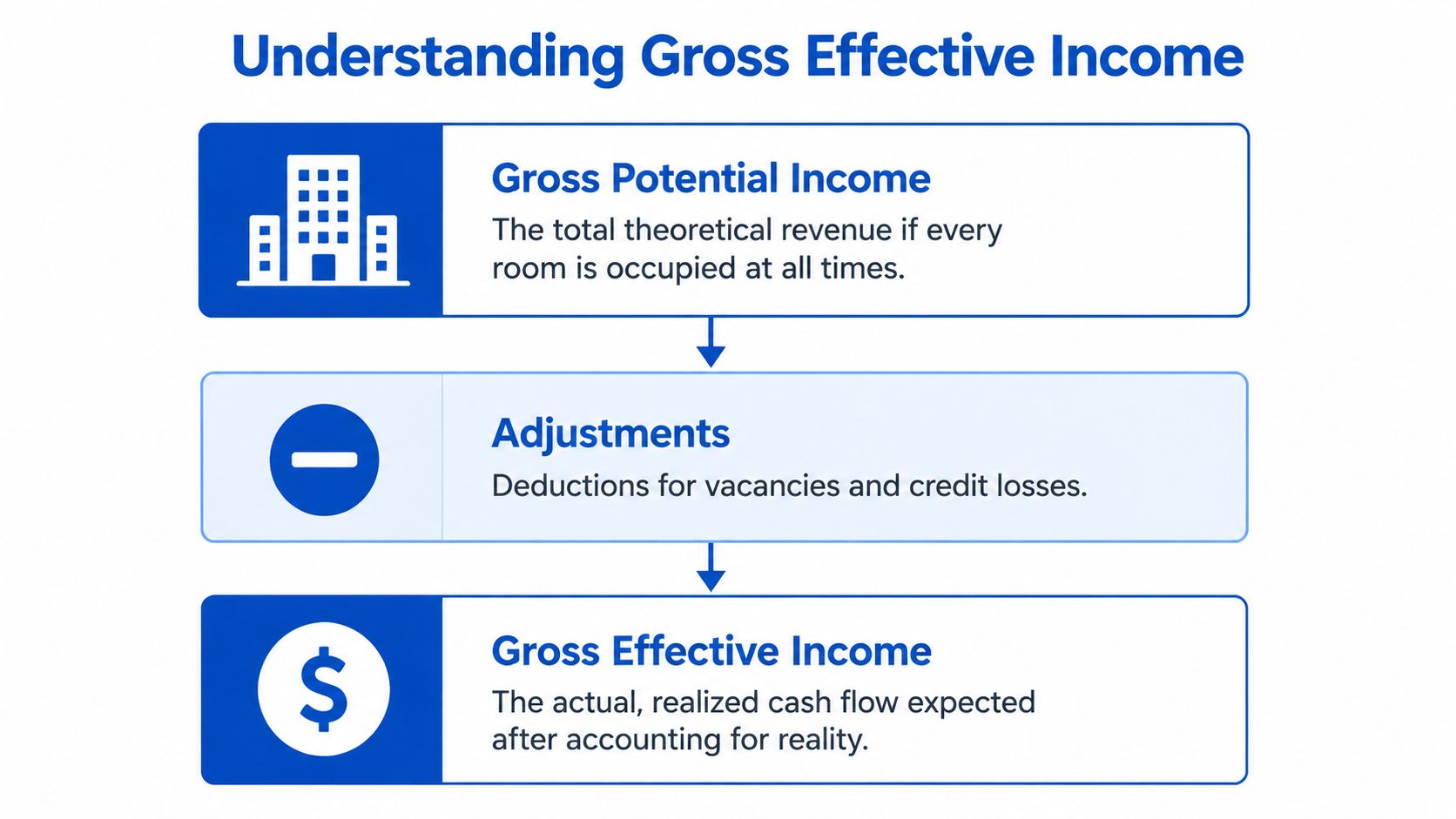
Gross effective income is the income a property is expected to produce after you adjust for real-world losses and add legitimate non-rent income.
The easiest place to start is with its cousin, gross potential income, sometimes shortened to GPI. That's the perfect-world number. Every room is full. Every member pays in full. No downtime. No missed payments.
Co-living rarely works that neatly.
The formula in plain English
The standard formula is:
Gross Effective Income = Gross Potential Rent + Other Income - Vacancies - Credit Loss
A simple analogy helps. Think of your property's income like a bucket:
- Gross potential income is the full bucket
- Vacancy and credit loss are leaks
- Other income is extra water flowing in
- Gross effective income is what's left in the bucket
That's the number you should use when you want a realistic picture of revenue.
What each part means for a PadSplit host
Here's how the formula translates in a room-by-room house:
Gross potential rent
The total rent if every room were occupied at the posted rate for the full period.Vacancy loss
Income lost when a room sits empty between members, during turn work, or while you're waiting on a move-in.Credit loss
Income you expected but didn't collect because of missed or partial payment.Other income
Revenue outside base room rent, such as parking, laundry, storage, or utility-related charges.
Practical rule: If the income only exists in a perfect scenario, it belongs in potential income. If it reflects what really happened, it belongs in gross effective income.
This idea has been around for a long time. The concept of adjusting for real-world losses was formalized in the 1960s, and analyses by the Urban Land Institute in the 1970s found that what we now call effective gross income averaged 92-95% of Gross Potential Income, with vacancy and credit losses accounting for the 5-8% difference, as summarized in this effective gross income history overview.
Why co-living operators should care more than traditional landlords
A traditional apartment landlord might sign a year lease and see fewer changes month to month. A room-by-room operator deals with more moving pieces.
You may have:
- Shorter stays
- More frequent turns
- More room-level pricing changes
- More side income opportunities
That makes gross effective income more useful, not less. In co-living, it's often the clearest way to tell whether your pricing, occupancy, and collections are working together.
Calculating GEI for a PadSplit House Step by Step
A PadSplit house can look full on paper and still miss its income target for the month.
That usually happens because room-by-room rentals have more small interruptions than a traditional apartment. One member moves out midweek. A new member gets a discounted first payment. Laundry income comes in, but it never gets added back to the property totals. GEI helps you clean that up and measure what the house produced.
Meet Host Helen. She runs a 6-room house. To keep the math simple, each room is listed at $800 per month.

Step one starts with full occupancy
Start with the best-case number.
If all 6 rooms were occupied for the full month at asking rent, Helen would collect:
6 rooms × $800 = $4,800
That is her gross potential rent for the month. In a co-living house, this number is the ceiling, not the result.
Step two subtracts vacancy loss
Now bring the house back into the world.
One room sat empty for 10 days during turnover. In a PadSplit-style model, that is common. The outgoing member leaves, the room gets cleaned, small repairs get handled, new photos go up, and the next move-in lands a few days later.
To estimate the vacancy loss for that room, use the monthly room rent and convert it to a daily amount:
$800 ÷ 30 = about $26.67 per day
For 10 vacant days:
$26.67 × 10 = $266.70 vacancy loss
So after vacancy, Helen is down to:
$4,800 - $266.70 = $4,533.30
This is why room-level pricing matters so much in co-living. If one room is overpriced for its size, layout, or bathroom access, it can sit longer and drag down the whole house. Hosts who study how to price rooms for rent often improve GEI faster than hosts who focus only on cutting expenses.
Step three subtracts concessions and uncollected rent
Next, look at what was billed versus what was collectible.
Say Helen offered the incoming member a $100 move-in concession to fill the vacancy faster. That helped occupancy, but it still reduced collected rent for the month. GEI should reflect the amount she gave up.
Now say another member still owes $75 from this month. That amount belongs in credit loss until it is collected.
Here is the running math:
- Starting gross potential rent: $4,800
- Less vacancy loss: $266.70
- Less concession: $100
- Less uncollected rent: $75
Subtotal: $4,358.30
A simple rule helps here. If the income was listed on your pricing sheet but did not make it into the month's realized revenue, do not leave it in GEI.
Step four adds other income
Now add the income streams that traditional multifamily examples often skip.
Helen also collected:
- $40 in laundry income
- $25 in late fees
- $35 in utility-related charges
That adds up to:
$40 + $25 + $35 = $100
Add that back to the subtotal:
$4,358.30 + $100 = $4,458.30
So Helen's gross effective income for the month is $4,458.30.
This is one of the biggest differences in co-living. A standard apartment guide may focus almost entirely on rent minus vacancy. A PadSplit host often has small but recurring side income tied to shared living, and leaving it out gives you an incomplete picture.
Helen's finished GEI formula
For this month, Helen's calculation looks like this:
| Item | Amount |
|---|---|
| Gross potential rent | $4,800.00 |
| Less vacancy loss | ($266.70) |
| Less concessions | ($100.00) |
| Less credit loss | ($75.00) |
| Add other income | +$100.00 |
| Gross effective income | $4,458.30 |
If you like formulas, it works like this:
GEI = Gross Potential Rent - Vacancy Loss - Concessions - Credit Loss + Other Income
What new hosts usually miss
New hosts usually make one of three mistakes.
They count listed rent instead of collected rent. They treat a half-month vacancy like a full month of income. Or they forget the side income that shared housing produces. GEI fixes all three.
The practical habit is simple. At the end of each month, go room by room and ask:
- What could this room have earned at full occupancy?
- How many days was it vacant?
- Did I discount rent to fill it?
- Was any billed rent left unpaid?
- What non-rent income came from operating the house?
That process gives you a monthly GEI number you can trust, especially in a high-turnover co-living model where the gaps between listed rent and real income show up fast.
How GEI Fits into Your Financial Picture
A lot of confusion comes from mixing up three different income numbers.
They're related, but they do different jobs.

GPI GEI and NOI in order
Think of your property's income statement like this:
| Metric | What it means | What it ignores |
|---|---|---|
| GPI | Full earning potential | Real-world losses |
| GEI | Realistic revenue after adjustments | Operating expenses |
| NOI | Income left after operating expenses | Financing and taxes |
So the flow is simple:
Gross Potential Income → Gross Effective Income → Net Operating Income
GEI sits in the middle. That's why it matters so much.
If your gross potential income looks great but your GEI is soft, the issue usually sits in vacancy, collections, concessions, or missing side income. If your GEI is strong but NOI is weak, the issue is probably expenses.
Why investors focus on this bridge number
Lenders, buyers, and experienced operators care about the handoff between revenue and profit. GEI is that handoff.
If you improve GEI, you usually improve NOI too, assuming expenses stay controlled. That has a direct impact on value. For many multifamily assets, every $1,000 of additional annual EGI can translate to $4,500 to $6,500 in property value appreciation, according to this Wall Street Prep explanation of effective gross income.
That's why a small operational improvement can matter more than many new hosts expect.
A room filled one week faster isn't just extra rent. It can improve the annual income figure that buyers and lenders use to judge the asset.
A short video can help if you want to see how these metrics fit into real estate analysis more broadly.
A practical co-living lens
In a co-living house, GEI is often the cleanest “operating quality” number you have.
A high asking rent doesn't prove much if rooms sit too long. Low expenses don't save you if members don't pay. GEI shows whether your house is converting demand into usable revenue.
If you monitor only top-line rent, you'll miss that bridge. If you monitor GEI, you can usually spot the underlying problem faster.
Actionable Strategies to Improve Your GEI
A PadSplit house can feel busy and profitable while GEI still slips. One room sits empty for five days. Another member pays late. A third gets a move-in discount you forgot to factor in. On paper, the house looks close to full. In practice, those small leaks lower the income you keep.
That is why improving GEI in co-living is usually about plugging several small gaps, not making one dramatic change.
For a room-by-room operator, three levers matter most. Fill rooms faster, collect more of what is owed, and add income that members willingly pay for. Traditional multifamily advice often treats vacancy as a monthly building-wide issue. In a high-turnover house, vacancy happens room by room, week by week, so your response has to be more precise.
Reduce vacancy loss
Vacancy is usually the first place to look because co-living creates more turnover events than a standard annual lease. A single empty unit in a duplex is obvious. In a six-bedroom house, one slow-turning room can hide in the background and chip away at GEI.
Start with pricing. Each room has its own demand curve. A larger room, a room with a private bath, or a room near the entrance should not automatically carry the same rate as every other room. If one room sits longer than the rest, the problem may be that the room is mispriced, not that demand is weak.
Then look at turn speed. Cleaning delays, incomplete photos, slow inquiry replies, and maintenance lag all create dead days between members. In co-living, those dead days add up fast because you repeat the process more often.
A simple rule helps here. Protect occupancy first, then fine-tune rent.
Useful vacancy moves include:
- Price by room type and features. Treat each room like its own small product.
- Set a turn standard. Cleaning, inspection, photos, and relisting should follow the same checklist every time.
- Reply fast to inquiries. A room that gets attention in the first hour often fills faster than one that waits until evening.
- Review concessions carefully. A planned move-in special can help if it shortens vacancy enough to raise actual collected income over the month.
If you want a repeatable process, this property management checklist for rental operations is a good starting point. Vacancy problems often come from missed steps, not weak demand alone.
Minimize credit loss
A full house does not guarantee strong GEI. If members pay late, miss payments, or need constant chasing, your collected income falls below what your rent roll suggests.
Many new hosts get tripped up. They treat occupancy and collections as the same problem. They are related, but they are not identical. One measures whether the room is filled. The other measures whether the income shows up in your account.
The strongest collection habits start before move-in:
- Screen for payment reliability and house fit. Fast placement is helpful only if the member can stay current.
- Make payment terms clear on day one. Due dates, fees, and payment methods should be easy to understand.
- Use automated reminders and autopay where possible. Fewer manual follow-ups usually means fewer missed payments.
- Track concessions separately from delinquencies. A discount you chose is different from rent you failed to collect.
In a PadSplit-style model, this distinction matters more than it does in a traditional apartment. You may have more frequent payment cycles, more member turnover, and more chances for small collection issues to stack up.
Strong collections begin with clear expectations, smooth payment setup, and consistent enforcement.
Increase other income without hurting retention
Other income can help GEI, but only if it fits the house and makes sense to members. The goal is useful income, not random fees.
The best add-ons usually solve a real problem:
- Reserved parking for members with cars
- Laundry income where machines are onsite and easy to use
- Storage fees for extra space in a garage or closet
- Premium room add-ons tied to privacy, furnishings, or convenience
Keep this simple. If a charge creates confusion, disputes, or resentment, it can cost more in turnover than it adds in revenue.
Where to focus first
For most co-living hosts, the best order is clear. Reduce vacancy loss first. Tighten collections second. Add other income third.
That sequence works because empty rooms and missed payments usually create the biggest GEI drag in a high-turnover house. Extra parking or laundry income helps, but it rarely fixes the core problem if rooms are sitting or payments are inconsistent.
Tracking GEI with Modern Dashboards
If you only calculate gross effective income at tax time, you're too late.
Co-living moves fast. One rough month of turnover can distort revenue before you realize what happened. Weekly stays and short booking gaps make the picture even noisier than in traditional multifamily.
What a useful dashboard should show
A solid dashboard for a room-by-room operator should help you answer a few questions quickly:
- GEI for the current month
- GEI compared with gross potential income
- Occupancy by room and by property
- Vacancy-related revenue loss
- Other income by category
- Trends over time, not just a single snapshot
That's much easier to manage in a purpose-built system than in a spreadsheet with manual tabs and hand-entered formulas.
Why this matters more in short-stay co-living
Emerging trends show that modern management platforms can reduce credit losses by up to 40% through automated collections and improved screening, and for weekly or short-term stays common in PadSplit models, seasonal demand can cause GEI to fluctuate by ±25%, according to this Fannie Mae guide reference on emerging EGI trends.
That kind of movement is hard to manage manually.
When stays are shorter and turnover is higher, gross effective income becomes a live operating metric, not a once-a-quarter accounting exercise.
A good dashboard won't make decisions for you. It will show you where the leaks are fast enough that you can fix them.
The primary win is clarity. When you can see vacancy loss, credit loss, and other income in one place, you stop guessing which part of the business needs attention.
If you want a simpler way to track room-by-room performance, PadPulse is building an all-in-one platform for PadSplit hosts and co-living operators. It's designed to help you monitor revenue, spot vacancy drag, improve collections, and get a clearer view of NOI without stitching together disconnected tools.