Pricing Intelligence Platform: Maximize Co-living Revenue
July 15, 2026
If you run co-living homes, you've probably done this recently. You checked Zillow, Craigslist, Facebook Marketplace, maybe Apartments.com. You looked at a few room listings nearby, picked a number that felt competitive, and hoped you didn't price the room too high for the current market or too low for the demand sitting right in front of you.
That works for a while. Then a room sits vacant longer than expected. Or it fills fast and you start wondering if you discounted too aggressively. Meanwhile, another room in the same house should probably be priced differently because it has better light, more privacy, or a shorter lead time to move-in.
That's where a pricing intelligence platform starts to matter. For room-by-room rentals, pricing isn't just about “what are nearby listings charging.” It's about balancing occupancy, lead flow, turnover timing, concession pressure, and the fact that an empty room is perishable inventory.
Are You Guessing Your Room Rents
A lot of operators still price by instinct.
One room opens up, so they scan local comps and post at a number that seems safe. If leads are slow, they cut the price. If inquiries come in fast, they raise the next listing. It feels active, but it's still guesswork.
The problem is that co-living doesn't behave like a standard apartment lease. A room available now isn't the same product as that same room available three weeks from now. A furnished room near transit competes differently than an unfurnished room in the same zip code. And a vacancy in a house with several open beds creates different pressure than a single opening in a full property.
Why generic pricing advice breaks down
Most pricing content online was built for e-commerce teams tracking product prices. That leaves a big blind spot for operators like us. As ChangeFlow's overview of price intelligence tools notes, existing content overwhelmingly frames pricing intelligence around competitor product prices, not room-by-room rentals where inventory is perishable, occupancy constraints matter, and operators deal with the messy overlap between nightly-rate logic and monthly-rent expectations.
That gap is real on the ground.
A co-living operator might ask:
- Should I lower rent today: because this room has been vacant for a week?
- Should I hold firm: because demand usually picks up before month-end?
- Should I price two similar rooms differently: because one has private bath access and the other doesn't?
- Should I offer a concession instead of cutting rent: to protect future pricing integrity?
Those aren't e-commerce questions. They're operating questions.
Manual pricing usually fails in the quiet moments, not the obvious ones. The room doesn't sit vacant forever. It just sits long enough to erode the month.
What a smarter process looks like
A pricing intelligence platform gives you a repeatable way to price rooms with current market signals instead of gut feel. It helps you compare relevant listings, monitor demand conditions, and make pricing decisions faster.
If you're still using spreadsheets and browser tabs, start with a stronger baseline first. This guide on how to price rooms for rent is a useful foundation before you layer in automation.
For co-living, the key win isn't fancy software. It's removing random pricing decisions from a business that already has enough variability.
What Is a Pricing Intelligence Platform Anyway
Think about how airlines price seats. The seat itself doesn't change much, but the price changes based on timing, demand, availability, and nearby alternatives. Hotels do the same thing with rooms.
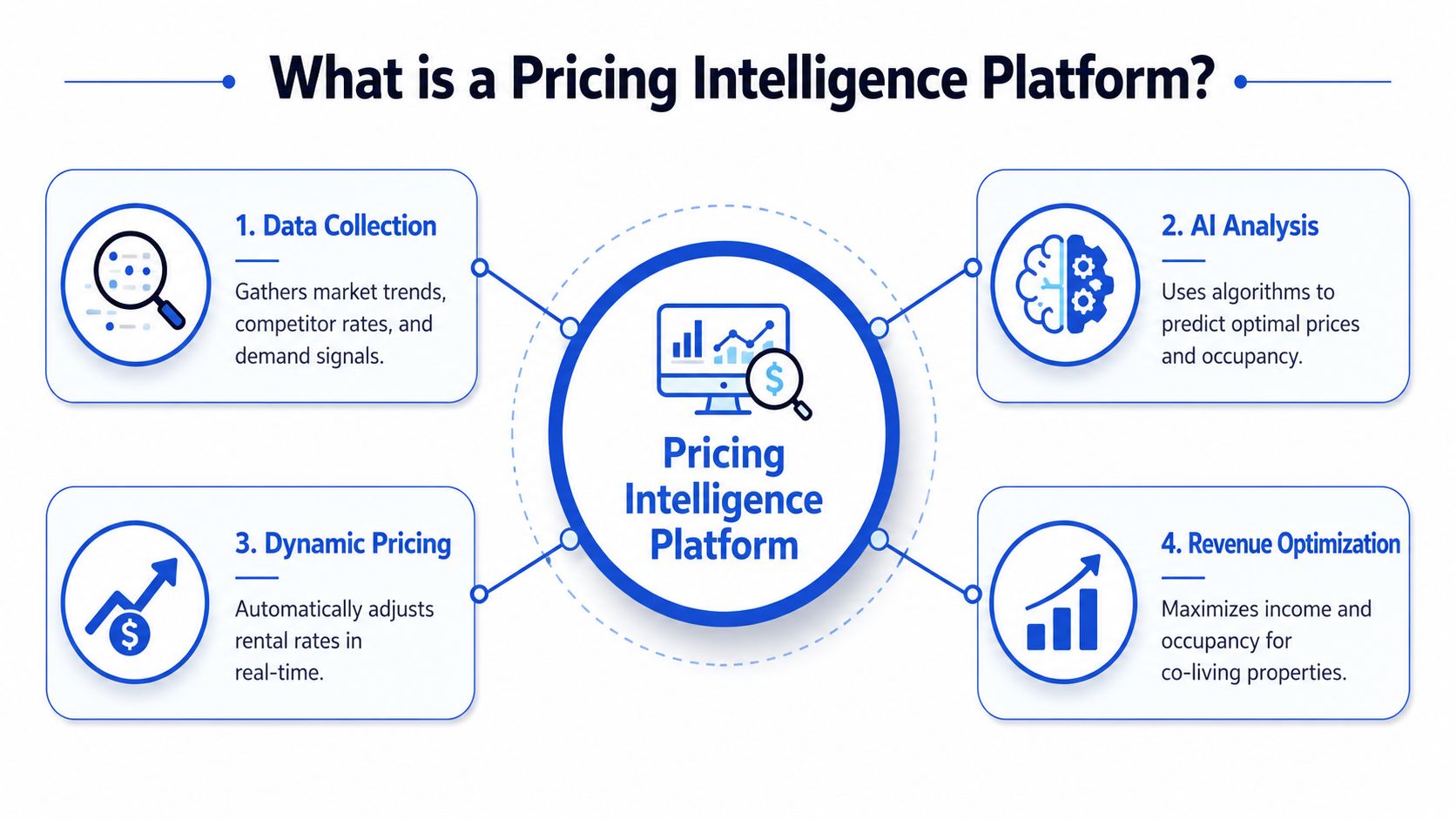
A Pricing Intelligence Platform applies that same logic to your rental inventory. It collects market signals, analyzes them, and helps you decide what a specific room should cost now, not what it should have cost last month.
It's more than a comp checker
Beginners often assume this kind of tool just scrapes nearby listings and spits out an average. Good systems do more than that.
They usually help with four jobs:
- Market collection: gather competitor rents, supply signals, and demand clues
- Analysis: identify patterns that a human operator would miss or take too long to spot
- Pricing recommendations: suggest a rate that fits your occupancy and revenue goals
- Ongoing adjustment: update decisions as market conditions change
That's why this category keeps expanding. The global price intelligence market was valued at $4.8 billion in 2025 and is projected to reach $14.2 billion by 2034, growing at a 12.8% CAGR. That growth reflects a broader shift toward automated pricing decisions made in near real time.
For co-living operators, that matters because room pricing has the same core challenge as airline and hotel pricing. Unsold inventory loses value with time.
What this means in plain English
You don't need to become a data scientist to use a pricing intelligence platform well.
You need a system that helps answer practical questions like:
- Is this room overpriced for current demand
- Am I underpricing high-interest inventory
- Should I push rent, add a concession, or hold
- Which comps matter
If you're new to the concept, it helps to understand the broader logic behind dynamic pricing strategy for rental operators. The short version is simple. Static pricing assumes the market is stable. Co-living markets rarely are.
A useful pricing platform doesn't replace judgment. It gives your judgment better inputs.
The strongest operators still make the final call. They just stop making that call with stale information.
How Pricing Intelligence Works for Co-Living Rentals
The mechanics sound technical, but the workflow is straightforward once you translate it into operator language. A pricing intelligence platform for co-living does three things well. It collects the right data, interprets that data, and turns it into usable pricing actions.
Near the top of the process, the dashboard matters because operators need visibility, not black-box output.

Data collection for room-by-room rentals
Dynamic pricing engines need six core inputs to work well. According to Stripe's explanation of dynamic pricing, those inputs are historical transaction data, real-time inventory, competitor pricing feeds, behavioral signals like site traffic, cost and margin requirements, and customer segmentation data.
In co-living terms, that translates into something like this:
- Historical transaction data: what similar rooms leased for, how fast they filled, and what concessions were needed
- Real-time inventory: which rooms are open now, which are turning soon, and how much vacant capacity you're carrying
- Competitor pricing feeds: nearby room listings, furnished comps, shared-housing offers, and substitute options
- Behavioral signals: inquiry volume, tour requests, listing engagement, and drop-off points
- Cost and margin requirements: utilities, cleaning, turnover expense, platform fees, and the minimum acceptable yield
- Customer segmentation: students, traveling workers, local workforce tenants, or members looking for flexible stays
That's a lot to process manually. Most operators end up overweighting the easiest variable to see, usually competitor list price, and underweighting the variables that shape net revenue.
Analysis that normal rent setting misses
Once the data is collected, the platform looks for patterns. It might detect that a private room near transit can support firmer pricing during a certain leasing window, while a shared room in the same neighborhood needs faster adjustments to avoid idle days.
Machine learning can also help with messy comparisons. In practice, room inventory isn't apples to apples. A larger room, a shorter minimum stay, furnished setup, included utilities, and move-in flexibility all affect what counts as a real comp.
A short explainer helps visualize that workflow:
Turning analysis into an actual asking rent
A good system doesn't stop at reporting. It produces recommendations you can use.
For a co-living operator, that might mean:
- Hold price steady when lead quality is healthy and vacancy risk is low
- Reduce price modestly when a room is aging and comparable listings are undercutting you
- Keep the asking rent but change terms by testing lease length, deposit structure, or included perks
- Price two rooms in one house differently based on demand, privacy, or urgency to fill
The key is speed. Humans can review listings. Systems can review patterns continuously and surface the rooms that need attention first.
Core Features Every Co-Living Operator Needs
Not every pricing tool is built for room-by-room operations. Some are basically alert systems. Some produce nice charts but don't help you act. Some are strong on data collection but weak on business rules, which is dangerous when one bad automation can push prices below what your house economics support.
The features below matter because they solve everyday co-living problems, not because they sound advanced.
Start with fast, relevant market visibility
If a platform can't show you what similar rooms are doing in your submarket, it's not helping much.
You want a dashboard that lets you separate noise from signal. A luxury studio building nearby may not be a valid comp. A furnished room in a similar neighborhood with similar lease flexibility probably is. The software should make that distinction easier, not harder.
A practical filter matters too. 42Signals' guidance on price intelligence software recommends filtering tracked competitors to listings with more than 100 reviews or a 4+ star rating, which is a useful reminder that low-quality listings can distort your pricing logic. The same piece also warns that repricing rules need to include all costs, because apparent profit can collapse once fees and shipping are factored in. For co-living, swap shipping for turnover, utilities, vacancy drag, and platform costs. The lesson is the same.
Rule controls are not optional
Automation without guardrails causes damage fast.
An effective pipeline should include a Rule Validation System that enforces business constraints. Pylar's breakdown of dynamic pricing implementation notes that these systems set minimum and maximum price floors to prevent margin erosion, and that competitor monitoring for AI-driven pricing often runs on a 15-minute refresh cycle.
For co-living, that means your system should allow rules like:
- Never drop below floor rent: because house-level margin has to stay intact
- Require approval for major price changes: especially on high-visibility listings
- Separate pricing logic by room type: since a shared room and private suite shouldn't move the same way
- Respect occupancy thresholds: because pricing decisions at high vacancy differ from decisions in a near-full house
Operator rule: Automation should change routine decisions. It shouldn't make irreversible ones without guardrails.
Integration-ready architecture saves pain later
A pricing platform that can't connect to the rest of your stack becomes another dashboard you forget to open.
Enterprise buying criteria from RetailGators' CTO guide to price intelligence platforms emphasize a few practical standards: 4 to 6 hourly crawl cycles for high-velocity categories, documented ability to handle 1M+ SKUs, and API readiness for pricing engines, ERP or OMS systems, and BI tools such as Power BI or Tableau. Co-living operators don't manage SKUs like a retailer, but the lesson still applies. Fresh data, dependable scale, and usable integrations matter.
Pricing intelligence platform evaluation checklist for co-living
| Feature / Capability | Why It Matters for Co-living | Look For This |
|---|---|---|
| Market analytics dashboard | Helps you see rent shifts, listing pressure, and vacancy trends by neighborhood and room type | Custom comp views, map-based filtering, historical comparisons |
| Competitor set configuration | Prevents bad pricing decisions based on irrelevant listings | Ability to include and exclude comps by furnishing, location, room type, and quality |
| Dynamic pricing engine | Turns market signals into actual pricing recommendations | Configurable strategies for occupancy, revenue, and lease-up speed |
| Rule validation system | Protects margins and prevents reckless repricing | Min and max price rules, approval workflows, exception alerts |
| Data refresh frequency | Keeps decisions current when local markets move quickly | Frequent updates, not once-a-day snapshots |
| Cost-aware pricing logic | Avoids “filled room, bad economics” outcomes | Inputs for utilities, turnover, fees, concessions, and margin floors |
| Reporting and NOI visibility | Connects pricing decisions to property performance | House-level and portfolio-level reporting tied to occupancy and revenue |
| API and tool integrations | Reduces manual re-entry and operational lag | Connections to PMS, CRM, messaging tools, BI dashboards, and access systems |
| Alerting and workflow support | Helps small teams react fast | Vacancy alerts, comp change alerts, approval notifications |
| Room-level pricing flexibility | Reflects real differences inside the same house | Separate logic by room size, bath access, furnishings, and lease terms |
The best test is simple. If a platform can't tell you what to do with one vacant room this week, it's probably not operational enough for co-living.
Boosting ROI with Smart Integrations
Pricing by itself helps. Pricing connected to operations helps a lot more.
A room repriced today affects more than rent. It changes lead flow, response urgency, staffing, move-in scheduling, lock access, and forecasting. When a pricing intelligence platform connects with the rest of your systems, each pricing decision triggers cleaner execution.
Where operators usually leave money on the table
A common failure pattern looks like this. The operator lowers rent to fill a room, but inquiry handling stays manual, follow-up is slow, and the lead goes cold before anyone books a tour.
That's not a pricing problem anymore. It's a systems problem.
A connected workflow looks better:
- If a room rate changes: the listing updates quickly across your active channels
- If a new inquiry arrives: automated messaging starts the qualification and scheduling flow
- If the room is booked: access setup, move-in instructions, and internal tasking begin immediately
- If demand stays weak: reporting flags the issue at the room, house, or neighborhood level
What useful integrations look like in practice
The strongest setup usually links pricing with:
- Property management software: so occupancy and upcoming turns feed pricing decisions
- CRM or messaging tools: so lower-priced inventory gets fast follow-up
- Business intelligence dashboards: so you can compare pricing actions against revenue and vacancy outcomes
- Access and smart-home systems: so operations keep pace when pricing accelerates leasing
If you want to think about this the right way, pair pricing with demand forecasting software for rental operators. Pricing tells you how to respond. Forecasting helps you understand what may be coming.
Better pricing without better execution still creates leakage. The room gets attention, but the process fails to convert it.
The real ROI comes from fewer delays
In co-living, speed matters twice. First when you notice a room needs a pricing change. Second when you capitalize on the demand that change creates.
Operators don't need more disconnected tools. They need pricing data to move into workflows people already use. That's where the return shows up. Faster reactions, cleaner handoffs, and less revenue left stuck between departments.
Your Implementation Roadmap for Dynamic Pricing
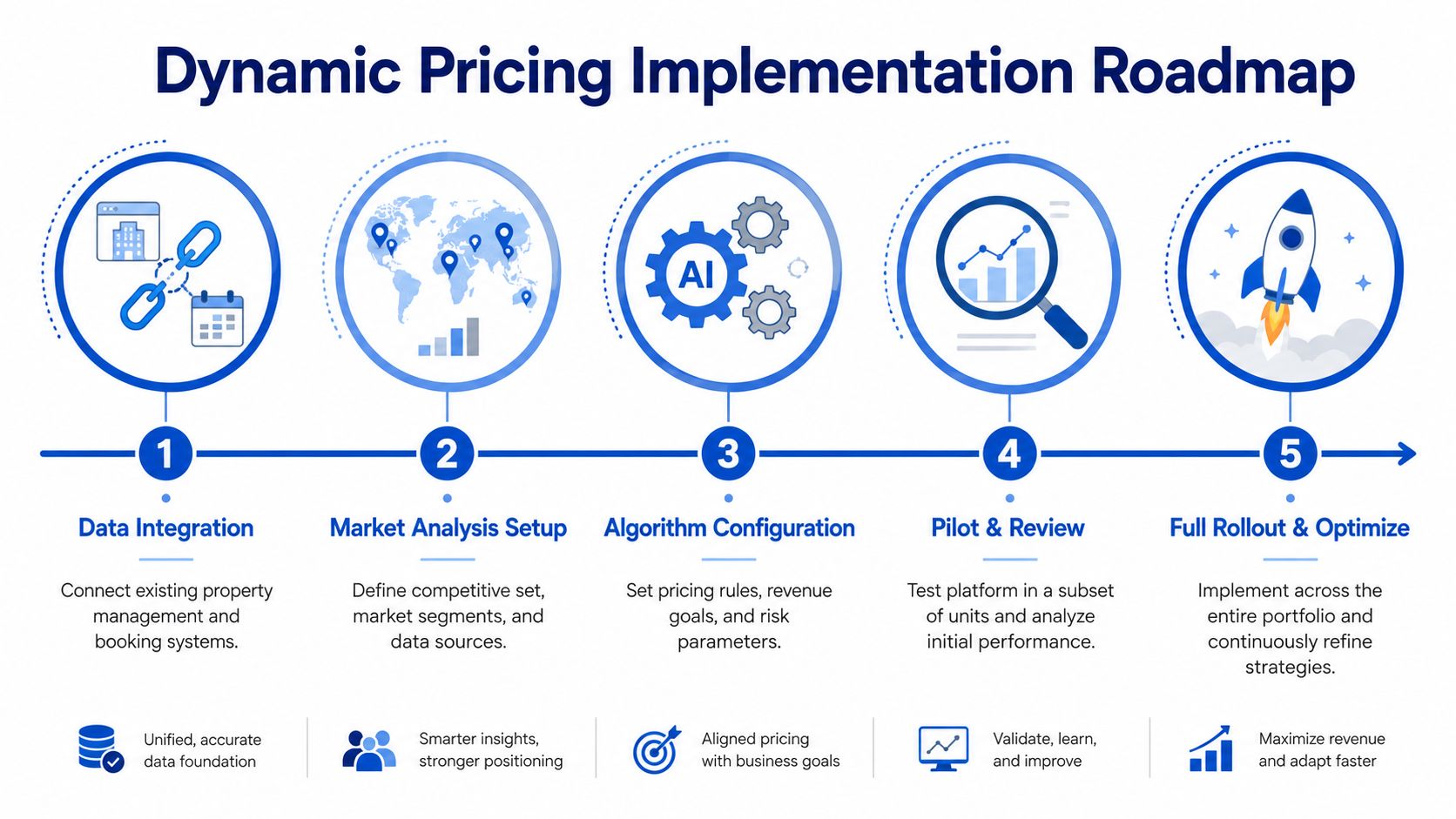
Most operators shouldn't roll out dynamic pricing across every room on day one. That creates too many moving parts, and it becomes hard to tell whether the system is helping or whether the team is reacting to noise.
A tighter rollout works better.
Start small and choose the right rooms
A useful principle comes from dynamic pricing rollouts in other categories. ATTN Agency's implementation guidance recommends starting with the top 20% of revenue-generating SKUs instead of trying to optimize the full catalog at once.
For co-living, the parallel is clear. Start with the rooms that matter most to revenue, or the inventory that creates the most operational friction when it sits vacant. That may be your highest-demand rooms, your hardest-to-fill rooms, or a specific cluster of houses where pricing consistency is weak.
A five-step rollout that actually works
Define the business goal
Don't start with software settings. Start with the operating goal. You might want to reduce idle days, tighten rent consistency, protect floor pricing, or improve lease-up for a certain room type.
Build a clean comp set
Bad comps create bad pricing. Use comparable furnished rooms, shared housing alternatives, and local substitutes that a real prospect would consider.
Set rules before automation goes live
Create approval thresholds, minimum acceptable pricing, and exceptions for premium rooms. This is also where you decide when to use concessions instead of rent cuts.
Run the pilot and review weekly
Watch lead volume, conversion quality, vacancy age, and whether managers are overriding recommendations. Frequent overrides usually mean the model, comp set, or rules need work.
Expand only after the team trusts the output
Once your pilot rooms are producing decisions that staff understand and can defend, add more houses or room types.
What not to do
A few rollout mistakes show up again and again:
- Uploading messy historical data: which teaches the system the wrong lessons
- Tracking every nearby listing: instead of only relevant comps
- Ignoring operational costs: which makes “filled” inventory look better than it really is
- Changing too many policies at once: so nobody knows what caused the result
Pilot dynamic pricing where the cost of being wrong is manageable, but the upside is still visible.
The goal isn't to automate everything instantly. The goal is to build confidence in a pricing process your team will implement.
The Future Is Automated Start Preparing Today
Manual room pricing isn't just inefficient anymore. It's a weak control system for a business that changes every week.
Co-living operators already deal with more moving pieces than a traditional landlord. Rooms turn at different times. Demand shifts by neighborhood and season. Similar listings aren't similar. Waiting too long to react costs occupancy. Reacting too fast without rules can damage margin.
That's why pricing is moving toward automation. Not because software is trendy, but because room-by-room rental businesses need faster inputs, cleaner comparisons, and more disciplined pricing decisions.

Operators who start preparing now will have an advantage. They'll know their comp sets, understand their floor pricing, and have a process for testing dynamic pricing without throwing the whole portfolio into chaos.
If you've been pricing rooms by checking listings and trusting your gut, that's a workable starting point. It's not a long-term operating system.
The shift for co-living is straightforward. Use better data. Put rules around pricing decisions. Connect pricing to the rest of your workflow. Then scale what proves itself.
PadPulse is building an all-in-one platform for PadSplit hosts and co-living operators, with planned tools for dynamic pricing, AI messaging, smart-lock workflows, and portfolio reporting. If you want early visibility into the platform, product updates, and limited beta access, join the PadPulse interest list.