Demand Forecasting Software: Maximize Co-living Revenue
June 10, 2026
You're probably doing some version of this right now. A room opens up, you check a few nearby listings, think about how fast the last tenant moved in, and pick a price that feels reasonable. Then the second guessing starts. If the room sits empty, was the rent too high? If it fills instantly, did you price too low?
That uncertainty is exactly where demand forecasting software becomes useful, especially in co-living and room-by-room rentals where demand can swing for reasons that don't show up in a simple spreadsheet. A new employer opens nearby. A college semester starts. A local rule change affects housing supply. One room layout performs better than another, even in the same house.
For many hosts, the confusing part is that most forecasting content is written for giant retail or supply chain teams. It assumes huge datasets, full-time analysts, and stable product demand. Co-living operators rarely have that luxury. You may have a handful of houses, uneven leasing history, and move-ins that come in bursts.
That doesn't mean forecasting is out of reach. It means you need to understand it in practical terms.
What Is Demand Forecasting Software Anyway
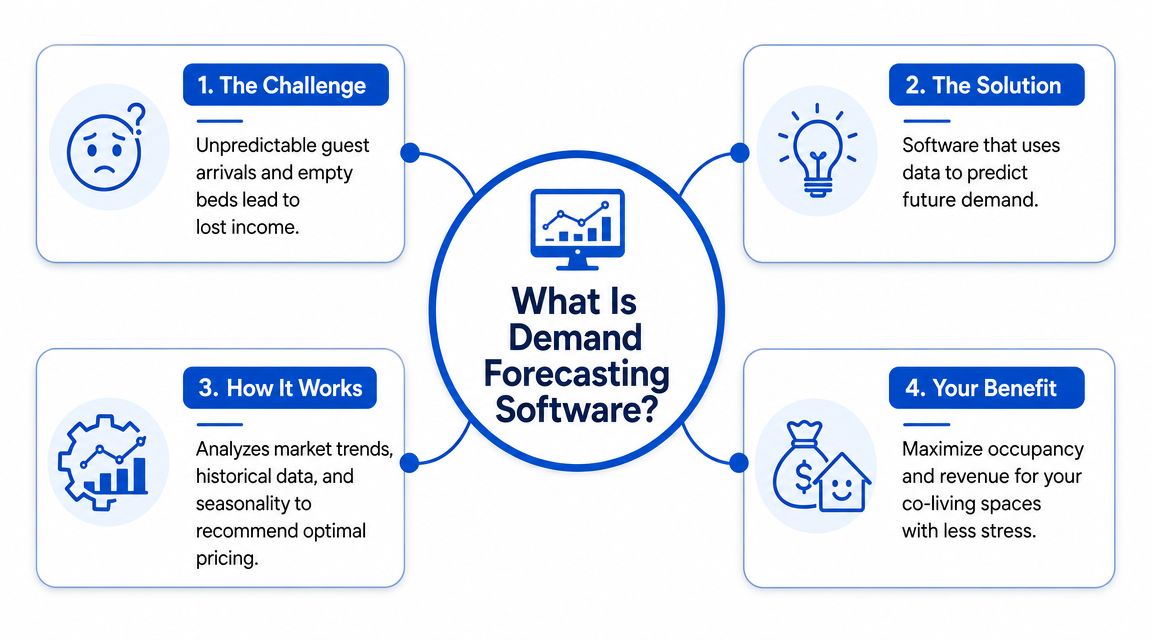
If you run co-living homes, demand forecasting software is best thought of as a decision tool. It helps you estimate future renter demand so you can make better pricing, marketing, and occupancy decisions before a vacancy turns into lost income.
A simple analogy helps. Imagine it as a weather forecast for your rental business. A weather app doesn't control the rain. It looks at patterns and signals so you can carry an umbrella or reschedule a project. Demand forecasting software does something similar for leasing demand. It looks at patterns in your business and market, then helps you decide whether a room will likely need a price adjustment, stronger promotion, or faster follow-up.
What the software is actually doing
Under the hood, modern forecasting tools are built on statistically driven methods. Industry guidance points to methods such as ARIMAX, econometric models, cluster analysis, and exponential smoothing as core capabilities in modern demand-planning systems, with quality tracked through metrics like MAE, MAPE, WMAPE, bias, and FVA in guidance on choosing demand forecasting software.
That sounds technical, but the practical meaning is simple. The software is asking questions like:
- What patterns repeat from week to week or month to month?
- What changed recently in pricing, occupancy, or inquiry flow?
- Which rooms behave similarly and should be grouped together?
- How wrong were past predictions, and did the system improve decisions over time?
Why this matters for a landlord
A room-by-room operator doesn't need a perfect forecast. You need a forecast that's useful enough to improve everyday choices.
Practical rule: A forecast is valuable when it helps you avoid obvious underpricing, reduce empty bed days, or respond faster to changing demand.
If you've ever looked at a room in February and thought, “This isn't the same market as August, so why am I pricing it the same way?”, you already understand the core problem forecasting software tries to solve.
The best way to see it is this. Manual pricing relies on memory and instinct. Demand forecasting software adds structure. It turns scattered signals into a repeatable process, so you're not reinventing your pricing strategy every time a room opens.
How Forecasting Works in Room-by-Room Rentals
In co-living, forecasting starts with pattern recognition. The software studies what happened before, compares it with what's happening now, and estimates what's likely to happen next for a specific room, house, or submarket.
That process is easier to grasp if you split the inputs into two buckets: internal data and external data.
Your internal signals
Internal data comes from your own operation. It usually includes things like:
- Past occupancy by room, house, or neighborhood
- Asking rent and signed rent
- Time to lease after a room becomes available
- Lead volume and inquiry timing
- Move-in and move-out patterns
- Room attributes such as furnished status, private bath, parking, or floor level
Think of this like your property's rental memory. If one room type fills quickly at a certain price range and another consistently lags, the software treats those as different demand patterns.
A landlord often gets tripped up here because they assume they need massive amounts of clean history. In reality, even modest records can reveal useful direction if you track them consistently.
The outside factors that change demand
External data matters because co-living demand rarely depends on your property alone. It's shaped by what's happening around it.
Examples include:
| External signal | Why it matters in co-living |
|---|---|
| University calendars | Student demand often rises before term starts |
| Local hiring news | New jobs can increase room demand nearby |
| Seasonal weather | Heat, storms, or relocation seasons can shift move timing |
| Competitor pricing | Nearby listings influence perceived value |
| Local events | Conferences, construction projects, and policy shifts can change demand |
Seasonality is a good example. A smart landlord already knows that some months feel easier than others. In forecasting terms, seasonality means a pattern that tends to repeat. In a college-adjacent market, August may bring a predictable rush. In a worker-housing market, demand may rise around local hiring cycles instead.
A single-family lease might feel like a yearly event. A co-living room behaves more like a short booking cycle with constant small market signals.
Not magic, just better pattern matching
Modern tools don't just rely on old history. According to this overview of adaptive demand forecasting technology, top systems now use AI, machine learning, and near-real-time data to create forecasts that adapt more quickly to changing conditions.
For a co-living operator, that means the system can respond when old patterns stop being reliable. Maybe a new employer increases demand on one side of town. Maybe a nearby operator drops prices aggressively. Maybe your private rooms start outperforming shared rooms.
If you've been trying to connect pricing to market timing manually, a guide on how dynamic pricing works can help clarify how forecasts and pricing recommendations fit together.
The most useful mindset is this: the software isn't replacing your judgment. It's giving your judgment better inputs.
Key Software Features for Co-Living Operators
A co-living operator rarely needs the kind of forecasting software built for a national retailer with years of clean, high-volume sales data. The harder problem is smaller and messier. You may have one room type with strong history, another with only a few lease cycles, and a third that changed meaning after a renovation or new furnishing package.
That is why the best tools for co-living focus on decision support at the room level. A landlord is not asking, “What will demand be for the whole portfolio next quarter?” The primary question is usually closer to, “Why has Bedroom 3 in this house been sitting longer than the other two, and what should I change today?”
Features that matter in daily operations
Start with room-level pricing suggestions. In co-living, every room behaves a little differently, even under the same roof. A larger room, a room with better light, or a room closer to a shared bathroom can lease on a different timeline. Software should reflect that reality instead of applying one property-wide price like every room is interchangeable.
Next, look for fast updates. A vacancy in a room-by-room portfolio acts more like an open hotel night than a yearly apartment renewal. Once a room is listed, small changes in inquiry volume, competitor pricing, or days on market can matter quickly.
You also want external signal ingestion. Sparse data is common in co-living. Maybe you only have a handful of past leases for a given room type. In that case, the software should pull context from the market around you, such as competing listings, neighborhood demand shifts, or season-specific patterns, rather than pretending your own history is enough.
Then there is forecast tracking. This feature matters because nice charts can create false confidence. You need to see whether the system's recommendations helped you reduce vacancy, protect rent, or spot weak demand earlier.
Finally, check for collaboration tools. In many co-living businesses, pricing decisions are shared across leasing staff, operators, and owners. Good software keeps those decisions in one place so your team can see what changed, why it changed, and who approved it.
Why ranges matter more than a single prediction
Beginners often expect one exact answer from forecasting software. Real leasing does not work that way.
A better system shows a range of likely outcomes. That approach, often called probabilistic forecasting, is explained in this comparison of demand forecasting software capabilities. For co-living, this is useful because uncertainty is normal, especially when each room does not generate much historical data on its own.
A practical way to read this is simple. A forecast should help you judge risk, not just output a number. It should show whether a room is likely to lease quickly at the current rent, whether a small increase might slow leasing, or whether a stale listing needs action now.
A useful platform should help you answer questions like:
- If I raise rent slightly, how much leasing risk am I taking on?
- If I hold price, what is the likely leasing window?
- Which vacancies can wait for a stronger applicant pool, and which ones need faster action?
- Where is the forecast confident, and where is the software working with thin evidence?
The reporting view you actually need
Reporting should feel like a property manager's control panel, not a corporate planning deck. You are trying to spot friction. Which rooms are underperforming, which properties are healthy, and where your pricing strategy is drifting away from what the market will bear.
Look for reporting that makes it easy to review:
- Occupancy by property and room type
- Current asking rent versus achieved rent
- Leasing velocity by room
- Exception alerts for stale vacancies or unusual pricing gaps
- Forecast error trends over time
- Side-by-side views of internal performance and outside market signals
If you are evaluating forecasting alongside operations, leasing, and resident management tools, this guide to co-living software platforms pairs well with the pricing side of the decision.
Good forecasting software helps you make better calls on real vacancies, with the level of detail that co-living actually requires.
Measuring the ROI of Smarter Pricing
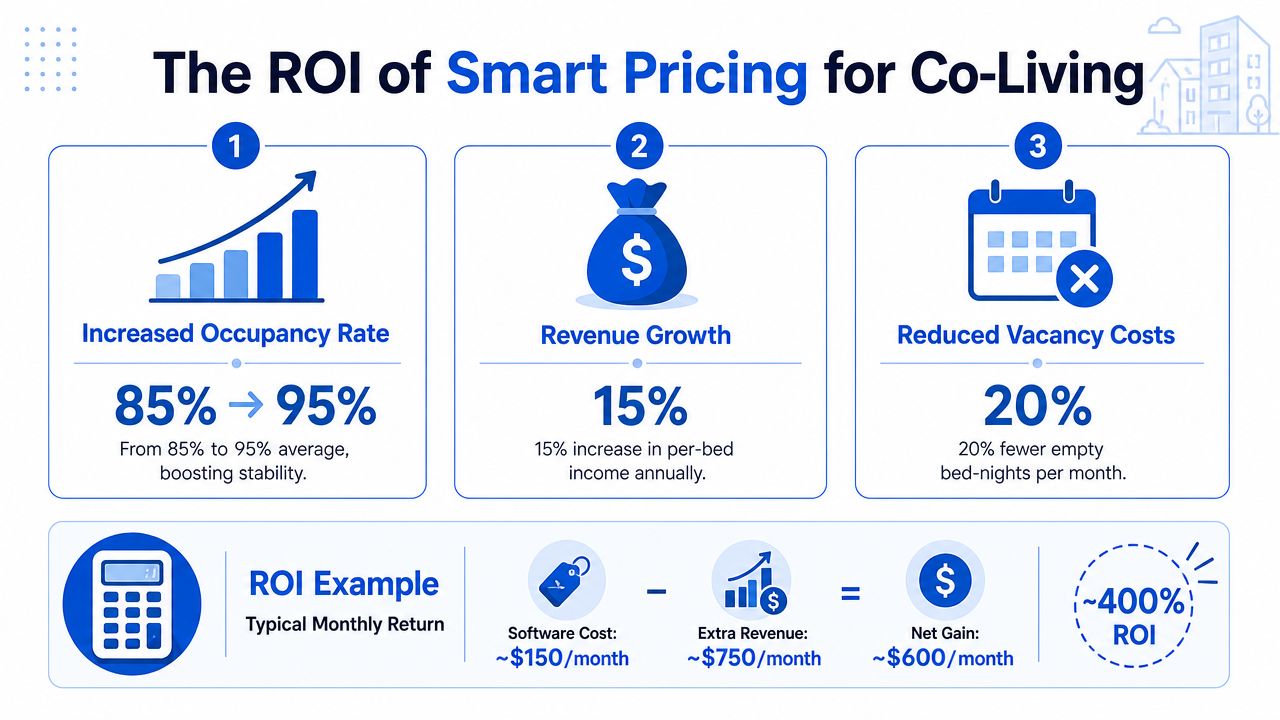
Software is only worth paying for if it improves business outcomes. In co-living, the simplest test is whether it helps you fill rooms more efficiently, protect rent levels, and spend less time making pricing decisions by feel.
That starts with two kinds of measurement. First, you track operating results such as occupancy, achieved rent, and vacancy duration. Second, you track forecast quality, because a forecast that sounds smart but performs poorly won't help your business.
The business case in plain English
A supply-chain industry source citing McKinsey reports that AI forecasting can reduce errors by 20 to 50 percent, with associated gains of up to 65 percent lower lost sales and product unavailability, 5 to 10 percent lower warehousing costs, and 25 to 40 percent improvement in administration costs in this article on AI demand forecasting software.
For a co-living operator, “lost sales” maps closely to vacant room nights or missed lease opportunities. “Administration costs” can show up as less manual repricing, less back-and-forth on stale listings, and fewer rushed decisions.
You shouldn't copy supply-chain assumptions directly onto housing. But the logic carries over cleanly. Better forecasting reduces avoidable mistakes. Fewer mistakes usually mean better occupancy and less friction.
What to track in your own portfolio
A practical scorecard can stay simple:
| Metric | What it tells you |
|---|---|
| Occupancy rate | How full your rooms stay over time |
| Average achieved rent | What residents actually pay, not just list price |
| Revenue per available room | How well each available room produces income |
| Time to lease | How long vacancies remain open |
| Forecast accuracy | Whether the tool is getting closer to reality |
For forecast accuracy, industry guidance commonly uses measures like MAPE and Forecast Value Add, often shortened to FVA. You don't need to become a statistician. The point is to compare predicted demand with actual results and see whether the software improves your decisions over manual methods.
If your forecast says a room will be hard to fill, and you adjust early instead of waiting through a vacancy, the value came from the decision, not just the prediction.
A helpful financial lens is to connect pricing performance to your broader income picture. If you want that bigger view, gross effective income in rental operations is the right place to start.
A Practical Guide to Getting Started
Most small operators hesitate for one reason. They assume they don't have enough data to use demand forecasting software well.
That concern is real, but it doesn't mean you should wait for perfect records. Enterprise content often assumes clean, high-volume data, yet smaller operators often have sparse or irregular demand history. Guidance for inventory and demand challenges notes that methods like exponential smoothing can work with smaller datasets, and newer tools increasingly pull in external signals when history alone isn't enough, as described in this discussion of demand forecasting challenges.
Start with what you already have
You don't need a data warehouse. A basic spreadsheet is enough to begin if it includes:
- Vacancy dates for each room
- List price and signed price
- Move-in timing
- Simple room attributes
- Notes on unusual events, like renovations or major local disruptions
If your data is messy, that's normal. Clean enough beats perfect. The first goal is consistency.
Build a local demand calendar
Co-living demand often changes for reasons that never appear in your property management system. Create a simple market calendar with events such as:
- University move-in periods
- Large local employer hiring cycles
- Seasonal slowdowns
- Transit or neighborhood changes
- Competing property openings
Many small landlords outperform larger operators. You know the block, the commute, the school calendar, and the local demand quirks better than a generic national model does.
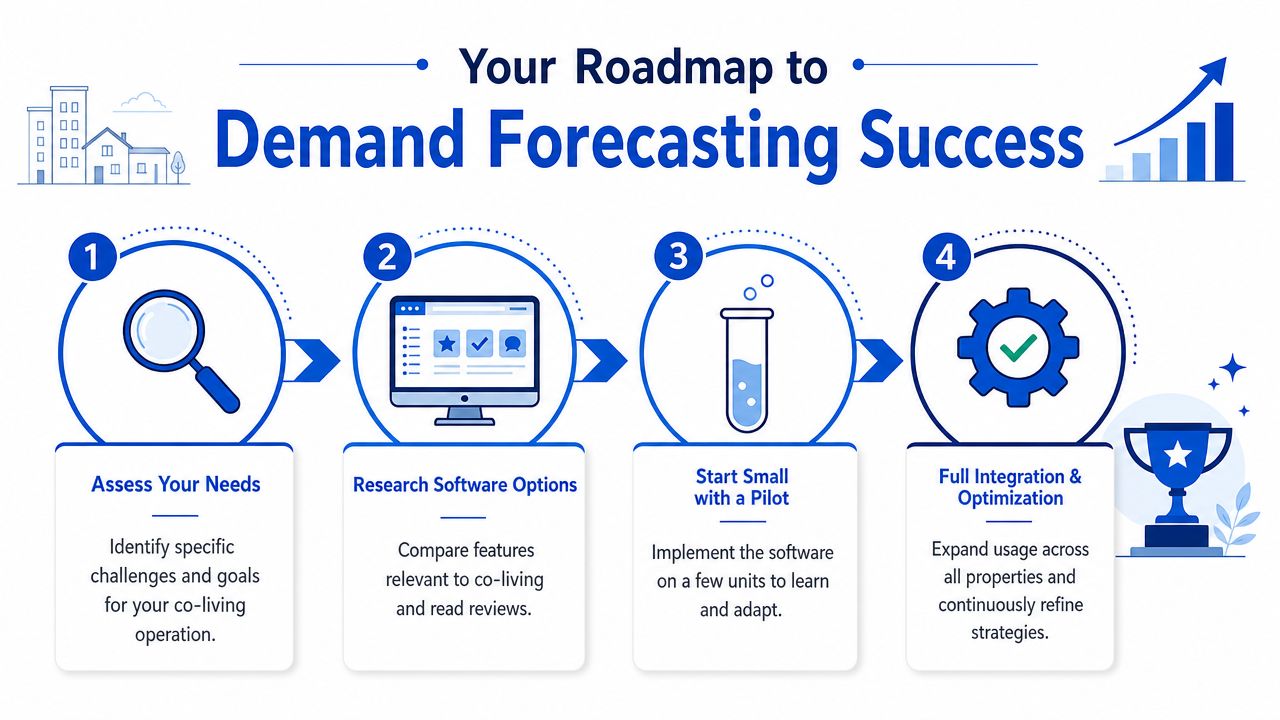
Pilot before you commit
Don't roll out a new workflow across every room at once. Choose a few units or one house and test it.
A small pilot works best when you:
- Pick similar rooms so you can compare outcomes more fairly.
- Set one review rhythm, such as a weekly pricing check.
- Document overrides when you ignore the recommendation and why.
- Review what happened after leases are signed.
Field note: More AI isn't automatically better. Sparse data still needs context, segmentation, and human review.
Treat the first months as training
Early forecasting use should feel more like guided learning than autopilot. Watch for patterns such as one room type consistently leasing faster, one neighborhood becoming more price sensitive, or one season behaving differently than expected.
A good first setup checklist looks like this:
- Keep inputs simple rather than collecting every possible variable
- Separate room types instead of averaging unlike units together
- Review misses to learn whether data quality or market shifts caused them
- Use external signals when your own history is too thin
- Refine gradually rather than changing strategy every few days
That last point matters. In co-living, overreacting can be just as costly as doing nothing. The strongest operators use forecasting software as a feedback loop. They test, review, and improve.
The Future of Co-Living Is Data-Driven
A co-living operator with 20 rooms used to make pricing calls the way many landlords still do. A quick scan of nearby listings, a feel for the season, and a best guess about what renters would pay. That approach gets harder to trust when leases are shorter, move-ins happen room by room, and one unfilled bedroom can drag down the whole property's income.
The next phase of co-living software is not just better charts. It is better timing. Good forecasting tools will keep getting more useful because they can connect small signals that room-by-room operators already see but rarely combine well: inquiry volume, tour activity, time-to-fill by room type, employer cycles nearby, university calendars, and even which layouts tend to lease first in a given house.
For co-living, that matters because sparse data is normal.
A 200-unit apartment building can learn from a large pool of similar units. A shared house with six bedrooms cannot. That means the best tools for this market will be built less like enterprise revenue systems and more like a smart property manager who remembers every leasing season, every room type, and every local pattern. In practice, that often means blending your own history with external market inputs instead of waiting years to collect enough internal data.
The future also points toward more automation around the forecast itself. If the software sees demand softening for private rooms in one neighborhood, it could suggest price adjustments sooner, change listing language, or prompt faster follow-up with qualified leads. If it sees a seasonal spike coming, it could help operators prepare inventory, tighten discounting, and reduce vacancy before the rush starts. It works a lot like a landlord who already knows August leases differently from January ones, but with a better memory and a weekly review habit.
That shift is as much operational as technical. Co-living operators who use data well will not hand every decision to a model. They will use forecasts to run a calmer, more consistent business: fewer reactive price cuts, clearer expectations for leasing teams, and stronger pattern recognition across homes that may look similar on paper but behave differently in the market.
Over time, "data-driven" in co-living will mean something practical. Fewer guesses. Faster learning. Better decisions from thin, messy, real-world rental data.
If you want a simpler way to manage pricing, operations, and portfolio visibility for room-by-room rentals, join the interest list for PadPulse. It's being built specifically for PadSplit hosts and co-living operators who want to fill vacancies faster, improve NOI, and run a more data-driven business without adding more manual work.