What Is Property Management Software: Your Essential 2026
May 25, 2026
A landlord with one single-family rental can get surprisingly far with a spreadsheet, a notes app, and a few payment methods. A co-living operator usually hits the wall sooner.
One house can mean six residents, six payment histories, different move-in dates, shared utility questions, lock-code changes, maintenance requests tied to common areas, and a vacancy that is not a whole unit but one room that needs to be filled fast. The work is less like collecting rent from one household and more like coordinating a small living operation.
Property management software is what brings that operation under control. It works like the central nervous system for your rentals, carrying information from leasing, rent collection, maintenance, documents, and resident communication into one place so you are not chasing answers across texts, apps, and memory.
That shift matters most when your setup is room by room. In a traditional rental, you may only need to know whether one lease is active and whether one tenant paid. In co-living, you need a live picture of who is in each room, what each person owes, what bed or room is opening next, which shared-space issue affects multiple residents, and which tasks are still unresolved.
That is why new operators start asking what property management software is. They are not asking for a definition from a software category page. They are trying to solve a daily problem. They want one operating record for the property, so they can stop piecing together the business from a spreadsheet, Zelle notifications, and late-night text threads.
Once you see it that way, the software stops sounding like an extra tool. It starts to look more like the system that keeps a growing co-living portfolio organized enough to run well.
From Chaos to Control An Introduction
It usually starts on a Tuesday night.
You are checking who paid, trying to confirm whether Room 3 is still available for Friday, answering a text about a clogged shower that affects half the house, and searching your email for the lease that one resident swears they signed. Nothing feels dramatic on its own. The problem is that every answer lives in a different place.
That is the moment many landlords realize they do not have a system. They have a collection of habits.
For a single-unit rental, those habits can hold up for a while. For co-living and room-by-room rentals, they break down faster. One property may have six residents, six payment schedules, six sets of documents, shared spaces used by everyone, and turnovers that happen room by room instead of all at once. A vacant bedroom is not a small detail. It is income sitting idle while you piece together status updates from texts, notes, and bank alerts.
Property management software fixes that problem by giving you one place to run the work.
What property management software is
Property management software is a platform that brings the daily jobs of operating rentals into one system. Leasing, payments, maintenance, documents, and resident communication live in the same place, so you are not switching between a spreadsheet, a payment app, and your message history to understand what is happening.
For a new landlord, the clearest way to understand the difference is this. A spreadsheet records facts. Property management software records facts and ties them to action.
That means you can quickly see:
- Who is living in each room or unit
- What each resident owes and whether they paid
- Which lease is active, ending soon, or still unsigned
- What maintenance issues are open and who is handling them
- Which documents are stored for each resident
- What happened at the property, with a timestamped record
For co-living operators, that last point matters more than it first appears. If three housemates report the same kitchen plumbing issue, you want one tracked request, not three disconnected text threads. If one resident moves out and another is scheduled to move into the same room a week later, you need a clear record of the turnover, not a sticky note reminder.
The software works like an operating system for the property. Without it, you spend too much energy remembering. With it, you can spend more energy managing.
Why small landlords use it too
Many first-time owners assume software is for large apartment companies with onsite staff and hundreds of units. In practice, smaller operators often feel the need sooner because they have less room for error.
If you manage co-living homes, one missed detail can affect several residents at once. A late lock-code update, an unclear utility charge, or a maintenance issue in a common area can turn into a stream of messages from multiple people. Software helps you keep those moving parts organized before they pile up.
As noted earlier, property management software has become a standard business tool across the market. The practical takeaway is simple. Using software is no longer a sign that your operation is huge. It is a sign that you want reliable records, faster follow-up, and fewer things slipping through the cracks.
The Core Concept A Central Hub for Your Properties
The best analogy is a simple one. Property management software works like the central nervous system for your rentals.
Your properties send signals every day. A payment comes in. A resident reports a plumbing issue. A lease approaches renewal. A contractor finishes a repair. A room turns over. If those signals go to different places, your operation feels fragmented. If they flow into one system, you can react faster and with fewer mistakes.
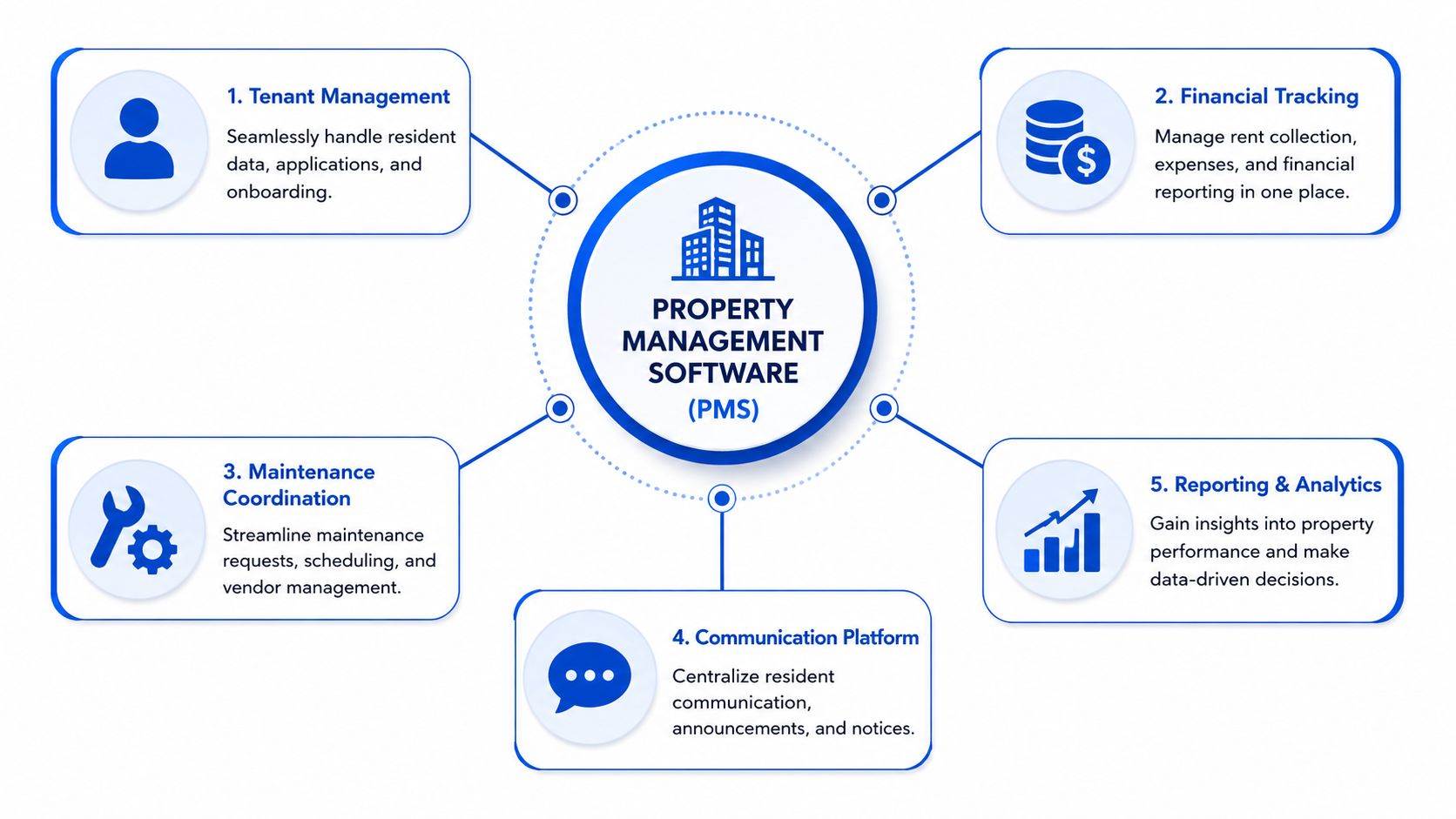
One source of truth
The phrase people often use is single source of truth. In plain language, that means everyone checks the same place for the same answer.
If a resident says they paid rent, you don't search your bank app, then your notes app, then your messages. You check the payment record. If you need to confirm a lease end date, you don't open an old email thread. You open the resident record. If a maintenance issue was reported last week, you can see the request, status, and timeline in one place.
That's a bigger shift than it sounds. The software doesn't just store data. It standardizes how work gets done.
Why cloud systems matter
A major reason this category became more practical is the move to cloud-based tools. TenantCloud notes that over 70% of the software market is cloud-based, reflecting the shift toward centralized tools for digital rent collection, lease tracking, maintenance coordination, and financial reporting in its overview of property management software statistics.
Cloud-based matters because you don't need to be at one office computer to run your business. You and your team can check records, send messages, review payments, or update tasks from wherever you work.
Practical rule: if the answer to a basic property question depends on who last updated a spreadsheet, you don't have a system yet. You have a habit.
For co-living operators, this central hub matters even more. Shared housing creates more touchpoints per property. More residents. More messages. More work orders tied to common areas. More move-ins and move-outs. The more moving parts you have, the more valuable a central hub becomes.
Anatomy of Property Management Software Core Features
Property management software is a transactional system of record that replaces disconnected spreadsheets and emails. MRI Software describes how these systems automate reminders, payments, and work orders so each action is timestamped and reportable from one database in its property management software guide.
That definition sounds technical, but the day-to-day meaning is straightforward. The system records the work of operating rentals and keeps that work organized.
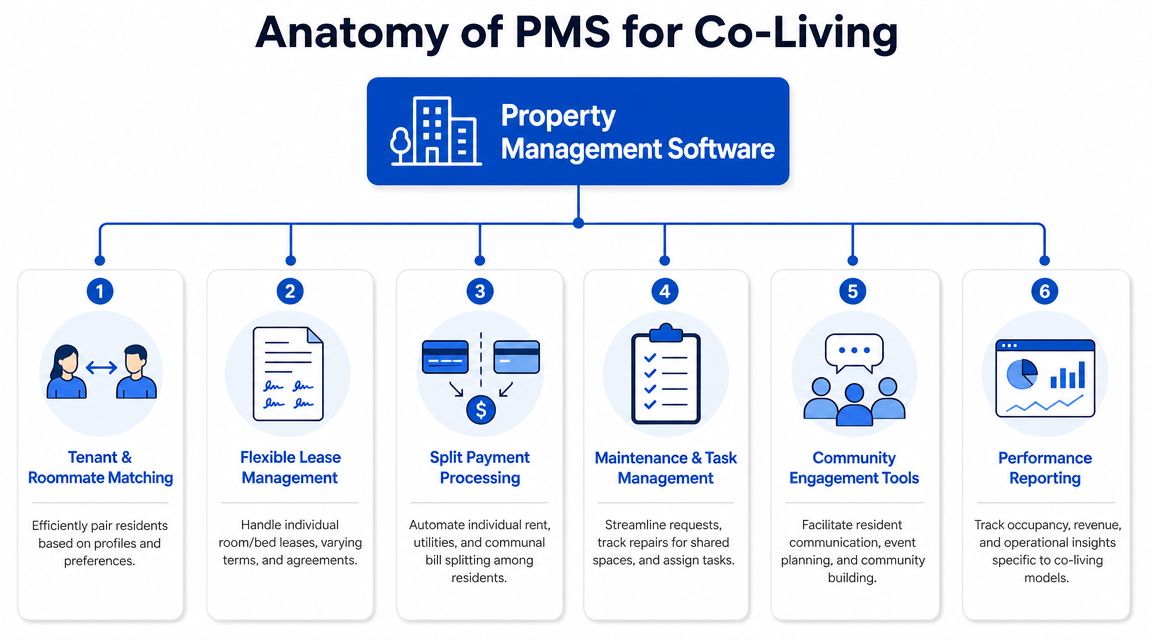
Tenant and lease management
At this point, most owners first feel the relief.
Instead of separate files for each resident, the software creates a resident record with contact info, lease terms, payment history, notices, and documents. In a co-living house, that can mean tracking separate agreements for different rooms under one property.
That solves a common beginner problem: confusing the property with the resident. The house is one asset. The leases inside it are multiple relationships, each with its own dates and obligations.
Online payments and rent reminders
Manual rent collection creates invisible admin work. You check apps, confirm amounts, send reminders, answer “did you get it?” texts, and update records afterward.
A modern system usually brings that into one workflow:
- Payment collection: residents pay through one defined channel
- Reminder automation: notices go out before or after due dates
- Receipt tracking: payment history stays attached to the resident record
- Balance visibility: you can quickly see who paid and who still owes
For room-by-room operators, this is especially helpful because one late payer shouldn't force you to rebuild the whole property ledger by hand.
Here's a closer visual example of how operators think about these workflows in practice:
Maintenance tracking
Maintenance is where informal systems break down fastest.
A resident texts about a leak. Another sends a photo to your personal phone. A contractor replies by email. A week later, nobody remembers whether the issue was fixed or just acknowledged.
Property management software turns that into a trackable work order. You can log the request, assign it, update the status, and keep a record of the timeline. In a shared house, that matters because problems in common areas affect multiple people at once.
Accounting and reporting
Good software doesn't replace judgment. It replaces repetitive reconciliation.
You still decide what to spend, when to repair, and how to price. But the system helps organize income, expenses, and records so you can understand the property's financial picture without rebuilding it every month.
Communication tools
Residents need updates. Owners need documentation. Staff and vendors need clarity.
A centralized communication log helps keep those conversations tied to the property and resident, instead of floating across personal texts and inboxes. That becomes important when turnover rises or multiple people help manage the same property.
A message in your phone is easy to send. A message attached to the property record is easy to manage.
Vacancy and listing workflows
Some platforms also help market vacancies and manage applications. That's useful for operators who want fewer gaps between move-out and move-in.
In co-living, this can be the difference between advertising a full house incorrectly and accurately showing one available room with the right terms, amenities, and timing.
Spreadsheets and Zelle vs An All-in-One Platform
Most landlords don't switch because they suddenly love software. They switch because manual methods start producing friction.
The old setup usually looks harmless. A spreadsheet for balances. Zelle for payments. Texts for maintenance. Email folders for leases. Then one resident disputes a payment, another says they never saw the renewal notice, and you spend your evening reconstructing a paper trail.
Side-by-side reality
| Task | Manual Method (Spreadsheets, Texts, Zelle) | Property Management Software |
|---|---|---|
| Rent collection | You check multiple payment apps and update records by hand | Payments and balances live in one system |
| Late follow-up | You remember to text, or forget | Reminders can be automated |
| Lease tracking | Dates sit in a spreadsheet or calendar | Lease terms stay tied to each resident record |
| Maintenance | Requests come through random texts and calls | Work orders are logged and tracked |
| Financial review | You piece together income and expenses manually | Reports are easier to generate from one dataset |
| Resident communication | Conversations are split across phone, email, and apps | Messages are centralized |
| Turnover handling | You search for documents and old notes | Move-out and onboarding steps can follow a set workflow |
Where manual methods usually fail
Manual systems can work for a while. The problem is that they depend on memory and consistency from one person.
If you're tired, busy, or handling several houses, the cracks show up quickly:
- Missed renewals because no one checked the date
- Unclear balances because payment records sit in separate apps
- Maintenance confusion because requests weren't logged formally
- Messy bookkeeping because income and expenses were tracked in pieces
This is also why many landlords eventually separate basic bookkeeping tools from true rental operations tools. If you're sorting out the finance side specifically, this guide to best accounting software for rental properties helps clarify where accounting software ends and property operations software begins.
The real upgrade
A true upgrade isn't “more features.” It's less reconstruction.
Instead of asking, “What happened here?” you can usually see the answer in the record. That changes how the business feels to run. Less chasing. Less guessing. Less time spent proving what already happened.
Specialized Benefits for Co-Living and PadSplit Hosts
Generic property management software often assumes one lease, one unit, one household.
That's not how co-living works.
A co-living house may have multiple residents under separate agreements, different move-in dates, different payment schedules, and a mix of private rooms and shared spaces. That creates a different management problem. You aren't only filling units. You're coordinating a small living ecosystem.

Why room-by-room operations need a different setup
In a standard apartment workflow, one vacancy usually means one empty apartment. In co-living, you may only have one room open while the rest of the house is occupied. That changes everything from pricing to leasing to communication.
A strong system for this model needs to handle details like:
- Individual room or bed tracking instead of only whole-unit status
- Separate resident records within one property
- Shared-space maintenance that may affect several people at once
- Faster turnover workflows because room-by-room operations can move quickly
- Clear house communication for notices that apply to everyone
A generic platform can sometimes be forced to fit this model. But “can be used” isn't the same as “was built for it.”
Where integrations become especially valuable
As platforms get more advanced, they increasingly act as integration hubs. Rentvine notes that modern systems can connect with smart-building devices such as locks and thermostats, allowing occupancy and energy data to flow into the same operational system that manages payments and work orders in its guide to property management software and integrations.
For co-living operators, that matters in very practical ways.
A smart lock isn't just a gadget. It can support controlled access when residents change. A smart thermostat isn't just convenience. It can help manage shared-house comfort and oversight. When those tools connect back to the same operating platform, you reduce the need to manage separate systems with separate histories.
In shared housing, the software shouldn't just know the property. It should understand the difference between a room, a resident, a common area, and an access point.
The often-missed benefit
The hidden benefit is operational clarity.
When a house has frequent inquiries, rolling room availability, shared amenities, and multiple residents under one roof, the hardest part isn't any single task. It's coordination. Better software reduces that coordination burden.
If you're comparing broad platforms and wondering where general-purpose systems start to feel limiting, this breakdown of Buildium vs AppFolio for rental operators is useful context before you look at co-living-specific workflows.
How to Choose and Implement Your First PMS
Choosing your first platform can feel bigger than it is. Most of the fear comes from thinking you need to rebuild your business overnight.
You don't.
The better approach is to choose software based on your operating model, then move your process over in a controlled way. Rentec Direct highlights an often-overlooked truth in its discussion of property management software implementation. The challenge isn't just buying software. It's handling data migration, workflow redesign, and the move away from fragmented tools.
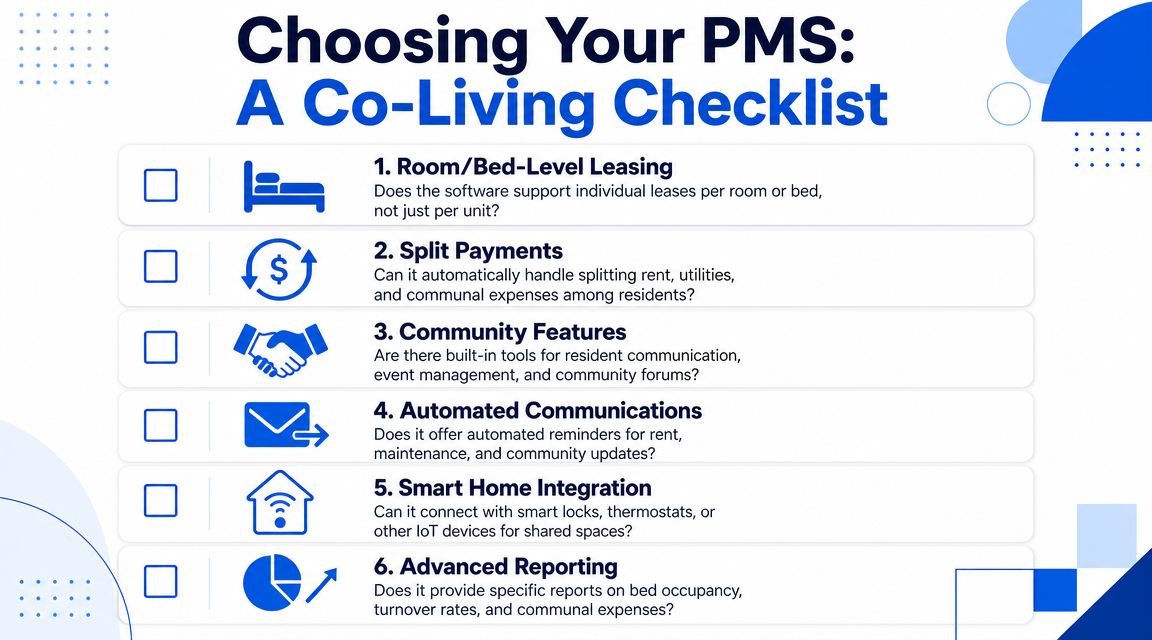
What to look for before you commit
Start with your actual day-to-day problems, not the longest feature list.
Ask questions like these:
- Does it support room-level leasing? If you rent by the room or bed, unit-only logic may create workarounds.
- Can it centralize payments, documents, and operations? You want fewer disconnected tools, not a new layer on top of old chaos.
- How does it handle maintenance? Shared spaces need clear ticketing and status tracking.
- Are communications logged? This matters when different residents need different notices.
- Does it connect with the tools you already use? Integrations matter more than flashy dashboards.
- Will your team use it? A simple system used consistently beats a powerful system nobody updates.
A manageable implementation path
Most first-time buyers do best with a phased setup.
Gather your records
Pull together leases, resident names, balances, payment histories, maintenance logs, and property details. This step usually reveals where your current process is messy.Configure the basics first
Set up properties, rooms, residents, payment rules, and lease templates. Don't try to automate every edge case on day one.Migrate active residents carefully
Focus on current occupancy before importing old archive data. Accuracy matters more than speed here.Train around real workflows
Show yourself or your team how to do common tasks: post a charge, send a notice, log maintenance, update a move-out.Go live in stages
Many operators start with payments and lease records, then expand to maintenance and reporting.
Keep this in mind: implementation feels heavy once. Manual admin feels heavy every week.
One area that often gets overlooked during setup is paperwork. If you want that part to run more cleanly, this article on how to automate document workflow for rental operations is a useful companion.
Your Next Step Toward Smarter Management
So, what is property management software?
It's the system that turns rental operations from scattered activity into a repeatable process. Instead of managing your business through memory, messages, and patchwork tools, you run it through one organized platform. That's the basic shift.
For traditional rentals, that means cleaner leasing, payment tracking, maintenance coordination, and reporting. For co-living and room-by-room operators, the value gets even sharper. You're dealing with more residents per property, more turnover, more shared-space issues, and more daily communication. The cost of disorganization is higher.
If you've outgrown spreadsheets and payment apps, that's not a sign you've failed. It usually means your portfolio is becoming a real operating business. And real operating businesses need systems.
The next smart move is to look for software that matches how you rent, not how a standard apartment workflow assumes you rent.
If you run PadSplit-style or room-by-room rentals, PadPulse is building an all-in-one platform specifically for co-living operators. You can join the interest list for beta updates, early access opportunities, and a closer look at tools designed for pricing, communications, access control, and reporting in shared housing.