What Is Net Operating Income (NOI): 2026 Expert Guide
June 28, 2026
You log into your bank account, see rent deposits coming in from multiple rooms, and feel a quick sense of relief. The house is occupied. Bills are getting paid. There's money moving.
Then the doubt hits.
Are you actually making money, or are you just watching cash pass through the property?
That question trips up a lot of new co-living hosts. It's even more common in room-by-room rentals, where income comes from several members, expenses are spread across shared spaces, and the property can feel busy even when the numbers are weak. A full house doesn't always mean a healthy rental.
If you've been searching for what is net operating income, the simple answer is this: net operating income, or NOI, tells you how much profit the property produces from operations before financing and taxes enter the picture. It strips away the noise and lets you judge the rental itself.
Your Rental's True Financial Health Score
A new co-living host usually starts with the same mental scoreboard.
Rent came in. Utilities got paid. The cleaner was paid. Internet is on. There's still money left in the account. So things must be fine, right?
Not necessarily.
A rental can feel active and still underperform. In a room-by-room house, that's easy to miss because the income arrives in pieces. One member pays on Monday. Another pays midweek. Someone pays a move-in fee. Laundry adds a little extra. Meanwhile, the electric bill spikes, a lock needs replacing, and a turnover costs more than expected. The property stays in motion, but motion isn't the same as profit.
That's why I treat NOI like a property's financial health score. It answers a cleaner question than “How much cash do I have today?” It asks, “How well does this house operate as a business?”
Why bank balance can mislead you
Your bank balance reflects timing. NOI reflects performance.
If you just collected deposits, delayed a repair, or paid insurance on a different schedule, your account balance can look better or worse than the property's actual operating strength. The same goes for your mortgage. A large loan payment can make a solid property feel weak, while a low loan payment can make an average property look stronger than it is.
Practical rule: NOI measures the property. Your bank account measures timing, financing, and cash movement.
That distinction matters even more for co-living. Shared housing has more moving parts than a standard single-tenant lease. You're managing room income, common-area costs, vacancy by bed rather than by unit, and often more frequent turnovers. A rough estimate won't cut it.
What NOI helps you see clearly
NOI gives you a cleaner lens for decisions like these:
- Should I keep this house as a co-living rental? You can compare its operating profit against other uses.
- Is one property outperforming another? NOI helps separate strong operations from personal financing choices.
- Did my latest change improve the business? If you adjusted pricing, reduced vacancy, or cut waste, NOI shows whether it worked.
For a host, NOI is the profitability engine reading on the dashboard. Revenue is the fuel coming in. Expenses are the friction and heat inside the machine. NOI is what the engine produces after doing the work of running the property.
The Net Operating Income Formula Explained
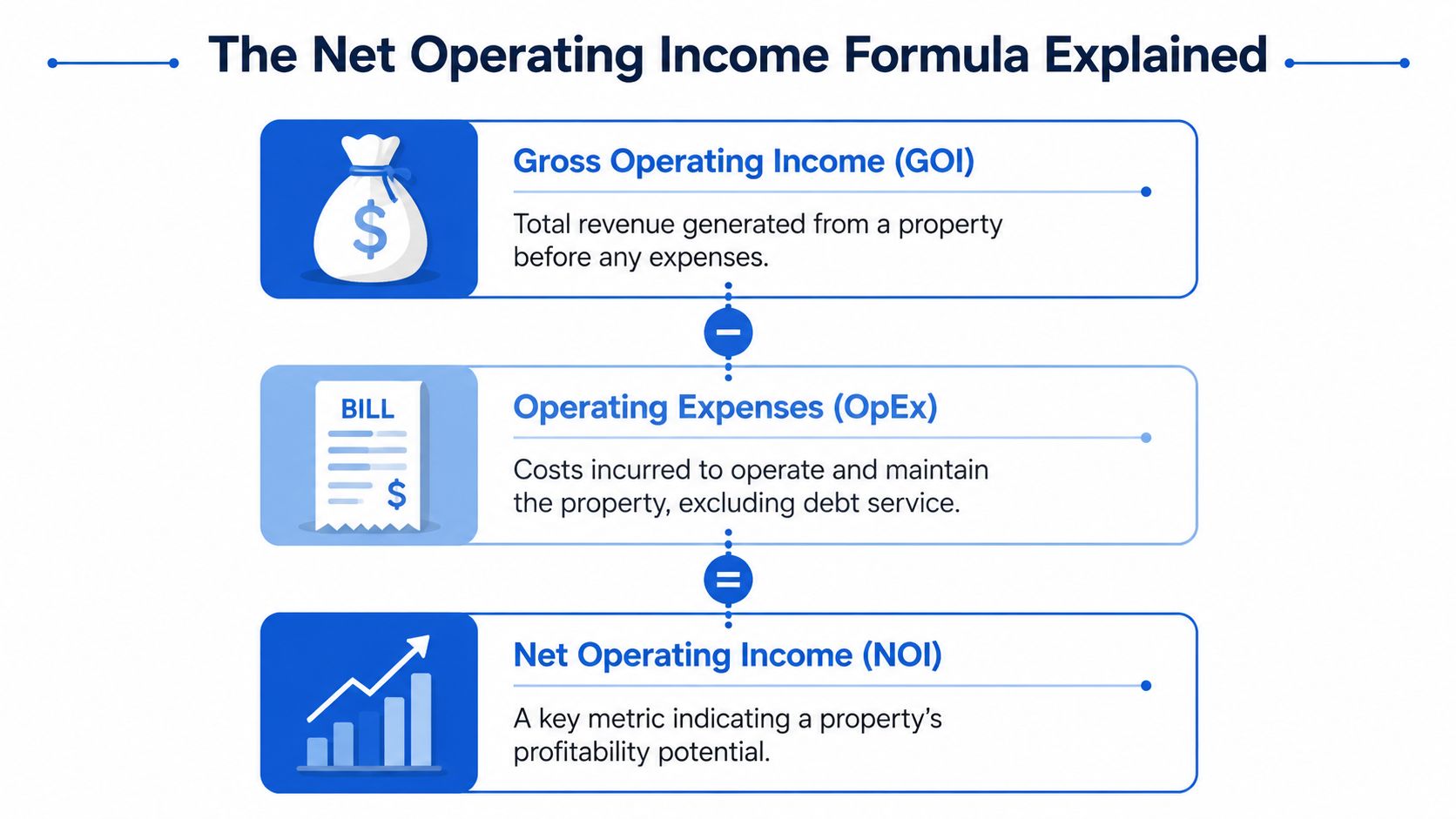
The basic formula is simple:
Gross Operating Income - Operating Expenses = Net Operating Income
If you like analogies, think of your rental as a small operating business. The property takes in income, spends money to keep running, and produces an operating profit. That operating profit is NOI.
Gross operating income
Gross operating income, often shortened to GOI, is the income the property generates from normal operations.
For a co-living house, that can include:
- Room rent: Monthly payments from each occupied bedroom
- Parking income: If you charge for driveway or reserved spaces
- Laundry income: If machines generate revenue
- Storage or upgrade fees: Charges for premium rooms, extra storage, or add-on services
- Other property income: Any recurring income tied to occupancy and use of the house
There's one detail beginners often miss. You shouldn't act like every room is occupied every day of the year. Real properties have turnover. A member moves out. A room sits empty while cleaning happens. A new applicant takes time to onboard. So your income estimate should reflect vacancy and collection reality, not fantasy.
Operating expenses
Operating expenses are the costs required to run and maintain the property.
Common examples include:
- Property taxes
- Insurance
- Utilities
- Routine repairs
- Cleaning and turnover costs
- Lawn care or landscaping
- Property management fees
- Software or admin tools used to manage the rental
- Supplies for shared spaces
- Professional fees tied to operations
These are the costs that keep the house functioning as a rental business.
What doesn't belong in NOI
People often get tangled up on this point. Not every property-related cost belongs in NOI.
Leave out:
- Mortgage principal and interest
- Income taxes
- Depreciation
- Major capital improvements, such as replacing an entire roof or installing a new HVAC system
Those costs matter to your overall investing picture, but they don't belong in NOI because they don't tell you how the property performs at the operating level.
A strong rental can have weak cash flow if the debt is heavy. A weak rental can have passable cash flow if the financing is unusually favorable. NOI helps you separate those two stories.
The profitability engine analogy
Here's the easiest way to keep it straight.
Your co-living property is an engine.
- Income is what you feed into it
- Operating expenses are what it consumes to keep running
- NOI is the usable output
Mortgage payments are not part of the engine. They're part of how you chose to buy the engine. Taxes aren't part of the engine either. They relate to your ownership structure and broader financial picture.
That's why NOI is such a useful measure. It asks one clean question: How much operating profit does this property produce on its own?
How to Calculate NOI with a Step by Step Example
Let's use a hypothetical co-living house with five bedrooms. Room-by-room hosts often first understand NOI in this context, because the math mirrors how the property runs.
Step one with room income
Start with the property's gross potential rent. That means the rent you'd collect if every room were filled for the full period at the expected rate.
For this example, assume the house has:
- Three standard rooms rented at one monthly rate
- One larger room rented at a higher monthly rate
- One smaller room rented at a slightly lower monthly rate
- Small add-on income from laundry and parking
Instead of forcing fake precision, build your own worksheet from the actual room rates you charge. The process matters more than the placeholder number.
Step two with vacancy and credit loss
Now reduce that total for reality.
Even in a well-run co-living house, there's usually some gap between one member leaving and another moving in. Sometimes the room is available but not yet leased. Sometimes a payment issue slows collections. If you ignore that, your NOI will look better on paper than it does in life.
So calculate:
- Potential room income
- minus expected vacancy or collection loss
- plus other recurring property income
That gives you effective gross income, which is the income base many operators use before subtracting expenses.
If you want a more accurate monthly operating picture, build vacancy into the model before you celebrate the top-line rent.
Step three with line-by-line expenses
Next, list the actual costs of operating the house.
For a five-bedroom co-living property, a practical expense list often includes:
| Item | Calculation/Notes | Monthly | Annual |
|---|---|---|---|
| Room rent income | Sum of all occupied room rents at market or in-place rates | Varies | Varies |
| Other income | Parking, laundry, storage, or room upgrades | Varies | Varies |
| Vacancy and collection loss | Reduction for expected unoccupied days or missed collections | Varies | Varies |
| Effective gross income | Room rent plus other income minus vacancy loss | Varies | Varies |
| Property taxes | Local tax obligation allocated monthly | Varies | Varies |
| Insurance | Landlord or dwelling policy cost | Varies | Varies |
| Utilities | Electric, water, gas, trash, internet | Varies | Varies |
| Routine maintenance | Minor repairs, supplies, handyman visits | Varies | Varies |
| Cleaning and turnover | Common-area cleaning and room prep between members | Varies | Varies |
| Landscaping | Lawn care or exterior upkeep | Varies | Varies |
| Management fee | Third-party management or self-management reserve | Varies | Varies |
| NOI | Effective gross income minus operating expenses | Varies | Varies |
This is the right structure even if your exact categories differ.
A clean way to run the calculation
Use this sequence:
- Add scheduled room rent
- Add recurring side income
- Subtract realistic vacancy and collection loss
- Add up all operating expenses
- Subtract expenses from effective gross income
That final result is your NOI.
For many hosts, the easiest way to keep this organized is to track the same categories in a monthly property statement. A profit and loss statement template for rental operators can help you line up room income, shared-house expenses, and recurring operating costs in a format you can review every month.
Where co-living hosts often slip
In a standard single-family rental, the math is simpler because there's usually one rent check and fewer operational variables. In a co-living house, you need to watch for these nuances:
- Utilities matter more: Shared housing often includes owner-paid internet and other services.
- Turnover is more frequent: One room can go vacant while the rest of the house stays occupied.
- Premium rooms distort averages: An ensuite or oversized room may carry more of the income burden.
- Common-area wear shows up faster: Furniture, locks, paint, and supplies can become recurring operating items.
If you build your NOI at the room level and then roll it up to the house level, you'll get a much more honest picture.
Why NOI Is the Most Important Metric for Investors
NOI isn't just an accounting number. Investors use it because it helps answer two big questions: What is this property worth? and How much debt can this property reasonably support?

How NOI influences value
In income-producing real estate, buyers often think in terms of cap rate, short for capitalization rate. In plain language, cap rate is a way of connecting a property's operating income to its market value.
The basic relationship is:
Market Value = NOI / Cap Rate
You don't need to be a finance person to use the concept. If a market values similar properties based on the income they produce, then improving NOI usually improves value. A house with stronger room income, lower vacancy, and better expense control often becomes more attractive to an investor because the underlying business is healthier.
That matters for co-living operators. If you run a house more efficiently than the average landlord, you aren't just creating better monthly performance. You may be improving the value of the asset itself.
Why lenders care about NOI
Banks and lenders also pay close attention to NOI because it helps them judge whether the property can carry debt safely.
They want to know if the property's operations are strong enough to support payments, not whether the owner feels optimistic. If your income is inconsistent, your vacancy assumptions are unrealistic, or your expense reporting is thin, your file becomes harder to defend.
That's one reason experienced operators document their property financials carefully. Lenders like clean records, stable operations, and a believable story about income and expenses.
Investor lens: NOI is one of the clearest ways to compare two properties without getting distracted by different loan terms or tax situations.
A short visual explanation can help if cap rate still feels abstract.
Why this matters more in co-living than many hosts realize
Room-by-room operators sometimes focus so much on occupancy that they underweight operational quality. But investors and lenders both care about whether the income is durable.
A co-living house with strong leasing, controlled utility usage, fast turn times, and disciplined expense tracking often looks more credible than a house that boasts high gross rent on paper. Gross rent can impress for a minute. NOI holds up under scrutiny.
That's why seasoned investors keep asking the same question: after the property does the work of operating, what's left?
Actionable Strategies to Improve Your NOI
You improve NOI in only two ways. Increase income or reduce operating expenses. The best operators work both sides at the same time.
For co-living and room-by-room rentals, the details matter. A small improvement across several rooms can reshape the house's performance faster than a broad, unfocused effort.
Increase the income your house already has the potential to earn
Start with pricing.
Many hosts underprice rooms because they want fast occupancy, then leave rates untouched while demand shifts around them. That creates a quiet leak in the profitability engine. The room stays full, but it may not be earning what the market would support.
A few practical levers:
- Adjust by room type: A larger room, ensuite, or room with better natural light shouldn't be priced exactly like the smallest bedroom.
- Shorten vacancy gaps: Faster cleaning, better listing photos, and prompt lead follow-up help the next member move in sooner.
- Add sensible extras: Parking, storage, premium furnishings, or other optional upgrades can create additional income without changing the core rent.
- Review concessions carefully: A discount that fills a room quickly may help. A lazy discount policy can train the market to wait you out.

Cut waste without damaging the resident experience
Most expense control in co-living comes from operational discipline, not dramatic cuts.
Look first at recurring friction:
- Utilities: Shared housing can burn through electric and water faster than expected. Better monitoring, house rules, and smart controls help.
- Maintenance: Small repairs become expensive when ignored. A dripping faucet, loose lock, or bad caulk line can turn into a larger issue.
- Vendor drift: Cleaners, groundskeepers, internet plans, and handymen should be reviewed periodically.
- Turnover process: Every extra day between residents costs income and often adds labor.
One area many hosts overlook is utility visibility. If owner-paid water is part of the model, water usage monitoring for rental properties can help you spot unusual consumption before a bill arrives and surprises you.
Focus on the levers unique to room-by-room rentals
A traditional landlord might focus on annual rent growth and major repairs. A co-living operator needs tighter control over the daily mechanics.
These often have the biggest NOI impact:
| Lever | Why it matters for NOI |
|---|---|
| Room mix strategy | Better matching price to room quality lifts total income |
| Turn speed | Shorter downtime protects effective gross income |
| Shared utility control | Prevents common-area overuse from eating profit |
| House rules and screening | Reduces damage, conflict, and costly churn |
| Common-area upkeep | Protects reviews, renewals, and leasing speed |
Don't chase higher revenue while ignoring operational drag. In co-living, a room filled at the wrong price and a house run loosely can still produce disappointing NOI.
Build a repeatable review habit
NOI doesn't improve because you calculate it once. It improves because you review the same categories regularly and act on what changed.
A simple monthly review might include:
- Income review: Which rooms underperformed, and why?
- Vacancy review: How long did turns take?
- Expense review: Which bills jumped unexpectedly?
- Action list: What can you fix before next month closes?
That habit turns NOI from a static formula into a working management tool.
Common NOI Mistakes and Accounting Nuances
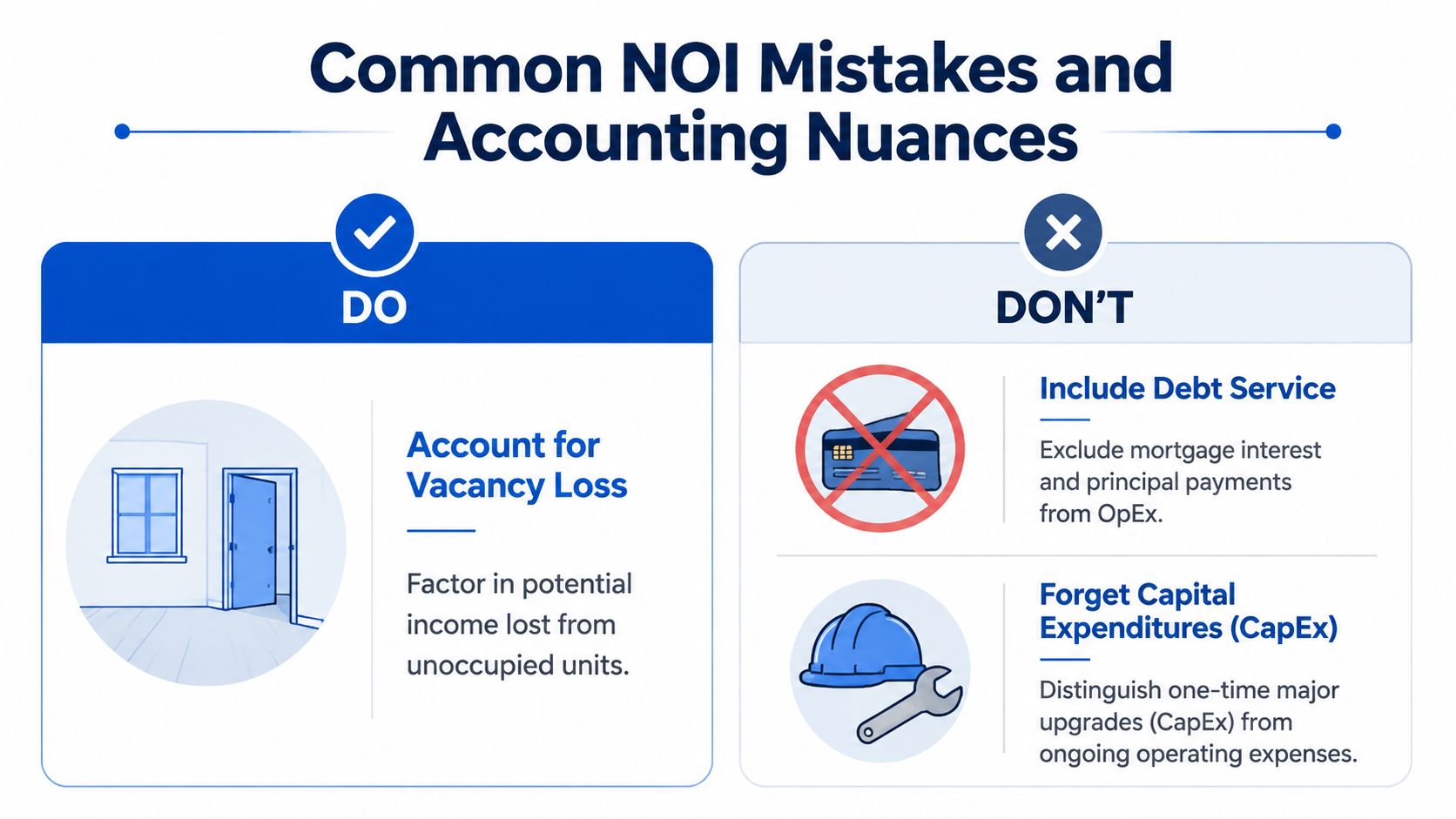
Most NOI errors come from categorizing the wrong thing the wrong way. The formula is simple. The judgment calls are where people slip.
A quick do and don't list
- Don't include mortgage payments: Principal and interest are financing costs, not operating expenses.
- Do account for vacancy loss: A fully occupied fantasy pro forma can make a weak deal look healthy.
- Don't bury major upgrades in operating expenses: A new roof, full HVAC replacement, or other major capital item belongs in a different bucket.
- Do include less obvious operating costs: Professional fees, leasing support, software, admin costs, and management oversight still count.
- Don't confuse irregular timing with profitability: Annual insurance or tax timing can distort a single month if you don't normalize it.
- Do reserve a management cost even if you self-manage: Your time has operational value, and the property should be able to stand on its own economics.
The nuance for co-living houses
Shared housing creates a few extra traps.
A host may forget to include cleaning between room turns because it feels occasional rather than monthly. Another may leave out internet because it's “small,” even though it's part of the operating model. Others ignore vacancy because the house is never fully empty, even when one or two rooms regularly sit open.
That's why category discipline matters. If the cost exists because the house operates as a co-living rental, it deserves a close look in your NOI model.
For hosts who want cleaner books and more reliable property-level reporting, this guide to property management accounting basics is a useful next step.
Clean NOI starts with consistent bookkeeping. If categories drift from month to month, the final number won't tell you much.
PadPulse is building an all-in-one platform for PadSplit hosts and co-living operators who want tighter control over pricing, communications, access, and property financials. If you want updates on the Winter 2026 launch projection, early beta access, and ways to improve operating visibility across room-by-room rentals, join the interest list at PadPulse.