Boost NOI: Water Usage Monitoring for Co-living in 2026
June 11, 2026
Water bills rarely become urgent until one month looks completely wrong.
That's the moment most co-living operators start paying attention. A house that seemed stable suddenly throws off your numbers. Tenants say nothing unusual happened. The property looks fine. No burst pipe, no flooding, no obvious crisis. But your margin just took a hit, and you still don't know why.
That's why water usage monitoring matters in rent-by-the-room housing. Not because dashboards are exciting. Not because sensors are trendy. It matters because shared homes produce messy, overlapping usage patterns, and utility waste hides inside that mess. If you're running co-living homes, you need a system that helps you catch problems early, assign follow-up clearly, and communicate with residents without turning every spike into an argument.
The Business Case for Monitoring Water Usage
Treating water monitoring as a maintenance gadget is a costly mistake. In co-living, it is an operating control tied directly to NOI.
A familiar scenario. The house is full, no one reports a problem, and the next water bill lands 25 percent above normal. Now someone on your team has to compare occupancy, message residents, call a plumber, and decide whether this was a one-off spike or the start of a bigger issue. That is time, payroll, and margin disappearing before you have an answer.
The baseline is already higher than many owners expect. The average American uses 82 gallons of water per day, and the typical American household uses 138 gallons per day, according to Mr. Rooter's summary of water usage benchmarks and leak figures. In a rent-by-the-room property, that baseline gets harder to interpret because usage rises and falls with move-ins, guests, cleaning turns, and shared-kitchen habits. Without monitoring, every bill increase turns into a guessing exercise.
Small leaks are not small business problems
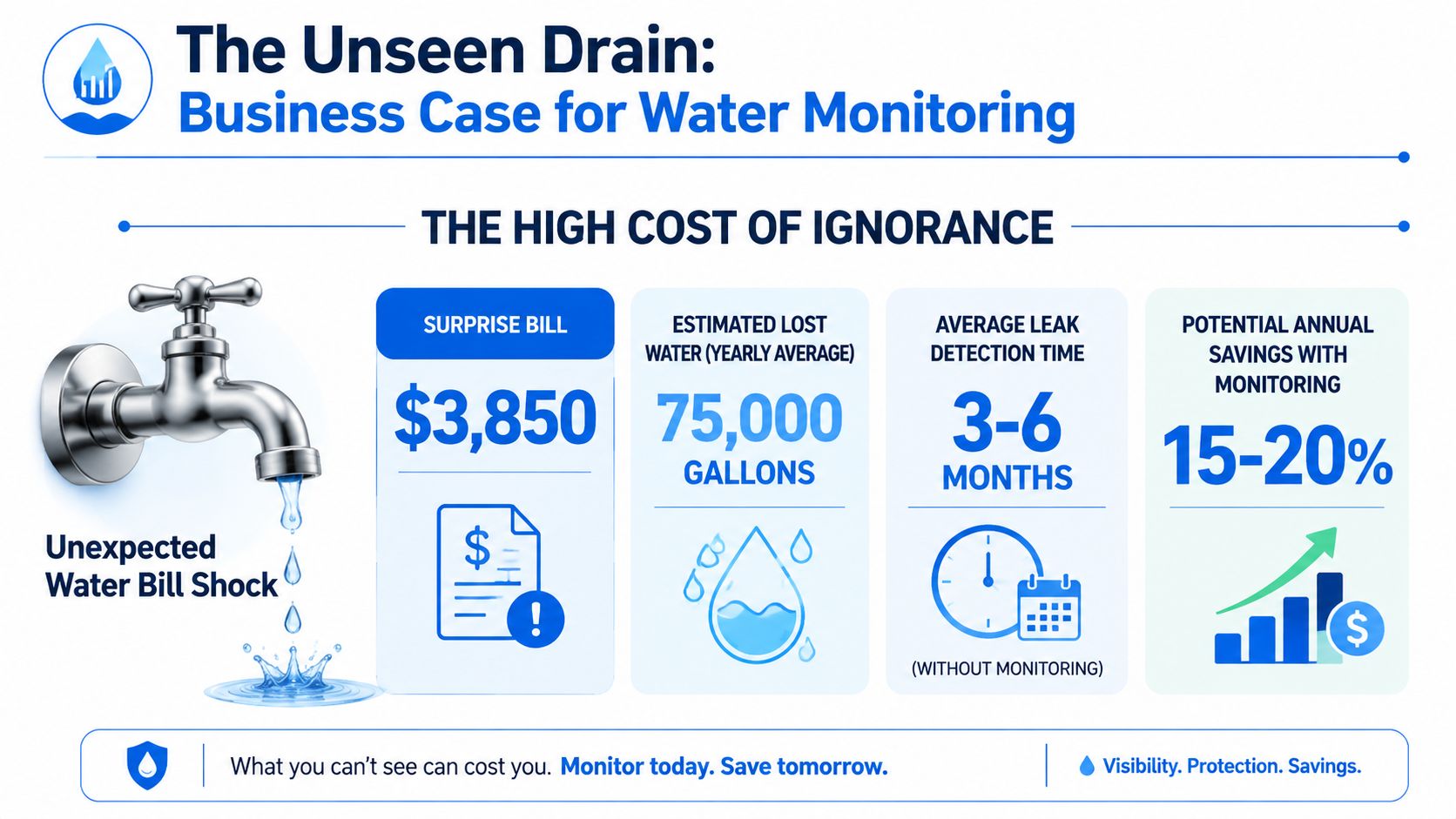
The expensive water problems in co-living are often the quiet ones. A slow toilet leak, a dripping faucet, or a faulty fill valve can run for weeks because normal resident activity masks the pattern.
The same source notes that a faucet dripping at one drip per second can waste about 17 gallons per day, and common home leaks can waste about 180 gallons per week or 9,400 gallons per year. In a single-family home, that may stand out faster. In a six-bedroom shared house, it blends into showers, laundry, dishes, and turnover cleaning.
I wish I had understood this earlier. The issue is rarely just the water itself. It is the chain reaction. More maintenance coordination, more tenant messages, more vendor visits, and more disputes about whether residents caused the spike.
Practical rule: If the bill feels off but not alarming, investigate early. That is often where the savings are.
Why this improves NOI
Water monitoring improves the business in three concrete ways:
- Lower utility expense: You catch waste before it runs through multiple billing cycles.
- Less staff time spent guessing: Your team stops chasing vague complaints with no timeline or pattern.
- Cleaner resident management: You can address overuse, leaks, and house rules with actual usage data instead of hunches.
That third point matters more in co-living than in a standard rental. In room-by-room housing, utilities are often bundled into rent or split loosely across residents. That setup is simple until one house starts consuming far more water than expected and no one can explain why. Monitoring gives operators a factual basis for house-level decisions, tenant communication, and, when needed, fairer cost allocation.
The cost objection is real. Hardware, installation, and another dashboard all add friction. But the bigger expense is running shared housing blind and finding out about abnormal usage from a monthly invoice, after the waste has already hit the P&L.
Choosing Your Monitoring Hardware
Most buyers start with products. Operators should start with use cases.
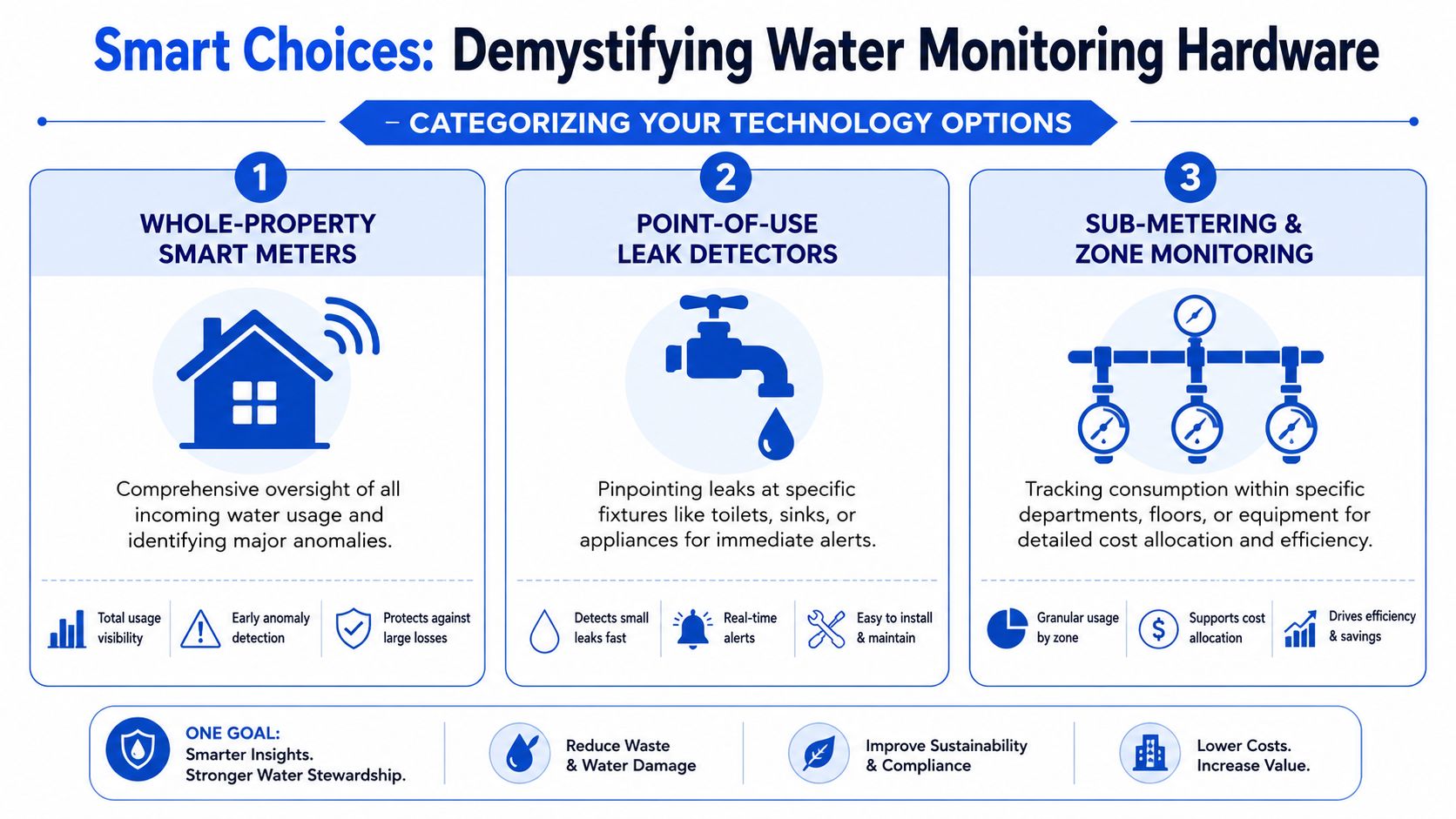
For co-living, there are three practical hardware buckets. Each solves a different management problem. If you pick the wrong one, you'll either overspend on detail you never use or underspend and end up with data too vague to act on.
Whole-property monitors
A whole-property monitor sits at or near the main line and tells you what the house is doing overall.
This is the best fit when you want to answer broad questions fast. Is the house using water continuously overnight? Did usage spike after a turnover? Is there likely a leak somewhere in the building? For operators managing several homes, this is usually the cleanest first layer because it creates one alert stream per property instead of a mess of disconnected device notifications.
Whole-property monitoring works well for:
- Leak triage: You know something is wrong before the next bill arrives.
- Portfolio oversight: You can compare houses by pattern, not just invoice total.
- Simple rollout: One install can cover the entire property.
What it doesn't do well is explain exactly which bedroom or fixture caused the issue. It tells you there's a problem. It doesn't always tell you where.
Point-of-use sensors
These are fixture-specific devices placed near toilets, sinks, water heaters, laundry areas, or other risk points.
They're useful when you already know where your recurring headaches live. If one house has aging toilets, repeated under-sink leaks, or appliance-related issues, targeted sensors can reduce the search time dramatically. They're also useful in older homes where a main-line monitor gives you alerts, but the plumbing layout makes diagnosis slow.
Their trade-off is fragmentation. You get precision at specific spots, but not a complete property picture. If you rely only on point-of-use sensors, you may miss problems outside the monitored areas.
For most shared houses, point-of-use devices work best as a second layer, not the only layer.
Sub-metering and zone monitoring
Sub-metering tracks defined portions of the property. That might mean a floor, an addition, a detached unit, or a specific branch line.
For co-living operators, water usage monitoring becomes a management tool instead of just a maintenance tool. If you want to allocate costs more fairly, compare one zone against another, or support utility policies with actual usage records, sub-metering is the category to look at. It's especially useful in houses with semi-independent living areas or where one part of the property consistently drives complaints.
Here's the cleanest way to understand it:
| Hardware type | Best for | Weak spot |
|---|---|---|
| Whole-property monitor | Fast anomaly detection across the house | Limited detail on source location |
| Point-of-use sensor | Specific leak-prone fixtures and appliances | Incomplete building visibility |
| Sub-meter or zone monitor | Cost allocation and area-level accountability | More planning and installation complexity |
Accuracy matters more than most buyers realize
If your goal is leak alerts, rough accuracy may be acceptable.
If your goal is tenant billing support or resident disputes, accuracy becomes a much bigger issue. Third-party testing cited in this review comparison of smart water monitors found that some devices over-reported daily usage by about 7%, others by roughly 5% to 10%, and one showed less than 1.5% deviation from the utility meter. That's a real operational distinction.
Use a simple filter when buying:
- Good enough for alerts: A device that reliably flags unusual flow may still be useful even if it isn't billing-grade.
- Needs tighter precision: If you plan to support room-level charges or defend pass-through costs, test accuracy against the utility meter before you build policy around it.
- Don't assume low-cost equals wrong: Some devices perform well. Some don't. Validate before rollout.
The mistake isn't buying an imperfect monitor. The mistake is using leak-detection hardware as if it were dispute-proof billing infrastructure.
Connecting Your System and Collecting Data
Most water monitoring setups fail at the boring layer. Not the sensor. The connection.
Operators get excited about the hardware and then discover that the device sits in a basement with weak Wi-Fi, the app sends too many meaningless alerts, or nobody knows where the data lives. The good setups are simple. Sensor, network, dashboard, alert path. If one of those pieces is shaky, the system becomes noise.
The network layer
Think of the network as the road between the meter and your phone.
Some devices use Wi-Fi. That's usually fine for smaller houses where the install location has a stable signal and reliable power. The problem is that many main water lines sit in garages, utility closets, or mechanical areas where Wi-Fi is weakest. In those houses, a sensor can be technically installed and still be operationally unreliable.
Other systems rely on protocols like Z-Wave or low-power long-range options. For operators, the exact protocol matters less than one question: who owns the connection path when something breaks? If your installer sets up a stack of hubs, repeaters, and app bridges, make sure someone on your team can troubleshoot it later.
A few practical checks save a lot of pain:
- Test signal at the install point: Don't assume the hallway router reaches the meter closet.
- Ask about offline behavior: Some devices queue data and sync later. Others go dark.
- Keep one owner for alerts: If maintenance gets app notifications but operations pays the bill, things get missed.
The platform layer
The platform is where raw readings turn into something usable.
You can run water usage monitoring through a general smart-home stack, or through a dedicated water dashboard. Smart-home platforms are flexible, but they often create extra setup work and too many consumer-style notifications. Dedicated dashboards usually give clearer usage history, cleaner alert settings, and better property-by-property oversight.
If you're evaluating software, check whether it helps you connect utility data, smart devices, and property-level workflows in one place. A platform built around operational integrations, such as PadPulse connections for property systems, can be useful if you want water monitoring tied to the rest of your co-living stack rather than living in another isolated app.
A dashboard isn't valuable because it shows charts. It's valuable if a house manager can open it in under a minute and know whether the issue is urgent.
The data layer
This part is easier than people expect. Modern systems usually collect data automatically.
Commercial guidance described in Envigilance's overview of water usage patterns recommends building baselines from at least 30 days of continuous data, with 90 days preferred for more reliable normalization. The same guidance notes that monitoring systems commonly collect readings every 15 to 60 seconds, that commercial facilities should track use at least hourly, and that abnormal patterns can be identified within minutes of deviation onset. It also notes that a deviation of more than 15% above expected consumption is already treated as a warning threshold in commercial monitoring guidance.
For operators, the takeaway is straightforward. Don't judge the system in the first week. Let it learn the property. Shared homes have weekday patterns, weekend patterns, turnover days, cleaning days, and occasional outlier events.
What matters most is consistency:
- Install the sensor in a stable location.
- Keep connectivity reliable.
- Let enough data accumulate to establish normal behavior.
- Review alerts against what happened in the house.
- Adjust your thresholds so the system interrupts you only when it should.
Turning Data Into Actionable Insights
Most water monitoring programs break after installation.
The sensors work. The app works. The data is technically available. But nobody has decided who responds when the alert hits, how fast they respond, or what “resolved” means. That's why some operators end up muting notifications and going back to monthly bill review.
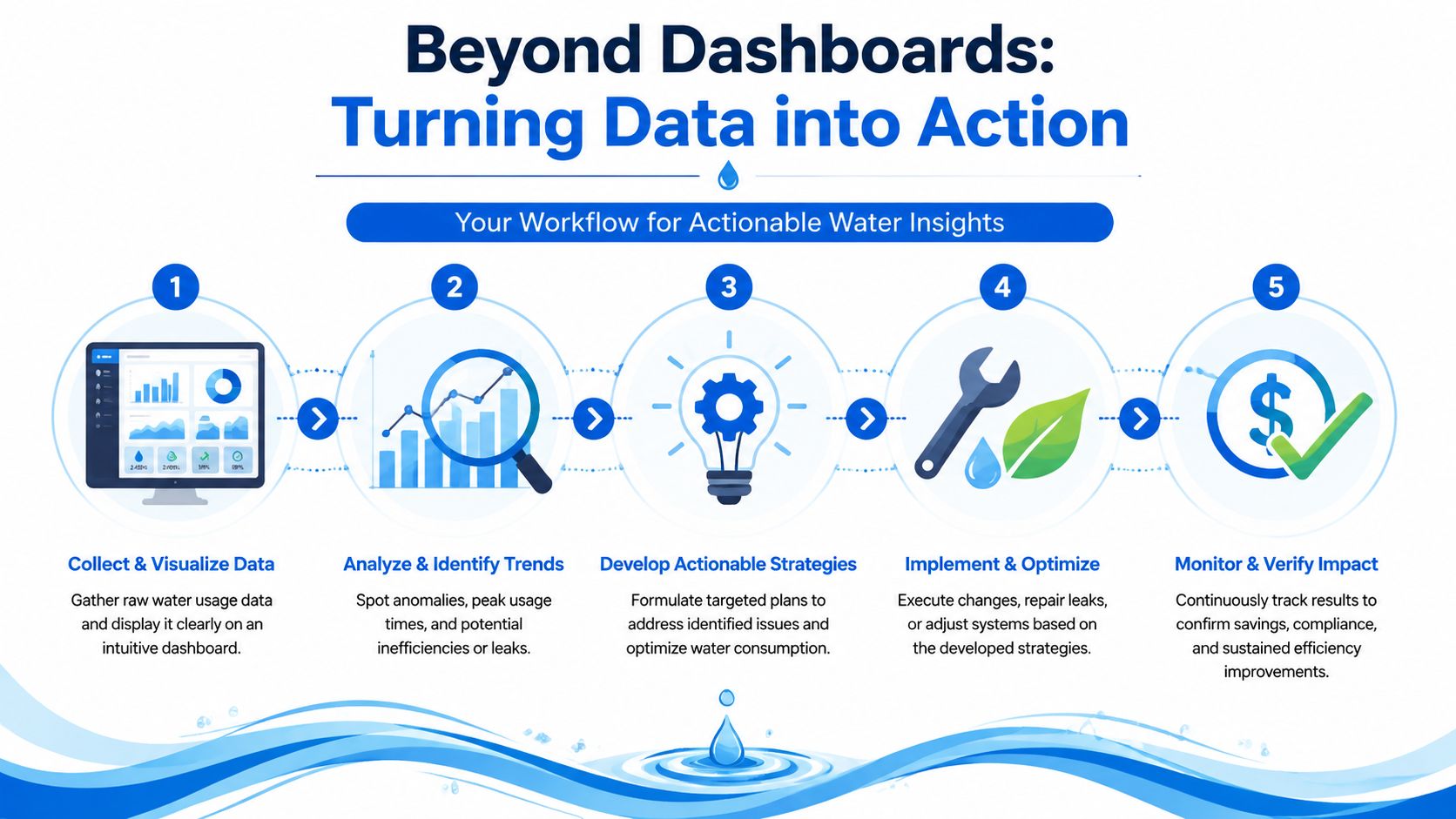
The hard part isn't collecting information. As Badger Meter's discussion of visibility and analytics makes clear, there's a real gap between having water data and changing behavior. The toughest operational question is workflow design after a spike is detected.
Build alerts around patterns, not panic
A useful alert system distinguishes between different types of events.
A large sudden spike may point to a major leak, a hose left running, or heavy but legitimate activity such as cleaning or move-in day. A small continuous flow is often more important in shared housing because it can indicate a running toilet or fixture issue that won't trigger resident complaints right away. Those are the problems that gradually erode margin.
I've found that operators get better results when they categorize alerts by action path instead of by technical severity alone.
- Immediate action alerts: Continuous abnormal flow, suspected active leak, or water use during times the house should be quiet.
- Same-day review alerts: Unusual but not urgent spikes that may be occupancy-related.
- Trend alerts: Gradual pattern changes that suggest a fixture is degrading or house behavior has shifted.
Use a simple triage checklist
When an alert comes in, the team should not improvise.
A basic triage process works better than a complicated playbook that nobody remembers. If you're managing co-living homes, the first response should sort the issue into one of three buckets: likely resident-driven use, likely maintenance issue, or unknown. Then assign one owner.
Here's a practical sequence:
- Check timing: Did the alert happen during normal shower, laundry, or cleaning hours?
- Check occupancy context: Was there a new move-in, turnover, vendor visit, or known maintenance task?
- Check duration: Did usage stop on its own, or is it continuing?
- Contact the right person: Resident if the issue may be behavior-based, handyman if it looks fixture-related, operator if it affects billing or escalation.
- Verify closure: Don't mark it resolved when someone says “looks fine.” Confirm the pattern returned to normal.
A daily operational dashboard helps here. If your team already uses resident and property workflows, something like PadPulse Daily Pulse fits naturally as a place to review unresolved anomalies alongside the rest of the day's tasks.
If nobody owns verification, the same toilet can be “fixed” three times and still run all month.
What works and what doesn't
What works is boring and repeatable:
- One response owner per alert
- Clear escalation rules
- Resident-friendly first contact
- Post-repair verification in the data
What doesn't work is also predictable:
- Sending every alert to everyone
- Treating dashboards as the workflow
- Assuming maintenance closed the issue because the visit happened
- Blaming residents before checking fixture behavior
The best operators don't stare at charts all day. They use water usage monitoring to shorten the time between anomaly, action, and confirmation.
Smart Billing and Tenant Communication
Water gets personal fast in co-living.
Residents don't like feeling monitored, and they really don't like surprise policy changes. If you introduce water usage monitoring without a communication plan, even a sensible system can feel punitive. The fix is transparency. Explain what you're tracking, why you're tracking it, and how the information will be used.
Three billing models that work in shared housing
Most operators land on one of these models.
Bundled utilities are the simplest. Water stays included in rent, and monitoring is used internally for leak detection, property benchmarking, and operational review. This works well when you want the least resident friction.
Split-by-room allocation divides the bill across occupied rooms using a house rule you disclose upfront. Monitoring doesn't necessarily determine each resident's exact charge, but it gives you a factual way to identify abnormal house-level consumption and decide whether a maintenance issue drove the bill.
Usage-informed allocation uses sub-metering or zone-level data to support more precise cost sharing. This model can feel fairer, but it requires stronger hardware accuracy, cleaner lease language, and better resident education. If your system isn't reliable enough to support disputes, don't pretend it is.
How to introduce monitoring without creating distrust
The framing matters. Residents respond better when water usage monitoring is presented as a fairness and maintenance tool, not as surveillance.
Send a short notice before launch. Keep it plain.
We're adding water monitoring to help us catch leaks faster, reduce waste, and keep utility costs predictable. This system tracks water flow at the property level and helps us identify maintenance issues early. It isn't being installed to monitor private activity inside bedrooms or bathrooms.
That last sentence matters. In co-living, people want to know where the line is.
Use the same tone when a usage issue comes up. Don't accuse. Start with the property.
Example message for a house-wide spike
Hi everyone, we saw unusual water usage at the house and are checking for a possible plumbing issue. If you've noticed a running toilet, dripping faucet, or appliance problem, please message us today so we can get it fixed quickly.
Example message for a likely room or zone issue
Hi [Name], we're reviewing a water usage alert tied to an area near your room or bathroom. This may be a fixture issue rather than anything you did. Have you noticed a toilet running, sink dripping, or anything unusual in the last day or two?
Where operators get into trouble
The human mistakes are usually these:
- Changing billing logic mid-lease without enough notice
- Using weak device data as if it were audit-proof
- Sending tense messages before checking for maintenance causes
- Failing to explain the resident benefit
If you want cooperation, make the resident benefit obvious. Faster leak repair. Fewer outages. Fairer utility handling. Less finger-pointing. That's what people care about.
A good communication plan also protects your team. When residents already understand why monitoring exists, each alert becomes a maintenance workflow, not a conflict.
Calculating ROI and Ensuring Compliance
The ROI usually becomes obvious the first time a leak alert saves a unit turn, a resident dispute, or a surprise utility bill review with the owner.
In co-living, the return is not just lower water spend. It shows up in fewer maintenance fire drills, less staff time spent arguing over shared utilities, and cleaner cost allocation in a rent-by-the-room setup. That matters because small operational leaks often hurt NOI more than the water bill itself.
A practical ROI check
Start with a simple formula:
Estimated annual avoided water cost + estimated avoided repair/admin cost - annual system cost
That last line item should include more than the device subscription. Count install labor, battery replacements if applicable, and the time your team spends reviewing alerts during the first few months. I wish I had modeled that upfront. The systems still penciled out, but the payback timeline was clearer once I included the actual operating effort.
A useful operator-level check looks like this:
- How often are leaks found only after the bill arrives?
- How many staff hours go into chasing unexplained spikes, resident questions, and vendor visits?
- How often does a water issue create a tenant complaint, room transfer request, or service credit discussion?
- Can better usage data support fairer utility allocation across rooms, floors, or shared bathrooms?
- Will owners get cleaner reporting on preventable loss and property performance?
If you want to pressure-test the math before buying hardware, use a water monitoring ROI calculator for rental operators.
The best ROI cases usually come from properties with frequent toilet leaks, older plumbing, high roommate turnover, or recurring disputes over utility handling. Newer buildings can still benefit, but the payoff often comes more from workflow control than from dramatic water reduction.
Compliance and privacy basics
Compliance is mostly about clear disclosure, narrow data collection, and using the system for the purpose you told residents about.
Water monitoring should focus on flow and consumption tied to property operations. If usage data may affect charges, maintenance response, or investigations, spell that out in the lease package, house rules, or utility addendum. In co-living, vague language creates avoidable friction later.
Keep these rules in place:
- Disclose the system clearly. Residents should know what is installed, where it is installed, and what it measures.
- Match the data to the use case. If the device is good for leak alerts but not precise enough for room-level rebilling, do not treat it as billing-grade evidence.
- Keep records. Document alerts, inspections, resident communication, and repair outcomes.
- Apply policies consistently. Cost allocation and follow-up procedures should not change from resident to resident.
- Review local lease and utility rules. Billing practices and notice requirements can vary by market.
This walkthrough gives a useful visual sense of how operators think about utility management inside a connected property stack.
The operators who get the most value from water monitoring treat it as an operating policy, not just a gadget. They define how alerts are triaged, what counts as evidence, when residents are contacted, and how costs are handled. That is what turns sensor data into fewer disputes, faster fixes, and better NOI over time. That's the core benefit.
If you're building a co-living operating system and want one place to manage property workflows, utility visibility, and resident operations, PadPulse is developing tools for room-by-room operators who care about NOI, speed, and cleaner day-to-day execution.