Property Management Accounting for Co-Living: A 2026 Guide
June 25, 2026
You're probably in the same spot most new co-living hosts hit after the first few move-ins. Rent isn't arriving as one clean payment. It's coming in from multiple residents, on different dates, with separate deposits, fees, and reimbursements tied to one house. Then the electric bill lands, someone paid for a replacement lock, another resident moved in mid-month, and your spreadsheet starts looking like a crime scene.
That confusion usually isn't a discipline problem. It's a system problem. Most accounting advice for landlords assumes one lease, one tenant group, one utility profile, and one deposit per unit. Co-living doesn't work that way.
Property management accounting for room-by-room rentals needs more detail, tighter workflows, and cleaner separation between property-level costs, shared household costs, and room-specific activity. If you build that foundation early, you protect your cash flow, make tax time easier, and stop guessing which rooms or houses are profitable.
Why Traditional Accounting Fails Co-Living Operators
A new host often starts with the tools they already know. One bank account. One spreadsheet tab per house. One income line for rent. One expense line for utilities. That setup can survive a single-family rental. It breaks quickly in co-living.
A five-bedroom home might produce five separate rent payments, multiple utility reimbursements, application fees, move-in charges, and security deposits from different people tied to the same address. If you record all of that at the property level only, you lose visibility fast. You can't tell which room is underperforming, which resident is behind, or whether shared costs are eating your margin.
The spreadsheet trap
The first failure point is usually revenue tracking.
If all rent goes into one line called “123 Main Rent,” you can't answer basic operating questions:
- Which room is vacant most often
- Who made a partial payment
- Whether one room's lower rate is still profitable after turnover and repairs
- How much of this month's cash belongs to deposits instead of income
Then expenses pile on. Internet serves the house. Electricity may be shared unevenly. A lock replacement belongs to one room. Cleaning after a move-out may belong to one resident event, not the whole property. Standard landlord bookkeeping doesn't show you where to place those costs with enough precision.
Standard rental accounting assumes the unit is the business object. In co-living, the room is often the operating unit that matters most.
This is an industry problem, not just your problem
The complexity isn't going away. According to the property management accounting guide citing U.S. Bureau of Labor Statistics data, property managers are projected to see 15% job growth from 2022 to 2032, driven by the increasing complexity of property management accounting, especially in co-living and room-by-room rentals.
That matters because it confirms what operators already feel on the ground. The work is getting more granular, not less.
What generic systems get wrong
Traditional setups fail co-living operators in a few predictable ways:
- They lump revenue together. That hides room-level performance.
- They blur deposits and income. That creates compliance headaches.
- They treat utilities as one simple bill. That misses real allocation decisions.
- They ignore resident-level ledgers. That makes delinquency and credits messy.
- They report too late. By the time you spot a leak in profitability, you've already lost margin for months.
The fix isn't more hustle. It's a chart of accounts and bookkeeping workflow built for the way co-living functions.
The Co-Living Accounting Foundation
A solid accounting system should feel like a filing cabinet where every dollar has one correct folder. If the folders are too broad, you lose the story. If they're too messy, you stop trusting your books.
For co-living, the foundation is a granular chart of accounts. According to Hemlane's property management accounting resource, a chart of accounts for property management must be organized around Assets, Liabilities, Equity, Income, and Expenses, with sub-accounts tracking activity by individual property, unit, and lease so you can calculate accurate NOI.
Start with the five categories
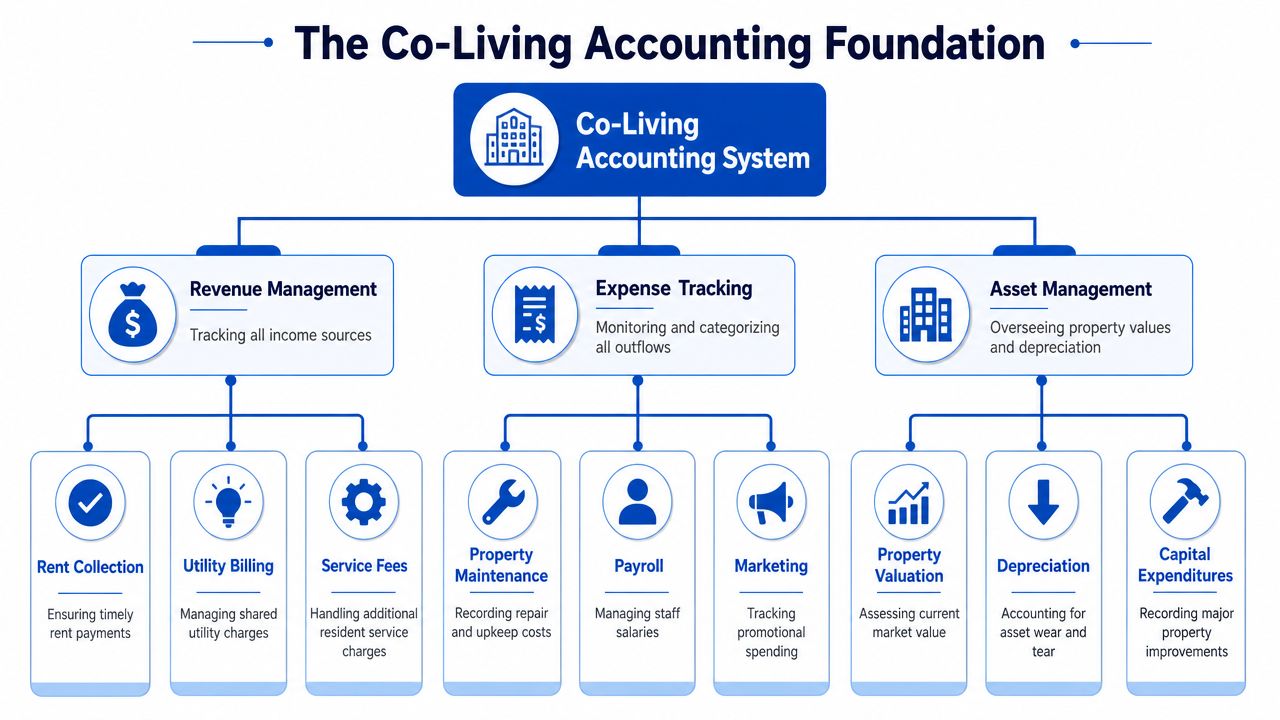
At the top level, keep the classic structure:
| Category | What belongs here in co-living |
|---|---|
| Assets | Operating cash, deposit cash, prepaid items, furniture, appliances |
| Liabilities | Security deposits held, unpaid bills, loan balances |
| Equity | Owner capital and retained earnings |
| Income | Rent by room, application fees, utility reimbursements, laundry, other resident charges |
| Expenses | Repairs, utilities, cleaning, software, supplies, marketing, management costs |
That's the skeleton. The useful detail lives in the sub-accounts.
Build room-level visibility into the chart
For a room-by-room house, broad categories like “Rent Income” and “Repairs” aren't enough. You need names that help you read performance without opening ten reports.
A practical setup might include:
- Income
- Rent Income, House A, Room 1
- Rent Income, House A, Room 2
- Utility Reimbursement, House A
- Application Fees
- Expenses
- Repairs, House A, Room 1
- Repairs, House A, Common Area
- Electricity, House A
- Internet, House A
- Turnover Cleaning, House A
- Liabilities
- Security Deposits Held, House A, Room 1
- Security Deposits Held, House A, Room 2
That level of detail makes your monthly review cleaner. If one room keeps generating make-ready costs, you'll see it. If a house looks profitable only because reimbursements are mixed into rent, you'll catch that too.
Your resident ledger should support this structure. If you need a quick refresher on what belongs in one, this guide to a rent ledger and what it should show is useful.
Practical rule: If a transaction would make you ask “which room?” or “which resident?” later, code it that way now.
Treat deposits like held funds, not earned money
Security deposits are where beginner books often go sideways.
In co-living, each resident may pay a separate deposit even though they share a kitchen, bathrooms, or living room. That means you need resident-level deposit tracking, not one pooled number in your head or one generic line in a spreadsheet.
What works:
- Record each deposit under a liability account.
- Tie it to the specific resident and room.
- Maintain a clean record of move-in date, amount held, deductions, and refund status.
- Keep a process for partial deductions when damage is tied to one room versus a shared area.
What doesn't work:
- Booking deposits as rent.
- Combining all deposits into one untracked lump.
- Refunding from memory instead of from a ledger.
- Charging shared-area damage to the wrong resident without documentation.
Keep the structure simple enough to maintain
Granular doesn't mean bloated. You don't need endless one-off categories. You need a system that answers real operating questions quickly:
- Which rooms produce the best NOI?
- Which houses carry the highest utility burden?
- Which residents owe money right now?
- How much deposit liability are you holding?
- What did turnover really cost this month?
If your chart of accounts can answer those questions, your accounting foundation is doing its job.
Mastering Daily Bookkeeping Workflows
Once the chart of accounts is in place, the daily work matters more than the setup. Good books come from boring consistency. Bad books come from “I'll clean it up later.”
That's especially true in co-living because standard guidance usually skips the hardest part. As noted by RealPage's overview of property management accounting, most standard property management literature fails to explain how to track income and expenses when a single property is divided into multiple revenue-generating rooms with shared utilities, which creates compliance risk around shared bills and per-room deposits.
Record income by resident event, not just by house
The cleanest revenue workflow is to post money based on what happened.
When cash comes in, record:
Who paid
Tie the payment to the resident, not only the property.What the payment was for
Rent, late fee, utility reimbursement, application fee, deposit, or other charge.Which room or house it belongs to
The same address can hold multiple revenue streams.Which period it applies to
This matters when someone prepays or pays late.
A practical daily routine looks like this:
- Post each resident charge when due.
- Match each incoming payment to the charge.
- Leave partial balances open if the resident underpays.
- Keep deposits separate from operating income.
- Review unapplied cash before the day ends.
If you're comparing systems that can support this workflow, this roundup of the best accounting software for rental properties helps clarify where general tools start to strain.
Allocate expenses by cost type
Most co-living expense mistakes come from weak allocation rules. Don't decide ad hoc each month. Pick a method and use it consistently.
Three buckets work well:
| Cost type | Example | How to think about it |
|---|---|---|
| Property-level fixed cost | Mortgage, property tax, insurance | Belongs to the whole property |
| Shared household cost | Internet, electricity, water, trash | Usually allocated across rooms or tracked at house level for analysis |
| Room-specific cost | Lock change, room repaint, furniture replacement | Charge to the specific room when possible |
This doesn't mean every shared cost must be billed back to residents. It means your books should still show where the cost sits.
A simple utility allocation example
Say you receive a $400 electric bill for a five-bedroom co-living house.
A basic bookkeeping method could look like this:
- Debit Electricity Expense, House A: $400
- Credit Cash or Accounts Payable: $400
Then for internal performance tracking, allocate that expense across the five rooms using your chosen rule. If you split evenly, you'd assign one-fifth to each room in your room-level reporting. If one room has a private HVAC zone or documented higher usage, use that logic consistently and document it.
The key isn't finding a perfect formula. It's using a repeatable one.
If you can't explain your utility allocation method in one sentence to an owner, it's too messy.
Keep source documents attached
A clean workflow includes backup.
For every transaction category that tends to create disputes, attach the record:
- Bills and invoices for utilities, internet, repairs, and supplies
- Move-in and move-out notes for deposit deductions
- Receipts for room-specific replacements
- Resident communication when a payment plan or credit was agreed
That habit saves time when someone asks why Room 3 had a spike in expenses or why a deposit refund was reduced.
The daily goal
Daily bookkeeping in co-living isn't about making the books pretty. It's about making month-end boring. When payments, charges, deposits, and expenses are posted correctly every day, your P&L starts to tell the truth.
Key Performance Indicators for Co-Living Success
Co-living operators get into trouble when they judge a house by total rent alone. A full house can still underperform. One “cheap” room can still be your best room if it turns less often and carries lower expense load.
The right KPIs act like dashboard gauges. They don't run the business for you, but they tell you where to look before a problem turns expensive.
Start with property and room-level NOI
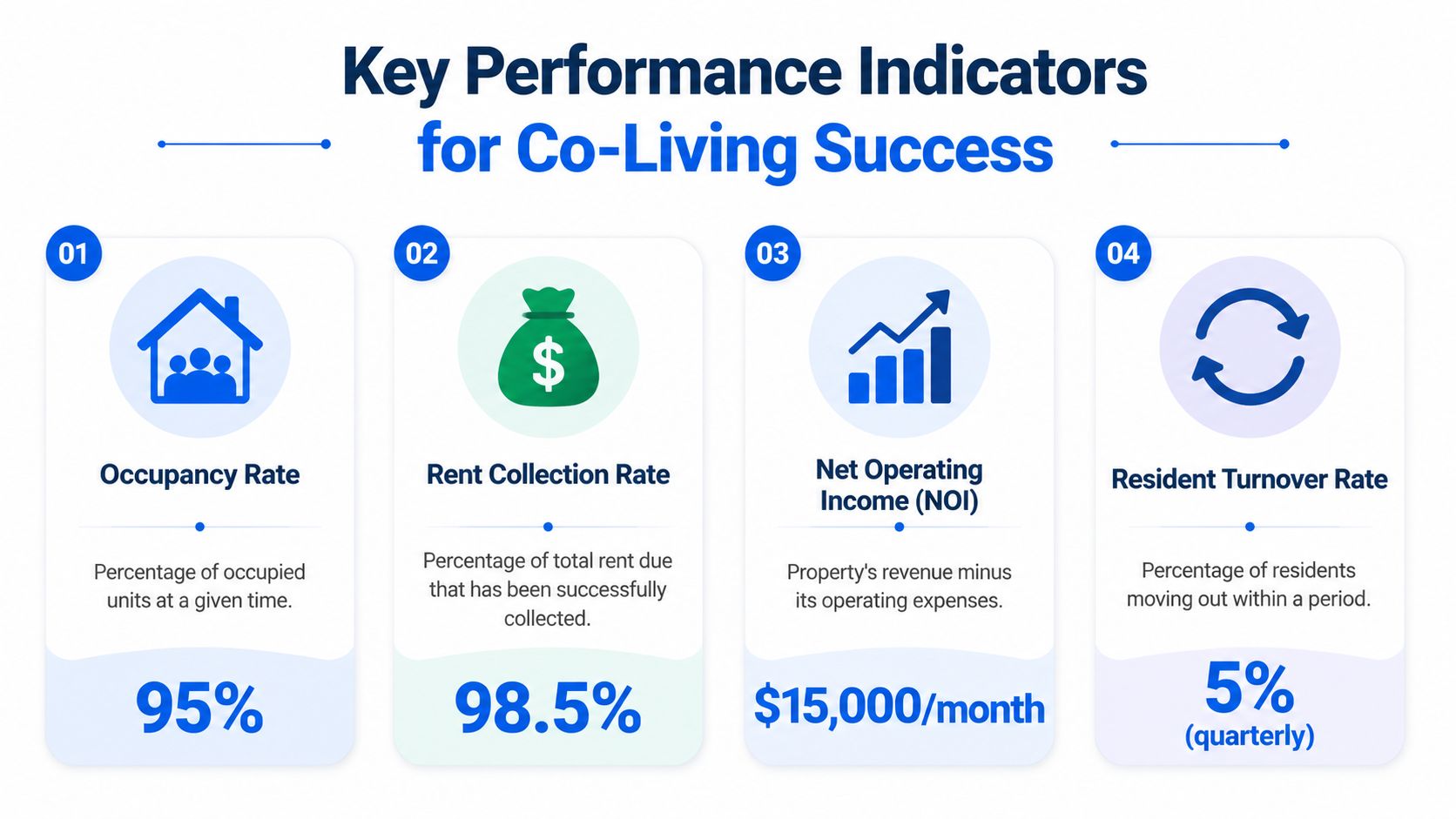
Net Operating Income (NOI) is the core measure.
Simple formula:
NOI = Income - Operating expenses
At the property level, this tells you whether the house is generating real operating profit before financing and ownership-specific items.
At the room level, it gets more useful. You can estimate:
Room NOI = Room income - Direct room costs - Allocated share of common operating costs
That second view helps with real decisions. If one room rents quickly but always needs touch-up work, extra cleaning, and utility-heavy occupancy, the headline rent may flatter its performance.
Track the metrics that change decisions
Use a compact set of KPIs you'll actively review every month:
Property-level NOI
Best for deciding whether the house itself is healthy.Room-level NOI
Best for spotting weak rooms, mispriced rooms, or rooms with chronic turnover cost.Revenue per available room
Formula: total room revenue divided by available rooms in the period.
This helps you compare one co-living property against another even when rents vary by room size or layout.Turnover cost by room
Add cleaning, maintenance, lock changes, and lost rent tied to move-outs. This often explains why two rooms with similar rent produce very different results.
A quick dashboard review is easier when the metrics live near your operating reports.
Here's a visual reference many operators find useful before building their own tracking habits:
What these metrics tell you in practice
A room-level KPI set helps answer questions that broad landlord reports miss.
| KPI | Formula | What it helps you decide |
|---|---|---|
| Property NOI | Income minus operating expenses | Keep, improve, or rethink the house |
| Room NOI | Room income minus direct and allocated costs | Raise, hold, or reposition room pricing |
| Revenue per available room | Total room revenue divided by available rooms | Compare houses with different room mixes |
| Turnover cost per room | Turnover expenses tied to a room | Invest in durability, furnishing, or screening changes |
Operator mindset: Don't ask only, “Is the house full?” Ask, “Which room is carrying the house, and which room is draining margin?”
Don't overcomplicate the dashboard
You don't need dozens of ratios. Most small operators make better decisions with four or five metrics they trust than with a giant report they never open.
If your KPIs show stable room NOI, manageable turnover cost, and healthy revenue per available room, you're usually seeing the business clearly. If they don't, the issue is often upstream in coding, allocation, or resident ledger discipline.
Your Co-Living Month-End Close Checklist
Month-end close is where operators either regain control or confirm that the month ran them over. If you wait until tax season to understand your books, you've already made too many decisions with bad information.
A consistent close process works like a pre-flight checklist. Same order. Same review points. No improvising.
The five tasks that matter every month
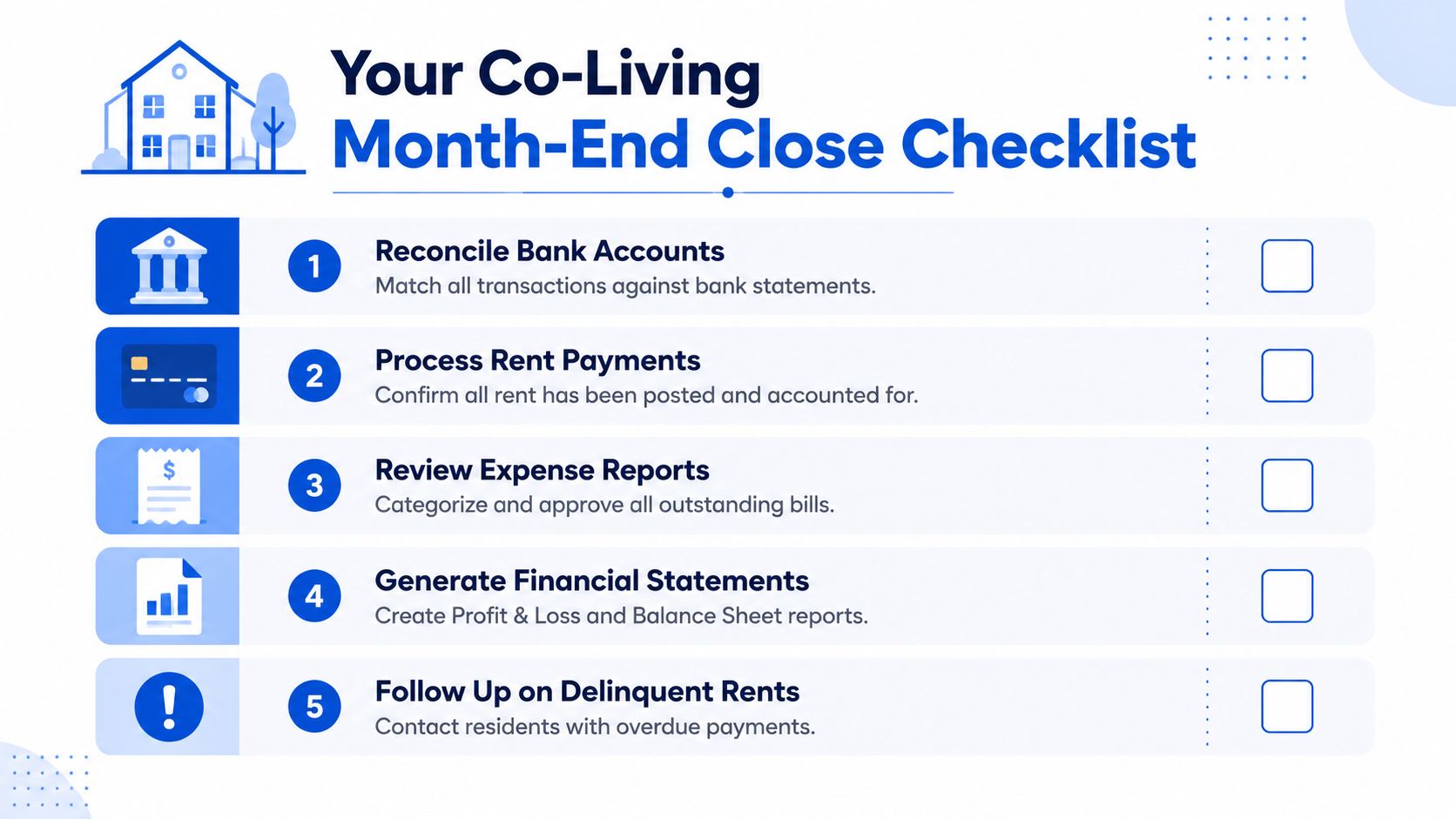
Use this sequence every month:
Reconcile bank and card activity
Match transactions to statements. Unmatched items should be explained, not ignored.Confirm all resident-side postings
Make sure rent, fees, reimbursements, deposits, refunds, and credits were posted to the correct resident and room.Allocate shared expenses
Apply your utility and common-area cost rules before running reports.Review the key reports
P&L, balance sheet, open receivables, deposit liability, and room-level performance summaries.Follow up on exceptions
Delinquent balances, uncoded expenses, unusual repair spikes, and unresolved deposit activity.
What to verify before you call the month closed
The close isn't done just because the software produced reports. The numbers must make operational sense.
Check for:
- Missing rent postings when a resident paid but the ledger still shows open rent
- Deposits sitting in income instead of liabilities
- Shared utilities coded entirely to one room
- Turnover costs buried in generic repairs
- Refunds or credits without notes
- Rooms showing income after a move-out date
A lot of operators only look at total property profit. That's too high level for co-living. You also want one quick read on each room's contribution and any outliers.
If you need a cleaner reference for what a finished statement should look like, this P&L report example for rentals is helpful for structuring your review.
A practical month-end rhythm
A good close process doesn't need to be complicated. It does need a deadline.
| Week of the cycle | Focus |
|---|---|
| Final days of the month | Make sure recurring charges and bills are entered |
| Early next month | Reconcile cash and resident ledger activity |
| After reconciliation | Allocate shared costs and review exceptions |
| Final review | Run reports and compare against your expectations |
Clean month-end closes prevent the two worst habits in co-living accounting: guessing and backdating.
What works and what doesn't
What works:
- Closing on the same schedule every month
- Reviewing unusual variances while the details are still fresh
- Keeping notes on one-off items so you remember them later
- Treating room-level oddities as signals, not noise
What doesn't:
- Waiting until quarter-end to reconcile
- Posting everything to generic utility or repair buckets
- Leaving resident credits unapplied
- Using your bank balance as a proxy for profitability
When your close process is tight, taxes get easier, owner reporting gets cleaner, and pricing decisions get sharper because the data is current enough to trust.
Choosing Your Accounting Tech Stack
Software won't fix bad accounting habits, but the wrong stack will absolutely slow you down. Co-living operators usually move through three stages. Spreadsheet first. Generic accounting software next. Specialized systems after the portfolio gets too complex for workarounds.
The right choice depends on unit count, how many rooms you manage, and whether you need resident-level operational detail or just clean books.
The market has already moved to cloud tools
Cloud software is no longer the exception. The Sage property management guide citing APMA data reports that 92% of property management firms now use cloud-based accounting software, and that these systems have reduced the average time to prepare financial statements by 40%.
That shift makes sense in co-living. You need live access, cleaner bank feeds, better collaboration, and faster reporting when multiple residents affect one property ledger.
Comparing the main options

Here's the practical trade-off:
| Option | Best for | Strengths | Limits |
|---|---|---|---|
| Spreadsheet | One house, very early stage | Cheap, flexible, familiar | Easy to break, weak audit trail, poor scaling |
| QuickBooks | Small operators who need formal books | Strong accounting engine, accountant-friendly | Needs workarounds for room-by-room operations |
| Property management software | Growing portfolios | Better ledgers, payments, reporting workflows | Some tools still assume whole-unit leasing |
| Specialized co-living platform | Operators focused on room-by-room scale | Built around room-level revenue, occupancy, and operational detail | Best fit depends on feature maturity and workflow match |
When a spreadsheet still works
A spreadsheet can work for a very small setup if you're disciplined.
It works when:
- You have a limited number of rooms
- You reconcile consistently
- You maintain a separate resident ledger
- You don't rely on memory for deposits and credits
It stops working when:
- Residents move in and out often
- Shared utilities need regular allocation
- You need owner-ready reports
- You keep creating new tabs to patch old mistakes
Where generic accounting tools help, and where they struggle
QuickBooks can be a solid middle step. It handles the accounting core well. You can set up classes, locations, and sub-accounts for properties and rooms if you're careful.
But generic software often struggles with the operating side of co-living:
- separate resident ledgers
- room-by-room occupancy visibility
- move-in and move-out workflow tie-ins
- deposit tracking tied to rooms and residents
- reimbursement logic for shared costs
That's where a more specialized stack becomes attractive.
What to look for in a serious co-living system
Don't shop by feature list alone. Shop by the headaches you want to remove.
Prioritize tools that support:
- Room-level income tracking
- Clear deposit liability workflows
- Shared utility allocation visibility
- Portfolio and property P&L reporting
- Resident communication records
- Smart-home data connections where relevant
A system that can connect room operations to financial reporting is where co-living accounting gets more accurate. A lot of operators still struggle here, especially when utility usage and smart-device data live outside the books. If your software stack can't tie those workflows together, your reporting will stay more manual than it should be.
Frequently Asked Accounting Questions
The final stretch is usually where practical questions show up. These aren't theory questions. They're the things that land in your inbox after a resident pays short, moves early, or breaks something in a furnished room.
How should I record furnishing costs for one room
Treat furniture purchases with intention. If you're buying a minor replacement item, many operators track it as a room-specific operating cost. If you're making a larger improvement to the room setup, record it in a way that keeps it separate from ordinary repairs so your reporting stays readable.
The key is consistency. Don't expense one bed frame as room setup and another identical purchase as generic repairs just because you were in a hurry.
What's the right way to handle a partial rent payment
Post the payment against the resident ledger and leave the remaining charge open. Don't force the account to look current by moving the difference into a vague suspense category.
That open balance matters for collections, reporting, and future conversations with the resident. Partial payments should leave a clear paper trail.
Should security deposits have their own bank account
In practice, separate handling for deposits is the safer habit because it protects visibility and reduces confusion. At minimum, deposits should be tracked distinctly from operating funds in your books and resident ledger.
For co-living, this matters even more because deposits are often resident-specific inside a shared property. If one person moves out, you need to know exactly what was held for that person and what happened to it.
How do I account for an early lease break
Keep the accounting tied to the financial events, not the emotion of the situation.
You'll usually need to address:
- any unpaid rent still due
- any agreed termination charge
- deposit deductions, if permitted and documented
- make-ready costs after move-out
- vacancy loss until the room is re-filled
Don't bury all of that into one catch-all line. Separate it enough that you can tell later whether the loss came from delinquency, turnover, or vacancy.
How should I think about IoT and utility-heavy properties
This is one of the least discussed issues in co-living accounting. Smart locks, thermostats, and sensors can improve operations, but they also create a reporting gap if usage data never reaches the financial side.
According to a 2025 IPT Association report referenced here, 40% of room-by-room operators struggle to link IoT data to financial outcomes, leading to a 12% average overestimation of NOI due to unallocated utility costs.
That tells you something important. If you run smart thermostats or similar devices, don't stop at operational convenience. Build a method to review whether those systems are changing room-level or house-level costs in a way your books capture.
The room that looks most profitable on paper can be the one creating the highest hidden utility burden.
What if one resident damages a shared area
Document the event, the cost, and why responsibility was assigned. Then record the charge in a way that distinguishes shared-area damage recovery from normal rent.
What doesn't work is netting the repair against general maintenance and hoping you'll remember later who caused it.
How often should I review room-level profitability
Monthly is the sweet spot for most operators. That's frequent enough to catch pricing issues, recurring repairs, utility drift, and turnover patterns before they become a habit.
Weekly is usually too noisy for decision-making unless you're running a larger portfolio. Quarterly is often too late.
If you're building a room-by-room portfolio and want a platform designed around the needs this article covered, PadPulse is worth watching. It's being built for PadSplit hosts and co-living operators who need better visibility into pricing, communication, smart-home operations, and property-level financial performance. You can join the interest list now to get updates on the Winter 2026 launch and early access opportunities.