Rent Ledger Meaning: The Landlord's Financial Guide
May 20, 2026
A rent ledger is the official financial record of a tenancy, tracking every dollar owed and paid. It keeps charges, payments, fees, deposits, credits, and balances in one place so you can prevent lost income, catch mistakes early, and handle disputes with clean records.
If you're a new landlord, you've probably already felt the problem a rent ledger solves. One payment came through Zelle, another by check, someone texted that they'd "send the rest Friday," and now you're trying to remember whether that move-in credit was applied.
That system works until it doesn't. The moment a tenant questions a balance, a payment arrives short, or you need to confirm what's still owed, memory and scattered notes stop being good enough. That's where understanding rent ledger meaning matters. It isn't just bookkeeping. It's the record that keeps your rental business organized, defensible, and far less stressful.
What Is a Rent Ledger Anyway
A rent ledger is a running record of every financial transaction tied to one tenant, including charges, payments, fees, deposits, credits, and balances, as described by Buildium's rent ledger definition. In plain language, it's the financial history of a tenancy written down in one consistent place.
Most beginners think a ledger is just a list of rent payments. It isn't. A proper ledger shows what was charged, what was paid, when each transaction happened, and what balance remained after each entry. That running balance is what turns a simple list into a real accounting record.
A good rent ledger gives you one place to answer four questions fast: what was due, what was paid, when it happened, and what's still open.
Why scattered records fail
A landlord can get away with informal notes for a while. You might use texts, bank screenshots, receipt emails, and a spreadsheet on the side. The problem is that those records live in different places and often don't tell the same story.
When records are scattered, you start seeing common mistakes:
- Missed charges because a late fee or move-in charge never got entered
- Wrong balances because a partial payment wasn't applied correctly
- Confused timelines when the payment date and due date get mixed up
- Weak documentation if a dispute turns into a formal complaint or non-payment case
Why it matters even more in co-living
In a traditional single-family lease, you usually have one household and one stream of rent. In co-living, one property can contain multiple rooms, multiple move-in dates, different concessions, and non-rent charges that change month to month.
That makes the rent ledger more than an accounting form. It becomes the operating record for each occupant. If you manage room-by-room housing, you need clean tenant-level records or you'll lose track of who owes what very quickly.
Practical rule: If you can't hand someone a single document that explains the full payment history for one tenant, your records aren't tight enough yet.
The Core Components of a Rent Ledger
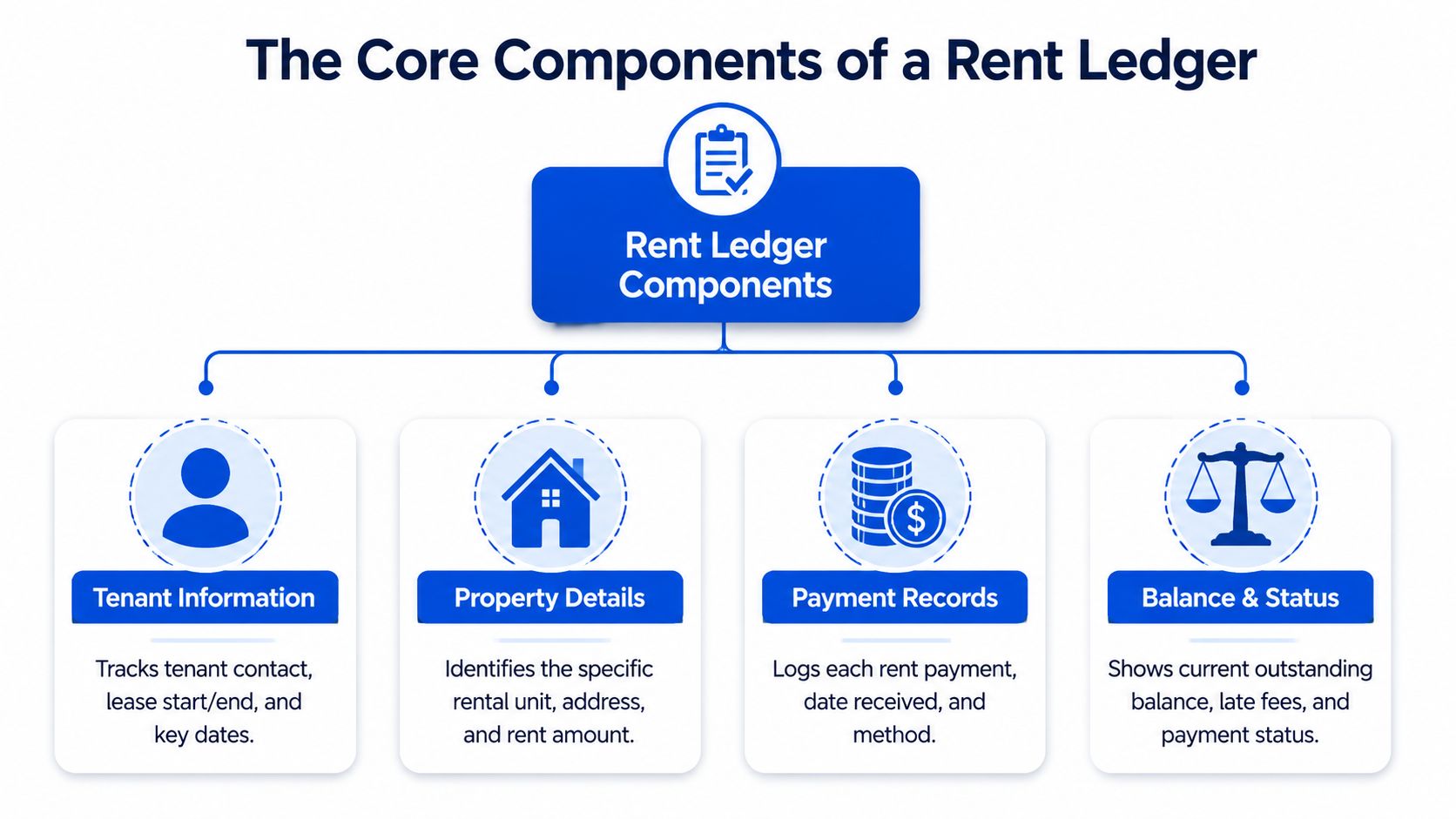
A useful rent ledger lets a third party review one tenant file and understand the account history without calling you for clarification. That standard matters more in co-living, where one property can have six tenants, staggered move-ins, room transfers, shared utility billbacks, and frequent turnover.
The fields that actually matter
These are the entries I expect to see in any ledger I would trust during a dispute, an owner review, or a month-end close:
Tenant identification
Record the occupant's full legal name. In co-living, add enough detail to separate people with similar names and to tie the ledger to the correct resident record.Property and unit details
Include the full property address and the exact room, unit, or bed space. "Oak House" is too vague if one resident owes for Room 3 and another transferred from the basement suite mid-month.Lease reference details
List the lease start date, end date, rent due date, and the recurring charge schedule. If the tenant has a concession, discount, or room-specific pricing, the ledger should reflect that structure clearly.Transaction date
Use the actual posting date for charges and the actual receipt date for payments. Mixing those up creates avoidable arguments about late status and fee timing.Transaction description
Every line item should say exactly what happened. Clear labels such as "April rent," "prorated move-in rent," "utility reimbursement," "lock replacement," or "late fee reversal" hold up much better than vague entries like "charge" or "adjustment."Charge amount and payment amount
Keep money owed and money received in separate columns. That format makes partial payments, credits, and reversals easier to follow.Payment method
Note whether the payment came by ACH, card, check, cash, or portal credit. This helps with reconciliation and with tracking failed or reversed payments. For operators standardizing collections, how tenants pay rent with ACH is worth reviewing because payment method affects posting speed, follow-up, and audit trail quality.Running balance
After each entry, show the balance still owed or the credit remaining. If the running balance is wrong, the rest of the ledger is hard to trust.
What separates a clean ledger from a weak one
A clean ledger does more than list payments in date order. It shows the full life of the account. Charges, payments, credits, reversals, and write-offs should appear in a sequence that another manager, bookkeeper, or attorney can follow line by line.
For co-living operators, that usually means tracking more than base rent. Internet splits, utility billbacks, cleaning fees, furniture charges, key replacement, and damage recovery often belong on the same tenant ledger if they affect the resident's balance. The trade-off is simple. The more charges you run through the ledger, the more disciplined your descriptions and posting rules need to be. If your team uses inconsistent labels, the record gets messy fast.
A reliable ledger should answer three practical questions immediately:
- What was charged
- What was paid
- Why the current balance exists
That is the standard.
The best rent ledgers are plain, consistent, and a little boring. That usually means the record will stand up when a tenant disputes a charge or an owner asks why income came in short.
Why Your Rental Business Needs a Rent Ledger
A rent ledger isn't paperwork for paperwork's sake. It's one of the few records that helps with operations, accounting, and legal protection at the same time.

A modern ledger helps you compare rent expected versus rent collected. Landlord Studio's overview of rent ledgers describes the ledger as a core tool for identifying discrepancies by showing all charges and payments in one place. That's the business case in one sentence. You see shortfalls early instead of discovering them weeks later.
Financial clarity beats guesswork
Most rental mistakes don't start as big problems. They start as one missing entry, one partial payment recorded incorrectly, or one fee that never made it into the books.
A ledger gives you cleaner visibility into:
- Outstanding balances so you know who still owes money
- Payment patterns so you can spot repeated lateness
- Income records that are easier to review at month end
- Charge history that explains why a balance exists
When your records are clean, decisions get easier. You know whether to send a reminder, waive a minor issue, or escalate because the history is already in front of you.
It protects you in disputes
Disputes usually aren't complicated at first. A tenant says they paid. You say the account still shows a balance. Without a ledger, the discussion turns into opinion and memory.
With a ledger, you have a dated transaction trail. That doesn't guarantee agreement, but it gives both sides a concrete record to review. That's also why so many operators use ledgers during move-out reconciliations and security deposit conversations.
For a visual overview of how landlords use these records in practice, this video is a solid primer:
It matters for legal and tax records
A ledger can also support non-payment documentation because it shows the payment history over time. If you ever need to explain what was charged, what was received, and what remained due, a proper ledger is one of the first records you'll reach for.
It also makes tax preparation less painful. Instead of rebuilding rental income from bank deposits and message threads, you already have an organized record of the tenancy's financial activity.
Clean ledgers don't just save time. They reduce the number of arguments you have to win later.
A Practical Rent Ledger Example
Definitions make more sense when you can see the record in motion. Here's a simple example for one room in a shared house.
Sample Rent Ledger for Room 3B
| Date | Description | Charge ($) | Payment ($) | Balance ($) |
|---|---|---|---|---|
| Jan 1 | Monthly rent charge | |||
| Jan 3 | Rent payment received | |||
| Feb 1 | Monthly rent charge | |||
| Feb 6 | Late fee posted | |||
| Feb 7 | Partial payment received | |||
| Feb 14 | Remaining payment received | |||
| Mar 1 | Monthly rent charge | |||
| Mar 1 | Utility reimbursement | |||
| Mar 2 | Full payment received |
The table is intentionally blank on amounts because the exact numbers will vary by property, room, and lease terms. What matters is the structure. Each line captures a specific event, and the balance updates after every entry.
How to read the story in the ledger
Start with the first line. On the due date, you post the month's rent charge. The balance increases because the tenant now owes that amount.
A few days later, the payment arrives. You record the payment on the actual date received, not the date it was due. The balance drops accordingly.
In February, the tenant pays late. That means the ledger shows the rent charge first, then the late fee, then a partial payment, then the remaining payment. At this stage, many beginner landlords encounter issues. They record the final total mentally but skip the sequence. The sequence matters because it shows exactly how the balance changed.
If a tenant pays in pieces, enter each payment separately. Combining partial payments into one line hides the actual history.
Why this example matters in co-living
March adds a room-level non-rent charge, such as utility reimbursement. In a standard apartment lease, that may be rare. In co-living, it's common. Cleaning fees, move-in charges, access device replacements, and utility allocations often belong in the same running record.
That broader use is important. TenantCloud's explanation of tenant ledgers notes that ledgers can show all tenant payments, fees, deposits, and credits in one place. For room-by-room operators, that's the difference between a rent-only list and a real receivables record.
Ledger Formats and Essential Tools
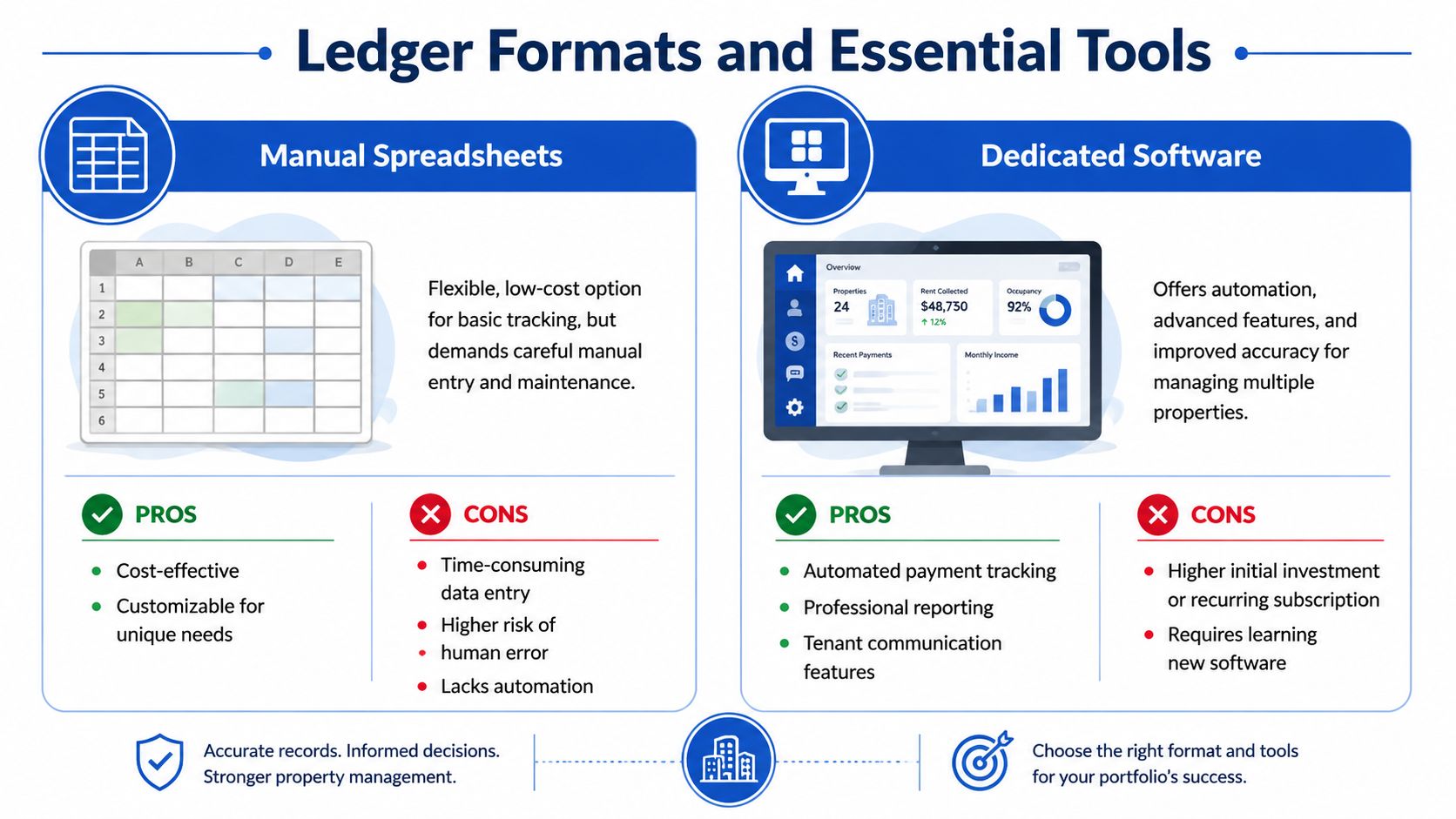
The format matters more in co-living than many new landlords expect. A single late payment is manageable in a spreadsheet. Five tenants in one house, each with different move-in dates, utility allocations, and one-off charges, can turn that same sheet into a reconciliation problem fast.
Spreadsheets versus software
Both can work. The better choice depends on how much churn you handle and how often you post charges beyond base rent.
| Format | Works well for | Where it breaks |
|---|---|---|
| Spreadsheet in Excel or Google Sheets | Small portfolios, stable tenants, simple monthly rent only | Formula errors, inconsistent naming, weak audit trails, harder reconciliation |
| Property management software | Frequent updates, shared housing, recurring non-rent charges, faster reporting | Subscription cost, setup time, and less flexibility for custom workflows |
Spreadsheets are workable at the beginning. They are cheap, familiar, and easy to customize. I still see plenty of small landlords use them successfully for one or two straightforward rentals.
The problem is control. In co-living, you are often tracking partial payments, room-level utility splits, cleaning charges, credits, and deposit adjustments. One edited formula or one charge posted to the wrong tenant can distort the balance and create a dispute later.
Software earns its keep when the ledger has to stay clean under pressure. If you are comparing options, this guide to free landlord accounting software is a useful starting point.
Rent ledger and rent roll aren't the same thing
New landlords mix these up all the time. A rent ledger is a transaction history. A rent roll is a snapshot of scheduled rent across units or tenants.
That difference matters in shared housing. One property may have a single address but six separate payment histories, six different balances, and six different move-out timelines. If you rely on a rent roll when a tenant disputes charges, you will not have the line-by-line record needed to show what was posted, when it was posted, and how the balance changed.
As noted earlier, the ledger tracks the detailed account history, while the rent roll gives you a broader occupancy and income summary.
When to move beyond manual tracking
Manual tracking starts to fail when the ledger needs to do more than record one rent payment per month.
You likely need software if:
- One property has multiple tenants with separate balances
- Charges change often, including utilities, cleaning, lock replacements, or move-in fees
- Tenants move in and out frequently, which raises the risk of credits, prorations, and old balances getting mixed together
- You spend too long matching deposits to tenant notes
- You cannot pull a clear ledger quickly for a dispute, notice, or court filing
The best system is the one you can keep accurate every week. In co-living, that usually means using a tool that records each tenant separately, timestamps changes, and reduces manual cleanup.
Best Practices for Co-Living Operators
Co-living changes the meaning of a rent ledger in practice. You're not just logging base rent. You're tracking a more complicated financial relationship that can include room-level charges, staggered move-ins, and faster turnover.
Keep one ledger per tenant
Don't run one house-level ledger and hope notes will sort it out later. In shared housing, each tenant needs a separate record. That gives you a clean trail for balances, credits, and disputes tied to that person, not the property in general.
This also helps when one room turns over but the rest of the house stays occupied. You don't want old charges and new occupants mixing in the same record.
Record non-rent charges clearly
For co-living operators, the ledger often needs to include pro-rated utilities, cleaning fees, and other room-level charges. DoorLoop's discussion of lease ledgers highlights that broader use and notes that ledgers should be updated each time income is received so operators can spot missing collections early.
That means vague entries won't cut it. Label charges clearly. If a fee is for cleaning, say that. If a credit reflects a concession or adjustment, state it plainly.
In room-by-room housing, "miscellaneous charge" is a bad ledger entry. It creates confusion now and problems later.
Update the ledger immediately
High-churn operations punish delay. If you wait to enter payments until the end of the week, you lose visibility at the exact moment you need it most.
Use a workflow that posts transactions as they happen. If you're trying to tighten up your back office, this guide on how to automate document workflow is worth a look.
A disciplined ledger process does more than clean up accounting. It helps you see occupancy risk, follow up on arrears faster, and keep every room's financial record ready for review. That's what makes it scalable.
PadPulse is building an all-in-one platform for PadSplit hosts and co-living operators who need better control over pricing, communications, access, and financial reporting. If you're growing a room-by-room portfolio and want a simpler way to manage operations, join the interest list at PadPulse.