What Is Market Rent and How to Price It Right
July 28, 2026
Market rent is what a comparable unit would lease for today in an open transaction, and it isn't the same as the current tenant's contract rent. It also isn't the same as the asking rent a new applicant sees first, because those two numbers can diverge fast when supply, concessions, or unit quality change.
If you've ever stared at one room that's occupied at one price, another room that just got listed higher, and a dashboard that insists both are “market,” you already know why this gets confusing. In room-by-room housing, the right number matters because every bedroom, bathroom setup, lease term, and utility package can shift what a fair comparison really is.
Why Two Rents Are Never the Same Number
A host opens two tabs and sees the problem immediately. One room has a current tenant paying a steady contract rent. Another room, three doors down in the same house, is being quoted higher to a new applicant because the room is furnished, the bathroom is private, and the utility bundle is different.
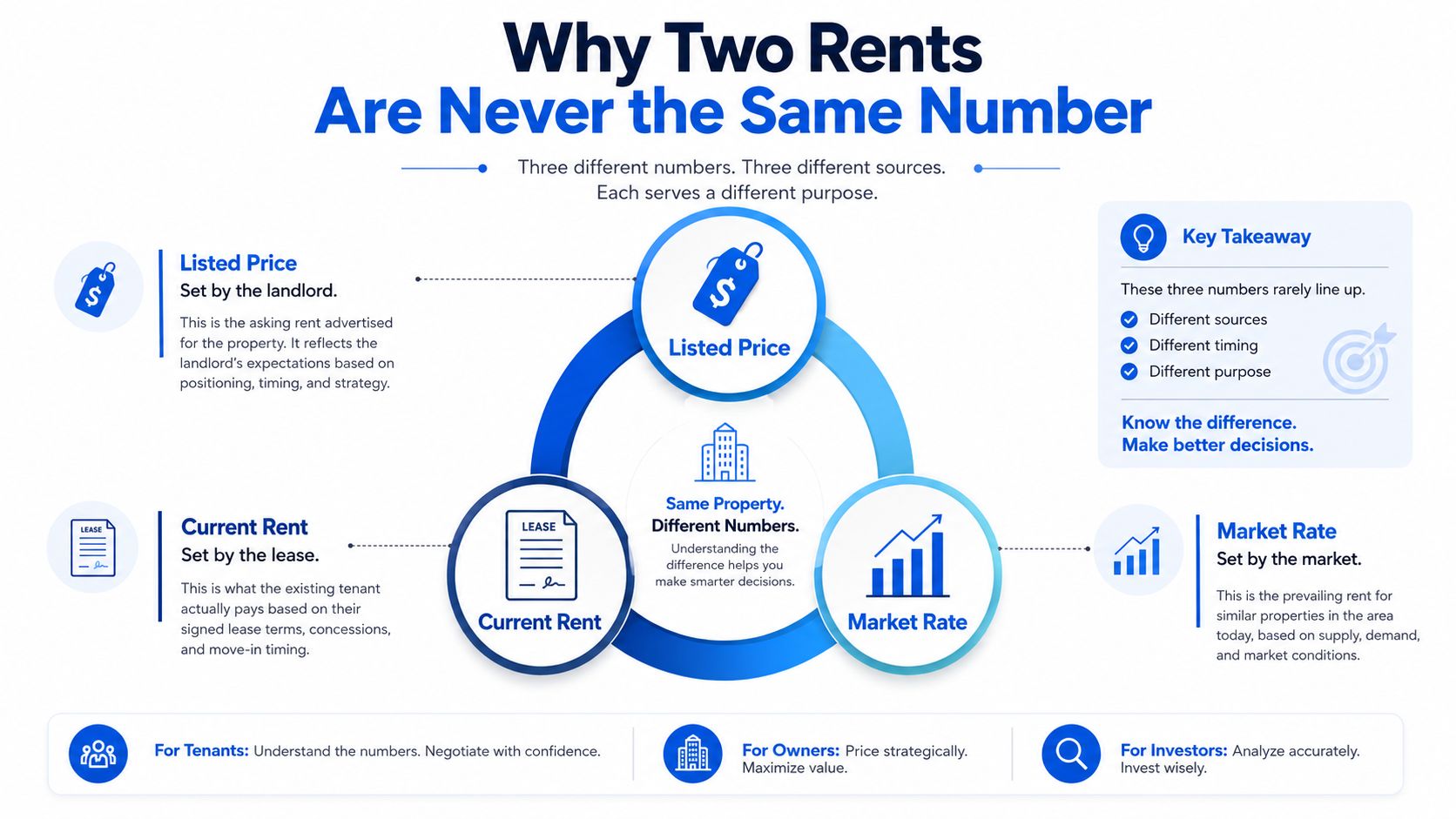
That's the trap. People call both numbers “rent,” but they're not measuring the same thing. Contract rent is the price already locked in for an existing lease, while market rent is the amount a comparable unit would command today in an open transaction, based on current conditions and similar properties.
Why the dashboard keeps lying to you
Most pricing confusion starts when operators mix three things that belong in different buckets. The occupied room shows what the last deal produced. The listing shows what the next applicant might accept. The market figure tries to bridge those two using comps and local conditions.
Practical rule: if you can't explain why two rooms in the same house have different economics, you're probably using the wrong benchmark.
For co-living, this matters more than it does for a standard apartment. A private bath, furnished setup, and all-in utilities can make one room a different product from the room next to it, even if they share the same roof. That's why “market rate” can't be a single house-wide guess.
What Market Rent Really Means
A room can be worth one number to the tenant already living in it and a different number to the next applicant standing at the door. That gap is where market rent lives. It is the price a comparable unit would command in an open, arms-length transaction today, based on current conditions, not the amount locked into an existing lease. In practice, the number is built from recent signed lease comparables and adjusted for size, quality, location, lease term, and concessions, so it works as a forward-looking benchmark rather than a historical one. Cove's glossary on market rent explains that open-transaction idea clearly.
Contract rent, asking rent, and market rent
Keep the three numbers separate or your pricing will drift. Contract rent is the old lease payment, the amount the current tenant is already obligated to pay. Asking rent is the price you post. Market rent is the price a similar renter would likely agree to after comparing the unit against the local alternatives.
That difference shows up every time a house has mixed economics under one roof. An occupied room can sit below, above, or right at today's market depending on when the lease was signed and what was included. A renovated room in the same neighborhood can justify a higher market rent while the older lease keeps running at its original amount. For operators, that gap is the difference between what is booked and what can be charged on the next turn.
The public-policy version of the same idea is even more formal. HUD treats Fair Market Rent (FMR) as a benchmark tied to local conditions, and it uses that benchmark to set payment standards in housing-assistance programs. HUD's explanation of FMR describes it as a standard reference point for gross rents in a local market, which is a useful reminder that rent benchmarks are usually built to compare like with like, not to mirror any single lease exactly. HUD's explanation of FMR
A note on why some systems use the median
New Zealand's tenancy guidance defines market rent around similar properties in similar areas, and its statutory approach uses the median weekly rent rather than the mean. That matters because the median is less thrown off by a few very high or very low listings. New Zealand's market rent guidance is a good example of how mature rental markets rely on repeatable comp-based methods instead of instinct.
For room-by-room operators, the bigger lesson is practical. A furnished room with utilities included is not the same product as an unfurnished room where the tenant pays power, internet, and water separately. Shorter lease terms also change what the market will bear, because flexibility has value and turnover has a cost. If you price every room off a single house average, you will miss those trade-offs and leave money on the table.
Use comparable property analysis as the next filter when you start sorting those differences into something usable.
The Three Inputs That Drive Every Market Rent Number
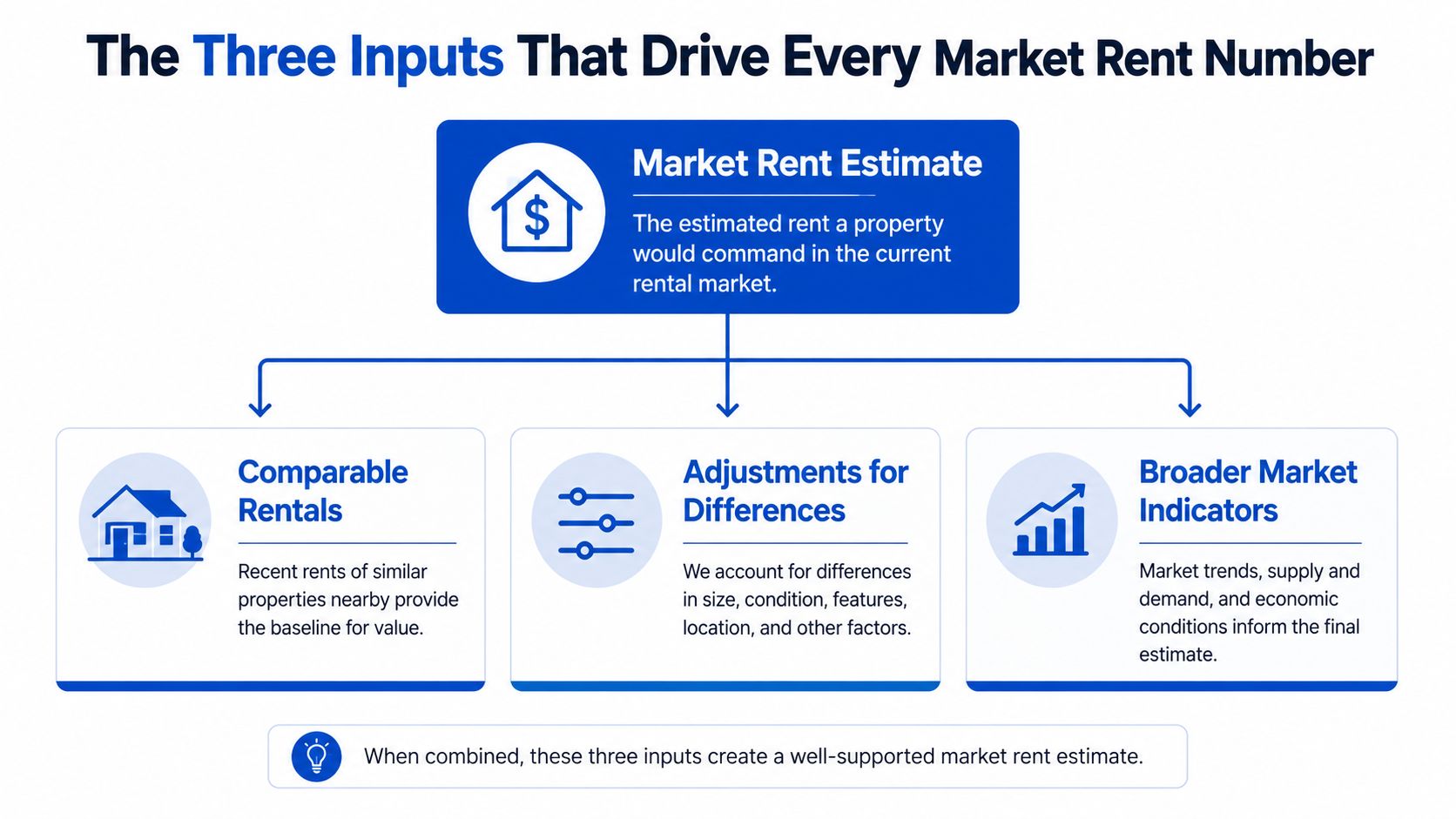
A defensible market-rent estimate usually comes from three things working together. First, you need comparable rentals from the same submarket. Second, you need adjustments for meaningful differences. Third, you need market indicators that tell you whether the comps are moving up, down, or holding steady.
Comparable rentals
Comps should be recent, local, and similar. For a room-by-room operator, that means similar room type, similar house quality, and a similar tenant experience, not just “another rental in the city.” A one-bedroom downtown and a furnished private room in a shared house can't carry the same weight unless you normalize the differences carefully.
If you need a refresher on comp selection, use this internal guide on comparable property analysis as a framework for building a cleaner set.
Adjustments for differences
A comp is only useful after you adjust for what makes it better or worse than your unit. Maybe it has a private bath, maybe it's unfurnished, maybe utilities are extra, or maybe the lease is longer. Each of those factors changes the economic value of the comparison.
Good operators don't ask whether a comp is “close enough.” They ask what price difference the differences justify.
Market indicators
The third input is the market backdrop. If demand is stronger, vacancies are tighter, or concessions are disappearing, asking rents can move even when yesterday's comp sheet still looks fine. That's why a market-rent number without current context is just a stale average wearing a confident label.
How to Calculate Market Rent Step by Step
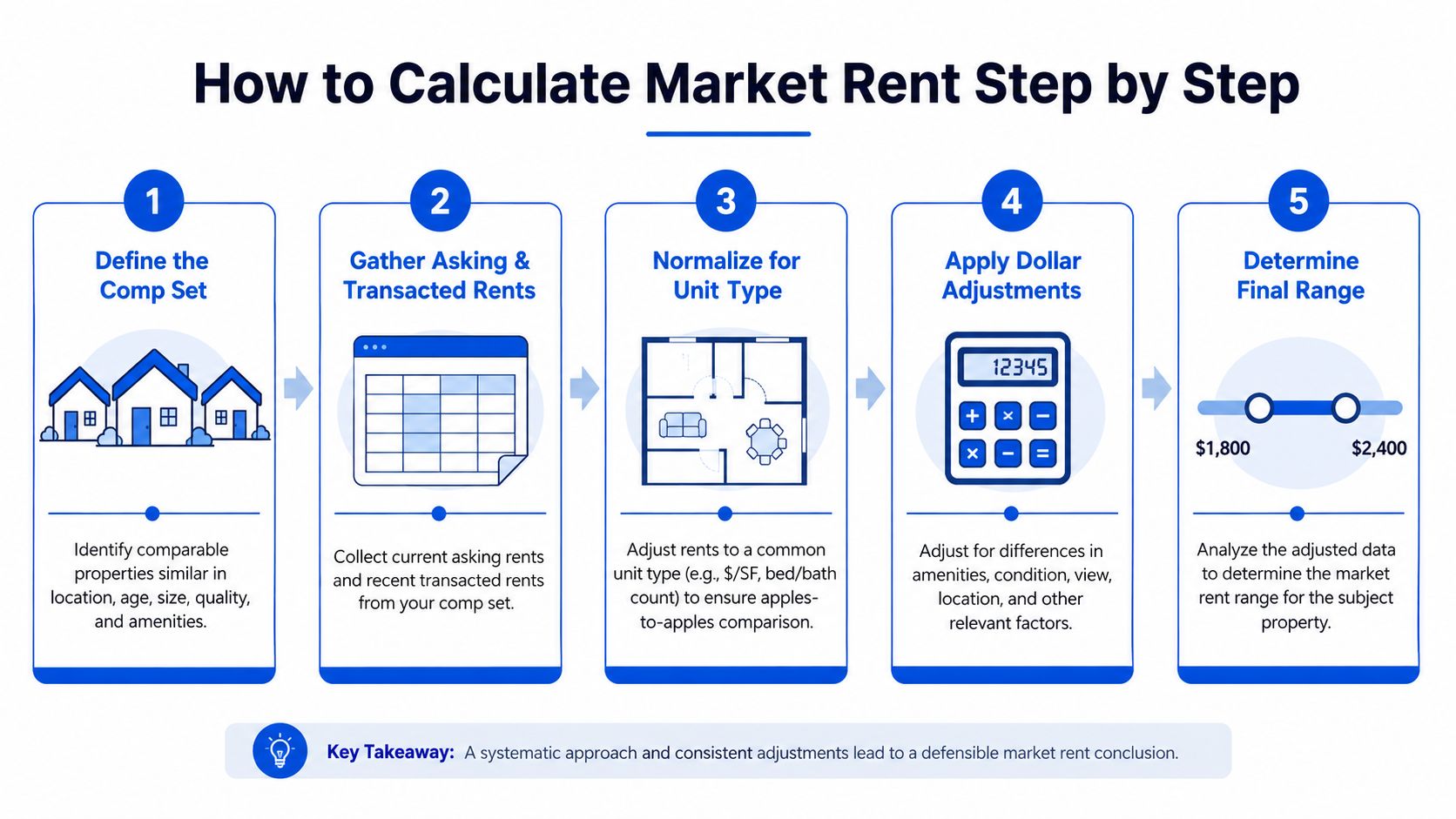
A good rent estimate starts with the comp set and ends with a range, not a single heroic number. The shortcut most hosts take is eyeballing the highest nearby listing and calling it market. That works only when the market is flat and the listing really reflects the closed deal, which is rarely true in fast-moving or concession-heavy conditions.
1. Define the comp set
Pick rentals that are comparable to your room or unit. Keep the geography tight, keep the product type similar, and don't mix in properties that solve a different renter problem.
2. Gather asking and transacted rents
Track both what landlords are asking and what tenants are paying when you can verify it. That split matters because asking rent is a spot-market signal, while transacted rent reflects completed deals. Recent housing research notes that common public data sources mostly capture the transacted side, not the live asking side, which is one reason market-rent estimates can lag in fast markets. This housing research on spot versus transacted rent data makes that gap clear.
3. Normalize for unit type
Compare like with like. A furnished room with a private bath should not sit in the same bucket as an unfurnished shared-bath room unless you've explicitly adjusted for the difference.
4. Apply dollar adjustments
Add value for features renters pay for, subtract for features they discount. The adjustment should reflect the true economics of the comp, not the headline sticker.
5. Set a final range
Land on a range, then choose a point inside it based on your occupancy goals and current demand. If you need a simple worksheet for this process, see the room rent calculator and use it as a starting template.
For a practical example, imagine a furnished private room with its own bathroom in a co-living house. You compare it with nearby room rentals plus a couple of small apartment comps that help you anchor the comfort and privacy premium, then adjust for furnishing, bathroom access, and bundled services. If the comps cluster around a narrower band after adjustments, the right answer is the band, not the loudest listing.
Adjustments Co-Living Operators Always Miss
Headline rent is only part of the price in shared housing. The actual number often hides inside utilities, furnishing, lease length, and how much privacy the renter gets. If you ignore those details, your comp sheet will look tidy and still mislead you.
What to add and what to subtract
A room that includes Wi-Fi, power, water, and streaming bundles should usually compare above a bare room where the tenant pays those bills separately. A furnished room also deserves an upward adjustment because the renter isn't buying or moving furniture. Private bath access usually lifts value, while a shared bath usually lowers it.
Lease term matters too. Shorter effective terms can push the price up because the operator absorbs more turnover and re-leasing work. On the other hand, an older HVAC setup, street parking instead of dedicated parking, or a shared-bath configuration can justify a downward adjustment.
Typical Co-Living Rent Adjustments
| Adjustment | Typical Range | Direction |
|---|---|---|
| Utilities included | Qualitative upward adjustment | Up |
| Furnished room | Qualitative upward adjustment | Up |
| Wi-Fi and streaming bundled | Qualitative upward adjustment | Up |
| Private bathroom | Qualitative upward adjustment | Up |
| Shorter lease term | Qualitative upward adjustment | Up |
| Older HVAC | Qualitative downward adjustment | Down |
| Street parking instead of dedicated parking | Qualitative downward adjustment | Down |
| Shared bathroom | Qualitative downward adjustment | Down |
The mistake I see most often is pricing the bedroom and ignoring the service bundle attached to it.
If you're comparing a co-living room to a plain apartment comp, be strict about the economics. The renter is not just buying square footage. They're buying convenience, privacy, and fewer friction points in daily life.
Tools and Data Sources Worth Using
No single source gives you a perfect market-rent answer. The best operators layer several inputs, then trust the overlap more than any one chart. Free tools can get you close, and paid data can tighten the range when the portfolio gets bigger.
Build a mixed-source stack
Start with Zillow's rent index to understand broad directional movement, then sanity-check with Rentometer and live listings on Craigslist or Facebook Marketplace. Use HUD FMR tables by ZIP code when voucher tenants or rent-reasonableness questions are in play, since the FMR benchmark is standardized and policy-relevant. For local precision, MLS rental data and platforms like CoStar or Apartments.com usually give stronger professional-grade comp coverage.
For room-by-room pricing, a dedicated market-intelligence layer can be more useful than generic apartment data. If you want a deeper look at how operators combine comp data with demand signals, this overview of a pricing intelligence platform is worth reading.
A pragmatic refresh cadence
Use broad market data monthly if you're active in a volatile area. Refresh live comps whenever you're about to reprice a vacant room or renew a lease. Save the heavier paid tools for the markets where a small pricing miss compounds across many doors.
That's the right stack for a 5 to 50 room operator, simple enough to run, but strong enough to keep you from making pricing decisions off one stale screenshot.
Legal and Seasonal Pricing Considerations
Pricing has guardrails. Miss them, and you can end up too low for subsidized tenants, too high for the local market, or too rigid for the season. Good operators keep one eye on rent reasonableness and another on the calendar.
When HUD FMR matters
HUD's 40th percentile FMR concept matters whenever a tenant uses a housing voucher or another subsidized structure tied to public benchmark rules. In that setting, the rent cannot just be whatever the market might bear. It has to clear the program's reasonableness logic, and the benchmark can shape how much subsidy is available. HUD's policy framing makes that clear in the way it uses FMR to cap subsidies and determine eligible units.
Seasonal demand is not optional
Shared-housing demand rarely stays flat all year. Many operators see stronger lease-up in late winter and summer, then softer demand in November and December. A flat annual pricing strategy usually leaves money on the table in the strong months and creates avoidable vacancy in the weak ones.
Price with the calendar, not just with last month's comp sheet.
I have seen operators hold a room at one number because it “matched the market,” then miss the seasonal window where applicants were moving faster and comparing fewer options. The better move is to recheck pricing as demand shifts, especially if you rely on room-by-room turnover and short notice re-leasing.
Don't skip the fine print
Concessions, lease length, fees required for occupancy, and utility treatment all change the effective rent. A headline monthly price can look competitive and still be off once the renter adds in the actual cost of living there. That matters even more in co-living, because the comparison is not just an empty apartment. It is the total package, including whether the room is furnished, whether utilities are passed through, and whether a short lease is being priced like a standard one.
Turning Market Rent Into Higher NOI
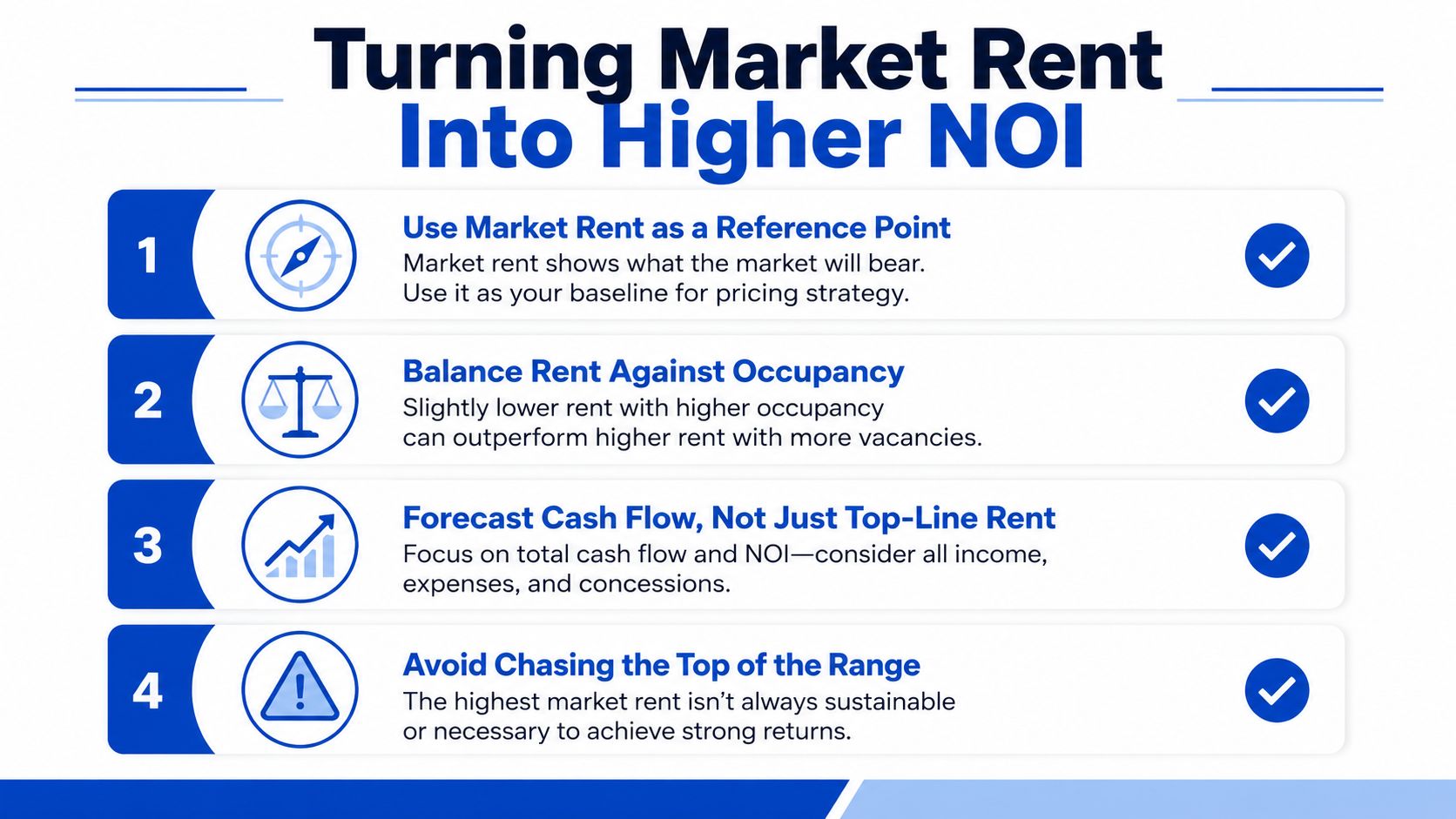
Market rent is a reference point, not a target to chase blindly. If you push every room to the top of the range, you usually buy yourself more vacancy, more turnover, and more time spent relisting the same space. If you sit too far below the range, you surrender income you could have captured without hurting occupancy.
A better pricing rhythm
A practical approach is to review rents on a quarterly cadence and keep a 3 to 5 percent repricing band in mind as you test the market. That doesn't mean every room should move inside that band every quarter. It means your default should be measured, not reactive, and tied to fresh comps rather than habit.
The trade-off is simple. A modest rent bump can improve revenue, but if it creates extra vacancy days, the gain can disappear fast. The right move is the one that improves NOI, not the one that looks strongest in a listing screenshot.
Six checks before you reprice
- Recheck the comp set: Make sure the comparables are still similar.
- Separate asking from transacted: Know whether you're reacting to a live quote or a closed deal.
- Audit the bundle: Utilities, furnishings, and privacy need explicit value treatment.
- Review concessions: A rent credit or free week changes the price.
- Test occupancy risk: Ask whether the higher number will slow leasing.
- Set the next review date: Don't let one pricing decision sit untouched.
If you keep those checks in rotation, market rent becomes a management tool instead of a theory. That's where the value is for room-by-room operators.
If you're pricing rooms, balancing occupancy, and trying to keep your comp data from going stale, PadPulse is built for that workflow. It helps co-living operators connect pricing, leasing, and portfolio reporting in one place, so you can make faster decisions with better market context. Visit PadPulse to see how it can support your next pricing review.