A Beginner's Guide to Using a Room Rent Calculator
July 26, 2026
A room rent calculator is more than just a math tool; it's your secret weapon for maximizing rental income. In a fast-moving market, guessing what a room is worth can cost you thousands. A data-driven approach isn't just a good idea—it's essential for staying profitable.
Why a Room Rent Calculator Is an Essential Tool

The old-school method of pricing rooms—simply dividing your mortgage by the number of bedrooms—is a recipe for leaving money on the table. The rental market is evolving, and thinking of your property as a single unit is an outdated model.
To succeed today, you need to view each room as its own individual asset. A good room rent calculator is built on this very principle, giving you the clarity needed to navigate a complex rental environment and price your rooms for maximum profit.
The Growing Gap in the Rental Market
A quick look at recent numbers reveals a major split between traditional apartments and room-by-room rentals. While large apartment complexes have seen rents fall, the co-living sector has shown impressive resilience and growth.
This comparison highlights why a specialized approach to rent calculation is so crucial for modern landlords.
Traditional Apartments vs. Room Rentals: A Market Snapshot
| Metric | Traditional Apartments | Room Rentals (e.g., PadSplit) |
|---|---|---|
| Year-Over-Year Rent Change | -3.9% (to $1,584/mo) | +4.23% (to $853/mo) |
| Vacancy Rate | 7.0% and rising | Lower, with steady demand |
| Landlord Incentives | Common (e.g., free rent) | Less common due to high demand |
By the end of 2025, for instance, traditional one-bedroom apartment rents saw a 3.9% year-over-year decline, dropping to $1,584. At the same time, professionally managed room rentals bucked the trend, posting a solid 4.23% rent increase to an average of $853 per month with utilities. You can dig into the specifics in this detailed Q4 market report.
These numbers tell a clear story. While many apartment landlords offer incentives like free rent just to fill vacancies, the demand for affordable, flexible rooms remains strong.
The market is sending a clear signal: dynamic, room-specific pricing isn't just a nice-to-have. It’s a core strategy for growth. Landlords who adapt are capturing demand that traditional property owners are missing.
Moving Beyond Simple Math
A powerful room rent calculator is more than a number-cruncher. Think of it as a strategic tool that helps you make smarter decisions, boost your bottom line, and keep your rooms consistently filled.
Here’s how it gives you an edge:
- Maximize Your Profits: By pricing each room based on its unique value—like its size, a private bathroom, or a better view—you ensure you aren’t undercharging for your best spaces.
- Reduce Vacancy Time: Competitive, data-backed prices attract tenants faster and help you retain them longer, which means fewer costly days with an empty room.
- Gain a Competitive Edge: While other landlords use guesswork, you can operate with confidence, knowing your prices are perfectly aligned with the market.
Ultimately, using a room rent calculator helps you adopt a data-first mindset. It turns pricing from a reactive chore into a proactive strategy, which is critical for thriving in today's rental market. When you treat each room as its own distinct revenue stream, you unlock the true financial potential of your property.
How to Manually Calculate Room Rent
Before jumping to an automated tool, it’s helpful to understand how to calculate rent by hand. Working through the numbers yourself gives you a practical feel for the "why" behind your pricing that no software can replace. Even the most advanced room rent calculator is built on these fundamental principles.
Let's walk through three common methods. Each has its pros and cons, and understanding them will help you choose the right approach for your property.
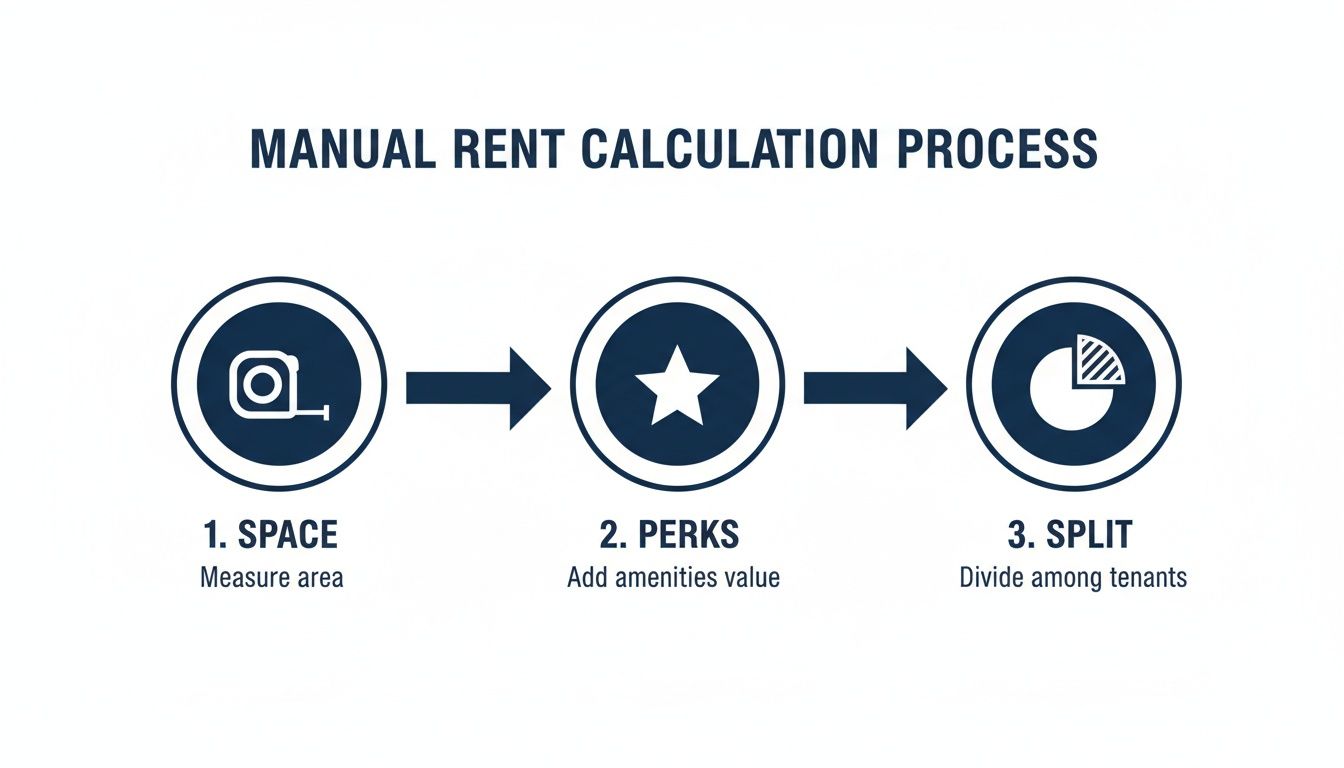
The Fair Square Footage Method
One of the most logical ways to split rent is based on the space each resident uses. The Square Footage Method is more sophisticated than just looking at bedrooms because it accounts for both private areas and each person’s share of the common spaces.
Here’s a simple, step-by-step guide:
- Measure the square footage of each private bedroom.
- Measure the square footage of all shared spaces, like the kitchen, living room, and common bathrooms.
- Calculate each room's share. For each bedroom, add its private square footage to its portion of the common areas (total common space divided by the number of residents). This gives you the "total assigned space" for each room.
- Determine the percentage. Find what percentage of the property's total assigned space each room represents.
- Calculate the rent. Multiply that percentage by your total target rent for the property to get the individual rent for that room.
This approach is transparent and makes sense to tenants because their rent is directly tied to the space they occupy. It's an excellent starting point for fair and justifiable pricing.
Example Using The Square Footage Method
Let's see this method in action. Imagine you have a 3-bedroom house and need to bring in $2,400 per month in total rent.
- Total Common Area: 600 sq. ft. (kitchen, living room)
- Bedroom A: 150 sq. ft.
- Bedroom B: 120 sq. ft.
- Bedroom C: 100 sq. ft.
First, split the common area among the three residents: 600 sq. ft. / 3 = 200 sq. ft. per person.
Now, calculate the "total" space for each room by adding its share of the commons:
- Room A's Space: 150 sq. ft. (private) + 200 sq. ft. (common) = 350 sq. ft.
- Room B's Space: 120 sq. ft. (private) + 200 sq. ft. (common) = 320 sq. ft.
- Room C's Space: 100 sq. ft. (private) + 200 sq. ft. (common) = 300 sq. ft.
The total assigned space for the property is 970 sq. ft. Now we can find each room's share of the $2,400 rent:
- Room A Rent: (350 / 970) * $2,400 = $866
- Room B Rent: (320 / 970) * $2,400 = $792
- Room C Rent: (300 / 970) * $2,400 = $742
With this simple math, the tenant in the bigger room pays a fair premium for their extra space. It just makes sense.
The Amenities Value Method
Square footage is a solid start, but it doesn't tell the whole story. What about the room with a private bathroom, a huge walk-in closet, or a balcony with a great view? The Amenities Value Method accounts for these desirable perks by assigning a specific dollar value to them.
This requires a bit of market research and your own judgment, but it creates a much more accurate price. You're no longer just renting square feet; you're pricing an experience.
Here’s how you might value certain features:
- Private Bathroom: +$150/month
- Walk-in Closet: +$50/month
- Better View or Natural Light: +$40/month
- Larger Window: +$25/month
By assigning a clear value to amenities, you move from just selling space to selling an experience. This mindset is key for attracting and retaining high-quality residents who will pay a premium for comfort and convenience.
This kind of detailed pricing directly impacts your profitability. For a closer look at tracking your numbers, our guide on how to perform a rental property cash flow analysis is a great resource.
The Simple (But Flawed) Per-Room Split
Of course, there's always the quick and easy way: the Simple Per-Room Split. You just take your total target rent and divide it by the number of rooms. If your rent is $2,400 for a three-bedroom, each room goes for $800.
The Good:
- It's incredibly fast and requires almost no effort.
- It can work if all your rooms are virtually identical in size and features.
The Bad:
- It ignores major differences in room quality, size, and amenities.
- It often creates friction when one person feels they're getting a bad deal.
- You will absolutely leave money on the table by underpricing your best rooms.
The simplicity is tempting, but this method rarely leads to the best outcome. It fails to account for the very things that people value, which is why a more thoughtful approach is almost always better. With the global sharing accommodation market expected to grow from $134.14 billion in 2025 to $144.34 billion in 2026, operators can't afford to be sloppy with pricing. You can read more in the global market report on sharing accommodation.
For the best results, try a hybrid approach: use the Square Footage Method to set a baseline price, then use the Amenities Value Method to make adjustments. This gives you a pricing structure that is logical, profitable, and easy to explain.
How to Build Your Own Rent Calculator in a Spreadsheet
Creating a basic room rent calculator in a simple spreadsheet is the first step toward operating like a professional. It gives you a clear and repeatable formula for pricing every room you manage.
Gather Your Essential Data Inputs
Your calculator is only as good as the data you put into it. Start by compiling a complete list of every cost tied to your property. It's helpful to separate these into fixed and variable expenses.
Fixed Costs are your predictable, recurring bills that don't change month to month.
- Mortgage or Rent: Your main housing payment.
- Property Taxes: The annual bill from your city or county.
- Homeowners Insurance: Your policy covering the structure and liability.
- HOA Fees: Any required community fees.
Variable Costs are the ones that fluctuate, usually based on usage.
- Utilities: This includes electricity, gas, water, and trash. A good practice is to average the last 12 months of bills to get a reliable monthly figure.
- Internet: The flat monthly fee for Wi-Fi.
- Maintenance & Repairs: Don't forget this! A solid rule of thumb is to budget 1-3% of the property’s value annually for upkeep.
- Landscaping/Snow Removal: Any recurring service costs.
Getting these numbers organized is the foundation for understanding the true cost of running your business.
Data Points For Your Custom Rent Calculator
| Data Category | Specific Data Points | Example Value / Source |
|---|---|---|
| Property-Level Costs | Total Monthly Mortgage/Rent, Property Taxes (monthly), Insurance (monthly), HOA Fees | Mortgage statement, Tax bill / 12 |
| Variable Expenses | Average Monthly Utilities (Electric, Gas, Water), Monthly Internet, Maintenance Budget | Avg. of last 12 utility bills, ISP bill |
| Room-Specific Attributes | Room Square Footage, Bathroom Type (Private/Shared), Closet Type, Windows/View | Property floor plan, Your own notes |
| Value-Based Adjustments | Dollar premium for private bath, Dollar premium/discount for size, Value for walk-in closet | Your own market analysis |
| Business Goals | Desired Monthly Profit Margin (e.g., 20%), Occupancy Target | Your business plan |
Factor in Room-Specific Attributes
This is where your calculator gets smart. Not all rooms are created equal, and your pricing should reflect that. By assigning a value to specific features, you can create a pricing model that tenants will understand and appreciate.
Consider creating a simple scoring system or a set of dollar-value adjustments for features that matter most to residents.
- Private vs. Shared Bathroom: This is a big one. A room with an en-suite bathroom can easily command $150-$250 more per month.
- Room Size: You can add a premium for an exceptionally large room or apply a discount for a smaller one.
- Closet Space: A walk-in closet is a major selling point and is worth a premium over a standard closet.
- Natural Light and View: Don't underestimate the appeal of a bright, sunny room. Rooms with big windows or pleasant views are more desirable and can be priced slightly higher.
- Floor Level: A quieter top-floor room is often more sought-after than a ground-floor one near the front door.
The goal isn't just to cover costs, but to align your price with the value a resident receives. A tenant who feels they are paying a fair price for a superior room is more likely to stay longer, reducing your turnover costs.
Create Your Spreadsheet Formula
With your costs and room attributes organized, it's time to build the engine in a spreadsheet. A simple but effective formula looks like this:
Base Rent per Room + Amenity Adjustments = Final Room Rent
Let's walk through an example.
- Calculate your total monthly cost. Let's say all your fixed and variable expenses add up to $3,000/month.
- Determine your profit margin. You're running a business, so aim for a profit. If you want a 20% profit margin ($600), your total target rent is $3,600.
- Set a Base Rent. The easiest starting point is to divide the total target rent by the number of rooms. For a 4-bedroom house, that would be $900 per room ($3,600 / 4).
- Apply your adjustments. Now, layer in your value-based pricing.
- Room A (Master with private bath): Base ($900) + $150 (bath premium) = $1,050
- Room B (Large, shared bath): Base ($900) + $50 (size premium) = $950
- Room C (Standard, shared bath): Base ($900) = $900
- Room D (Small, shared bath): Base ($900) - $50 (size discount) = $850
If you check the math, the total rent comes to $3,750, putting you right over your $3,600 target. This dynamic approach ensures every room is priced fairly based on what it offers. Going through this exercise gives you incredible insight into your business and sets you up to scale with more advanced tools like PadPulse.
Advanced Pricing Strategies Beyond The Basics
Figuring out your base rent is a great first step, but the real money is made through smart adjustments. To think like a seasoned professional, you need to treat pricing as an active tool to drive occupancy and boost your income.
This is where a sophisticated room rent calculator becomes your modeling engine. It helps you test different pricing scenarios to see how they would affect your revenue, especially as markets shift and tenants turn over.
Set a Dynamic Pricing Cadence
Your room rents should never be "set it and forget it." The market is a living thing, influenced by seasonality, local events, and the economy. Dynamic pricing means you proactively adjust your rents to match current conditions.
For example, if you operate near a university, you know demand will spike in August and dip in December. Your prices should reflect that. Start with quarterly reviews as a baseline, but in a fast-moving market, you might need to make tweaks monthly to stay competitive and profitable.
Create Tiered Pricing for Lease Lengths
Not all leases offer the same value. A resident who commits to a 12-month lease provides stability and reduces your turnover costs. Someone signing a 3-month lease offers flexibility but comes with a higher risk of vacancy. Your pricing should reward the commitment you want to see.
Here’s a simple tiered structure that works well:
- 12-Month Lease: This is your baseline, standard market rate.
- 6-Month Lease: Price this at the standard rate + a 5-7% premium.
- 3-Month Lease: This should carry a significant premium, such as the standard rate + 10-15%.
This strategy isn't about overcharging; it's about compensating your business for the added risk and work of shorter-term tenancies. It also smartly positions the 12-month lease as the best deal, guiding applicants toward the stability you need.
By offering different price points for different lease terms, you cater to a wider audience while incentivizing the stability that strengthens your cash flow. It’s a win-win that puts you in control.
Implement Strategic Discounts to Drive Occupancy
Discounts aren't about desperation; they are surgical tools used to solve the costly problem of vacancy. When used correctly, a small, targeted discount can save you from the much larger financial hit of an empty room.
Here are a couple of practical discount ideas:
- Early Bird Discount: Offer a small incentive, like $50 off the first month's rent, for tenants who sign a lease more than 30 days before moving in. This helps you fill your pipeline and reduces last-minute stress.
- Long-Stay Renewal Incentive: When a great resident's lease is up, don't just hike their rent to the full new market rate. Offer them a renewal rate that's slightly below it. This rewards their loyalty and saves you the costs and headaches of finding a replacement.
These are fundamental revenue management tactics. For a more detailed playbook, check out our complete guide on implementing dynamic pricing strategies for your rentals.
Calculating and Bundling Utilities
How you manage utilities can make or break a resident's experience. While manually splitting bills each month might seem fair, it’s an administrative nightmare and creates unpredictable expenses for your tenants.
A much cleaner approach is bundling utilities into a single, all-inclusive rent payment. For residents, the simplicity of one fixed payment is a massive selling point. To get the number right, calculate your average monthly utility spend over the past 12 months and add a small 10-15% buffer to cover unexpected price hikes.
This all-inclusive model makes your listing stand out and eliminates arguments over bills. That clarity is crucial, especially as rental markets show uneven growth. Staying on top of complex rental market trends and predictions is key to staying ahead.
Ready to Scale? Moving Beyond the Spreadsheet
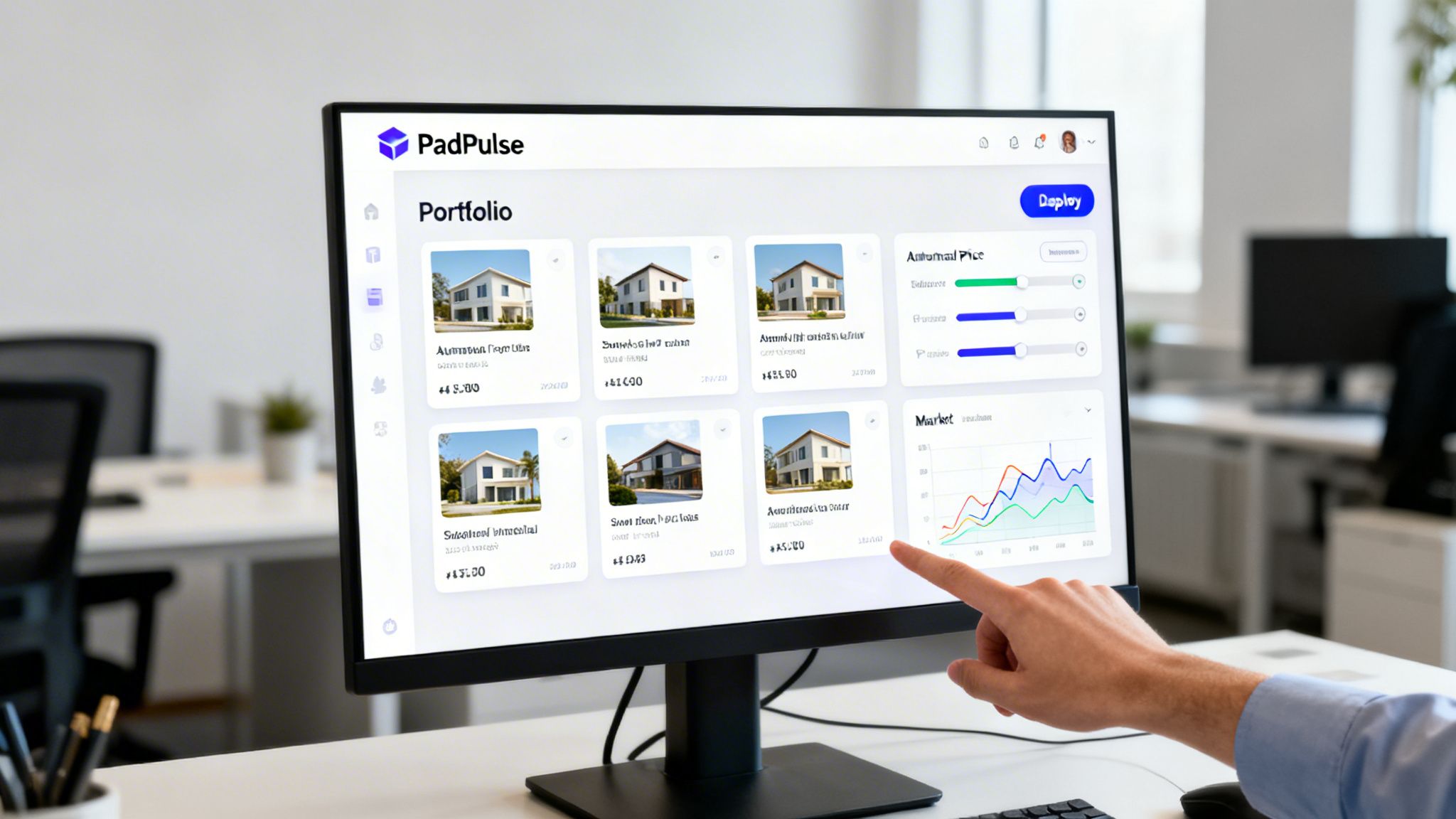
Let's be honest—we all start with spreadsheets. But what happens when you go from one property to five? Or ten? Suddenly, that beautiful spreadsheet becomes a monster.
You spend hours updating numbers, hunting for typos, and second-guessing your prices. This is the natural breaking point where manual methods stop working and start costing you money. To grow, you have to trade human error for data-driven precision.
This is exactly why we're building PadPulse. It takes all the principles we've talked about—valuing amenities, tracking market data—and applies them automatically across your entire portfolio. You’re not just getting a room rent calculator; you’re getting a true revenue management engine.
Let Automation Do the Heavy Lifting
The real game-changer is getting out of the weeds of manual data entry. An automated platform takes over tedious, repetitive tasks, freeing you up to focus on finding your next property or improving the resident experience.
PadPulse is being designed to handle the critical functions that drain your time:
- Dynamic Rent Adjustments: The platform will use real-time market data and seasonal demand to suggest and apply price changes, so you'll never have to wonder if your rooms are priced correctly.
- A Single Source of Truth: Forget juggling a dozen different spreadsheets. You’ll have one clean dashboard showing the performance of every single room you manage.
- No More Costly Mistakes: Automation eliminates the risk of a simple typo or broken formula that could quietly sabotage your profits.
This isn't just about saving a few hours. It’s about accessing a level of market intelligence that’s physically impossible to gather on your own once you're managing more than a handful of rooms.
By automating your pricing, you shift from a reactive chore to a proactive strategy. You’re no longer just keeping up—you’re staying one step ahead of the market.
More Than Just a Rent Calculator
Smart pricing is the cornerstone of a profitable rental business, but it's just one piece of the puzzle. A truly powerful platform has to connect pricing with all the other parts of your operation.
We're developing PadPulse as a complete management ecosystem where every feature works together to boost your bottom line.
- AI-Powered Messaging: Imagine automated workflows that handle inquiries, send rent reminders, and update residents on maintenance, cutting down your admin time.
- Smart Home Integrations: We’re planning to connect with keyless smart locks for seamless access control and smart thermostats to help you manage utility costs.
When your pricing, communications, and property tech all talk to each other, you unlock incredible efficiencies. To see our planned features and transparent costs, check out our PadPulse pricing page.
We're building PadPulse with experienced landlords to solve the real-world challenges you face every day. If you’re ready to graduate from spreadsheets and scale your business the smart way, we invite you to join our early adopter list.
Frequently Asked Questions About Room Rent Calculation
Even after you’ve mastered the formulas, a few practical questions always pop up. Getting your pricing right is an ongoing process, not a one-time task.
Let’s tackle a few of the most common questions from landlords.
How Often Should I Update My Room Rents?
More often than you probably think. Setting your rents once a year is a surefire way to leave money on the table. The market is always moving.
As a bare minimum, you should conduct a thorough review of your rents at least quarterly. This rhythm lets you stay responsive to market shifts without making knee-jerk decisions.
In a highly dynamic area—like a university town or a city with a big tourism season—you may want to adjust even more frequently. This is where a good room rent calculator that pulls in real-time market data becomes invaluable, helping you capture peak demand or offer a strategic discount to avoid vacancy.
How Do I Handle Utilities in My Rent Calculation?
This is a classic friction point. You have two solid options, and the best one depends on the experience you want to create.
- The All-Inclusive Model: This is our preferred method. You figure out the average monthly cost for all utilities (internet, electricity, etc.), add a small buffer of 10-15%, and roll it all into a single rent price. Tenants love the simplicity, and it's a powerful marketing tool.
- The Utility-Split Model: Here, you charge a base rent and then divide the actual utility bills among residents each month. While it might seem "fairer," it’s often an administrative headache that creates unpredictable costs for your tenants.
For most landlords, the all-inclusive model is simply a better business decision. It streamlines your operations and delivers a more professional experience.
What Is the Biggest Mistake Landlords Make When Pricing Rooms?
The single most expensive mistake is under-pricing rooms out of a fear of vacancy. This often stems from using a simple "per-room split"—just taking the total mortgage and dividing it by the number of bedrooms.
That approach completely ignores the actual value of each room. The spacious master suite with a private bathroom is not the same product as the smaller room down the hall. By pricing them equally, you are leaving a huge amount of money on the table.
The goal isn't just to fill every room; it's to maximize the total revenue from the entire property. A single room priced $100 below its market value for a year costs you $1,200 in pure profit. That's a direct hit to your bottom line.
Using a proper calculation method forces you to think like an asset manager. It helps you assign a fair, market-driven price to every room based on its unique features, ensuring you never undervalue your best assets again.
Ready to move past manual calculations and scale your business with an automated solution? PadPulse is the all-in-one platform we’re building to do just that. We're combining dynamic pricing with AI-powered messaging and smart home features to help you save time and maximize returns. Join our early adopter list for updates and beta access at https://padpulse.io.