Comparable Property Analysis: 2026 Guide for Co-Living Hosts
June 27, 2026
Most advice on comparable property analysis starts in the wrong place for co-living. It tells you to value the house, then back into the room price. That works for a conventional rental. It breaks for a furnished room with shared amenities, flexible terms, and a different tenant decision process.
That mismatch is why so many hosts feel like the market data they can find doesn't match the business they're running. In co-living markets, 74% of operators report that standard CMAs produce inaccurate valuations because they rely on whole-property sales, ignoring the premium for shared amenities and individual room configurations, and experts suggest adjusting for a co-living density premium of 15–22% over traditional leases according to Innago's discussion of comparative market analysis in real estate.
If you're pricing rooms to maximize NOI, the primary task isn't estimating what the house might sell for. It's figuring out what one specific room is worth to one specific renter in one specific micro-market, right now. That's a different discipline. It still uses comparable property analysis, but the unit of comparison changes from whole property to room-level demand.
Why Standard Property Comps Fail for Co-Living
A traditional comp set usually compares one house to other houses. That's useful if you're listing a home for sale or underwriting a standard lease. It doesn't tell you enough about a room with a private bath, a furnished setup, utilities included, keyless entry, and access to shared common areas that reduce the renter's total friction.
The biggest blind spot is the room-by-room data gap. Public records are built around property sales and conventional leases. They rarely capture the details that drive room choice. Renters compare things like bathroom privacy, kitchen quality, laundry access, parking, storage, noise, commute friction, and whether the room looks move-in ready. Standard comps flatten all of that into one building-level number.
Why whole-house logic misses room economics
A three-bedroom house doesn't produce room revenue evenly. One room may be near the front door and hear everything. Another may have better light and a larger closet. A third may have an en suite bath and effectively function like a mini-studio. If you price all three from the same house-level rent logic, you'll misprice at least one of them.
That creates two common problems:
- Underpricing the best room and leaving NOI on the table.
- Overpricing the weakest room and increasing vacancy drag.
Practical rule: A room isn't priced by what the house is worth. It's priced by how it competes against other available rooms a renter would actually choose instead.
The co-living premium is operational, not theoretical
The co-living density premium isn't just about putting more tenants in one house. It's about packaging the asset differently. Shared Wi-Fi, cleaner common spaces, furnished bedrooms, flexible move-ins, and smoother house operations change perceived value. That's why room-level pricing can't be copied from a standard single-family rental worksheet.
What doesn't work:
- Using whole-home Zestimate-style thinking for room rent
- Ignoring amenity packaging because it's “already part of the house”
- Copying nearby room ads without qualifying them
- Pricing every room in the same house the same way
What works is a comp process that starts with the renter's alternatives, not the investor's spreadsheet.
Defining Your Hyper-Local Co-Living Market
Before you collect comps, define the market the way your member experiences it. A one-mile radius can be useful in conventional comparable property analysis, but room renters often shop by convenience, safety, and routine. They don't care that two listings are geographically close if one feels disconnected from work, transit, or daily life.

Start with the member profile
A travel nurse, warehouse worker, airport employee, student, and newly relocated service worker may all rent rooms in the same city. They are not shopping the same market.
Define your competitive set around the renter you're trying to attract:
- Commute pattern matters more than radius. A room near a direct bus line can outperform a technically closer room with a frustrating trip.
- Employment anchors shape demand. Hospitals, distribution hubs, campuses, downtown service corridors, and industrial parks all create different room demand patterns.
- Lifestyle friction affects conversion. Grocery stores, gyms, laundromats, and safe late-night access can matter more than neighborhood branding.
If you want a stronger view of neighborhood demand, local supply, and comp signals, use a dedicated local market intelligence workflow for rent-by-the-room operators.
Keep the data current
Even a good market definition fails if the listings are stale. The most reliable comps must have sold or been rented within the last 3 to 6 months, and using older data can lead to valuation errors of 10% or more, because market trends can shift by 5% in a single quarter according to 360training's guide to comparative market analysis.
That matters even more in co-living because room demand can move faster than whole-house pricing. A new employer, a transit disruption, or a cluster of new room listings can change the competitive picture quickly.
Use old data only as background. Use recent data to make pricing decisions.
Build a competitor map that reflects real choice
Make a simple map or spreadsheet with the places your target renter would consider. Include:
Primary competitors
Same renter profile, similar room type, similar commute logic.Secondary competitors
Slightly different setup, but still plausible substitutes. Examples include smaller rooms with stronger amenities or better rooms in weaker locations.Disqualifiers
Listings that look similar at first glance but target a different renter altogether.
A beginner mistake is treating all room listings in a zip code as equal. They aren't. A room near a medical center with quiet house rules isn't competing head-to-head with a student-heavy room near campus just because both are furnished.
Filter the market before you analyze price
Your hyper-local market should answer one question clearly: Which rooms would your next renter compare against yours before sending an inquiry?
If you can't answer that, your comp set is too broad.
How to Find and Qualify Room-Level Comps
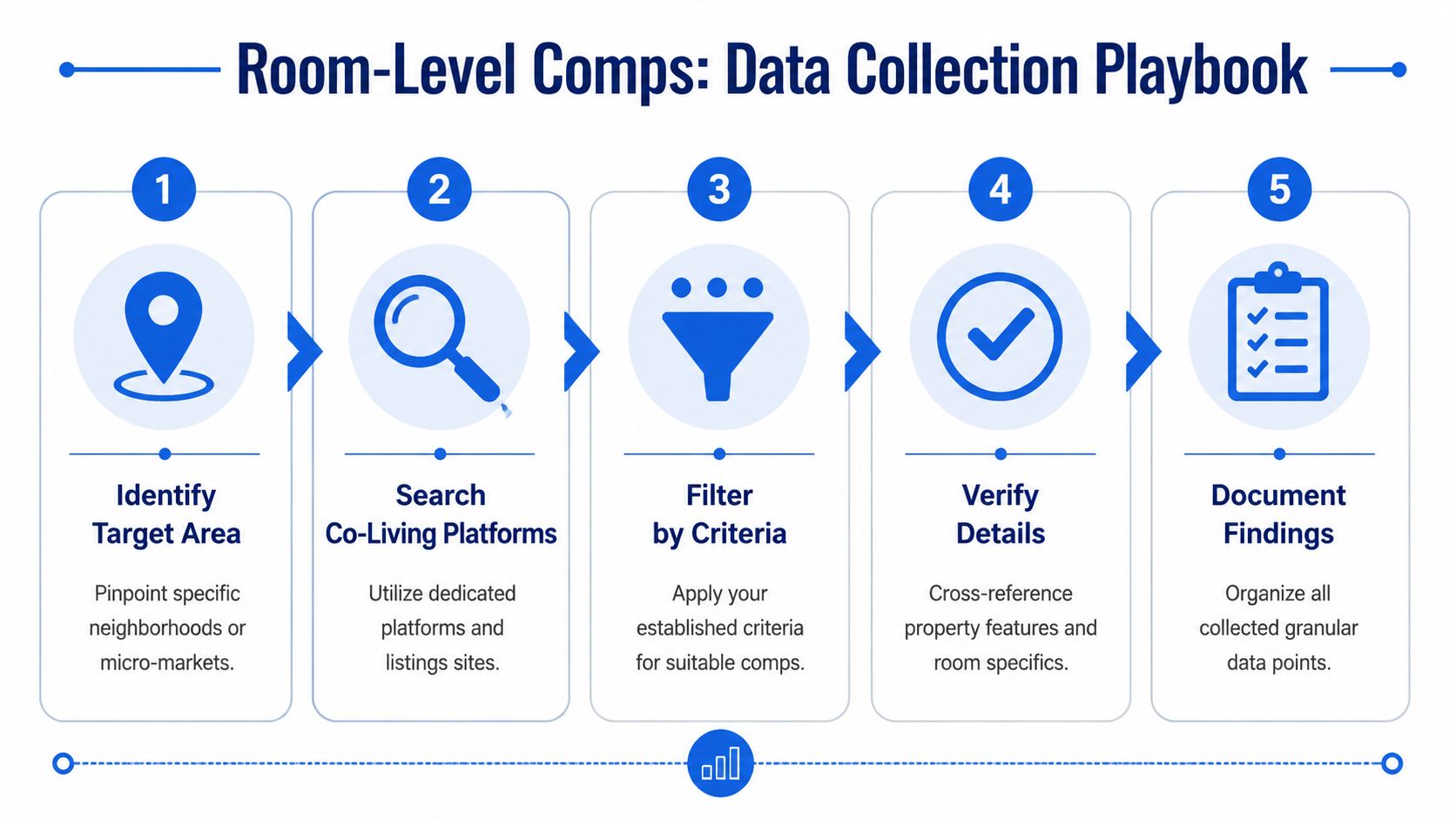
Public records won't give you the room-level detail you need, so you have to work from live listing environments and operator intelligence. That's normal in co-living. The trick isn't just finding room ads. It's separating useful comps from noise.
Where room operators should actually look
The best room-level comp search usually pulls from several sources:
- PadSplit listings if you're competing in that ecosystem
- Facebook Marketplace for local room supply and aggressive pricing behavior
- Craigslist for no-frills room inventory
- Roomies.com for roommate-oriented listings with clearer room detail
- Local property manager sites if they offer room-by-room inventory
- Google Maps and direct operator websites for branded co-living groups in your area
If you're refining your sourcing process, this guide to rent-by-the-room strategy and operations pairs well with comp work because it sharpens what details to capture from each listing.
Use a five-part qualification method
A thorough analysis requires a strict methodology: research and select comparable properties, document the data, select relevant units of comparison like price per room or per amenity package, make adjustments, and reconcile the values to estimate a final price, as outlined in HouseCanary's comparable market analysis tool overview.
That framework is the right backbone for room pricing, but the qualification standard needs to be tighter than most hosts expect.
1. Listing freshness
Check when the room was posted or updated. A stale listing can mean one of two things. Either the room is overpriced and sitting, or the operator forgot to remove it. Both can distort your comp set.
2. Amenity package
A room rate without context is worthless. Note whether the listing includes:
- Utilities
- Wi-Fi
- Furniture
- Parking
- Laundry
- Cleaning of common areas
- Kitchen access
- Private or shared bathroom
- Move-in flexibility
A cheap room may not be cheap once you account for what the renter still has to arrange on their own.
3. House quality
Look beyond the bedroom photo. Co-living renters buy the whole living experience. If the kitchen looks worn, the bathrooms look crowded, or the common areas feel unmanaged, the room shouldn't comp against a professionally run house with clean, functional shared spaces.
A room listing is only comparable if the shared areas are also comparable.
4. Occupant fit
Try to identify who the listing is for. Some signals are obvious. Quiet hours, furnished desk setups, blackout curtains, and hospital proximity suggest one profile. Party-heavy copy, student references, or “split bills with roommates” language suggest another.
5. Price integrity
Watch for rates that are technically real but practically misleading. Common examples include teaser pricing, hidden fees, or listings that show one rate for a tiny room and use better photos from the largest room in the house.
A simple spreadsheet that keeps you honest
Track each comp in one row. Include columns for:
| Field | What to record |
|---|---|
| Platform | PadSplit, Facebook Marketplace, Craigslist, Roomies.com, direct site |
| Listing date | Posted date or last updated date |
| Neighborhood | The micro-market, not just the city |
| Room type | Standard, premium, private bath, furnished, basement, etc. |
| Included items | Utilities, Wi-Fi, furniture, parking, laundry |
| Shared area quality | Strong, average, weak |
| Tenant fit | Worker, student, travel professional, mixed |
| Asking rent | The listed monthly room rate |
| Notes | Red flags, standout strengths, unclear details |
Reject more comps than you keep
Beginners often think more comps always mean better analysis. For room pricing, messy comps are worse than a smaller clean set. If a listing doesn't clearly show the room, shared areas, or included amenities, skip it. If the target tenant is different, skip it. If the photos are old or incomplete, skip it.
The hosts who price well aren't the ones who collect the most listings. They're the ones who qualify them with discipline.
Making Adjustments for Room-Level Differences
Comparable property analysis becomes useful instead of decorative. Raw listing rents are only starting points. If your room and the comp room are not alike, you need to normalize the difference before you trust the price signal.
A comparable analysis is an informal method for estimating market value, distinct from a legally binding appraisal. Success improves when you analyze the operational circumstances and physical conditions of comps before making adjustments, as explained in Altus Group's overview of commercial real estate comparative analysis.
Think like an operator, not a spreadsheet
The goal of an adjustment isn't mathematical perfection. The goal is to answer a practical question: If my room had the same features as the comp, what would it likely rent for?
For room-level pricing, the differences that usually matter most are:
Bathroom setup
Private bath rooms usually compete in a different tier than shared bath rooms.Furnishing level
A move-in-ready room often attracts a broader pool than an empty room.Size and storage
Extra floor space, a larger closet, or built-in shelving can shift renter preference.Light and noise
A bright room at the back of the house often leases faster than a dark room near shared traffic.Workability
A room with space for a desk can appeal more strongly to members who need to work or study from home.
Use plus and minus adjustments consistently
The easiest way to stay consistent is this:
- If the comp is better than your room on a meaningful feature, make a minus adjustment to the comp rent.
- If the comp is worse than your room, make a plus adjustment to the comp rent.
That direction matters. You're not changing your room. You're changing the comp to estimate what it would look like if it matched your room.
Operator note: The best adjustment system is the one you can repeat across every vacancy without changing the logic each time.
Sample Room Rent Adjustment Calculation
| Feature | Comp Room Rent | Your Room | Adjustment | Adjusted Rent |
|---|---|---|---|---|
| Private bathroom | Listed with higher room rent | Shared bathroom | Minus adjustment | Lower adjusted rent |
| Furnished with desk | Unfurnished room | Better furnishing package | Plus adjustment | Higher adjusted rent |
| Larger closet | Smaller closet | Comp is superior | Minus adjustment | Lower adjusted rent |
| Better natural light | Average light | Comp is superior | Minus adjustment | Lower adjusted rent |
| Included parking | No parking | Your room is inferior on parking | No adjustment unless your renters value parking strongly | Same or lower adjusted rent |
The exact dollar amounts depend on your market and your comp evidence. If you're new to this, keep the system simple. Use the same feature list for every room, and only adjust for differences that a renter would clearly care about.
What to adjust and what to ignore
Some differences deserve an adjustment. Some should clearly disqualify the comp.
Adjust for:
- Room-specific features that change renter choice
- Included amenities that reduce total living cost or hassle
- Shared-space quality when it's close enough to compare but not identical
Do not force adjustments for:
- A totally different tenant profile
- A house in a different micro-market
- A luxury setup competing against workforce housing
- A listing with unclear photos or vague details
A weak comp with too many adjustments becomes fiction. In practice, if you find yourself rewriting half the listing to make it fit, reject it and move on.
A practical way to assign value
Start by ranking your own rooms by ease of lease-up. Most operators already know which room gets the fastest interest and which one drags. That ranking helps you estimate feature importance. Then compare that pattern against outside listings.
For example:
- If rooms with private baths consistently outperform your shared-bath rooms, that feature deserves a meaningful adjustment.
- If furnished versus unfurnished doesn't seem to affect inquiry quality in your market, keep that adjustment small or skip it.
- If parking barely matters because most members use transit, don't overvalue it.
Operational reality beats generic formulas. You are pricing to maximize NOI, not trying to win an academic appraisal exercise.
Calculating and Verifying Your Target Rent
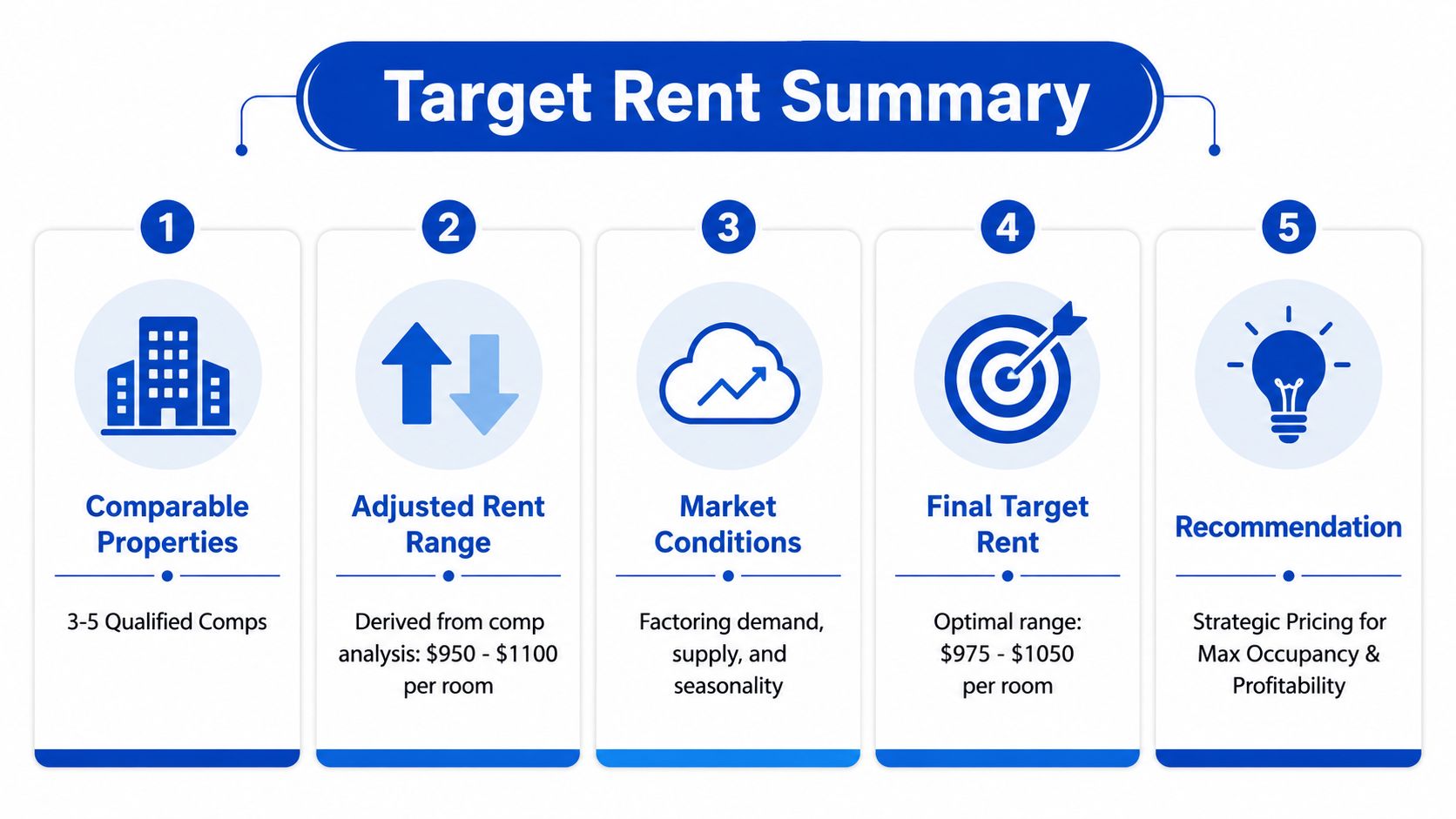
Once you've adjusted your best comps, don't chase a single perfect number. Price rooms as a range, then choose the launch price based on how aggressively you need to fill the vacancy.
For accuracy, rental data should come from the past 3 to 6 months so it reflects current market conditions rather than stale inventory, according to Vacation Property Expert Network's guidance on using comparable property analysis.
Build a defensible range from your best comps
A common rule of thumb in comparative analysis is to work from 3 to 5 comps when you can. At room level, that usually gives you enough signal without polluting the set with weak matches.
Use a simple process:
- List your adjusted rents from the qualified comps.
- Order them from low to high.
- Find the cluster, not the outlier.
- Set a working range around the most believable middle values.
- Choose a launch price based on urgency and room quality.
If one comp lands far outside the rest, don't average it in blindly. Ask why. It may reveal a hidden feature difference, a weak listing, or a different target renter.
Verify against live market behavior
A rent target from comps is only half the job. The market still gets the final vote.
Check your live indicators:
- Inquiry volume on similar rooms
- Time to first qualified inquiry
- How long comparable rooms sit before changing price
- Competitor price cuts or listing rewrites
- Your own vacancy pressure across the house or portfolio
If your comp-based number looks strong on paper but renters ignore the listing, the market is correcting your model for you.
Match price strategy to NOI goals
Not every room should launch at the middle of the range.
Consider a higher starting point when the room has standout features, your house has strong operational reputation, and nearby alternatives look weaker. Lean lower when the room is harder to place, when the house already has another vacancy, or when inquiry volume is soft.
A practical pricing posture looks like this:
| Situation | Better move |
|---|---|
| Premium room with few substitutes | Start near the top of your range |
| Standard room in a crowded comp set | Start in the middle |
| Weaker room or urgent fill need | Start near the lower end |
That keeps the process grounded in NOI. A room that's overpriced for too long doesn't earn premium revenue. It earns zero while it sits.
From Static Analysis to Dynamic Pricing Workflows
A one-time comparable property analysis gives you a useful baseline. It does not give you a durable pricing system. Room demand keeps moving, and hosts who treat pricing as a monthly or quarterly spreadsheet task usually react too late.

Static comps are a snapshot
Your comp set reflects a moment. But room-level leasing decisions are influenced by changing availability, seasonality, neighborhood shifts, and portfolio occupancy. Even when your original analysis is solid, the launch price may need to move if market response changes.
That doesn't mean abandoning discipline. It means using your comp work as the floor of a smarter workflow.
A useful workflow usually includes:
- A baseline comp file for each room type
- A refresh habit whenever a room turns or demand changes
- A response rule for weak inquiry flow or extended vacancy
- A portfolio view so one house doesn't get priced in isolation from the rest
What a better pricing workflow looks like
The strongest operators don't rely on intuition alone and don't rely on stale comps either. They combine market evidence with operating signals.
A practical loop looks like this:
- Set baseline room rent from qualified, adjusted comps.
- Launch and monitor inquiry quality, not just inquiry count.
- Watch competing listings in the same micro-market.
- Reprice intentionally when the market response doesn't match expectations.
- Document the result so the next vacancy starts smarter.
If you want a deeper breakdown of automated repricing logic for co-living, this explanation of how dynamic pricing works for room-by-room rentals is a useful next read.
A short demo helps make that shift from manual pricing to workflow thinking more concrete.
Why this matters for scale
Manual pricing can work for one house if you're hands-on. It gets shaky when you manage multiple properties, different room types, and staggered vacancies. Then pricing delays start to show up in NOI as slower fills, inconsistent room positioning, and avoidable discounting.
The hosts who win long term treat comparable property analysis as the foundation, not the endpoint. They build a repeatable pricing process that can adapt without starting from scratch every time.
Comparable property analysis still matters. It just needs to evolve from a static report into an operating system for room revenue.
PadPulse is building that operating system for PadSplit hosts and co-living operators. If you want one place to manage room-by-room pricing, market intelligence, member communications, smart access, and portfolio reporting, join the early interest list at PadPulse.