Rent by the Room: The Operator's Ultimate Guide
June 6, 2026
A lot of landlords reach the same point the same way. They own a decent house in a decent area, the property stays occupied most of the time, and yet the numbers still feel tight. One vacancy hurts. One bad renewal hurts more. And after maintenance, utilities, cleaning, and leasing time, the return can feel smaller than it should.
That's usually when rent by the room starts looking less like a side idea and more like a real operating model.
The appeal is simple. Instead of leasing one home to one household, you lease individual bedrooms to separate residents and treat the property like a small housing business. Done well, that can produce more gross income from the same address. Done poorly, it creates noise, turnover, and constant friction. The difference is rarely the property itself. It's the operator.
Your Next Step in Rental Property Strategy
Take a standard three-bedroom rental. Under a traditional lease, you market one unit, sign one agreement, and collect one payment stream. If the property underperforms, your only easy lever is usually raising the full-unit rent, cutting expenses, or hoping the next tenant is better.
Rent by the room gives you another lever. You can break the home into separate revenue lines and manage each room as its own product. One room might appeal to a commuter. Another might appeal to a student or shift worker. A larger room with better privacy can command a premium relative to the others. The property stops behaving like a single lease asset and starts behaving like a portfolio of small leases under one roof.
That shift matters because this model is no longer fringe. The market is getting more formalized, and operator participation is growing. SpareRoom reported in March 2026 that the number of U.S. homeowners looking to rent out spare rooms had increased by 92% over the previous five years according to Statistics Canada's discussion of shared rental market measurement.
Practical rule: If you're considering rent by the room, stop thinking like a landlord first and start thinking like an operator first.
That doesn't mean every house should be converted. Some properties have weak layouts, poor parking, or neighborhood dynamics that make shared living harder to run. But when the layout works, the model can turn an average rental into a stronger income producer.
The mistake beginners make is treating it like a loose roommate setup. That's not the business. The business is controlled leasing, room-level pricing, clear rules, fast turns, and repeatable systems. Without those, the extra revenue gets eaten by chaos.
What Is the Rent by the Room Model
Rent by the room means leasing individual bedrooms in one property to different tenants under separate agreements. Each resident rents a private sleeping space and shares common areas such as the kitchen, living room, laundry area, and sometimes bathrooms.
That's very different from a traditional lease.
In a traditional setup, one tenant or one household controls the entire property. In a room-by-room setup, the operator controls the house, assigns rooms, manages shared standards, and keeps direct relationships with each resident. That structure gives you more control, but it also gives you more work.
How it differs from a normal roommate house
A lot of landlords confuse this with a standard roommate situation. They're not the same.
In a roommate house, a group often signs together, or one master tenant informally fills spare rooms. In a true operator-led model:
- Each resident has a separate obligation: One person's late payment doesn't automatically drag the entire household into default.
- The house stays under operator control: You decide who fills vacancies and how the home is run.
- Common space rules are managed centrally: Cleaning, guest limits, noise standards, and utility expectations aren't left to chance.
- Turnover happens at the room level: You may replace one resident while the rest of the house stays occupied.
That last point changes the whole business. You don't think only in annual renewals anymore. You think in rolling occupancy.
Why demand is strong
This model works because affordability pressure is real, and shared housing already operates at scale. An estimated 79 million Americans live in shared households, and 22.4 million households spend more than 30% of their income on rent according to U.S. rental housing statistics compiled by iPropertyManagement.
Those numbers tell you two useful things.
First, there's already a large renter base comfortable with shared living. Second, room rentals solve a practical budget problem for many residents who can't or don't want to carry the cost of a whole apartment.
Shared housing isn't just a tenant preference category. For many residents, it's the only version of the market that fits their monthly budget.
The role shift most landlords underestimate
The cleanest analogy is this. A traditional landlord manages a unit. A room-by-room operator manages a living environment.
That means you're handling:
| Traditional lease | Rent by the room |
|---|---|
| One lease | Multiple leases |
| One turnover event | Ongoing room-level turnover |
| Tenant group self-manages | Operator manages house standards |
| Unit-level pricing | Room-level pricing |
| Limited resident interaction | Frequent resident communication |
If that sounds more like hospitality operations than passive real estate, that's because it is. The upside is real, but only if you accept the model for what it is.
The Financial Case and Risks of Co-Living
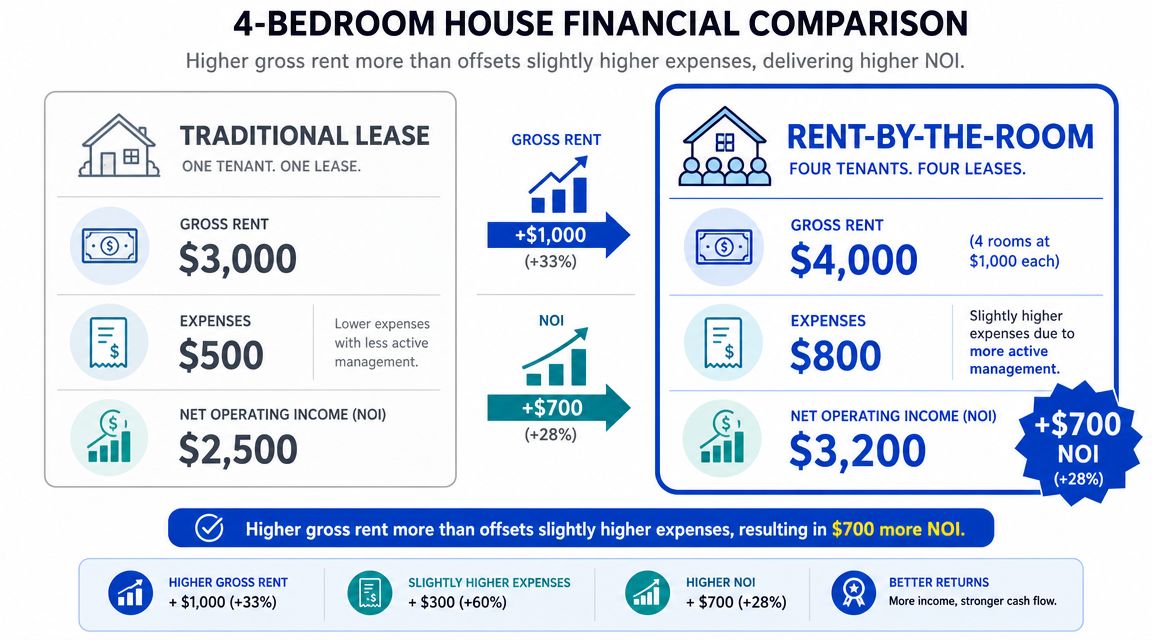
Most owners move into co-living for one reason. They want higher NOI.
That's a valid reason. If you can rent four bedrooms separately, furnish strategically, and maintain strong occupancy, the property can outperform a standard single lease. But the part that matters isn't gross rent on paper. It's what survives after vacancy, turn costs, utilities, cleaning, maintenance coordination, and management time.
Where the upside really comes from
The easy story is “more rooms, more rent.” But the full picture is more nuanced.
A room-by-room house can generate stronger income because you can segment the product. The largest room can be priced above the smallest. A room with a private bath can be priced differently from one that shares a hall bath. A furnished room near transit can compete with a different renter profile than an unfurnished full-unit lease.
That flexibility creates upside. It also means you need a model for each room, not just a target for the house.
Vacancy is the hidden killer
Many first-time operators get punished when they focus on the best possible room rate and ignore lost time between residents.
Public listings in New York show how wide the range can be. PadSplit advertises rooms in New York starting at $247 per week and also listings at $329 per week, while HousingAnywhere says private rooms in Manhattan usually range from $1,200 to $1,800 per month and Brooklyn and Queens from $800 to $1,300 according to PadSplit's New York room listings overview. The lesson isn't to copy those prices. The lesson is that room pricing has broad dispersion, and your house sits somewhere inside that local spread.
One vacancy in a room-by-room property immediately changes performance. If the room sits empty while you hold out for a slightly higher rate, the “better” pricing decision may reduce income.
A useful way to think about this is through gross effective income. The right room price isn't the highest advertised number. It's the one that balances rent level with lease-up speed and keeps the house earning consistently.
Operator mindset: A room that rents a little lower but fills faster can outperform a room that sits empty while you chase a perfect number.
Expenses increase in ways traditional landlords miss
Your cost structure changes when you convert to co-living. Common increases include:
- Utilities: Many operators offer all-inclusive pricing because it simplifies the sale and avoids resident disputes.
- Cleaning and resets: Shared kitchens and bathrooms need more attention than a single-family lease with one tenant group.
- Leasing time: More inquiries, more screening, more showings, more renewals.
- Wear and tear: More people means more usage on locks, appliances, flooring, plumbing fixtures, and HVAC.
- Coordination costs: Even when the direct bill is small, the time cost can be large.
That doesn't make the model bad. It means your underwriting has to reflect operations, not just rent.
A simple decision filter
Before converting a property, ask:
- Does the layout support privacy? Awkward circulation patterns create resident conflict.
- Can the house absorb room-level vacancy? Thin margins make the model fragile.
- Will the neighborhood support room demand? Proximity to work, school, or transit often matters more than curb appeal.
- Can you run fast turns? Profit leaks out during downtime.
If you can't answer those questions clearly, the property may still work. But it won't work passively.
Essential Legal and Lease Structures
The lease package for rent by the room can't be a recycled single-family template with a few edits. It needs to match the way the house operates.
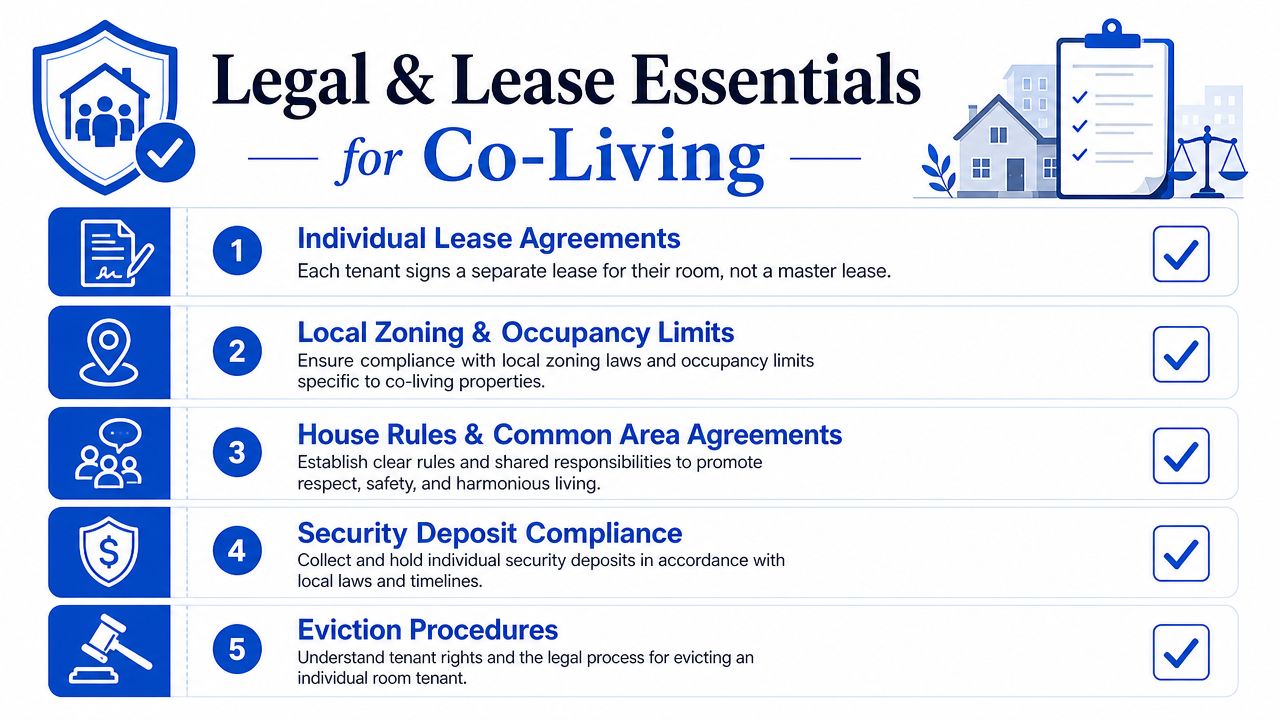
Each resident should have a room-specific agreement that clearly identifies what they control privately and what they're allowed to use jointly. If that line is vague, enforcement gets messy fast.
What must be in the agreement
A strong room rental agreement needs more than rent amount and due date. Best practice is to define the rented area, common space access, and rules for utilities, internet, guests, quiet hours, cleaning, pets, and violation procedures in writing according to Hemlane's guide to room rental agreements.
For operators, that means the lease should answer practical questions before they become arguments.
A solid agreement usually covers:
- Exact room identification: “Bedroom 2” is better than “upstairs room.”
- Shared-space rights: Kitchen, laundry, living room, storage, parking, outdoor areas.
- Included services: Furnishings, internet, utilities, supplies, cleaning expectations.
- Behavior standards: Noise, overnight guests, smoking, pets, trash handling.
- Violation handling: Warnings, cure periods, charges if allowed by local law, and next steps.
Compliance comes before marketing
Before you list a room, check the rules that govern occupancy in your market. Some cities and counties place restrictions on the number of unrelated adults in one dwelling. Others treat shared housing differently depending on layout, parking, or owner occupancy.
That's also when many landlords ask whether they need a manager license to run this model for others. If you're scaling into third-party management, property management license requirements are worth reviewing before you sign management agreements or advertise services.
Your lease is not just a legal document. In co-living, it's your operating manual.
House rules should support enforcement, not replace it
A separate house rules addendum is useful, but it shouldn't carry the whole burden. If an important standard matters operationally, put it in a signed document that ties directly to the tenancy.
Here's a practical division that works well:
| Put in the lease | Put in house rules |
|---|---|
| Rent terms | Cleaning rotation details |
| Room assignment | Kitchen storage labels |
| Common area access | Trash day reminders |
| Guest policy baseline | Shared fridge etiquette |
| Utilities and fees | Messaging norms |
| Violation procedures | Move-in tips |
The lease handles the enforceable framework. The house rules handle day-to-day living standards.
Don't ignore the boring details
Most disputes don't start with major legal issues. They start with ordinary ambiguity.
Who cleans the bathroom? Can a guest stay three nights? Is internet included? Can one resident use the hall closet? If a tenant moves out early, what happens to shared items they leave behind?
A traditional landlord can sometimes coast through vague wording because one household works things out internally. A room-by-room operator doesn't get that luxury. Precision saves time, protects occupancy, and reduces resident conflict.
Developing a Dynamic Pricing Strategy
The biggest pricing mistake in rent by the room is dividing a whole-house target rent by the number of bedrooms and calling it done. That's not pricing. That's arithmetic.
Room pricing works better when you treat each room as its own product with its own demand profile.
Start with local room comps, not apartment comps
Room renters compare your offer to other rooms, not only to studio apartments or one-bedroom units. That's why local room-level benchmarking matters.
Guidance from housing platforms recommends using comparable local room listings and adjusting for room size, bathroom type, amenities, and neighborhood access. It also warns that large datasets often miss informal room rentals, so manual local research is often necessary to avoid pricing bias, as explained in Azibo's guide to renting a room.
That manual work matters more than many owners expect. Large listing datasets can be useful, but room rentals are often fragmented across Facebook Marketplace, Craigslist, specialized roommate platforms, and local operator sites. If you only use broad apartment data, you can easily overprice a weak room or underprice a strong one.
Build a room ladder inside the house
Most profitable houses use an internal pricing ladder. Not every room should cost the same.
A simple way to structure it:
- Top tier rooms: Private bath, larger footprint, better light, stronger privacy, better floor location.
- Middle tier rooms: Standard size, shared bath, decent closet, stable appeal.
- Value rooms: Smaller footprint, less privacy, near common noise, limited storage.
Then layer in operational factors:
- Furnished or unfurnished
- Included internet and utilities
- Parking access
- Laundry access
- Transit convenience
- Work-from-home suitability
Pricing rule: Residents don't pay for square footage alone. They pay for privacy, convenience, and friction reduction.
Use pricing to protect occupancy
Dynamic pricing in this model doesn't mean chasing daily swings like a hotel. It means adjusting with discipline when demand, seasonality, or vacancy conditions change.
For example, if one room type sits longer than others, that's a signal. If your best room fills immediately every time, that's also a signal. If leads are strong but conversions are weak, the issue may be price, listing quality, or house fit.
A good operator reviews pricing through three lenses:
By room type
Which room categories consistently lease fastest?By lead response
Are inquiries turning into showings and applications?By vacancy cost
Is waiting for a higher rate improving monthly outcome?
If you want a practical overview of how operators adjust rates around these signals, dynamic pricing for rentals is the concept to study.
A workable pricing workflow
Here's a lean process that works for smaller operators:
- Check current comparable room listings in your submarket.
- Rank your rooms from strongest to weakest.
- Set an asking price for each room, not one blended figure.
- Watch inquiry quality during the first days of marketing.
- Adjust quickly if the room isn't attracting the right demand.
- Keep notes on actual lease-up speed by room type.
That last step is what turns pricing from guesswork into a system. Over time, you stop relying on instinct and start using your own room-level history.
Mastering Operations Tenant Screening and Turnover
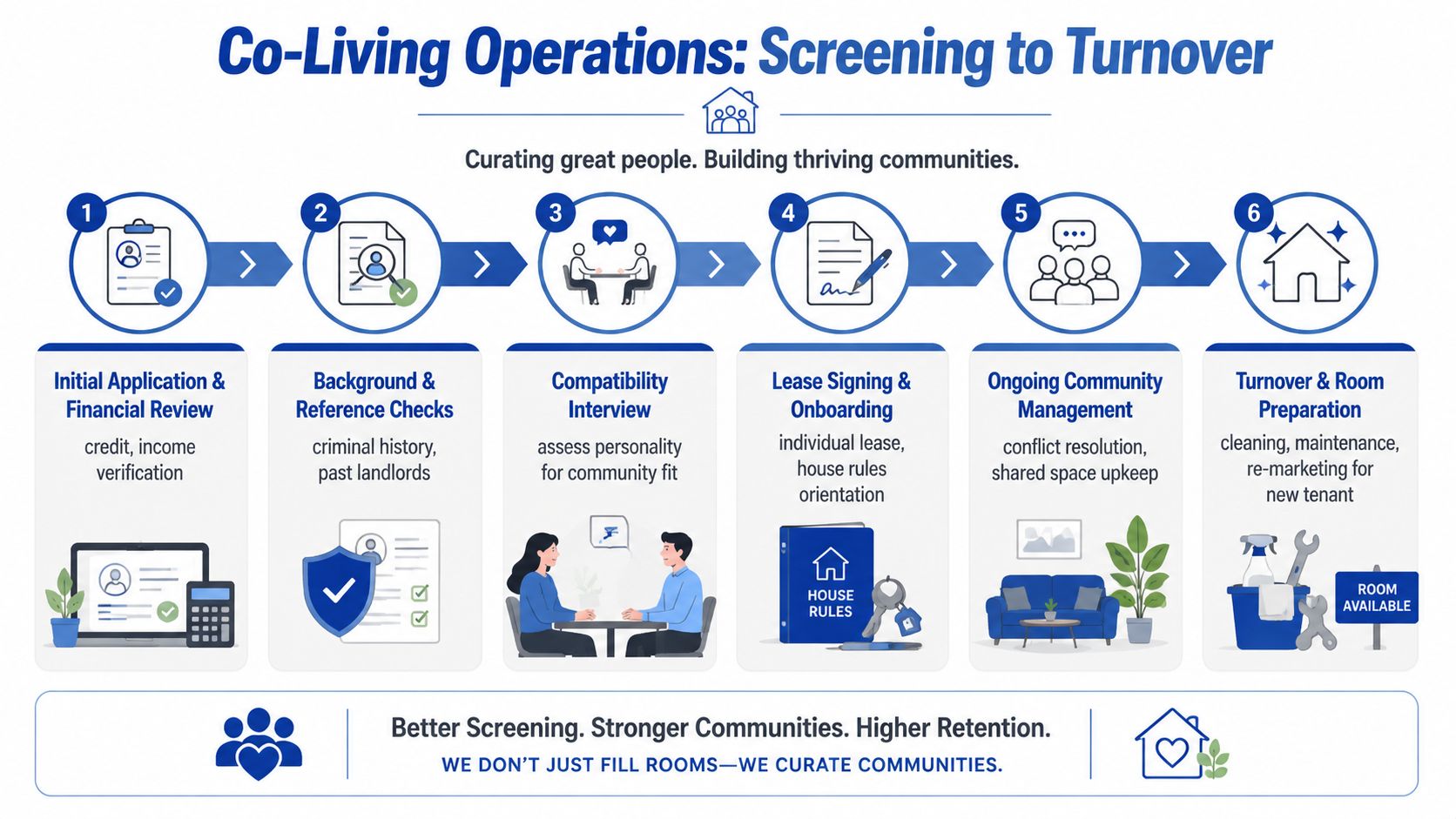
In rent by the room, operations decide whether the model feels controlled or exhausting. Screening, onboarding, conflict handling, and turnover aren't side tasks. They are the job.
The operational burden is also different from a standard lease. You aren't only screening for ability to pay. You're screening for the ability to live around other people without turning the house into a complaint loop.
Screening for fit, not just approval
A room-by-room screening process needs two layers.
The first is standard housing qualification. Can the applicant document income? Do their references align with the application? Are there obvious risk signals you can't ignore?
The second layer is compatibility. Shared housing works better when residents have at least a baseline alignment around noise, cleanliness, schedules, guests, and communication.
Useful screening topics include:
- Daily schedule: Night shift and early-morning households can clash.
- Work style: Remote workers usually care more about daytime quiet and internet reliability.
- Guest expectations: This issue causes more conflict than many owners expect.
- Cleaning habits: You don't need perfection, but you do need honesty.
- Reason for moving: Urgency can be fine. Chaos is different.
A short conversation often tells you more than an application alone.
The walkthrough below gives a visual sense of how operators think about furnished room setup and turnover presentation.
House rules need daily relevance
The best house rules aren't long. They're usable.
Residents should know where to find them, what matters most, and how enforcement works. If your rules read like generic boilerplate, people won't follow them until there's already a conflict.
Strong house rules usually cover:
- Kitchen conduct: Labeling, food storage, dishes, shared items.
- Bathroom expectations: Cleaning basics, personal storage, reporting issues.
- Guests and quiet hours: Clear, direct, and enforceable.
- Shared supplies: Who provides what, and what happens when things run low.
- Communication channel: Text, app, portal, or email for issues and notices.
The goal isn't to create a perfect community. The goal is to prevent small problems from becoming expensive turnover.
Turnover should run like a checklist
Turnover speed is a profit lever. If one resident gives notice, your process should start the same day.
A simple turnover workflow looks like this:
| Stage | What happens |
|---|---|
| Notice received | Confirm move-out date and next steps in writing |
| Pre-inspection | Identify damage, missing items, cleaning needs |
| Listing prep | Update photos if needed and publish marketing |
| Showings | Pre-qualify quickly and batch when possible |
| Reset | Clean, repair, restock, test locks and utilities |
| Re-onboarding | New lease, room assignment, access setup, house orientation |
Operators who struggle with vacancy often don't have a pricing problem first. They have a workflow problem. The room isn't photographed, the listing is late, the showing window is disorganized, or the reset takes too long because no checklist exists.
Consistency beats hustle
You can brute-force one house. You can't brute-force a portfolio.
The operators who scale this model well use the same screening questions, the same move-in instructions, the same room turn standards, and the same communication templates every time. That consistency lowers mistakes and makes resident experience more predictable.
Marketing Your Rooms and Tech for Scaling
Marketing a room is not the same as marketing a house. A full-unit listing sells square footage and neighborhood. A room listing sells daily life.
That means your listing has to answer practical questions fast. What exactly is private? What is shared? Is the room furnished? What does the bathroom situation look like? How easy is the commute? What kind of house environment should the applicant expect?
What good room marketing looks like
Strong room listings do a few things well:
- They lead with the actual offer: “Private furnished room with shared bath near transit” is better than a vague lifestyle headline.
- They show the room and the shared spaces: Residents rent both.
- They explain house structure clearly: Number of occupants, bathroom sharing, laundry, parking, internet, and basic rules.
- They remove uncertainty: If utilities are included, say so. If there's a quiet-hours standard, say so.
The marketing job is partly persuasion and partly filtering. Clear listings help attract the right resident and reduce wasted inquiry volume.
Why tech stops being optional
A single house can be managed with spreadsheets, texting, and a lot of memory. Multiple houses can't.
Once you run more than a small number of rooms, the bottlenecks show up fast. Leads come in at odd hours. Prospects ask the same questions repeatedly. Move-ins require access changes. Turnovers require coordination. Financial tracking gets messy because room-level performance disappears inside property-level accounting.
A practical co-living tech stack usually includes:
- Listing and pricing tools: To update room rates and keep marketing active across channels.
- Communication workflows: To respond to inquiries, schedule showings, and keep residents informed.
- Access control: Smart locks simplify move-ins, room access, and turnover handoffs.
- Reporting tools: You need visibility by room, by house, and across the portfolio.
One example is PadPulse, which is being built as an all-in-one platform for PadSplit hosts and co-living operators with planned features such as dynamic pricing, AI-powered messaging, smart-home integrations, and room-level financial reporting.
The first scaling problem in co-living usually isn't demand. It's operational fragmentation.
The stack should reduce response time and decision time
When owners buy software too late, they usually do it after they're already overwhelmed. Better timing is to build systems when the portfolio still feels manageable.
A useful test is simple. If you can't answer these questions quickly, your stack is too manual:
- Which rooms are vacant right now?
- Which listings are live?
- How long has each room been open?
- Who has been contacted, screened, or scheduled?
- What did each room earn last month?
If the answers live in different spreadsheets, text threads, and inboxes, scaling will be harder than it needs to be.
Manual management also creates inconsistency. One prospect gets an immediate response, another waits. One move-in gets a clean onboarding flow, another gets improvised instructions. One room gets repriced promptly, another sits stale. Technology doesn't replace good operations, but it does make good operations repeatable.
If you're building or scaling a rent-by-the-room portfolio, PadPulse is worth watching. It's an in-development platform designed for PadSplit hosts and co-living operators, with planned tools for pricing, messaging, smart access, and room-level reporting. You can join the interest list to follow the launch and beta updates without any billing before release.