Do You Need a Property Management License? 2026 Guide
May 21, 2026
You're ready to launch a rental. Maybe it's your first co-living house. Maybe you already lease by the room and want to hand off showings, rent collection, or guest screening to someone else. Then the licensing question hits, and suddenly a simple operating decision feels like a legal trap.
That concern is legitimate. Do you need a property management license isn't a yes-or-no question in most cases. It depends on who owns the property, who gets paid, what tasks they perform, and how your state classifies those tasks.
For co-living operators, this gets even trickier. Room-by-room rentals create more leasing touches, more applicant communication, more collections, and more people handling day-to-day operations. Those moving parts can push an operator into licensed activity faster than a traditional single-family rental would.
The good news is that the issue is usually clearer once you stop asking, “Am I a property manager?” and start asking, “What am I doing, for whom, and for compensation?” That's the test that matters.
The Property Management License Question
A common beginner scenario looks like this. An investor buys a house, furnishes the bedrooms, lines up cleaners, and starts marketing rooms. At first, everything seems straightforward because they own the asset and are managing their own property.
Then the business grows.
A friend asks for help managing another house. A virtual assistant starts answering leasing inquiries. A local runner begins showing rooms and collecting move-in funds. Someone negotiates deposit terms with applicants. That's where people often drift into regulated activity without realizing it.
Practical rule: The legal issue usually isn't the title on your business card. It's the task you perform and whether you're doing it for someone else for a fee.
Historically, property management in the United States has been regulated through real estate brokerage law, not through one national property manager credential. A broad industry summary explains that most states require either a property management license or, more commonly, a real estate broker's license for activities tied to leasing and managing rentals for others, and that only “a couple of states” don't impose that requirement, as described in this industry overview of property management licensing rules.
That framework matters because it explains why two people can both call themselves “property managers” and get different legal answers. One might be exempt because they manage their own building. The other might need a license because they advertise units, negotiate leases, or handle rent for an owner client.
For new operators, especially in co-living, the safest mindset is simple. Don't guess from job titles. Audit the actual workflow.
What Activities Require a Property Management License
The central idea is straightforward. Licensing is usually triggered by activities, not labels. If you perform regulated real estate acts for another person and get paid, your state may treat that as licensed property management or brokerage work.
The activities that usually trigger licensing
These are the tasks that most often create licensing exposure:
Leasing or renting for an owner: If you find tenants, place occupants, renew agreements, or manage occupancy on behalf of someone else, that often falls inside regulated real estate activity.
Negotiating lease terms: Discussing rent, deposits, move-in dates, house rules that become contract terms, or concessions can be more than “customer service.” In many states, negotiation is a licensing trigger.
Advertising available units: Marketing rentals can be regulated when it's done for another owner as part of leasing activity.
Showing units or rooms: Conducting tours may seem administrative, but some states treat showing property as part of leasing work.
Collecting rent or security deposits: Once someone receives and processes tenant funds for an owner, the risk level goes up. Handling trust funds is a major compliance issue in many states.
Executing or preparing lease paperwork: Even if software handles the form, the person walking applicants through terms or presenting agreements may be performing licensed activity, depending on the state and the setup.
Ohio gives a useful example of how regulators think about this. The state says property management includes negotiating contracts and lease agreements, and that a license is required for a person who, for another and for a fee, operates, manages, rents, or attempts to manage or rent buildings to tenants, as outlined by the Ohio property management guidance from the state real estate division.
Why co-living operators get tripped up
Traditional rentals might involve a few leasing events each year. Co-living houses create repeated touchpoints:
- Individual room listings
- Frequent tours
- Applicant screening coordination
- Separate rent collection workflows
- Move-ins and renewals happening on different dates
That operational model creates more moments where an assistant, contractor, or partner can accidentally cross into licensed activity.
A good example is screening. Pulling reports isn't the issue by itself. The issue is who communicates decisions, who handles the leasing conversation, and whether that person is acting for an owner client. If you're building a room-by-room process, keep your screening and underwriting workflow organized. A tool stack often starts with tenant screening and credit review, and landlords comparing options often look at guides like this breakdown of a TransUnion credit check for landlords.
If someone on your team can discuss terms, accept funds, and move an applicant toward occupancy for another owner, treat that role as a licensing review issue.
A simple way to test your own operation
Use this quick decision screen:
| Question | Why it matters |
|---|---|
| Do you own the property yourself? | Owner-managed property is often treated differently from third-party management. |
| Are you acting for another person? | Managing for others is the classic trigger. |
| Are you paid a fee or compensation? | Compensation often turns casual help into regulated activity. |
| Do you negotiate, market, show, lease, or collect funds? | Those tasks commonly sit inside licensing rules. |
| Are tenant funds handled through your process? | Money handling raises compliance risk fast. |
If you answer yes to several of those, don't rely on informal advice from investor groups or social media. Check your state rules before assigning those duties.
Common Exemptions from Licensing Rules
A lot of new operators get tripped up here. They hear that an “employee” or an “onsite manager” can be exempt, then assume that covers any helper involved in leasing a room. It usually does not.
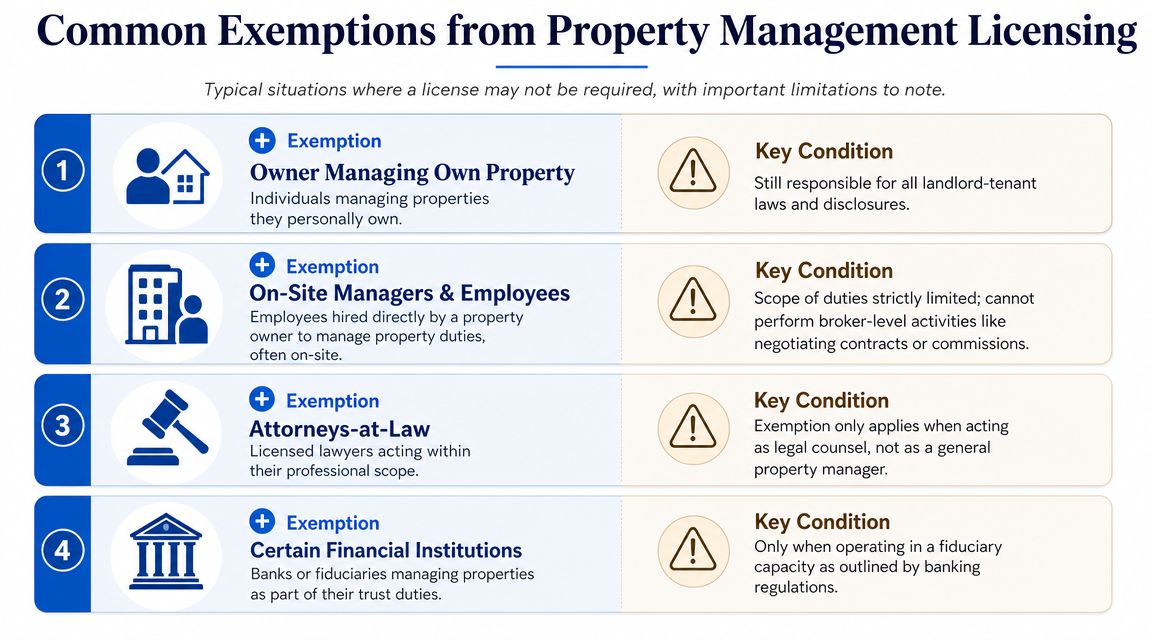
The owner exemption
The clearest exemption is the owner managing property they own.
If you hold title to the home, you can often advertise it, sign leases, collect rent, coordinate repairs, and run day-to-day operations without a property management license. For many small landlords, that is the starting point.
Co-living makes this less straightforward in practice. A host may own the property and still use assistants, virtual staff, or local contractors to handle room tours, resident communication, and payment collection. The owner exemption usually protects the owner's own activity. It does not automatically protect every person the owner puts into the leasing process.
That distinction matters in room-by-room rentals because more touchpoints exist. A single-family lease often has one prospect, one showing, and one move-in. A co-living house can have frequent turnovers, multiple applicants, and more staff interaction with residents.
Employees, onsite staff, and clerical help
In this context, operators make expensive assumptions.
As noted earlier in the Ohio guidance, some exemptions can apply to owners managing their own property, W-2 employees, fiduciaries, and certain workers performing limited support tasks under the right supervision structure. Other states also recognize narrow exceptions for onsite residential managers or purely clerical staff.
The key word is limited.
An exemption often turns on a few practical questions:
- Who employs the person? W-2 status is commonly treated differently from an independent contractor relationship.
- What does the person do? Scheduling, maintenance coordination, and form delivery are different from discussing lease terms.
- Who supervises the work? Some states only allow certain activities if a licensed broker is responsible for the process.
- How is the person paid? Transaction-based or leasing-based compensation can create more licensing exposure than straight hourly or salary pay.
In co-living operations, this line gets crossed fast. A house lead who only opens doors and reports maintenance issues may stay inside an exemption. If that same person starts telling applicants which room rate is negotiable, approves exceptions, or collects deposits for another owner, the analysis changes quickly.
Fiduciaries and other narrow exceptions
Some exemptions exist because the person is acting under a separate legal duty, not because property management is broadly unregulated.
Examples often include:
- Executors handling estate property
- Guardians acting within their court-appointed role
- Trustees in bankruptcy
- Certain onsite residential managers
- Clerical or maintenance staff with no leasing authority
These categories are narrow for a reason. Regulators usually look at the actual work being performed, not just the job title.
That is the practical takeaway. Do not rely on labels like “assistant,” “community manager,” or “host support” if the person is effectively leasing rooms or managing property for someone else.
The Risks of Managing Property Without a License
Most operators don't get into trouble because they intended to ignore the law. They get there because they scaled informally. A friend helped with leasing. A contractor started doing tours. An assistant began discussing move-in terms. The business kept moving, and nobody stopped to ask whether the role required a license.
The risk isn't just regulatory. It's operational.
Where problems show up first
The first cracks usually appear in one of these places:
- Owner disputes: An owner may challenge your right to get paid if your agreement depended on work you weren't licensed to perform.
- Tenant disputes: If a leasing process was mishandled, enforcement actions can become messier.
- Trust funds and rent handling: Money creates a paper trail. Once funds move through the wrong hands, mistakes become easier to prove.
- Brokerage enforcement: State regulators often care less about what your website says and more about what your team did.
For co-living and room-by-room operators, there's a second layer of risk. Because more people may touch the resident journey, there are more chances for unlicensed leasing conduct to happen in text messages, calls, tours, or payment collection.
What doesn't work in practice
A few bad assumptions show up repeatedly:
| Bad assumption | Better approach |
|---|---|
| “I'm just helping a friend.” | If you're managing for another person and getting compensated, treat it as a compliance issue. |
| “I only show rooms.” | Showing can still be regulated depending on state rules and supervision. |
| “My VA handles messaging, not leasing.” | If messages drift into terms, approvals, or move-in commitments, the role may no longer be clerical. |
| “We're not a property management company.” | Regulators usually care about activities, not branding. |
Unlicensed activity can turn a profitable workflow into a liability. The cost shows up in disputes, delayed collections, broken owner relationships, and cleanup work you could have prevented.
Risk management matters more than labels
A smart operator treats licensing the same way they treat entity setup, trust accounting, and fair housing procedures. It's part of the operating system.
That means documenting who can do what, limiting access to tenant funds, keeping negotiation authority with properly authorized people, and reviewing every outsourced role. If your process depends on informal helpers doing leasing work, that process is fragile.
How to Become a Compliant Property Manager
Compliance gets easier once you treat it like an operations project instead of a legal mystery. The work usually comes down to role mapping, state research, and following the licensing path if your activities require it.
A practical starting point is this. Write down every task in your rental workflow, then match each task to a real person.
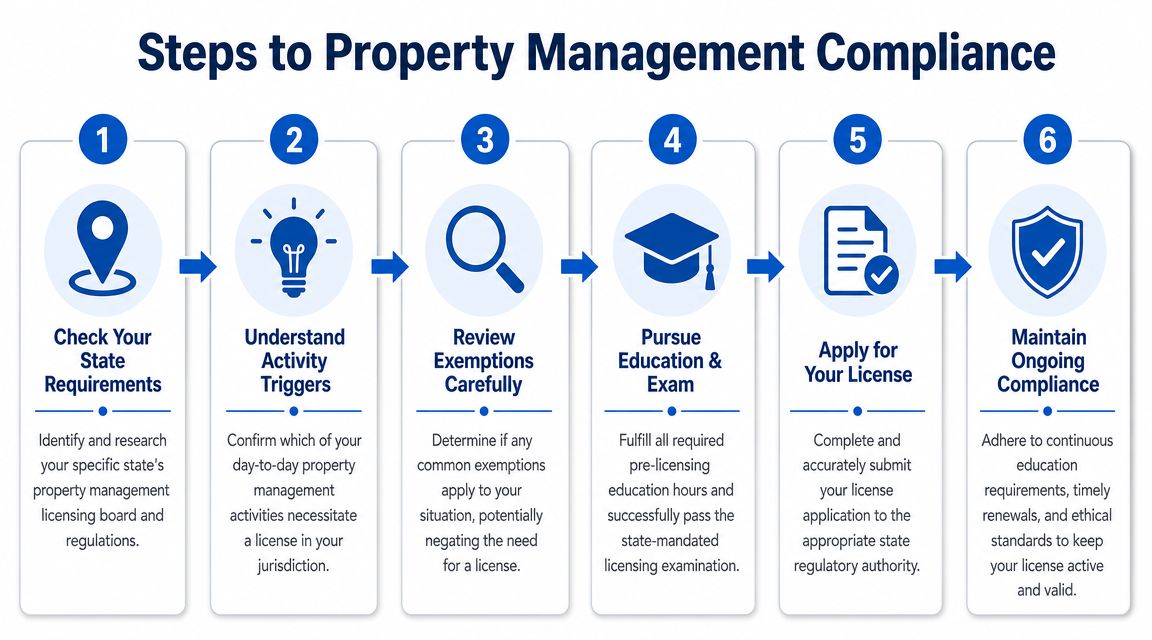
Start with your state, not internet summaries
Generic articles can help you understand the issue, but they shouldn't be your final answer. Your next step is to review your state real estate commission or licensing authority.
When you review state guidance, look for answers to these questions:
- Which activities are defined as licensed real estate acts?
- Does the state regulate leasing, showing, rent collection, or trust fund handling?
- Are there exemptions for owners, W-2 employees, on-site managers, or clerical staff?
- Does a broker need to supervise certain work?
- Are there separate rules for company structure or firm licensing?
Connecticut is a good example of how specific these rules can get. A practical licensing overview notes that compliance often includes state-specific education, exam, and background check requirements, often with 30 to 90 hours of pre-licensing instruction, and that Connecticut requires a 60-hour course and a broker exam, as summarized in this property management licensing overview with Connecticut examples.
Follow the usual licensing path
If your work requires a license, the process often looks like this:
Confirm the role and license type
Some states fold property management into salesperson or broker licensing. Others impose broker-of-record or supervision requirements for firms.Complete pre-licensing education
State rules often require classroom hours before you can sit for the exam.Take the exam
The exam usually tests real estate law, contracts, agency, and state-specific compliance.Submit to background review and application processing
Many states include a background check as part of the application process.Set up your operating structure correctly
If you're running a company, firm registration, broker oversight, and trust fund procedures may matter as much as the individual license.
Here's a quick walkthrough that helps many new operators understand the process:
Build compliance into your workflow
Getting licensed is only part of the job. Staying compliant matters just as much.
For co-living operators, I'd map at least these workflows:
- Vacancy marketing
- Lead response
- Room showings
- Application handling
- Lease or occupancy agreement execution
- Move-in funds
- Recurring rent collection
- Renewals and term changes
A lot of operators benefit from documenting those workflows in one place. If you need a starting point, a solid operational reference is this guide to property management checklists.
Field advice: Don't assign duties by convenience. Assign them by compliance. The cheapest person on your team can become the most expensive mistake if they perform the wrong task.
Special Considerations for Co-Living and PadSplit Hosts
Co-living changes the licensing conversation because the operating model is more fragmented. Instead of one lease and one household, you may manage several room listings, staggered move-ins, separate payments, and repeated applicant interactions. That creates more chances for a team member to cross from admin work into leasing work.
Room-by-room rentals create more licensing touchpoints
If you own the house and self-manage, you're usually asking a landlord question. If you manage a co-living property for another owner, you're often asking a licensing question.
That distinction matters because room-by-room operations usually involve:
- More marketing activity
- More showings
- More application discussions
- More conversations about pricing or move-in terms
- More handling of deposits and rent streams
Each one is a point where the person doing the task needs to fit your state's rule set.
Master lease and subleasing setups need extra care
Some operators use a master lease model and then sublease rooms. Others manage under an owner agreement. Those aren't the same structure.
If you are the actual tenant under a lawful arrangement and you're subleasing within the rules of your jurisdiction and contract, the licensing analysis may look different from third-party management. But if your model functions like management for an owner while you advertise, place occupants, set terms, and collect funds, calling it “co-living” or “hosting” won't change the substance.
That's why room-by-room operators should review both the legal structure and the workflow. The paperwork matters, but so does the day-to-day conduct.
Platforms don't remove legal responsibility
Using a listing platform, rent collection tool, messaging system, or smart lock system doesn't remove licensing obligations. Software can support compliance, but it doesn't replace it.
If you run shared housing, you need a system that clearly separates:
- Clerical communication
- Screening support
- Authorized leasing decisions
- Fund handling
- Agreement execution
Operators building those systems often benefit from studying how the niche differs from ordinary rentals. This overview of co-living property management is useful for understanding the operational side of room-by-room housing.
The more your business depends on repeated leasing actions, the more carefully you should define who is allowed to speak, approve, negotiate, and collect.
Your Compliance Action Plan and Key Takeaways
By this point, the answer to do you need a property management license should feel more manageable. The question isn't abstract. It comes down to ownership, compensation, activities, supervision, and state rules.
A lot of new operators waste time looking for a universal answer. There isn't one. The safer move is to audit the work and match it to the law where the property sits.
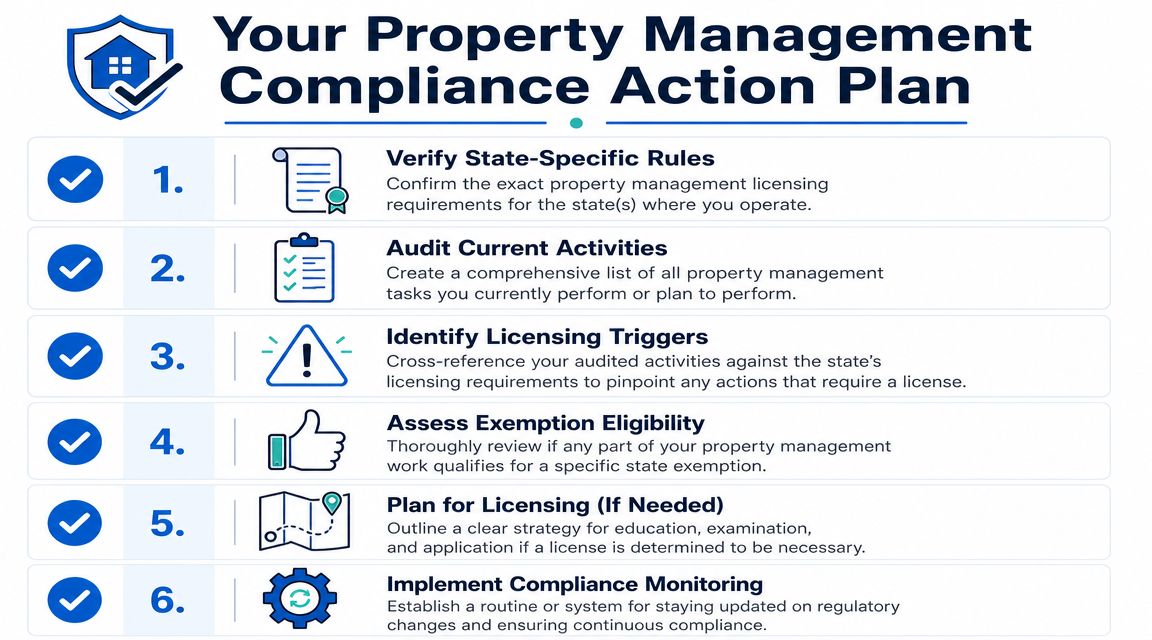
A practical checklist
List every task in your operation
Include marketing, tours, screening communication, lease discussions, rent collection, renewals, and handling of deposits.Identify who performs each task
Separate owners, W-2 employees, independent contractors, virtual assistants, and outside managers.Review your state's official rules
Don't rely on forum answers when assigning regulated duties.Check exemptions carefully
Owner management, clerical support, and on-site roles may help, but only if the facts fit the exemption.Document authority levels
Decide who can communicate logistics and who can negotiate terms. Those are not always the same role.Get local legal guidance when the structure is unusual
This matters most for co-living, master lease arrangements, and multi-owner portfolios.
The best compliance plan is simple enough to use. If a new hire joined tomorrow, could you tell them exactly what they are and aren't allowed to do? If not, the process needs work.
When in doubt, slow down before scaling. Cleaning up a licensing mistake after you've filled a house is much harder than setting the workflow correctly at the start.
PadPulse is building an all-in-one platform for PadSplit hosts and co-living operators who want tighter control over rent-by-the-room operations. If you want one place for pricing, communications, access control, and reporting, join the PadPulse interest list to get product updates, beta access news, and early launch information.