A Guide to TransUnion Credit Check Landlord Tools in 2026
May 12, 2026
You have a vacant room, two applicants, and very little time. One sounds great on the phone. The other filled out the form faster and uploaded documents right away. In co-living, that's normal. Rooms turn faster, applicants often have mixed income sources, and one bad placement can affect not just rent collection but the whole house.
That's why a transunion credit check landlord process matters. It gives you a structured way to review financial risk before you hand over keys. For room-by-room operators, that structure matters even more because you're not only choosing someone who can pay. You're choosing someone who can fit into a shared home without creating avoidable problems.
A good screening process doesn't need to be complicated. It needs to be consistent, documented, and legally clean. TransUnion tools are often part of that setup because they combine credit-based screening with rental-focused signals and a workflow that's easier for small landlords to manage than collecting sensitive data by hand.
Why Landlords Trust TransUnion for Tenant Screening
A room goes vacant on Friday. You want it occupied by next week. An applicant says they start a new job Monday and can move immediately. Another has better communication but a thinner application. Many new hosts make the mistake of choosing based on instinct in this situation.
Instinct helps, but it shouldn't run your screening.
TransUnion has stayed central in rental screening because it gives landlords a more objective starting point. In a 2014 TransUnion survey, 48% of landlords ranked credit check results among their top three factors for approving lease applications. That matters because it shows credit review isn't some extra step landlords recently added. It has been a core leasing tool for a long time.

Why it matters more in co-living
A whole-unit landlord can sometimes absorb one weak tenant more easily if the lease structure is stronger or turnover is lower. A co-living host usually has less room for error. Rent comes in room by room. House dynamics matter. Faster turns mean you're screening more often.
A TransUnion-based workflow helps in a few practical ways:
- It creates consistency. You stop making exceptions based on who sounded nicest on the phone.
- It flags identity and report issues early. Mismatched addresses, odd inquiry activity, or other discrepancies deserve a second look.
- It keeps screening fair. If every applicant goes through the same process, you reduce the chance of ad hoc decisions that are hard to defend later.
Practical rule: The best screening system is the one you can apply the same way to every applicant, every room, every time.
What landlords are really looking for
Most hosts aren't trying to find a perfect applicant. They're trying to avoid obvious risk. A TransUnion report helps answer basic questions quickly:
- Has this person handled past obligations reasonably well?
- Do the application details line up with the report?
- Is there a pattern that suggests chronic payment trouble?
- Is this someone who needs extra verification before approval?
That last point matters. Screening doesn't only produce yes or no decisions. Sometimes it tells you to slow down, verify income again, call prior housing references, or require additional support if your written policy allows it.
For new hosts, that's usually the biggest shift. A credit check isn't there to eliminate judgment. It gives your judgment a factual base.
Direct TransUnion vs Screening Services Which Is Right For You
Once you decide to use a TransUnion report, the next choice is how to access it. Most small landlords end up in one of two lanes. They either use a direct TransUnion-connected product such as SmartMove, or they use a broader screening platform that includes TransUnion data inside a larger workflow.
Neither option is automatically better. The right one depends on how many rooms you manage, how often you screen, and whether you want a single-purpose tool or an operating system around it.
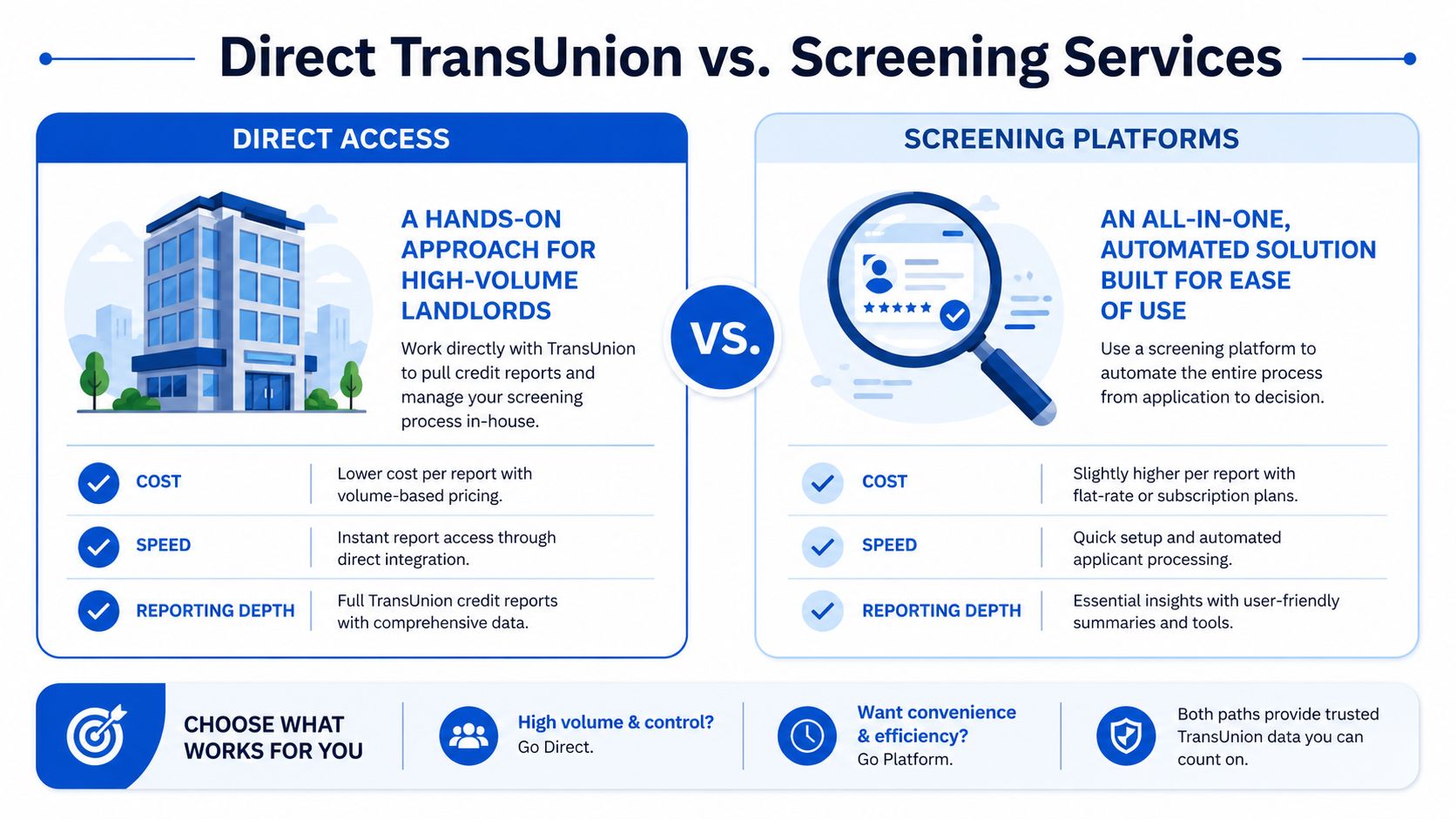
What direct access feels like
A direct option is usually simpler if you're starting out. You send the applicant through the provider's workflow, review the results, and make a decision. For a landlord with one house or a small handful of rooms, that can be enough.
The upside is control. You know exactly what report you ordered and what workflow the applicant followed. The downside is that you may still be stitching together messaging, application tracking, and move-in coordination somewhere else.
What integrated screening feels like
Integrated screening platforms make more sense when screening is only one part of a bigger operation. If you're handling inquiries, showings, approvals, deposits, and renewals at a steady pace, having screening inside the same system can reduce manual work.
Operators often compare broader property software stacks and ask whether screening should live inside them. If you're sorting through that larger software decision, this comparison of Buildium vs AppFolio for rental operations is useful background.
TransUnion Screening Options Compared
| Feature | Direct (e.g., SmartMove) | Integrated Screening Service |
|---|---|---|
| Setup style | Standalone screening workflow | Built into a larger property management process |
| Best for | Small landlords who want a focused screening tool | Operators managing more moving parts across multiple rooms or homes |
| Tenant experience | Usually straightforward and purpose-built | More convenient if the application, screening, and lease steps are connected |
| Operational fit | Good when you don't mind using separate tools | Better when you want fewer handoffs between systems |
| Report handling | You review the screening result directly | You review it inside the platform with other applicant data |
| Trade-off | Simpler, but less centralized | More efficient, but you depend on platform design and workflow quality |
Direct access works well when screening is the main task. Integrated services work better when screening is one step in a repeatable leasing machine.
How to choose without overthinking it
Use a direct service if:
- You manage a smaller portfolio. A few rooms or one house usually doesn't justify extra system complexity.
- You want a clear, focused process. You don't need bundled messaging, accounting, or automation.
- You're still refining your criteria. A simple setup makes it easier to learn what matters in your market.
Use an integrated service if:
- You screen frequently. More turnover usually means more value from a centralized workflow.
- You want less admin. Fewer exports, fewer emails, fewer chances to lose track of an applicant.
- You manage by process. If you already use checklists and repeatable approval rules, integration helps.
What doesn't work well is a hybrid process with no standard. That's when one applicant gets screened one way, another gets reviewed manually, and nobody can explain why the outcomes were different.
How to Legally Request a TransUnion Report
The legal part of screening is where many new landlords get sloppy. They think the software handles everything, so they don't need to understand the process. That's risky. The tool helps, but you're still responsible for how you request and use consumer report data.

A compliant process starts before you ever see a report. You need a legitimate rental-related reason to request it, and the applicant needs to authorize that screening. If you're handling room-by-room rentals, keep your process identical for every applicant to the same room type. Consistency makes compliance easier.
The clean workflow to follow
Services like SmartMove use a workflow where the tenant initiates the check through a secure portal, triggering a soft inquiry that generates a rental-focused ResidentScore without affecting the applicant's credit, as explained in this overview of TransUnion credit checks and ResidentScore.
That setup helps in two ways. First, the applicant doesn't have to hand sensitive details directly to you in the same way a manual process might require. Second, the soft-pull structure is easier to explain to applicants who are nervous about damage to their credit file.
My basic landlord checklist
Use this before you click send on any screening request:
- Use written criteria first. Decide your standards before reviewing any individual applicant.
- Get explicit permission. The applicant should clearly authorize screening as part of the application process.
- Keep the request tied to a real application. Don't run reports casually or “just to check.”
- Use a secure workflow. Avoid collecting more personal information than you need.
- Document the steps. If a decision gets challenged later, you want a paper trail.
If your process changes depending on who applies, your legal risk goes up fast.
What applicants usually ask
Most applicants want answers to three questions:
- Will this hurt my credit? With tenant-initiated soft inquiry workflows, the answer is generally no impact from that inquiry.
- Why do you need this? Because you're evaluating payment reliability and rental risk in a standardized way.
- Who sees my information? The answer depends on the service, but modern screening workflows are built to limit unnecessary sharing.
That last point is especially important in co-living. You may be leasing quickly and working with many inquiries, but that doesn't justify loose handling of personal data.
Here's a helpful walk-through if you want to see a screening-related workflow in action:
What doesn't work
A few habits cause problems over and over:
- Asking for screenshots instead of running a proper report
- Using different authorization language for different applicants
- Collecting full documents by email when a secure portal is available
- Running the report before your criteria are written down
None of that saves meaningful time. It just creates confusion and liability. A legal screening process should feel boring. That's usually a sign it's working.
Decoding the TransUnion Report for Rental Decisions
Once the report arrives, don't stare at the score and stop there. That's the easiest mistake to make. The better approach is to read the report like an operator looking for patterns.
The most useful number in a TransUnion rental screen is usually ResidentScore 2.0, not a generic consumer lending score. A 2025 analysis of TransUnion data found the average ResidentScore 2.0 was 680, which corresponded to an estimated eviction risk of under 6%. The same analysis notes that the score ranges from 350 to 850 and is built for rental outcomes rather than general borrowing behavior.

Start with patterns, not panic
A report can contain negative items that don't all mean the same thing. One isolated collection account doesn't tell the same story as repeated missed obligations and unresolved rental-related issues.
I read reports in this order:
- Identity consistency first. Name, address history, and anything that doesn't match the application.
- Rental-relevant payment behavior next. Not every debt matters equally to a landlord.
- Public record concerns after that. These deserve attention, but context still matters.
- Overall score last. The score helps summarize risk, but it shouldn't replace reading the file.
What deserves extra weight
Some report elements matter more in a room-rental business than others:
- Housing-related trouble: unpaid rent patterns, landlord collections, or eviction-related issues are more relevant than a one-off small consumer account.
- Ongoing payment strain: multiple active delinquencies can suggest cash flow trouble.
- Thin but clean history: this is very different from damaged history. Don't treat them as the same applicant profile.
A thin file is not the same thing as a bad file. New credit users, recent movers, and many working-class renters won't look polished on paper even when they pay reliably.
A practical way to interpret results
Here's the kind of distinction that helps in real approvals:
| Report pattern | How to think about it |
|---|---|
| Moderate score with stable application details | Often worth continued review instead of quick denial |
| Thin file but clean supporting documents | Better handled with added verification than automatic rejection |
| Score looks decent but application details conflict | Slow down and verify identity and claimed history |
| Multiple unresolved signs of payment stress | Usually calls for a more cautious decision under your written policy |
What doesn't work is using one rigid number as your only filter. Reports are strongest when they support a decision framework, not when they become the entire framework.
The best question to ask
Don't ask, “Is this applicant perfect?”
Ask, “Based on this report and the rest of my file, is this applicant likely to pay reliably and fit my approval policy?”
That question leads to better decisions because it forces you to combine the report with the application, income review, references, and the realities of shared housing.
Screening Strategies for Co-Living and Room-by-Room Rentals
Generic screening advice often assumes a traditional apartment lease. Co-living doesn't work like that. You may have shorter stays, more frequent turns, applicants with hourly or variable income, and people rebuilding financially who can still be solid residents.
That's why rigid score cutoffs often fail in room-by-room rentals. They can screen out people who are perfectly capable of paying for a room while doing little to tell you whether they'll function well in a shared house.
A 2023 CFPB report, as referenced in SmartMove-related guidance, noted that screening errors disproportionately affect low-income renters. The same discussion also points to rising rental fraud and the need to combine tools like ResidentID with manual verification rather than relying only on algorithmic scores, as summarized in this overview of tenant screening issues in shared housing contexts.
What works better than a single cutoff
In co-living, use layered screening.
Start with the report, but don't end there. Add verification steps that reflect how shared housing works:
- Check identity carefully. Fraud prevention matters because room rentals can move fast.
- Verify current income reality. Don't rely only on what the applicant typed into a form.
- Call prior housing references when the file is unclear. You're looking for lived rental behavior, not just score output.
- Review house fit. A person can qualify financially and still be a poor fit for a quiet, shared home.
How to handle non-traditional applicants
Many good co-living applicants won't fit a textbook profile. Some are contract workers. Some have new jobs. Some have thin files because they haven't used much credit. Some are coming out of a rough stretch and are stabilizing.
That doesn't mean lowering standards. It means defining what alternate support you'll accept.
For example:
- A thin credit file might trigger extra income verification and stronger housing references.
- Irregular income might call for a longer look at deposit patterns and employment consistency.
- Borderline applications might be better managed with a stronger upfront risk policy if your local rules and written criteria allow it.
If you're considering flexible move-in structures, this guide to a security deposit alternative for landlords and operators can help you think through the trade-offs.
Shared housing rewards nuance. The host who reads beyond the score often places better residents than the host who auto-rejects anything imperfect.
Build a policy you can repeat
A durable co-living screening policy usually includes:
- Financial criteria for room rent, not whole-unit assumptions
- A documented way to review thin-file applicants
- Manual verification steps for identity and income
- A house-rules fit check before approval
- Clear notes on when to pause, verify more, or decline
What doesn't work is improvising every time. High-turnover operators need judgment, but they also need repeatability. If your decisions depend on mood, urgency, or vacancy pressure, bad approvals become much more likely.
Adverse Actions and FCRA Compliance After the Check
The screening process doesn't end when you make a decision. If a consumer report influenced your denial, conditional approval, or other negative outcome, your next step matters just as much as the report itself.
This is not optional.
In 2024, TransUnion was fined $23M by the CFPB and FTC for FCRA violations that included inaccurate eviction data, as reported by HousingWire's coverage of the TransUnion settlement. For landlords, the lesson is simple. You can't treat screening output as infallible, and you can't skip the adverse action process.
What to do after a denial or negative decision
If report information played a role, make sure your adverse action notice is handled correctly. At a practical level, your process should include:
- A written notice. Don't leave denials as casual text messages or phone calls.
- Clear identification of the screening company used. The applicant needs to know where the report came from.
- A record of timing and delivery. Keep proof that you sent the notice.
- Internal consistency. Your file should show that the decision matched your stated criteria.
Why this matters in co-living
Room-by-room operators make faster decisions, and fast decisions create shortcuts. That's where people get into trouble. A rushed decline sent by text with no formal notice can create avoidable legal exposure.
Data handling matters too. Applicant files contain sensitive information. Limit access, store records carefully, and avoid passing documents around by email or chat when you don't need to. If you're reviewing how your business should treat applicant and resident information, a clear privacy policy framework for rental operations is worth keeping in view.
Your screening vendor provides data. You still own the decision, the notice, and the recordkeeping.
The short compliance checklist
Before you close an application file, confirm that you:
- Applied your written criteria consistently
- Documented the decision
- Sent an adverse action notice when required
- Stored or disposed of applicant data securely
- Kept enough records to explain the outcome later
That discipline protects applicants and protects you.
If you're building a room-by-room rental business and want software designed around co-living operations, join the interest list for PadPulse. It's being built for PadSplit hosts and shared-housing operators who want one place to manage pricing, leasing workflows, communications, access, and portfolio visibility without patching together generic tools.