Security Deposit Alternative: Boost Your Co-Living NOI
May 3, 2026
You’re probably dealing with this already. A qualified renter wants the room, likes the house, and can move in this week. Then the move-in total lands in their inbox. First month’s rent, maybe fees, and a cash security deposit. Suddenly the deal slows down, or dies.
In co-living, that friction hurts more than it does in a standard apartment lease. Room-by-room operators live on speed. You need empty rooms filled quickly, clean turnovers, and fewer admin tasks that eat up your day. Traditional deposits often do the opposite. They create move-in resistance, trigger move-out disputes, and add bookkeeping work that doesn’t scale well when residents turn over often.
Consequently, more operators are exploring the security deposit alternative model. The pitch is straightforward. Lower the renter’s upfront cost, maintain protection, and decrease the operational burden associated with managing and returning deposits. The actual situation is more complex, particularly within shared housing. Certain models function effectively for private-room leasing. Others introduce new vulnerabilities regarding shared kitchens, bathrooms, and common-area damage.
The operators who make this shift successfully don’t treat it like a marketing gimmick. They treat it like an underwriting and operations decision. That means understanding which model you’re using, what risk it transfers, where claims fail, and how your leasing workflow needs to change.
Why Security Deposits Are Becoming Obsolete
Traditional security deposits made sense when leases were slower, turnovers were lower, and most operators managed a smaller number of units with simpler accounting. That’s not the environment many co-living operators are in now.
A cash deposit can still provide a cushion, but it comes with friction on both ends. At move-in, it raises the amount a renter has to pay before they get a key. At move-out, it creates one of the most common sources of conflict in housing operations. In the middle, someone on your team still has to track balances, handle refunds, document deductions, and stay aligned with state rules.
The old model fits poorly with room-by-room leasing
In shared housing, speed matters. A vacant room is lost income. A delayed move-in often means a prospect keeps shopping. If your offer requires a large upfront payment, you’re asking the renter to commit more cash at exactly the point where they’re comparing multiple options.
That’s one reason deposit alternatives took off. In 2018, security deposit alternatives began gaining significant traction in the U.S. rental industry amid a changing regulatory climate and demands for increased efficiency, and by 2025 that shift intensified as operators saw that conventional deposits often misalign with actual risk, according to RealPage’s coverage of deposit alternatives in the rental industry.
What operators are actually trying to solve
Most owners aren’t switching because deposits are trendy. They’re switching because deposits often fail at the jobs operators care about most:
- Filling rooms faster: A lower move-in cost removes a common objection.
- Reducing admin work: Teams spend less time handling escrow-like processes and refund disputes.
- Matching protection to risk: A flat deposit amount doesn’t always reflect the resident’s actual payment behavior or likelihood of damage.
- Improving the renter experience: Easier move-ins usually create less friction from day one.
Cash deposits often feel safest because they’re familiar. In practice, they can be clunky, slow, and poorly matched to the way co-living portfolios operate.
That doesn’t mean every alternative is better. It means the old system isn’t automatic anymore. For many room-by-room operators, the question has shifted from “Should we require a deposit?” to “Which protection model creates the least friction without exposing us to preventable losses?”
The Main Types of Security Deposit Alternatives
Most beginners hear “deposit alternative” and think it’s one thing. It isn’t. Several very different products get grouped under the same label, and that’s where confusion starts.
Some products are insurance-based. Some are surety-backed. Some rely on payment authorization or access to funds rather than a held deposit. From an operator’s perspective, the details matter more than the label.
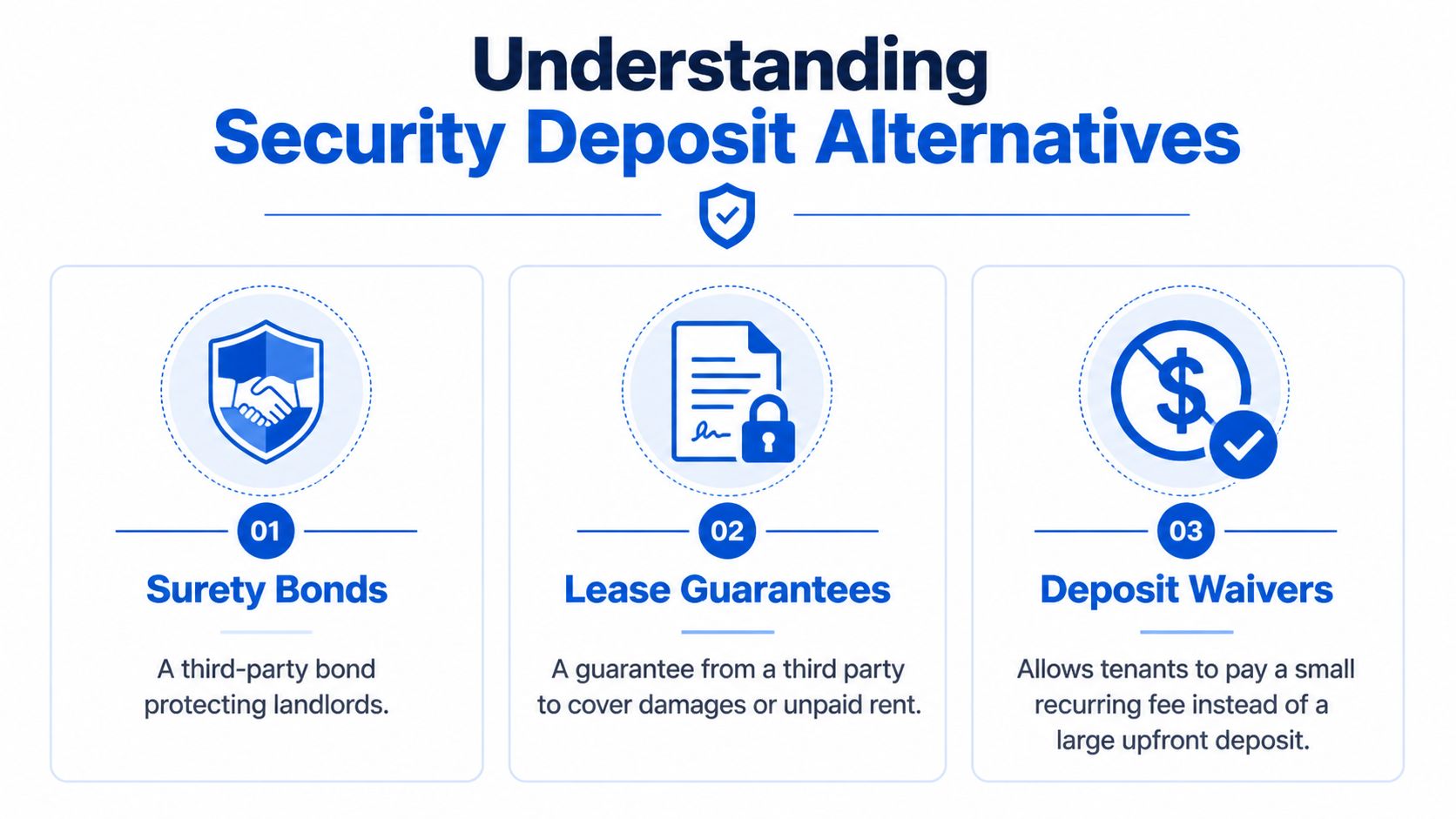
Surety bonds
A surety bond is a three-party arrangement. The tenant pays a non-refundable premium to a surety provider, and the provider agrees to cover approved losses up to the bond limit, then seeks reimbursement from the tenant.
This is often the easiest model for operators to understand because it feels closest to a replacement for a standard deposit. It reduces the renter’s upfront burden while preserving a formal recovery path for the owner.
According to Imagine Homes’ overview of security deposit alternatives, surety bonds typically cost tenants 10% to 25% of the deposit amount and can speed up lease-ups by 20% to 30% because move-in costs drop.
For co-living, that leasing speed is appealing. The catch is that the bond doesn’t solve attribution problems. If a shared refrigerator door is broken, you still need to show who caused the issue or how the lease assigns responsibility.
Lease insurance
Lease insurance replaces the deposit with a monthly non-refundable fee that funds insurance-like protection for the operator. In these programs, the provider pays approved claims directly based on the policy terms.
For operators, the main attraction is simplicity. There’s no resident escrow to manage, and the coverage can be broader than a one-month deposit. For residents, the appeal is lower move-in cost, though they give up the possibility of getting a deposit back.
This model often fits portfolios that prioritize fast occupancy, standardized workflows, and minimal refund administration. It can work especially well when units turn frequently and staff time is limited.
ACH authorizations and deposit waiver style programs
Some alternatives don’t look like insurance or bonds at all. They rely on preauthorized payment methods, linked bank accounts, or a third-party process that lets the operator draw funds if damage or unpaid balances are validated.
These can feel lightweight and renter-friendly at move-in. They may also reduce administrative drag. But from an operator’s point of view, they usually demand tighter documentation and cleaner processes. If the draw fails, the practical protection may be weaker than it first appeared.
Security deposit alternative models compared
| Model | Who Pays | Cost Structure | Best For |
|---|---|---|---|
| Surety bond | Tenant | Non-refundable premium, usually paid upfront | Operators who want a familiar substitute for deposits |
| Lease insurance | Tenant, sometimes via embedded program | Non-refundable recurring fee | Portfolios focused on speed, standardization, and reduced admin |
| ACH authorization or waiver-style program | Tenant authorizes payment access | No traditional held deposit, recovery depends on authorization terms | Tech-forward operators with strong documentation workflows |
If you manage co-living rooms, don’t choose based on the sales pitch. Choose based on how claims are paid, what documentation is required, and how shared-space damage gets handled.
Comparing Cost Models and Financial Impact
The first financial question most operators ask is simple. If I stop collecting cash deposits, am I taking on more risk or making the business more efficient?
The answer depends on what’s hurting your portfolio today. If your biggest issue is slow leasing, a security deposit alternative can improve occupancy and reduce lost time between residents. If your biggest issue is severe property damage in shared spaces, a weaker recovery model can backfire.

What changes on the income side
In room-by-room rentals, faster fills matter because every empty room affects monthly revenue. The strongest case for deposit alternatives usually isn’t the fee structure itself. It’s the operational effect.
Entrata’s discussion of deposit alternatives notes that lease insurance products can provide up to 50% more protection than a traditional one-month deposit, pay claims within 7 days, and that portfolios using this model report 25% to 40% cash flow uplift and 5% to 10% NOI improvement tied to eliminating escrow holds and filling units faster.
That doesn’t mean every house will see those results. It does mean the financial upside often comes from vacancy reduction and smoother operations, not from the alternative product itself.
If you already track vacancy by room and lease-up speed by listing source, this is the point where you should connect deposit policy to pricing discipline. Faster leasing only helps if you’re also quoting the right rent. A useful companion process is a regular room-pricing review, like the framework in this guide on how to price rooms for rent.
What changes on the risk side
A held cash deposit is simple. You have funds on hand, subject to legal limits and refund rules. Alternatives are different. They trade immediate possession of the tenant’s money for either a claims process, a guarantee structure, or payment authorization.
That creates a different financial profile:
- Surety bond: Lower move-in friction, but recovery depends on claim approval and the provider’s rules.
- Lease insurance: Better administrative efficiency, broader protection in many cases, but still dependent on policy language and documentation.
- ACH-style model: Minimal upfront burden for the renter, but potentially the weakest position if funds can’t be drawn or a dispute arises.
A practical way to evaluate the numbers
Instead of asking whether deposits are “better,” ask:
- How often do large upfront move-in costs kill an otherwise good lease?
- How much staff time goes into deposit handling and disputes?
- How often do shared-house damages exceed what a normal deposit would cover?
- How fast does your chosen provider pay approved claims?
A security deposit alternative helps most when your portfolio loses more money from vacancy and friction than it gains from holding cash deposits.
That’s common in co-living. It isn’t universal.
Managing Risks in a Co-Living Environment
In this context, generic multifamily advice falls short. A standard apartment has one household, one front door, and fewer arguments about who damaged what. Co-living houses are messier.
When five, eight, or twelve residents share kitchens, bathrooms, hallways, and living rooms, the risk isn’t just whether a claim gets paid. The risk is whether you can prove who caused the damage, whether the provider accepts shared-space responsibility, and whether your lease language supports the claim.

Shared damage is the real operational challenge
A deposit alternative may work smoothly for damage inside a private bedroom. It gets harder when the issue is a broken sofa arm, wall damage in a stairwell, or a clogged sink used by several residents.
That’s why co-living operators need stricter evidence systems than traditional landlords. According to Baselane’s analysis of security deposit alternatives, claim denial rates in shared housing can run 15% to 25%, compared with 5% to 10% in single-family rentals. That gap is exactly why room-by-room operators can’t rely on generic leasing workflows.
What actually works in practice
You need a structure that makes claims easier to support before a problem happens.
- Document room condition at every turnover: Use time-stamped photos and short inspection notes for private rooms and common areas.
- Create separate standards for shared spaces: Don’t rely on a generic move-in checklist written for apartments.
- Assign responsibility in the lease: Spell out whether common-area damage is charged to an identified resident, pooled among house members, or handled another way.
- Keep incident logs: Maintenance notes, resident complaints, and cleaning records often become claim evidence.
For operators tightening procedures, a recurring operational checklist helps more than memory. This kind of process is easier to maintain when you use a defined system like these property management checklists for recurring housing operations.
In co-living, the claim usually isn’t lost because damage didn’t happen. It’s lost because the record was weak.
Tech matters more in co-living than in apartments
If you want deposit alternatives to hold up in a shared house, pair them with technology that reduces ambiguity.
Useful tools include:
- Smart locks: Access logs can help narrow down who entered a room or shared area during a relevant time window.
- Digital inspections: Standardized photo sets reduce “before and after” disputes.
- Maintenance ticket systems: They help establish when damage was first reported.
- Centralized messaging records: Written resident communication can support timelines and responsibility.
House rules need to be tighter
Many operators underestimate this part. If your house rules are vague, the deposit alternative provider won’t fix that for you.
Your lease and house manual should clearly address:
| Risk area | Policy question to answer |
|---|---|
| Shared kitchen damage | Who pays if no single resident is identified |
| Furniture wear vs damage | What counts as billable misuse |
| Guest-related incidents | Whether the hosting resident is responsible |
| Cleanliness failures | When cleaning becomes chargeable damage or remediation |
A co-living portfolio can absolutely use a security deposit alternative. It just needs more operational discipline than a standard apartment building.
Navigating Legal and Regulatory Requirements
Operators usually focus on leasing speed first. That’s understandable. But the legal review has to come before rollout, not after the first dispute.
A security deposit alternative changes more than your move-in payment flow. It can change disclosure requirements, lease language, refund procedures, consumer notices, and in some markets, whether the option is voluntary or structured under renter-choice rules.
Start with state and local law
State law still sets the boundaries. Some markets tightly regulate deposits, alternatives, or both. Others leave more room for provider-specific programs. The practical issue isn’t just whether an alternative is allowed. It’s whether your implementation matches local requirements.
Review these areas with counsel before launch:
- Deposit cap rules: If your market limits cash deposits, confirm how your alternative is treated under that framework.
- Disclosure obligations: Residents may need clear written notice that the fee is non-refundable and not the same as a deposit.
- Lease addendum requirements: Your standard lease usually won’t be enough on its own.
- Claims and billing procedures: Make sure your recovery process aligns with local consumer protection rules.
Affordable housing adds a separate layer
This issue gets more complicated in subsidized housing. A major challenge is the viability of deposit alternatives in LIHTC and HUD housing, where strict rules govern interest-bearing escrow accounts and many third-party solutions may not align with HUD Handbook requirements, as noted by Tax Credit Advisor’s review of affordable housing compliance issues.
For operators in affordable shared housing, that matters a lot. A product that works fine in market-rate co-living may create compliance problems in a regulated program.
A practical legal checklist
Before adopting any security deposit alternative, confirm:
- Whether the program is permitted in your state and city
- Whether the resident must be offered a choice between cash deposit and alternative
- How the lease explains fees, reimbursements, and resident liability
- Whether the provider’s terms conflict with affordable housing rules
- How your accounting treatment changes if no cash deposit is held
If you operate in LIHTC or HUD-assisted housing, treat deposit alternatives as a compliance project first and an operations project second.
A fast lease-up isn’t worth much if the policy itself creates legal exposure.
Integrating Alternatives into Your Operations and Tech Stack
Choosing a provider is the easy part. The harder part is making the policy work in the day-to-day flow of a co-living business.
If your team still handles leasing manually, sends inconsistent move-in instructions, and documents damages in scattered folders, a deposit alternative won’t simplify anything. It may expose those weaknesses faster.

Update the workflow, not just the lease
The policy needs to show up everywhere a resident interacts with your business.
That includes:
- Listings and lead replies: Explain the move-in option in plain language.
- Screening flow: Tell applicants when they’ll choose or be evaluated for the alternative.
- Lease signing: Include a dedicated addendum, not a buried clause.
- Move-in checklist: Capture condition data in a consistent format.
- Move-out process: Use the same photo standards every time.
For operators comparing software stacks, this is one reason integrated systems matter. If your leasing, accounting, and resident workflows are split across too many tools, even a good deposit alternative can turn into manual busywork. That trade-off becomes clearer when reviewing broader platform differences such as Buildium vs AppFolio for property operations.
Build for claims from day one
A lot of claims problems start at onboarding. Residents don’t understand the product, staff overpromise coverage, or nobody defines how shared-space damages are billed.
Use plain language internally and externally. Your site team should be able to explain:
- what the resident is paying for
- that the fee may be non-refundable
- what damages or balances can still be charged
- how disputes are documented and reviewed
The best implementation is boring. Staff know the script, residents know the rules, and documentation is standardized before the first issue shows up.
Sample policy language
You’ll need legal review for final lease language, but your operating policy should be straightforward.
Residents may satisfy the property’s move-in protection requirement through an approved security deposit alternative program, subject to eligibility and enrollment terms. Enrollment in the program does not limit the resident’s responsibility for unpaid charges, physical damage, lease violations, or shared-area damage as defined in the lease and house rules. The property reserves the right to assess documented charges consistent with applicable law and program terms.
What to watch after launch
Don’t roll this out and forget it. Track the basics every month:
| Operational metric | Why it matters |
|---|---|
| Lease conversion rate | Shows whether lower move-in cost is helping |
| Time to fill a vacant room | Measures leasing speed improvement |
| Claim approval patterns | Reveals provider fit for co-living risk |
| Shared-area chargebacks | Highlights weak lease language or poor attribution |
| Staff exception handling | Shows whether the process is actually scalable |
If those numbers improve and your disputes stay controlled, the model is working. If conversions rise but claim recovery breaks down, the policy needs adjustment.
Conclusion Making the Right Choice for Your Portfolio
A security deposit alternative can be a strong move for co-living, but only when the operating model supports it.
The upside is clear. Lower move-in friction can help you fill rooms faster. Third-party handling can reduce some of the admin burden tied to holding and refunding deposits. In the right setup, insurance-style products can also improve cash flow and make claims more predictable.
The hard part is what general rental advice often skips. Shared housing creates shared risk. Common-area damage, multiple residents, frequent turnover, and inconsistent documentation can turn a promising deposit alternative into a messy dispute pipeline if you don’t tighten your process first.
The best choice depends on your actual portfolio.
A smaller operator with a few houses may prefer a simpler model with easy resident messaging and low setup complexity. A larger portfolio may benefit from an insurance-based program with standardized workflows and stronger claims handling. Operators in affordable housing need to be especially careful because legal compliance may matter more than operational convenience.
Use a simple filter when deciding:
- Choose for leasing speed if vacant rooms are your biggest problem.
- Choose for recoverability if damage disputes are your biggest problem.
- Choose for compliance if you operate under regulated housing rules.
- Choose for workflow fit if your team needs a process they can follow consistently.
A cash deposit isn’t automatically the safest option anymore. It’s just the familiar one. For many co-living portfolios, the better path is a system that lowers friction without lowering standards.
If you make the switch, do it deliberately. Review the legal framework, tighten the lease, standardize inspections, and make sure your tech stack can support evidence-based claims. That’s how a security deposit alternative improves NOI instead of creating a new category of operational headaches.
If you run PadSplit-style or room-by-room rentals and want a simpler way to manage pricing, communication, access, and portfolio visibility, keep an eye on PadPulse. It’s being built specifically for co-living operators who need to fill rooms faster and run tighter operations without stitching together a dozen separate tools.