Master Your Rentals: What Is a Co Host in 2026?
May 28, 2026
A co-host is a partner who helps manage a rental property without owning it, usually handling guest communication, calendar updates, check-ins, cleaning coordination, and issue resolution in exchange for a 10% to 25% share of rental income. In many setups, owners and co-hosts land around 15% to 20%, which is why co-hosting works more like an operating partnership than casual help.
If you just bought your first property, you're probably feeling two things at once. Excitement, because the place has real income potential. Pressure, because every booking, message, cleaner handoff, and maintenance hiccup now has your name on it.
That pressure gets even sharper in room-by-room rentals. One whole-home guest might send a few messages. A shared house with multiple residents, move-ins, turnovers, and common-area issues can create a constant stream of small tasks that eat up your day.
That's where understanding what a co-host is really matters. Not as a buzzword, and not as a watered-down version of property management, but as a working partnership built on trust, systems, and very clear expectations.
Are You Drowning in Rental Management Tasks
The first few weeks of hosting often feel manageable. Then real life starts. A guest can't find the lockbox. The cleaner says the last checkout left the kitchen a mess. Someone asks for an early check-in while you're in the middle of your regular job. By evening, your phone feels like a second front desk.
For room-by-room operators, it can get even more fragmented. One resident asks about Wi-Fi, another reports a clogged sink, and a third wants to know whether a room will be available next month. None of these problems are huge on their own. Together, they can turn your rental into a full-time operations job.
Practical rule: If your property depends on fast replies and smooth turnovers, you're not just running real estate. You're running daily operations.
A co-host steps into that gap. Think of this person as the partner who handles the moving parts that can't wait until tomorrow. They help keep the experience smooth for guests or residents while you keep control of the property itself.
Why new owners get overwhelmed fast
Most beginners underestimate the number of tiny decisions involved in hosting. The work isn't just "renting out a place." It's answering questions, updating the calendar, coordinating cleaners, restocking supplies, and solving problems before they turn into bad reviews or unhappy house members.
That's why many owners don't hire a co-host because they're lazy. They do it because speed and consistency matter.
A strong co-host can help with things like:
- Guest and resident messages: Responding when someone has a question before booking or needs help during a stay.
- Turnover coordination: Making sure cleaners, supplies, and access details line up between stays.
- Issue handling: Managing lost keys, late arrivals, maintenance handoffs, and small on-site problems.
- Daily workflow: Keeping the property moving when you can't be available every hour.
The real problem co-hosting solves
The main benefit isn't just "less work." It's better coverage. Someone is watching the day-to-day details, which helps the property stay organized and responsive.
For a whole-home rental, that means fewer dropped balls around bookings and check-ins. For a room-by-room property, it often means fewer communication gaps between owner, residents, vendors, and cleaners.
If you've been asking yourself whether you need help or just need to get more organized, the answer might be both. A good co-host gives you support, but they also force the business to run on clearer systems.
The Co-Host Role Explained
A lot of new owners assume a co-host is just an extra set of hands. In practice, the role is closer to an operating partner for the day-to-day side of the rental.
A co-host is an authorized helper who manages rental operations on behalf of the primary host. On Airbnb, the role is permission-based, so the owner chooses what the co-host can access inside the listing account. Some co-hosts can handle messages and calendars only. Others have broader access to operational settings. That setup matters because co-hosting works best when responsibility matches permission.
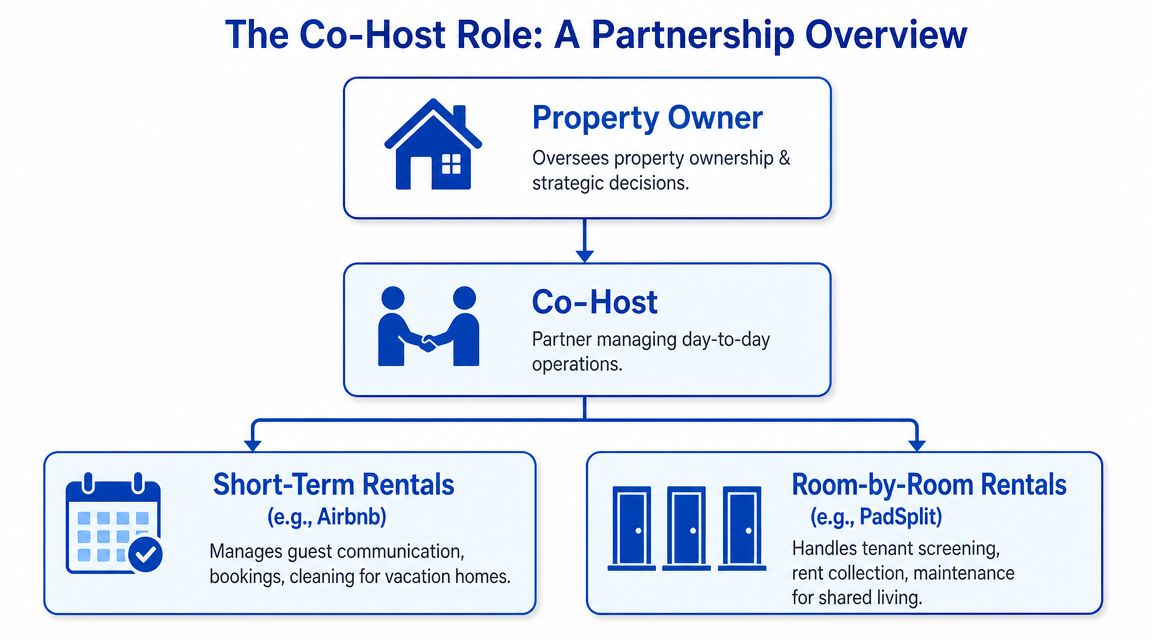
The role sits between ownership and daily operations
The owner sets the direction. The co-host helps carry it out.
If you have ever run a rental, you know those are two different jobs. One person decides pricing strategy, house rules, and how much risk to take. The other person often keeps the machine running each day by answering messages, coordinating turnovers, checking on supplies, and making sure small problems do not pile up.
That middle position is where beginners get confused. A co-host usually does not hold title to the property. They also are not limited to one narrow task like cleaning or key handoff. Their real value comes from being the person who connects the moving parts and keeps communication clear.
That is why co-hosting is less about delegation and more about partnership.
What the role looks like in real life
A co-host may handle guest communication, cleaning coordination, restocking, and maintenance follow-up. Sometimes the owner keeps tight control and asks the co-host to cover only a few tasks. In other setups, the co-host becomes the main operator while the owner focuses on finances, approvals, and bigger decisions.
The exact shape of the job depends on the property and the agreement.
For a short-term rental, the work often centers on booking flow and fast response times. For a room-by-room rental, the role usually becomes more operational. There may be fewer vacation-style touches and more ongoing coordination between multiple residents, shared spaces, cleaners, and vendors. It starts to feel less like hosting one guest party at a time and more like keeping a small household business organized.
That difference matters. In a shared house, one missed message can affect several people at once.
Why trust and systems matter so much
A co-host can only do the job well if the owner gives them clear lanes, clear access, and clear standards. Otherwise, the partnership turns into constant second-guessing. One person assumes the other handled a task. Nobody documents what happened. Small issues become expensive because no system existed to catch them early.
Good co-hosting works like a relay team. The handoff matters as much as the running.
For example, if a resident in a room-by-room property reports a bathroom leak, the co-host may be the one who receives the message, contacts the handyman, updates the other house members, and logs the cost for the owner. If the owner wants clean records at tax time, those expenses need to end up in the same workflow as the rest of the business. A simple system, along with the right accounting software for rental properties, makes that partnership much easier to manage.
In shared housing, the hard part is rarely one dramatic emergency. It is the steady stream of small decisions that need a reliable person, a clear process, and fast follow-through.
That is the heart of the co-host role. It is a working relationship built on trust, communication, and agreed systems. When those pieces are in place, a co-host does more than lighten your workload. They help the property run in a consistent, professional way.
Common Co-Host Responsibilities and Compensation Models
You buy a rental because you want income, not because you want to answer messages at 10:43 p.m., chase a cleaner for photos, and figure out who replaced the paper towels in the shared kitchen. That pile of small jobs is where a co-host earns their place.
A good co-host is not just a helper with a spare key. They are an operating partner with clear lanes. In practice, those lanes usually fall into three buckets: communication, day-to-day property operations, and listing support. The exact mix depends on the property and on how involved you want to stay.
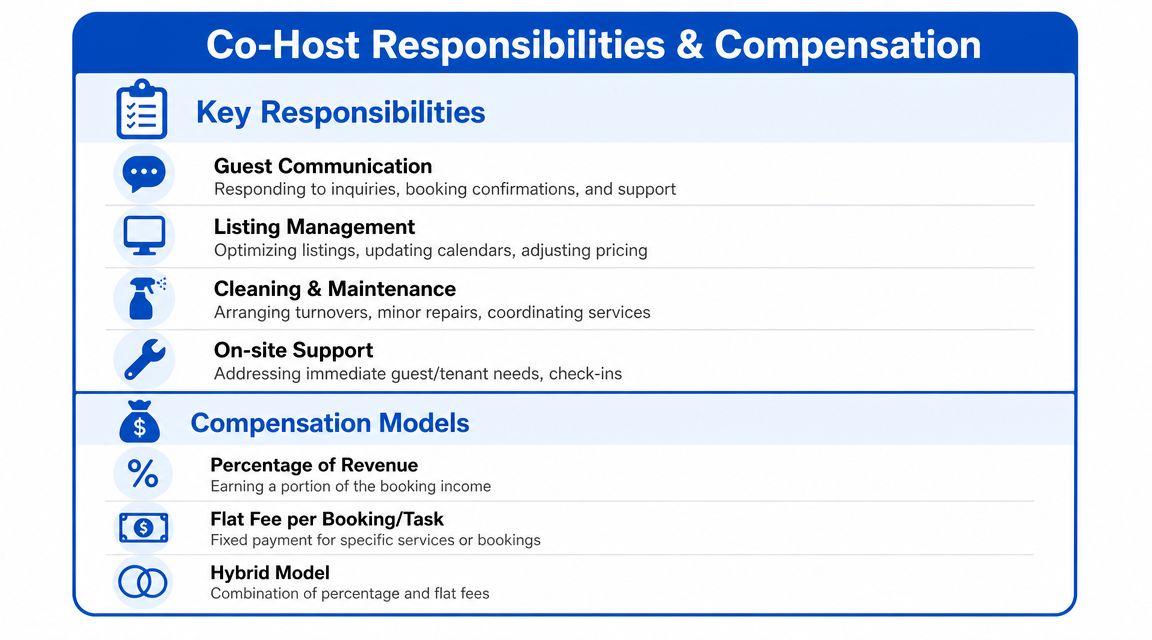
What co-hosts usually handle
Here is what that often looks like on the ground:
- Guest communication: Answering inquiries, replying to booked guests, sending arrival instructions, and solving routine stay problems.
- Listing management: Updating availability, watching the calendar, and adjusting pricing or booking settings if that is part of the agreement.
- Cleaning and turnover coordination: Scheduling cleaners, confirming the job was done well, flagging damage, and making sure the unit is ready for the next guest or resident.
- Restocking and maintenance coordination: Replacing supplies and passing repair issues to the right cleaner, handyman, or vendor.
- Check-ins and local support: Meeting guests, fixing access problems, or being the nearby point person when something needs in-person attention.
Room-by-room rentals add a different layer. The work is often less about polished check-ins and more about keeping a shared house calm, clean, and predictable. A co-host may spend more time answering resident questions, tracking shared-space issues, coordinating house rules, and spotting tension early before it turns into turnover.
That is why co-hosting works best as a partnership, not a vague handoff. In a whole-home short-term rental, one missed message can lead to a bad review. In a shared property, one missed issue can affect several people living under the same roof. Clear task ownership matters more here because the property behaves more like a small system than a single unit.
Some owners also want the co-host to help keep the business side organized. If you need better visibility into expenses, payouts, and property performance, it helps to pair the role with accounting software for rental properties that keeps records in one place.
How co-hosts get paid
The payment model should match the job.
Revenue share is common because it ties the co-host's pay to the property's income and gives both sides a reason to keep operations tight. Minoan's guide to Airbnb co-host pay describes common co-host commission ranges and gives a simple example: a 20% commission on a property earning $3,000 per month would pay the co-host $600.
That example is useful because it shows the logic in plain terms. You are usually not hiring a salaried employee. You are agreeing to share part of the income in exchange for recurring operational work.
Other compensation structures can make more sense depending on scope:
- Flat fee: A good fit when the co-host handles a short, repeatable list of duties each month.
- Per-booking or per-task pay: Useful when the workload rises and falls a lot.
- Hybrid model: A smaller revenue share plus fixed payments for specific responsibilities.
Here's a short overview before you decide:
| Model | Best for | Watch out for |
|---|---|---|
| Revenue share | Ongoing hands-on co-hosting | Scope creep if tasks aren't clearly defined |
| Flat fee | Stable, limited duties | Can feel unfair if workload spikes |
| Hybrid | Mixed responsibilities | More moving pieces to track |
This short video gives a useful visual overview of how co-hosting arrangements can work in practice.
If the co-host handles more of the labor-intensive work, the pay structure should reflect that. Compensation and scope need to match.
Co-Host vs Property Manager What Is the Difference
First-time owners often get stuck on this point. They hear "co-host" and assume it means "property manager with a trendier name." That's not quite right.
A property manager is usually a third-party service provider with a broader, more formal management role. A co-host is often a closer operating partner who works inside a tighter relationship with the owner. Sometimes the tasks overlap. The working dynamic usually doesn't.
The simplest way to compare them
A co-host often fits owners who still want visibility and involvement. A property manager often fits owners who want to hand off more of the business.
That doesn't make one better. It just means they solve different problems.
| Aspect | Co-Host | Property Manager |
|---|---|---|
| Relationship | Collaborative partner working alongside the owner | Third-party manager providing a service |
| Owner involvement | Usually higher | Usually lower |
| Scope | Flexible and customized | Often broader and more standardized |
| Access and control | Defined by platform permissions and agreements | Managed through company processes and contracts |
| Best fit | Owners who want support but still want a hand in operations | Owners who want more complete delegation |
Why the distinction matters in room-by-room rentals
Shared housing usually creates lots of recurring, human-level issues. That can make a co-host attractive because the arrangement can be more flexible and personal. You may want someone who knows the house, understands the resident mix, and can work closely with your exact systems.
On the other hand, some owners want distance. They'd rather hand the property to a management company and review reports instead of being involved in daily judgment calls.
If you're unsure how formal your setup needs to be, it's smart to review whether your situation may involve licensing questions. This guide on whether you need a property management license is a useful starting point.
A practical decision test
Ask yourself three questions:
- Do I want a partner or a provider?
- Do I want to stay involved in decisions?
- Does my property need flexible hands-on coordination or broad full-service management?
If your answers lean toward collaboration, frequent communication, and custom workflows, a co-host may fit better. If they lean toward distance, standard processes, and full delegation, a property manager may be the cleaner choice.
The best model is the one you can actually manage well. A cheaper setup isn't better if roles stay fuzzy and problems keep bouncing back to you.
How to Build a Successful Co-Hosting Partnership
You hand your new co-host the keys on Friday. By Sunday, a cleaner is asking who approves extra laundry, a guest wants a late check-in, and one bedroom tenant is complaining about noise in the kitchen. Nothing is wrong in a dramatic way. But everyone is waiting for direction.
That is what co-hosting really is. A strategic partnership built on trust, clear rules, and repeatable systems.

Put the agreement in writing
A friendly handshake is not enough when someone is helping run your rental. Your co-host will touch guest communication, money, vendor coordination, and access to the property. If those rules live only in text messages or memory, small misunderstandings turn into expensive ones.
A good written agreement works like house rules for the partnership. It should spell out:
- Responsibilities: Who handles guest messages, cleaner follow-up, supply runs, maintenance calls, and calendar oversight.
- Approval limits: What the co-host can decide alone, and what still needs your sign-off.
- Pay terms: How compensation is calculated, when it is paid, and how changes in workload are handled.
- Access: Which accounts, locks, tools, and documents the co-host can use.
- Exit steps: How either side ends the arrangement and how the handoff happens.
The more shared spaces your property has, the more this matters. In a whole-home rental, there may be one guest group at a time. In a room-by-room setup, you are often managing overlapping needs from multiple residents, cleaners, and vendors. Clear written rules keep those moving parts from colliding.
Build a communication rhythm early
Co-hosting usually breaks down in ordinary moments, not dramatic ones. One person expects a message for every issue. The other assumes silence means things are under control.
Set the rhythm before problems show up.
Decide where urgent issues go, where routine updates live, how often you want a check-in, and which situations require immediate owner input. For example, a lockout, a plumbing leak, or a dispute between room renters may need same-day escalation. A low stock of paper towels probably does not.
Room-by-room rentals need tighter communication than many new owners expect. Shared kitchens, bathrooms, and entryways create more small judgment calls. If those calls are handled differently each week, tenants feel the inconsistency fast.
A calm property usually has boring systems behind it. That is a compliment.
Match access to the job
Trust should be supported by permissions, not replaced by them. If your co-host only handles guest messaging and scheduling, they may not need payout controls or full account authority. If they coordinate the full operation, broader access may make sense.
Start by matching access to actual duties:
- Guest communication access for messaging and reviews
- Calendar access for bookings, turnovers, and availability
- Operations access for cleaners, maintenance notes, and supply tracking
- Financial visibility only if pay, refunds, or reimbursements are part of the role
This is also a good point to set up one shared system instead of running everything through scattered texts. Even a basic stack with calendars, task tracking, and message records makes the partnership easier to manage. If you are still piecing tools together, this guide to property management software for rental operations can help you choose a setup that fits your workflow.
Review the partnership like an operator
The strongest co-hosting relationships feel easy because both sides review them on purpose. Roles drift. Properties change. A co-host who started with guest messaging may slowly become the person handling cleaner performance, supply ordering, and resident disputes.
Check in regularly and ask simple questions. What decisions keep getting stuck? What problems repeat? Which tasks need clearer ownership? That review process matters even more in shared homes, where friction often shows up in the gaps between bedrooms, bathrooms, and common spaces.
Good co-hosting is less like hiring random help and more like building a small operating team. When the trust is real, the systems are clear, and communication is steady, the partnership gets stronger instead of heavier.
Your Co-Host Onboarding Checklist and Smart Tools
Once you've chosen the right person, onboarding matters almost as much as the hire itself. A great co-host can still struggle if they walk into missing passwords, vague rules, and scattered instructions.
Good onboarding turns the partnership from "I'll text you what you need" into a repeatable operating system.
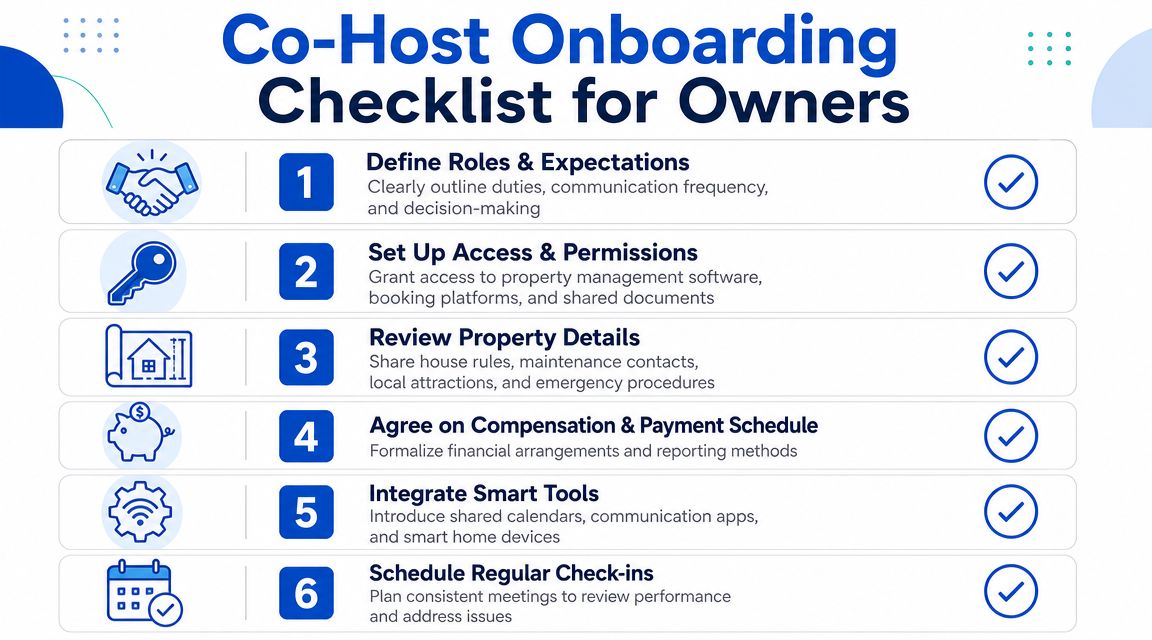
A practical checklist for owners
Define the role clearly
Write down exactly what the co-host owns each week. Include communication, turnover tasks, issue handling, and approval limits.Set up account access
Add the co-host to booking platforms, shared calendars, messaging tools, and any operating documents they need.Share property playbooks
Give them house rules, check-in instructions, cleaner contacts, maintenance vendors, supply lists, and emergency steps.Walk the property together
A short in-person or video walkthrough can prevent a lot of future confusion, especially in shared homes with multiple rooms and common spaces.Confirm the payment process
Make sure both sides know how compensation is calculated, tracked, and paid.Schedule recurring check-ins
A regular review keeps small issues from becoming bigger ones.
Smart tools make co-hosting easier
The smoother the systems, the easier it is for an owner and co-host to work as partners instead of constantly chasing each other for updates.
Helpful tools often include:
- Shared calendars for bookings, move-ins, and vendor visits
- Messaging platforms for faster internal communication
- Smart locks for cleaner handoffs and access control
- Financial tracking tools for payouts and expense clarity
- Centralized property software so tasks, communication, and reporting live in one place
If you're comparing software options, this guide on what property management software is is a helpful place to start.
The best co-host setup doesn't depend on one person's memory. It depends on systems both people can see and use.
For room-by-room rentals, tools matter even more because there are more moving parts. Multiple residents, shared spaces, recurring supply needs, and frequent coordination can overwhelm a loose setup. Good software and shared processes give the partnership structure.
The key takeaway is simple. A co-host isn't just extra help. Done well, they're part of the operating backbone of the property.
If you run room-by-room rentals or co-living homes, PadPulse is building tools designed for that exact workflow, including pricing, messaging, smart access, and reporting in one place. If you want a simpler way to support owners and co-hosts with shared systems, it's worth joining the interest list and keeping an eye on the launch.