Vacation Rental Pricing Strategy for 2026: A Guide
May 5, 2026
You open your calendar, look at a vacant room next week, and wonder if the rate is too high. Then you look at a booking that came in instantly for next month and worry you priced it too low. That tension sits at the center of every good vacation rental pricing strategy.
For room-by-room and co-living hosts, it gets trickier fast. You aren't pricing one self-contained vacation home. You're pricing individual rooms with different layouts, bathroom access, noise levels, and appeal, while also carrying shared costs across the house. A rate that works for a whole-home listing often falls apart when you're trying to keep multiple rooms filled without dragging down total property income.
Most pricing advice online was written for traditional short-term rentals. It focuses on villas, cabins, and full apartments. That leaves co-living operators with a real blind spot, especially when room turnover, utility usage, and shared amenity costs shape the economics more than weekend getaway demand.
Why Your Pricing Strategy Matters More Than You Think
A weak pricing approach usually fails in one of two ways. Some hosts underprice because they want to avoid vacancy at all costs. Others overprice because they copy the nicest listing nearby and assume the room will justify it. Both mistakes show up later in the same place: lower NOI and more calendar stress.

For co-living hosts, pricing isn't just a nightly number. It's an operating decision. It affects who books, how long they stay, how often rooms turn, and whether shared house costs stay under control. That's why a room-by-room operator needs a different playbook than a beach-house host.
According to Rentals United's gap-booking analysis, existing content overwhelmingly targets whole-property vacation rentals, while shared housing operators have to balance tenant turnover and shared amenity costs. That gap in guidance can leave 20-30% of NOI on the table.
Why whole-home advice often misses the mark
A whole-home host usually asks questions like these:
- Can I charge more on weekends: Demand often swings around leisure travel.
- Should I set a holiday minimum stay: Longer bookings may improve calendar efficiency.
- How do I fill one awkward orphan night: Small gaps matter in traditional STR calendars.
A room-by-room operator faces a different set of problems:
- Which room should be priced highest: The ensuite, the largest room, or the quietest one?
- How much discount is too much: Filling one room cheaply can lower perceived value across the property.
- When should you hold firm: Mid-term demand can be steadier than it looks, especially in workforce housing and co-living.
A good pricing strategy doesn't just fill rooms. It protects margin while helping the right bookings come in faster.
What a practical strategy actually does
A working vacation rental pricing strategy for co-living should do three things well:
| Focus | What it solves | Why it matters |
|---|---|---|
| Set a floor | Stops you from taking bad bookings | Every occupied room should still make financial sense |
| Adjust for demand | Captures upside during strong periods | You don't want static pricing during busy windows |
| Differentiate rooms | Reflects real room value inside one house | Not every room deserves the same rate |
If you manage shared housing, pricing has to connect to operations. That's why understanding co-living property management fundamentals matters just as much as watching competitor rates.
Laying the Foundation with a Solid Base Rate
Before you use any pricing tool, you need a base rate you can defend. Not a guess. Not a number copied from the listing down the street. A base rate built from your local market and your actual costs.
That foundation matters even more in co-living because one bad pricing decision can spread across multiple rooms. If your floor is too low, you can stay “occupied” and still lose ground financially.
Start with room-level comps, not whole homes
Many hosts make the same early mistake. They search their area, see high nightly rates on entire apartments, and assume their private room should track somewhere close. It usually shouldn't.
Instead, build a small comparison set around listings that match your setup:
- Room type: Private room versus shared room versus studio conversion
- Bathroom access: Ensuite, private detached bath, or shared bath
- Location reality: Walking distance to jobs, transit, hospitals, or campuses
- House profile: Quiet co-living home, higher-churn workforce housing, or lifestyle-focused shared home
- Stay pattern: Short stays, mid-term stays, or mixed demand
If your property serves traveling workers or members staying several weeks, look for rooms with similar booking behavior. A stylish weekend-focused Airbnb room isn't always a useful comp for a co-living room with steadier occupancy.
A simple rule helps here: if you wouldn't trade your guest demand for theirs, don't use that listing in your pricing set.
Build your minimum profitable nightly rate
Cost-based pricing gives you a safety rail. RentalReady's dynamic pricing guide lays out a clear method for setting a profitable minimum rate.
Here is the example in plain terms:
- Add per-stay variable costs. If cleaning and linens total $70 per stay, start there.
- Divide by average stay length. If the average stay is 3 nights, that works out to about $23 per night.
- Add per-night costs. Utilities and overhead in the example total $17 per night.
- Apply your target margin. Using a 30% margin on those costs produces a minimum nightly rate around $52.33, commonly rounded to $55.
That approach matters because it prevents undercutting your own operation. The same source notes that preventing loss-making nights can lift RevPAR by 12% in major markets.
A co-living twist most hosts miss
Room-by-room operators should go one step further. Don't stop at house-level cost averages. Break out costs that vary by room condition and turnover pattern.
For example:
- High-turn rooms: More cleaning, more inspection time, more lock resets
- Large rooms: Higher utility burden if HVAC use tends to be heavier
- Premium rooms: Better light, more privacy, or private bath may justify a stronger floor
Practical rule: Your cheapest sellable rate should still cover turnover friction, not just fixed house expenses.
Many manual hosts get into trouble by using one house-wide “good enough” rate and then absorb room-specific losses.
Put the floor into your pricing workflow
Once you've set the floor, treat it as an absolute minimum. Discounts, weekly promotions, and last-minute adjustments should happen above that line.
A clean setup looks like this:
- Base rate: Your normal starting point in average demand
- Minimum rate: Your hard floor based on cost
- Premium triggers: Better room features, stronger dates, or local demand spikes
- Discount windows: Only for dates and rooms where occupancy is worth chasing
If you want a more room-focused framework, this guide on how to price rooms for rent is a useful companion to your broader vacation rental pricing strategy.
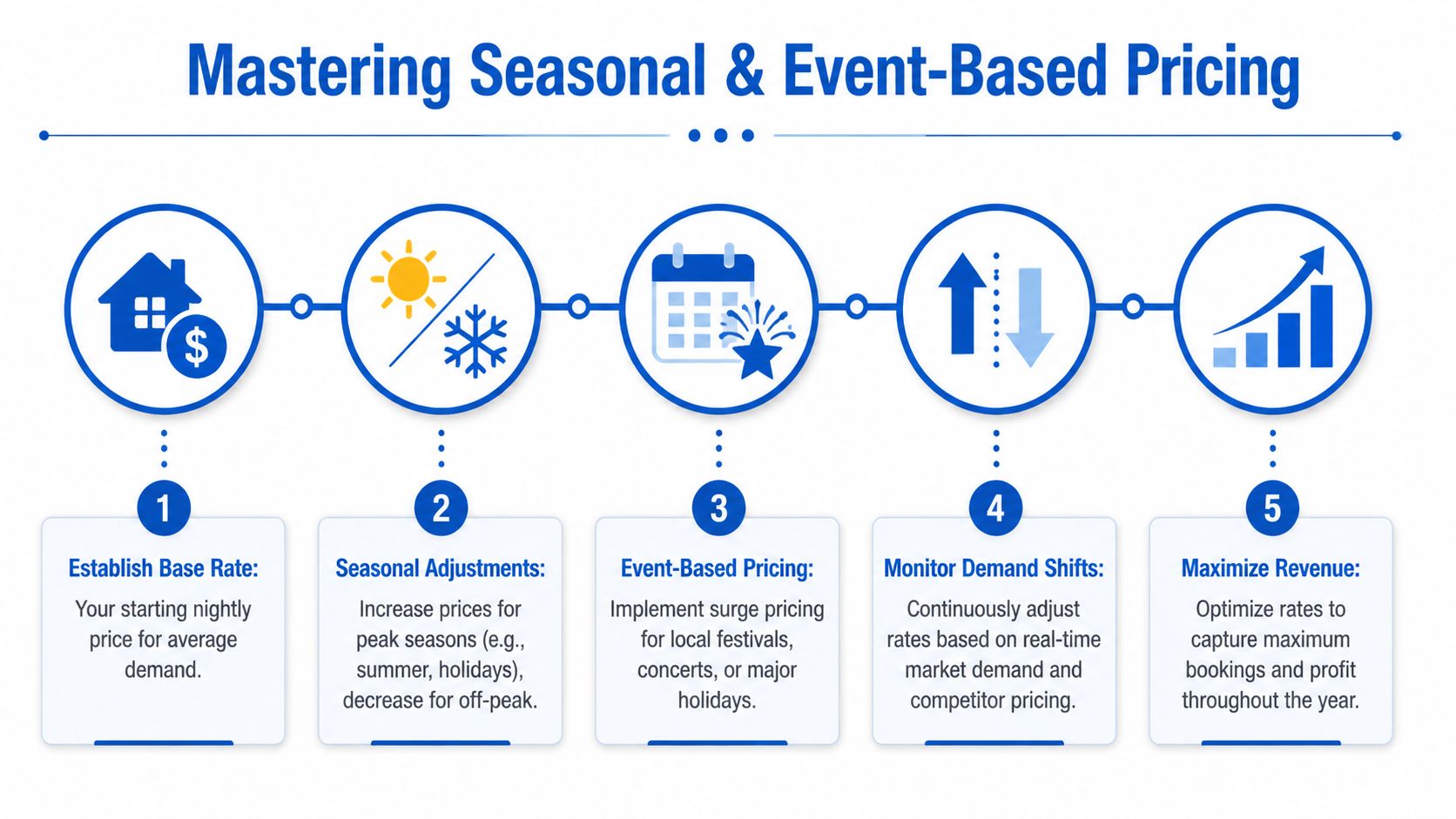
Mastering Seasonal and Event-Based Pricing
Seasonality doesn't look the same in every market. A beach property may rise steadily into summer. A room near a university can stay flat for weeks, then tighten sharply around move-in dates, graduation, and campus events. A downtown co-living house may see its strongest pricing around conferences, hospital rotations, or holiday staffing shortages.
That difference matters because many hosts apply generic “high season” logic to markets that behave in shorter, more localized bursts.
Use a seasonal calendar, even for shared housing
You don't need a complicated revenue model to get this right. You do need a calendar with pricing periods defined before demand hits.
Hostaway's pricing factors guide gives a simple example: an off-season rate of $200/night can rise 50% to $300/night in shoulder season and then move to $500+ in peak summer, with further increases for major holidays or local events.
The exact numbers won't map directly to your rooms, but the structure does. Most room-by-room hosts should think in tiers:
| Season type | What it looks like in co-living | Pricing response |
|---|---|---|
| Off-season | Slower demand, more applicant choice | Stay competitive and protect occupancy |
| Shoulder season | Stable demand with improving booking pace | Nudge rates upward and watch conversion |
| Peak periods | Move-ins, graduations, events, labor surges | Push rates and tighten policies where needed |
Two real-world patterns to learn from
A university-adjacent rooming house often sees demand surge around:
- Semester move-ins
- Graduation periods
- Parent weekends
- Short academic program starts
A coastal rental town behaves differently:
- Summer travel peaks
- Holiday weekends
- School break demand
- Weather-driven shoulder seasons
The mistake is treating those as the same market. A co-living operator near a hospital or campus should build pricing around local rhythms, not tourism assumptions.
Raise rates before the calendar gets tight. Once the room is the last good option in the area, you're negotiating from strength.
Event pricing should be deliberate
Event-based pricing works best when you prepare early. If a convention, festival, or major employer event is coming, decide in advance how you'll respond.
Useful event levers include:
- Higher nightly rates: Especially when nearby room supply starts thinning
- Longer minimum stays: Helpful when turnover is expensive
- Reduced discounting: Don't cut rates automatically if the market is already tightening
- Room prioritization: Push your best rooms hardest first
For co-living homes, event pricing often works best on the most flexible inventory. If one room is usually harder to fill, event demand can erase that weakness quickly.
What doesn't work
Three habits usually hurt more than they help:
- Late adjustments: By the time everyone notices the event, the best pricing opportunity may be gone.
- Flat pricing across all rooms: Premium rooms should lead the increase.
- Blind discounting in slow patches: Shoulder periods often reward small, careful changes, not panic cuts.
A strong vacation rental pricing strategy uses seasonality as a framework, then lets local events sharpen the edges.
Embracing Dynamic Pricing to Maximize Revenue
Static pricing feels safe because it's simple. You choose a number, maybe add a weekend bump, and move on. In practice, static pricing misses too many shifts in demand, especially when you're managing several rooms with different booking patterns.
Dynamic pricing fixes that by adjusting rates as the market changes. Instead of asking whether one number works all month, you let software react to signals like booking pace, local events, lead time, and competitor pricing.
Guesty's pricing overview reports that properties using dynamic pricing tools earn up to 40% more annual revenue, and that these tools show average revenue gains of over 20% per listing by automating daily adjustments around factors like seasonality, local events, lead time, and competitor benchmarking.
Why automation matters more for room-by-room operators
A whole-home host may manage one calendar. A co-living host might manage several rooms that don't behave the same way.
One room may book quickly because it has an ensuite. Another may lag because it's smaller or faces the street. One vacancy next week might need a sharper move. Another two weeks out might not need any discount at all.
Dynamic tools help because they can do the repetitive work every day:
- Scan demand signals: They react when the local market tightens or softens.
- Compare against nearby listings: They keep your pricing anchored to reality.
- Adjust by lead time: They treat next week differently from next month.
- Preserve your floor: Good setups still respect your minimum profitable rate.
What dynamic pricing should control
For room-by-room and co-living inventory, the best use of dynamic pricing isn't just “raise when busy, lower when slow.” It should handle several layers at once.
A practical setup usually includes:
- Base room pricing: Different starting rates for each room
- Lead-time rules: A vacancy six days away should not be priced the same as one thirty days away
- Length-of-stay logic: Longer stays can reduce turnover pain without collapsing nightly value
- Event overrides: Important local dates often need manual confirmation or stronger rules
- Channel awareness: Direct bookings and OTA bookings don't always carry the same economics
If you're comparing software options, this breakdown of short-term rental pricing tools can help narrow what matters for room-level operations.
Automation still needs supervision
Dynamic pricing isn't set-and-forget. It works best when you check the rules and inspect outliers.
Good hosts still review questions like these:
- Did the tool overreact to weak competitors?
- Is a premium room being discounted too aggressively?
- Are event dates getting enough upside?
- Is the minimum rate still accurate after expense changes?
That review habit matters because your property has context that software may not fully understand. A room with better privacy, keyless access, or lower turnover friction may deserve a different pricing path than the comps suggest.
Here's a quick visual explainer on how pricing tools think about these adjustments:
What usually works better than manual pricing
Manual pricing often breaks down in three places:
- Hosts react too slowly.
- They use the same logic across every room.
- They discount first instead of checking demand conditions.
Operator note: The biggest benefit of dynamic pricing isn't just a better rate. It's consistency. Your rooms are being repriced even when you're busy with turnovers, messages, and maintenance.
For co-living operators, that consistency can be the difference between a clean revenue system and a calendar full of one-off decisions.
Advanced Tactics and Performance Measurement
Once your pricing is live, the work changes. The question is no longer “what should I charge?” It becomes “which decisions are improving the business, and which ones just feel active?”
That shift matters because pricing activity can look smart without producing better results. Raising rates, adding discounts, or changing minimum stays only matters if your numbers improve in the right direction.

Track the metrics that reveal trade-offs
Three metrics matter most for a room-by-room operator:
| Metric | What it tells you | What to watch for |
|---|---|---|
| ADR | Your average booked nightly rate | Helpful for seeing whether premium rooms are pulling their weight |
| Occupancy | How often rooms are filled | Useful, but dangerous if you chase it without margin discipline |
| RevPAR | Revenue generated per available room | The clearest combined view of price and occupancy |
In shared housing, RevPAR is often the most honest metric because it forces you to look at both sides of the equation. A full house at weak rates can still underperform. So can beautiful ADR with too many empty nights.
Build a compset that actually matches your business
Your comparison set should be tight, not broad. Rentals United's pricing strategy guide notes that top managers achieve 20-35% revenue gains by curating a precise compset of 10-20 similar properties and using automated demand-based adjustments. The same source gives a concrete example of setting rates to increase by 1.5-3x when local availability in the compset drops below 30%.
For room-level operators, “similar” needs discipline.
Use comps that line up on:
- Property type: Private rooms should compete with private rooms
- Amenity level: Shared bath and ensuite inventory should not be blended casually
- Guest profile: Workforce and co-living demand behaves differently from weekend tourism
- Neighborhood reality: Same city isn't enough if transit access and local demand differ
Bad comps create false confidence. If you benchmark against listings that attract a different guest or offer a different stay experience, your pricing system starts drifting.
If your compset includes properties you'd never substitute for your own, the benchmark is already broken.
Test one variable at a time
A/B testing sounds technical, but the practical version is simple. Change one thing, hold the rest steady, and watch what happens.
Good tests for co-living hosts include:
- Minimum stay rules: Does a longer minimum reduce turnover without slowing bookings too much?
- Cleaning fee structure: Does a different fee presentation help conversion?
- Premium room spread: Are your best rooms priced far enough above standard rooms?
- Last-minute discount windows: Are you cutting too early?
Keep the test window long enough to observe a real pattern, especially if your demand comes in waves. If you change three rules at once, you won't know what caused the outcome.
Watch room-level performance, not just house-level averages
House-wide reporting can hide weak decisions. One premium room may be carrying the property while two underpriced rooms erode margin.
Review rooms individually for:
- Booking speed
- Rate acceptance
- Turnover frequency
- Lead-time differences
- Guest complaints tied to room expectations
That last point matters more than many hosts realize. If a room gets booked easily only when priced low, the issue may not be pricing alone. It may be listing position, photos, amenities, or how clearly the room's limitations are explained.
Advanced pricing isn't about making constant changes. It's about learning which changes produce better outcomes and repeating those.
Your Top Vacation Rental Pricing Questions Answered
How should I price different rooms in the same house
Don't force one rate across the property. Price by room quality, privacy, bathroom access, noise level, natural light, and convenience. The largest mistake here is flattening the room mix so aggressively that your best room is underpriced and your weakest room becomes hard to book.
A simple ranking system helps. Put rooms into clear tiers, then review whether the booking pace matches the value gap you've set.
What should I do with a last-minute vacancy
Don't default to a discount. First check whether there's a local event, a temporary supply squeeze, or a booking pattern that suggests demand may still arrive. In co-living, some rooms fill on short notice without needing a rate cut, especially when demand is driven by work, relocation, or housing transitions rather than leisure travel.
If you do discount, protect your minimum profitable rate and keep the reduction targeted. Broad cuts can train the market to wait you out.
Should an ensuite room cost more
Yes, if your market consistently values privacy and convenience, which it usually does. The same goes for rooms with better furniture, stronger light, quieter placement, or easier access. Price premiums should follow real guest preference, not your emotional attachment to a renovation.
Should I use the same strategy as a whole-home Airbnb host
Usually not. Whole-home pricing advice often focuses on weekend demand, gap nights, and leisure seasonality. Co-living rooms often perform on steadier demand cycles and carry shared costs that whole-home hosts don't split the same way.
Where is pricing headed next for room-by-room operators
The clearest direction is more automation at the room level. Tools are moving toward finer demand signals, smarter rule-setting, and closer integration with operating data. For co-living hosts, that means pricing decisions should gradually become more connected to occupancy trends, turnover behavior, and real house conditions instead of relying on static calendar rules alone.
PadPulse is building for exactly this kind of operator. If you run PadSplit-style or co-living properties and want better control over pricing, occupancy, communications, smart-home workflows, and portfolio reporting, join the interest list at PadPulse. It's designed to help room-by-room hosts fill vacancies faster and improve NOI without stitching together separate tools.