Software Integration Best Practices for Co-Living
September 3, 2026
A room becomes vacant in the morning. By lunchtime, pricing should reflect the opening, the listing should show the correct availability, a prospect should receive an accurate message, and access records should remain aligned with the tenant who has just moved out. If one system updates while another keeps yesterday's information, your team may chase manual fixes, quote the wrong rate, or create an access problem at the door.
That's why software integration best practices matter to more than developers. They protect occupancy, rent collection, tenant access, staff time, maintenance workflows, and portfolio reporting. Integration means connecting separate applications so they can exchange information and trigger useful actions without forcing people to copy data between screens.
The checklist below follows a room-by-room rental operation. It connects architecture choices to listings, tenants, payments, occupancy, smart locks, thermostats, messaging, and reporting, then carries each decision through security, testing, monitoring, recovery, vendor selection, and ongoing maintenance. The history of integration supports this approach. Enterprise systems moved from manual and file-based transfers toward ETL, middleware, service-oriented architecture, APIs, and event-driven systems as organizations added more applications and point-to-point links became harder to maintain, as described in this history of enterprise integration.
Choose the simplest architecture that meets your current operating needs. You don't need complexity for its own sake. You need dependable connections that make every room, property, and workflow easier to manage, whether you build internally or use tailored integration solutions.
1. API-First Architecture for Seamless Third-Party Integrations
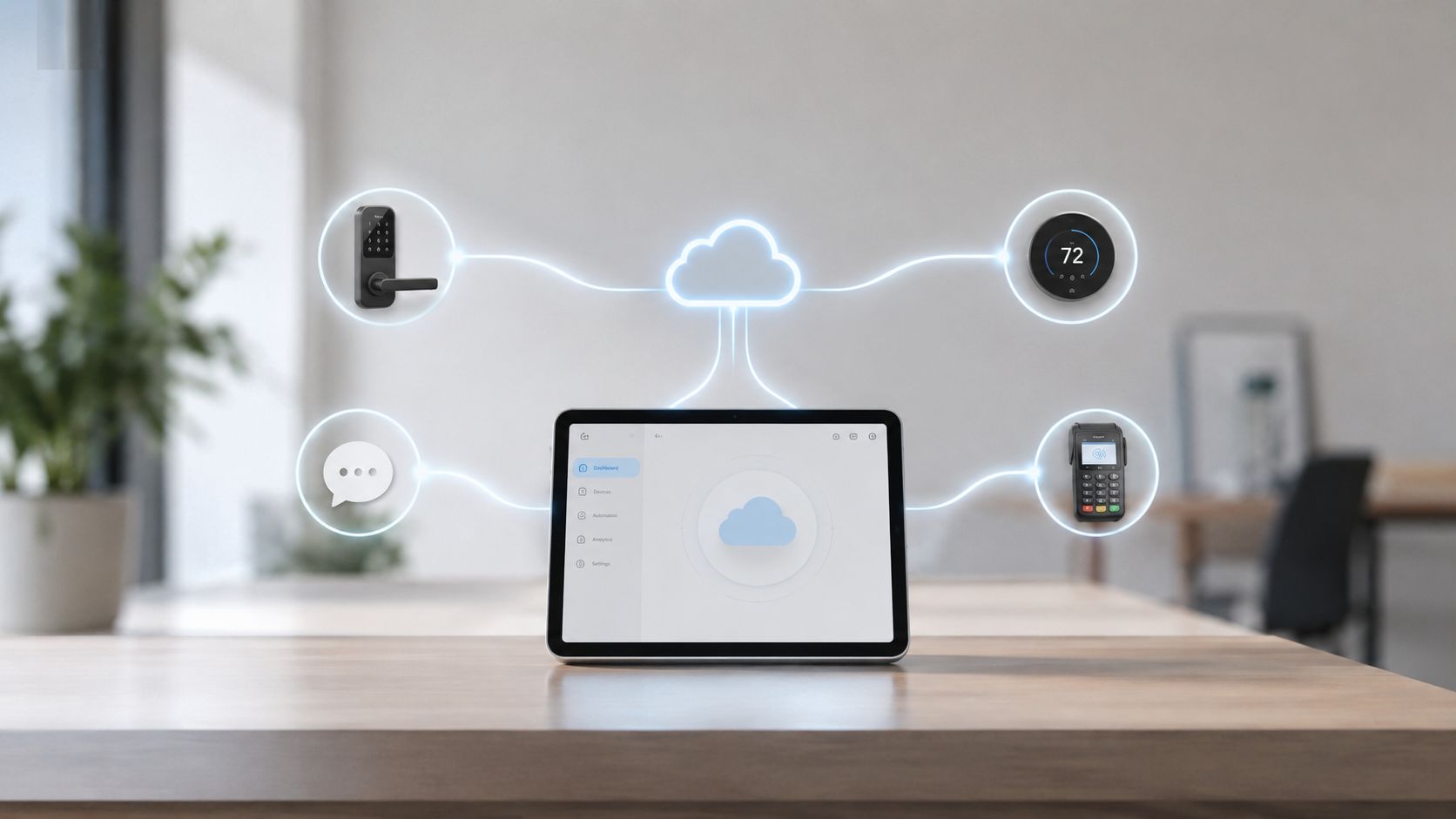
An API, or application programming interface, is a defined way for one system to request data or an action from another. An API-first platform treats those interfaces as a core product capability, rather than an attachment added after the main application is built. That matters when a co-living operation depends on payment processing, smart locks, thermostats, messaging, pricing, and analytics.
For a room-rental operator, the practical benefit is a shared flow of trusted information. A vacancy can become an input for a pricing service. A tenant record can support an approved messaging workflow. A smart-lock service can receive an access instruction without forcing staff to re-enter details manually. PadPulse's planned integrations include smart locks, dynamic pricing, AI-powered messaging, and smart thermostats, all of which require clear interfaces between systems.
The broader adoption trend explains why API-first design has become a mainstream integration pattern. One 2024 industry report on API adoption states that 74% of teams work API-first, while another reports that over 85% of enterprises are using APIs or actively implementing them. The same summary says nearly 90% of developers use APIs, with 69% relying on third-party APIs and 20% on internal or private APIs. These figures are cited once here because they show the shift toward reusable interfaces, ownership, version control, and governance.
Build a connection contract before launch
Before coding, review each provider's documentation. Confirm its request and response formats, authentication method, rate limits, and error codes, as recommended in this API integration guidance.
Use a sandbox for payment and access testing. Define versioned endpoints such as v1 and v2, document status codes, limit excessive requests, and log failures without exposing private data. If you're adding tenant screening to the workflow, map its data permissions and lifecycle through this background-check integration resource.
Practical rule: An integration isn't finished when two systems connect. It's finished when the connection is documented, tested, observable, and owned.
2. Microservices Architecture for Modular and Scalable Operations
A microservice is a small software service responsible for a focused capability. In a room-rental platform, one service might handle pricing, another messaging, another access control, and another portfolio reporting. Each service communicates through defined interfaces and can be changed without rebuilding every other function.
That separation helps when workflows grow at different speeds. A pricing service may process occupancy and market inputs while an AI messaging service handles prospect questions. A large volume of messages shouldn't make a portfolio P&L view unavailable. Likewise, a change to thermostat controls shouldn't interrupt rent reconciliation.
A useful comparison is a house with separate utility systems. If the water heater needs maintenance, the front door shouldn't stop locking. Microservices apply the same principle to software, but they also introduce more moving parts. Each service needs its own ownership, deployment process, logs, health checks, and failure behavior.
Choose boundaries around business responsibilities
Don't split an application into services just because the architecture sounds modern. Start with the business capabilities that need independent change or scaling. A small operator may be better served by a well-structured monolith, meaning one application with clear internal modules. Refactor into separate services when shared code, release conflicts, or operational load creates a real problem.
For a growing portfolio, define boundaries such as:
- Pricing service: Calculates recommendations from occupancy and market inputs.
- Messaging service: Handles inquiries, tenant notices, and approved response workflows.
- Access service: Manages smart-lock commands, permissions, and access history.
- Reporting service: Collects financial and operational data for property and portfolio views.
Use consistent communication standards, such as REST or gRPC, and trace requests across services. Containers such as Docker can help teams run services in consistent environments. Circuit breakers should stop repeated calls to an unavailable service, rather than allowing one failure to spread through the platform.
Netflix and Uber are commonly discussed examples of service-oriented design, with separate capabilities supporting recommendations, streaming, routing, payments, and driver management. For a co-living operator, the lesson isn't to copy their scale. It's to isolate the workflows that must remain dependable when another workflow is busy or unavailable.
3. Middleware Layer for Standardized Data Transformation and Routing
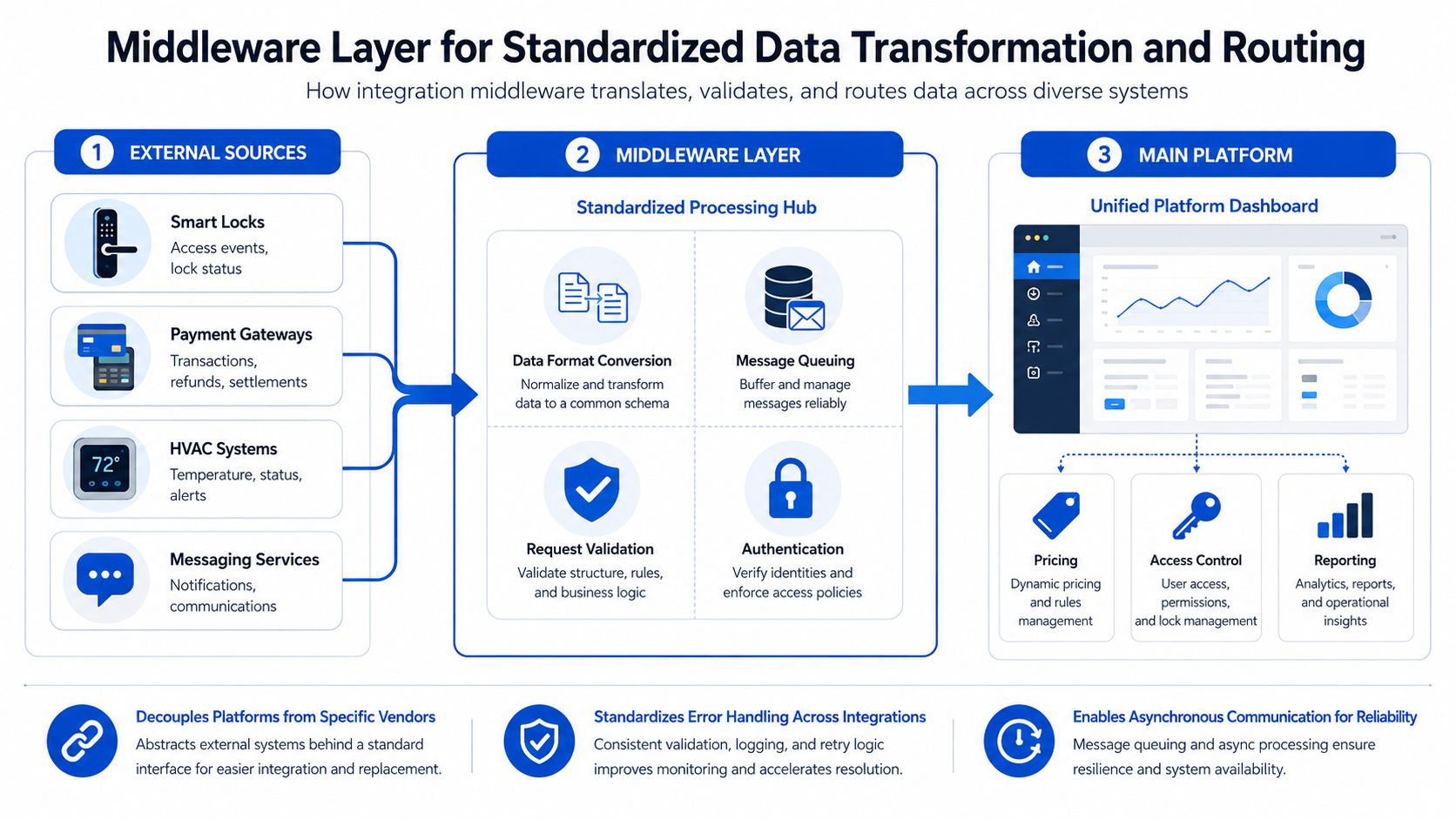
Different vendors rarely describe the same business object in exactly the same way. A lock provider may identify a door by a device identifier, while a property platform uses a room number. A thermostat may send a temperature reading in one structure, while an analytics service expects another. Middleware sits between these systems as a translator, router, and control point.
Suppose a tenant moves into Room 4. The property platform knows the tenant, lease dates, and room. The access provider needs a permission attached to a specific lock. The messaging service needs an approved move-in notice. Middleware can transform the shared tenant and room information into the format each destination understands, while applying validation and routing rules.
It can also reduce the number of direct connections. Instead of building separate logic for every lock brand, payment provider, and messaging system, a central layer can expose a consistent internal model and adapt vendor-specific details behind it. That makes vendor changes easier to contain.
Make every message traceable
Message brokers such as RabbitMQ or Apache Kafka can support asynchronous delivery when the receiving service doesn't need to respond immediately. JSON Schema or Protocol Buffers can validate payloads before they travel further. A correlation ID should follow a request through the platform, so an operator can trace a failed access update from the room record to the vendor response.
For a security-camera workflow, the same discipline matters. Review the permissions, event types, retention behavior, and failure responses in a security-camera integration guide before connecting the system to tenant or property records.
Use retries carefully. Exponential backoff gives a temporary outage time to clear, while validation prevents malformed data from entering the next system. Log incoming and outgoing events, but redact credentials and sensitive tenant information. Middleware should also have dashboards, because a translator that queues or drops messages can become a hidden operational bottleneck.
4. Event-Driven Architecture for Real-Time Automation and Responsiveness
An event records that something happened. A tenant inquiry arrived. A payment was processed. A room became vacant. A smart-lock battery reached a warning state. An event-driven architecture lets services subscribe to these facts and respond without waiting for a large scheduled export.
Consider a vacancy. The occupancy service publishes a room_became_vacant event. The pricing service recalculates its recommendation, the listing workflow updates availability, the messaging service can notify suitable prospects, and the reporting service records the change. Each action can happen through its own consumer, rather than one large process that must complete every step before anything changes.
That responsiveness is useful, but “real time” shouldn't become a default requirement for every workflow. An access revocation may need immediate handling. A portfolio summary may tolerate a delayed refresh. Defining the required freshness for each workflow helps operators balance speed, reliability, and support effort.
Treat events as shared contracts
An event schema should state the room identifier, event type, timestamp, source, and relevant business data. Version the schema when it changes, and document which services publish and consume it. Event handlers should be idempotent, meaning processing the same event twice produces the same final result. That protects you when a network retry delivers a duplicate payment or vacancy notification.
Monitor event lag and processing delays. If a lock permission event waits in a queue, staff need to know before a tenant reaches the door. For remote entry workflows, connect the event design to the permissions and recovery rules in this remote access control system resource.
Uber's ride_requested and e-commerce order_placed patterns illustrate the general idea. A single business event can trigger matching, pricing, inventory, payment, and notification actions. In co-living, the important work is defining which events deserve immediate automation and which can use a batch process.
5. Data Synchronization and Consistency Protocols for Multi-System Reliability
A room can have several valid-looking records that disagree. The occupancy database says it's available, the listing still says occupied, the pricing engine uses an old snapshot, and the access provider retains a former tenant's permission. Data synchronization keeps those systems aligned, but alignment starts with a clear answer to a basic question: which system owns each piece of information?
Assign a source of truth for tenant identity, lease status, room availability, payment status, device identity, and pricing recommendations. Then define how updates travel. A payment processor may notify accounting through a webhook. An occupancy change may update listings and pricing. A lock update may return a success or failure that the platform records against the room.
Strong consistency means systems wait for immediate agreement. Eventual consistency means systems may be briefly different but converge after updates are delivered. Eventual consistency can suit reporting or pricing displays, while access removal and payment authorization may need stricter controls.
Give operators a way to find stale data
Build reconciliation jobs that compare records and identify mismatches. A reconciliation result should show the room, source timestamp, current values, and recommended action. Don't overwrite conflicting data automatically unless the rule is safe and documented.
Track synchronization lag so staff can distinguish a current vacancy from a delayed update. Use idempotent operations, retries, and alerts for failed deliveries. Test scenarios such as a payment webhook arriving twice, a lock provider becoming unavailable, or a room changing status while a listing update is still queued.
For the operator, the daily check is simple: can you trust the occupancy count, payment status, access permissions, and pricing view at the same time? If not, the integration needs clearer ownership and recovery rules, not just more connections.
6. Standardized Data Models and Schema Design for Platform Integration
A data model defines what an object means and how its information is represented. For room rentals, that includes a tenant, property, room, lease, payment, occupancy state, device, message, and maintenance event. Without a shared model, one system may use a room number, another a device label, and a third a listing identifier for the same space.
Create business-facing definitions before choosing database fields. A tenant record might include name, email, payment method, lease dates, and room number. A room record may include property, availability state, current lease, listing status, and connected devices. The exact fields depend on your operation, but every team should use the same meaning.
Design for change without losing clarity
Use optional or nullable fields when information won't exist for every property. A room may have a smart thermostat in one building and no device in another. Document every field, accepted values, format, and example. ISO date formats, stable identifiers, and explicit time zones prevent confusion when staff manage properties in different locations.
Use schema versions such as 1.0.0, 1.1.0, and 2.0.0 when changes affect how services exchange data. Those examples are version labels, not performance measures. Provide migration guidance for major changes, and use JSON Schema or Protocol Buffers to enforce the contract programmatically.
Get input from operations, finance, leasing, engineering, and support before finalizing the model. A field that seems obvious to a developer may not answer the question a property manager asks every morning. Standardization also makes onboarding easier because a new property can use established room and tenant structures instead of receiving a separate custom configuration.
7. Comprehensive API Security and Authentication for Protected Integrations
Every connected system creates an access path. A smart-lock integration can issue entry permissions. A payment integration can expose transaction operations. A messaging integration can send tenant communications. API security controls who can use those paths, what they can do, and how the platform protects information while it moves.
Authentication verifies identity. Authorization determines permissions. Encryption protects data in transit and at rest. Rate limiting restricts excessive requests. These controls work together. A valid user should still be unable to change a lock at a property they don't manage, and a service that only reads occupancy shouldn't receive permission to issue access commands.
Apply least privilege to every connection
Use established protocols such as OAuth 2.0 and OpenID Connect instead of creating custom authentication. Store secrets in a managed vault such as HashiCorp Vault or AWS Secrets Manager, not in application code or shared documents. Require HTTPS for every endpoint and use TLS 1.2 or higher for encrypted communication.
A practical security review should ask:
- Tenant access: Can a tenant authorize an approved device connection without sharing a main platform password?
- Staff permissions: Can a manager view only the properties assigned to them?
- Payment scope: Does the payment connection have only the permissions it needs?
- Secret lifecycle: Does the team rotate keys and revoke credentials when staff or vendors change?
- Abuse detection: Do alerts identify repeated authentication failures or unusual request activity?
Keep authentication logs free of passwords, full payment details, and other sensitive values. Schedule security audits and penetration testing, and document the response when a credential is exposed. Security isn't a final checkbox. It's part of the connection design.
8. Logging, Monitoring, and Observability Infrastructure for Integration Health
A connection can be technically online while the business workflow is broken. The payment provider may respond, but accounting may reject the payload. The lock API may accept a request, but the device may not apply it. A message may leave the platform but fail before reaching the tenant.
Logging records what happened. Monitoring watches known health indicators. Observability helps a team investigate why a result occurred by connecting logs, metrics, traces, and context. For a room-rental operator, that means tracing a pricing update from the recommendation through the listing and reporting systems, or finding why a move-in access request didn't reach a lock.
The operational gap is easy to underestimate. Independent API research says 82% of organizations have adopted some level of API-first, while 17% use no monitoring tools at all, and monitoring is often fragmented across vendors, according to this API integration observability analysis. The figures appear here because they highlight a specific risk: teams may design connections carefully but lack a reliable way to maintain them after launch.
Monitor business outcomes, not only servers
Give every request a correlation ID and use structured logs, such as JSON, so systems can search and group events. Use appropriate severity levels, including ERROR, WARN, INFO, and DEBUG. Never log passwords, card details, or government identification numbers.
Build dashboards that answer operator questions:
- Did the vacancy update reach every relevant listing?
- Did the payment status reach accounting?
- Did the smart-lock permission succeed?
- Are tenant inquiries waiting in a queue?
- Is a thermostat connection sending current readings?
Alert on failed deliveries, unusual error rates, missing expected events, and excessive lag. Test alerts and incident procedures rather than assuming they work. This complete guide to data observability can help teams think beyond raw logs and toward usable operational visibility.
9. Graceful Degradation and Fallback Mechanisms for Fault Tolerance
External systems fail. A smart-lock provider can become unavailable, a payment processor can experience an outage, or a network connection can drop while a tenant is trying to enter. Graceful degradation means the core operation continues with reduced functionality instead of collapsing completely. A fallback is the defined alternative behavior.
For example, a property team might use a documented manual access process when an automated lock service is unavailable. A pricing service might preserve the last approved recommendation until new data arrives. A messaging workflow might route an urgent notice through email when its primary channel fails. These choices should be designed before an incident, not improvised at the front desk.
Define degraded mode in business terms
For each integration, write down what remains available, who can activate a fallback, and how the team returns to normal operation. A fallback that bypasses access controls can create a security risk, so manual procedures need identity verification, approval, expiry, and an audit record.
Circuit breakers can stop calls to a failing provider. Timeouts prevent a room status update from waiting indefinitely. Retries can help with temporary failures, but repeated retries may worsen an outage. Notify users when the platform is operating in degraded mode, and explain what staff should do next.
Netflix's cached content behavior and Gmail's ability to hold unsent messages illustrate the principle in familiar services. The co-living equivalent is a safe, documented operating path for access, payments, communications, and occupancy updates.
Use the patterns for graceful degradation as a prompt for failure planning, then adapt the procedures to your properties. Test them regularly with implementation and operations teams. If nobody knows how to issue a temporary access credential or reconcile a delayed payment, the fallback exists only on paper.
10. Version Management and Backward Compatibility for Safe API Evolution
A vendor can change an endpoint, add a field, alter an error response, or retire an older interface. If your pricing, access, payment, or reporting connection assumes the old behavior, a routine release can become an operational incident. Version management lets a platform evolve while giving existing consumers a controlled migration path.
Imagine a pricing API with /v1/pricing already used by several properties. A new /v2/pricing endpoint adds richer inputs or a different response structure. Supporting both during migration lets operators move properties gradually, test the new behavior, and keep established workflows running while the team verifies compatibility.
Backward compatibility depends on restraint. Add new fields as optional where possible. Don't remove an existing field or change its meaning without a migration plan. Maintain separate documentation for major versions, publish deprecation notices, and use feature flags to release changes to selected properties.
Make change control part of integration ownership
A documented change process should identify the owner, affected services, test evidence, approval, release timing, rollback plan, and communication path. Government change-management guidance says system owners should establish procedures to document, review, approve, and monitor all changes, while version-control guidance recommends explicit labels such as v1.0, v1.1, and v2.0 with audit logs for edits, approvals, and access, as described in this documentation and version-control guidance.
Automated compatibility tests should run before deployment. Migration instructions should use room-level examples, such as confirming that a v1 tenant record still produces the expected access permission. A vendor evaluation should also ask how much notice it provides, how long versions remain supported, and who handles a failed migration.
10-Point Software Integration Best Practices Comparison
| Integration Pattern | 🔄 Implementation Complexity | ⚡ Resource Requirements | ⭐ Expected Outcomes | 💡 Ideal Use Cases | 📊 Key Advantages |
|---|---|---|---|---|---|
| API-First Architecture for Seamless Third-Party Integrations | High, requires design of APIs, auth, docs and versioning | Medium–High, developer time, security, testing, API gateway/infrastructure | ⭐⭐⭐⭐, real-time sync, extensibility, faster integrations | Platforms needing broad third‑party connectivity and partner ecosystems | Reduces manual work; enables real‑time data sharing; faster time‑to‑market |
| Microservices Architecture for Modular and Scalable Operations | High, distributed services, orchestration, service discovery | High, DevOps, container orchestration (K8s), monitoring, CI/CD | ⭐⭐⭐⭐, independent scaling, faster focused releases, resilience | Large systems with multiple bounded domains and varying load profiles | Independent deploys/scaling; tech diversity; limits blast radius |
| Middleware Layer for Standardized Data Transformation and Routing | Medium, mapping, validation, routing logic and error handling | Medium, message brokers, transformation services, maintenance | ⭐⭐⭐, standardized flows, vendor decoupling, error normalization | Heterogeneous ecosystems where systems use different formats/protocols | Simplifies onboarding; centralizes validation, security and retries |
| Event-Driven Architecture for Real-Time Automation and Responsiveness | High, event modeling, ordering, delivery semantics, idempotency | Medium–High, event brokers, tracing, consumer management | ⭐⭐⭐⭐, near‑instant automation, decoupled interactions, audit trail | Real‑time workflows (pricing updates, notifications, occupancy changes) | Highly scalable; enables immediate reactions and loose coupling |
| Data Synchronization and Consistency Protocols for Multi-System Reliability | High, CDC, reconciliation, conflict resolution and consistency models | High, sync jobs, monitoring, reconciliation tooling, engineering effort | ⭐⭐⭐, improved reliability and accurate multi‑system state | Financials, occupancy tracking, and systems requiring tight data correctness | Prevents inconsistencies; supports compliance and reliable reporting |
| Standardized Data Models and Schema Design for Platform Integration | Medium–High, schema design, governance, versioning discipline | Medium, schema tooling, docs, migration support and training | ⭐⭐⭐, better data quality, fewer integration bugs, predictable contracts | Platforms onboarding many vendors or properties and many consumers | Consistent data, easier integrations, simpler developer onboarding |
| Comprehensive API Security and Authentication for Protected Integrations | Medium–High, auth flows, RBAC, encryption, key management | Medium–High, security expertise, secrets vaults, monitoring and audits | ⭐⭐⭐⭐, strong protection of PII/financials and access control | Any integration handling payments, tenant data, or device control | Reduces breach risk; enables secure third‑party integrations; compliance support |
| Logging, Monitoring, and Observability Infrastructure for Integration Health | Medium, structured logs, tracing, metric instrumentation | High, log storage, APM/monitoring tools, alerting and dashboards | ⭐⭐⭐⭐, faster detection and resolution; operational visibility | Distributed/microservice platforms and mission‑critical operations | Lowers MTTD/MTTR; enables root‑cause analysis and proactive alerts |
| Graceful Degradation and Fallback Mechanisms for Fault Tolerance | Medium, circuit breakers, timeouts, fallback design and testing | Medium, fallback implementations, testing, health checks | ⭐⭐⭐, maintained partial availability and better UX during outages | Systems where integrations may fail but continuity is required | Prevents cascading failures; preserves partial functionality; improves resilience |
| Version Management and Backward Compatibility for Safe API Evolution | Medium, semantic versioning, deprecation policies, multi‑version support | Medium, docs, testing, support for old versions and migration guides | ⭐⭐⭐, safe evolution with minimal breakages for integrators | Public APIs or long‑lived integrations with many external clients | Enables gradual migration; reduces breaking changes and support incidents |
Turn the Checklist Into a Living Integration Practice
The ten practices become useful when operators turn them into a repeatable operating routine. Start with the business objects that staff handle every day: tenant, listing, payment, occupancy record, room, device, message, and report. Define what each object means, which system owns it, who may change it, and how another system learns about that change.
Then select the simplest architecture that supports the workflow. A small operation may begin with a modular application and a few documented APIs. A larger portfolio may need middleware, event processing, separate services, or a combination of those patterns. The choice should follow the number and importance of workflows, not a desire to adopt fashionable technology.
Security belongs in the design from the first vendor conversation. List every credential, permission, endpoint, and data category. Store secrets securely, limit each integration's access, require encrypted communication, and establish a process for rotation and revocation. Ask vendors how they handle authentication failures, audit records, incident notifications, and tenant privacy.
Before launch, validate connections in a staging or sandbox environment. Test normal flows, malformed data, duplicate events, delayed webhooks, rate-limit responses, expired credentials, unavailable providers, and partial updates. Confirm that the team can recover a room record when systems disagree. A successful test isn't only “the API returned a success response.” It's proof that the right listing, payment record, access permission, message, and report changed as intended.
Launch with operational visibility. Dashboards should show integration health in language that property staff understand. Alerts should identify the affected property, room, workflow, and next action. Runbooks should explain who investigates a failed payment sync, who approves manual access, how staff handle a stale vacancy, and how the team rolls back a risky release.
The need for this discipline is clear at enterprise scale. Organizations average 897 applications, but only 28% are connected, and just 2% have integrated more than half of their applications, according to enterprise data integration research. The same source reports that 95% of IT leaders say integration hurdles block AI adoption. These figures belong here because they frame integration as an operational ownership problem, not merely a coding task. More tools don't automatically create a more connected business.
Market direction also favors reusable integration layers. The global application integration market is projected to grow from $26.06 billion in 2026 to $110.20 billion by 2034, while 85% of businesses are moving toward event-driven architectures and 84% of enterprises have adopted low-code solutions, according to application integration market research. Those are projections and industry findings, not a reason for every landlord to build an event platform. They support a narrower conclusion: composable, API-first connections, reusable connectors, centralized monitoring, and automated testing are becoming practical design considerations across many operating environments.
Review the environment on a recurring schedule. Check vendor performance, API changes, synchronization gaps, alert quality, access permissions, credentials, documentation, and fallback procedures. Treat every integration as a service with an owner and a maintenance budget, even when another company supplies the endpoint.
Operators evaluating a centralized platform such as PadPulse should ask how planned pricing, messaging, smart-lock, thermostat, and reporting connections will be documented, monitored, secured, tested, and supported. PadPulse is an in-development platform for PadSplit hosts and co-living operators, with planned capabilities across dynamic pricing, AI-powered messaging, smart-home integrations, P&L tracking, portfolio analytics, and market intelligence. Its expected launch is targeted for Winter 2026, so buyers should verify current availability, supported connections, and operational commitments directly with the team.
Reliable integrations come from clear ownership and repeatable operations, not one-time setup. When every room workflow has a defined data owner, secure connection, tested failure path, visible health status, and documented change process, your software can support the work your team does.
PadPulse is being developed to bring dynamic pricing, AI-powered messaging, smart-lock and thermostat connections, and financial and portfolio reporting into one toolkit for co-living operators. Visit PadPulse to review the platform and join the interest list for launch updates and potential beta access.