Reserve Accounts Accounting: A Complete Guide
August 7, 2026
25% of small businesses hold reserves covering fewer than 13 days of operations if revenue stops, and the median cash reserve is about $12,000. For a pad-style operator, that's the difference between riding out a vacancy spike and scrambling for short-term financing.
A co-living house can look healthy on paper and still be fragile in real life. One empty room, one failed appliance, or one slow-paying resident can put pressure on the same month's cash, which is why reserve accounts accounting matters as much to operators as rent collection and occupancy.
Why Reserve Accounts Matter for Rental Operators
A reserve isn't a vague comfort blanket. It's a deliberately set-aside cushion for a known future need, and the evidence shows why that discipline matters. Stripe's summary of JPMorgan research says that among 597,000 small businesses, 25% held reserves covering fewer than 13 days of operations if revenue stopped, while the median cash reserve was about $12,000. The same source notes that reserve sizes vary widely by industry, with high-tech manufacturing averaging more than $34,000 and personal services averaging about $5,300. Stripe also points to a common planning target of three to six months of operating expenses in reserve, which is a more useful benchmark than a random leftover balance. See Stripe's reserve guidance for the full context on small-business liquidity planning and runway thinking.[^1]
For a pad-style or co-living operator, those numbers land differently than they do for a traditional storefront. A room-by-room portfolio doesn't usually fail because of one dramatic event. It gets squeezed by a vacancy cluster, a broken water heater, turnover cleaning, or a resident who leaves behind unpaid charges.
I've seen operators treat “extra cash” as available cash. That works until two problems hit at once. One month, three rooms turn over later than planned, and a refrigerator or HVAC issue arrives on the same week. Without a reserve policy, the manager starts mixing operating cash with maintenance money and hoping the next rent cycle fixes the hole.
Practical rule: if a repair or vacancy would force you to delay another payment, the reserve wasn't big enough for the risk you were carrying.
That's why reserve discipline is more than bookkeeping. It helps a landlord decide what money is already spoken for, what can be distributed, and what has to stay inside the portfolio for stability. In rental operations, the accounting treatment is the guardrail that keeps that money from drifting back into day-to-day spending.
What Are Reserve Accounts and the Main Types
A reserve account is money earmarked for a specific purpose. In practice, that purpose might be replacing a worn-out appliance, covering vacancy losses, absorbing unrecoverable tenant charges, or holding resident funds that can't be mixed with operating money. The point is separation, both in intent and in the books.
Common reserve types in rental operations
| Reserve Type | Purpose | Accounting Treatment | Typical Use Case |
|---|---|---|---|
| Operating reserve | Buffer against short-term cash gaps | Usually tracked as designated equity or management reserve | Vacancy swings, delayed receipts |
| Reserve-for-replacement | Funds for major asset replacement | Often set aside from retained earnings or designated surplus | Roof, HVAC, appliance replacement |
| Maintenance reserve | Funds for recurring repair needs | Tracked separately so repair spending stays controlled | Turns, callouts, preventive work |
| Bad-debt reserve | Covers uncollected tenant balances | Used to reflect expected losses and disputed receivables | Move-outs with unpaid charges |
| Security-deposit reserve | Holds resident deposits separately | Must stay segregated from operating money | Refunds and lawful deductions |
| Escrow reserve | Holds funds subject to rules or third-party control | Kept under separate contractual or regulatory handling | Tax, insurance, or lender-required funds |
The accounting detail matters because these buckets do different jobs. A replacement reserve shouldn't be used to paper over a weak month of collections, and a security-deposit reserve shouldn't get blended into general cash.
For co-living portfolios, separate tracking is what keeps room-level economics readable. If one house runs hot on occupancy and another lags, the reserve labels should make that obvious. If they're all lumped together, you lose the ability to see what protects the portfolio.
Why the labels matter
The title on the account tells you what the money is for, but the ledger tells you whether the rule is being followed. That distinction is what keeps reserve accounts useful instead of decorative. It also makes it easier to compare a property's upkeep burden against its income stream without guessing where the cash came from.
How Reserve Accounts Work in Practice
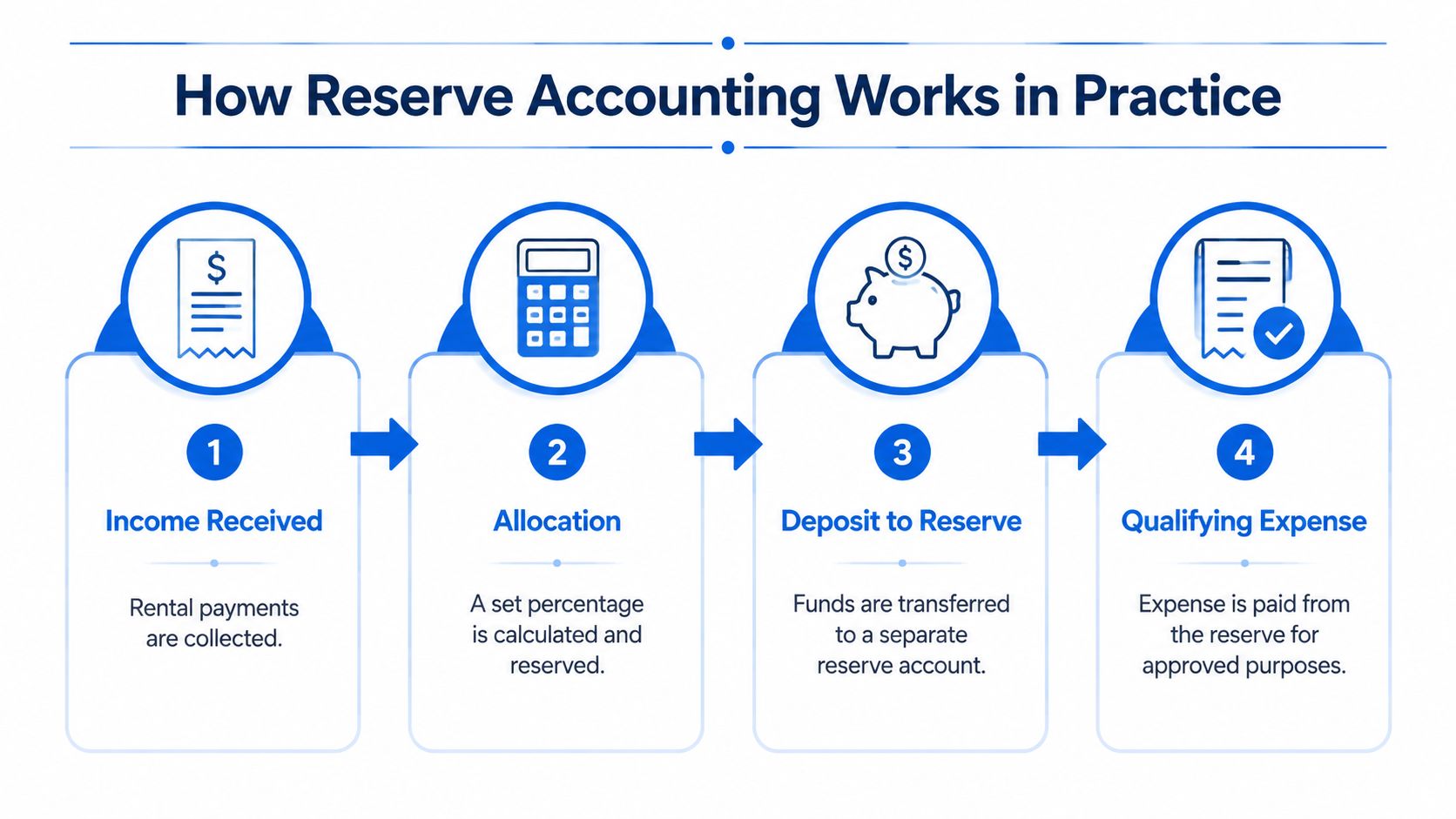
Reserve accounting is not an expense entry. It's an equity reclassification, which means the money stays inside shareholders' equity while moving from retained earnings into a designated reserve. GoCardless explains the standard treatment clearly, debit retained earnings and credit the reserve account, then reverse the entry when the reserved purpose is fulfilled.[^2] AccountingTools adds that reserve accounting records a transfer from retained earnings into a separate reserve account, and once appropriated, the reserve remains part of shareholders' equity rather than being available for dividends.[^3]
For a rental operator, that means reserve funding is a decision about designation, not a recognition of loss. The cash may be moved, but the accounting story is that management has committed part of accumulated profit to a future use.
A simple journal-entry example
Here's how a $10,000 reserve contribution can look for a co-living portfolio:
| Transaction | Debit | Credit | Effect on Equity |
|---|---|---|---|
| Set up reserve | Retained Earnings $10,000 | Reserve Account $10,000 | Total equity unchanged, funds designated |
| Use reserve for approved purpose | Reserve Account $10,000 | Retained Earnings $10,000 | Designation reversed when purpose is met |
That's the clean version. The entry doesn't hit the income statement because it isn't an operating expense. It also doesn't change the cash flow statement by itself, because the transfer is within equity classification, not a new inflow or outflow.
A useful way to think about this is to separate economic use from accounting classification. Paying a contractor out of a reserve may reduce cash, but the reserve entry itself tells the books why the money had been set aside in the first place.
For operators who keep their records in a general ledger, this is the point where clean account structure starts paying off. If the reserve category is clear from the start, the month-end close gets much easier. A detailed general ledger setup for rentals helps keep those classifications consistent, especially when the portfolio has multiple houses and multiple reserve needs, as outlined in general ledger practices for rental properties.
The reserve entry should explain intent, not just movement. If the reason for the transfer can't be understood six months later, the system isn't doing its job.
The accounting treatment also matters for distributions. Once funds are designated as reserve, they're no longer casually available for dividends or owner draws until the reserve purpose is released.
Reserve Governance and Control Requirements
Good reserve policy fails fast when the ledger is sloppy. Institutional guidance emphasizes separate general ledger cash and equity records for each reserve fund, with independent tracking for contributions, earnings, withdrawals, and balances.[^4] That's the standard that keeps reserve accounting supportable, especially when auditors, lenders, or tax reviewers ask where the money came from and where it went.
The roll-forward control that keeps reserves honest
Reserve reconciliation usually follows a simple control logic, opening balance plus additions minus utilization minus releases, plus or minus reclassifications. That roll-forward makes it possible to prove the ending balance instead of just asserting it. If a reserve statement doesn't tie to that math, the balance is suspect.
For a PadSplit-style operator, this matters because money can look separated in one place and commingled in another. Security deposits, maintenance cash, and owner surplus should never be blurred together. Once that happens, the reserve isn't a reserve anymore, it's just a label on a balance.
Purpose restrictions are real, not cosmetic
The USDA and UC Davis reserve-fund guidance gives a concrete example of tight use rules. Reserve funds must be used only to replace depreciated equipment with the same or similar equipment performing the same function, and they can't be charged to Federal contracts and grants.[^5] That's a good reminder that reserve money is often narrower in purpose than operators expect.
The same discipline should show up in property management accounting. If a reserve is tagged for replacement, it shouldn't get tapped for payroll. If it's a security-deposit reserve, it should stay away from operating expenses altogether. Clear records help, but clear rules matter more.
For operators who want a practical model for mapping reserve activity into the broader accounting system, property management accounting methods are most useful when they preserve separate treatment for each fund. That's especially true in shared-housing portfolios, where one messy ledger can hide several kinds of cash risk at once.
Separate the bank story from the purpose story. If you can't explain both, the reserve control is incomplete.
Setting Reserve Policies and Target Levels for Pad-Style Portfolios
Stripe's planning benchmark of three to six months of operating expenses is a strong starting point for rental operators because it ties reserve size to real cash need, not to guesswork.[^1] For pad-style portfolios, that benchmark should be translated into room-by-room exposure. A property with thin margins and frequent turnover needs more protection than a stable asset with longer resident stays and lower repair intensity.
How to think about target levels
A practical approach is to estimate monthly operating expenses, then spread that cost across the number of rentable rooms. That gives you a per-room operating load. From there, the reserve target can be scaled to cover several months of that load, instead of relying on one blended number for the whole portfolio.
That method works because vacancy and repair risk are experienced at the room level, not just at the building level. If two rooms turn over in the same month, the property's cash pressure rises quickly, even if the rest of the house is performing well.
Reserve policies that should not be treated the same
Not every reserve deserves the same target or the same release rules.
- Replacement reserves need the longest runway, because large asset failures are infrequent but expensive.
- Maintenance reserves should be replenished more steadily, because small repairs happen all the time.
- Bad-debt reserves can be narrower if collections are strong, but they still need a written method.
- Security-deposit reserves are not a cushion for operations at all, because they belong to residents and follow separate handling rules.
- Escrow reserves should be documented under the lender, tax, or contractual framework that created them.
The tension for operators is obvious. Set the target too low and the portfolio gets brittle. Set it too high and you starve the business of growth capital. New operators usually need a phased plan, with modest reserve funding at first and stronger contributions once occupancy and collections are stable.
Good policy is written before the emergency, not during it.
A simple checklist helps keep the policy usable:
- Define each reserve category in plain language.
- Assign a funding rule for each one.
- State who can approve use of reserve funds.
- Set a review cadence for balances and releases.
- Document what counts as eligible spending for each reserve.
That kind of policy turns reserve accounting from an informal habit into an operating standard. For co-living portfolios, that's what keeps cash management aligned with room-by-room economics instead of day-to-day stress.
Worked Example and Setup Checklist for Rental Operators
Maya runs a twelve-room co-living property and wants a reserve system that can survive repairs, turnovers, and tenant movement without constant guesswork. She starts by splitting reserves into four buckets, replacement, maintenance, bad debt, and security deposits, because each one serves a different purpose and should not be spent the same way.
Maya's first reserve setup
She decides to make a monthly transfer of $10,000 across those buckets. The accounting entries are simple when the categories are clean.
| Transaction | Debit | Credit | Effect on Equity |
|---|---|---|---|
| Fund replacement reserve | Retained Earnings | Replacement Reserve | Moves designated profit into reserve |
| Fund maintenance reserve | Retained Earnings | Maintenance Reserve | Keeps repair money separate |
| Fund bad-debt reserve | Retained Earnings | Bad-Debt Reserve | Reflects expected collection loss |
| Hold security deposits separately | Liability or custodial account | Security deposit control account | Keeps resident funds off operating cash |
The first three buckets are reserve designations. The last one is different, because security deposits are not owner surplus. They need their own handling so resident money doesn't get confused with business money.
After the first quarter, Maya updates her roll-forward. She starts with the opening balance, adds the monthly reserve transfers, subtracts the repair work paid from the maintenance bucket, and subtracts any approved release from the bad-debt reserve if a move-out balance is written off. That leaves a supportable ending balance she can explain to a lender or partner without reworking the books from scratch.
A clean opening balance matters here, because every reserve framework depends on knowing what existed before the new policy started. If that starting point is wrong, the whole roll-forward becomes harder to trust. A practical guide to setting that baseline is opening balance account setup, especially when a portfolio is moving from informal tracking to a real reserve structure.
Setup checklist for a rental operator
- Name each reserve account so the purpose is obvious.
- Separate the ledgers for operating cash, reserves, and resident funds.
- Write the funding rule for each reserve in one paragraph.
- Define approval authority for reserve withdrawals.
- Match every release to a qualifying expense.
- Reconcile quarterly using the roll-forward formula.
- Review the policy annually and adjust for occupancy, turnover, and repair history.
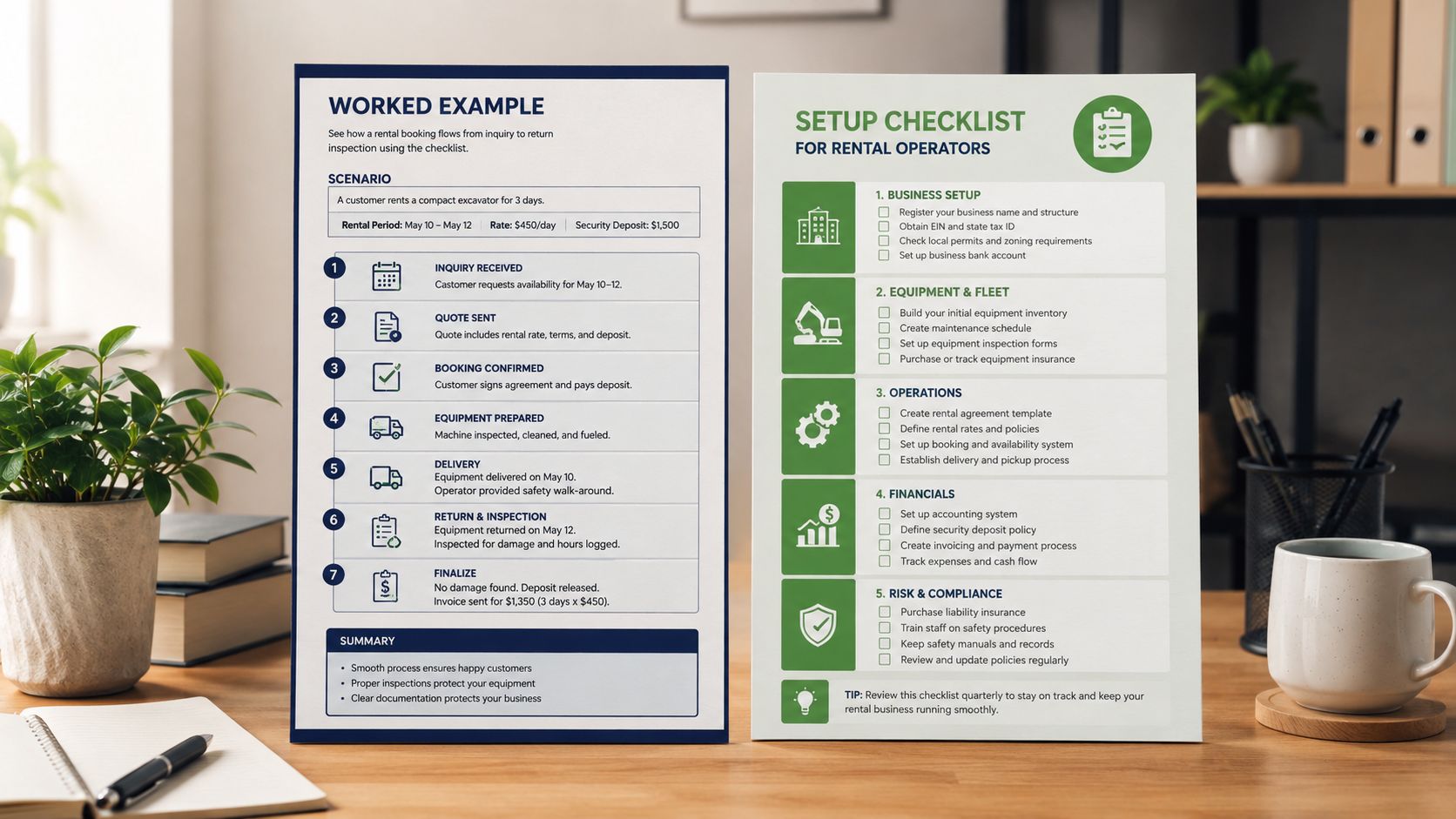
Maya's real advantage isn't the size of the reserve. It's the fact that every dollar has a rule attached to it. That's what makes the system durable when the property gets messy.
Key Takeaways and Next Steps
Reserve accounts work best when they are treated as a planned equity designation, not as leftover cash. For rental operators, that distinction keeps the books honest and makes it easier to explain why certain dollars are restricted while others remain available for day-to-day use.
For pad-style and co-living portfolios, the test is whether the reserve policy works room by room. A property with shared kitchens, frequent turnover, and uneven wear needs reserve rules that reflect how cash leaves the business in practice, not just how the chart of accounts is labeled. Cornell's reserve account governance guidance and UC Davis' reserve fund usage guidance both point to the same basic control idea, reserves need defined purpose, approval, and use rules, or they stop being useful. That is the level of discipline a co-living operator needs before the numbers can hold up in a lender review or partner meeting.
The decisions that matter most are straightforward:
- Classify reserves correctly so you know what each dollar is for.
- Use separate accounts for replacement, maintenance, bad debt, and resident funds.
- Post the entries cleanly so retained earnings and reserve balances stay aligned.
- Reconcile with roll-forward controls so the ending balance is defensible.
- Set target levels from operating expenses, then scale them to room-level risk.
- Review policies regularly so they still fit occupancy, turnover, and repair patterns.
The operators who do this well do more than keep cleaner books. They make better calls under pressure because they know which cash is protected, which cash is flexible, and which cash is already spoken for. In a pad-style building, that clarity matters because one cash mistake can affect several rooms at once, especially when collections, repairs, and move-outs all hit in the same week.
PadPulse is being built for that operating reality, with tools for pricing, communication, smart-home coordination, and portfolio reporting that help operators keep the whole system visible in one place. If you want to tighten reserve discipline and make room-by-room financial management easier to track, visit PadPulse and see how it is shaping the next generation of co-living operations.
[^1]: Stripe reserve account guidance
[^2]: GoCardless reserve accounting overview
[^3]: AccountingTools reserve accounting explanation
[^4]: Cornell reserve account governance guidance
[^5]: UC Davis reserve fund usage guidance