General Ledger for Rental Properties: A Complete Guide
July 29, 2026
If you've ever opened a spreadsheet and found that the room balances, the bank balance, and the owner's “real profit” don't agree, you're already dealing with the problem a general ledger for rental properties is supposed to solve. That mismatch shows up fast in co-living and pad-style housing, where one unit can have several tenants, one bill can be split three ways, and a mid-month move-in can throw off every shortcut.
A rent ledger can tell you who paid and who still owes. The general ledger is the record that ties those tenant-level details back to the property's income, expenses, assets, liabilities, and equity, which is why it becomes the basis for monthly control, lender reporting, and NOI analysis as defined in this property accounting guide. For room-by-room operators, that broader view matters because a property can look occupied while still underperforming financially.
Why Room-by-Room Operators Need a Real General Ledger
Most first-time hosts start with one spreadsheet for rent, another for utilities, and a notes app for deposit issues. That works until a tenant pays half, another moves out mid-cycle, and the utility reimbursement gets booked against the wrong room. At that point, the issue is no longer “bad organization,” it's that the books don't have a single source of truth.
A proper general ledger for rental properties solves that by holding every financial event in one master record. It captures income, expenses, assets, liabilities, and equity, while the rent ledger underneath it keeps the tenant-by-tenant detail the master-record structure is outlined here. That distinction matters because operators judge performance at the portfolio level, not just by whether a room is technically occupied.
Rent ledgers and general ledgers do different jobs
A rent ledger answers a narrow question: who owes what, when, and why. The general ledger answers the bigger questions: what did the property earn, what did it spend, what's still owed, and what does that mean for profit. Rental bookkeeping guidance also notes that economic occupancy is rent collected divided by gross potential rent, which is why a clean ledger is essential for seeing how much of the housing stock is producing revenue as described in this rental income ledger guide.
Practical rule: if the rent ledger says one thing and the bank feed says another, the rent ledger is not the final answer.
That difference is where many co-living books break. A tenant can be physically present, yet late fees, concessions, or short payments can make economic occupancy weaker than the unit count suggests. Industry guidance notes that when economic occupancy trails physical occupancy by more than 3 percentage points, value is already leaking through concessions, write-offs, or chronic late payments according to this property-management accounting report guide.
The good news is that you don't need a giant accounting system to get this right. You need a ledger structure that separates rooms, tenants, and charge types cleanly, then gets updated fast enough to stay trustworthy. Done well, it takes a weekend to set up and under an hour a month to keep tight.
Building the Chart of Accounts for Pad-Style Rentals
The chart of accounts is the skeleton of the ledger. If the account list is sloppy, the books will stay sloppy no matter how careful you are with posting. Standard landlord templates usually work for a single-family rental, but they get messy fast when one property has multiple roommates, split bills, and room-specific pricing.
Start with five clean buckets
A good double-entry bookkeeping setup means every transaction touches at least two accounts, and the chart of accounts gives each touchpoint a home that is the control layer described in this general ledger overview. For pad-style rentals, I'd start with these buckets:
- Assets
- Operating bank
- Security deposit bank
- Tenant receivables
- Liabilities
- Tenant deposits
- Accounts payable
- Mortgage payable
- Owner draws payable
- Income
- Rent by room
- Application fees
- Late fees
- Utility reimbursements
- Expenses
- Repairs
- Utilities
- Cleaning
- Insurance
- Platform fees
- Property management
- Equity
- Owner contributions
- Retained earnings
The most important rule sits inside the liability section. Security deposits should stay on the books as liabilities until they are legally earned or applied, not as income that treatment is explicitly recommended in this accounting guidance. If you record deposits as revenue on day one, your income statement will look better than it should, and your liability balance will be wrong.
When to add a new account
Don't create a new account for every tiny exception. Add a new account only when the amount needs to be tracked separately for reporting or tax clarity. If the item is just a variation of a recurring expense, keep it in the same bucket and use a memo, class, or property tag if your software supports it.
Separate by meaning, not by mood. If two charges should appear differently on a P&L or tax report, they deserve different accounts.
That approach keeps room-level reporting readable. A platform fee should not be netted into rent income, and a reimbursement should not be buried inside utilities. Rental accounting guidance also warns against mixing tenant payments, owner contributions, and operating cash in one stream, because traceability breaks almost immediately as noted in this GL best-practice guide.
A practical first pass is enough. Set up the core accounts, map every recurring charge into one of them, and keep the list small until a real reporting need proves otherwise. For a broader accounting workflow, see this property management accounting overview.
Sample Journal Entries You Will Post Every Month
The fastest way to understand the ledger is to post the entries you'll see. Room-by-room operators usually don't have exotic transactions. They have rent receipts, repairs, utility splits, deposits, and owner draws. The trick is posting each one immediately, so balances don't drift.
Rent collected from three tenants
Suppose three tenants each pay rent for their rooms. The entry is simple, but it has to be posted per payment, not as one vague lump sum.
- Debit Cash, 3,000. Money hit the bank.
- Credit Rent by Room Income, 3,000. The property earned rental revenue.
That entry increases cash and revenue at the same time. If one tenant paid late, you'd still post the payment on the actual date received, because rent-ledger guidance says entries should show the payment date, amount, and any outstanding balance clearly as laid out in this rent ledger guide.
Return of a security deposit at move-out
When a tenant moves out and receives a deposit refund, the deposit doesn't hit income. It reduces the liability you've been holding.
- Debit Tenant Deposits, 500. You're reducing what you owe the tenant.
- Credit Cash, 500. Cash leaves the bank.
This is the cleanest place where beginners get tripped up. The money was never yours to recognize as revenue in the first place.
Plumbing repair and utility split
A plumbing invoice for 180 is an operating expense.
- Debit Repairs and Maintenance, 180.
- Credit Accounts Payable, 180 if the bill hasn't been paid yet, or Credit Cash, 180 if it has.
For a utility bill split across rooms, post the utility expense in full, then allocate the reimbursement separately as income if your bookkeeping method and reporting policy call for that structure. That keeps the expense visible instead of netting it away.
Owner draw
If the owner takes cash out, don't bury it in expenses.
- Debit Owner Draws, 400.
- Credit Cash, 400.
That's an equity movement, not a property cost.
The monthly posting rule is blunt. Enter each transaction the moment it happens, then reconcile later. Delayed posting is where late fees, partial payments, and owner transfers become impossible to untangle.
Designing the Rent Ledger Behind the General Ledger
The rent ledger is the tenant-facing layer that explains each balance. The general ledger is still the master record, but it needs a cleaner bridge if you're managing rooms, not just whole units. That bridge should show who paid, what they paid for, and what remains outstanding.
Use one row per transaction, not one row per month
A strong rent ledger should include these fields:
- Tenant name
- Property address and unit or room number
- Lease start and end dates
- Due date
- Payment date
- Amount due
- Amount paid
- Late fees
- Other charges
- Payment method
- Running balance
- Notes for waivers or payment-plan adjustments
That field list is the difference between a ledger you can defend and one you can only guess from it matches the recommended rent ledger structure here. For co-living, room number matters just as much as tenant name, because one property can have several separate payment histories in the same month.
Tie the rent ledger back to the GL
A rent ledger row should always map to a general ledger account. Rent hits rent income. Late fees hit late fee income. Deposits hit a liability account until they're applied. If you can't trace a row back to a GL account, the ledger isn't properly reconciled.
| Rent Ledger Fields Tied to the General Ledger | | |
| Field | Purpose | GL Account It Touches |
| Tenant name | Identifies who owes or paid | Accounts receivable, rent income |
| Room number | Separates roommates in the same unit | Rent income by room |
| Due date | Shows when rent was expected | Accounts receivable |
| Payment date | Shows when cash arrived | Cash |
| Amount paid | Records the actual receipt | Cash, rent income |
| Late fees | Documents penalty charges | Late fee income |
| Other charges | Captures reimbursements or add-ons | Utility reimbursements, other income |
| Running balance | Shows what remains outstanding | Accounts receivable |
Keep proration rules consistent
Mid-month move-ins create a mess if you improvise. Use one proration rule across the portfolio, either daily proration or a 30-day convention, and apply it the same way every time. Rental ledger guidance recommends consistent proration and immediate posting of partial payments and fees, because inconsistent classification makes the running balance unreliable that practice is emphasized in this ledger template guide.
A ledger becomes defensible when the same event always lands in the same place.
That consistency is what keeps room-level P&L readable later. Once the rent ledger is clean, the general ledger stops being a pile of transactions and starts becoming a reporting system.
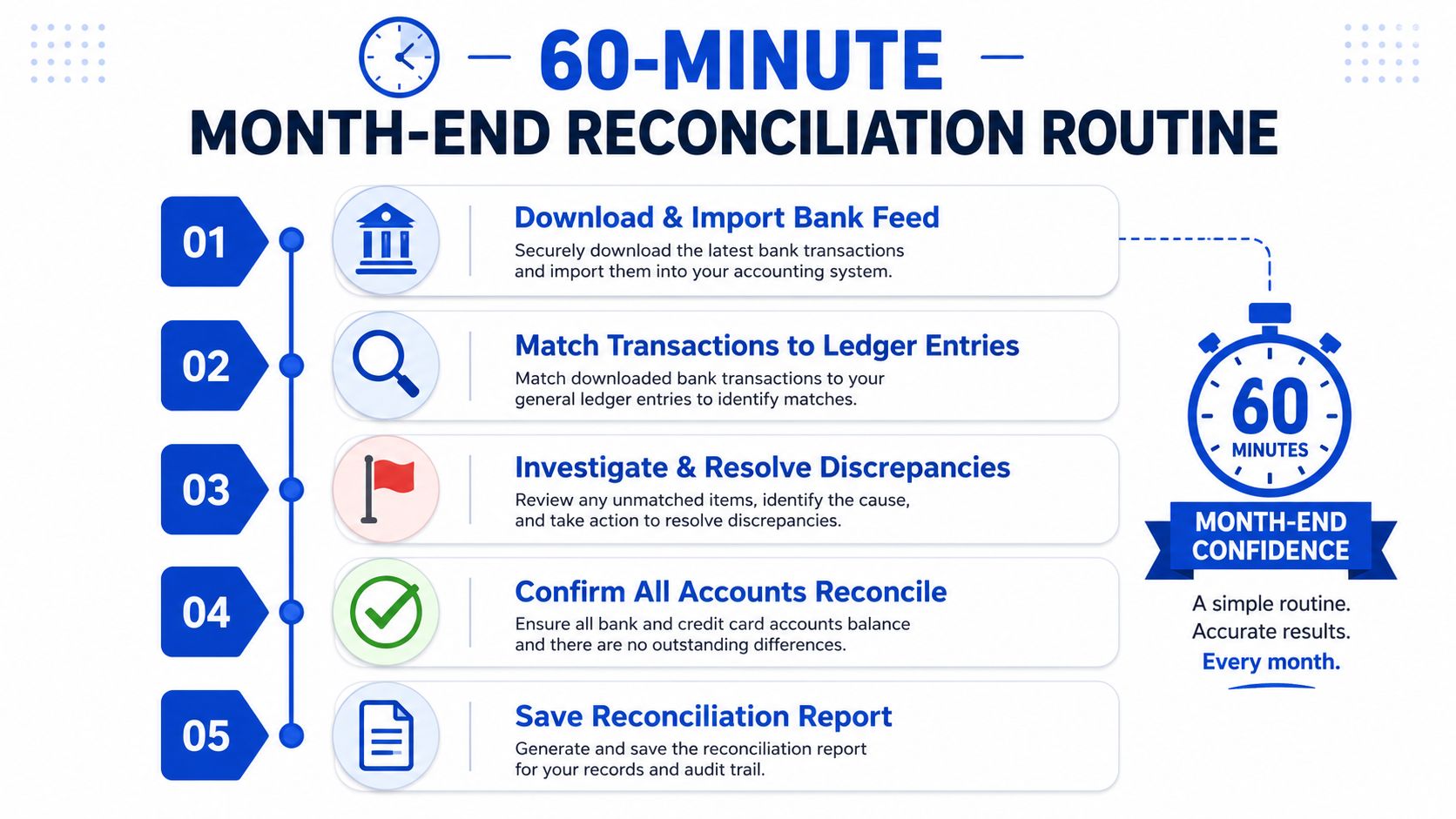
A Repeatable Month-End Reconciliation Routine
Month-end reconciliation is where you prove the ledger is right. I've seen operators spend hours fixing problems that were caused by two missed postings and one deposit recorded in the wrong account. A tighter routine catches those issues before they spread.
The monthly sequence
- Match bank feed activity to posted entries. Every deposit, payout, and bill should have a home in the ledger.
- Tie the security deposit bank balance to the deposit liability balance. Those two numbers should move together.
- Compare rent ledger totals to rental income. Collected rent should roll into the income account cleanly.
- Review accounts payable. Any unpaid vendor bill should still appear as an obligation.
- Roll the trial balance forward. That gives you a clean snapshot for the next period.
Bank reconciliation is routinely recommended as a monthly habit, because the general ledger should match the official bank statement that practice is noted in this rental accounting guide. The same source also defines the general ledger as the full record of business transactions, which is why the reconciliation is more than a cleanup exercise. It's the proof that the record is complete see the general ledger definition here.
Two checks catch problems early
One check compares economic occupancy to physical occupancy. If you're filling rooms but not collecting rent, the portfolio is leaking value somewhere in concessions, arrears, or write-offs. The other check is older but just as useful, any GL account that hasn't moved in 60 days when it should have may be stale, misclassified, or forgotten.
A security deposit bank account that doesn't match the liability balance is a red flag. So is a utilities account that stays flat while occupancy changes, or a receivables balance that grows without explanation.
For opening balances and setup questions, this opening balance guide is worth keeping nearby when you're first loading the books.
Keep the process boring. Boring books are easier to trust.
Cash Versus Accrual for Deposits, Prorations, and Prepaid Rent
The accounting method changes what the ledger says, even when the cash movement is identical. Many small operators never make that choice deliberately, then wonder why their books don't match their intuition. Cash basis and accrual basis both work, but they answer different questions.
Where the method matters most
Under cash-basis accounting, you record income when money is received and expenses when money is paid. Under accrual accounting, you record transactions when they occur, even if the cash hasn't moved yet those methods are defined in this rental ledger guide. That distinction matters for prorated move-ins, prepaid rent, and waived fees.
Security deposits stay liabilities either way until they're earned or applied. That's the one item that shouldn't change with the method, because it's not revenue on receipt as explained in the general ledger guidance. Prepaid rent is different, because cash may arrive before the service period starts.
Side-by-side treatment
Here's the practical split:
- Prorated move-in rent
- Cash basis, record when paid.
- Accrual basis, recognize the portion tied to the occupied period.
- Prepaid rent
- Cash basis, often looks like income on receipt.
- Accrual basis, part of that cash sits as deferred income until the rental period arrives.
- Waived late fees
- Cash basis, nothing is collected, so nothing is booked as revenue.
- Accrual basis, the waiver should be visible if it was once expected and later forgiven.
- Platform service charges
- Don't net them out of rent. Separate the gross income from the fee so the ledger shows true performance this separation is specifically recommended in rental accounting guidance.
If you only book net payouts, you lose visibility into both revenue and cost.
For small co-living operators filing Schedule E, cash basis often feels simpler because it follows the bank. Accrual gives a sharper operational picture, especially when you want to see earned rent and outstanding obligations more clearly. The right choice is the one the owner will use consistently across the portfolio.
Reporting Templates and Tools That Make the System Stick
A clean ledger only matters if it turns into reports people can read. The three outputs I'd prioritize are a property-level P&L, a per-room contribution view, and a rolling cash forecast. Those are the reports that tell you whether a building is healthy, which room types carry the most weight, and whether cash will cover the next round of bills.
A property-level P&L pulls from rent income, utility reimbursements, repairs, cleaning, insurance, and platform fees. A per-room view splits the same data by room number so you can see which layouts, rates, or tenant mixes create the strongest margin. A rolling cash forecast uses cash receipts, accounts payable, and upcoming owner draws to show what's likely to hit the bank next.
For template ideas, this financial reporting template guide is a useful reference point once the books are clean. The same logic works whether you're using QuickBooks Online, Stessa, Buildium, or a spreadsheet that's finally been disciplined enough to behave.
The tools that make the system stick are the boring ones:
- Bank-feed automation so transactions arrive daily instead of in batches.
- Receipt capture so repairs and supplies don't get lost in email.
- Smart-lock access logs and thermostat data so operational activity can be matched to utility patterns.
- Dynamic pricing if you're actively managing room rates and need revenue reports to keep up.
Start with the reporting stack, then layer in automation. A fancy workflow won't fix a messy chart of accounts, but a clean chart plus decent bank sync will save a lot of midnight cleanup.
If you're building this for a co-living portfolio and want the accounting, pricing, and reporting pieces to live in one place, take a look at PadPulse. It's being built for room-by-room operators who need clearer P&L visibility, better operational control, and less time spent stitching together spreadsheets.