Rental Property Rules for Co-Living Operators
October 1, 2026
The most popular advice about rental property rules is also the least useful for co-living: use a standard lease, check local law once, and let your property manager handle the rest. That approach may work for a single household renting one home. It breaks down when several residents occupy separate rooms, share kitchens and bathrooms, enter and leave on different dates, and trigger different licensing, pricing, access, and safety obligations.
For room-by-room operators, compliance isn't a document sitting in a filing cabinet. It's a live operating system. You need reliable records for every room, resident, lease event, repair, deposit, access credential, and local exemption. The business works best when those records drive consistent decisions about pricing, communication, maintenance, and occupancy.
Why Standard Landlord Advice Fails Co-Living Hosts
Traditional landlord guidance usually assumes one property, one household, and one lease. Co-living replaces that simple arrangement with separate residents, shared facilities, staggered move-ins, recurring turnover, and rules that may apply to the building, the room, or the specific occupancy model. A guide written for a single-family rental rarely tells you how to document a bathroom safety issue affecting one resident, manage room-level deposits, or distinguish a vacant room from a vacant regulated unit.
Shared housing also sits between conventional rental housing and managed lodging. An overview of co-living helps explain the operating model, but the legal classification still comes from local statutes, zoning decisions, licensing requirements, and the actual way the property is used.
The rulebook changes at the room level
A room-by-room operator may need to track:
- Unit identity: Record the room, shared spaces, building, construction details, and applicable property classification.
- Resident status: Keep the lease start, end, renewal, notice, and vacancy events for each resident.
- Compliance documents: Store licences, inspections, safety certificates, deposit records, and repair evidence where staff can retrieve them.
- Operational events: Log lock changes, maintenance access, complaints, notices, and communications with timestamps.
This isn't administrative overkill. A vacancy can change the rent treatment, licensing position, or marketing decision for a particular unit. A new resident can also change occupancy calculations or trigger a fresh disclosure obligation.
Short-term and room-by-room rules are moving toward registration, tax collection, renewals, and platform data-sharing in many jurisdictions. In the European Union, the 2026 data-sharing regime requires platforms to transmit monthly activity data per listing to national authorities, according to RedAwning's 2026 guide for property managers. The practical lesson is broader than short-term rentals: authorities increasingly expect operators to produce organized records, not just a one-time permit.
Practical rule: Treat every room as a managed record with its own status, dates, documents, and exceptions.
Why occupancy pressure creates legal pressure
High occupancy can improve revenue, but rushed move-ins create predictable failures. Operators may skip a room inspection, issue incomplete paperwork, leave old access credentials active, or accept a resident before confirming that the property can legally support the intended occupancy. Those shortcuts often cost more than an empty room would have.
A workable process separates three decisions:
- Can the property legally operate in this format?
- Can this room be occupied under the current licence and safety conditions?
- Can this applicant be onboarded with complete records and clear terms?
Standard landlord advice answers the first question, sometimes. Co-living operations require all three answers to remain current every day.
Navigating Rent Control and Stabilization Laws
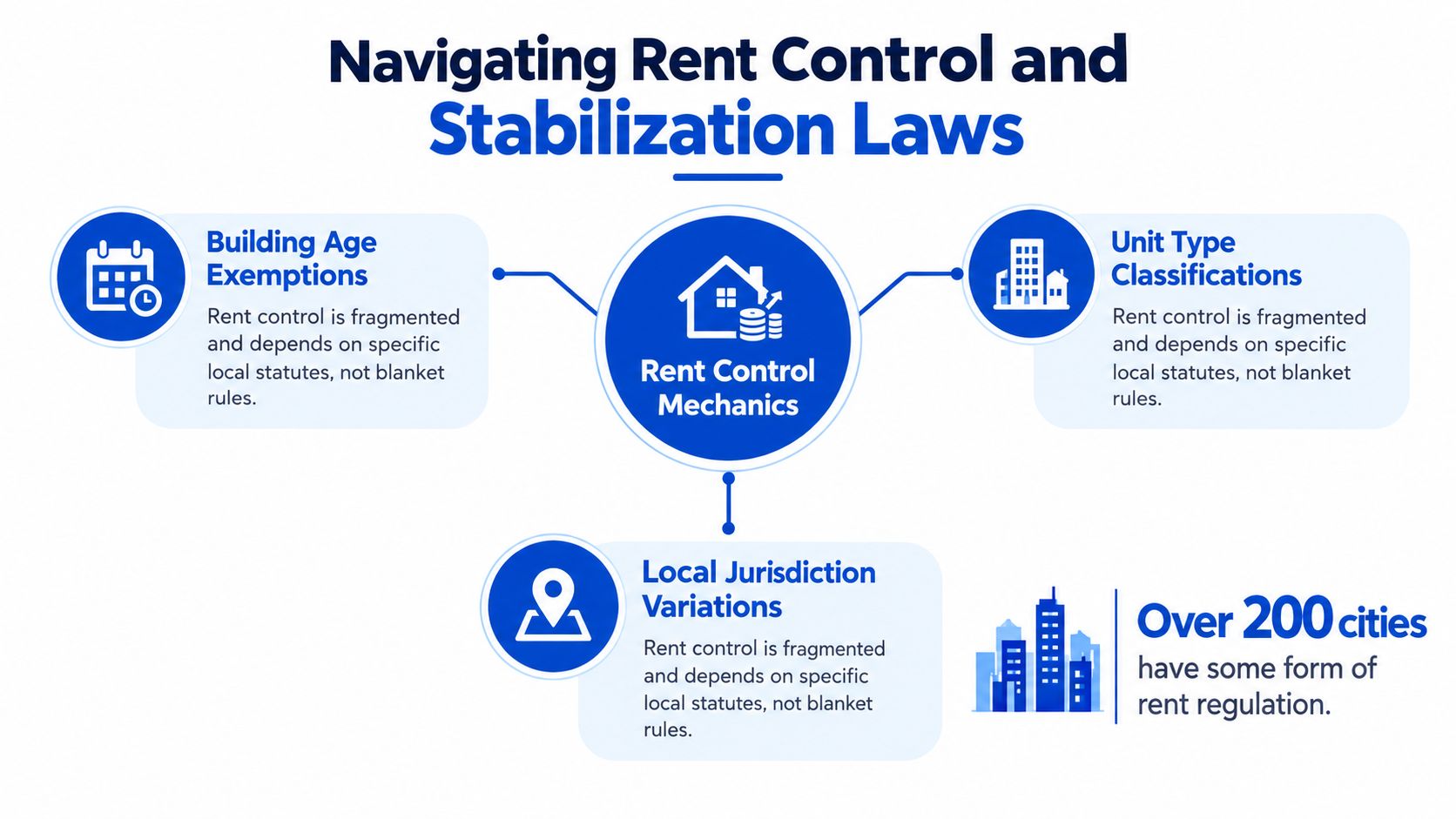
Rent control is rarely a blanket rule covering every property in a city. The applicable treatment can depend on building age, unit type, ownership structure, vacancy history, and local exemptions, which means a portfolio-level assumption can produce the wrong rent for an individual room.
A comparative dataset covering 101 countries and provinces from 1910 to 2020 found that 77% used or still use some form of rental market regulation. The research also describes major surges in restrictive rules during the first half of the 20th century, especially around the World Wars, followed after World War II by a movement in many markets from absolute freezes toward limits on annual increases. See the comparative history of rental market regulation for the historical context.
Rent stabilization changes the turnover calculation
Modern stabilization commonly combines an annual increase limit with vacancy decontrol. Under that structure, a landlord may reset rent to market when a tenant leaves, while the unit becomes regulated again under local rules when it is reoccupied. The precise result depends on the jurisdiction, so operators should never treat vacancy decontrol as a universal permission to reprice without review.
The operating trade-off is clear. A vacancy may create pricing flexibility, but a long vacancy also delays revenue and can complicate the compliance record. Renewal timing, notice delivery, inspection evidence, and the exact date of the vacancy all matter. In a shared home, separate room turnover makes this harder because one room can be vacant while the rest of the property remains occupied.
The OECD rental regulation indicator reports rent control on initial rent levels in 13 countries and regulation of rent increases over time in 23 countries. A broader OECD housing affordability report identified controls on initial rents and/or increases in 24 countries. The categories aren't interchangeable, which is precisely why operators need jurisdiction-specific records.
Build a unit-level rent control register
For each room or legally relevant unit, record:
- Construction year and building type: These details may determine whether a local exemption applies.
- Unit classification: Note whether the space is treated as a dwelling unit, room, accessory space, or another category.
- Regulatory status: Label the unit as controlled, stabilized, exempt, or requiring legal review.
- Vacancy history: Record when the previous tenancy ended, how notice was delivered, and when the room became available.
- Lease cycle: Store the current rent, permitted increase process, renewal date, and supporting notices.
New York illustrates the complexity. The Urban Institute analysis of rent control describes first-generation rent control for units in buildings built before February 1947, with some units subject to annual increases up to 7.5% subject to a ceiling rent. It also notes that certain buildings with six or more units can transition from control to stabilization on vacancy, while smaller buildings can become unregulated. California's framework, as described in the same research, exempts units built after 1995 and single-family homes and condominiums, while vacancy decontrol resets pricing when a tenant moves out.
These examples aren't templates for another city. They're a warning against using one spreadsheet field called “rent controlled” for an entire portfolio.
For lease structure and state-specific terms, operators can also review a Maryland tenant lease agreement guide. Use it as an operational reference, then confirm the current local requirements before publishing rents or issuing renewal paperwork.
Shared Housing and Occupancy Compliance Standards
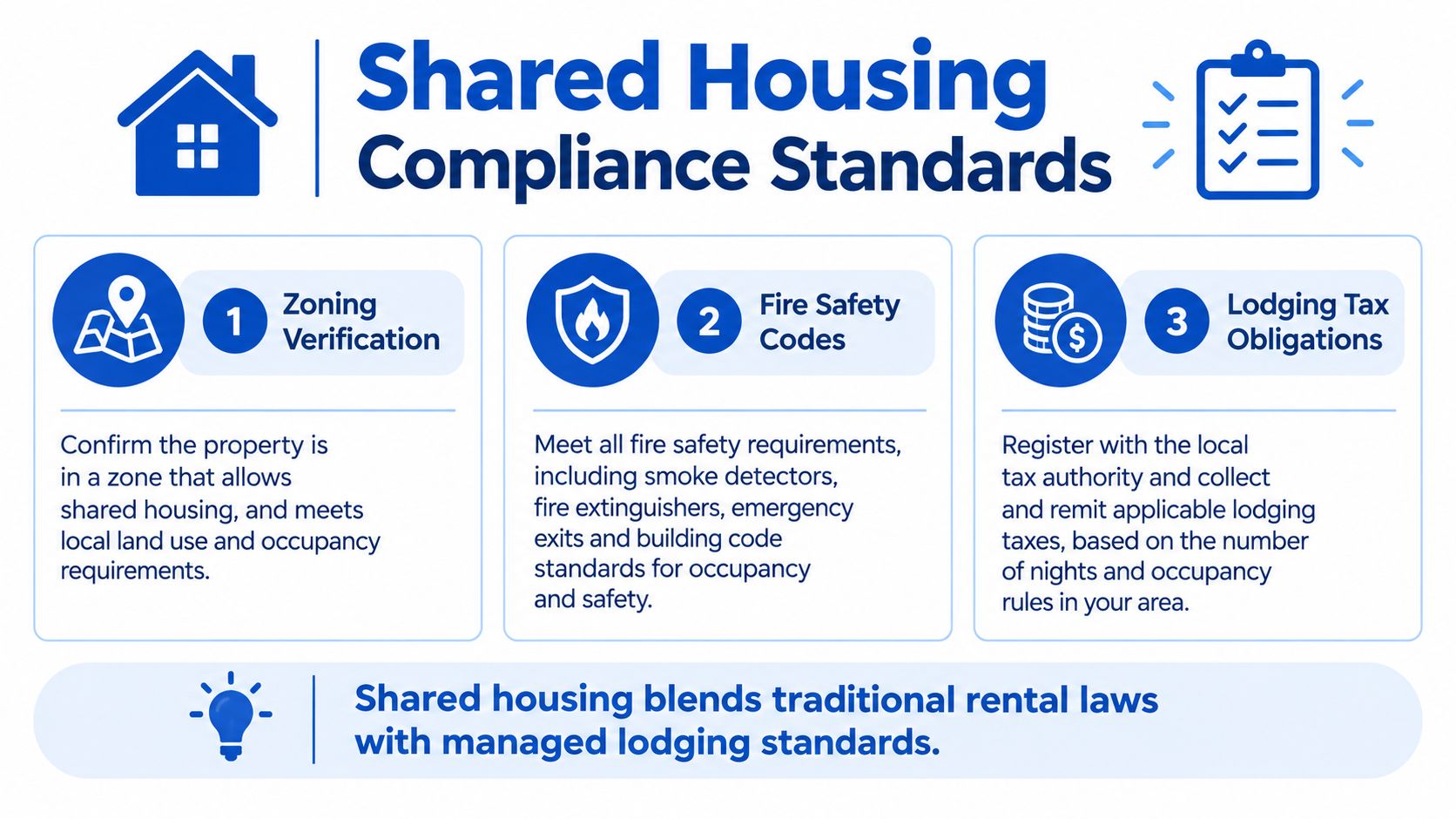
A shared house can be legally treated like rental housing for one purpose and managed lodging for another. That hybrid status affects zoning, licensing, room dimensions, fire protection, sanitation, security, and sometimes tax treatment. A normal lease doesn't cure an occupancy violation, and a full house inspection doesn't prove that every resident has the correct paperwork.
Research comparing shared-tenancy frameworks identifies recurring requirements around licensing or registration, minimum room size, overcrowding, fire safety, environmental hygiene, and security. Some jurisdictions also require separate legally binding leases for each resident and adequate space and security. The Shared Housing Institute's compilation of rules and regulations is useful background, but local authorities control the final answer.
Start with the physical property
Before accepting residents, verify the property against the rules that apply to its actual use. Don't rely on a listing description or a previous owner's assumption that the home is approved.
Check:
- Zoning and licensing: Confirm that room-by-room occupancy is permitted and identify any registration, inspection, or licence renewal duties.
- Room suitability: Measure bedrooms and document windows, exits, ventilation, locks, and usable floor area where local rules require them.
- Fire safety: Confirm alarms, escape routes, fire separation, extinguishers, emergency lighting, and inspection records according to local standards.
- Environmental hygiene: Address damp, mould, pests, waste storage, water issues, and shared-space cleaning before they become resident disputes.
- Occupancy limits: Match the number of residents to the approved capacity, not just the number of beds you can physically place in the building.
Decide how residents will contract
Separate leases often make the operational relationship clearer. Each resident can have an agreement for a named room, access to defined shared spaces, a rent obligation, a deposit record, and specific responsibilities for conduct and damage. That structure may reduce confusion over one person's arrears or departure, but it doesn't remove the need to check whether local law permits the arrangement.
Utilities deserve the same discipline. State whether rent includes utilities, whether an allowance applies, how excess use is calculated, and which records support any charge. Avoid informal “we'll split it fairly” language. Residents need a method they can understand before they sign.
Voucher or public-assistance occupancy adds another review layer. Confirm the program's unit standards, inspection process, documentation requirements, and payment rules before advertising a room as eligible. A property can satisfy ordinary landlord requirements and still fail a program-specific standard.
Access control best practices should be part of the same checklist. A resident needs reliable access to their room and permitted shared spaces, while former residents, contractors, and emergency contacts need carefully limited credentials.
Crafting Clear House Rules and Lease Clauses
A lease establishes the legal relationship. House rules make that relationship workable at 7 a.m. in a shared kitchen, after a late-night guest arrives, or when one resident leaves dishes in a common sink. The strongest documents connect each rule to a clear responsibility, a reasonable process, and a defined consequence.
Use individual room agreements where appropriate, then attach the house rules as a signed addendum. Identify the room, shared areas, included services, payment terms, notice process, access arrangements, maintenance reporting, and prohibited conduct. Don't hide important obligations in a general handbook residents may never read.
Write rules that can be observed
A vague rule such as “keep the home clean” invites arguments. A usable clause explains what residents must do and how the operator will manage a failure.
Examples:
- Shared kitchen: “Residents must remove personal food, cookware, and waste from shared counters after use. The operator may issue a written notice when an item obstructs cleaning or creates a hygiene concern.”
- Bathrooms: “Residents must leave shared bathrooms reasonably clean after use and must report leaks, blockages, or loss of hot water through the designated maintenance channel.”
- Noise: “Residents must keep music, calls, and gatherings at a level that does not materially disturb others, with additional quiet periods stated in the house rules.”
- Guests: “Guests may use only the areas permitted by the resident's agreement. The resident remains responsible for guest conduct, damage, and compliance with occupancy limits.”
- Alterations: “Residents may not change locks, install equipment, paint, or modify fixtures without written approval.”
The language should be specific without becoming hostile. Residents are more likely to follow rules they can understand and predict.
Separate conduct from enforcement
A house rule should not promise an outcome the lease or local law doesn't allow. Avoid automatic penalties for every complaint, broad rights to enter, or language that treats a disagreement as a lease breach. State how the operator will document an issue, give notice where required, allow a response, and escalate serious or repeated problems under the governing agreement.
The best house rule is one your team can enforce consistently, explain calmly, and prove from its records.
Keep a version-controlled copy of the lease and rules for every resident. When a rule changes, record the effective date, the notice delivered, and the resident's acknowledgement where required. This prevents a common dispute: the operator enforcing a policy that the resident never received or that was changed after signing.
Enforcing Rules with Smart Home Automation
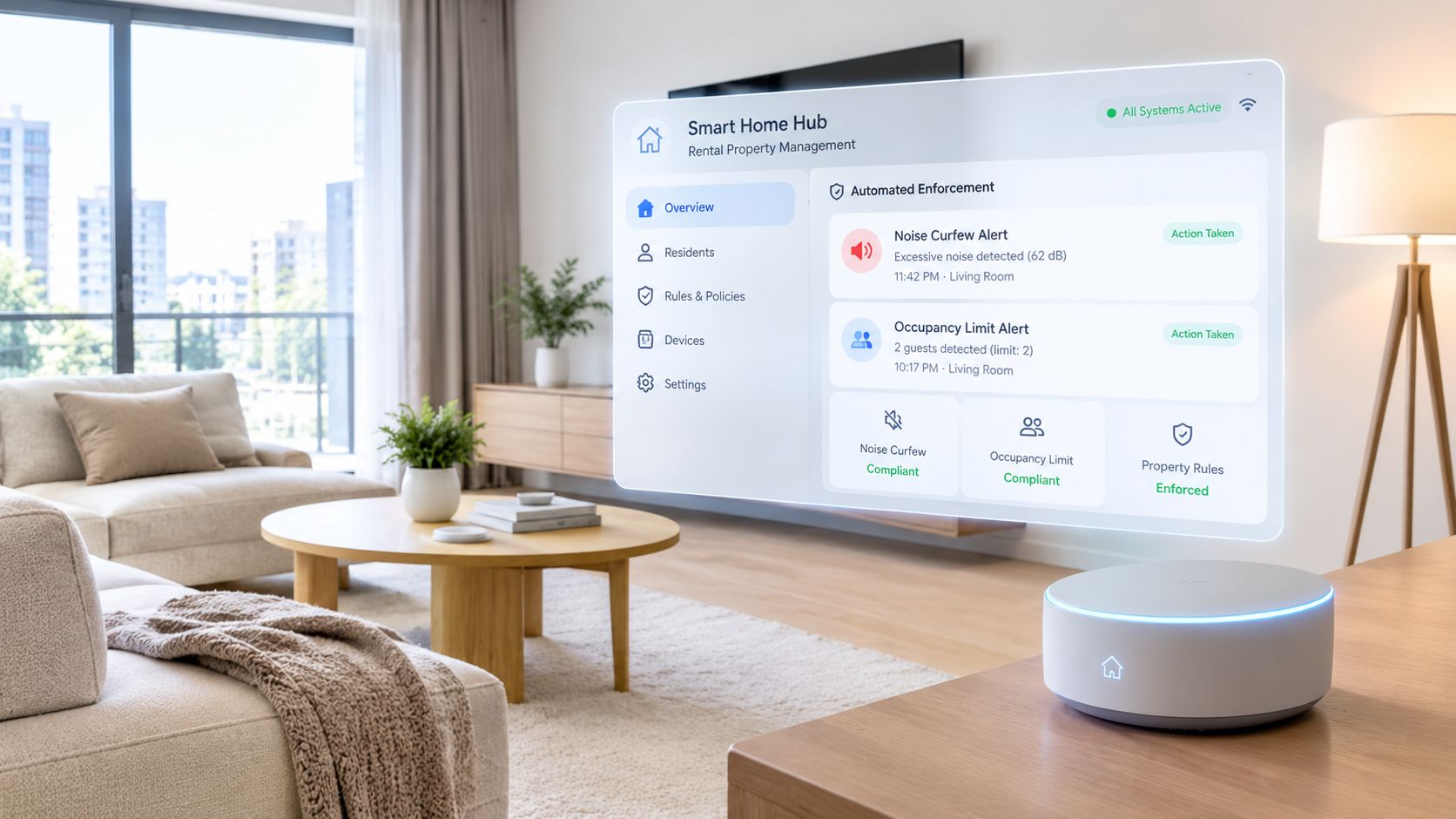
Manual enforcement makes the operator the building's permanent hall monitor. A better system uses technology for repeatable tasks, while reserving human judgment for complaints, emergencies, reasonable accommodations, and legal notices.
Keyless locks are useful when access follows a documented lifecycle. Create credentials after onboarding is complete, limit them to the correct room and shared areas, and schedule their activation and expiry around the lease record. A lock system can also support a controlled response to lockouts or a lawful possession change without replacing physical hardware, but it must never be used to bypass notice, court, or tenant-protection requirements.
Automate the routine, not the judgment
A practical workflow can connect the lease record, messaging system, and device controls:
- Move-in trigger: Send access instructions, house rules, emergency contacts, and utility guidance when the resident's onboarding status is complete.
- Reminder trigger: Deliver a neutral message about a scheduled inspection, cleaning obligation, noise concern, or maintenance visit.
- Status change: Suspend or update credentials only when the underlying lease and legal process authorize the change.
- Audit record: Save the message, timestamp, recipient, and related room record.
Smart thermostats can help manage HVAC in common areas by applying agreed temperature policies, schedules, and alerts. They shouldn't be used to create unsafe conditions or override a resident's legally protected needs. Explain the policy before move-in and provide a channel for reporting discomfort or equipment failure.
Protect privacy while collecting evidence
Occupancy sensors, noise monitors, locks, and thermostats can generate sensitive information. Tell residents what each device measures, why it is installed, who can access the data, and how long records are retained. Avoid recording private conversations or using technology as a substitute for a fair complaint process.
Automation works when the resident experiences it as predictable service, not surveillance. Send reminders before a breach becomes a confrontation, give people a way to report faults, and review alerts before taking action. The operator remains accountable even when software starts the workflow.
Financial Rules for Deposits and Depreciation
Security deposits and depreciation affect different sides of the business. Deposits are resident funds subject to local handling and return rules. Depreciation is a tax deduction based on the property's depreciable basis. Confusing the two can create both cash-management problems and inaccurate tax records.
Deposit limits vary by jurisdiction. California's rule changed on July 1, 2024, while Virginia uses a different statewide ceiling. The comparison below shows why a standard “one month” or “two months” policy is unsafe across a multi-state portfolio.
Security Deposit Limits by Jurisdiction
| Jurisdiction | Maximum Deposit Limit | Key Exceptions |
|---|---|---|
| California | One month's rent | A small landlord who owns no more than two residential rental properties totaling no more than four dwelling units may qualify for an exception allowing up to two months' rent. The rule applies whether the unit is furnished or unfurnished. See the Los Angeles County security deposit guidance. |
| Virginia | Two months' periodic rent | The statewide ceiling is set by Virginia Code Section 55.1-1226. |
For a room-by-room business, store the deposit amount, date received, resident, room, payment method, required notices, deductions, inspection evidence, and return date. Don't rely on a single property-level deposit balance when residents have separate agreements. A room transfer or replacement resident should generate a fresh review rather than an informal adjustment.
Depreciate the building, not the land
The IRS generally treats U.S. residential rental property as depreciable under MACRS over 27.5 years, with the deduction beginning when the property is placed in service for income production. The IRS guidance in Publication 527 states that only the building portion is depreciable, not the land, and that depreciation stops when the full basis is recovered or the property is retired from service.
That distinction matters when a co-living operator buys a house and equips it for room rentals. The purchase basis must be allocated between land and building, and eligible improvements or equipment may require separate tax treatment. Keep closing documents, allocation support, improvement invoices, placed-in-service dates, and depreciation schedules together.
A tax professional should review the allocation and any room-specific improvements. The operational goal isn't to invent a larger deduction. It's to preserve a clear audit trail showing how the claimed basis and service dates were determined.
Building a Scalable Compliance Workflow
Spreadsheets fail when the business needs to connect one event to several consequences. A resident's move-out can affect rent treatment, vacancy marketing, access credentials, cleaning, deposit accounting, and the next lease. Those tasks should share a room record rather than live in disconnected email threads.
A scalable workflow starts with a single source of truth for each property and room. At minimum, capture:
- Regulatory data: Jurisdiction, licence status, occupancy limit, unit classification, exemptions, inspection dates, and renewal deadlines.
- Resident data: Lease terms, notices, deposits, contact preferences, access status, and required documents.
- Financial data: Advertised rent, approved rent, utilities, collections, deposits, repairs, and property-level reporting.
- Operational data: Maintenance tickets, cleaning schedules, complaints, communications, and device events.
- Change history: Who changed a record, when they changed it, and what evidence supports the decision.
Use alerts for deadlines and exceptions
A rules engine can flag a licence nearing renewal, a room missing an inspection record, an access credential that should expire, or a rent change requiring review. It can also trigger messages for move-in instructions, maintenance updates, and policy reminders. The system should escalate uncertainty to a person instead of silently applying a risky default.
PadPulse is an in-development management platform for PadSplit hosts and co-living operators that is planned to combine dynamic room pricing, AI-assisted messaging workflows, smart-lock and thermostat integrations, P&L tracking, portfolio analytics, and market intelligence in one dashboard. Its planned rules system includes event-based messages and occupancy-based repricing rules, which can adjust room rates based on occupancy and end-of-month demand. Availability and features may change before the planned Winter 2026 launch.
Audit the portfolio before expanding
Start with one property and test the workflow against real records. Reconcile every room's legal status, lease, deposit, access credential, safety document, and current occupancy. Then review where staff still rely on memory or manual copying.
The strongest operators don't choose between strict compliance and high occupancy. They design processes that make the compliant action the easiest action. That means no advertising before the room is cleared, no access before onboarding is complete, no price change without a regulatory check, and no resident dispute handled without a written record.
A dynamic regulatory environment will continue to reward organized operators. Build the data structure now, review local rules before each material change, and ask qualified legal and tax professionals to confirm issues your workflow can't resolve.
PadPulse is being built to centralize room pricing, resident messaging, access control, and portfolio reporting for co-living operators managing these moving parts. Join the early interest list through PadPulse to receive launch updates and potential beta access, with no billing required before launch.