Maryland Tenant Lease Agreement: A Co-Living Guide
July 5, 2026
You've got a house in Baltimore or Prince George's County, you want to rent rooms individually, and the lease sitting on your laptop looks close enough. It has rent, deposit, guests, and signatures. That feels like progress until you notice it treats the whole property like one unit, says nothing useful about shared kitchens, and doesn't reflect Maryland's newer tenant rules.
That's where many room-by-room operators get exposed.
A strong Maryland tenant lease agreement for co-living isn't just a standard lease with the word “bedroom” swapped in. It has to fit Maryland law and the daily reality of unrelated adults sharing bathrooms, storage, entrances, and common areas. If the document is vague, the house starts running on text messages, side deals, and arguments. That's when late-night guest problems, utility disputes, and move-out conflicts become expensive.
Why a Generic Lease Fails in Maryland Co-Living
A new operator usually starts the same way. They find a generic residential lease, add “Room 3” to the property description, paste in some house rules, and assume they're covered. In a single-family rental with one household, that shortcut might limp along for a while. In co-living, it breaks fast.
I've seen the pattern repeatedly in room-by-room setups. One tenant thinks they've rented a private room plus one parking space. Another believes the living room can be used for overnight guests. A third assumes utilities are split evenly, even though the lease never explains the method. None of those issues feels dramatic on move-in day. They become serious once people are living on top of each other.
Shared houses need more than a standard unit lease
A generic lease usually misses the basic architecture of co-living:
- Private space definitions: It often doesn't clearly separate the tenant's bedroom from shared kitchens, hallways, laundry areas, and outdoor space.
- Operational rules: It may mention “quiet enjoyment” but not cleaning schedules, storage limits, bathroom use expectations, or guest boundaries.
- Room turnover realities: In a shared home, one room may turn while the rest of the house stays occupied. A generic lease rarely handles that well.
- Utility disclosures: If you use any allocation system, your lease has to say so clearly and consistently.
Practical rule: If a lease leaves room for two reasonable interpretations, house conflict usually fills the gap.
That matters even more in Maryland because compliance is not optional. Lease terms that clash with state rules can become hard to enforce, and informal practices that seem efficient can create avoidable disputes.
The Baltimore example most landlords recognize
Take a rowhouse in Baltimore rented by the room. The landlord uses one lease template for all residents. It says the “premises” are the property address, but it doesn't identify the specific bedroom. It includes a deposit clause copied from an older form. It has a late fee paragraph, but no useful language for shared common areas or individual responsibility for damage to a furnished bedroom.
Then one tenant moves out, another complains about a roommate's partner staying over, and a third disputes a cleaning charge. The landlord now has three problems:
- The lease didn't define each occupant's exclusive-use area.
- The house rules weren't integrated into the lease in a way that makes enforcement cleaner.
- The financial language may be outdated for Maryland.
A proper Maryland tenant lease agreement fixes those issues before move-in. It turns daily operations into written expectations. That's what works. What doesn't work is trying to manage a shared house through goodwill alone.
Maryland's Mandatory Lease Foundations
A Maryland room-rental lease fails fast when the legal basics are loose. In a shared house, one unclear clause can turn into three separate arguments. One tenant disputes a charge, another challenges a guest rule, and a third says the lease never identified what space was rented.
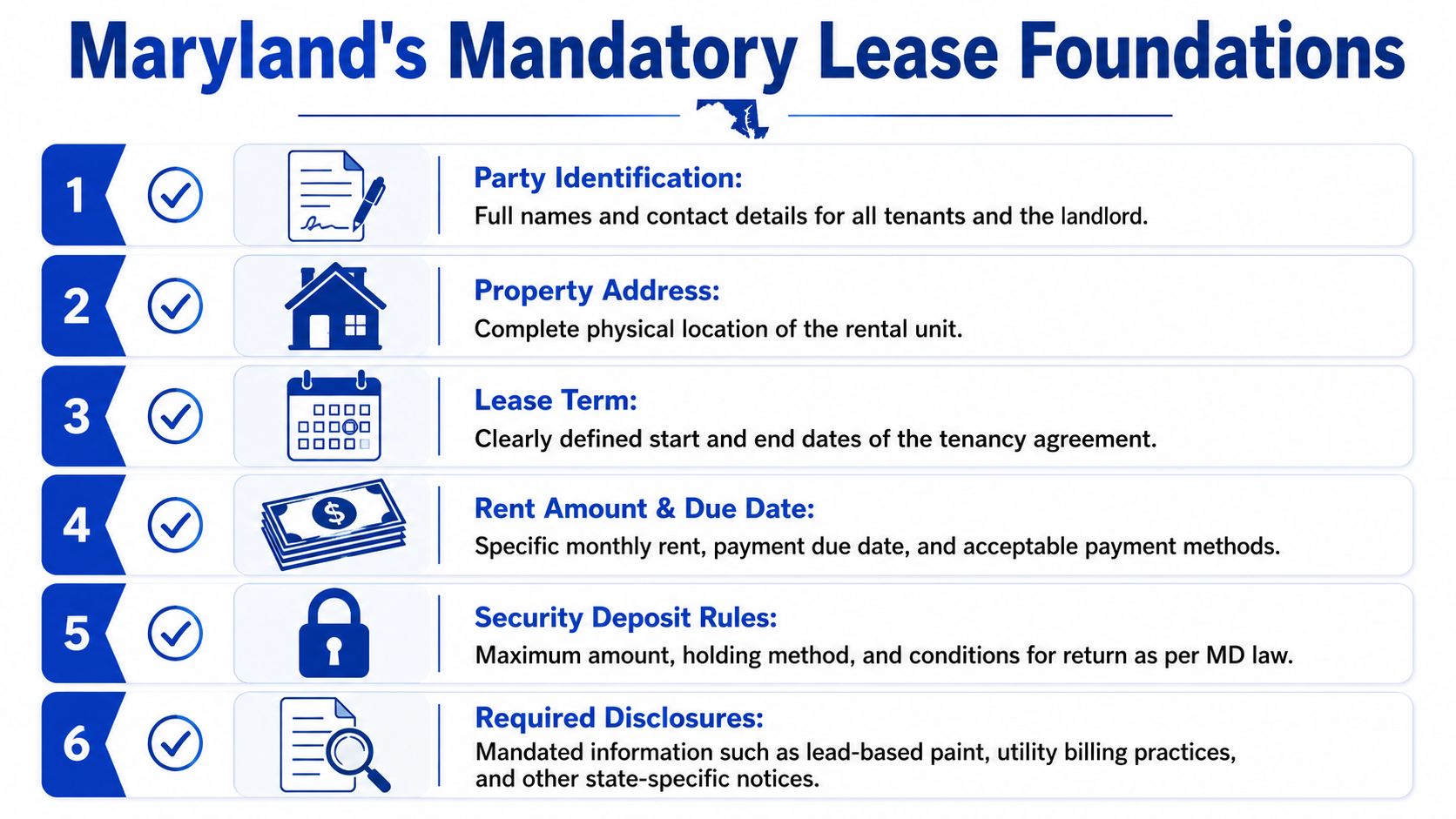
Maryland law sets the floor. For co-living operators, the job is to meet that floor in a way that still works room by room. A lease should hold up as a legal document and also reflect how the house runs.
The foundation is straightforward, but the drafting has to be precise:
- Identify the parties clearly: Use full legal names for the landlord and each tenant. In room-by-room rentals, match each person to the actual room they occupy.
- Describe the rented space accurately: List the property address, then identify the specific bedroom or exclusive-use area. Separate that from the tenant's right to use shared spaces such as the kitchen, living room, laundry area, or yard.
- State the payment terms in plain language: Rent amount, due date, accepted payment methods, and any fee terms should be easy to read and hard to misread.
- Draft the security deposit clause to match Maryland rules: This is one of the first places older templates break down.
- Include required disclosures: If your property uses utility allocation, lead-based paint disclosures, or other required notices, put them in the lease package in a form you can prove was delivered.
- Use a written lease when Maryland requires one: People's Law on Maryland leases explains that landlords with five or more rental units must use written residential leases, and written leases are also required for terms longer than one year.
For shared housing, the property description matters more than many landlords expect. If the lease says the tenant rented "the premises" at the full street address, that can blur the line between private space and common area. A stronger lease names Bedroom 2, basement rear room, or another clear designation, then grants non-exclusive access to defined common areas. That single change resolves a lot of avoidable conflict.
Maryland operators also need to update their lease packets for the state's newer disclosure requirements. This summary of Maryland's July 1, 2025 lease requirement explains that new leases and renewals must include the Maryland Tenants' Bill of Rights. If your process still sends only the signature pages and the base lease, it needs work.
I also see confusion on habitability and management structure. If you operate multiple homes, or manage units for other owners, your lease paperwork and your business model need to line up. This guide on whether a Maryland property management license may apply to your setup is worth reviewing before you scale.
A few mistakes show up repeatedly in Maryland co-living leases:
| Issue | Why it causes trouble in co-living |
|---|---|
| Bedroom not identified | The tenant can argue they rented more than the operator intended |
| Common-area access not defined | House rules become harder to enforce consistently |
| Deposit clause copied from an old template | Charges and return procedures become easier to challenge |
| Required disclosures missing from the lease packet | Enforcement gets harder and compliance risk goes up |
The best Maryland leases read clearly to everyone involved. Tenant. Manager. Judge. In room-by-room housing, that level of clarity is what keeps a legal requirement from turning into an operating problem.
Customizing for Room-by-Room Rentals
A Maryland lease for a shared house fails fast if it reads like a standard single-family rental. The problem shows up on ordinary days, not edge cases. One resident stores boxes in the hallway, another starts treating the living room like a second bedroom, and a third insists their boyfriend is “just visiting” even though he has stayed four nights a week for a month. If the lease does not sort out private space, shared space, and occupancy limits, the operator ends up making policy on the fly.
That is why room-by-room leasing needs its own drafting logic.
Individual leases versus one joint lease
For most pad-style homes, individual leases fit the operation better. Each resident rents a defined bedroom, pays their own rent, and can move out without forcing a full-house reset. That matters in Maryland co-living because turnover rarely happens all at once.
A joint lease still has its place. If a pre-formed group applies together and wants to share responsibility for the entire property, one lease can work. In practice, though, joint leases create friction in room-by-room housing. One missed payment becomes everybody's problem. One roommate departure can trigger arguments about replacement tenants, rent splits, and who has authority to approve a new occupant.
A practical rule is simple:
- Use individual room leases when residents apply separately, rooms are marketed separately, and renewals happen on different timelines.
- Use a joint lease when the household is functioning as one tenant group from the start.
Operators comparing models in more detail can review this guide to rent-by-the-room leasing.
Define private rights and common-area rights clearly
The lease should identify the exact bedroom the resident is renting. Use a room number, floor-plan label, or another description that cannot be confused later. “Upstairs bedroom” is not enough in a five-bedroom house.
Then spell out the resident's right to use shared areas. Kitchens, bathrooms, living rooms, laundry rooms, yards, and hallways should be described as shared, non-exclusive spaces subject to house rules and reasonable management policies. That wording does real work. It gives the resident clear access rights while preserving your ability to address clutter, misuse, safety issues, and disputes over storage.
Restricted areas need the same clarity. Owner closets, supply rooms, utility rooms, and any locked storage should be listed as off-limits. If parking or storage is assigned, say whether it is exclusive or shared.
In co-living, vague space language turns into weekly arguments.
House rules should be part of the lease file
A welcome email is not enough. House rules should be attached as an addendum and signed with the lease packet.
The best addenda cover the pressure points that disrupt shared housing:
- Guests and occupancy limits: define overnight guest limits and when a guest becomes an unauthorized occupant
- Cleaning standards: explain whether residents clean after themselves, rotate chores, or receive scheduled cleaning in common areas
- Quiet hours and noise expectations: useful in homes with remote workers, students, and night-shift residents
- Kitchen and storage use: assign cabinet, fridge, freezer, or pantry space if the home operates that way
- Safety and prohibited conduct: address smoking, lock changes, tampering with detectors, obstruction of exits, and sleeping in common areas
A good operator wants flexibility. A good lease also needs enforceability. Signed rules give you both, if the language is specific enough to apply consistently.
Utility clauses need an actual billing method
Utility disputes are common in shared houses because usage is personal and the bill is collective. The lease has to remove guesswork.
If utilities are included in rent, say so plainly and note any limits that apply, such as extra charges for unusually high usage if your model allows that and the clause is drafted clearly. If utilities are billed separately, identify the method. Do not write “split fairly” or “shared among tenants.” Those phrases sound friendly and perform poorly in a dispute.
If you use a ratio utility billing method, explain how charges are allocated, when residents are billed, and where they can raise billing questions. If utilities are placed in one resident's name, which I generally avoid in co-living, the lease should still state whether that resident is collecting reimbursement and what happens if service is interrupted.
Smaller shared properties need sale-related language checked carefully
Operators of smaller Maryland properties should review lease language around a future sale. A room-by-room house may still sit inside a property type where tenant sale rights matter, and a generic lease often ignores that issue entirely.
The practical mistake is trying to solve it with broad waiver language. That approach can create more trouble, not less. A better lease acknowledges that any rights required by law will apply and reserves the landlord's ability to follow the required process if the property is marketed or sold.
This comes up more often than newer operators expect. A resident may rent only one bedroom, but that does not mean the property is treated like a simple bedroom license for every legal purpose. In shared housing, the structure of the deal and the structure of the building both matter.
Handling Money Matters Correctly
Money clauses create more landlord trouble than almost anything else because they're easy to copy from an old form and hard to fix after move-in. In Maryland, your financial terms need to match current rules, and in room-by-room rentals that means each room's lease should stand on its own.
A deposit clause from a prior year can be enough to create a compliance problem. So can a vague fee paragraph that says “reasonable late charge.”
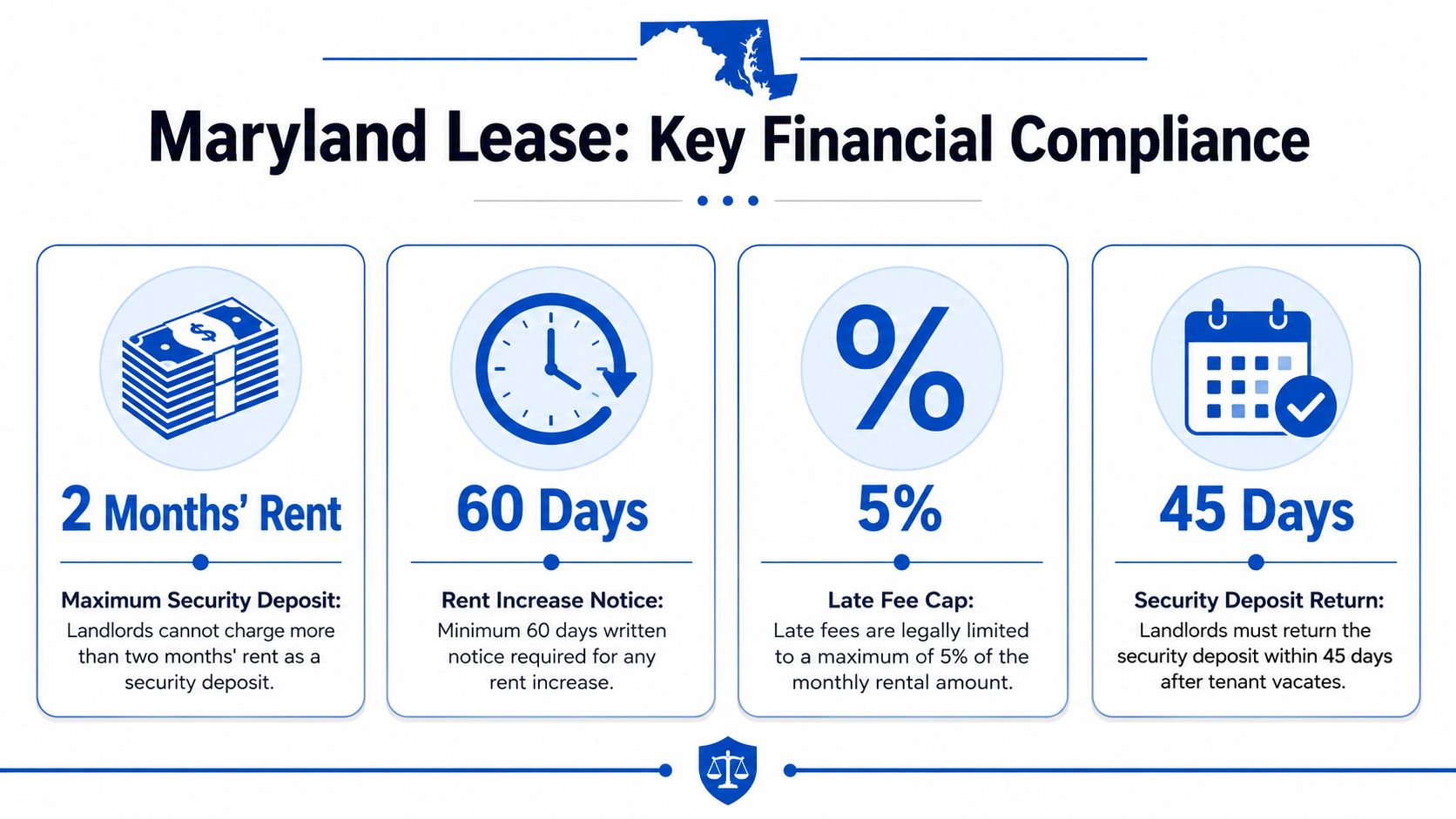
Early in this section, keep this quick visual in mind:
Security deposits need updated language
The biggest issue is the maximum deposit.
As of October 1, 2024, landlords in Maryland are legally prohibited from charging a security deposit exceeding one month's rent for most residential tenancies and must hold these deposits in a separate escrow account, according to Steadily's Maryland lease law summary.
That means your lease should say all of the following in substance:
- the deposit amount
- that it will be held as required
- the conditions under which deductions may be made
- how and when it will be returned
If your template still says “two months' rent,” stop using it for covered tenancies.
Return timing, receipts, and interest
Maryland's deposit rules are procedural, not just numerical. Under the Maryland rules summarized by FormSwift's Maryland month-to-month lease page, landlords must return the full deposit within 45 days after move-out, provide an itemized list for any deductions, and for tenancies beginning on or after January 1, 2015, pay interest on the deposit at 1.5 percent per year or the daily U.S. Treasury yield curve rate, whichever is higher.
Steadily's Maryland summary also notes that landlords must provide a written receipt detailing the amount received, landlord contact information, and terms for withholding funds for damages or unpaid rent in connection with the deposit process in Maryland, along with the return requirement and accrued interest under its summary of current law.
In practice, operators get into trouble when they treat the deposit as a floating reserve fund. Don't. Keep the accounting clean and the paperwork consistent.
Here's a useful way to consider this:
| Lease item | What your document should do |
|---|---|
| Deposit amount | State the exact amount for that room lease |
| Holding method | Confirm the deposit is handled as required under Maryland rules |
| Deductions | Limit them to lawful categories and promise an itemized statement |
| Return process | State the timeline and move-out mailing or delivery procedure |
Late fees must be capped
Maryland allows late fees, but not open-ended ones.
Under eForms' Maryland rental law summary, the maximum late rent fee is 5% of the monthly rent amount under MD Code, Real Property § 8-208(d)(3). For weekly rentals, the penalty cannot exceed $3 per week or $12 per month, and there is no state-mandated grace period for late payments.
That means a room-rental operator should avoid clauses like:
- “late fee at landlord's discretion”
- “administrative fee plus late charge”
- “daily penalties” without checking legal support
If rent is due on a certain date, write the due date clearly, define the payment method, and cap the late fee in the lease according to Maryland law.
The video below gives broader context on lease and landlord issues in Maryland.
For operators collecting room rents digitally, ACH setups can reduce payment confusion and create cleaner records. This guide on how tenants can pay rent with ACH is useful if you're tightening your collection process.
Watch for this mistake: A lease can be detailed everywhere else and still fail on the money page because the deposit cap or late fee language is outdated.
Maintenance Eviction and Lease Termination
At 9 p.m., the only shower in a four-bedroom house starts leaking through the ceiling below. One resident wants it fixed immediately. Another refuses entry to their room because they were not warned. A third is already late on rent and says they are moving out next week. That is a normal co-living problem in Maryland, and a generic lease usually does not give clear instructions for handling it.
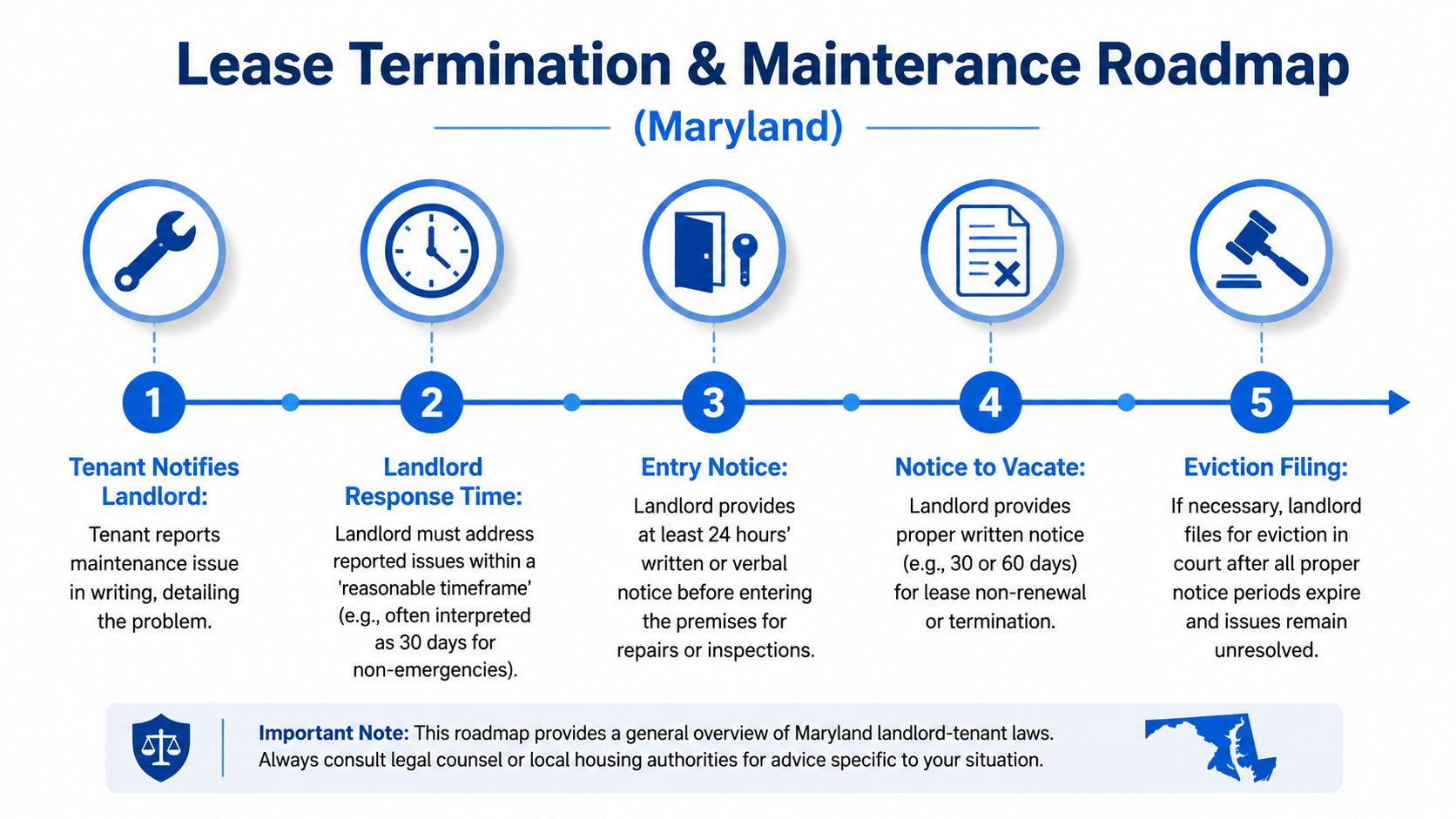
A workable Maryland room-rental lease needs three separate systems here: maintenance reporting, room access, and lawful termination. If those rules blur together, operators make avoidable mistakes. The usual ones are informal repair requests, undocumented entry, and pressure tactics that look like self-help eviction.
Maintenance clauses should separate private and shared responsibility
In a shared house, maintenance duties need to be assigned by area, not in broad landlord-versus-tenant language. Private rooms, bathrooms used by only one resident, and common spaces create different risks and different arguments.
A lease should spell out:
- Tenant duties inside the room: keep the room reasonably clean, replace consumables if that is part of the arrangement, report damage promptly, and avoid conduct that causes preventable repairs
- Landlord duties for the property: maintain major systems, structural components, appliances you provide, and common areas in rentable condition
- How requests must be submitted: require written notice for routine issues and define what counts as an emergency
- Access expectations tied to the request: if a resident reports a repair affecting their room, the lease should say that reasonable access is required to complete it
This matters more in room-by-room rentals than in a standard single-family lease. If two residents use the same bathroom and one keeps it clean while the other blocks the drain with wipes, broad lease language does not help much. A room-rental lease should give you a way to document the problem, assign responsibility, and fix the issue before the whole house is affected.
Entry rules should be specific enough to use in real life
Shared housing creates more entry events. Repairs in one room can affect another. Showings often happen while other residents still live in the house. Common-area inspections are routine, but private bedrooms still need separate handling.
Maryland has expanded tenant protections around entry, so operators should write notice procedures carefully and keep their forms current. In practice, that means the lease should answer four questions clearly: why entry is allowed, how notice is delivered, when entry can happen, and what qualifies as an emergency.
Write the clause in operational terms. List acceptable delivery methods for notice. State who can enter, such as the owner, manager, licensed contractor, or emergency personnel. Separate scheduled entry from emergency entry. Residents are much less likely to fight access when the lease reads like an actual procedure instead of a vague reservation of rights.
Termination has to match the tenancy structure
Termination gets trickier in co-living because each room may have its own term, rent ledger, and violation history. Treating the whole house as one file creates confusion fast.
If one resident stops paying, the other residents do not lose their tenancy because of that default. If one resident gives notice, that does not end the leases for the rest of the house. Your lease and your records should reflect that each room is administered on its own track, even when the property shares utilities, common furniture, and house rules.
For periodic tenancies, notice periods still matter. TurboTenant's Maryland lease summary states that landlords must give 60 days' written notice to terminate a month-to-month lease or decline renewal, while tenants may end a month-to-month tenancy with 30 days' notice. In practice, that means operators often have less time to refill a room than they would prefer, so renewal review needs to start early.
Nonpayment and eviction require discipline
Maryland does not give room-rental operators a shortcut because the tenant rents only one bedroom. If the resident does not pay, use the court process and keep the file clean.
The lease should support that process by identifying the exact tenant, the exact room, the exact rent amount, and the payment history for that tenancy. In co-living, that recordkeeping is what keeps one resident's default from contaminating the file for the whole property.
A few rules are worth stating plainly:
- Do not change locks, remove belongings, or cut off services to force a move-out
- Use written notices consistently and keep copies
- Track violations by resident and room, not just by property address
- Document repair requests and entry notices in the same system you use for rent records
I have seen operators get the business side right and still create legal exposure because house-level management was too informal. Maryland room rentals need more paperwork, not less. The trade-off is administrative work up front in exchange for fewer disputes, cleaner enforcement, and better odds that your lease holds up when a resident challenges it.
Streamline Your Co-Living Operations with PadPulse
A compliant lease gives you the rules. Operations software helps you execute them without drowning in reminders, spreadsheets, and manual follow-up.
That matters in co-living because room-by-room properties create more moving parts than a standard single-family rental. Each room may have a different rent amount, a different renewal timeline, and a different communication history. Add smart locks, maintenance coordination, and applicant messaging, and the admin work stacks up fast.
Here's a look at the platform:

PadPulse is being built specifically for PadSplit hosts and co-living operators. The value isn't that it replaces your Maryland tenant lease agreement. It helps you carry out the agreement more consistently. If your lease says rent is due on a certain schedule, communication must be documented, and room access must stay organized, software can make those workflows much easier to run.
The planned feature set is aligned with the actual pressure points in room-by-room management:
- Dynamic pricing tools to help balance occupancy and revenue
- AI-powered messaging workflows for inquiries and resident communication
- Smart-home integrations such as keyless locks and thermostat controls
- Financial visibility through reporting, analytics, and portfolio-level tracking
For operators trying to scale beyond a handful of rooms, that centralization is often the difference between a system and a scramble.
A good lease protects the business. Good tooling helps you follow it every day.
PadPulse is an in-development platform built for co-living operators who want cleaner pricing, communication, access control, and reporting in one place. If you're growing a room-by-room portfolio and want early visibility into the beta, join the PadPulse interest list.