Rental Income Schedule E: A Landlord's Reporting Guide
September 12, 2026
You're at the kitchen table with a stack of rent receipts, repair invoices, mortgage statements, and a property-management report open on your laptop. Filing day is approaching, and the question is simple but important: where does rental income go on your tax return?
For most individual landlords, the answer is Schedule E, Form 1040. This form organizes rental income, qualifying expenses, depreciation, and the resulting profit or loss for each rental activity. It's especially useful for room-by-room and co-living operators, because a disciplined property-by-property recordkeeping system makes the form much easier to complete.
What Schedule E Does and Why Landlords Use It
Schedule E, Supplemental Income and Loss, is the IRS form used to report rental real estate income or loss. The IRS says that if you rent buildings, rooms, or apartments, you normally report the related income and expenses on Form 1040 or Form 1040-SR, Schedule E, Part I. The form also covers royalties, partnerships, S corporations, estates, trusts, and residual interests in REMICs. The IRS overview of Schedule E explains its broad role in reporting supplemental income.
For a landlord, the practical unit of organization is the individual property or rental activity. Rent collected from one co-living house shouldn't be mixed casually with expenses from another house. You need to know which income and cost belongs to which property before totals reach your personal return.
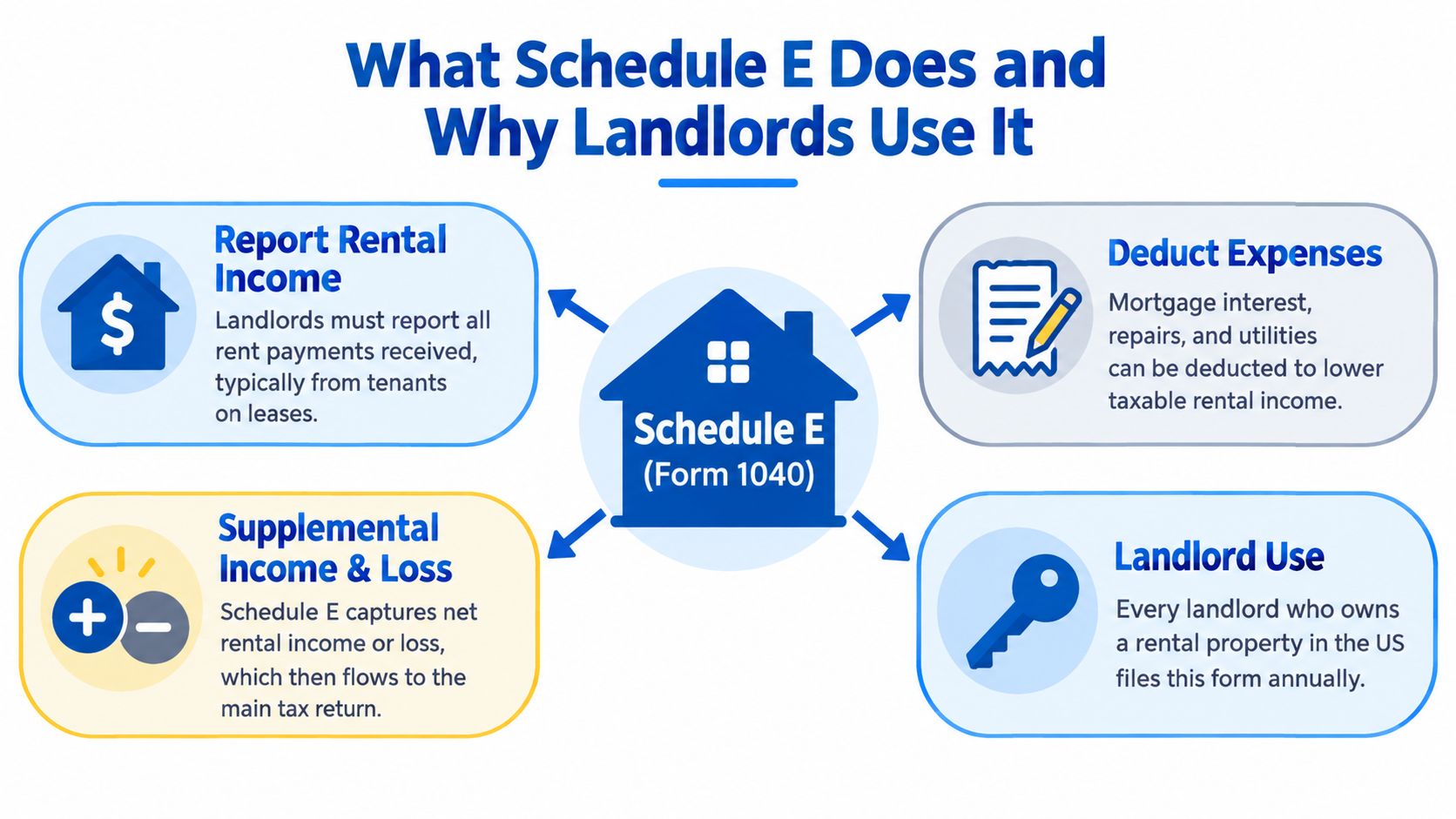
The form captures the basic landlord calculation:
- Rental income: Rent and other amounts connected to renting the property.
- Allowable expenses: Costs such as repairs, insurance, property taxes, management, utilities, and mortgage interest.
- Depreciation: A non-cash deduction for the building and qualifying assets.
- Net result: Rental profit or loss that flows into the rest of your tax return.
The IRS also provides an operational rule for larger portfolios. If you have more than three rental properties, you must attach as many Schedules E as needed, while the totals column is completed on only one Schedule E with combined totals from the attached schedules. The IRS rental real estate guidance confirms that filing structure.
Working rule: Build your bookkeeping property by property first. Schedule E should be the summary of clean records, not the place where you try to reconstruct an entire year.
Reporting Rental Income the Right Way
Start with the money connected to renting, not just the recurring lease payment. A room-by-room operator may receive base rent, late charges, pet fees, parking amounts, application fees that aren't returned, and reimbursements for shared utilities. Those amounts can belong in rental income when they're retained or earned under your accounting method.
Security deposits require a careful distinction. A refundable deposit generally isn't rental income when you receive it because you may have to return it. If you keep part of the deposit for unpaid rent, damage, or another permitted charge, the retained amount generally becomes reportable rental income.
Consider a house with four housemates. One pays the full room charge, another pays late, and a third pays only part of the amount due. You still need to record the amounts received and identify whether any unpaid balance remains a receivable under your accounting method. If a tenant pays a cleaning or damage charge that you retain, track it separately so you can explain its purpose.
Non-cash arrangements count, too. If a tenant provides services in exchange for reduced rent, record the arrangement and its reasonable rental value consistently. Short-term rental hosts should also preserve the gross platform payout and the platform fee separately, rather than recording only the net deposit.
| Income Item | Reported on Schedule E? | Notes |
|---|---|---|
| Regular rent | Yes | Record according to your accounting method. |
| Late fees | Generally yes | Treat retained late charges as rental-related income. |
| Pet or parking fees | Generally yes | Track them by property and purpose. |
| Refundable security deposit | Generally no at receipt | Report the portion later kept for rent, damage, or permitted charges. |
| Shared-utility reimbursement | Generally yes | Track the reimbursement and the related utility expense. |
| Bartered services | Generally yes | Document the value and the services exchanged. |
| Platform payout | Yes | Preserve gross payout and platform fees separately. |
A general ledger for rental properties can help you tag every payment to the correct address, tenant, and income category before tax preparation begins.
Deductible Expenses Every Landlord Should Claim
Schedule E works best when you group expenses by what they do for the property. Advertising, insurance, management fees, utilities paid by the landlord, repairs, maintenance, professional services, property taxes, supplies, and mortgage interest are common categories for rental operations. Keep invoices, receipts, statements, and payment records with the property they support.
The most important classification question is whether a cost is a current repair or a capital improvement. Replacing a leaking faucet is generally a repair that may be deducted as an operating expense. Installing a new roof usually adds value or extends the property's useful life, so it's generally tracked as a capital cost and recovered through depreciation rather than deducted all at once.
| Expense Category | Schedule E Line | Deductible? |
|---|---|---|
| Advertising and listing fees | Advertising | Generally yes, when rental-related |
| Insurance | Insurance | Generally yes |
| Repairs and maintenance | Repairs or maintenance-related category | Generally yes for ordinary repairs |
| Property management | Commissions or management fees | Generally yes |
| Landlord-paid utilities | Utilities | Generally yes |
| Property taxes | Taxes | Generally yes |
| Mortgage interest | Mortgage interest | Generally yes, subject to the applicable rules |
| Capital improvements | Not a current operating deduction | Generally recovered through depreciation |
| Principal repayment | Not a deductible expense | No current deduction for principal |
| Personal travel or repairs | Not a rental expense | No, unless properly allocated to rental use |
Commonly overlooked costs include pest control, HOA dues, tenant-screening charges, listing fees, cleaning, supplies, and professional services. Travel to inspect or manage a property may require a contemporaneous record showing the date, destination, purpose, and business connection.
Your own labor isn't a deductible expense because you spent the weekend turning over rooms or repairing a door. You can track supplies and qualifying outside services, but you can't create a tax deduction by assigning yourself an hourly wage.
A home office deduction requires more than working at the kitchen table. A dedicated space used solely and regularly for managing rental activity is the kind of fact pattern that deserves careful review. Mixed-use properties need the same discipline. If you live in one side of a duplex, allocate shared costs between personal and rental use instead of deducting the entire bill. This guide to property tax deductions can help you build a more complete expense review process.
Depreciation Basics and How It Lowers Your Tax Bill
Depreciation lets you recover the cost of a qualifying rental building over time. It's a non-cash deduction, which means it can reduce taxable rental income even though you didn't write a new check during the year.
The building can generally be depreciated, but land isn't depreciable. Personal property used outside the rental isn't part of the rental building's depreciable basis, and tenant improvements may require separate treatment. The depreciation clock generally begins when the property is ready and available to rent, not necessarily when a tenant first moves in.
Residential rental buildings are generally depreciated over 27.5 years under MACRS, using straight-line depreciation and a mid-month convention. The IRS explains this treatment in its Schedule E instructions and related form guidance.
Suppose a property costs $275,000, with $50,000 assigned to land. The depreciable building basis is $225,000. Dividing that amount by 27.5 years produces roughly $8,182 of annual depreciation, before considering the mid-month convention for the first and final years.
| Component | Amount | Calculation | Result |
|---|---|---|---|
| Purchase price | $275,000 | Total acquisition cost in the example | $275,000 |
| Land allocation | $50,000 | Excluded from building depreciation | $50,000 |
| Depreciable building basis | $225,000 | $275,000 minus $50,000 | $225,000 |
| Recovery period | 27.5 years | Residential rental building schedule | 27.5 years |
| Annual depreciation | Not a cash payment | $225,000 divided by 27.5 | Roughly $8,182 |
Form 4562 is used to calculate depreciation, while the resulting amount flows into the rental activity reported on Schedule E. Keep the depreciation schedule from year to year. It should show the original basis, land allocation, placed-in-service date, prior depreciation, current depreciation, and remaining basis.
A skipped deduction doesn't make the underlying tax history disappear. Your depreciation records also matter when you sell, because the property's tax basis and allowable depreciation affect the later gain calculation. For a repeatable workflow, depreciation calculation software can help maintain schedules across multiple properties, but the classification and basis inputs still need to be correct.
Passive Activity Rules and the $25,000 Allowance
Rental real estate is generally treated as a passive activity rather than self-employment income. That distinction separates ordinary long-term rental activity from services that may belong on Schedule C, and it affects whether a rental loss can offset wages or other non-passive income. IRS Tax Topic 414 discusses rental income, deductions, and passive activity treatment.
The default rule is restrictive. Passive losses generally offset passive income, while unused losses may be carried forward. A special exception can help landlords who actively participate, meaning they make meaningful management decisions such as approving tenants, setting rents, or arranging repairs.
The cited guidance provides an allowance of up to $25,000 for qualifying active participants. That allowance phases out by 50 cents for every dollar of modified adjusted gross income above $100,000, and it disappears at $150,000. These thresholds come from the passive-loss guidance referenced for this article. The cited Schedule E passive-loss explanation describes the allowance and phase-out.
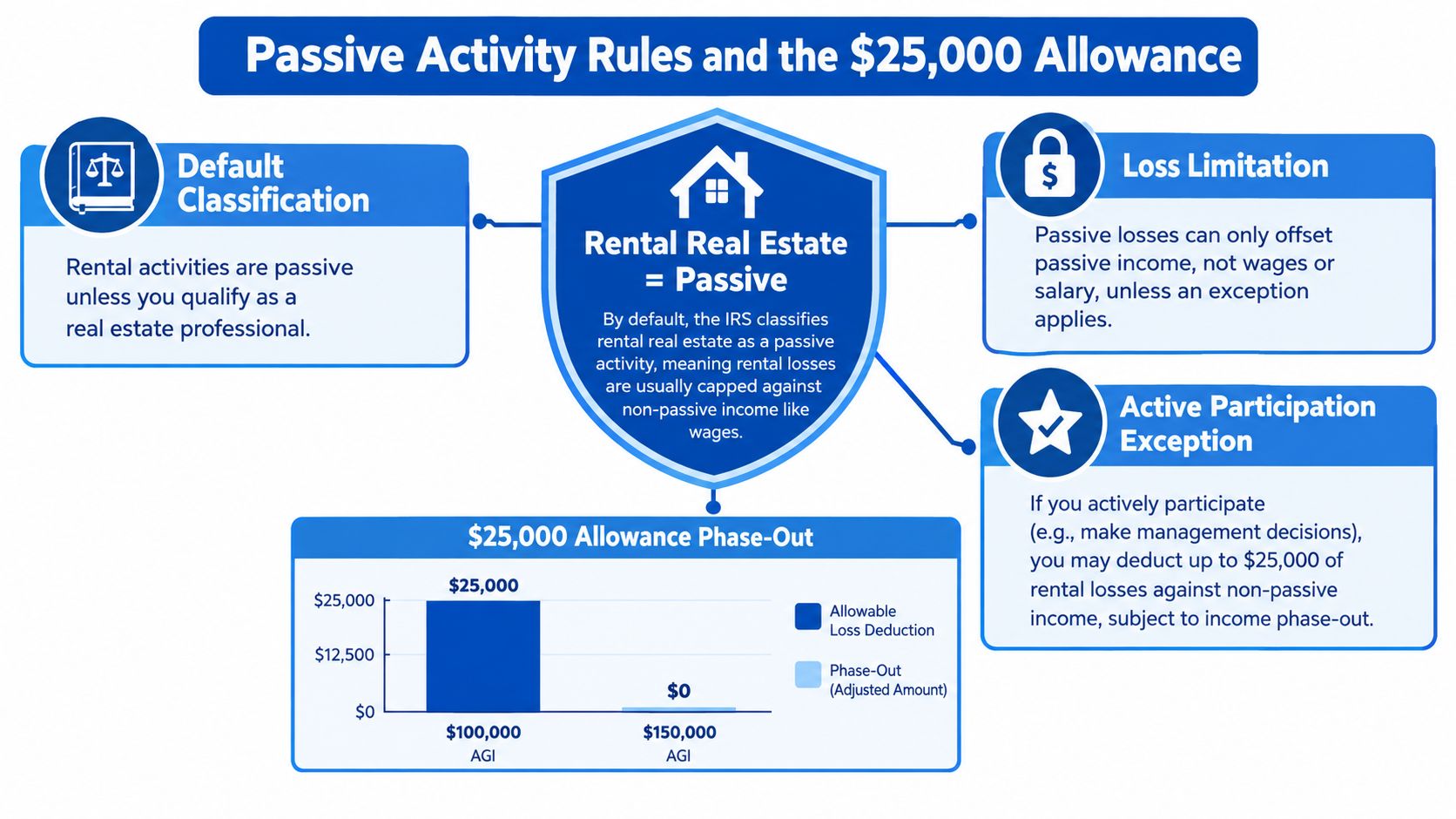
Active participation isn't the same as real estate professional status. Real estate professional and material-participation tests are stricter and involve requirements such as spending over 750 hours in real property trades or businesses and performing more than half of your personal services in those trades, along with other qualifying tests. Keep a time log and management record if you believe a stricter exception applies.
Form 8582 is used to track passive activity losses that can't be deducted currently. Don't treat a Schedule E loss as automatically deductible. First determine the loss, then apply the participation and passive-activity rules to decide whether it is currently usable or suspended.
Worked Example With Real Numbers
Take one rental property with a straightforward annual record. The landlord collects $24,000 in rent, plus $600 in late fees and shared-utility reimbursements. Total rental income is therefore $24,600.
The operating expenses are:
- Property taxes: $3,200
- Insurance: $1,400
- Repairs: $1,800
- Management fees: $1,200
- Landlord-paid utilities: $600
- Mortgage interest: $6,500
Those expenses total $14,700. The property has the sample depreciation amount of $8,182, producing total deductions of $22,882.
The Schedule E calculation looks like this:
| Line Item | Property A | Property B |
|---|---|---|
| Rental income | $24,600 | $24,600 |
| Operating expenses | ($14,700) | ($14,700) |
| Mortgage interest included above | Included | Included with additional financing effect |
| Depreciation | ($8,182) | Additional depreciation and interest produce paper loss |
| Schedule E result | $1,718 taxable rental income | ($4,282) paper loss |
| Cash position | Positive after actual cash costs | Positive cash flow can remain despite tax loss |
For Property A, subtracting $22,882 of total deductions from $24,600 of income leaves $1,718 of net taxable rental income. Depreciation reduced taxable income, but it didn't reduce the landlord's bank balance because it wasn't a cash payment.
Property B illustrates the issue that confuses many first-time landlords. Suppose mortgage interest and depreciation together push the reported result to a $4,282 loss. The landlord may still have cash left because mortgage principal payments, tenant deposits held for return, and depreciation don't behave like ordinary operating expenses in the same way.
Cash-flow check: A tax loss doesn't automatically mean the property lost money in the bank account. Compare Schedule E deductions with actual cash receipts and payments separately.
The final question is whether the paper loss is currently deductible. Passive activity rules, active participation, modified adjusted gross income, and any suspended losses determine the answer. Schedule E reports the property result, but it doesn't override those limitation rules.
Common Mistakes That Trigger IRS Notices
Most Schedule E problems begin before tax preparation. A landlord receives money through several channels, pays expenses from a personal account, and tries to sort everything at year-end. That process makes it easy to omit income, misclassify costs, or lose the records needed to support a deduction.
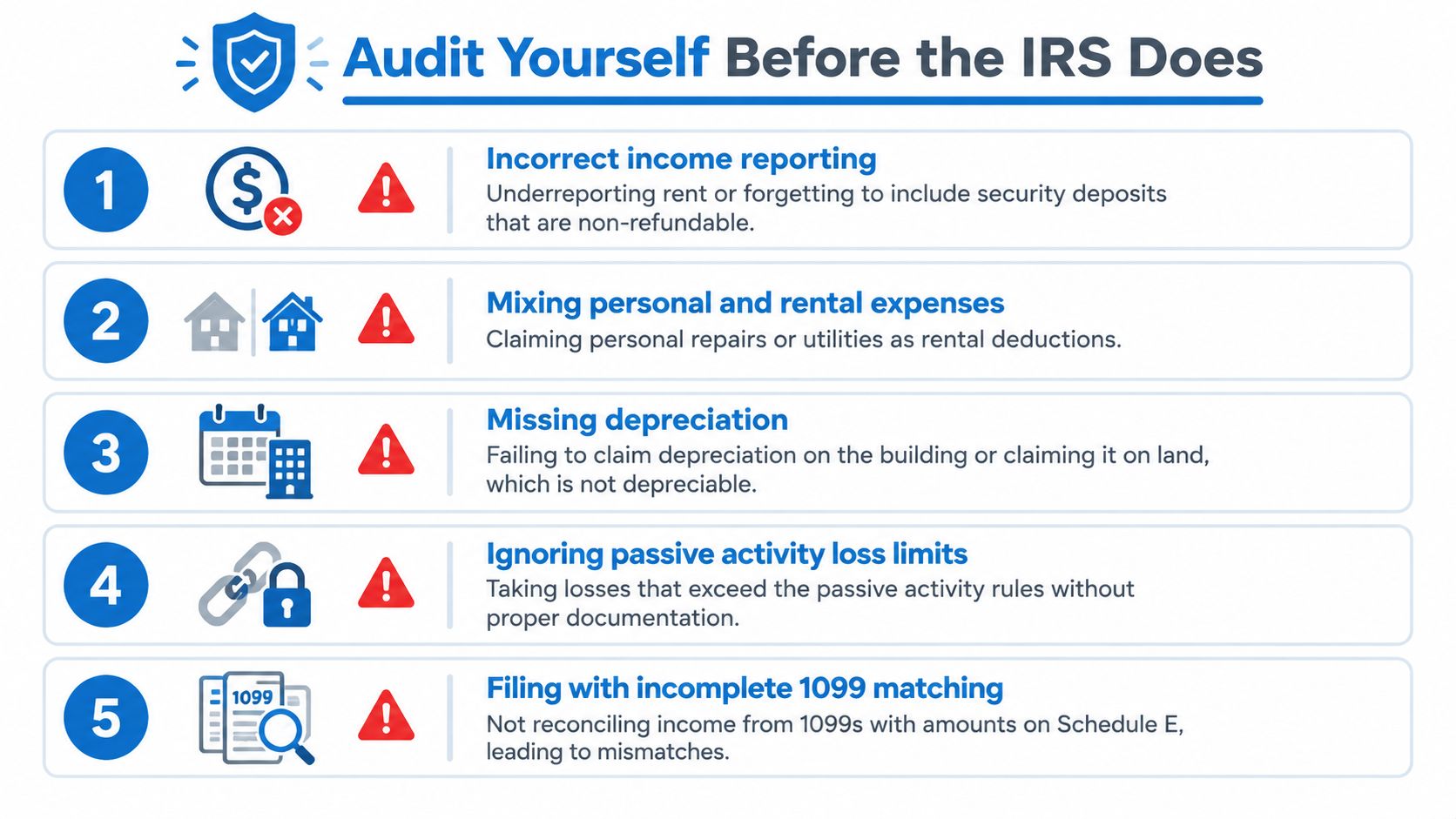
Use this audit-yourself checklist:
- Reconcile every payment channel: Include rent received by check, bank transfer, cash, Venmo, and rental platforms. Compare deposits with leases, tenant ledgers, and third-party statements.
- Separate personal spending: Don't deduct personal repairs, utilities, travel, or household purchases because they happened near a rental property.
- Maintain depreciation schedules: Properties held beyond the acquisition year still need consistent basis and depreciation records. Don't depreciate land.
- Classify improvements correctly: A roof replacement, major flooring project, or appliance installation may require capitalization rather than a current repair deduction.
- Keep mileage evidence: Log the date, destination, property, purpose, and vehicle information for property visits. A vague estimate created months later is weak support.
- Review passive losses: Don't claim a rental loss without checking active participation and modified adjusted gross income limits.
- Reconcile information returns: Compare property-manager statements and platform forms with the amounts reported on Schedule E. A mismatch can require an explanation even when your records are accurate.
The same review applies to mixed personal and rental use. If you advertise a property on Airbnb but later claim it was entirely personal, keep records that show the actual use, availability, and rental activity. Don't assume a platform statement replaces your own ledger. Your books should explain gross receipts, fees, refunds, deposits, repairs, and the allocation between personal and rental use.
A clean monthly reconciliation is more reliable than a frantic annual search. Attach receipts to transactions, label the property, and preserve contracts, mortgage statements, insurance bills, and improvement invoices with the relevant tax records.
Key Takeaways and When to Hire a Pro
Before filing, run this short checklist for every rental activity:
- Report all rental-related receipts: Include rent, retained fees, applied deposits, shared-utility reimbursements, and non-cash arrangements.
- Separate the property records: Keep each address's income, expenses, improvements, and depreciation schedule distinct.
- Claim appropriate deductions: Review repairs, insurance, taxes, utilities, management, interest, advertising, supplies, and professional costs.
- Depreciate the building correctly: Use the applicable 27.5-year residential schedule and exclude land from depreciable basis. The IRS residential rental property form guidance explains the relevant Schedule E reporting structure.
- Apply loss limits: Check passive activity rules before using a rental loss against non-passive income.
- Preserve support: Keep receipts, invoices, statements, leases, mileage records, and depreciation schedules for the required recordkeeping period, including at least three years after sale as a practical retention benchmark.
DIY filing may be reasonable for a single uncomplicated property with organized records. A tax professional becomes more valuable when the facts become layered.
| Scenario | DIY Filing OK | Hire a CPA or EA |
|---|---|---|
| One long-term rental with clean books | Often reasonable | Helpful for a first filing |
| More than three rental properties | Less practical | Strongly consider professional preparation |
| Short-term and long-term rentals together | Risk of classification errors | Recommended |
| Rental held through an LLC | Depends on tax treatment | Recommended for entity review |
| Form 1099-A or 1099-C involved | Not ideal for most beginners | Recommended |
| Claiming the QBI deduction | Requires careful eligibility review | Recommended |
| Passive losses approaching limits | Possible with strong records | Recommended |
| IRS notice received | Not a good DIY situation | Seek professional help |
A professional can also review ownership shares, cost allocations, depreciation, entity reporting, and state filing requirements. The earlier you involve that person, the more options they usually have to correct bookkeeping or classification problems.
Clean Schedule E work supports more than tax compliance. Property-level books help you see actual operating performance, calculate stronger net operating income, prepare for refinancing, and compare one room-by-room property with another. The form is the final report, while disciplined bookkeeping is the system behind it.
PadPulse is being built for PadSplit hosts and co-living operators who need clearer rent-by-the-room operations, including financial visibility, P&L tracking, portfolio analytics, pricing support, messaging workflows, and smart-home integrations. Visit PadPulse to join the interest list for updates and potential early access, with no billing required before launch.