Property Tax Deductions for Landlords a Landlord's Guide
July 21, 2026
Last month, a PadSplit host opened a property tax bill and saw a number big enough to wipe out a good chunk of the month's cash flow. The house was full, the rooms were rented, the tenants were paying on time, and the county still wanted its share. That's the moment where property tax deductions stop being a boring accounting line and start becoming one of the few legal levers that can protect Net Operating Income. If you want the NOI framing in plain English, this short NOI guide is a useful companion.
The mistake most new co-living investors make is assuming their tax bill works like a homeowner's bill. It usually doesn't. Once a property becomes a room-by-room rental business, the tax treatment can change in ways that matter a lot, especially when you're trying to keep more of each month's rent instead of handing it over later through preventable tax errors.
Practical rule: if the property is being used to produce rental income, stop thinking like an owner-occupier and start thinking like a business operator.
Your Property Tax Bill Is Not Just an Expense
A high property tax bill feels like overhead until you connect it to taxable income. For a rental operator, the essential question isn't whether the tax is annoying, it's whether the tax is being recorded in the right place so it reduces income legally. That distinction matters because the federal property tax deduction has long been a meaningful part of the tax code, costing the U.S. government an average of $31.5 billion in foregone revenue each year from 2013 through 2017, according to the Congressional Research Service's summary of the deduction's role in federal housing incentives (CRS report).
For co-living owners, the upside is that the tax bill is not always trapped under homeowner rules. A rental property's taxes can function like a business cost, which means the deduction can directly support cash flow and NOI when the property is treated correctly on the return. That's why investors who run shared housing need a different playbook from someone who owns a primary residence.
The surprise for many hosts is how uneven the benefit can be when a property isn't clearly separated between personal and business use. The deduction doesn't reward sloppy records. It rewards proper classification, clean payment history, and a return that matches how the property is used.
If the tax bill belongs to a business-use property, the deduction should be defended like any other operating expense.
Why co-living changes the conversation
A single-family homeowner usually just asks whether property taxes are deductible on a personal return. A room-by-room operator has a more useful question, which is whether the tax belongs on the business side of the ledger. That shift is where many new investors realize better after-tax results, because the IRS treatment can be much friendlier when the property is part of a rental operation.
The catch is that you need to classify the property correctly before you chase the deduction. The same county bill can be treated very differently depending on whether it relates to a personal home, a mixed-use property, or a pure rental business. That is why the accounting process matters as much as the bill itself.
The Golden Rule Schedule E vs Schedule A
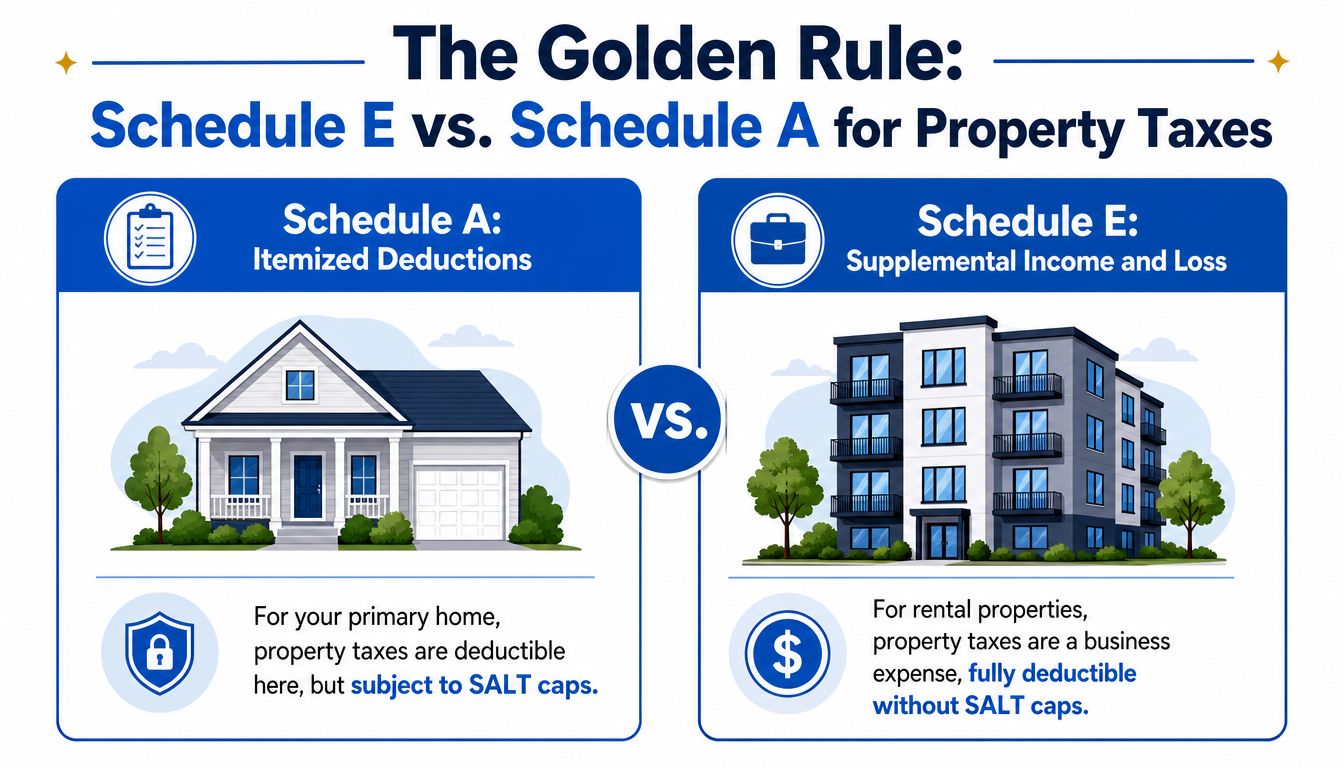
The cleanest way to think about property tax deductions is to separate them into two buckets. Schedule A is for personal itemized deductions, which means the tax is tied to your own home or other personal-use property and sits inside the SALT cap. Schedule E, by contrast, is for rental real estate, where the tax is treated as a business expense and is not trapped by the same ceiling when the property is rental property (Bench explanation).
Why the IRS treats them differently
The logic is simple. A personal residence is treated like a household expense, so the deduction is limited under itemized rules. A rental property is treated like an income-producing asset, so the property tax is part of the cost of earning rent. That is the same broad reason business travel is handled differently from a family vacation, the tax law cares about purpose, not convenience.
For landlords and co-living operators, that difference can be decisive. If the property is a rental, the tax is not just “partially deductible.” It can be fully deductible on the business side when reported properly, which directly lowers taxable rental income. That's one reason shared housing operators should be careful about assuming the standard homeowner tax guides apply to them.
The federal SALT rules still matter for your personal home, but they don't rewrite the treatment of business real estate. If you're running a room-by-room operation, the rental property itself belongs in the business column, not the personal column.
The non-negotiable filing rule
If you want the deduction on the rental side, the return has to reflect that reality. For rental property, that means Schedule E, not Schedule A. For personal property, you're still in itemized-deduction territory and the cap can bite.
A practical way to remember it is this:
- Primary home: Schedule A, subject to SALT limits.
- Rental property: Schedule E, treated as a business expense.
- Hybrid property: split it according to actual personal and rental use.
That split matters even more in co-living, because one property can have multiple rooms, mixed occupancy, and changing use patterns over the year. Treating every dollar of tax the same way is how owners overclaim, underclaim, or both.
Navigating the 2026 SALT Cap Deduction
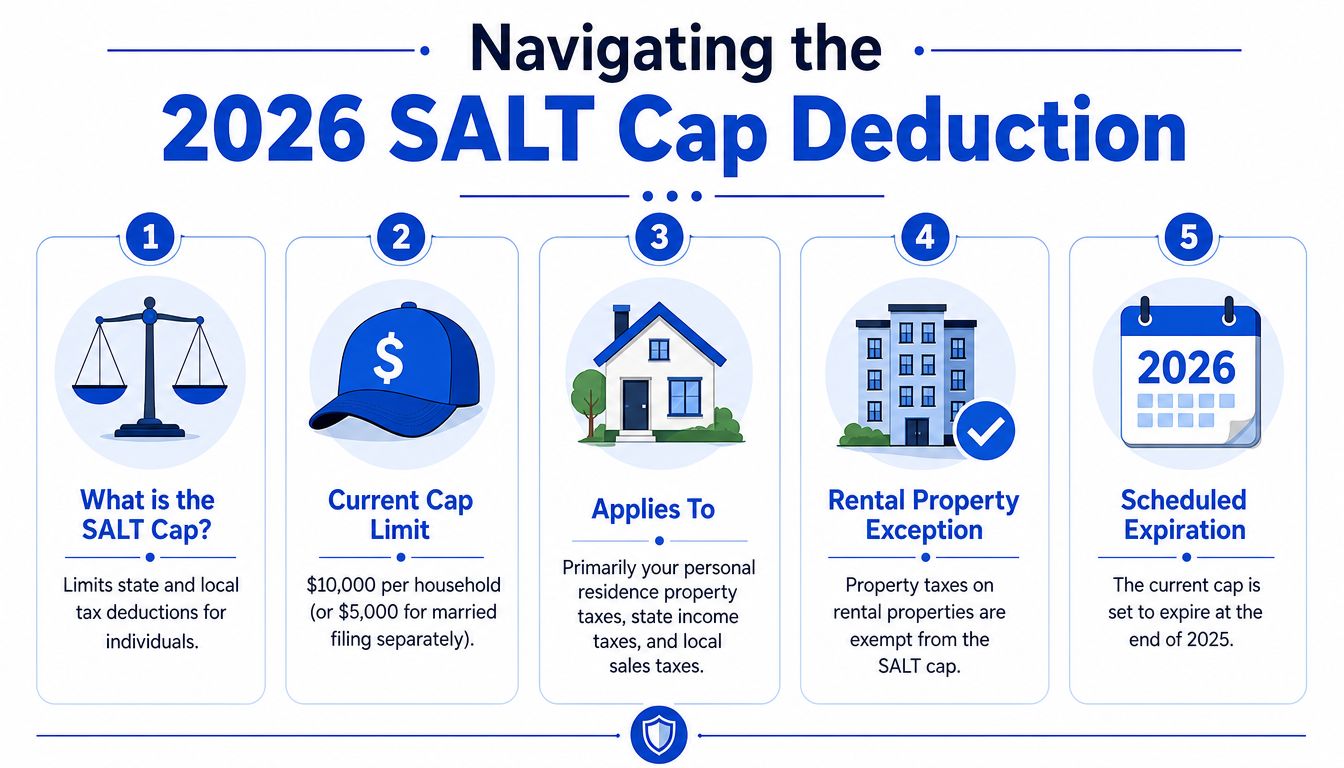
If you own a co-living property and also keep a personal residence on the books, the SALT cap can still affect your household return. Under current rules, the cap is higher for a limited period, then scheduled to drop back later unless Congress changes the law again. If a proposed bill were to pass, the limit could increase for the relevant tax years before returning to $10,000 later, but that is not the same thing as treating a future change as already enacted. The point for investors is simple, state and local income, sales, and property taxes still sit inside one combined ceiling for the personal side of the return.
What the cap means in real life
The cap does not produce a full write-off for every homeowner. It still depends on itemizing, and itemizing only helps when total itemized deductions exceed the standard deduction for your filing status. For homeowners, that means you have to clear the standard deduction before the property tax bill even matters on Schedule A, and for married joint filers the threshold is $31,500 (Jackson Hewitt overview).
The cap can also shrink for higher-income taxpayers. The higher limit is reduced by a percentage of modified adjusted gross income above a set threshold, though it does not fall below the $10,000 floor. That creates a moving target for wealthier households, especially when the same owner also has rental real estate, because the personal return and the rental return have to be separated cleanly.
Why landlords must keep personal and business taxes separate
The SALT cap applies to personal-use property, not rental real estate. A landlord cannot mix a personal residence tax bill with a rental property tax bill and assume the whole amount belongs in one SALT bucket. The business side belongs on Schedule E, while the personal side belongs in itemized deductions, if itemizing is worthwhile at all.
For operators with a primary residence and one or more rentals, clean separation is not optional. It is the only way to tell what is capped, what is fully deductible, and what needs to stay on the personal side of the return. That matters even more in co-living, where one property may have owner use, rented rooms, and shifting occupancy across the year. Treating every property tax dollar the same way is how owners overclaim, underclaim, or hand an examiner a messy return.
How to Allocate Deductions in a Co-Living Property

When a property is part rental and part personal use, allocation becomes the entire game. A co-living house with rented rooms, a spare room, and maybe an owner-occupied bedroom doesn't get to pretend every square foot is the same. The IRS cares about use, and your records need to show how you separated the business portion from the personal portion.
Two common allocation methods
The most defensible methods are usually square footage and number of rooms, but they don't always fit every property the same way. Square footage is cleaner when the rooms are similar in size or when the owner uses a clearly defined portion of the house. Room count can work when the property layout is more uniform and the bedrooms are the main income-producing spaces.
A practical allocation usually starts with the use pattern:
- Identify the property type. Is it a pure rental, a second home with rental use, or a mixed-use house where you live on-site?
- Separate personal-use days from rental-use days. That matters for hybrid homes.
- Choose a reasonable allocation method. Square footage often gives a stronger paper trail, but room count can be easier to maintain.
- Apply the same method consistently. Consistency matters more than elegance when a tax return is reviewed later.
If the property is a second home used as a rental, the days of personal use can change the reporting split. When use exceeds 14 days or 10% of rental days, the tax must be split between Schedule A and Schedule E, depending on how the property was used during the year (Schwab explanation). If use stays below that threshold, the whole property can be treated as a rental for tax purposes.
A simple co-living example
Suppose a house has five bedrooms, and four are rented while one is reserved for the owner. A room-based allocation may point to 4/5 of the property being rental use, but that doesn't automatically settle the issue if the owner's room is larger or if the common areas are used differently. In a more polished file, I'd want the taxpayer to document the floor plan, measure the relevant areas, and tie the allocation to the actual income-producing use.
That's also where a good records system matters. If you're already tracking unit-level performance, expense allocation becomes much easier to defend. For operators who want a stronger bookkeeping process, this depreciation software guide is a helpful companion to the property tax workpaper.
Identifying What Counts as a Deductible Tax
The county bill may list several charges, but not every line is a deductible real estate tax. The IRS rule is narrower than most owners expect. To qualify, the tax has to be levied uniformly on property in the jurisdiction, based on property value, and used for general governmental purposes, while assessments for specific capital improvements are not deductible (H&R Block summary).
Read the bill like an auditor would
A deductible property tax usually looks like a broad-based tax imposed across the jurisdiction. A non-deductible assessment often looks more like a fee tied to a specific project, such as a road improvement or sewer upgrade that increases the property's value. Those charges may still be real costs, but they don't always qualify as deductible taxes.
Do this every year: separate the general property tax from anything labeled assessment, improvement district charge, or special benefit charge before you enter it into your books.
That review protects you from overstating the deduction. It also helps you avoid turning a normal tax return into an audit headache by claiming local improvement charges as if they were ordinary property taxes.
What usually belongs on the deductible side
In practice, the deductible category is the part of the bill that reflects general real estate taxation. The non-deductible side is the special assessment or fee side, especially when the local government is using the money for a specific project rather than general services.
For co-living operators, this distinction matters because aggressive local reassessments and special district charges can show up after a property is converted from a single-family residence to a multi-room rental. Owners sometimes assume everything on the statement is deductible. It isn't.
If you're managing multiple properties, compare the bills side by side. The pattern will often show which charges recur as general taxes and which are tied to special projects. That's much easier to catch before filing than after a notice arrives.
Reporting and Recordkeeping to Stay Audit Proof
A deduction without documentation is just wishful thinking. The strongest tax position for a landlord is not the biggest claimed number, it's the number you can prove quickly if the IRS asks. For co-living operators, that means keeping the tax bill, proof of payment, the allocation worksheet, and any records showing how the property was used during the year.
For rooms treated as rental business activity, property taxes are fully deductible without the $40,000 SALT cap and are claimed on Schedule E (Form 1040) rather than Schedule A, which lets the actual tax paid reduce rental income directly (E2E Accounting summary). That is the clean business treatment most room-by-room operators want, but it only works if the paperwork supports the classification.
Build a simple audit file
I'd keep these items in one digital folder per property:
- Property tax bill: the official statement from the county or assessor.
- Proof of payment: bank statement, canceled check, or electronic confirmation.
- Allocation workpaper: your square footage or room-use calculation.
- Use log: especially for hybrid properties or second-home rentals.
- Supporting notes: anything that explains special assessments, exemptions, or local quirks.
A simple folder structure beats a scattered email trail every time. If you need a better system for holding the books together, this rental accounting software guide is worth reviewing before tax season gets busy.
Why this matters more for co-living than for standard rentals
Shared housing creates more edge cases. One house may have owner use, rented rooms, vacant rooms, or relatives living there without paying rent. That's exactly where sloppy records create risk. The deduction is still available in many cases, but the taxpayer has to show what part of the property belongs on Schedule E.
Audits usually don't start with a dramatic accusation. They start with a missing detail, a bad allocation, or a bill that was copied into the return without reading the fine print. Clean records turn those issues into routine follow-ups instead of expensive problems.
Putting It All Together to Maximize Your NOI
The best property tax deductions strategy isn't complicated, but it does require discipline. Treat the rental property as a business asset, push the deduction to Schedule E when the facts support it, allocate mixed-use properties carefully, and keep every bill and payment record in one place. That is how you turn a tax expense into an after-tax NOI improvement instead of a messy filing risk.
For co-living operators, the primary advantage is clarity. Once the property is tracked correctly, the tax treatment becomes easier to defend, the books are easier to read, and the investment itself becomes easier to scale. You're not trying to game the system, you're making sure the return reflects how the property operates.
A centralized management workflow helps with that discipline because tax data, rent data, and occupancy data stop living in separate spreadsheets. When those records line up, you can spot allocation mistakes early, preserve deductions you're entitled to, and keep your tax position consistent from one year to the next.
If you're building or expanding a room-by-room portfolio, get your tax process in order before the next bill lands. Review your filing setup, tighten your allocation method, and make sure your records are clean enough to survive a question from the IRS. A stronger system now saves money later, and it makes every property easier to manage as the portfolio grows.
If you're serious about protecting NOI in a co-living business, PadPulse is worth watching. Join the interest list, keep your tax records organized, and stay ready for a smarter way to manage rent-by-the-room operations.