Rent Roll Definition: A Landlord's Guide to Profit
July 13, 2026
A rent roll is the financial heartbeat of a rental property. A standard professional rent roll contains at least 12 distinct data fields per unit, and in co-living it needs even more room-by-room detail to show what income is collectable and where profit is leaking.
If you're a new landlord, you might be doing what almost everyone does at first. You check bank deposits, open a spreadsheet, scroll through lease PDFs, and try to answer a simple question: “Is this property performing well?”
That confusion gets worse in co-living. One house can have multiple residents, different move-in dates, payment plans, concessions, and room-level vacancies that don't show up clearly in a unit-based spreadsheet. You can feel busy every day and still not have a clean view of your income.
A good rent roll fixes that. It turns scattered lease and rent data into one working document you can trust.
Your Property's Financial Health in One Place
A landlord I know bought a shared house thinking the math was straightforward. Five rooms, mostly occupied, rent coming in. On paper, it looked healthy.
But when we sat down with his numbers, the picture changed fast. One room had been vacant longer than he realized. Another resident was on a payment plan. A third lease was ending soon, and he hadn't noticed. His bank account showed deposits, but it didn't show the property's real condition.
That's where the rent roll becomes useful. Not as an accounting chore, but as the one page that tells you what your property is producing, who is paying for what, and where your risk sits right now.
Why new landlords miss the real story
Most beginners rely on a mix of tools:
- Bank statements that show money received, but not lease obligations
- Lease files that contain the terms, but are hard to scan quickly
- Notes and texts that explain side arrangements no report is capturing
- Spreadsheets that start simple, then become messy
That setup works for a minute. Then renewals, late payments, concessions, and vacancies pile up.
A profitable rental doesn't just need rent coming in. It needs a clean record of what should be coming in, from whom, and until when.
When you keep a current rent roll, you stop guessing. You can compare expected rent to actual collections, spot expiration risk, and feed cleaner data into broader reporting like a rental property profit and loss statement.
Why it matters more in co-living
In a standard apartment, one unit often means one lease. In a room-by-room property, one address can mean several independent income streams. If even one room slips, your results change. A rent roll helps you see that without digging through scattered records.
So What Is a Rent Roll Exactly
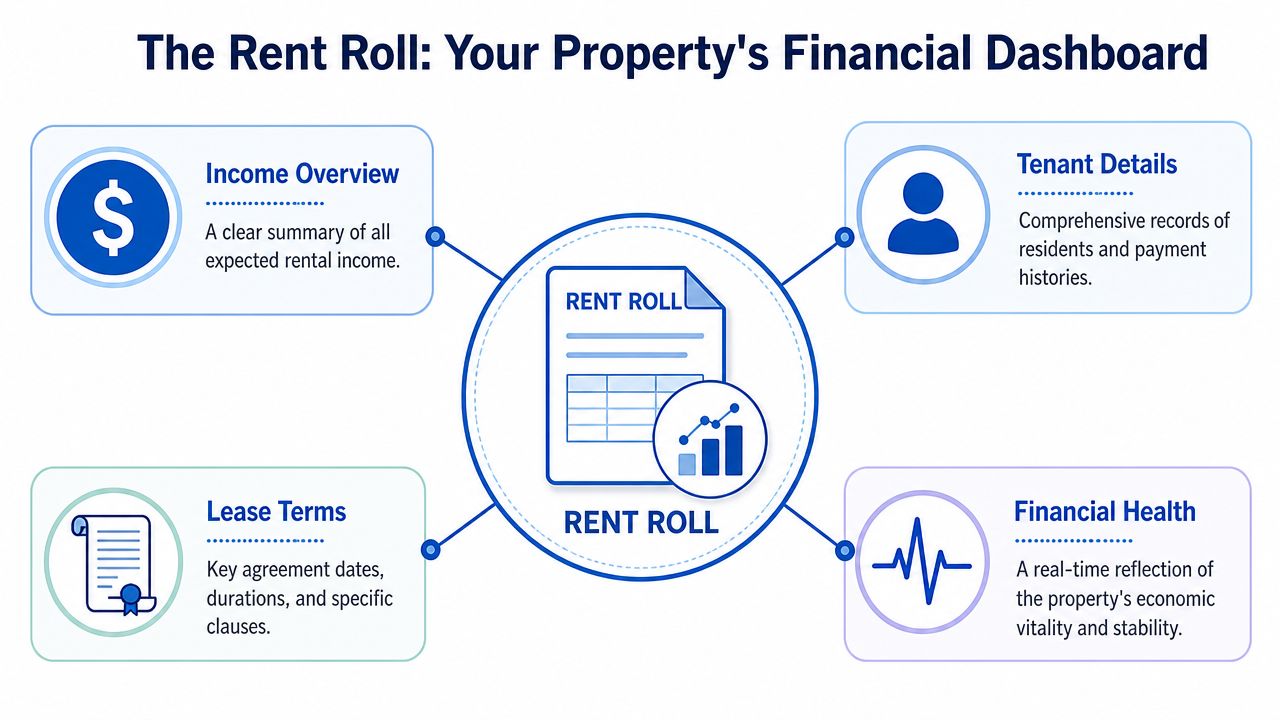
Think of a rent roll as your property's dashboard. When you drive, you don't want to open the engine every time you need to know how the car is doing. You glance at the dashboard and see speed, fuel, warning lights, and temperature.
A rent roll does that for a rental. It gives you a current snapshot of income and occupancy so you can understand the property's condition quickly and make decisions before small issues turn into expensive ones.
The plain-English rent roll definition
A rent roll is defined as a foundational, itemized report that aggregates tenant names, unit identifiers, monthly and annual rent amounts, and lease start/end dates to provide a precise snapshot of a property's current income and occupancy. It captures the actual rent currently collectable rather than hypothetical gross potential income, as explained in Kolena's rent roll definition guide.
That phrase “actual rent currently collectable” matters. It's the difference between fantasy income and contractual income.
If you have a room that could rent for more, but the signed lease says otherwise, the rent roll should reflect the signed amount. If a resident has a concession, your report should reflect the actual economics of that lease. If a room is empty, the rent roll should show it clearly.
What a rent roll is not
Readers often get stuck at this point.
A rent roll is not just:
- A tenant list with names and room numbers
- A payment history showing every transaction
- A budget based on what you hope to earn
- A lease folder with raw documents
It's a structured summary of your rent-producing obligations at a specific moment.
Practical rule: If someone asked, “What income is this property supposed to produce right now, and what lease terms support that?”, your rent roll should answer in seconds.
Why investors and operators care
A strong rent roll helps you read the property the way a lender, buyer, or disciplined operator would. You can see who occupies each room or unit, when leases end, where rates are below market, and whether upcoming turnover could interrupt cash flow.
For beginners, that makes the rent roll definition much more useful than the textbook version. It's not paperwork for its own sake. It's a working snapshot of property health.
The Key Components of a Powerful Rent Roll
A rent roll becomes valuable when the fields are complete and consistent. If key columns are missing, you can't trust the picture you're seeing.
A standard professional rent roll contains at least 12 distinct data fields per unit, including tenant identifiers, suite numbers, square footage, lease duration, monthly and annual rent, rent escalations, and security deposits. The same source also notes that leaving out market rent data makes it harder to spot underperforming units, as outlined in Adventures in CRE's rent roll glossary.
The core fields every landlord should track
Start with the essentials. Even if you're managing one house, these columns give you a usable operating report.
| Room | Tenant Name | Lease Start | Lease End | Monthly Rent | Deposit Paid | Status |
|---|---|---|---|---|---|---|
| Room A | Jordan Lee | 01/01/2026 | 06/30/2026 | $ | Yes | Active |
| Room B | Alex Smith | 02/01/2026 | 07/31/2026 | $ | Yes | Active |
| Room C | Vacant | - | - | $ | No | Vacant |
That simple layout is enough to answer basic questions fast. Which rooms are occupied? Which leases expire soon? Which deposits are missing? Where is vacancy sitting?
What each field tells you
Some columns look administrative, but each one helps you protect profit.
- Tenant name or identifier helps you tie the row to a real lease and resident record.
- Room or unit number keeps income tied to inventory. In co-living, this matters more than people expect because one address can hold several distinct leases.
- Lease start and end dates show renewal timing and upcoming vacancy risk.
- Monthly rent tells you the current contractual charge.
- Deposit paid helps you verify move-in compliance and prepare for potential damage or unpaid balances.
- Status should show whether the space is active, expiring, vacant, or recently vacated.
The fields that separate amateurs from professionals
Once the basics are in place, add the fields that improve decisions:
- Market rent so you can compare what a room should earn versus what it does earn
- Actual rent or effective rent to capture concessions or special arrangements accurately
- Escalation terms for leases with built-in rent changes
- Square footage when room or unit size affects pricing logic
- Lease type and notes if costs or terms vary across residents
Missing “market rent” is one of the easiest ways to overlook income you're leaving on the table.
This is also where many owners confuse a rent roll with a ledger. If you want a cleaner distinction between the two, it's worth reading a practical breakdown of rent ledger meaning.
How a Rent Roll Drives Profit and Operations
A rent roll only looks passive. In practice, it's one of the most useful decision tools in your business.
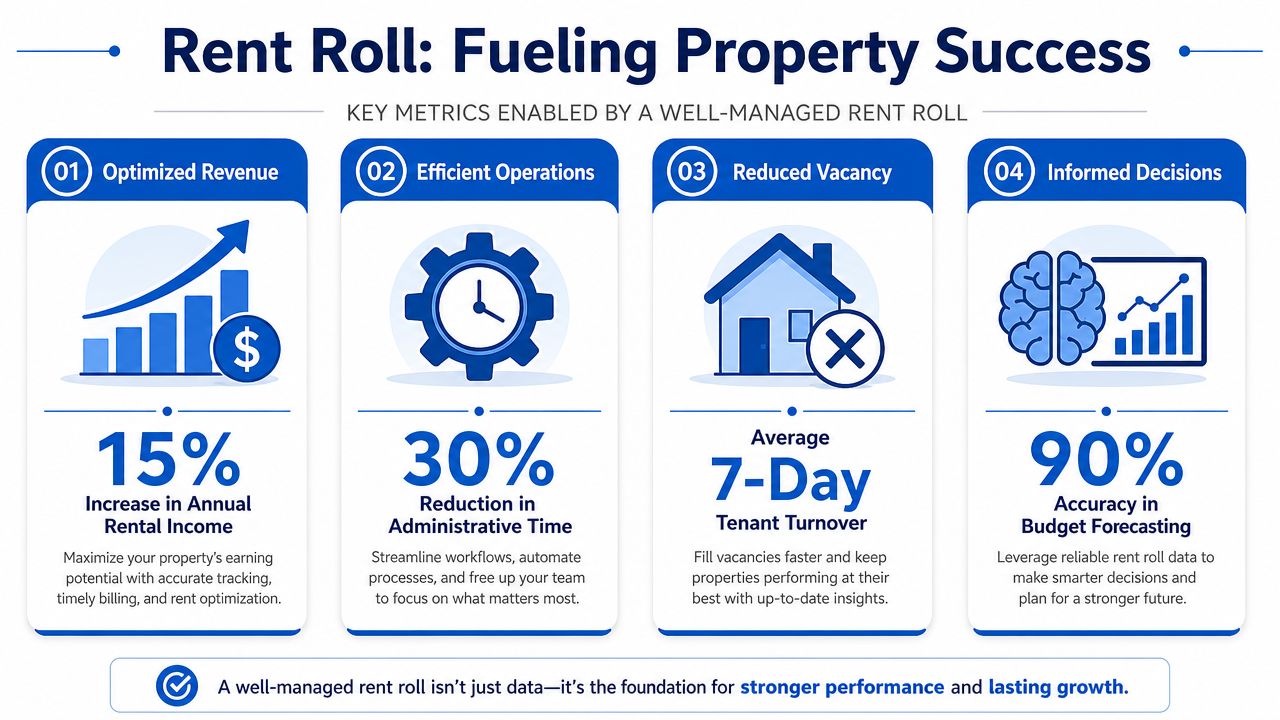
When the report is current, it feeds your numbers, supports financing conversations, and helps you act before vacancy or underpricing starts dragging down returns. That's why experienced operators don't treat it like a file they update only when someone asks for it.
It helps you calculate real property performance
For multifamily investors, an accurate rent roll consolidates information on rent payments and lease terms to help calculate Net Operating Income, which is a fundamental metric for evaluating how much cash flow a property will produce. It also supports virtually every part of the property management process, from owner reporting to property valuation, according to REI Hub's explanation of rent rolls.
If you're still getting comfortable with that metric, this guide to Net Operating Income for rental property owners can help connect the dots.
A simple example makes this easier. If your rent roll shows one room vacant, one lease ending soon, and another room rented below current market, your future income may be weaker than your current bank deposits suggest. The rent roll gives you the raw material to see that early.
It supports financing and valuation
Lenders don't want vague statements like “the house usually stays full.” They want documentation. A well-kept rent roll shows what income is supported by active leases and what occupancy looks like at that moment.
That matters in sales, refinances, and routine underwriting. If your records are sloppy, the property can look less stable than it really is.
The cleaner your rent roll, the easier it is for another party to trust your numbers.
It improves day-to-day operations
The best operators use the rent roll as a planning tool, not just a reporting file.
Here are a few examples:
- Renewal planning: You can spot upcoming lease ends and start outreach early.
- Vacancy prep: If several move-outs cluster together, you can prepare turnover work and marketing in advance.
- Pricing review: Comparing actual rent with market rent helps you identify rooms that need adjustment.
- Cash flow visibility: You can estimate where income may soften before it happens.
That's how a simple report turns into an operating advantage. It helps you move from reacting to managing.
Adapting Your Rent Roll for Co-Living Success
A regular apartment rent roll often tracks one lease per unit. That breaks down in co-living.
If you manage shared housing, you need room-level visibility. One resident may renew, another may move out, and a third may be on a special arrangement, all under the same roof. A unit-based rent roll hides those differences, which makes your income look smoother than it really is.

Why room-by-room tracking matters
In multifamily and co-living contexts, the rent roll must granularly disaggregate room-by-room data rather than just unit totals, capturing individual tenant lease expirations to model vacancy risk. That granularity helps operators forecast cash flow gaps caused by staggered lease renewals, which is especially important in higher-turnover room-rental models, as described by the American Apartment Owners Association.
That point lands hard in co-living because one vacant room isn't just a minor note. It changes house-level performance immediately.
What to add for shared housing
For co-living, your rent roll should go beyond standard unit fields and include details like:
- Room-level inventory instead of only property-level or unit-level rows
- Individual lease expiration dates for each resident
- Status labels such as active, notice given, vacant, or ready-to-fill
- Concession or payment-plan notes when a room isn't paying standard terms
- Market rent by room type so you can compare like with like
In co-living, the room is the revenue unit. If your report only tracks the house, you're missing the operating reality.
Where new operators get tripped up
The common mistake is summarizing a five-bedroom house as one occupied asset because “most rooms are full.” That's not enough. You need to know which room is empty, which lease ends next, and whether one underpriced room is dragging the whole property's performance down.
That's the difference between a generic rent roll and one that works for room-by-room rentals.
Rent Roll Best Practices and Common Mistakes
A rent roll works only if it's current and clear. Once it falls behind, every decision built on it gets shakier.
One of the biggest problems is mixing up a rent roll with a rent ledger. A rent roll is a snapshot of current income, while a ledger is a history of payments. Buildium notes that 78% of small co-living landlords manually reconcile rent rolls and ledgers due to software incompatibility, which creates financial blind spots in shared housing operations, according to Buildium's rent roll reference.
Do this consistently
- Update it monthly: Add new leases, renewals, move-outs, and vacancies before the next month starts.
- Verify against real records: Check lease terms, payment records, and deposit status so the report reflects reality.
- Track concessions and special terms: If rent is discounted or structured differently, note it clearly.
- Include market rent: Without it, it's harder to identify underperforming rooms or units.
Don't make these common mistakes
- Don't treat it like a ledger: The two reports answer different questions.
- Don't group co-living income too broadly: House-level summaries can hide room-level risk.
- Don't let expired leases sit unresolved: An old end date can make occupancy look healthier than it is.
- Don't build decisions off memory: If it isn't in the report, it usually gets missed.
A clean rent roll gives you control. That's what turns a rental from “I think it's doing okay” into a business you can manage.
If you run PadSplit homes or co-living properties and want a better way to manage room-by-room operations, keep an eye on PadPulse. It's being built to help operators centralize pricing, communications, access control, and financial reporting so you can save time, fill rooms faster, and improve NOI without stitching together spreadsheets and disconnected tools.