Real Estate Investment North Carolina: 2026 Strategy Guide
May 11, 2026
North Carolina's 62.4% FHFA House Price Index growth over the five years ending April 2026 is the stat that changes the conversation from “interesting market” to “serious market” for investors focused on North Carolina market performance. For a lot of landlords, that headline suggests appreciation first and cash flow second.
I'd look at it the other way.
If you're pursuing real estate investment north carolina with a co-living or room-by-room strategy, the state works because it gives you both demand and operating margin. You have migration, job creation, relatively accessible pricing in many submarkets, and a renter base that increasingly needs flexible housing. That combination matters more than hype. A standard single-family rental can perform fine here. A well-run co-living house can turn the same demand into stronger NOI, if you buy the right property and stay inside local rules.
The catch is that North Carolina is not one market. Charlotte, Raleigh, Durham, Fayetteville, and secondary cities all behave differently. The underwriting is different. The resident profile is different. The compliance risk is different. Investors who treat the state like a single playbook usually overpay in the strongest metros or walk into avoidable operational problems in smaller ones.
Why North Carolina is a Top Market for Real Estate Investors
North Carolina's FHFA House Price Index climbed 62.4% over the five years ending April 2026. That kind of appreciation gets attention, but for co-living investors, the more useful takeaway is what sits underneath it: the state still gives operators a shot at buying houses at a basis that can support room-by-room income.
That matters because co-living is an operating model first. If acquisition costs are too high, the extra rent per bedroom gets eaten up by debt service, furnishing costs, turnovers, and management. North Carolina still has enough submarkets where that math can work.

The macro setup supports rental housing
The state is attracting new residents, adding jobs, and keeping a broad renter base in play. For a traditional landlord, that usually means decent occupancy. For a co-living operator, it means something more specific: a steady flow of people who need a private room near work, school, hospitals, or major commuting routes, but do not want the cost of a full apartment on their own.
That renter profile shows up again and again in North Carolina. New grads. Traveling staff. Early-career workers. People relocating before they decide where to settle long term. People rebuilding after a divorce or household change. Co-living works when a market has enough of those residents every month, not just during one leasing season.
North Carolina has that depth.
Why the numbers work better for room-by-room rentals
A standard single-family rental in North Carolina can produce acceptable returns, but in many metros the conventional rent does not fully reflect the cost of the asset. That gap is where co-living earns its keep.
Instead of collecting one rent check, the operator is pricing each bedroom separately, often with shared common areas, utilities included, and a furnished setup. Done well, that raises gross income meaningfully enough to offset higher operating intensity. Done poorly, it creates management headaches and thin margins.
I underwrite North Carolina co-living deals with a simple question: does the house support enough rentable bedrooms, parking, and common-area function to create a real spread over the long-term rental option? If the answer is no, appreciation alone is not a good reason to buy.
Lower carrying costs help preserve NOI
North Carolina also benefits from relatively low property taxes compared with many competing states. That does not make a weak deal strong, but it does help preserve margin once the property is stabilized. In a co-living model, where expenses already run higher because of utilities, cleaning, supplies, and more frequent leasing activity, every point of tax relief matters.
The same logic applies to purchase price. A house bought at a reasonable basis gives you room to do the work that lifts NOI: adding durable furniture, improving bathroom count where feasible, creating better parking flow, and setting up lockable storage and clean common spaces. Those upgrades are not cosmetic. They directly affect rent per room, occupancy, and turnover.
Supply is growing, but that does not kill the strategy
Builders are active across North Carolina. That matters, but new supply does not automatically compete with co-living inventory.
A new Class A apartment lease is aimed at a different renter than a well-run house-share near a hospital corridor, university, or employment center. The co-living resident is often optimizing for monthly affordability, flexibility, and location. That resident may prefer a private room in a clean four- or five-bedroom house over paying for a full one-bedroom apartment alone.
In practice, a few property traits matter more than broad market heat:
- Functional bedroom count: Four true bedrooms usually outperform a prettier three-bedroom house with no way to add usable space.
- Parking and access: Tight parking kills deals faster than new investors expect, especially in suburban North Carolina neighborhoods.
- Bathroom ratio: One bath for four or five adults is usually a leasing problem.
- Distance to job centers: Short commutes matter more than trendy finishes for this renter base.
- Zoning and occupancy rules: Revenue looks great on a spreadsheet until local occupancy limits cut the model back.
In North Carolina, co-living returns usually come from operations, not from buying a “hot” house and hoping the market fixes the deal for you.
That is why the state stands out. It has enough growth to keep renter demand strong, enough pricing variation to find workable entry points, and enough population churn to support a room-by-room model that can outperform a standard lease when the property and local rules line up.
Top North Carolina Metro Areas for Investment
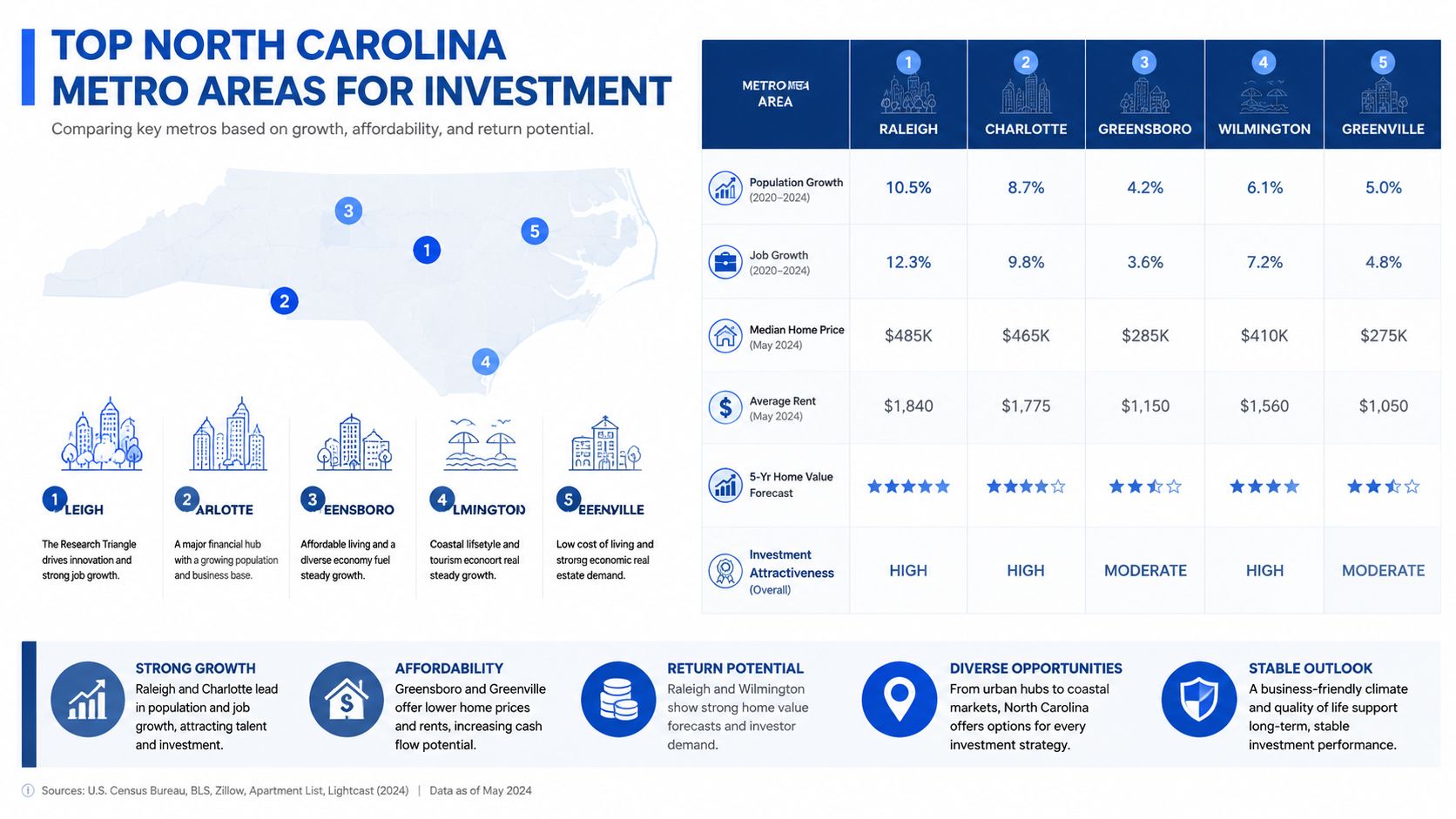
The best metro depends on what you want the property to do. Some investors want appreciation and easier leasing. Others want lower basis and more cash flow room. In North Carolina, those are not always the same place.
The broad market signal is strong. Raleigh-Durham ranks #2 nationwide for tech job growth, investors account for 23% to 28% of home purchases in major markets like Charlotte, Raleigh, and Durham, the average home value is $336,465, and properties go pending in 23 days, according to Rasberry Realty's North Carolina investment overview. That tells you demand is real and investor competition is real too.
Raleigh and Durham for demand depth
Raleigh and Durham are usually the first places investors look for co-living, and for good reason. The tech and life sciences presence supports a steady pipeline of renters who value convenience, furnished options, and flexible move-in timing.
Verified market data shows:
- Raleigh with 49% five-year appreciation and average rent of $2,020
- Durham with 52% five-year appreciation and average rents at $1,950
Those are attractive fundamentals for operators who want deep demand and stronger long-term appreciation.
The trade-off is that buying mistakes are more expensive here. If you overpay, underestimate rehab, or choose a house with weak parking and poor common space flow, it's harder to fix the deal with operations alone. In these markets, I'd rather buy a plain house on a practical street than a prettier house with layout issues near a trendy pocket.
Charlotte for scale and liquidity
Charlotte is the most obvious “big city” option in the state for many investors. It offers a large renter base, varied employment, and strong resale liquidity.
The verified data pegs Charlotte at 44% appreciation, average rent of $2,105, and an average home price of $411,000. That usually means more competition and a higher entry cost, but also more leasing velocity when the product is right.
Charlotte works well for investors who want:
- A broad demand base: New residents, corporate moves, service workers, and young professionals all create leasing depth.
- Cleaner exit options: Larger buyer pools can matter if you plan to refinance or sell.
- Operational density: If you want multiple houses in one metro, Charlotte gives you more neighborhoods to test.
What doesn't work as well is buying purely for headline demand. A room-by-room house still has to function like shared housing. In Charlotte, residents notice management quality fast. Poor cleaning, weak screening, or unclear house rules can damage occupancy even in a strong market.
In top metros, the market can cover small mistakes. It won't cover repeated ones.
Fayetteville for affordability and cash flow discipline
Fayetteville deserves more attention from investors who care about basis. Verified data lists $233,000 homes, $1,460 rents, and 28% growth. That's a very different entry point from Charlotte or core Triangle submarkets.
For co-living, lower acquisition cost can create room for:
- furnishing
- minor layout changes
- stronger cash reserves
- a more forgiving break-even point
The trade-off is that tenant screening and management discipline become even more important. Lower-priced markets can produce strong cash flow, but they punish lazy operations. You need a clear resident profile, stable turnover processes, and realistic maintenance budgeting.
How I'd match market to strategy
Here's the most straightforward approach:
| Market type | Best fit for | Main risk |
|---|---|---|
| Raleigh-Durham | Investors prioritizing demand depth and appreciation | Paying too much for a weak floorplan |
| Charlotte | Operators planning to scale in a large metro | Competition and higher entry cost |
| Fayetteville | Buyers seeking lower basis and cash flow flexibility | Management quality matters more than market momentum |
If you're new, start where you can operate well. A mediocre house in a famous zip code isn't safer than a solid house in a less glamorous market. For real estate investment north carolina, the winning move is usually the metro where you can buy below your pain threshold, lease to a clear resident profile, and manage tightly from day one.
Navigating North Carolina's Legal and Tax Landscape
For co-living, legal risk in North Carolina is mostly local, not just statewide. That's the part many beginners miss. They spend weeks analyzing rent potential and almost no time confirming whether the actual use will work under city rules, neighborhood restrictions, or property-specific limitations.
The verified guidance is blunt: North Carolina may offer incentives like Opportunity Zones, but co-living operators face a complex and hyperlocal regulatory patchwork, with major information gaps around city-specific licensing, dynamic pricing limits, and qualification pathways for affordable housing tax credits, as noted by Superior School NC's discussion of profitable real estate niches.
What to verify before you buy
Don't assume “single-family house” means “room-by-room rental allowed.” Those are not the same question.
Check these items in writing:
- Zoning use: Ask the planning department how the municipality classifies room rentals, unrelated occupants, and boarding-style arrangements.
- Occupancy rules: Some cities draw lines around how many unrelated adults can live together.
- Licensing and inspections: Ask whether the property needs rental registration, periodic inspection, or specific safety upgrades for the intended use.
- HOA and covenant limits: A house can be legally rentable under city code and still restricted by private covenants.
If the answer from staff is unclear, keep asking until you understand who enforces the rule and how they define the use. Vague comfort from an agent or seller won't protect you later.
The tax side is friendlier than the compliance side
North Carolina does offer meaningful operating advantages. The verified data shows an effective property tax rate of 0.72% and a flat 4.50% income tax scheduled to decline to 3.99% by 2027. For investors, that can improve NOI retention and after-tax cash flow.
That doesn't mean you should underwrite aggressively. It means a good deal in North Carolina keeps a little more of what it earns.
A few practical habits help:
- Separate property-level expenses from business overhead.
- Track furniture, locks, appliances, and common-area upgrades carefully.
- Use a CPA who understands rental real estate and can sort capital improvements from routine repairs.
Compliance habit: If a city cannot clearly tell you how it treats your planned co-living setup, treat that uncertainty as deal risk, not as permission.
What usually causes trouble
Most room-by-room operators don't get hurt by one dramatic legal mistake. They get hurt by small assumptions.
Common examples include leasing first and fixing safety items later, assuming a prior landlord's use was legal, or ignoring HOA language because “everyone rents here.” Those shortcuts are expensive. Co-living is operationally heavier than a standard lease, so it needs cleaner documentation from the start.
A workable rule for North Carolina is simple: buy only where the property, the city, and the neighborhood all support the same business plan. If one of those three is shaky, the deal isn't ready.
Financing and Underwriting Your First NC Property
The financing side of a co-living acquisition usually looks ordinary at closing and very different in operation. You might use a conventional investor loan, a portfolio lender, local bank debt, or private capital depending on your experience and property condition. The key is that your lender may underwrite the house one way while you plan to run it another way.
That gap means your own underwriting has to be tighter than the bank's.
Underwrite the property twice
I like to review every candidate house in two versions:
- Conventional rental view: What does the asset look like as a standard lease?
- Co-living operating view: What does it look like after furnishing, room pricing, turnover, and common-area management?
If the house only works in the second version, be conservative. Shared housing can outperform, but it comes with more moving parts. Build in room for slower lease-up, furniture replacement, cleaning, and occasional conflict-driven turnover.
Gross rent isn't enough. If you want a clean framework for revenue forecasting, use the distinction between scheduled income and collected income explained in this guide to gross effective income for rental underwriting. It's a useful way to keep optimism from sneaking into your pro forma.
A practical co-living pro forma
Use a simple model first. Don't build a spreadsheet monster.
Here's a sample structure for a Raleigh four-bedroom property. The format matters more than the exact figures. Keep your inputs local, conservative, and easy to revise.
| Item | Monthly | Annual |
|---|---|---|
| Gross scheduled room rent | Estimate from current room pricing | Multiply monthly by 12 |
| Vacancy and collection loss | Conservative allowance | Conservative allowance x 12 |
| Other income | Parking, fees, or storage if applicable | Annualized |
| Gross effective income | Gross scheduled income less vacancy plus other income | Annualized |
| Property taxes | Quote from county records and underwriting | Annualized |
| Insurance | Broker quote | Annualized |
| Utilities | Actual estimate for shared housing | Annualized |
| Cleaning and turnover | Based on operating plan | Annualized |
| Repairs and maintenance | Conservative reserve | Annualized |
| Lawn, pest, internet, software | Real vendor quotes | Annualized |
| Net operating income | Income minus operating expenses | Annualized |
| Debt service | Lender quote | Annualized |
| Cash flow before tax | NOI less debt service | Annualized |
Two mistakes show up constantly in beginner underwriting.
First, people use market apartment rents to price private rooms. That's the wrong comp set. Room rentals compete with other room rentals, workforce housing options, extended-stay habits, and “I'll stay with family for now” decisions. Second, they understate utilities and turnovers because a house-share has heavier common-area usage.
What lenders care about versus what operators should care about
A lender will often focus on income, credit, reserves, down payment, and the condition of the collateral. You should care about those too, but your operating lens needs to go further.
Ask harder questions:
- Can the floorplan support privacy? A house with four legal bedrooms may still feel chaotic in practice.
- Can residents park without conflict? Parking problems can destabilize a house faster than minor rent issues.
- Can one bad roommate poison the house? Shared living needs screening for compatibility, not just ability to pay.
Buy the house that still works after a few annoying things go wrong. That's usually the one that survives year one.
If you're buying your first property, keep the deal plain. Avoid major foundation issues, strange additions, and houses that require heroic repositioning. Clean underwriting beats creative storytelling every time.
Executing the Co-living Strategy for Higher Returns
The strongest reason to pursue co-living in North Carolina is that the market gives you a real affordability gap to solve. As of April 2026, entry-level homes under $250,000 had only a 4-month supply statewide, and that tight inventory pushes more residents toward rentals, according to NC REALTORS market data.
That's exactly where room-by-room housing can outperform a standard lease. You're not just renting a house. You're selling access to a neighborhood, lower upfront cost, and a private sleeping space at a price point many residents can handle more easily than a full apartment or home.

What makes a house work for room-by-room leasing
The best co-living homes are usually boring on the outside and practical on the inside.
Look for:
- Natural bedroom separation: Split layouts reduce conflict.
- Enough bathrooms for the headcount: Morning congestion hurts resident satisfaction quickly.
- Durable finishes: Cheap luxury vinyl plank beats delicate materials in most shared houses.
- Useful common space: Residents need a place to eat, work, and reset without crowding one another.
I'd avoid properties that require you to invent bedrooms, convert garages aggressively, or rely on oversized occupancy to make the numbers work. That's not a strategy. That's a rescue mission.
Revenue management matters, but house culture matters too
In co-living, rent optimization isn't just about the highest possible room rate. It's about balancing price with stability. A room that sits empty earns nothing. A room filled with the wrong resident can cost more than vacancy.
That's why I'd treat pricing and operations as one system:
- Price the best rooms at a premium.
- Use slight discounts for less desirable rooms instead of forcing parity.
- Reprice based on actual inquiry quality, not ego.
- Standardize lease terms, cleaning expectations, and move-in procedures.
For operators managing multiple houses, systems start to matter as much as leasing skill. An association management system for multi-resident operations can help organize communications, recurring tasks, and resident coordination workflows that become messy once you move beyond one property.
A co-living house performs well when residents know the rules before they move in, not after the first conflict.
Screening and setup are where most NOI is won
A lot of investors focus on acquisition and furnishing because those are visible. The key difference-maker is day-to-day execution.
What usually works:
- Written house rules before application approval
- Clear quiet-hours and guest policies
- Basic but durable furnishings
- Move-in photos and documented room condition
- Fast maintenance response on shared systems like locks, Wi-Fi, HVAC, and plumbing
What usually fails:
- Trying to run the house casually
- Underpricing to fill beds with weak screening
- Ignoring resident fit
- Letting common areas decline
The room-by-room model can absolutely lift NOI versus a standard lease, but only when the house feels managed. Residents will tolerate a smaller private footprint if the kitchen is clean, the Wi-Fi works, the entry process is simple, and house expectations are consistent.
Your Essential Due Diligence Checklist
A North Carolina property can look perfect in photos and still be wrong for co-living. Due diligence is where you find that out before the wire goes out, not after. For this strategy, your checklist has to cover the building, the block, and the business model.
Physical checks that matter for shared housing
A house-share stresses a property differently than a single-family occupant does. More showers, more kitchen use, more door cycles, more laundry.
Inspect with that in mind:
- Roof and drainage: Water intrusion creates recurring resident complaints and expensive turnover issues.
- HVAC performance: Uneven temperatures create conflict room by room.
- Plumbing capacity: Weak drains and marginal water pressure become constant headaches.
- Electrical layout: Enough outlets, safe panels, and practical lighting matter more than fancy finishes.
- Windows and doors: Security and sound control matter in shared living.
Ask your inspector to flag not just defects, but systems that are likely to struggle under heavier use.
Deal killers that beginners miss
The most dangerous problems often aren't visible in the home tour.
Use this field checklist:
- Confirm zoning directly: Call the city or county planning office yourself.
- Read HOA documents: Don't rely on summaries.
- Check parking reality: Visit at night and on weekends.
- Walk the surrounding block: Shared housing needs a location residents feel comfortable entering late.
- Map daily needs: Grocery, transit access, major employers, and convenience retail help leasing more than cosmetic charm.
- Review insurance availability: Some uses are harder to insure than standard rentals.
- Verify room legality: Don't count spaces that won't hold up under scrutiny.
If the deal only works when every gray area breaks your way, it doesn't work.
Questions worth asking before you remove contingencies
Here are the questions I'd want answered in plain English:
- Can unrelated adults occupy this property as I intend?
- Are there any private restrictions that limit room rentals?
- What safety upgrades will my insurer require?
- Which bedrooms are marketable without pushing the layout too hard?
- Will residents have enough parking, storage, and bathroom access to stay long enough for the model to be stable?
A solid due diligence process doesn't just reduce risk. It tells you whether the house can operate smoothly, which is what protects NOI after closing.
Sourcing and Scaling Your NC Portfolio
The first North Carolina co-living property teaches you what no spreadsheet can. Which floorplans lease easily. Which neighborhoods create fewer headaches. Which contractors finish punch lists. Once you know that, scaling becomes a systems problem more than a theory problem.
The best portfolio builders don't chase every deal. They repeat a tight buy box.
How to source better deals
On-market listings can work, especially if the house has been overlooked because it doesn't show beautifully. Co-living investors often value features traditional buyers don't, like extra parking, secondary living areas, or a plain but efficient layout.
As you grow, add other channels:
- Agent relationships: Find agents who understand investor math, not just retail comps.
- Local contractors: They often hear about tired rentals before they hit the market.
- Property managers: Some owners want out after operational fatigue.
- Direct outreach: Consistent letters, calls, or texts can uncover landlords with underperforming houses.
The goal isn't volume. It's pattern recognition. Once you know exactly what a good co-living house looks like in your target submarket, sourcing gets faster.
Build the business before you add doors
A lot of investors buy house two before house one is stable. That's how portfolios get sloppy.
I'd want these pieces locked in first:
- Reliable leasing process
- Standard furnishing package
- Resident screening workflow
- House rules and enforcement process
- Preferred vendors for cleaning, maintenance, locks, and turnover
- Monthly reporting that shows property performance
If you're managing more than one property, a purpose-built workflow for co-living property management becomes important because room-by-room operations create more tasks, more communication, and more turnover points than a typical rental.
Scale only after you can hand your current operation to someone else and trust the result.
The portfolio mindset
For real estate investment north carolina, the long game is simple. Buy practical houses in demand-supported areas, run them with discipline, and let operational consistency do the compounding.
You don't need a giant portfolio to build a good business. You need repeatable standards. The investors who last are usually not the boldest buyers. They're the ones who keep acquisitions selective, reserves healthy, and operations boring in the best possible way.
If you're building or scaling a room-by-room rental business, PadPulse is worth watching. It's being developed as an all-in-one platform for PadSplit hosts and co-living operators, with planned tools for pricing, messaging, smart-home integrations, and portfolio reporting. If you want a simpler way to manage occupancy, resident communication, and NOI across shared housing, join the interest list and keep an eye on the Winter 2026 launch.