Maximize Profits With an Association Management System
May 10, 2026
If you're running co-living homes with spreadsheets, text threads, Venmo screenshots, and a notes app full of move-in dates, you already know where the friction lives. One resident asks about a balance. Another reports a broken lock by text. A cleaner sends a photo to one phone, while a contractor replies to another. By Friday, you're matching payments to rooms by hand and hoping your vacancy tracker is current.
That setup can work for a house or two. It usually breaks when you try to grow.
An association management system sounds like software built for trade groups and nonprofits, but the core idea fits co-living surprisingly well. At its best, it acts like a digital headquarters for a shared-housing business. One place for resident records, billing, communication, maintenance, and reporting. For room-by-room operators, that means less chasing, fewer mistakes, and a much clearer view of what each property is doing.
From Spreadsheets and Texts to Streamlined Operations
Most small operators don't start with a system. They start with whatever gets the job done.
That usually means a spreadsheet for vacancies, a payment processor for rent, text messages for maintenance, email for documents, and a separate tool for bookkeeping. None of those tools are wrong on their own. The problem is that they don't share context. When one resident changes rooms, pays late, or moves out unexpectedly, you have to update several places manually.
What changes when everything lives in one place
A good association management system pulls those separate jobs into one operating layer. Instead of asking, “Where did I put that lease?” or “Did that resident already pay?” you open one dashboard and see the full record.
For a co-living operator, that record can include:
- Resident status so you know who is active, pending move-in, notice given, or moved out
- Room assignment so the person and the bed are tied together
- Payment history so balances, partial payments, and late fees are easy to review
- Communication log so important messages aren't buried in personal texts
- Maintenance activity so recurring issues at a house become visible
You don't need more apps. You need fewer handoffs between apps.
This shift isn't a niche software trend. The global AMS market grew from $1.53 billion in 2021 to over $2.6 billion by 2025, with some forecasts projecting $4.35 billion by 2030, according to Mordor Intelligence's association management software market analysis. That tells you something important. More member-based businesses are moving away from fragmented tools and into centralized systems.
Why the old setup becomes expensive
Manual work doesn't always look expensive at first. It shows up as:
- missed follow-ups
- duplicate data entry
- slower turns between residents
- disputes over balances
- poor visibility into which house is performing
When you manage room by room, small process gaps multiply fast. One late update can trigger the wrong reminder, delay a repair, or leave a room offline longer than necessary. A centralized system won't solve every operating problem, but it does remove a lot of avoidable chaos.
What an Association Management System Does
In plain terms, an association management system organizes a community. Traditional associations use it for members, dues, events, and communication. A co-living operator can use the same logic for residents, rent, house operations, and recurring tasks.
The easiest way to think about it is this. An AMS is the back office for a shared home.
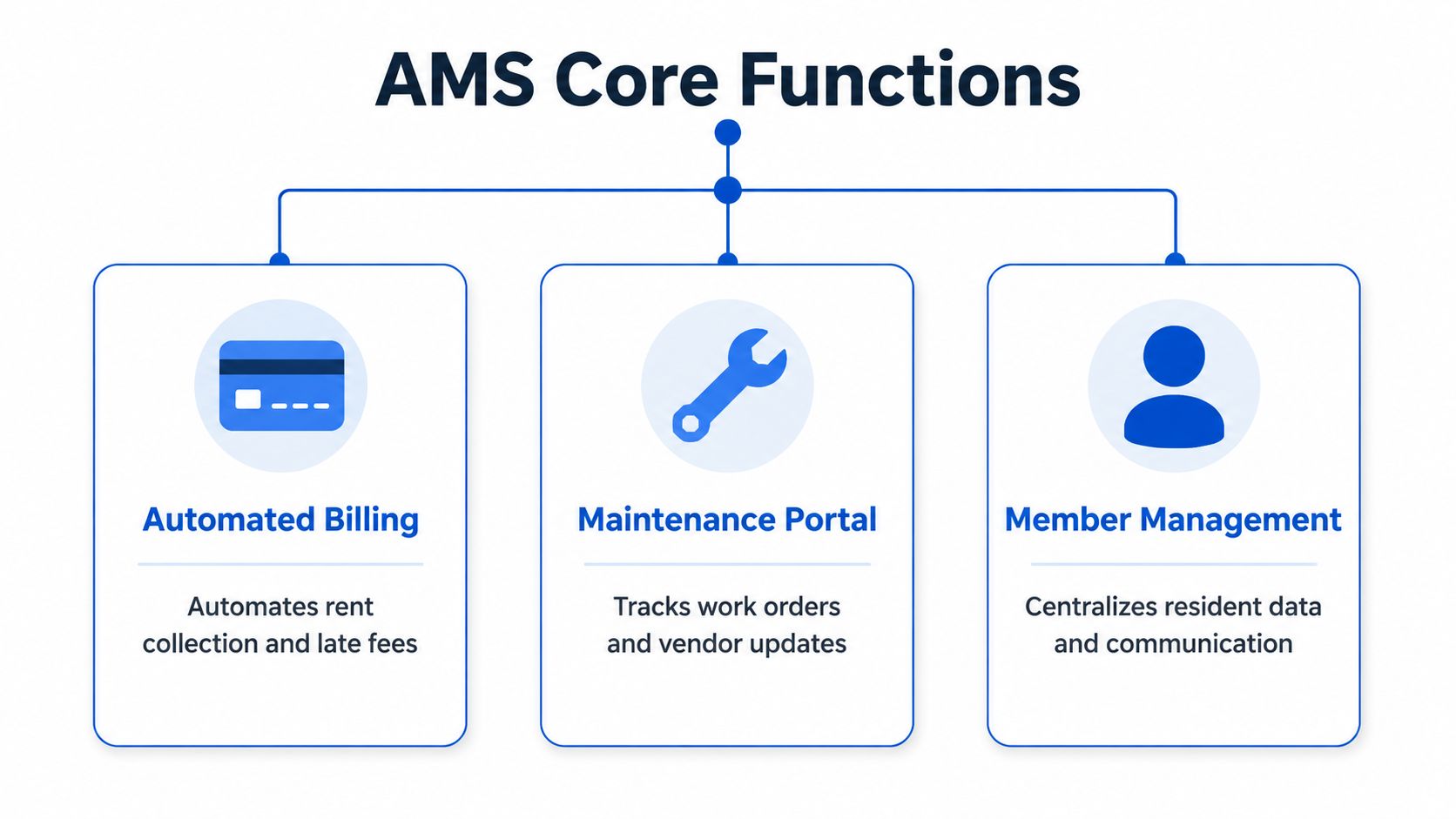
Resident and room management
The “member management” part of an AMS translates directly into tenant and room management.
Instead of keeping one spreadsheet for residents and another for rooms, the system ties them together. You can see who lives where, when they moved in, what they owe, what they've signed, and what messages they've received. That matters in co-living because the room is the revenue unit. If the room record and the resident record drift apart, mistakes follow.
This kind of setup usually works best when each resident has one core profile tied to billing, communication, and property activity.
Billing and payment workflows
Billing is where many operators lose time. Not because collecting rent is conceptually hard, but because by-the-room rentals create edge cases. Partial payments, move-in proration, room switches, deposits, credits, and late fees all create admin work.
A strong AMS handles the repetitive parts:
- Automatic rent schedules for recurring charges
- Payment tracking linked to the resident record
- Late fee rules that apply consistently
- Receipts and reminders sent without manual follow-up
If you're already leaning into automation for day-to-day operations, this guide to short-term rental automation for operators is useful context because the same discipline applies here. The less your team relies on memory, the more stable your operation becomes.
Communication and maintenance coordination
Shared housing creates more communication than a standard single-family rental. Residents need move-in instructions, house reminders, repair updates, policy notices, and occasional conflict resolution. If those messages are scattered across personal phones, they're hard to track and even harder to delegate.
An AMS gives you a central communication history. That helps with consistency and accountability.
Practical rule: If a message affects money, access, safety, or house rules, it should live inside your system, not only in a personal text thread.
Maintenance also fits naturally into an AMS-style workflow. A resident reports an issue. The issue gets logged. A vendor gets assigned. Updates are stored with the property record. Over time, you stop reacting one message at a time and start seeing patterns by house, room, or asset.
Reporting, integrations, and security
The reporting side matters more than many first-time operators expect. You need to know which rooms stay vacant longer, which houses produce the most maintenance noise, and where collections issues keep repeating. A dashboard can't make those decisions for you, but it can stop you from guessing.
A modern system should also connect with the tools you already use, such as payment processors, accounting software, smart locks, and messaging platforms. Good integrations save work. Bad integrations create hidden manual steps, which defeats the point.
Security is the final piece. Resident data includes personal and financial information. That shouldn't live in loosely shared spreadsheets forever.
Why Every Co-Living Operator Needs an AMS
The value of an association management system isn't that it feels more organized. The value is that it changes the economics of running shared housing.
When every resident, room, charge, and conversation sits in a separate place, you spend time stitching your business together. When those pieces sit in one system, your operation becomes easier to run and easier to trust.

Less admin drag means more time for revenue work
Most operators don't grow because they suddenly become better at bookkeeping. They grow because they get better at filling rooms, managing turns, controlling expenses, and keeping residents longer.
A centralized system helps by removing low-value repeat work:
- matching payments to the right person
- checking whether a reminder was sent
- looking up lease terms in old email chains
- answering resident questions that should be self-serve
- rebuilding reports at month end
Organizations that adopt a unified system like an AMS report up to a 40 to 60 percent reduction in manual data reconciliation efforts, according to i4a's overview of what an AMS is. The logic is simple. When one record tracks status, history, and engagement, fewer people have to cross-check separate tools.
Better resident experience reduces friction
Residents notice when operations are messy. They may not use the phrase “association management system,” but they feel the effect when they get the wrong balance notice, wait too long for updates, or have to repeat the same issue twice.
A cleaner system improves the basics:
| Operational area | Manual setup often feels like | Centralized setup usually feels like |
|---|---|---|
| Rent questions | Delayed replies and screenshots | Clear ledger and faster answers |
| Maintenance | Texts get buried | Requests are logged and tracked |
| Move-in process | Documents come from different places | One consistent workflow |
| House notices | Group chat confusion | Broadcasts from one channel |
That kind of consistency reduces disputes and saves owner attention for higher-level work.
A quick walk-through can help if you're evaluating the concept in action.
Scale without hiring chaos
The test comes when you add more rooms. A loose system that works for one property often collapses under a portfolio. The issue isn't only volume. It's coordination.
If you want to add houses without adding the same amount of admin overhead, you need standard workflows. A centralized platform gives you that base. You can hand tasks to a VA, an onsite manager, or an operations lead because the work lives in the system instead of in your head.
Operators who scale well don't just buy more rooms. They standardize how each room gets managed.
A Buyer's Checklist for the Right System
Not every association management system fits co-living. Many products were built for nonprofits first and only loosely map to property operations. If you're shopping for software, don't get distracted by long feature lists. Focus on whether the system handles room-by-room rentals well.
What should be non-negotiable
Use this checklist before you sit through demos.
Room-level structure: The system should treat each room or bed as an operational unit, not only the property as a whole. If you can't clearly assign a resident to a specific room and track that room's status, you'll end up rebuilding the logic outside the platform.
Flexible billing rules: Co-living billing gets messy fast. You want support for recurring charges, credits, move-in timing, and resident-specific payment histories without manual workarounds.
Communication tools that keep a record: Broadcasts, reminders, and one-to-one messages should be easy to find later. This matters when disputes come up or when you delegate leasing and support.
Maintenance workflow support: Even if the system isn't a full maintenance platform, it should let you log issues, assign follow-up, and preserve history.
Integrations that reflect real operations: Payment processors, accounting tools, and smart-home systems matter more than flashy association features that won't help a landlord.
Pricing matters more than the demo
Software can look polished and still be wrong for a small operator.
The subscription model now underpins 73.1% of deployments in 2024, which is one reason smaller operators can access stronger systems without heavy upfront spend, as noted in the earlier market data. In practice, pay-as-you-grow pricing is usually better for co-living because your needs change as you add rooms.
When reviewing options, compare:
| Question | Why it matters |
|---|---|
| How does pricing scale? | You don't want cost jumps that punish growth |
| Are key integrations extra? | Add-ons can turn a fair price into an expensive one |
| Can you start simple? | Smaller operators need a workable entry point |
| Will setup require a consultant? | Complicated onboarding can erase early value |
If you're comparing property software categories and trying to avoid buying a system that's too bulky for your stage, this breakdown of Buildium vs AppFolio for landlords is a helpful reality check.
What usually doesn't work
Be cautious with systems that need too many workarounds. If a vendor says, “You can probably customize that,” ask who will do it and how long it takes. Co-living operators rarely need endless customization. They need clean daily execution.
Buy for the workflow you run every week, not the dream workflow in the sales demo.
Your Implementation and Data Migration Roadmap
Switching systems feels bigger than it usually is. The fear comes from one question. “What if I move everything and lose track of the business in the process?” That's a fair concern, especially if your resident data lives across spreadsheets, inboxes, bank records, and text threads.
The safest way to implement an association management system is to treat it like an operations project, not an IT project.
Phase one: gather and clean your data
Start by pulling your core records into one working file.
That usually includes current residents, room assignments, balances, recurring charges, signed documents, move-in dates, notice status, and maintenance history worth preserving. Don't try to migrate every old note you've ever collected. Bring over what helps you operate and what you may need for compliance or disputes.
A simple rule helps here.
- Keep active resident records complete
- Keep recent financial history readable
- Archive old clutter instead of importing it
Phase two and three: configure first, then verify
Once your data is organized, set up the structure of the system before you load everything. Create properties, rooms, charge types, user permissions, message templates, and integrations.
Then verify the details.
Check a sample of resident records against your source files. Confirm that room assignments match reality. Review balances. Test a payment flow. Send a message template to yourself. Open and close a maintenance ticket. The point isn't perfection on day one. The point is catching obvious mismatches before residents rely on the new setup.
A smooth migration depends less on technical skill and more on clean source data.
Phase four: train, launch, and stabilize
When the system is ready, don't flip every process at once if you can avoid it. Launch the essentials first. Billing, resident records, communication, and maintenance are usually the highest-value starting points.
A practical rollout often looks like this:
- Owner setup: Learn the dashboard and core reports.
- Team access: Give staff or assistants role-based permissions.
- Resident communication: Tell residents what's changing and what they need to do.
- Go-live week: Monitor questions closely and fix process gaps fast.
Expect a short adjustment period. Residents may still text old numbers. Staff may keep side notes for a while. That's normal. What matters is bringing key work back into the system consistently.
Real-World ROI for PadSplit Hosts
The return on an association management system usually shows up in two places first. Time you get back, and mistakes you stop paying for.
For co-living operators, those gains are tangible because room-by-room management creates constant small tasks. When the system absorbs routine work, the owner gets breathing room to focus on occupancy, expenses, and expansion.

Where operators usually feel the payoff
A common pattern looks like this.
One operator starts with a couple of homes and handles almost everything manually. Rent records live in one tool. House issues come in by text. Vacancy notes sit in a spreadsheet. Nothing is fully broken, but every admin task takes longer than it should. Once that operator centralizes resident records, recurring billing, and maintenance tracking, the business becomes easier to review at a glance. The immediate payoff isn't just convenience. It's the ability to stop spending prime hours on clerical cleanup.
Another operator runs a larger room count and has a different problem. The issue isn't collecting information. It's interpreting it. A centralized system makes room-level revenue, collections friction, and maintenance patterns easier to compare across the portfolio. That improves decision-making because pricing, turnover planning, and house-level performance stop being guesswork.
Two practical examples
Consider these realistic scenarios.
| Operator type | Before a centralized system | After a centralized system |
|---|---|---|
| Small host with a few homes | Chases balances manually, searches texts for maintenance history, rebuilds reports at month end | Uses one resident record, standard reminders, and a shared issue log |
| Growing operator with many rooms | Sees revenue at the bank-account level but struggles to compare room performance | Uses dashboards to review occupancy, collections, and room-level trends |
In both cases, the financial impact often ties back to the same fundamentals:
- Faster decisions because the right information is easier to find
- Fewer avoidable errors in billing and communication
- Better use of owner time on leasing, turnover, and acquisitions
- Clearer performance tracking across houses and rooms
If you care about portfolio performance, understanding gross effective income in rental operations helps connect software decisions to actual operating results. The point isn't to buy software for its own sake. It's to protect revenue and reduce drag.
The best ROI from software often comes from the tasks you stop repeating, not from a flashy feature you use once a month.
What not to expect
An AMS won't fix bad leasing, weak screening, or poor house rules. It won't turn an underperforming property into a strong one by itself. What it will do is give you cleaner information and more consistent execution, which makes those other problems easier to address.
That's why operators who benefit most from centralization usually pair the system with standard operating habits. They document workflows, keep records current, and use the dashboard to manage by exception instead of reacting to every message live.
The Future of Room-by-Room Management
Room-by-room rentals have outgrown the old operator toolkit. Spreadsheets, scattered apps, and personal text threads might get a business off the ground, but they don't support clean growth for long. At some point, every co-living operator has to choose between staying reactive and building a system that can handle more rooms without more chaos.
That's where an association management system becomes useful for this niche. Not because co-living is identical to a traditional association, but because both models rely on managing a community through one operating center. In shared housing, that center needs to connect residents, billing, maintenance, communication, and performance reporting in a way that feels simple to use.
What the next generation of tools should do
The strongest platforms for this category will likely share a few traits:
- Built around rooms, not just units
- Designed for recurring communication
- Connected to payments and smart-home tools
- Clear enough for small operators to run without technical help
The operators who win over the next few years probably won't be the ones with the most apps. They'll be the ones with the cleanest operating system.
Shared housing runs better when every important action leaves a clean record.
Purpose-built tools for co-living are starting to close the gap between generic property software and the practicalities of managing a house full of individual residents. That's a good shift for hosts who want better control without building a patchwork stack on their own.
If you're a PadSplit host or co-living operator who wants a cleaner way to manage pricing, communication, access, and reporting, join the interest list for PadPulse. It's being built specifically for room-by-room operators who want less operational noise and better visibility into what each property is doing.