Property Valuation Methods: Co-Living & PadSplit Portfolio
July 22, 2026
You've got the rooms leased, the cash flow looks strong, and then the appraisal comes back as if your co-living house is just another ordinary home. That gap is where a lot of hosts get stuck. They know the property performs like a business, but they don't always know how to explain that performance in the language of property valuation methods.
The good news is that appraisers aren't guessing, they're usually following a logic tree. If you learn how the Sales Comparison Approach, Cost Approach, and Income Approach work, you can read a valuation report with a sharper eye, spot weak assumptions, and defend the parts of your property that drive value. For room-by-room rentals and PadSplit-style houses, that matters because the value often comes from NOI, not from looking like every other single-family home on the block.
Why Your Co-Living Property Is Worth More Than You Think
A host gets excited about a refinance, orders the appraisal, and then feels deflated. The house has strong room rents, the utility setup is dialed in, and vacancy is stable enough to keep the calendar full, yet the report still leans on ordinary neighborhood sales. That mismatch is common when an appraiser is forced to treat a co-living property like a standard residence.
The core problem is that the asset isn't behaving like a normal home. It's producing income through separate rooms, shared spaces, and operating systems that a traditional buyer might never think about. In that situation, property valuation methods need to reflect the business reality, not just the paint colors and square footage.
Practical rule: If the property makes money because of how it's operated, the valuation should show that operating engine somewhere in the numbers.
That's why experienced investors pay attention to all three valuation lenses at once. The sale comparison lens asks what similar properties sold for, the cost lens asks what it would take to rebuild the asset, and the income lens asks what the property earns after expenses. For a shared-house operator, the income lens usually carries the most weight because the rooms are the product.
A better way to think about it is this, the appraisal is a conversation between a historian, a builder, and an accountant. The historian looks at what the market has paid, the builder looks at replacement cost, and the accountant looks at cash flow. If your property is a room-by-room rental, the accountant's voice is usually the one you want to strengthen.
The Three Core Property Valuation Methods Explained
Every valuation starts with a simple question, what is this property really worth, and from whose point of view? One appraiser might focus on recent sales, another on construction cost, and another on cash flow. The three approaches exist because each one catches a different part of the truth.
The Sales Comparison Approach, sometimes called the market approach, compares the subject property with similar recent sales and adjusts for differences. The Cost Approach estimates what it would cost to reproduce the property, adjusts for age and obsolescence, then adds land value. The Income Approach values the property by what it can earn, which is why it becomes so important for operating assets. A clear overview of those core methods appears in this appraisal guide from New England Condo.
Sales Comparison Approach
Think of this like shopping for a used car. You look at similar cars, compare mileage, condition, and features, and then decide whether the asking price is fair. In real estate, the appraiser compares your property with recent nearby sales and makes adjustments for differences.
That works well when the property is ordinary and the market is active. It gets messy when your house has more bathrooms, more locks, more operational intensity, and more rent-earning bedrooms than the typical comp. A standard house next door may look similar from the street, but it can be a poor match for a co-living investment property.
Cost Approach
The cost method asks a builder's question, what would it cost to create this asset again? The appraiser estimates reproduction cost, subtracts depreciation from age or obsolescence, and adds land value. That makes sense for unique buildings and newer assets where sales evidence is thin.
For hosts, this approach can be useful when you've made major physical upgrades that aren't reflected in nearby sales yet. New plumbing runs, added bathrooms, or a full-room conversion can matter here. The weakness is that cost doesn't always equal market demand, so it's usually best treated as a support tool rather than the whole answer.
Income Approach
This is the accountant's lens. The property is worth what its cash flow can support, and that's especially true in co-living. When a house is operated as a room-by-room rental, buyers are really buying future income streams, not just walls and a roof.
A property can look plain and still appraise well if the income is strong. A flashy property can appraise poorly if the rent math doesn't work.
Applying the Sales Comparison Approach to Co-Living Homes
The sales comparison method still matters, but co-living operators have to use it carefully. A six-room shared house is not directly comparable to a standard three-bedroom family home, even if they sit on the same street and share the same exterior style. The market may be nearby, but the business model isn't.
That means the best comps are often imperfect. You may need to compare with the closest available properties, then adjust for the things that drive room-by-room demand, such as bathroom count, bedroom configuration, privacy, parking, and proximity to transit. A good comp analysis starts with similarity, then works toward realism, not the other way around. For a practical framework, see comparable property analysis.
What to compare, and what to ignore
Some features deserve more weight than others in a shared-house valuation. Extra bathrooms often matter more than a fancy dining room because they change the daily living experience for multiple occupants. Better lockable bedrooms, cleaner common areas, and easier access to transit can also influence what a room-by-room buyer will pay.
Use this method like a filter:
- Start with the closest physical match: Similar size, neighborhood, and layout.
- Adjust for co-living functionality: Bedroom count, bath count, and shared-space usability.
- Respect the rent model: A house that supports room-by-room leasing should not be priced only like an ordinary single-family rental.
- Watch the overcompensation trap: A big kitchen doesn't matter much if the rooms can't command strong rents.
The key mistake is assuming a comp is “good enough” because it's in the same ZIP code. It has to be good enough for the buyer you're targeting. If the buyer is an operator who values income, then the comparison should reflect operator demand, not just homeowner demand.
That's why this method works best as a check, not as the whole valuation story. It helps you see where the market is anchored, but it rarely captures the full earning power of a well-run shared house.
The Income Approach Your Co-Living Superpower
For co-living, the income approach usually tells the truth better than any other method. It treats the house like a business that sells room access, utility convenience, and occupancy flow. The relevant formula is straightforward, Valuation = NOI / Cap Rate, and for room-by-room rentals the starting point is usually NOI, or Net Operating Income.
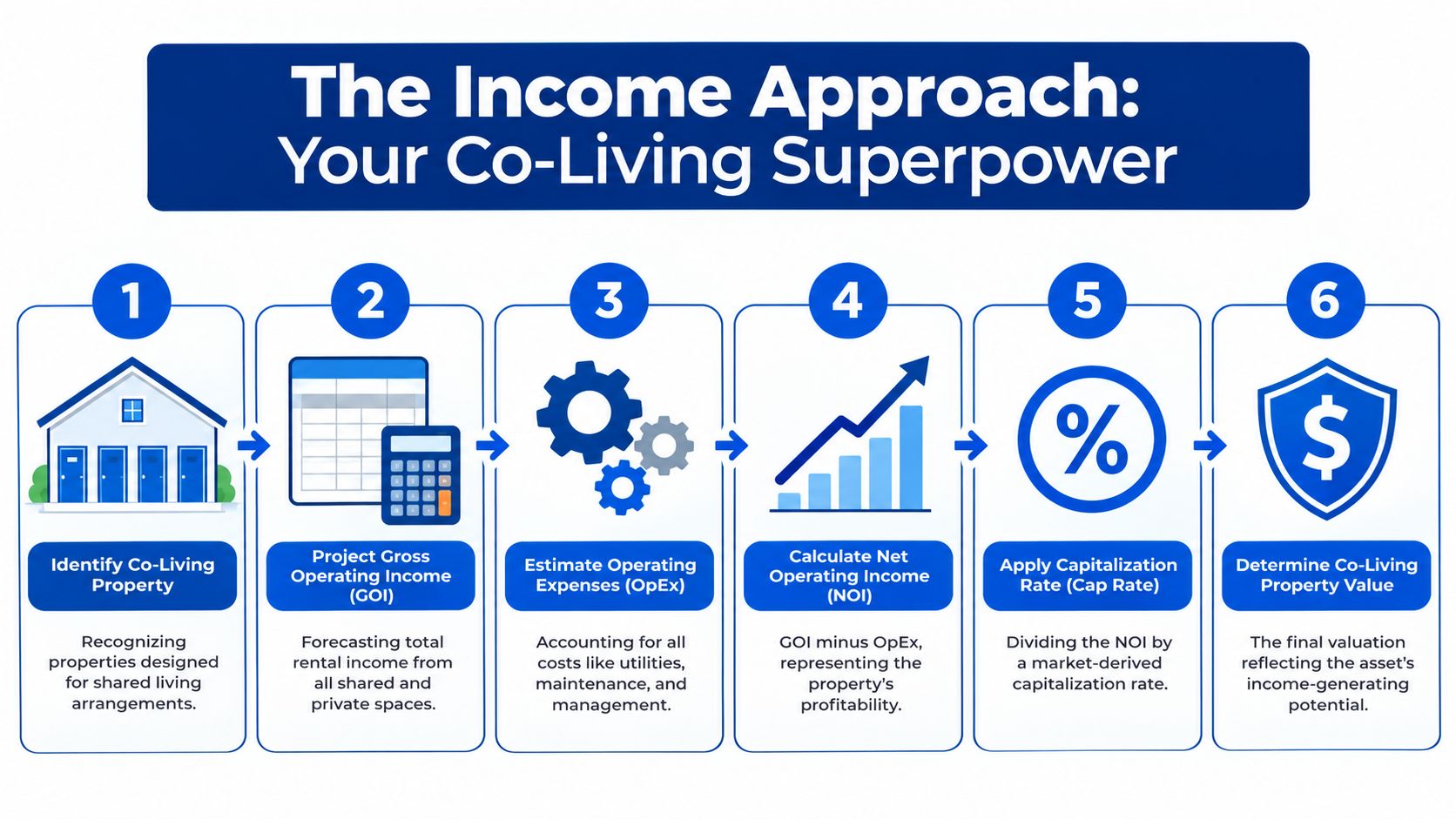
For co-living or room-by-room rentals, NOI is built from total revenue minus operating expenses, and the workflow usually starts with typical gross market rents, then a vacancy deduction to reach effective gross income (EGI) before expenses are removed. That structure is described in this co-living valuation guide. If you want a tighter grip on the expense side, this NOI explainer is worth keeping handy.
Step one, build gross room revenue
Start with each rentable room, not with the whole house as a single unit. If one bedroom rents for a different amount because it has a private bath or better light, keep that separate in your estimate. A co-living house is a bundle of mini-products, so the revenue model has to match that reality.
Step two, subtract vacancy and operating costs
Vacancy matters because not every room stays full all the time. Then subtract operating expenses like utilities, cleaning, repairs, platform fees, insurance, and management. NOI is what's left after the property pays its own bills, before debt service and taxes.
A simple worked example
Say a house has five rooms, each rented individually. If the total monthly room revenue is $3,000 and monthly operating expenses are $1,200, the monthly NOI is $1,800. On an annual basis, that's $21,600 in NOI.
If the market cap rate for a similar income property is 10%, the valuation would be $216,000 using the NOI divided by cap rate formula. The number is only as good as the inputs, but the logic is what matters, strong NOI supports a higher value.
Practical rule: When you improve NOI, you're not just improving cash flow, you're also improving what an income buyer may be willing to pay.
GRM and EBITDA multiple
Some operators also use the Gross Rent Multiplier (GRM) as a faster screening tool, especially when they need a rough value check. In a co-living context, that can help you move quickly, but it still relies on reliable rent data. The same is true for the EBITDA multiple approach, which is often used when the operation is asset-light and the business performance matters more than the building itself.
Using the Cost and Residual Valuation Approaches
The cost approach becomes especially useful when the market can't tell you much. That happens with newly built shared houses, highly customized properties, or major conversions where nearby sales don't reflect what you've created. A recent review of specialized-property valuation literature says standard comparable-sales and income-capitalization methods often fall short in these data-scarce settings, and it recommends flexible use of cost-based and income-based methods, with the income method often the best primary choice when possible. That same concern appears in a 2025 paper on specialized-property valuation uncertainty from IJSAT.

Where cost helps most
Use the cost approach when your property is hard to compare and you can document the physical work clearly. If you converted a standard home into a higher-function shared property, the value story may include new walls, added bathrooms, updated plumbing, and other improvements that a sales comp can miss. The method won't fully capture business performance, but it can support the argument that the asset would be expensive to replace.
Where residual thinking matters
Residual valuation is different. It asks what the property could be worth after a planned project is completed, which makes it useful for acquisitions, remodels, and ground-up development. Investors use it when they're deciding whether a lot, teardown, or heavy-rehab house can become a viable co-living asset after the dust settles.
That mindset fits hosts who are planning their next move, not just defending an existing appraisal. If the project only works when the future income supports the end value, then residual thinking forces discipline before you spend on construction. For depreciation and improvement tracking, this depreciation calculation resource can help organize the paper trail.
The big lesson is simple. Cost tells you what it took to create the asset, and residual thinking tells you whether creating it makes sense in the first place. Both are useful when the market doesn't have a neat stack of comps waiting for you.
Common Valuation Pitfalls and Modern Tools
Most appraisal mistakes in co-living aren't dramatic. They're small math errors, sloppy assumptions, or weak documentation that erode value. A host might undercount utility costs, forget to support repairs, or use a cap rate that belongs to a different neighborhood and risk profile.
The same problem shows up on the revenue side. If room vacancy is assumed to be too optimistic, or if rent estimates don't reflect the actual leasing pattern of the house, NOI gets overstated. Once NOI is distorted, the income approach will still look precise, but it won't be trustworthy.
What to watch closely
- Operating expenses: Track utilities, cleaning, maintenance, and management with the same discipline you use for rent.
- Vacancy assumptions: Use a realistic assumption for room turnover and downtime, not a hopeful one.
- Cap rate selection: Match the rate to the property type and local buyer expectations.
- Improvement records: Keep receipts, before-and-after photos, and scope notes for major upgrades.
Technology is changing how valuation gets done at scale. The Lincoln Institute notes that the biggest shift in assessment practice over the past three decades has been computer-assisted mass appraisal (CAMA), which uses formulas to estimate market value from property characteristics and sale prices, and it also highlights GIS-based response surfaces that use geocoded parcel data and nearby amenities to model location value. It further points to a broader move toward machine-learning-driven predictive models for portfolio-level valuation in traditional land valuation practice.
That doesn't replace judgment. It just means the modern operator has more tools than a paper comp and a calculator. The smartest hosts use the model that best fits the asset, then test it against reality.
Which Valuation Method Should You Prioritize
The right method depends on the question you're asking. If you want a quick market check, the sales comparison approach can give you a rough anchor. If you're planning a new build or a major conversion, the cost approach and residual thinking matter more. If you run an income-producing house, the income approach should usually lead.
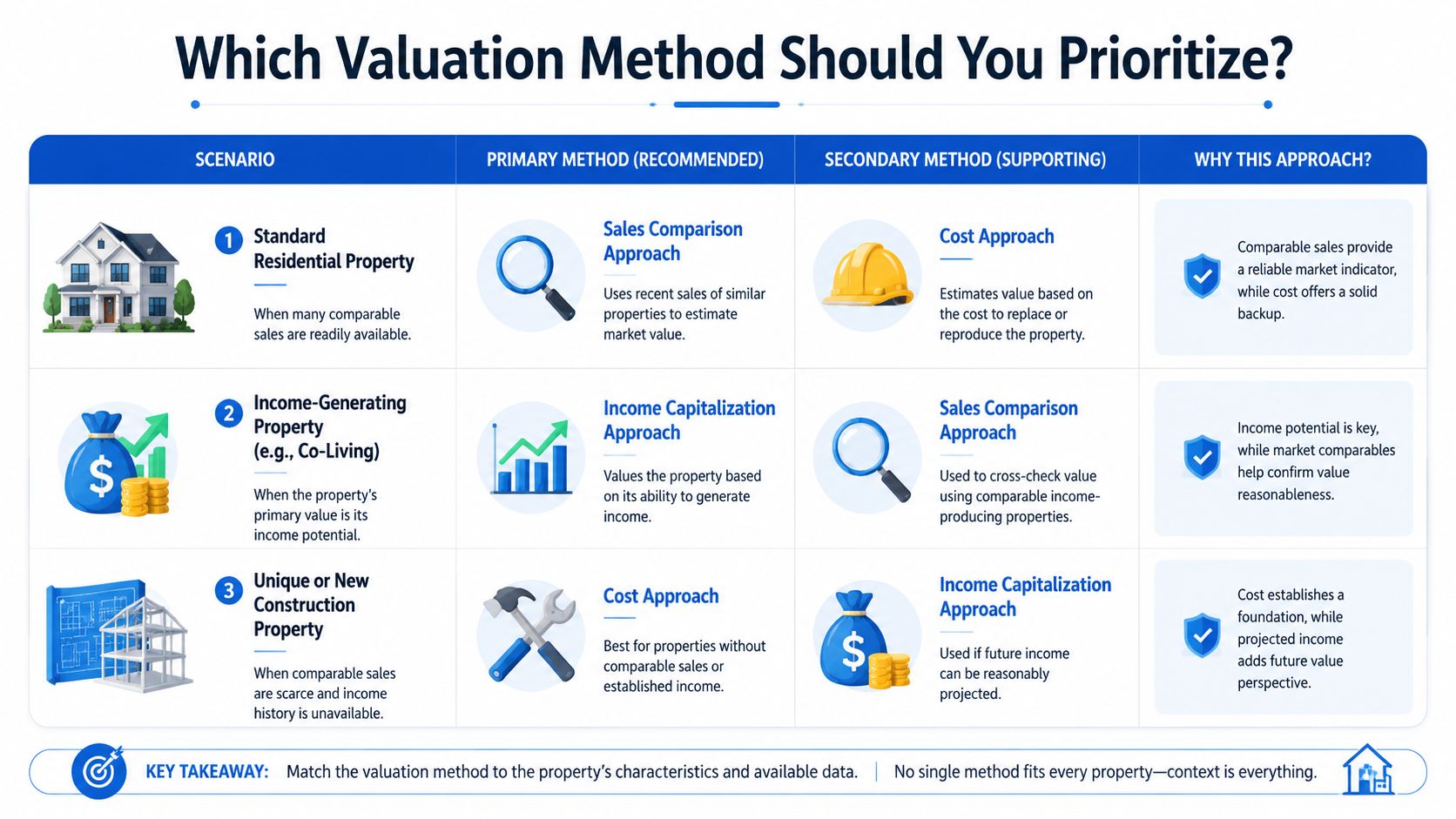
A simple way to prioritize them looks like this:
- Standard residential property: Start with sales comparison, then use cost as a check.
- Income-generating property such as co-living: Start with income capitalization, then use sales comparison as support.
- Unique or new construction property: Start with cost, then use income if future performance can be projected.
That ranking reflects how buyers think. A homeowner buyer wants market context, a builder wants replacement logic, and an investor wants cash flow. For co-living operators, cash flow is usually the center of gravity, because that's where business value resides.
The practical move is to learn all three, then know which one deserves the microphone. If your room-by-room rents are strong, your paperwork is clean, and your operating expenses are under control, you're in a much better position to justify value on refinance, sale, or acquisition. Keep your focus on NOI, document your improvements carefully, and treat the appraisal like a business discussion, not a guessing game.
If you want better results on your next refinance, acquisition, or portfolio review, start by tightening your NOI story and your comp support today. A smarter valuation process can change how lenders, buyers, and partners see your co-living assets, so use these methods on your next deal with PadPulse.