Property Management Fees Explained for Real Estate Investors
August 2, 2026
What are you paying for when a manager says 10% and the other one says 12%? Most landlords ask the wrong question first. The question is whether the fee matches the work, because a simple percentage can hide a very complicated service bundle.
That's why property management fees deserve a sharper look than most brochures give them. The number on the proposal matters, but the workload behind it matters more, especially if you run room-by-room rentals or co-living houses where every vacant room, message, inspection, and reset adds real operating friction.
What Property Management Fees Actually Cover
A first-time landlord usually gets two quotes and thinks the higher one is overpriced. Then the lower quote starts adding line items for leasing, inspections, maintenance coordination, and renewal work, and the “cheaper” deal gets a lot less cheap. That's the trap.
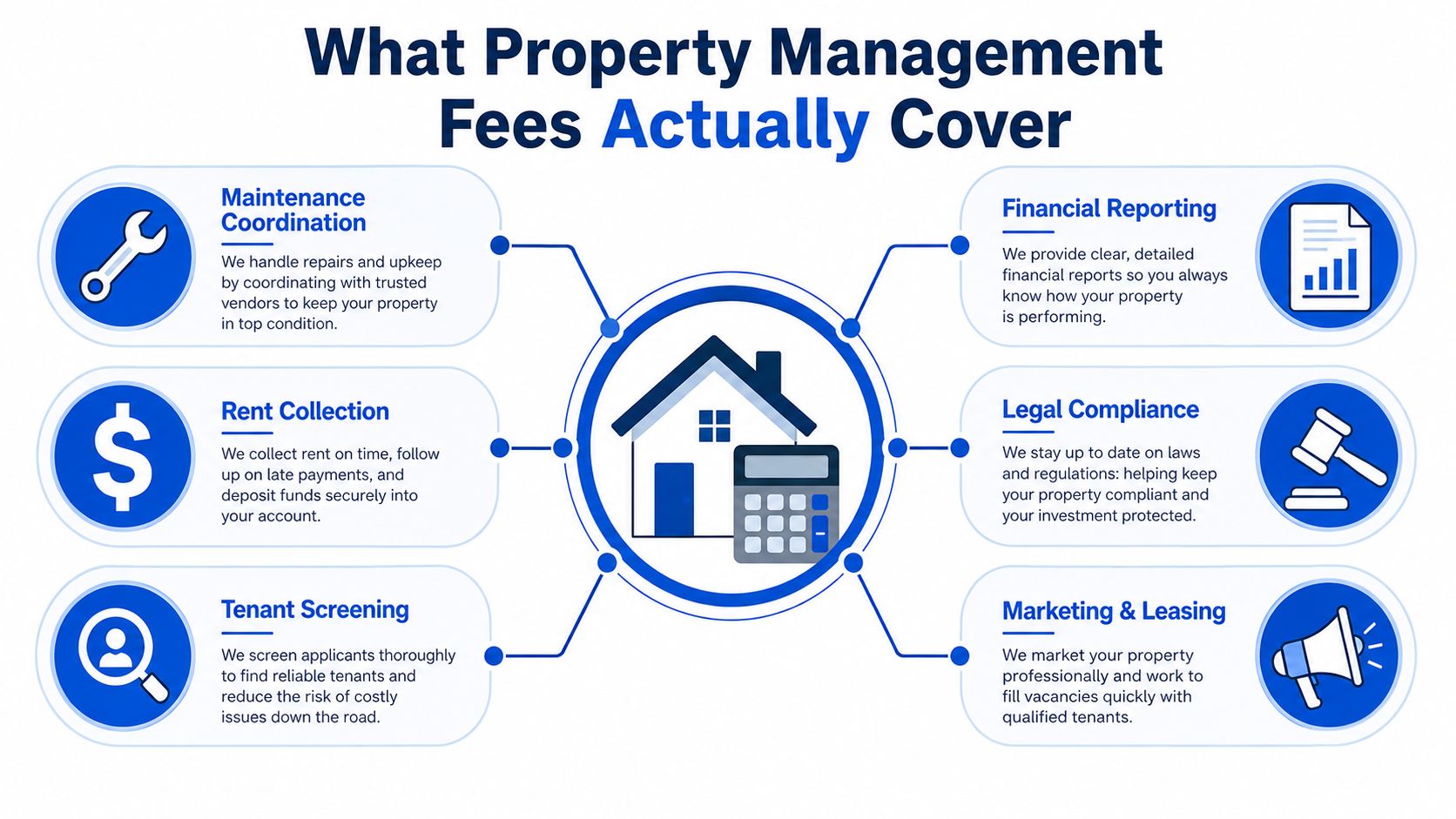
At the core, property management fees pay for the daily tasks that keep a rental from turning into a second job. Those tasks usually include rent collection, tenant communication, maintenance coordination, accounting, screening, lease enforcement, and handling emergencies after hours. A solid manager is not just “collecting rent.” They're managing the operational mess that shows up before it becomes a vacancy or a legal problem.
What's usually inside the base fee
A full-service agreement often covers the recurring work that keeps a property stable. That includes collecting rent, answering tenant questions, coordinating repairs, tracking the books, and handling routine compliance tasks. The exact bundle varies, which is why the headline percentage alone tells you very little.
Practical rule: If the manager won't give you a written list of included services, assume some of the work is being billed separately.
The cleanest way to compare quotes is to ask what's included and what triggers a surcharge. A manager who handles showings, screening, accounting, and after-hours calls is doing a different job than one who only collects rent and forwards maintenance requests. That distinction matters more than the sales pitch.
For a simple operational checklist, review this property management checklist guide and compare it line by line against the contract you're reviewing.
Full-service, leasing-only, and a la carte
Full-service means the manager handles the ongoing day-to-day work. Leasing-only means they fill the vacancy, then step back. A la carte means you buy individual tasks one at a time, which can look flexible but often gets expensive fast if your property needs constant attention.
If you own a stable long-term rental with low turnover, a lighter arrangement can make sense. If you run a property with frequent move-ins, high message volume, or regular maintenance coordination, the “partial service” model usually becomes a false economy. The more operational touchpoints you have, the more important it is to know exactly what you're paying for.
The Four Main Fee Models Compared
The best fee model depends on how your property behaves, not on which manager says their plan is “standard.” A single-family rental and a 40-room co-living house do not produce the same workload, so they shouldn't be priced as if they do.
Here's the short version. Percentage-based pricing aligns revenue with rent collected. Flat fees create predictable costs. Per-door fees make more sense when the manager is tracking multiple units or rooms. A la carte works only when you know exactly which tasks you want to keep in-house.
| Fee Model | Typical Cost | Incentive | Best Fit |
|---|---|---|---|
| Percentage of rent collected | Usually tied to monthly rent | Manager earns more as collected rent rises | Long-term rentals and owners who want aligned incentives |
| Flat monthly fee | Fixed amount per unit or property | Predictable billing, weaker upside tie | Simple, steady rentals with limited turnover |
| Per-door fee | Charged per room, unit, or door | Scales with count, not just revenue | Larger portfolios, room-by-room rentals, co-living homes |
| A la carte | Individual charges for specific tasks | You only pay for what you use | Experienced owners who want tight control over scope |
Percentage pricing is common because it scales with rent, but it can blur the difference between low-touch and high-touch properties. A flat fee can be better when the manager's workload is stable and the property doesn't generate a lot of surprises. Per-door pricing is often cleaner for shared housing because it reflects the number of operational touchpoints, not just the gross rent total.
A la carte is the most dangerous model if you don't read the agreement closely. It looks lean at signing and then starts charging for every meaningful task. That's fine if you're running a tight operation and want control. It's a bad fit if you expect the manager to absorb complexity without charging for it.
Market Benchmarks You Can Plan Around
The first question is not what percentage sounds fair. It is what level of operational complexity you are buying. A basic long-term unit should sit in a different fee bracket from a room-by-room house, and a co-living property should be priced for the extra labor it creates.
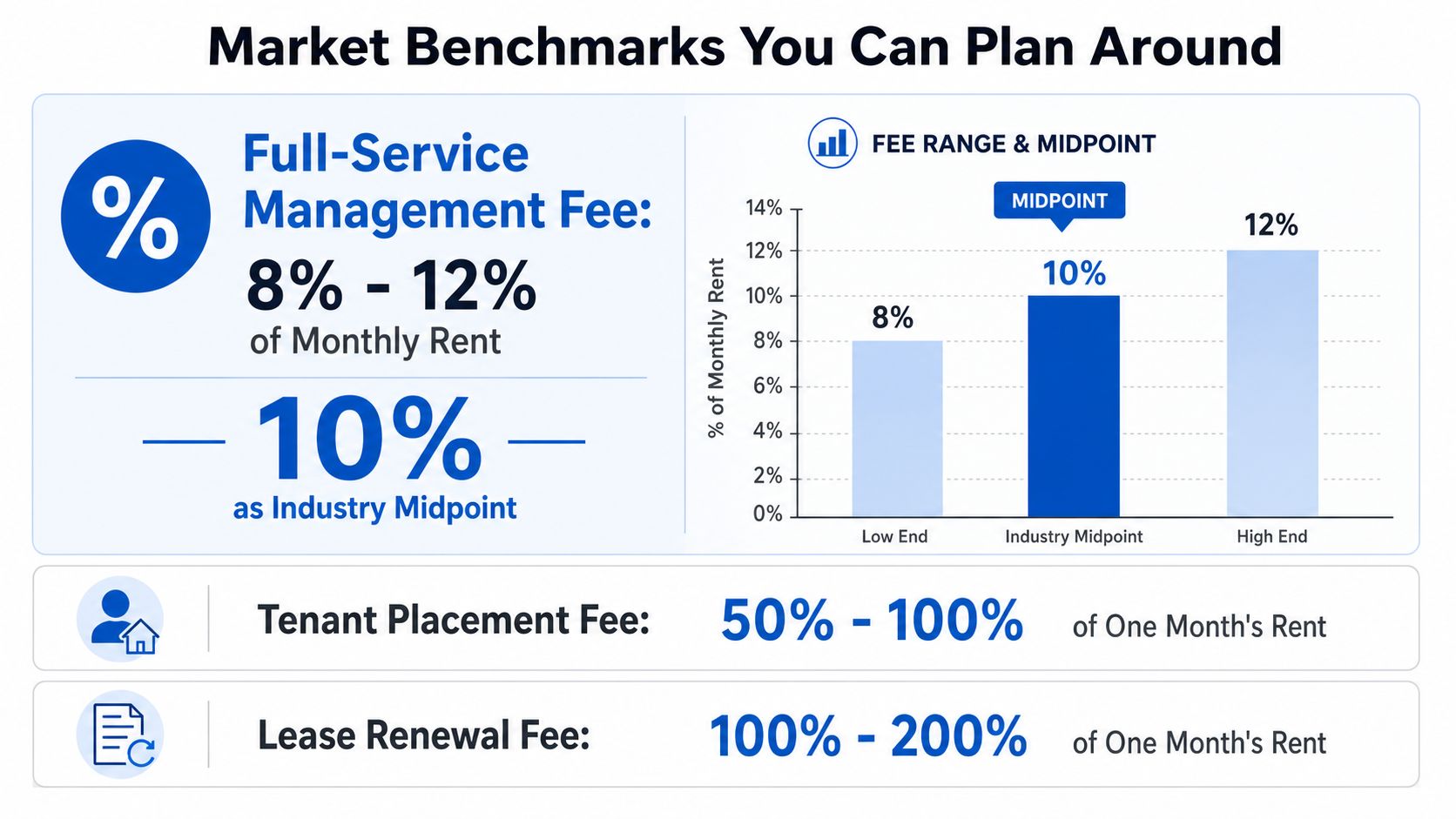
For full-service residential management, the market still lands around 8% to 12% of monthly rent, with 10% commonly used as the middle of the range. One independent sample put the average management fee at 8.49% of collected monthly rent, while flat-fee structures averaged $101.04 per unit per month in that sample (iPropertyManagement research). Those numbers matter because they show how often managers still price off collected rent instead of one universal fixed fee.
Why the benchmark shifts by asset type
The same fee structure does not belong on every asset. Long-term residential rentals usually stay near the standard 8% to 12% band, while short-term rental managers often charge 15% to 25% of rental income, and some sources put them at 25% to 40% because the manager is covering guest messaging, cleaning coordination, and round-the-clock support (Baselane). That spread makes sense. More touchpoints mean more labor.
Operational intensity is the primary driver. The Net Operating Income guide is the right lens here, because a fee that looks modest on paper can still crush returns once it stacks on top of vacancies, turnover work, and small service charges. A property that needs constant attention belongs in a higher service band, full stop.
Negotiation anchor: Start with the benchmark, then classify the property as low-touch, standard, or high-complexity before you discuss price.
If you want a market-rent check before you compare proposals, use this market rent guide to make sure the manager is charging against realistic income, not an inflated assumption.
Where your property probably fits
A stable long-term unit belongs in the standard residential bracket. A short-term rental belongs in a much higher service band because the manager is doing more work for every dollar collected. Room-by-room and co-living properties usually sit between those two worlds, and that is exactly why they should be priced by workload instead of habit.
Do not treat the benchmark like a rule. Treat it like the opening position in a negotiation.
The Hidden Add-On Fees That Drain NOI
The biggest mistake landlords make is stopping at the monthly management percentage. That number is only the front door. The back door is where NOI leaks out.
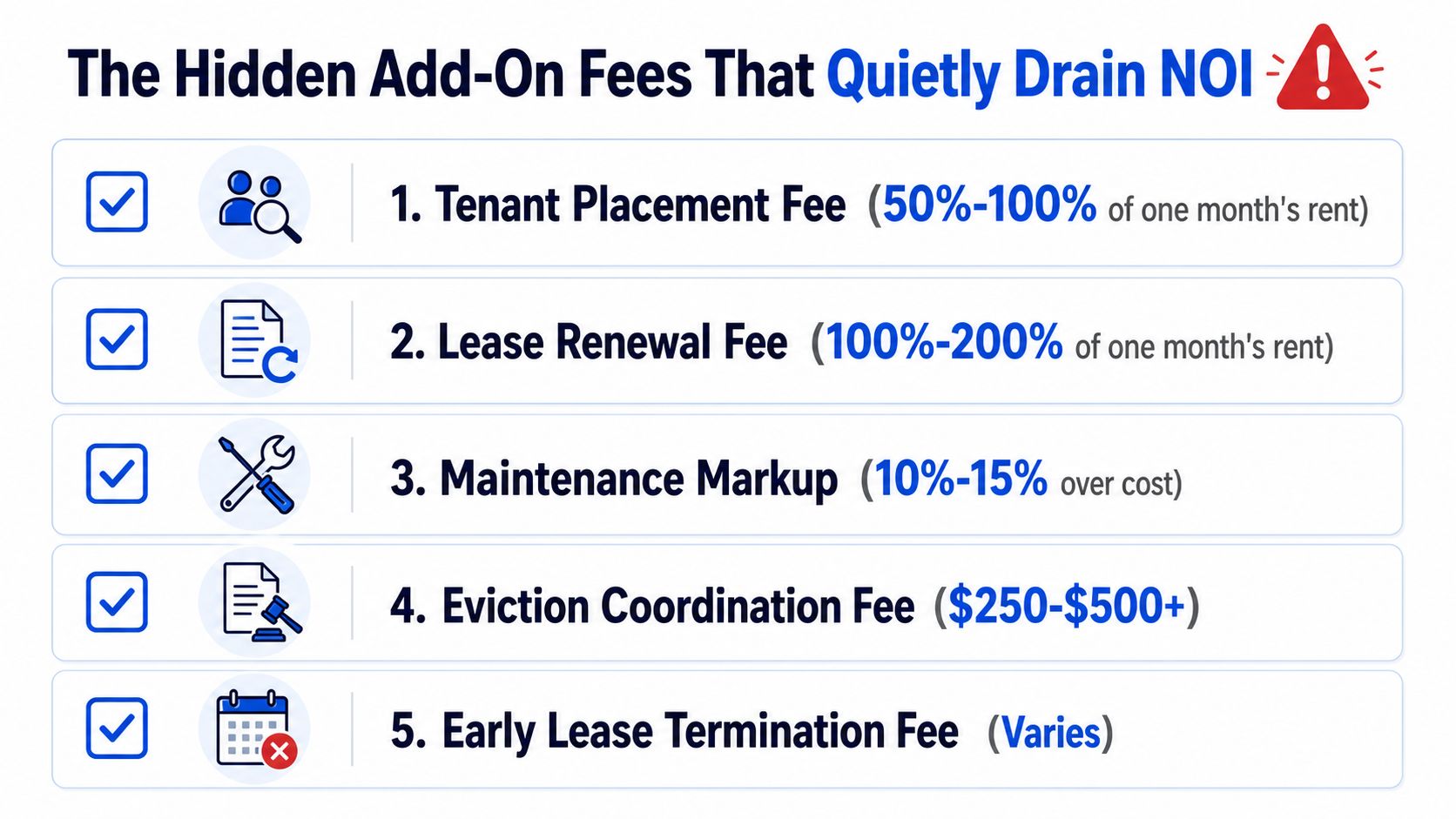
The charges that hurt most are the ones buried in the agreement. Tenant placement fees are often set at 50% to 100% of one month's rent (MYND, Home365). If a property turns over often, that single fee can outweigh months of routine management. Add that to monthly charges and the first-year total can push well past the headline rate, with one research source saying the total first-year cost can reach 18% to 20% of gross rent once add-ons are included (Clear Lead Digital).
The charges landlords miss first
The same agreements that advertise simple pricing often hide the cost in the fine print. Maintenance markups are commonly described around 10% to 25% on vendor invoices, and some operators use separate renewal, inspection, or administrative charges (Home365, Bluefield Group). That is why two managers quoting the same monthly rate can produce completely different bottom lines.
A lease renewal charge also deserves attention. Some providers charge a flat fee, while others use a percentage-style approach. Either way, renewal work is not free in many contracts, and it should never be assumed into the base fee.
What to ask before you sign
Use this checklist and get every answer in writing.
- Tenant placement: Ask whether the fee is charged per placement, and whether it changes with vacancy length.
- Maintenance markup: Ask whether the manager adds a percentage to vendor invoices or uses a flat coordination fee.
- Renewals: Ask if lease renewals are included or billed separately.
- Inspections: Ask whether move-in, move-out, and periodic inspections are part of the base fee.
- Miscellaneous charges: Ask what counts as emergency, legal, or after-hours work.
If you are comparing whether these add-ons are eating your NOI, map them against this NOI primer before you approve anything.
Property Management Fees in Room-by-Room and Co-Living Operations
Room-by-room housing changes the economics fast. The manager is not just collecting one rent check and handling one set of tenant issues, they are dealing with multiple occupants, more touchpoints, faster turnover, and more chances for something to break when coordination slips.

A management fee that looks normal on a single-family lease can become expensive in a shared-house setup. The same percentage on room-by-room revenue may cover more work, or it may hide a cheap-looking rate that underprices the operator's labor. The number alone tells you almost nothing. The workload behind it tells you everything.
Why shared housing needs a different pricing lens
Co-living operators should stop asking whether a percentage sounds fair and start asking what operational complexity they are paying for. That means looking at member communication, smart-lock access, vacancy churn, room-level pricing, and constant turnover coordination. Those tasks hit every property differently, and they drive the cost of management.
A percentage model still works if the scope matches the property. If the manager is handling room-level pricing, onboarding, guest-style communication, and turnover coordination, a standard residential fee may be too low for the labor involved. If the property is simple and most of the process is automated, the manager should not be paid like every room requires a separate full-service team.
The mistake operators make
Operators make the same bad comparison over and over. They compare fee percentages without comparing the actual workload. Two managers can quote the same percentage, but one may be managing a quiet long-term house while the other is fielding constant operational tasks across several rooms. Those are not the same job.
Operator rule: Price the manager against task volume, not just rent total.
Room-by-room housing should be treated as an operations-heavy asset. The contract should say exactly what the manager handles, what triggers extra billing, and how room-level work is priced. If the agreement pretends the property works like a conventional rental, the owner will usually pay for that mistake through weak service, surprise fees, or both.
The video above is worth watching if you are comparing manager proposals against a room-by-room operating model. Room-level management should be priced like a specialized service, not like a standard rental with extra paperwork.
How to Negotiate Better Property Management Fees
Negotiation works best when you know where the manager has room to move. Smaller portfolios, hard-to-fill units, and owners willing to handle part of the workload all create bargaining power. If you show up as a completely hands-off owner with a difficult property, your bargaining power shrinks fast.
The first thing to push for is a defined scope of services. Spell out what's included, what's extra, and when approval is required before spending money. If the contract is vague, the manager gets to interpret the gray areas in their favor.
Clauses worth asking for
A stronger contract usually includes these items:
- Capped maintenance markup: Set a hard ceiling on vendor invoice markups.
- Tiered percentage pricing: Ask for a lower rate as rent rises or as your portfolio grows.
- Included-services list: Make rent collection, messaging, and standard coordination explicit.
- Performance-based exit clause: Give yourself a way out if service quality slips.
- Invoice transparency: Require itemized third-party invoices for repairs.
You should also push back on automatic renewal language that lets rates rise without a fresh conversation. Broad indemnity language is another red flag, especially if it shifts too much risk onto the owner. And any line item labeled “miscellaneous fees” deserves immediate scrutiny.
Practical rule: If a manager can't explain a fee in one sentence, don't sign the fee.
The right negotiation posture is firm, not emotional. Ask for clarity, ask for caps, and ask for a scope that matches the property's actual workload. If the manager refuses basic transparency, that tells you more than the price does.
Alternatives Worth Considering Before You Sign
Traditional full-service management is not the only way to run a property well. In some cases, it's the most expensive way to do a pretty ordinary job.
Flat-fee services can work when the property is stable and the workload is predictable. They give you billing certainty, which is useful if you hate percentage-based variability. The downside is obvious. If the unit is simple, fine. If the property starts demanding more attention, the value proposition can vanish.
Tech-enabled platforms are the next obvious alternative. They automate leasing workflows, messaging, rent collection, and sometimes pricing, which can reduce the amount of human labor required to keep the asset moving. That doesn't remove management from the equation, but it can compress the cost of routine tasks.
Where self-management still wins
Self-management works when the owner can execute. That means answering messages quickly, coordinating vendors, tracking payments, and staying on top of compliance without dropping balls. It's not passive, and too many people fool themselves about that.
For room-by-room operators, the best middle ground is often a hybrid setup. The owner handles the parts they're best at, and software or a specialist handles the repetitive work that eats time. That approach can be especially strong for shared housing because the workload is fragmented across many rooms, not concentrated in a single tenant relationship.
If you're comparing options, use this simple filter:
- Choose full-service when you want someone else to absorb the burden.
- Choose flat-fee when the property is simple and predictable.
- Choose self-management when you have time, systems, and discipline.
- Choose tech-assisted management when the property is operationally dense and you want to reduce labor without losing control.
The right answer is the one that protects NOI without creating chaos in the day-to-day operation.
Smart Takeaways for Landlords Ready to Move
The key question is not what percentage sounds fair. It is what operational complexity you are paying for, and whether that complexity is part of your property's day-to-day reality.
For a standard residential rental, the market still clusters around the familiar range noted earlier in iPropertyManagement research. Treat that as a starting point, not a decision rule. Once you move into room-by-room, co-living, or otherwise high-touch operations, the fee has to track the work, not just the rent roll.
Model the full first-year cost, not the monthly headline. Leasing fees can distort the math fast, and maintenance markups can turn a quote that looks clean into one that eats into NOI. If a manager is vague about setup charges, renewal charges, or repair handling, assume the final bill will be higher than the pitch.
Shared housing deserves a different lens. Room-by-room operators should ask whether the manager is absorbing more tenant communication, more move-in and move-out churn, more issue tracking, and more coordination across units than a conventional landlord setup. If they are carrying that load, the contract should say so in plain terms. If they are not, there is no reason to pay a premium just because the asset sounds more complicated.
Insist on a capped markup, a tight service list, and invoices you can audit. If the scope is fuzzy, you are not comparing management companies. You are agreeing to a structure that can drain margin later through add-ons and surprise billing.
Before you sign, compare full-service, flat-fee, hybrid, and self-management against your real workload, not your comfort level. A room-by-room operator with strong systems may do better with a lighter model than a traditional landlord would. A hands-off owner with a messy asset may need to pay for more support. The right fee structure is the one that protects NOI and matches how the property really runs.