Property Insurance Coverage for Co-Living Operators
August 17, 2026
The most popular advice about property insurance coverage is also the most dangerous: buy a standard landlord policy, set the rent-loss limit, and renew it every year. That approach may work for a straightforward single-family rental. It can fail badly when a house operates as a room-by-room business with shared kitchens, frequent move-outs, multiple leases, and rooms that sit empty between occupants.
Co-living insurance isn't just about whether fire, wind, or theft appears on the declarations page. The key question is whether your policy matches how the property operates every day. Vacancy, mechanical breakdown, roommate damage, excluded water losses, and inadequate valuation can determine whether a claim is paid, reduced, or denied.
A useful policy review should connect the insurance contract to your operating records. Occupancy, maintenance, lease structure, building systems, tenant belongings, and expected downtime all matter. Property insurance has long been a major risk-transfer mechanism. Swiss Re reported worldwide property insurance premium income of about USD 413 billion in 2014, roughly 25% of total Property & Casualty premiums, while estimating a global property underinsurance gap of USD 221 billion per year (Swiss Re property insurance context). The lesson for operators is simple: insurance is a financial system for protecting the asset, not a checkbox added after the deal closes.
Why Standard Policies Fail Co-Living Operators
A standard landlord policy can fail precisely because it appears to fit. The declarations page may identify a rental dwelling, while the actual operation functions as shared housing, property management, and a small hospitality business.
Room-by-room rentals create exposures that a single lease does not. Residents share kitchens, laundry areas, entrances, and mechanical systems. One room can be vacant while the rest of the house remains occupied. A manager may collect rent, arrange repairs, control access, and communicate with residents for the owner. Each fact affects underwriting, liability, vacancy conditions, and loss-of-income calculations.

The single-family assumption causes operational gaps
Owners often read the listed perils and miss the conditions attached to coverage. Water damage may be covered in one circumstance but excluded when gradual leakage, neglect, vacancy, or mechanical failure caused the loss. Business income coverage may also require covered physical damage before income protection begins.
Operational decisions create claim problems too. A resident can slip in a shared hallway, damage another resident's belongings, or leave an appliance running. The insurer may then examine responsibility, supervision, maintenance records, and exclusions. Roommate damage and common-area incidents require clear rules, reporting procedures, and coverage that matches the rental model.
Practical rule: Describe the business honestly before the insurer describes it for you after a loss.
Review the operation, not just the building
Before renewal, document how residents use the property and how your team manages it. Record lease types, shared areas, furnished rooms, access systems, maintenance duties, vacancy patterns, and responsibility for resident-caused damage. Ask the broker to confirm the underwriting description and relevant conditions in writing.
Agency selection matters when the risk needs commercial placement or specialized underwriting. Independent agencies placed a substantial share of U.S. property and casualty business and commercial lines, according to Risk & Insurance reporting on agency distribution. For co-living operators, the practical recommendation is clear: use a broker who understands room-by-room occupancy, then test the policy against actual operations before signing or renewing.
Choosing the Right Policy Type for Your Rental
The right policy starts with property use and lease structure. Don't begin by asking which policy is cheapest. Begin by asking who occupies the building, who controls it, how rent is collected, and whether the activity looks like a personal residence or an income-producing operation with multiple occupants.
A homeowners policy is generally designed for an owner-occupied residence and personal exposures. It may be unsuitable when the owner doesn't live at the property or when the rental arrangement is more complex than an occasional room rental. A landlord or dwelling-fire policy is built for non-owner-occupied rental property, but its terms may still be too narrow for a room-by-room operation.
Commercial property insurance becomes more relevant when the owner operates several rooms as a business, uses a management company, has substantial shared-space exposure, or needs broader business income, liability, and equipment treatment. The policy form must still be read carefully. Commercial property insurance often uses named-peril and open-peril forms. Basic and Broad forms cover listed causes of loss, while the Special form generally covers direct physical loss unless the cause is specifically excluded, as explained in this commercial cause-of-loss form guide.
Policy Type Comparison
| Policy Type | Best For | Key Limitation |
|---|---|---|
| Homeowners | Owner-occupied homes with limited rental activity | May not fit non-owner occupancy or a sustained room-by-room business |
| Landlord or dwelling fire | Non-owner-occupied residential rentals | May restrict business income, shared housing, vacancy, or tenant-related exposures |
| Commercial property | Operating businesses, larger portfolios, and complex rental structures | Costs more to analyze and may contain detailed exclusions, sublimits, and conditions |
| Renters | Residents insuring their personal belongings and personal liability | Doesn't insure the building or the owner's lost rental income |
Match the policy to the lease model
A master lease gives one tenant or entity control under one agreement. Individual room leases create multiple tenant relationships inside one building. Neither structure automatically determines the correct policy, but both should be disclosed because they affect occupancy, liability, income records, and the response to a loss.
If residents rent furnished rooms, ask whether the owner's furnishings are covered and how the policy treats damage caused by occupants. If the operator provides appliances, internet equipment, locks, or HVAC systems, ask whether those items fall under building, business personal property, or equipment coverage. If a management company signs leases or handles residents, confirm who is an insured party and whether the management entity needs its own liability protection.
Don't accept “all-risk” as a complete answer. Open-peril wording still excludes specified causes and conditions. A broker should identify the exclusions that matter to your property, explain the required endorsements, and show how the policy responds to a vacant room, a damaged common area, and a full-house shutdown.
Understanding Valuation and Coinsurance Rules
A policy limit that looks large can still be inadequate if it doesn't reflect the cost to rebuild. Co-living houses often have added fixtures, upgraded kitchens, durable flooring, fire-safety equipment, locks, appliances, and common-area contents. Your valuation should reflect the building as it operates, not the purchase price or tax assessment.
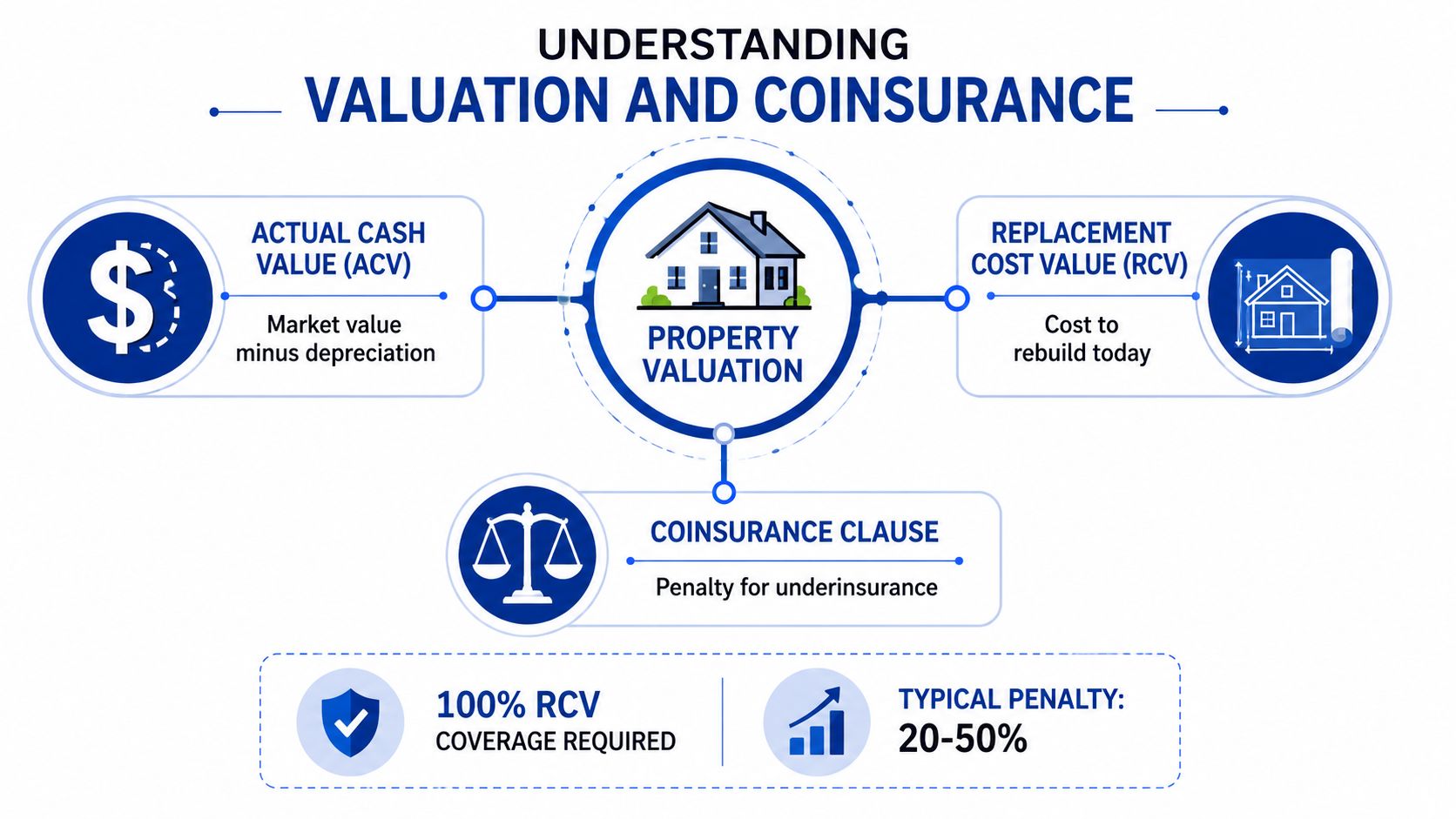
Actual cash value, or ACV, pays based on depreciated value. Age and wear reduce the amount used to calculate the settlement. Replacement cost value, or RCV, pays the cost to repair or replace without deducting depreciation, subject to the policy's conditions and limit. Allstate's ACV and replacement-cost explanation provides the core distinction.
ACV can turn an old building into a cash shortfall
Suppose a damaged roof or appliance is old. Under ACV treatment, the insurer can account for depreciation, leaving the owner to fund the difference between the depreciated settlement and the cost of new work. RCV is usually more appropriate when the operator needs to restore the property to its operating condition, but it may require completed repairs, documentation, or adequate insurance limits.
The deductible remains your responsibility before the insurer pays. In a typical example, USD 10,000 of covered damage minus the policy deductible is the insurer's payment calculation, as described by the National Association of Insurance Commissioners. Build the deductible into your reserve planning rather than treating it as an unexpected claim expense.
The 80% coinsurance threshold matters
Many property insurers apply an 80% coinsurance threshold to dwelling replacement cost. If the insured limit falls below 80% of the property's full replacement cost, the insurer may reduce the claim proportionally, as explained in this 80/20 property insurance rule overview.
For example, assume the full replacement cost is USD 500,000. The 80% threshold is USD 400,000. If the owner carries only USD 300,000 and suffers a covered partial loss, the insurer may apply the coinsurance formula before subtracting the deductible. The result can be materially lower than the repair bill even though the loss is otherwise covered.
Ask for a current replacement-cost estimate and review it after renovations, code upgrades, inflation, or major changes to the room layout. Use this property valuation methods guide to organize the information your broker and valuation professional will need. Don't insure to market value. Insure for the cost of rebuilding and restoring the operating asset.
Essential Endorsements for Room-by-Room Rentals
A room-by-room operator should treat endorsements as operating tools, not optional policy decorations. Each endorsement should answer a specific exposure created by shared occupancy, resident turnover, or the owner's responsibility for income-producing systems.
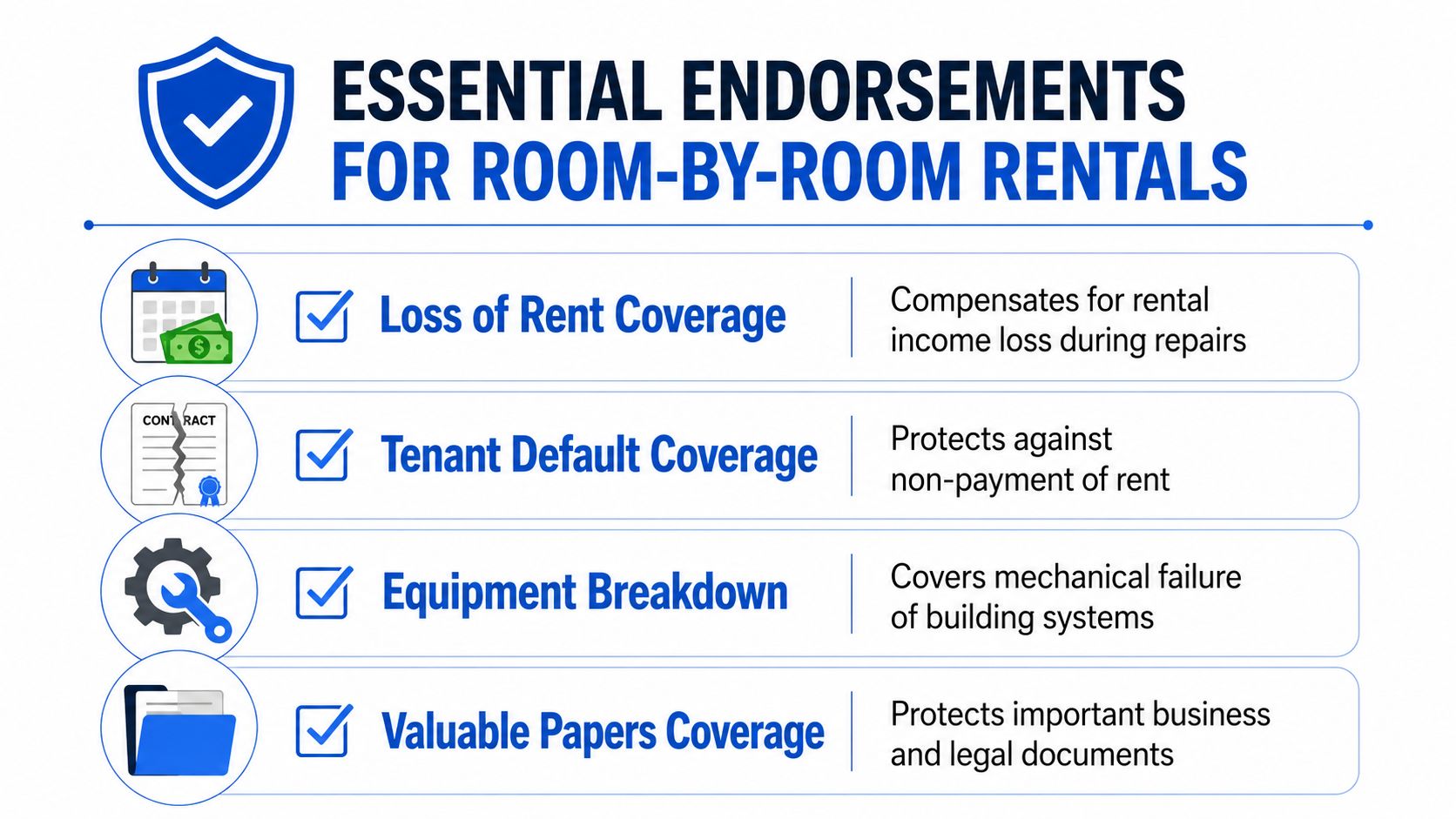
Start with the revenue question. If a covered loss makes the property uninhabitable, loss of rent or business income coverage can help replace income during repairs, subject to the policy's waiting periods, limits, period of restoration, and covered-cause requirements. Set the limit using actual rent records and realistic downtime assumptions, not an optimistic occupancy target.
Build the endorsement package around the business
Loss of rent coverage protects the income stream when covered physical damage prevents residents from occupying the premises. Confirm whether the wording covers rent from every room, common-area access problems, temporary relocation costs, and the time needed to obtain permits and complete compliant repairs.
Liability limits should reflect shared-space activity. A visitor, resident, delivery worker, or contractor can be injured in a kitchen, stairwell, bathroom, driveway, or hallway. Ask about medical payments, personal injury, contractual liability, and additional insured status for property managers or ownership entities.
Tenant default coverage may help with non-payment, but it isn't the same as business income coverage after physical damage. Read the trigger carefully. A policy that responds only to a covered property loss won't necessarily pay because a resident stops paying rent.
Roommate damage and theft deserve precise questions. Standard forms may exclude intentional acts, resident-owned property, unexplained disappearance, or damage that falls within a tenant's responsibility. Require residents to carry renters insurance where appropriate, but don't mistake that requirement for a guarantee of collection. Review whether your own policy covers furnishings, appliances, locks, cameras, and other business property.
Don't overlook building equipment
Mechanical breakdown coverage can address failures of covered equipment that a standard property form excludes. The exposure is significant in shared housing because one HVAC system, water heater, electrical component, or appliance can affect several rooms at once. Confirm whether spoilage, expedited repair, temporary protection, and business income are included or separately limited.
Valuable papers coverage can protect leases, rent records, inspection files, invoices, and other documents. Digital backups are essential, but they don't replace a policy review. Keep records in a secure, organized system so you can establish occupancy, income, ownership, and repair history after a loss.
Navigating Common Exclusions and Coverage Gaps
The costliest insurance error is treating a covered building as proof that every resulting loss is covered. Room-by-room operators must test the policy against the operational decisions that interrupt shared housing, especially flood exposure, vacancy, mechanical failure, and resident damage.
Flood and earth movement need separate review
Many standard property policies exclude flood and earth movement. Business interruption coverage may also require covered physical damage, so flooding can damage the building, stop rent, and still fail to trigger expected income protection. Commercial flood insurance may carry low limits and actual-cash-value treatment, according to the 2025 industry session on property insurance exclusions.
Ask the broker to identify whether flood, sewer backup, surface water, storm surge, earthquake, landslide, and earth movement are covered, excluded, or assigned separate limits. Examine deductibles as closely as limits. Coverage that exists on paper but cannot fund repairs after a disaster leaves your NOI exposed.
Vacancy is an operating condition
A property can appear occupied while an individual room, floor, or building meets the policy's vacancy definition. Room turnover, renovation, delayed leasing, or a failed placement strategy can create that condition. Vacancy provisions may restrict recovery for vandalism, water damage, theft, and other losses.
Get the exact definition before accepting the policy. Confirm the permitted vacancy period, notice requirement, inspection schedule, and protective measures required to preserve coverage. Maintain heat and water protection, secure locks, conduct documented visits, and record the status of every unoccupied space. Do not assume resident occupancy elsewhere protects a vacant room or floor.
Mechanical failure and resident damage require separate handling
Mechanical breakdown is commonly excluded from standard property forms. A failed HVAC compressor, boiler component, or electrical part can disrupt several rooms without creating a covered property loss. Equipment breakdown coverage can address that gap, but only when the equipment, cause of failure, and resulting losses fall within the endorsement. Confirm treatment of emergency repairs, temporary protection, spoilage, and lost income rather than relying on the endorsement title.
Resident-caused damage needs its own claims process. Use signed move-in records, dated room and common-area photos, repair invoices, incident reports, and lease language that assigns responsibility clearly. A practical photo documentation workflow helps establish condition before a dispute starts. Documentation cannot override an exclusion, but it can prevent a potentially covered claim from turning into a dispute over pre-existing damage. Pair the records with prompt incident reporting and consistent inspections so the insurer can trace what happened, where it happened, and which property was affected.
Managing Claims and Business Interruption
A claim is easier to manage when the operator treats it as an incident-response process rather than a single phone call. Protect people first, prevent additional damage, preserve evidence, and communicate with the insurer before making major repairs.
Follow a disciplined response
Mitigate immediately. Shut off water, secure damaged openings, remove standing water when safe, and arrange temporary protection. Keep receipts and photograph conditions before discarding damaged items.
Notify the insurer and broker. Report the event promptly and request claim instructions, adjuster details, temporary housing guidance, and documentation requirements. Don't assume a verbal conversation replaces formal notice.
Document every affected area. Photograph and video rooms, shared spaces, building systems, furnishings, and visible damage. Record dates, resident reports, contractor findings, invoices, and emergency actions.
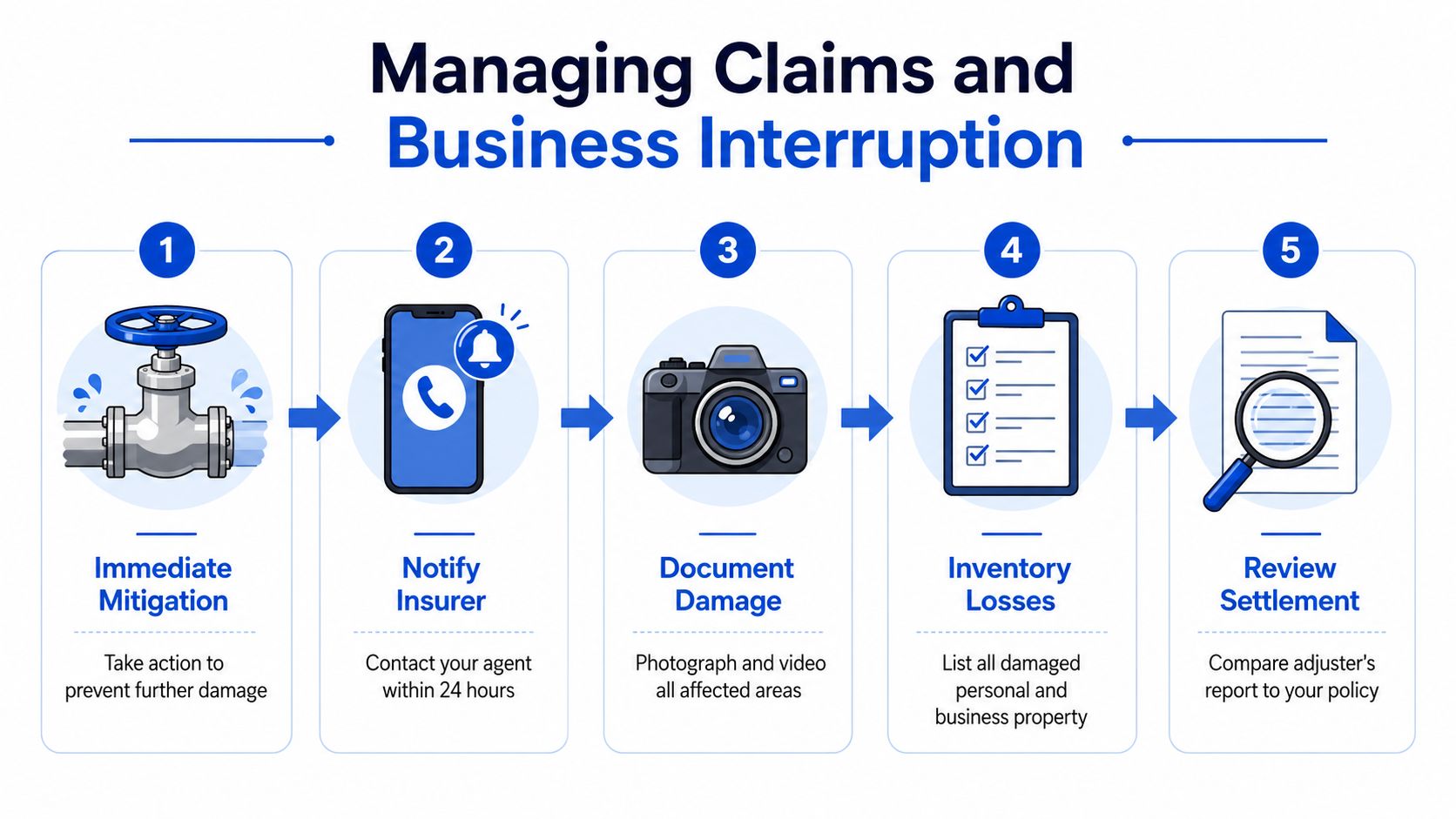
Inventory the loss. Separate building damage, business personal property, resident property, lost rent, extra expenses, and repairs that improve rather than restore the property. Tie each amount to a receipt, lease record, invoice, or valuation document.
Review the settlement. Compare the adjuster's report with your policy, endorsements, exclusions, valuation basis, deductible, and limits. Escalate disputed items with a written explanation and supporting evidence.
Business income depends on the cause of loss
For commercial or income-producing property, business interruption coverage is often triggered only by covered physical damage. Policies may exclude flood or earth movement from the insured cause of loss, which can leave an operator with a damaged building and no expected rent recovery. The Hiscox commercial property wording%20COMBI-PS.pdf) illustrates why the cause of loss and physical-damage requirement must be read together.
Create a claim-ready file before anything happens. Keep the declarations page, endorsements, leases, rent ledger, occupancy records, utility bills, tax documents, maintenance history, replacement-cost estimates, vendor contacts, and photographs in one controlled location. A structured insurance claim management workflow can reduce missing documents and make the loss easier to explain.
Strategies to Lower Premiums and Improve Insurability
Insurance pricing reflects more than a building's address. Underwriters review how reliably an operator prevents losses, detects problems, controls access, and records maintenance. Operational discipline does not guarantee a lower premium, but it gives your broker evidence to use at renewal and can improve the terms available for a room-by-room property.
Start with water and HVAC controls. Install leak detectors near water heaters, washing machines, sinks, and exposed supply lines. Use smart thermostats where they suit the building, and service HVAC equipment on a written schedule. Keep inspection dates, invoices, service reports, and photographs in one organized file. Informal texts are not a maintenance program.
Make the property easier to underwrite
- Control access: Manage smart locks properly, remove former residents promptly, and record every key or credential change.
- Detect leaks early: Place sensors in high-risk areas and assign a clear response procedure for every alert.
- Maintain life-safety systems: Service alarms, extinguishers, lighting, railings, and exits. Retain completion records.
- Reduce vacancy exposure: Track each empty room, inspect it on a documented schedule, maintain utilities, and notify the insurer when the policy requires it.
- Control resident damage: Use move-in inventories, clear house rules, incident reports, and consistent inspection routines. Roommate damage becomes easier to allocate when the condition of the room is recorded.
- Present clean renewal data: Give the broker current occupancy, rent, claims, maintenance, security, and capital-improvement information.
Premium pressure affects operating decisions. Homeowners insurance costs have risen sharply in recent years, reflecting inflation, catastrophe losses, and reinsurance pressure. Model insurance as part of NOI, not as a fixed administrative line. Also ask the broker how vacancy, mechanical breakdown, and resident-caused damage affect eligibility and exclusions before renewal.
Best operating standard: Every major system should have an owner, a maintenance date, a response procedure, and a record.
PadPulse is being built for co-living operators who need clearer control over pricing, occupancy, resident communications, smart-lock access, HVAC monitoring, and property-level reporting. Visit PadPulse to join the early-adopter interest list and prepare for a more organized way to connect daily operations with stronger insurance documentation and NOI management.