Insurance Claim Software: Maximize Property ROI 2026
June 18, 2026
A tenant moves out on Friday. By Saturday morning, you're standing in a bedroom with broken blinds, a soaked patch of flooring near the bathroom wall, and a phone full of photos that may or may not match the right unit. The contractor wants approval. The next tenant is supposed to move in soon. Your insurer needs dates, receipts, maintenance history, and a clean description of what happened.
That's where most property damage claims go sideways.
For co-living operators and room-by-room landlords, claims are rarely neat. Damage often affects shared spaces, multiple residents, and a turnover schedule that doesn't wait. The true cost isn't only the repair. It's the admin scramble, delayed re-listing, missing documentation, and the staff time spent piecing together a timeline from texts, email threads, and camera rolls.
The Nightmare of a Property Damage Claim
The ugliest claims usually start with ordinary chaos.
A resident reports water under a sink. Another says the hallway wall is bubbling. A maintenance tech takes photos but stores them on a personal phone. Someone else has the move-in checklist. Leasing has the resident messages. Accounting has the vendor invoice. By the time you start the insurance claim, the facts are scattered across five systems and three people.
For room-by-room rentals, that mess gets worse fast. One leak can affect a private room, a shared bath, and common-area flooring. Now you're not just documenting damage. You're tracking who reported it first, which room went offline, what repairs were emergency work versus permanent work, and whether any tenant-caused damage belongs in a deposit dispute instead of an insurance file.
Where manual claims break down
The old process usually looks like this:
- Photos live everywhere: Some are in texts, some in email, some never get uploaded at all.
- Timelines get fuzzy: Nobody can quickly prove when damage was first noticed or when a vendor entered the property.
- Paperwork slows repairs: Claims forms, receipts, tenant statements, and invoices don't arrive in one place.
- Vacancy risk grows: Every extra day spent organizing a claim is another day a room may stay offline.
The biggest claim problem for small operators usually isn't denial. It's delay caused by disorganized evidence.
That's why this category has matured into a major operational software market. The insurance claims processing software market reached $16.5 billion in 2026, with a 3.9% annual growth rate since 2020, according to IBISWorld's industry overview of insurance claims processing software. That growth matters because it signals something practical. Claims automation isn't niche anymore. It's becoming standard operating infrastructure.
Operators already use digital tools to prevent problems before they become claims. For example, water usage monitoring for rental properties can help surface leaks early. But once damage happens, prevention is over. Documentation speed becomes the priority.
What Is Insurance Claim Software for Property Managers
Insurance claim software is best understood as a digital command center for property incidents.
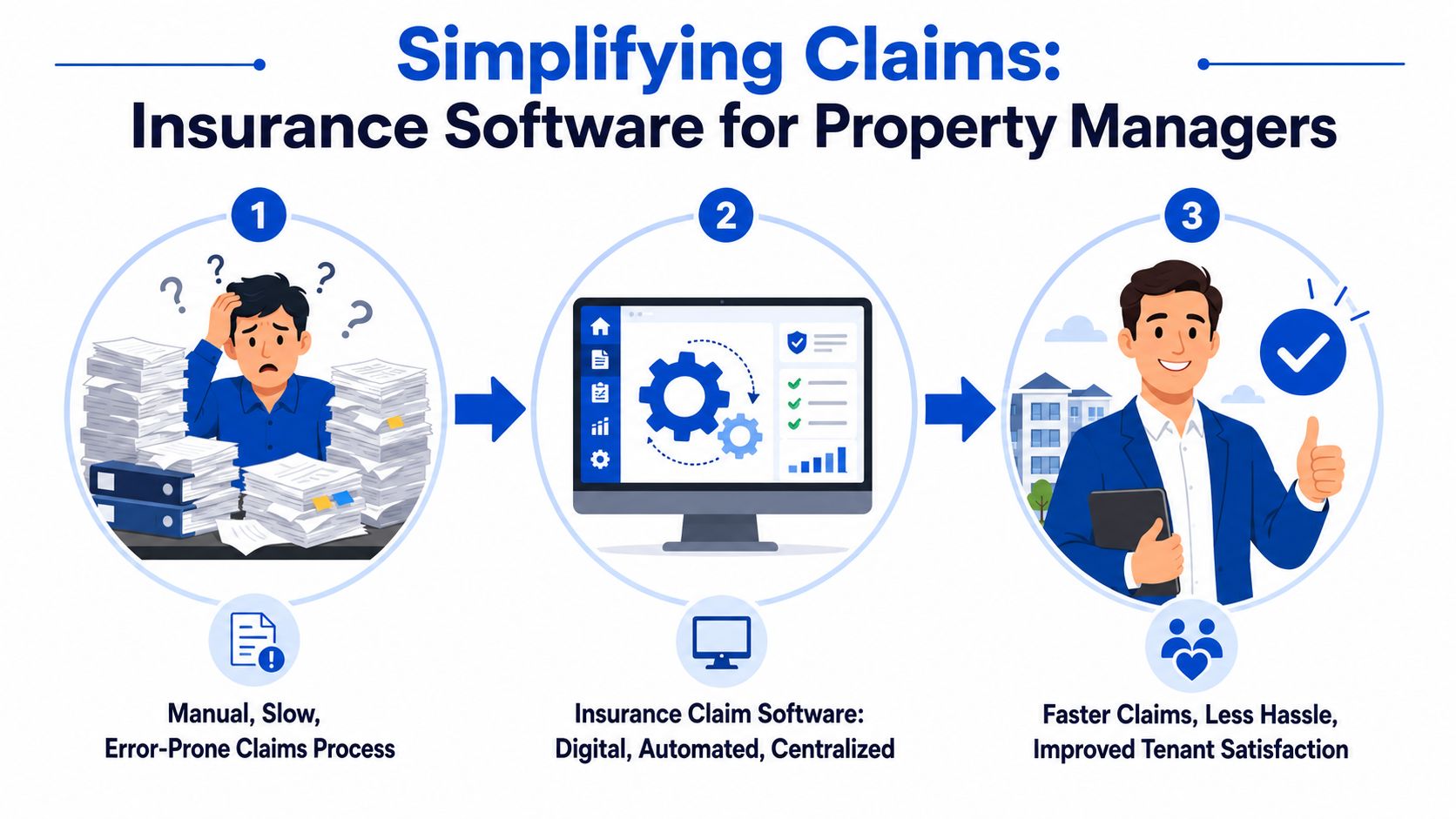
It replaces the patchwork system most small operators rely on. Instead of keeping claim details in spreadsheets, texting contractors for updates, and hunting for before photos in old folders, you manage the claim in one record. That record can hold the incident report, photos, videos, invoices, resident communications, vendor notes, and settlement status.
The old way versus the usable way
Here's the practical difference.
| Task | Manual process | With insurance claim software |
|---|---|---|
| Incident intake | Texts, calls, scattered notes | One standardized incident record |
| Evidence collection | Loose photos and email attachments | Centralized, time-stamped files |
| Vendor coordination | Phone calls and inbox follow-up | Logged updates tied to the claim |
| Status tracking | Spreadsheet or memory | Visible workflow from report to settlement |
| Audit trail | Hard to reconstruct | Chronological activity history |
For a non-technical operator, that matters more than any flashy feature list. You don't need a system that sounds advanced. You need one that helps your team answer basic questions fast:
- What happened?
- Which unit or room was affected?
- Who documented it?
- What was repaired?
- What did it cost?
- What's still pending?
Why it fits rental operators, not just carriers
Many people hear “insurance claim software” and assume it's built for giant insurance companies. In practice, property-facing tools and claims workflows are also valuable for landlords, managers, and co-living operators who need a clean record before they ever send anything to a carrier or third-party administrator.
It functions as a project manager combined with an evidence locker.
One side keeps tasks moving. The other protects the file. That combination is useful when a claim overlaps with tenant disputes, habitability issues, emergency maintenance, and unit turns.
Practical rule: If a team can't reconstruct a claim timeline in under a few minutes, it doesn't have a workflow problem. It has a documentation problem.
Good insurance claim software also helps separate issues that often get blended together. A broken interior door after a resident move-out may belong in a chargeback workflow. A pipe burst affecting multiple rooms may become an insurance event. The software won't make that judgment for you, but it gives you the organized facts needed to make the right call.
Key Features That Automate Your Claim Workflow
The best insurance claim software doesn't just store files. It removes friction from the steps that usually slow a claim down.
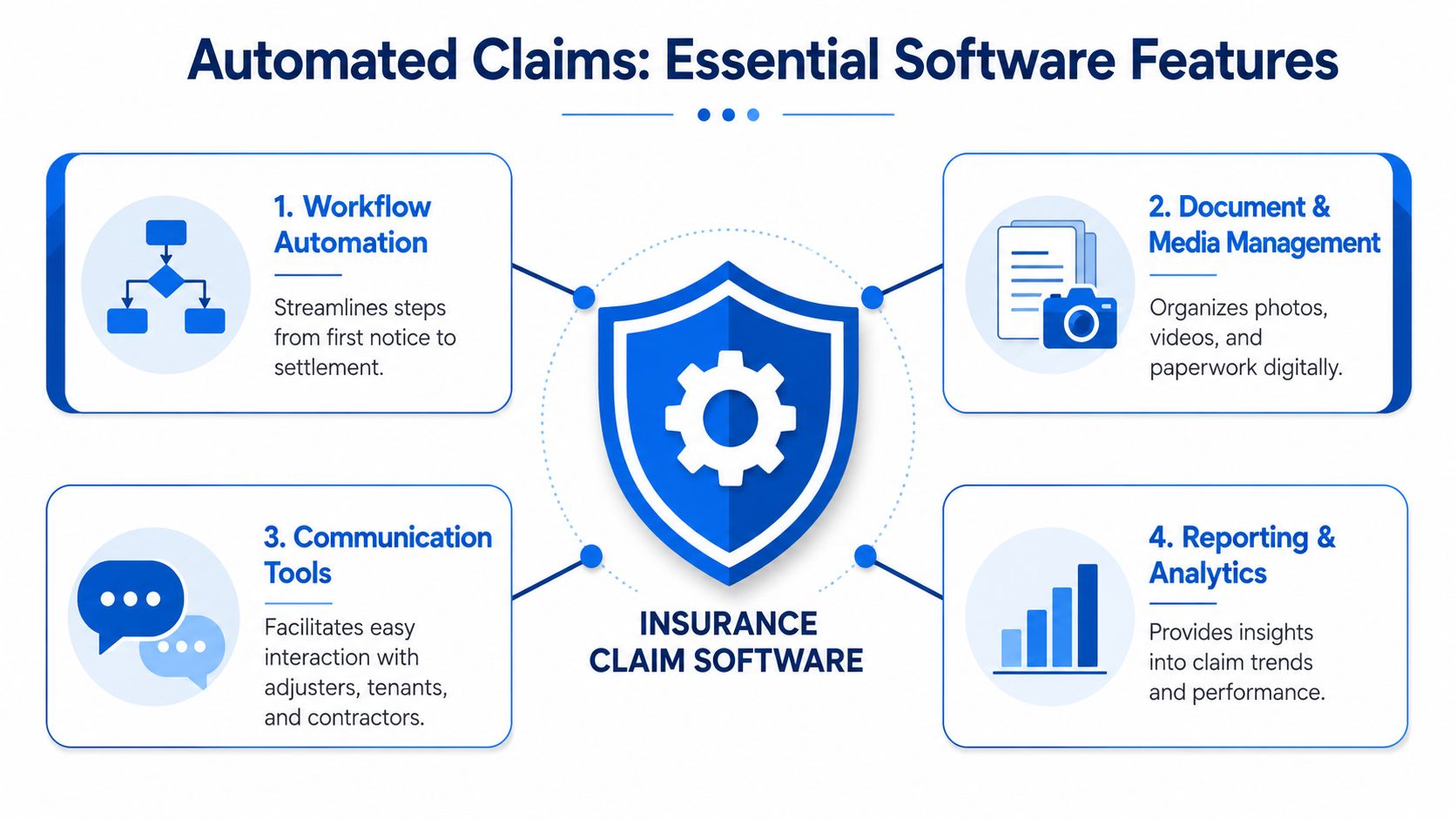
A useful system for property operators usually comes down to four working parts: intake automation, evidence management, communication tools, and reporting. If one of those parts is weak, the team falls back into manual work.
Intake and workflow automation
Early on, strong systems save the most time.
When First Notice of Loss workflows are automated, teams can move from incident report to structured claim intake much faster. Systems that automate FNOL can reduce claim submission time from hours to minutes, cut data entry errors by up to 40%, and shorten the average claim cycle by 35%, according to N2uitive's insurance claims statistics and trends summary.
For a co-living operator, that means:
- Faster incident capture: Staff can log damage while standing in the room.
- Cleaner submissions: Required fields reduce missing details like date of loss, affected area, or tenant statement.
- Automatic routing: The system can send the file to the right manager, vendor, or adjuster queue.
- Task reminders: Follow-ups don't disappear because someone got busy with leasing.
A lot of smaller teams get value from replacing “I'll remember to send that later” with a tracked workflow.
If your current process still depends on email attachments and manual handoffs, it helps to look at broader ideas for automating document workflows in property operations.
Document and media management
Claims are won or delayed on documentation quality.
Room-by-room rentals generate a surprising amount of evidence. Move-in photos, inspection notes, maintenance logs, invoices, signed agreements, and vendor estimates all matter. If they aren't attached to the same incident record, staff wastes time hunting for proof instead of moving the repair forward.
Good systems should make it easy to:
- Upload photos from mobile devices right at the property
- Store before-and-after images under the same claim
- Tag files by unit, room, or incident type
- Keep invoices and estimates tied to the damage event
- Create a clean activity trail for later disputes
That matters when a hallway leak affects three residents and one common area. The file has to stay organized enough that anyone stepping in can understand it without calling five people.
Here's a quick explainer on how these capabilities fit together:
Communication and reporting
Claims stall when communication leaves the system.
The best setups keep tenant updates, contractor notes, and adjuster communication close to the claim record. That doesn't mean every conversation happens inside the platform. It means the important parts get logged in one place.
Reporting also matters more than many smaller operators expect. Over time, patterns show up. One property may have repeat water issues. Another may generate frequent turnover damage disputes. Reporting helps operators see whether they have a claims problem, a maintenance problem, or a resident screening problem.
A claim file should tell the story without requiring a staff meeting.
Major Benefits for Co-Living and Rental Properties
Co-living operators don't experience claims the same way a conventional multifamily owner does. Shared kitchens, shared baths, faster turns, and multiple occupants per house create a different kind of operational pressure.
That's why insurance claim software delivers the most value when it protects occupancy, not just paperwork.
Faster repairs and less vacancy drag
In room-by-room rentals, one unresolved incident can disrupt several revenue streams at once. A water event in one section of the house may block a bedroom, inconvenience neighboring residents, and delay a scheduled move-in. If the claim process is messy, repairs slow down because approvals, documentation, and vendor coordination slow down with it.
Software helps by keeping the incident file clear enough that repairs can move without constant backtracking. Staff doesn't have to stop and ask where the photos are, whether the invoice was approved, or which resident first reported the issue.
This is even more important in a market where insured losses from natural disasters now exceed $100 billion annually and liability claims have increased 57% over the last decade, making effective claims handling a strategic requirement for property owners, as noted in the earlier data set from N2uitive.
Better records for tenant-caused damage
Not every loss should become an insurance event.
For co-living houses, many of the most common incidents sit in a gray zone between maintenance, reimbursement, and claims. A damaged door frame, ruined mattress, unauthorized lock change, or kitchen fire caused by misuse may trigger different financial paths. If your documentation is weak, you can lose both ways. The carrier may question the file, and the resident may dispute the charge.
Insurance claim software helps operators keep cleaner records for:
- Move-in and move-out comparisons
- Damage linked to a specific room or resident
- Vendor confirmation of cause
- Resident communication history
- Security deposit support files
Stronger communication during stressful events
Residents don't expect perfection during a property incident. They expect clarity.
A shared-house claim often affects people who didn't cause the problem. One resident may lose bathroom access. Another may need a temporary room switch. A third is worried about a pending move-in date. When the team communicates from scattered notes, residents get conflicting updates.
Residents are more patient with bad news than with inconsistent news.
A structured claim workflow gives staff one version of the facts. That improves response quality and reduces the chance that maintenance, leasing, and management each tell a different story.
Portfolio insight, not just incident control
Over time, claims software becomes a management tool, not only a filing tool.
Operators can start spotting operational patterns. If a specific house keeps generating moisture-related repairs, the issue may be deferred maintenance. If certain room types create repeated damage disputes, your house rules or inspections may need work. That kind of visibility is hard to get when every claim is handled as a one-off emergency.
For co-living portfolios, that's where the primary return often shows up. The software doesn't just help close a claim. It helps reduce the next one.
How to Select the Right Software for Your Portfolio
Most demos look good. Most platforms promise automation, visibility, and efficiency. The problem is that many tools were designed for larger organizations with more staff, more technical support, and more patience for setup than a typical rental operator has.
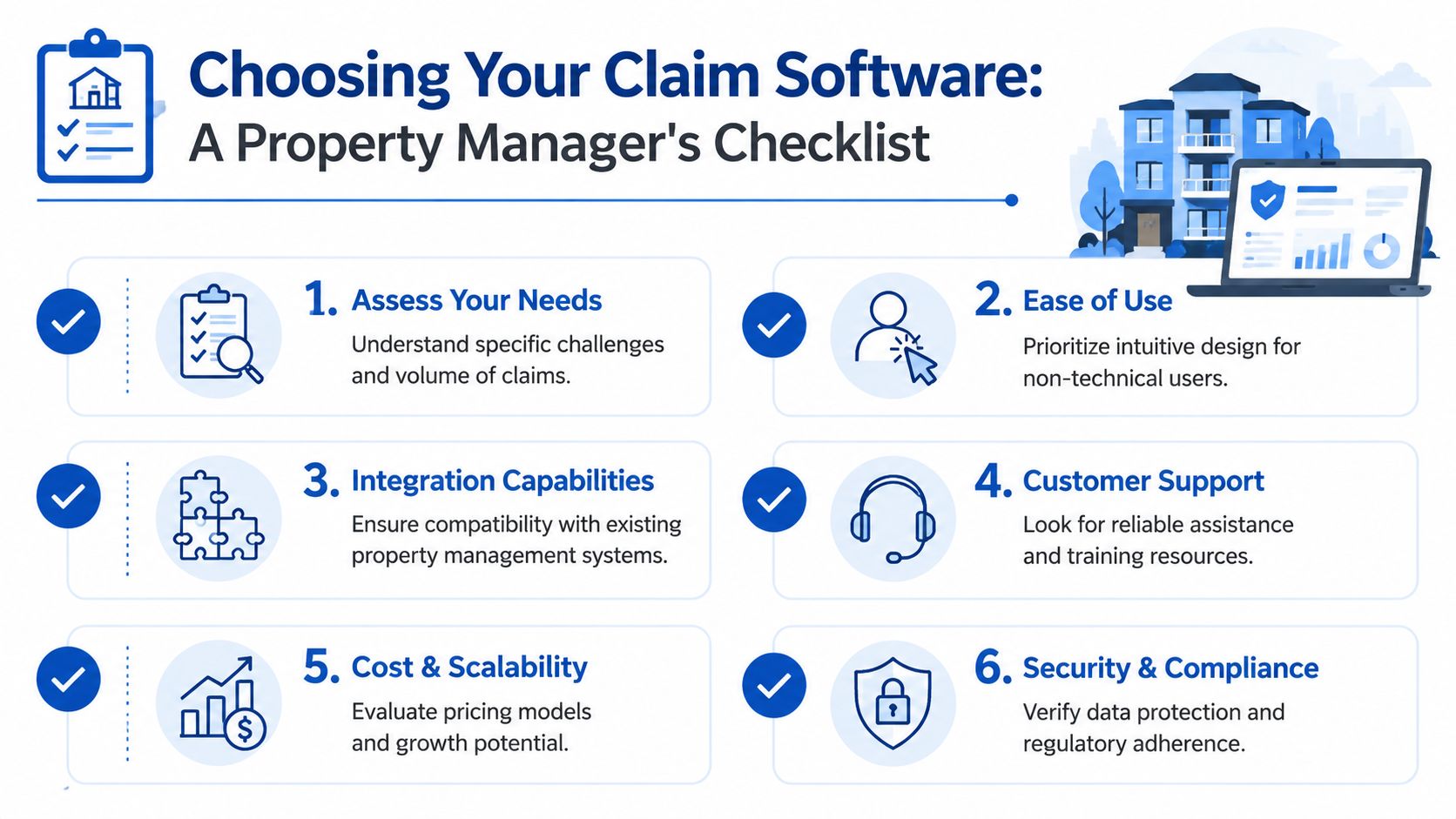
The best buying decision usually comes from asking operational questions, not software questions.
Start with your actual claim environment
Before comparing vendors, list the kinds of incidents you handle most often. Water damage, resident-caused damage, fire events, storm damage, theft, vendor liability, and habitability issues create different workflow needs.
A small co-living operator should pressure-test software against everyday reality:
- Mobile use: Can a field manager capture photos, notes, and invoices from a phone without extra steps?
- Room-level tracking: Can the system handle one property with multiple occupants and shared areas?
- Access control: Can leasing, maintenance, and ownership each see only what they should?
- Vendor coordination: Is there a clean way to track estimates, approvals, and payment status?
- Document discipline: Does the system force the team to complete key fields before moving the file forward?
If a vendor can't show those workflows clearly, the platform may be better at selling than solving.
Ask hard questions about rollout
This is the part sales calls often blur.
A known challenge for smaller operators is implementation reality. Public material often highlights automation and analytics but doesn't spell out how much data cleanup or process redesign is needed for teams without dedicated IT support, as described in Creatio's overview of insurance claims management software.
That matters because the software may be fine while the rollout fails.
Ask questions like these:
What data has to be cleaned before launch?
If your current files are inconsistent, ask what must be standardized first.What does onboarding look like for a small team?
You want training that fits busy property staff, not enterprise-style workshops.Which integrations are native and which are manual?
“Integrates with everything” often means CSV exports and custom setup.How are old claims migrated?
You may not need every historical file moved, but you do need a rule.What breaks if staff uses email instead of the platform?
This question exposes whether the workflow is realistic or fragile.
Field check: If the vendor can't describe a messy rollout scenario, they probably haven't helped many small operators go live.
Watch for these red flags
A practical shortlist gets easier when you know what to avoid.
| Red flag | Why it matters |
|---|---|
| Beautiful dashboard, weak mobile workflow | Claims begin on-site, not in a boardroom |
| Heavy setup with vague support promises | Small teams can't absorb long implementation projects |
| No clear audit trail | Disputes become harder to defend |
| Generic property support | Co-living and room-by-room issues may not fit standard multifamily assumptions |
| Reporting that looks broad but not actionable | You need claim-level visibility tied to operations |
The right insurance claim software should feel boring in the best way. Staff should know where to click, what to upload, and what happens next. If the workflow needs a champion to explain it every week, adoption will fade.
Implementation and ROI Putting Your Software to Work
Software doesn't create ROI at login. It creates ROI when the team uses it the same way, every time, under pressure.
That's where many small operators struggle. The product may be capable, but the rollout leaves old habits untouched. Photos still stay on phones. Vendors still text estimates to one person. Residents still report issues through whatever channel is easiest. The software becomes a second system instead of the main system.
Integration matters more than feature count
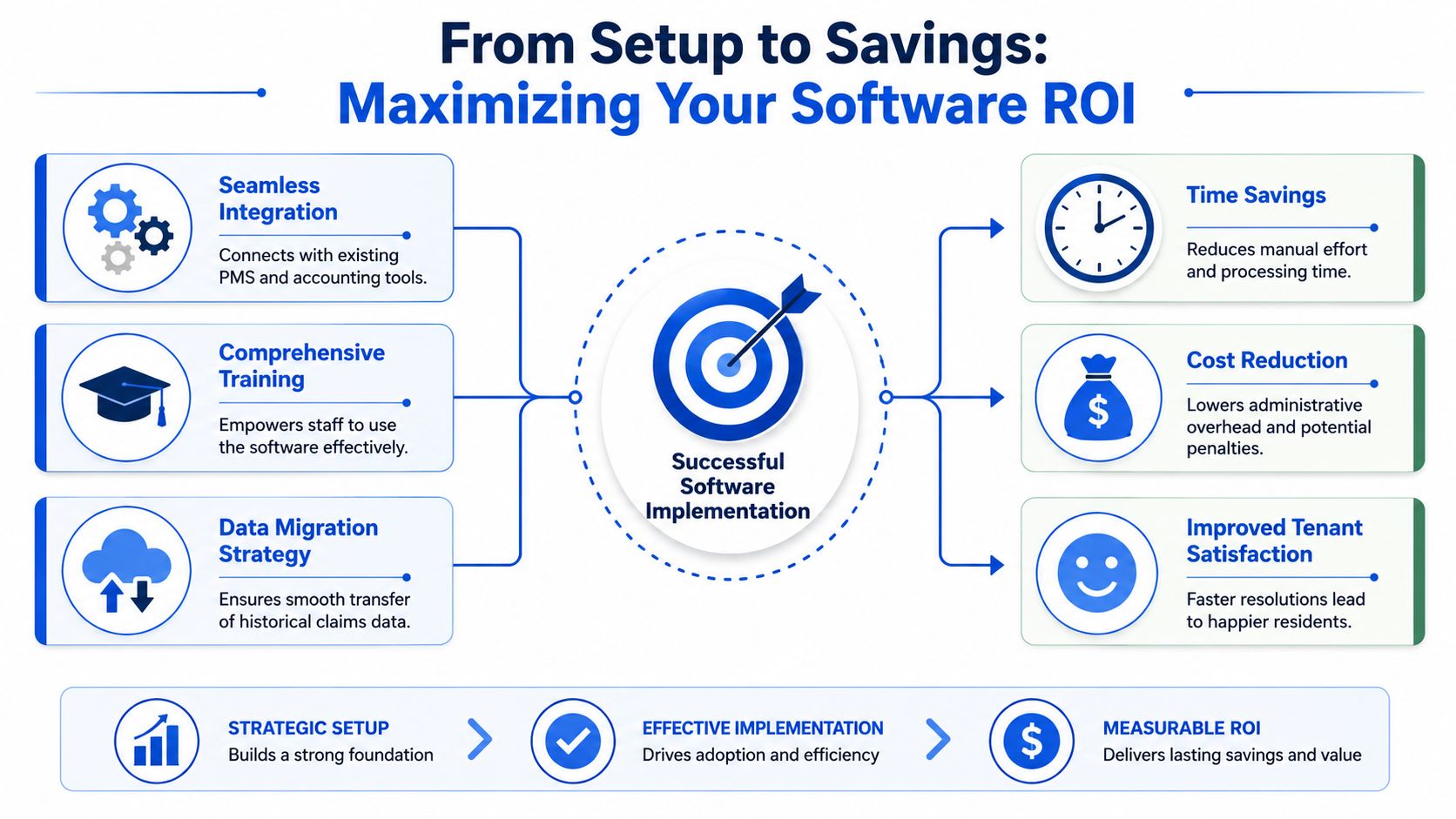
For property operators, the goal isn't to build a standalone claims department. It's to connect incidents to the systems that already run the business.
A practical rollout usually links claim workflows to:
- Property management records for unit, room, lease, and resident context
- Accounting tools for invoices, reimbursements, and reconciliations
- Vendor workflows for repair approvals and payment tracking
- Maintenance logs for prior issues and recurring problem areas
Vendor payments are a good example. If repair invoices live outside the operational record, staff loses time matching work performed to claim documentation. A connected workflow for vendor payments in property operations makes that handoff cleaner.
What usually works in the first 90 days
Smaller teams do best when they keep the first rollout narrow.
A sensible implementation approach often looks like this:
- Pick one claim type first: Water damage is a common starting point because it creates urgent documentation needs.
- Set one intake standard: Every incident needs the same core fields, photos, and notes.
- Train by role: Maintenance, leasing, and management should each learn only the steps they own.
- Create a file-closing rule: No claim closes until required documents and communications are attached.
- Review early files weekly: Small corrections early prevent bad habits from hardening.
That discipline matters because implementation is where the hidden work sits. The common gap for smaller operators isn't feature availability. It's the unplanned effort required to clean data and redesign process before the software delivers value.
What ROI really looks like
For co-living and room-by-room portfolios, return usually shows up in a few practical ways.
| Before software is embedded | After workflow discipline improves |
|---|---|
| Staff reconstructs claims from inboxes and phones | Staff opens one incident record with the full timeline |
| Repairs wait on missing documentation | Vendors and managers have a cleaner approval path |
| Residents get uneven updates | Teams communicate from a shared record |
| Claim handling depends on one experienced person | The process becomes more repeatable across staff |
That kind of return is easy to underestimate because part of it is avoided loss. Less admin drag. Fewer missing documents. Fewer stalled repairs. Less confusion during disputes. More consistency when someone on the team is out.
The best ROI from insurance claim software often comes from preventing preventable delay.
For operators managing multiple homes, the payoff compounds when the same process works across every property. A burst pipe shouldn't become a custom project each time. It should trigger a familiar sequence with clear documentation, accountable tasks, and a reliable handoff to repairs and finance.
PadPulse is building an all-in-one platform for co-living and room-by-room operators who want tighter control over operations, communications, and NOI. If you're preparing your portfolio for cleaner workflows around incidents, vendors, and property performance, join the interest list at PadPulse to follow the Winter 2026 launch and early access updates.