Multi Unit Property Management: Owner's Complete Guide
September 29, 2026
A house with eight rentable rooms can look simple from the street. Inside, you may be coordinating eight leases, different move-in dates, separate payment histories, shared kitchens, access permissions, maintenance requests, and one vacancy that reduces income without making the whole property appear empty. That's the operational reality of multi unit property management for room-by-room rentals.
Traditional multifamily advice still helps with leasing, repairs, accounting, and compliance. It doesn't fully solve the fragmented occupancy risk of shared housing. The practical answer is a system that tracks each room as its own revenue-producing space while preserving a property-level view of costs, residents, vendors, and risk.
The State of Multi Unit Property Management
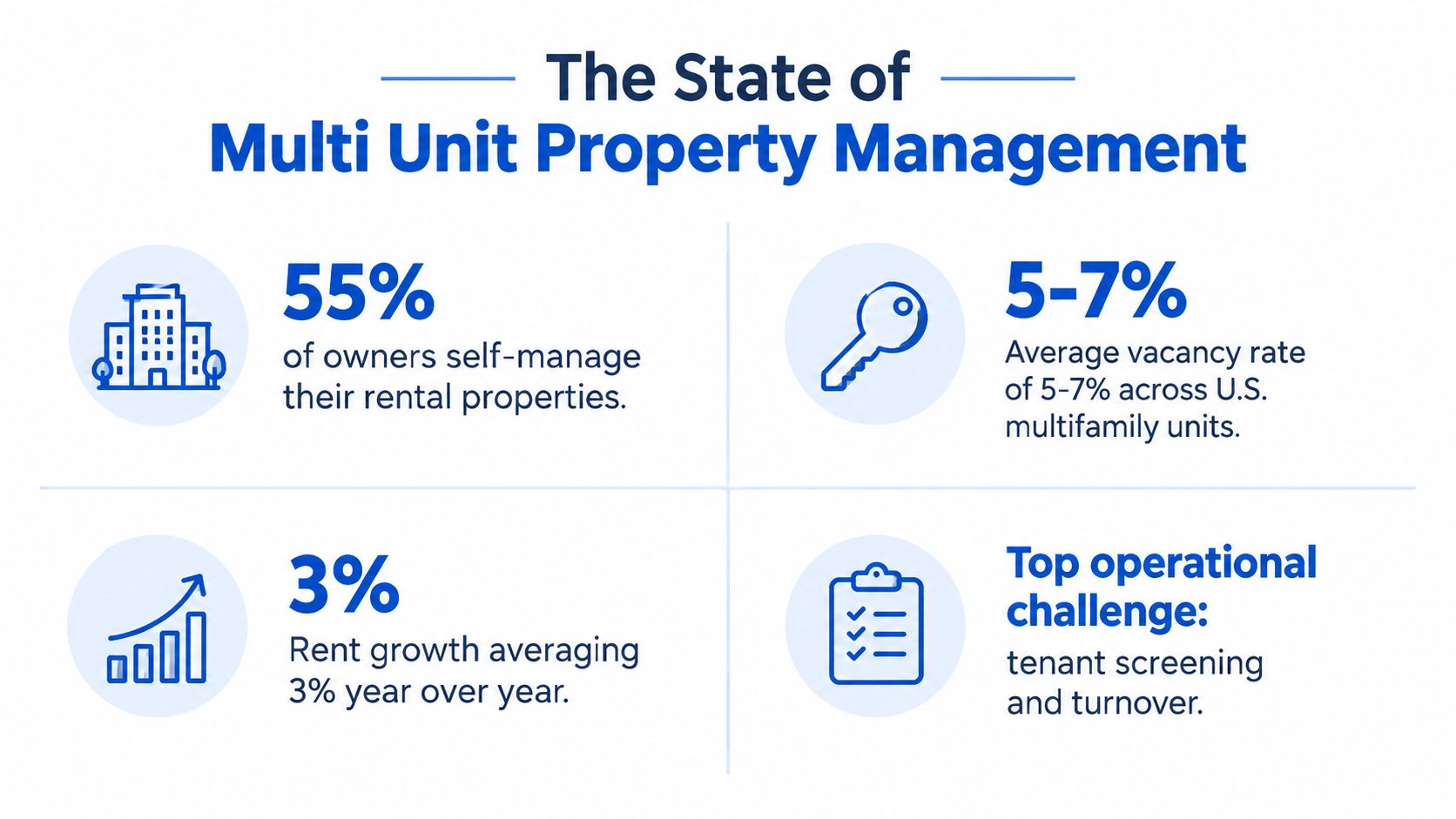
The U.S. apartment market is professionally managed at a much higher rate than many small landlords assume. A 2026 Harvard Joint Center for Housing Studies analysis of Yardi data covered 103,761 apartment properties with at least 50 units. Of those, 98,391 properties, or 95%, were managed by a company rather than directly by owners. The finding establishes a useful baseline: once a portfolio reaches meaningful scale, management becomes an operating function, not an occasional owner task. Harvard's multifamily management analysis
The same analysis counted 11,919 companies managing rental properties with at least 50 units. Yet the market remains highly fragmented. Forty percent of those companies managed only one property, another 30% managed two to four properties, and just 107 companies, about 1%, managed at least 100 properties. That mix matters to an owner moving from one house to a dozen. You're not necessarily competing with enterprise operators, but you are adopting the same basic disciplines, including standardized leasing, reliable reporting, documented maintenance, and controlled access.
Scale changes the management problem
Industry benchmark data from 2025 shows that the largest U.S. multifamily operators managed nearly 4.3 million units across 18,800 communities. Surveyed firms reported an average occupancy rate of 93.33%, up 8 basis points from 2023. Among participating companies, 44 of 75 increased their managed unit count, and those expanding firms grew their footprints by an average of 11.9% versus 2023. Across a two-year window, 59 firms increased portfolios by an average of 27.2%. The 2025 multifamily operator benchmark
Those figures describe large operators, but the lesson applies to smaller portfolios. A slight occupancy change across many rooms affects revenue repeatedly, while a duplicated manual task affects staff time repeatedly. At room level, a vacancy isn't just a leasing issue. It changes cleaning schedules, utility allocation, access permissions, viewing availability, and the timing of neighboring residents' experience.
Use market trend analysis to understand demand, comparable rents, and local changes, but don't let market research replace a room-level operating ledger. Your own records should show which room is vacant, why it's vacant, how long it has been available, and what action is scheduled next.
Mastering Leasing and Tenant Screening Workflows
The fastest way to create operational problems is to treat a room-by-room lease like a smaller version of a whole-property lease. Each room needs its own applicant record, agreement, rent schedule, deposit record, move-in condition report, access profile, and renewal date. The shared areas need separate rules because one resident's behavior can affect everyone in the house.

Build one repeatable screening path
A practical workflow starts before the application arrives:
Define the offer clearly. State the room, furnished or unfurnished status, shared amenities, utilities, house rules, lease term, payment schedule, and required documentation. Ambiguous listings attract mismatched applicants and create avoidable questions later.
Collect consistent information. Use the same application fields for every applicant. Record identity details, income information, rental history, references, and consent for permitted screening checks. Consistency helps staff compare applications fairly and creates a defensible record.
Verify rather than assume. Review submitted income evidence, employment details, and identity information through a documented process. If a document appears inconsistent, pause the application and follow the same escalation rule every time.
Assess room fit. A financially qualified applicant can still be a poor fit for a shared home if expectations around guests, noise, cleanliness, smoking, or shared facilities conflict with the house rules.
Create a move-in checklist. Confirm the agreement, payment instructions, emergency contacts, condition report, keyless access permissions if used, and house handbook before handing over access.
A dedicated background check integration workflow can reduce duplicate entry, but software doesn't decide your screening standards. Write those standards first, then configure the workflow around them.
Manage staggered move-ins deliberately
Staggered move-ins are normal in room-by-room operations. They're also where owners lose control of availability. Keep a live room board with the current resident, lease start and end dates, notice status, cleaning status, inspection status, listing status, and next action.
Never mark a room available just because a resident has given notice. Mark it available only when you know the possession date, cleaning window, repair needs, showing plan, and target-ready date. That distinction prevents double-booking and stops prospective residents from receiving promises the property can't meet.
The video below offers a useful visual reference for organizing screening and leasing tasks.
Practical rule: Treat every room as a mini lease file, and every shared area as a separate operating responsibility.
Track occupancy in two ways. Property occupancy tells you whether the home feels full and whether shared costs are covered. Room occupancy tells you where revenue is leaking. A house can look occupied while one difficult-to-fill room remains vacant for weeks.
Staffing Models and Vendor Management Strategies
A shared house can appear fully staffed on paper while residents wait for a repair or a vacant room sits unprepared. Fragmented leases create work at the room level: move-outs occur on different dates, shared areas need separate attention, and one unresolved issue can affect several residents. Staffing decisions should therefore separate coordination work from physical work.
Leasing communication, payment follow-up, inspection scheduling, room-readiness tracking, and reporting can often be centralized. Cleaning, repairs, emergency response, and specialized trades require dependable local coverage. Budget models commonly use about one staff member per 40 to 50 beds, while mid-market models use about one per 25 to 35 beds as operating benchmarks. The appropriate ratio depends on property condition, geography, resident needs, turnover, and the work removed by software.
Choose the model that matches the work
| Model | Works well when | Main trade-off |
|---|---|---|
| In-house team | Properties are concentrated and work volume is predictable | Service quality is easier to control, but payroll, coverage, and training remain your responsibility |
| Outsourced vendors | Repairs are specialized or properties are geographically dispersed | Capacity is flexible, but response standards and invoices need active management |
| Hybrid operation | Leasing and resident communication are centralized while field work is local | The structure balances control and flexibility, but handoffs must be documented |
A small operator often starts with a hybrid model. Keep leasing standards, resident messaging, room readiness, and financial approval in-house. Build a vetted bench for plumbing, electrical, HVAC, cleaning, locksmith work, and general maintenance. Assign ownership by room and shared area so a vacancy or repair cannot fall between teams.
Put vendors inside a control system
A vendor relationship needs more than a phone number. Maintain current insurance documentation, service areas, rates, emergency availability, preferred materials, and approval limits. Each work order should identify the property, room or shared area, access instructions, issue, available photos, and completion standard.
Maintenance triage protects residents and the budget. Water intrusion, heating or cooling failure during extreme weather, plumbing leaks, and electrical hazards should receive urgent attention targeted within 24 hours. Routine requests belong in the normal queue, with completed work confirmed and attached to the relevant unit's maintenance record. Multifamily maintenance management guidance
Use a vendor coordination process that records assignment, arrival, approval, completion, and invoice review. The objective is controlled service, not the lowest price on every job. Clear records reduce unapproved work, repeat visits, and unresolved room or shared-area issues that disappear into text messages.
Financial Management and NOI Improvement Tactics
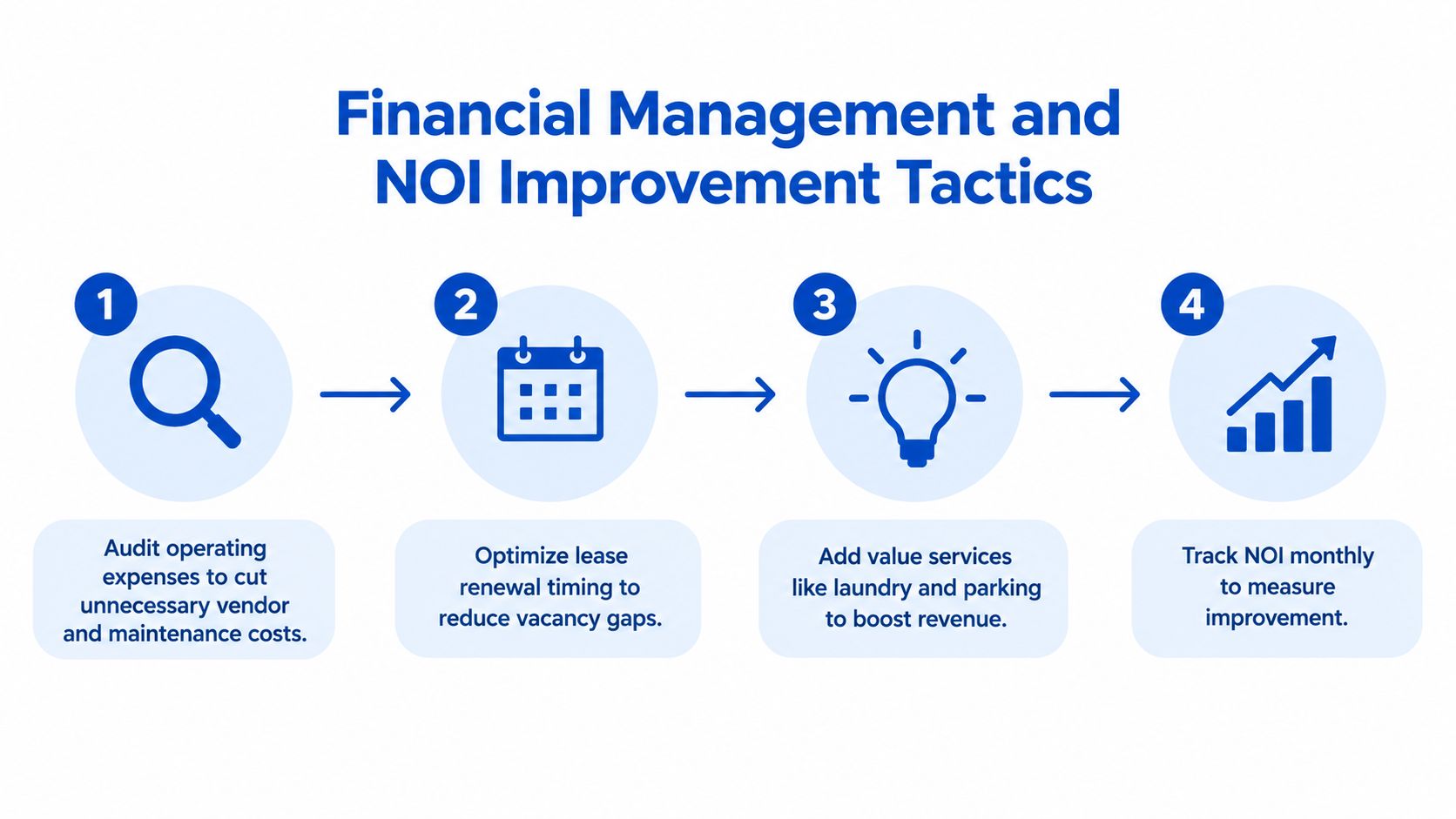
Room-by-room NOI improves when the property is managed as both a portfolio and a set of individual revenue lines. A whole-property income statement may show a profit, yet hide a poorly priced room, repeated repairs in another, or turnover costs concentrated in a third.
Start with room-level visibility
Record rent, fees, concessions, vacancy days, utilities, cleaning, repairs, and furnishing costs by room whenever the expense can be assigned reliably. Allocate shared costs with a documented method. Consistency and clear explanations matter more than choosing a theoretically perfect formula.
For coliving operations, stabilized occupancy is commonly benchmarked at 92% to 97%, with strong operators expected to stay above 90%. Operating costs commonly run $400 to $800 per occupied bed per month, while staffing efficiency varies by operating model. Coliving operating benchmarks Treat these figures as planning references, then compare them with your own rooms, lease timing, and service demands. A property can meet an occupancy target while still losing NOI through one persistently vacant room or frequent shared-area repairs.
Review these measures every month:
- Revenue per available room: Include vacant rooms in the denominator to expose unused capacity.
- Turnover cost: Separate cleaning, repairs, marketing, concessions, and staff time.
- Collection performance: Compare scheduled rent, received rent, outstanding balances, and aging.
- Utility intensity: Check abnormal usage against occupancy and maintenance records.
- NOI movement: Explain each material change instead of recording only the final figure.
Use pricing and technology with discipline
Dynamic pricing can balance occupancy and revenue when each room has its own vacancy date and demand pattern. Keep a reason log for every price change. Review current inquiries, competing listings, room features, lease timing, and recent conversion behavior before changing the offer. A higher asking rent is unhelpful if it extends vacancy or creates weaker applicant demand.
Smart-home technology can reduce expenses when an operating policy defines its purpose, controls, and review process. A Parks Associates white paper cited by Multifamily Executive reported 18% to 20% annual energy cost savings and 20% to 30% reductions in energy use from smart thermostats in common areas. A separate survey of 300 U.S. multifamily managers reported expected rent uplifts of 5% to 30% from smart-home products and services. Multifamily smart-technology ROI reporting
Those findings do not guarantee the same outcome in shared housing. Install controls staff can manage, define resident privacy boundaries, and compare utility bills before and after implementation. Technology earns its place when it improves access, reduces waste, supports resident value, or provides better evidence for room-level decisions.
Navigating Compliance and Risk Mitigation
Risk management in shared housing begins with recognizing that the property has more points of exposure than a conventional single-lease rental. You're handling multiple applicants, separate payment records, shared spaces, access credentials, house rules, vendors, insurance requirements, and local occupancy restrictions.
Fraud deserves a formal workflow rather than an informal impression of whether an application “looks right.” In a 2026 multifamily survey, 80% of respondents said they had encountered credit-history fraud or fake AI-generated documents during the previous 18 months. The survey also reported fraud attempts across portfolio sizes. Multifamily fraud and risk findings
Verify identity and preserve the record
Use identity verification, permitted screening checks, document review, and manual escalation for inconsistencies. Store the result of each review, including who reviewed it, what was checked, and why the application was approved, declined, or referred for further review. A clean audit trail helps managers apply standards consistently and investigate disputes.
Insurance and safety controls need the same discipline. Keep certificates, inspection records, appliance information, incident reports, and vendor completion evidence in one accessible location. Review whether coverage reflects room-by-room leasing, shared areas, furnished contents, employee access, and smart devices.
Treat local rules as operating requirements
Shared housing may be governed by rules that differ from standard apartment rentals. In New South Wales planning materials, for example, occupancy agreements for boarding-house style operations must be written in accordance with the Boarding Houses Act 2012 and Boarding Houses Regulation 2013. Residents must receive four weeks' written notice before an occupancy fee increase, and an approved plan can cap occupancy. One plan states that total boarding-room occupancy must not exceed 24 lodgers. New South Wales boarding-house planning materials
The jurisdiction differs, but the operating lesson travels well. Confirm zoning, licensing, occupancy limits, notice rules, privacy expectations, fire safety, accessibility, and insurance requirements before increasing room count or changing the leasing model.
Compliance is a workflow, not a binder. Assign an owner, set review dates, and record completion.
Building an Integrated Operational Workflow
A reliable multi unit property management system connects the room board, applications, leases, payments, maintenance, access, compliance, and financial reporting. The connection doesn't mean every task must be automated. It means staff should enter information once and use it wherever the next decision requires it.
Start with a single record for each property, room, resident, vendor, and work order. Then define the handoffs:
- Leasing updates room availability and lease dates.
- Move-in activates payment, access, and resident communication tasks.
- Maintenance records the room or shared area, cost, status, and completion evidence.
- Finance uses those records to reconcile income and expenses.
- Compliance receives inspection, incident, screening, and notice records.
Disconnected systems create duplicate entry and conflicting information. Integrated platforms can connect leasing, messaging, maintenance, access control, pricing, and reporting, but only if the team agrees on naming conventions, permissions, approval rules, and the source of truth for each field.
PadPulse is an in-development management platform for PadSplit hosts and co-living operators, with planned tools for dynamic pricing, AI-powered messaging workflows, smart-lock and thermostat integrations, P&L tracking, portfolio analytics, and market intelligence. It's designed to centralize room-level operations across shared-housing portfolios rather than treating every property as a single lease.
The practical roadmap is simple: document the workflow, measure room-level performance, remove duplicate entry, and automate only stable processes. That approach gives a small owner the control needed for one house and the structure needed for a dozen.
If fragmented leases, staggered move-ins, and room-level vacancy are consuming your week, review how PadPulse is being built to centralize pricing, communications, access control, and reporting for co-living operators. Join the interest list to receive launch updates and information about limited beta access, with no billing required before launch.