Vendor Coordination for Co-Living Operators
July 25, 2026
You know the feeling. It's Monday morning, a smart-lock battery is dying, a pest-control crew is due during a new member move-in, the plumber still hasn't shown, and your phone has three separate threads that all sound busy and still solve nothing. In a shared house, vendor coordination isn't a back-office chore, it's the thing that keeps a small mess from turning into a resident complaint, a delayed turnover, or a hallway full of people who all think someone else owns the problem.
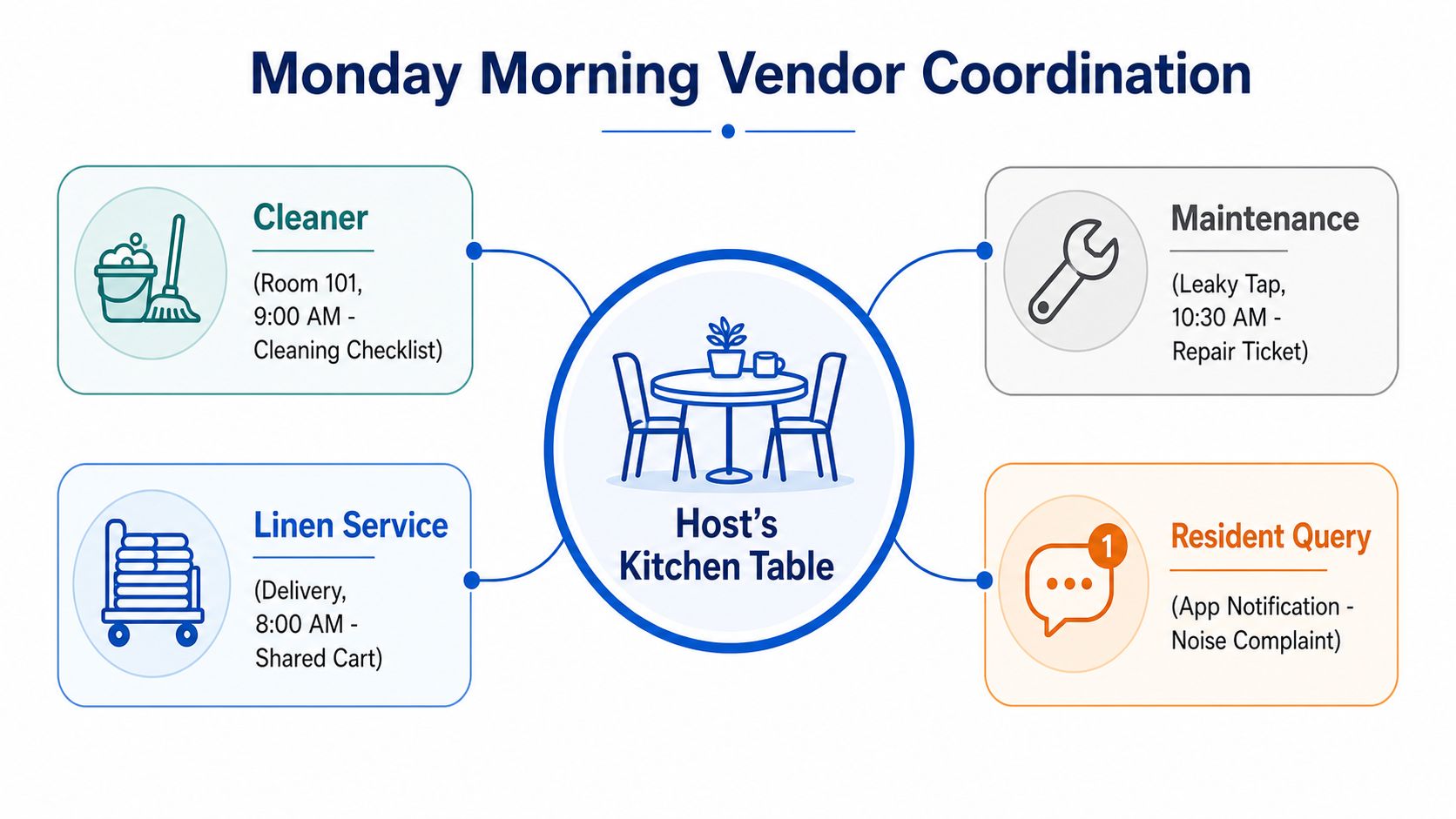
The job is broader than most operators first assume. Vendor coordination covers choosing vendors, onboarding them, tracking performance, maintaining communication, and managing risks across the full working relationship, making it a broader operational process than simple purchasing or order management source. That broader view matters in co-living because vendors rarely work in isolation. They cross paths in kitchens, corridors, utility closets, lock panels, stairwells, and HVAC spaces, where one missed handoff can disrupt the whole house.
What Vendor Coordination Looks Like in a Co-Living House
A typical week in a room-by-room property doesn't fail in one dramatic event. It fails in fragments. One vendor texts that they're “on the way,” another asks for access instructions already sent twice, and a third shows up during a move-in with no clear way to work around residents who are still carrying boxes through the hall.
That's why good vendor coordination looks less like chasing updates and more like building a repeatable operating rhythm. You're not just buying a repair or a cleaning visit, you're managing selection, onboarding, timing, access, communication, performance, and risk as one connected workflow. In shared housing, the work has to survive real-world overlap, not just a clean purchase order.
The practical difference between ordering and coordinating
A one-off order is simple. A coordination problem has dependencies. The cleaner can't start until the turnover painter finishes, the smart-lock tech needs the lockbox access code before arrival, and pest control may need the hallway clear before residents leave for work.
That's the daily reality in a co-living house. The same person often has to confirm scope, prepare access, warn residents, monitor the job, and close the loop after completion. If any of those steps live in different inboxes or text threads, the house becomes the project manager.
A vendor who's “good” on paper can still be a coordination problem if the handoffs are messy.
The rest of this guide is about turning that chaos into a system you can run from the kitchen table. The aim is simple: fewer surprises, clearer ownership, and fewer moments where everyone is waiting on everyone else.
Selecting and Tiering Vendors for Shared Housing
The fastest way to create vendor chaos is to treat every service provider the same. A smart-lock contractor, a weekly cleaner, and a one-time drywall patcher don't need the same review cadence, contract depth, or oversight style. The more clearly you tier vendors, the easier it becomes to spend your attention where it matters.
A practical vendor coordination model starts with selection criteria. Best-practice guidance recommends clear selection criteria, regular check-ins and performance reviews, centralized updates through shared platforms, and escalation paths for disputes source. In co-living, those criteria should include responsiveness, licensing and insurance, willingness to work around residents, after-hours coverage, and experience with shared homes.
Use tiers instead of gut feel
For shared housing, a simple tiering model works better than a long vendor list with no structure. Strategic vendors are the ones that can disrupt the whole portfolio if they miss, think HVAC, smart locks, or portfolio-wide pest control. Operational vendors are recurring partners like cleaning or landscaping. Transactional vendors handle one-off repairs or small jobs.
Here's a simple comparison you can adapt.
| Vendor Tier Comparison for Co-Living Operators | Examples in Co-Living | Review Cadence | Management Style |
|---|---|---|---|
| Strategic | HVAC, smart-lock platform, pest control across multiple homes | Quarterly business reviews | Executive oversight, formal scorecard |
| Operational | House cleaning, lawn care, turnover support | Regular check-ins | Standardized scheduling and quality checks |
| Transactional | Patch repair, single appliance fix, minor plumbing call | After each job | Fast dispatch, light-touch review |
For sourcing, keep a live directory so you're not searching old texts when a lock dies on a Sunday. A structured vendor database, like the one described in PadPulse's vendor directory, is the kind of thing that saves time when you need a backup name fast.
Onboarding needs to be boring on purpose
The best onboarding is dull. Collect the basics, confirm access rules, define communication expectations, and make sure the vendor knows how they'll be judged. In shared homes, I'd treat these as essential, even for a small job:
- W-9 and insurance proof so finance and risk aren't improvising later.
- Key handoff protocol so you're not guessing who has access.
- Resident-facing rules so the vendor knows when to knock, when to text, and when not to enter occupied spaces.
- Escalation contact so a missed appointment doesn't sit unresolved until the next day.
Practical rule: if a vendor can't explain how they work around people living in the house, they're not a fit for co-living.
The goal isn't perfection. It's consistency. A vendor who fits your house rules and communication flow is usually worth more than the cheapest option that creates follow-up work every time they visit.
Scheduling, Dispatch, and the Single Source of Truth
Once vendors are selected, the work is running the calendar without losing the thread. In a shared house, scheduling failures don't just waste time, they interrupt sleep, move-ins, and resident trust. That's why one shared operating record matters more than another app full of “updates.”
A high-reliability workflow uses a single shared source of truth for roles, dependencies, deadlines, acceptance criteria, and fallback decisions, while requiring one named owner at every vendor boundary who restates the written done condition before work begins source. That can live in a property management system, a structured spreadsheet, or a disciplined shared channel. The tool matters less than the discipline.
Replace status chatter with decision-making
Most vendor meetings waste time because they're status updates disguised as coordination. The better pattern is to use meetings for decisions, not narration. If the cleaner needs to know whether the painter is finished, that should already be in the record before anyone gets on a call.
A useful dispatch board should capture:
- The job window so everyone knows when work starts and ends.
- The access method so nobody arrives without the right code or escort.
- The boundary owner so one person can make the call when scopes touch.
- The fallback plan so the house isn't stuck when a vendor is late or absent.
The same logic shows up in event coordination, where a master timeline prevents setup and breakdown from colliding. Shared housing needs that same mindset. A smart-lock battery replacement, a pest visit, and a move-in can all be valid jobs, but they can't all own the same hallway at the same time without someone making the call.
One named owner at each boundary is usually the difference between “handled” and “we thought someone else had it.”
Build a master timeline that includes the ugly parts
A real dispatch plan has to include setup, execution, and cleanup. If a vendor job ends when they send the invoice, you've already lost control of the process. The job ends when the space is usable again, the access issue is closed, and the next vendor can proceed without guessing.
A simple way to pressure-test your timeline is to ask three questions for every job. Who arrives first, who gets blocked if they're late, and what happens if the vendor finishes only half the scope? If you can't answer those quickly, the coordination system isn't ready for a busy house.
Communication Templates and Escalation Workflows
A lot of vendor problems start as language problems. The message was too vague, the access note was incomplete, or the success criterion never got written down. In co-living, that turns into someone showing up at the wrong time, at the wrong door, for the wrong part of the building.
The fix is to standardize the first message, the dispatch confirmation, the resident notice, the no-show follow-up, and the sign-off. Every note should name the property address, the room or zone affected, the access protocol, and the success condition. If those details are missing, the vendor is forced to guess, and guessing is expensive.
Templates you can reuse
Initial outreach “Hi [Vendor Name], we'd like to schedule work at [Property Address], [Room or Zone]. Please confirm availability, arrival window, insurance on file, and any access needs before we lock the job.”
Dispatch confirmation “Confirmed for [date/time]. Access is [lockbox/code/escort]. Please text on arrival and close with a photo or completion note once the work is done.”
Resident notice “Vendor work is scheduled for [day/time]. The affected area is [room/zone]. Please keep that area clear and expect brief noise or access interruptions.”
No-show follow-up “You were scheduled for [time] at [property]. We haven't seen a check-in. Please confirm ETA now, or we'll need to reschedule and escalate.”
Post-job sign-off “Thanks for completing the work at [property]. Please send the final notes, photos, and any follow-up recommendations so we can close the ticket.”
Escalation should be predictable, not emotional
A useful escalation path has to be clear before the problem shows up. For strategic vendors, the first stop is the vendor's primary contact. If that doesn't resolve the issue, it goes to the host or property manager. For critical vendors with repeated misses, the final stop is the owner or executive sponsor.
| Vendor Escalation Matrix | Owner | Response Window | Trigger to Escalate |
|---|---|---|---|
| Tier 1 | Vendor primary contact | Same business day | Missed confirmation, unclear ETA, incomplete scope |
| Tier 2 | Host or property manager | Within the agreed follow-up window | No resolution after first contact |
| Tier 3 | Owner or executive sponsor | After repeated failure on a strategic vendor | Two failed attempts or recurring missed obligations |
For a deeper operating structure, keep your resident and vendor messages aligned with a unified communication layer like PadPulse's unified communication system. That kind of consistency matters because the same confusion tends to repeat across properties, not just within one job.
SLAs, KPIs, and Vendor Scorecards That Actually Predict Failure
A scorecard only helps if it predicts trouble before the residents do. In co-living, the useful metrics are the ones that tell you whether the vendor can protect access, time windows, and household routines. Pretty reports don't help if the plumber still misses the only morning residents are out.
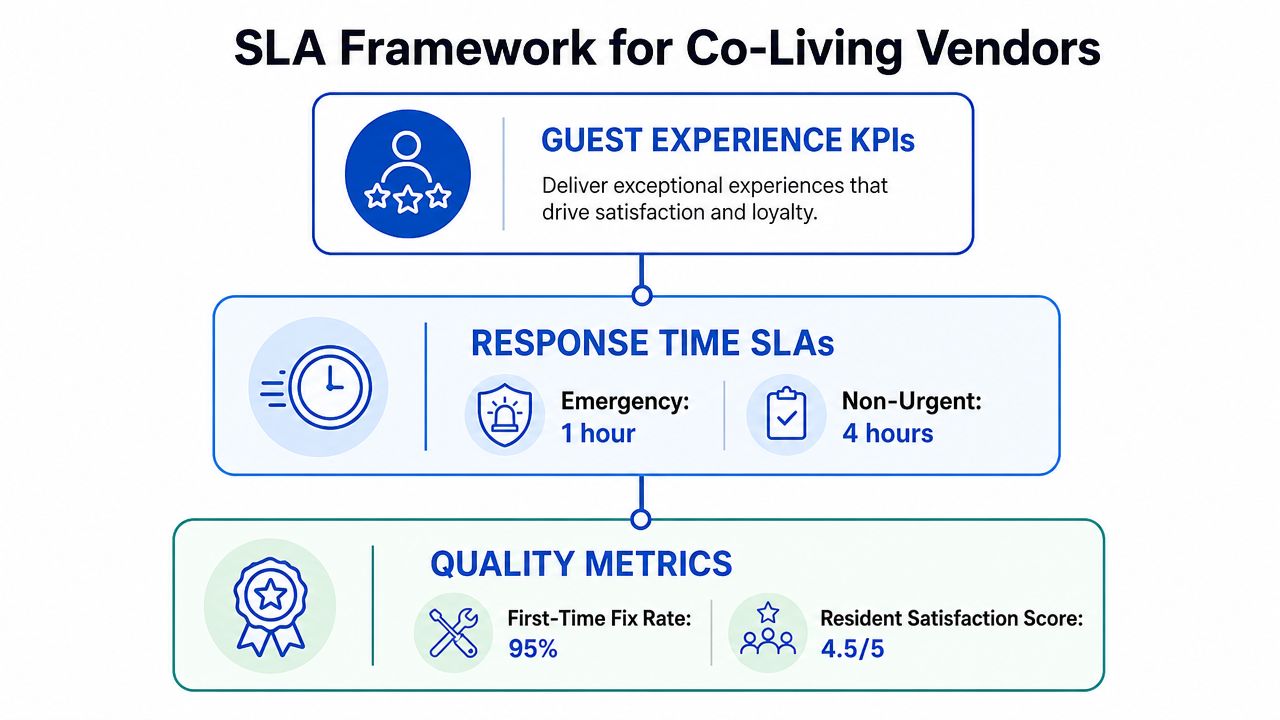
Strategic vendors typically need quarterly business reviews and executive sponsorship, while transactional vendors can be managed with automated monitoring and a consistent dashboard of spend, delivery performance, and risk indicators source. That structure makes sense in shared housing too, because a critical HVAC partner should not be managed like a one-off handyman.
Metrics that tell the truth
A good vendor scorecard doesn't need to be fancy. It needs to show whether the vendor can show up, finish, and leave the house better than they found it. Track the basics that affect daily operations:
- On-time arrival because missed windows create resident frustration fast.
- First-time fix rate because repeat visits eat time and goodwill.
- Invoice accuracy because billing errors hide in busy months.
- After-hours response because emergencies don't wait for office hours.
- Resident complaints tied to the visit because guest experience is part of the job.
An SLA should say what happens in practice, not in a polished brochure. For HVAC and plumbing, emergency response should be defined before the first crisis. Arrival windows, scope completion, and photo or report submission should also be written into the agreement so there's no debate later.
Enforce standards without turning vendors defensive
Good vendors usually want clear expectations. What they don't want is vague criticism after the fact. Set the standard during onboarding, then use the monthly review to talk about the scorecard, not personality.
A vendor review works best when the conversation is about patterns, not one unlucky day.
If a strategic vendor slips, don't improvise. Review the scorecard, confirm the root cause, and decide whether the next step is a correction, a probation period, or replacement. That's not harsh, it's operational discipline.
Smart Integrations That Cut Coordination Time
The hidden cost in vendor work is not always the invoice. It is the staff time spent confirming access, relaying updates, chasing status, and rewriting the same resident message over and over. In co-living, that overhead shows up fast because vendors touch the same building systems, and the same people end up coordinating the handoffs again and again.
A 2025 analysis reported that 60% of vendor coordination time is eliminable through automation source. The same analysis said that for a 500-unit portfolio, the time saved can translate into a lighter monthly workload, lower labor cost, and a strong first-year return. Those figures are a reminder that coordination overhead is labor, even when it does not look like field work.
Automate the repeatable, keep people on the exceptions
The best automation strategy is selective. Routine dispatch confirmations, access code delivery, resident notices, and completion reminders should be system-driven. Complex renovations, difficult resident conversations, and unusual site conditions still need a human who understands the property and can make a judgment call when the job stops fitting the script.
A strong integrated setup can handle the boring repetition well:
- Smart locks can issue one-time access codes that expire with the job window.
- Messaging workflows can send the same confirmation and resident notice every time without manual rewriting.
- Thermostat alerts can flag HVAC issues before a resident turns them into a complaint.
- Dashboards can pull job photos, invoices, and completion notes into one view.
If you are evaluating tech, look at whether the platform reduces handoffs or just moves them around. A tool that gives you one more inbox is not much of a solution. The bigger win is a single workflow where the access, message, and job status stay attached to the same record, so the team is not piecing together the story from three systems.
For operators comparing lock and access integrations, PadPulse's TTLock and Sifely connection is the kind of example that shows how access control can live inside the workflow instead of outside it.
Know which tasks should stay human
Not everything should be automated. A new vendor who has never worked in shared housing may need a live walkthrough. A resident-facing issue after a messy repair may need a call, not a template. A significant change in scope should still be explained by a person who can answer follow-up questions and keep the resident from feeling like they are dealing with a machine.
That balance is the operator's choice. Use systems for repetition, use people for judgment, and keep the two connected so no one has to rebuild the story every time a job changes. The point is to cut coordination time without making shared-housing work feel impersonal or brittle.
Coordinating Around Shared Physical Zones
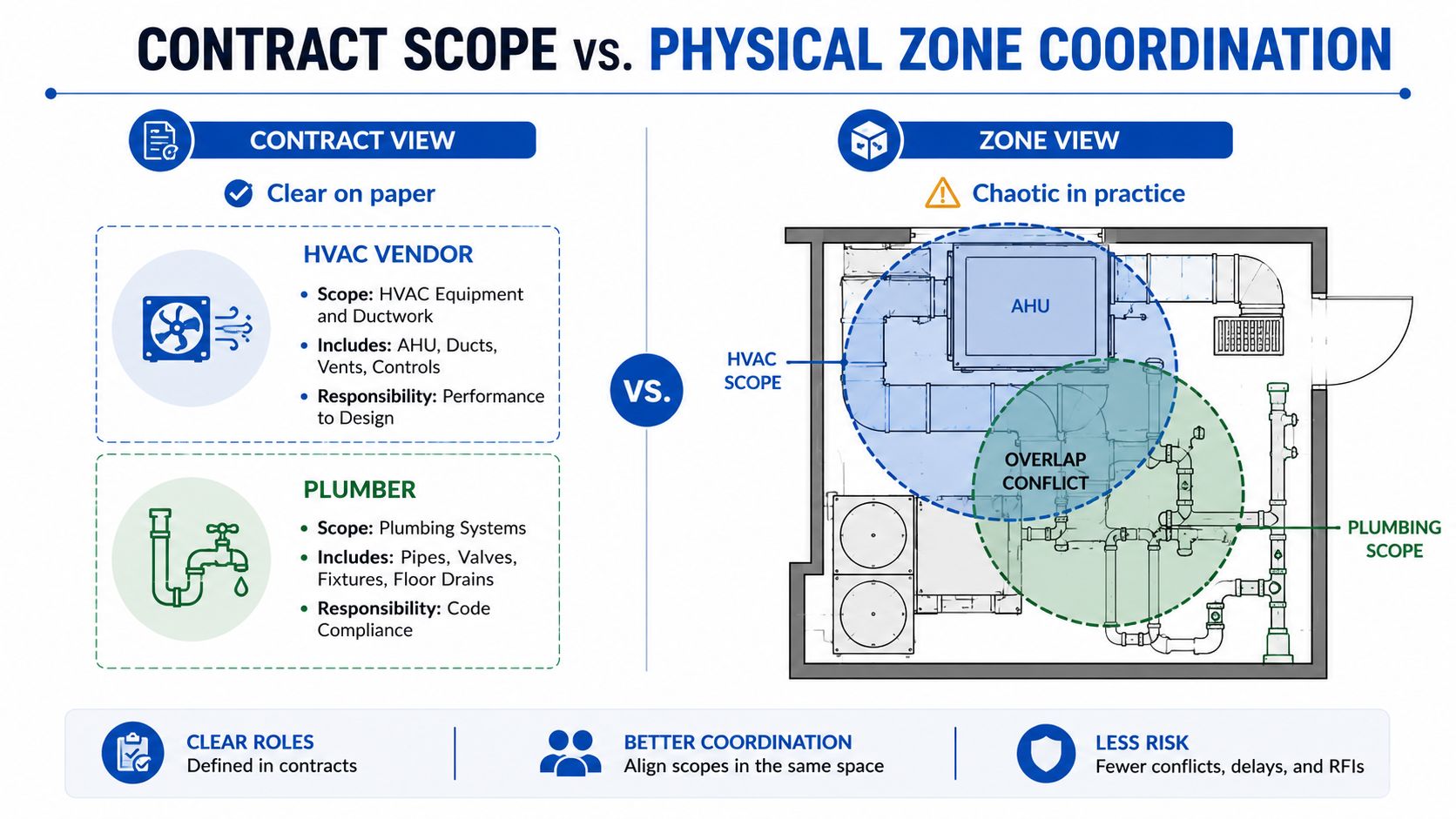
Most vendor coordination advice misses the hardest part of co-living. The contract may look clean, but the property itself isn't cleanly divided. A corridor, a smart-lock panel, a kitchen exhaust, or an emergency stairwell can be the site of three separate vendor jobs that all look reasonable until they happen at the same time.
That's why scope boundaries need to be defined at the physical zone level, not just the contract level. Multi-vendor operations fail when responsibilities overlap at the zone or asset level, so a unified SLA and a shared checklist and scoring rubric should be used across sites source. In shared housing, that idea is more useful than another generic “stay in touch” reminder.
Draw the zone, then assign the boundary
A good coordination map starts with the actual space. Mark the hallway, utility closet, lock panel, laundry area, and any shared entry point. Then write down who owns each zone, who has the right to work there, and who has to yield if two vendors show up for the same space.
That map matters because the failure often isn't technical. The cleaner may be doing fine, the HVAC tech may be on schedule, and the smart-lock vendor may have good notes, but if all three need the same hallway at once, someone still gets blocked. The only way around that is to decide, in advance, which work takes priority and how handoffs are documented.
Use one checklist across overlapping scopes
A unified checklist keeps the same house from being managed three different ways by three different vendors. It also makes performance comparable across sites, which matters when you're trying to spot recurring problems instead of debating anecdotes.
A simple zone-level checklist should include:
- Zone name so everyone uses the same language.
- Primary owner so there's no ambiguity during conflict.
- Conflict rule so vendors know who yields if schedules overlap.
- Completion proof so the next vendor can confirm the area is ready.
A Tuesday morning with pest control, a lock battery swap, and a turnover clean can work if the handoffs are written down. Without that, you end up with the classic “I thought they handled it” outcome, which usually means nobody handled the part that mattered most.
A 30-day rollout is enough to make this real. Start with your most crowded property, map the physical zones, name the owners, write the unified SLA, and test one overlapping vendor day on purpose. If that works, copy the same rubric to the next house.
If vendor coordination is still living in texts, memory, and last-minute phone calls, fix the system before the next HVAC emergency or no-show forces your hand. Start by centralizing your vendor records, setting one owner per job, and tightening access and communication in the properties that create the most overlap. If you want a place to organize that workflow, join the interest list at PadPulse and keep your next vendor visit from becoming a house-wide problem.