Managing Vacation Rental Property: The Ultimate 2026 Guide
May 23, 2026
You're probably in the phase where the property is booked often enough to feel real, but not systemized enough to feel stable.
Messages come in from Airbnb, Vrbo, and text. A cleaner asks whether the guest checked out. Someone can't find the door code. A room needs fresh sheets, another needs a lamp replaced, and your rates haven't changed in weeks because there wasn't time. That's the point where managing vacation rental property stops being a hosting hobby and starts becoming an operations business.
That shift is even sharper in co-living and room-by-room rentals. One whole-home booking is work. Multiple rooms turning over on different dates inside the same house is a workflow problem. Profit doesn't come from nice throw pillows alone. It comes from fast turns, fewer mistakes, clear communication, and a setup that holds up under repeated use.
From Accidental Host to Pro Operator
At 10:40 a.m., one guest is asking for a late checkout, the cleaner is waiting outside because the room is still occupied, and the next arrival is due at 3:00. If that is happening in a single whole-home rental, it is stressful. If it is happening across four or five rooms in the same house on different schedules, it turns into margin loss fast.
That was the point where hosting stopped feeling casual for me. My second co-living property earned less than the first for one simple reason. The issue was not demand. It was slower turns, missed follow-ups, and too many decisions living in my head instead of in a process.
One property can survive on improvisation for a while. A spreadsheet for bookings, cleaner instructions by text, a few saved replies, and a lockbox may hold together longer than they should. Room-by-room rentals expose the cracks much sooner because occupancy is fragmented, guest questions overlap, and maintenance never arrives one issue at a time.
The operators who stay profitable in this model do not win because the furniture looks better in photos. They win because the house runs the same way on a busy Tuesday as it does on a quiet Sunday. Cleaning gets assigned without chasing people down. Door codes change on time. Guests get the right message before they ask. Small repairs get logged, assigned, and closed before they become reviews.
What changes when you get serious
The shift is operational. Every recurring task needs a clear owner and a repeatable method.
- A rule: when rates change, when early check-in gets approved, what counts as an after-hours emergency, and when to comp a guest.
- A workflow: who gets notified, what gets checked before turnover is marked complete, and where photos or notes are stored.
- A system: software, templates, smart locks, task tracking, and calendars that stay in sync.
Without that structure, the operator becomes the fallback for everything. That works until occupancy rises and response time slips.
I use a simple threshold. If a task shows up more than twice a week, it gets documented. If it affects check-in, cleaning, pricing, or maintenance, it gets documented first.
That standard came from mistakes. I used to rely on text threads with cleaners and handoff notes in my phone. It felt fast, but it created rework. A missed linen reset in one room could delay the next arrival, trigger a refund request, and push the cleaner into overtime. In co-living, one sloppy turnover does not just affect one booking. It can disrupt the rhythm of the whole house for a day.
The side-hustle mindset gets expensive
Early operators often assume growth means adding another listing. In practice, growth usually exposes weak control over the listing you already have.
Common failure points show up in predictable places:
- Pricing stays static: rates miss local demand changes because no one reviews them on a schedule.
- Turnovers depend on texting: the cleaner says the room is done, but there is no checklist, photo confirmation, or inventory check.
- Guest communication stays reactive: replies go out when something breaks instead of before common questions appear.
- Maintenance has no owner: small issues wait because everyone saw them and nobody took responsibility.
Professional operation is less about working harder and more about reducing preventable misses. In high-turnover co-living, that is the difference between a property that looks busy and one that produces healthy cash flow.
If one house feels heavier than it should, the answer is usually not more hustle. It is tighter operating structure. Once that is in place, performance becomes easier to measure, staff become easier to train, and guest experience stops depending on whether you are personally available that day.
Setting Up Your Property for Profit and Durability
A profitable setup starts before the first booking. In high-turnover rentals, especially room-by-room co-living, every furnishing choice affects cleaning time, replacement cost, guest satisfaction, and future maintenance.

A beginner mistake is furnishing for looks only. That works in photos and hurts in operations. Light fabric stains. Fragile side tables wobble after a few stays. Decorative clutter slows cleaning and breaks easily.
Furnish for repeated use
For managing vacation rental property well, durability beats trendiness almost every time.
Use this filter when buying anything for the unit:
- Can it be cleaned quickly: smooth surfaces, washable covers, and fewer grooves or seams help.
- Can it survive frequent turnover: bed frames, dining chairs, and nightstands should handle repeated use.
- Can it be replaced without redesigning the room: standard items make reordering easier.
- Can a cleaner inspect it fast: simple layouts help staff spot damage or missing items.
For shared housing, this matters even more in common areas. Kitchen stools, living room seating, and dining tables take the most abuse. Pick finishes that hide wear and don't require delicate upkeep.
Build the listing around clarity
Good listings don't just sell the stay. They screen the guest.
Your photos should show exactly what a guest gets. In room-by-room rentals, that means the bedroom, bathroom arrangement, kitchen, work areas, laundry, parking situation, and common spaces. If the bathroom is shared, say it clearly. If quiet hours matter, say that too.
A strong listing description should answer these practical questions:
- Who is the property best for
- What spaces are private versus shared
- How access works
- What rules matter most
- What amenities are reliably available
Clear rules in the listing prevent more problems than long apology messages after booking.
House rules should be operational, not vague. “Be respectful” is weak. “Quiet hours begin at 10 p.m.” is useful. “No unregistered guests” is useful. “Parking is limited to one vehicle in the marked space” is useful.
Stock for consistency, not improvisation
The easiest way to lose margin is to handle supplies casually. Last-minute runs for paper goods, detergent, or light bulbs eat time and create uneven guest experience.
A better setup is a simple par system. Keep a locked owner closet or supply cabinet and restock to a fixed baseline after every turn.
A practical startup checklist:
- Bedrooms: mattress protector, extra sheet set, extra pillow set, hangers, bedside lamp, blackout window covering if needed
- Bathrooms: extra towels, hand soap, toilet paper, plunger, trash liners, basic cleaning backup
- Kitchen: matching dish sets, enough silverware, cookware that can handle heavy use, sponge supply, paper towels
- Entry and access: labeled backup batteries, spare smart-lock plan, printed emergency contacts
- Utility shelf: light bulbs, air filters, touch-up paint, hardware basics
Design for fewer support tickets
Every confusing thing in the house becomes a message from a guest.
Label light switches if they're not obvious. Make Wi-Fi details easy to find. Put laundry instructions where the machines are. If parking is tricky, include a photo in the guide. If multiple guests share a home, use room labels and storage labels that make ownership obvious.
Here's the trade-off most new hosts miss: a prettier setup can still be less profitable if it creates more cleaning time, more breakage, and more guest confusion. The best-performing rentals are often the easiest ones to maintain.
Developing a Profitable Dynamic Pricing Strategy
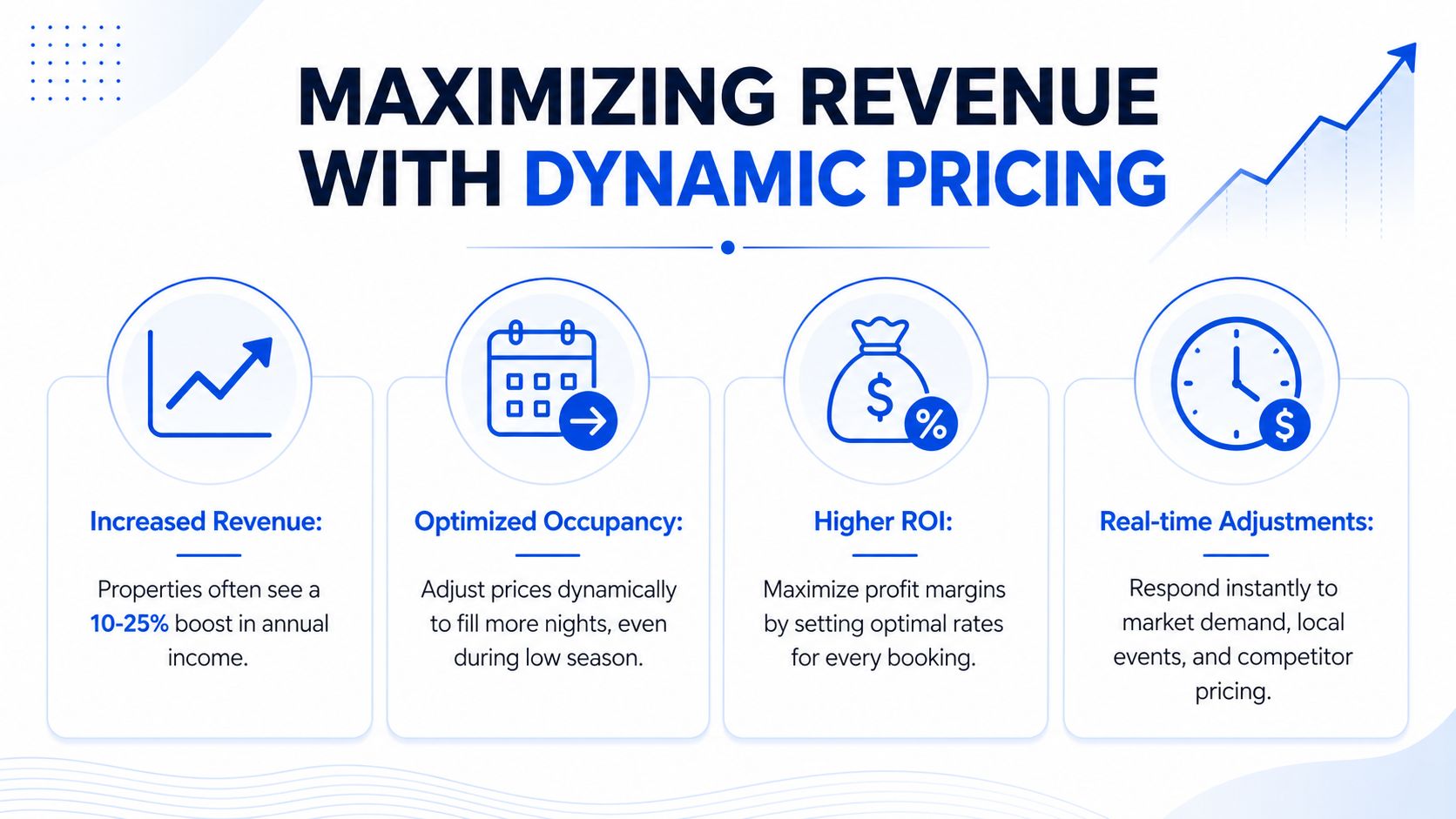
Static pricing feels safe. It's also one of the fastest ways to underperform.
The market has grown, but competition has become more demanding. One industry summary says the global vacation rental market was valued at US$82.63 billion in 2022 and is projected to reach US$119.01 billion by 2030, while a recent report also noted occupancy slipping from 54% in 2022 to 47% in 2024. That combination matters because it means future gains depend more on pricing precision and efficient operations than on assuming bookings will continue to rise. Those projections and occupancy figures are summarized in DoorLoop's vacation rental statistics roundup.
Why static rates fail
A fixed nightly rate ignores what drives bookings:
- Seasonality: weekends, holidays, and shoulder periods don't behave the same.
- Local demand shifts: concerts, sports, weather, and conferences change booking behavior.
- Lead time: last-minute inventory should often be priced differently from dates far out.
- Competitive position: your room, house, or location may justify more or less than nearby options.
In co-living, there's another layer. Not all inventory performs equally. The room with a private bath, quieter location, or better natural light will usually support stronger pricing than the one near the front door or laundry.
A practical pricing model
You don't need to become a revenue manager overnight. You do need a system.
Start with four pricing layers:
| Layer | What to review | Why it matters |
|---|---|---|
| Base rate | Your standard market rate | Gives you a starting point |
| Seasonal adjustment | High and low demand periods | Keeps you aligned with predictable patterns |
| Date-specific adjustment | Events, holidays, compressed demand | Captures short bursts of pricing power |
| Stay-rule adjustment | Minimum stays and gap-night handling | Helps avoid awkward calendar holes |
Avoid the common beginner move of only checking nearby listings and undercutting them. Cheap pricing can fill a calendar and still weaken the business if it attracts the wrong bookings or leaves no room for turnover costs and maintenance.
A better benchmarking habit is to compare against similar inventory. Shared bath should be compared with shared bath. One room in a co-living home should not be priced like a full private apartment.
Rate changes should follow a rhythm
If you're self-managing, set a recurring review schedule. Weekly is better than “when I remember.” Daily review becomes useful in tighter markets or around event-heavy periods.
A solid review process asks:
- Which dates are still open that should already be booked
- Which upcoming dates are booking faster than expected
- Which nights are stranded between reservations
- Which units or rooms consistently command more
Don't ask, “What nightly rate feels fair?” Ask, “What rate fits this room, this date, and this booking window?”
For operators who want a more structured approach, tools built for dynamic pricing for rental operators can help standardize repricing and reduce the lag between market movement and rate updates.
Dynamic pricing isn't about changing numbers for the sake of it. It's about protecting revenue on strong dates and protecting occupancy on weak ones. That balance is where margin lives.
Mastering Guest Communication and Turnovers
Good reviews usually look like hospitality. Behind the scenes, they're process.
Expert guidance on vacation rental operations consistently points to the same failure points: near-real-time guest communication, synchronized calendars, and disciplined inspection and cleaning workflows. When those slip, occupancy and reviews usually slip with them, as described in this operational guide to managing a vacation rental.
The communication sequence that prevents problems
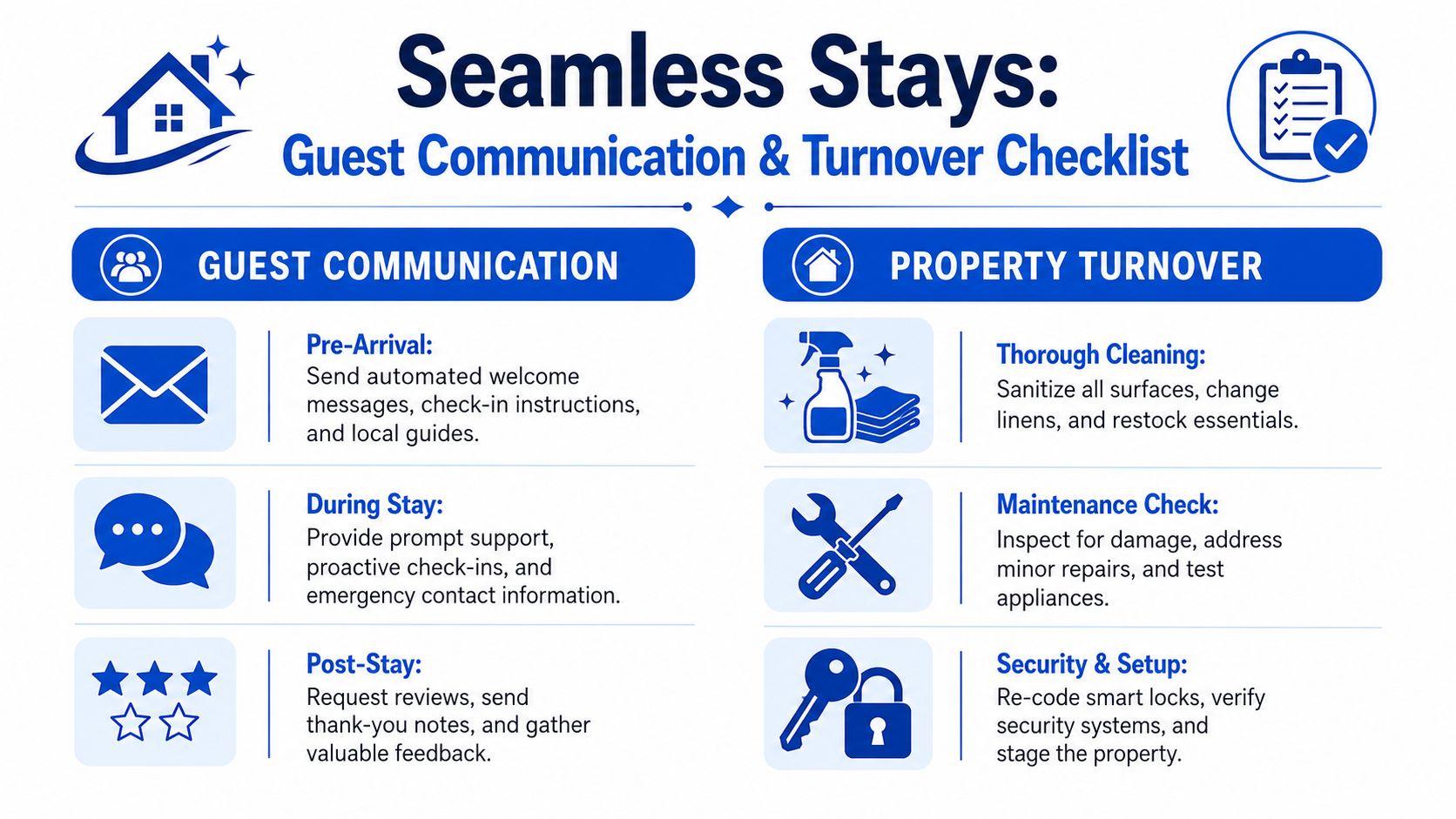
Most guest issues start before the guest arrives. Either they didn't get the right information, got it too late, or had to ask for it manually.
A strong communication workflow uses timing, not just friendliness.
After booking
- Confirm quickly: thank the guest, confirm dates, and set expectations.
- Restate key rules: parking, quiet hours, shared-space expectations, and check-in window.
- Flag anything unusual early: stairs, shared bathrooms, entry gate instructions, or ID requirements.
Before arrival
- Send check-in details at least 24 hours before arrival: include the address, entry steps, parking instructions, Wi-Fi, and house notes.
- Keep it skimmable: long paragraphs get ignored. Use short bullets.
- Include support guidance: tell them how to reach you if the lock, Wi-Fi, or thermostat creates trouble.
During stay
- Check in once, briefly: ask whether everything is as expected.
- Reply fast to operational issues: access, cleanliness, noise, and climate control need quick handling.
- Escalate clearly: cleaners handle linen issues, maintenance handles broken items, and only true emergencies interrupt the whole team.
After checkout
- Thank the guest
- Request a review
- Log any issue internally: don't rely on memory
For room-by-room rentals, pre-arrival messaging should also explain shared-space norms. That single message can prevent noise complaints, fridge conflicts, and bathroom misunderstandings.
Turnovers need a checklist, not trust
A cleaner saying “all set” isn't a system.
Every turnover should have a repeatable checklist with room-specific steps. That's even more important when different rooms turn on different days inside one home. If you don't standardize this, small misses compound. Missing towels, trash left in a bathroom bin, or a dead remote battery all create avoidable guest friction.
Useful turnover categories include:
- Reset the room: strip beds, replace linens, inspect mattress protector, restage surfaces
- Refresh the bathroom: sanitize fixtures, restock essentials, remove hair, check drains
- Inspect functionality: lights, outlets, thermostat response, TV remote, lock operation
- Check damage and wear: stains, broken hardware, wall marks, furniture looseness
- Prepare access: update codes if needed and verify arrival instructions match reality
If you want a structured starting point, a set of property management checklists for rental operations can help turn recurring tasks into standard operating procedures.
Calendar drift is more dangerous than people think
Double bookings don't only happen because software fails. They happen because operators update one place and forget another, or because a room was blocked for maintenance and never reopened.
In multi-room operations, the calendar is inventory control. Treat it that way.
A simple operational standard looks like this:
| Workflow point | What must happen |
|---|---|
| New booking | All channels and internal task systems reflect it |
| Maintenance block | Booking channels and cleaner schedule update together |
| Early checkout or extension | Calendar, access, and cleaning assignment are revised |
| Same-day turn | Cleaner confirmation arrives before check-in info is sent |
Fast replies help win bookings. Clean, accurate turnovers help keep them profitable.
What actually works
Operators often focus on writing better guest messages when the underlying problem is inconsistency.
What works better:
- Saved templates with a human edit when needed
- One owner-approved house manual
- Photo confirmation after each turnover
- A short damage escalation path
- One source of truth for booking status
What doesn't:
- Messaging guests ad hoc
- Telling cleaners “just do the usual”
- Sending check-in instructions only when the guest asks
- Assuming the last person noticed maintenance problems
Managing vacation rental property well means treating communication and turnovers like linked systems. One protects the review. The other protects the calendar.
Ensuring Safety, Compliance, and Maintenance
A rental that books well can still become a weak business if safety, repairs, and local rules are handled casually. Operators usually feel this only after a problem hits. A denied permit. A guest incident. A house issue that forces a room offline longer than expected.
The better approach is to treat all three as one risk-management system. Safety protects the guest. Maintenance protects the asset. Compliance protects the business model.
Build a preventive maintenance rhythm
Reactive maintenance is expensive because it creates urgency, guest disruption, and idle inventory. Shared housing amplifies this because more people use locks, plumbing, appliances, and HVAC controls more often.
Set recurring inspections for the items that fail most often in high-turn environments:
- Access hardware: smart locks, door closers, strike plates, batteries
- Wet areas: toilets, drains, caulking, under-sink leaks, exhaust fans
- Climate systems: filters, vents, thermostat behavior
- Furniture and fixtures: bed slats, drawer pulls, chair legs, lamps
- Kitchen wear points: garbage disposal, cabinet hinges, appliance seals
Keep a maintenance log by property and by room. If the same issue appears repeatedly, it's a system issue, not a one-off.
Run a simple safety audit
Safety shouldn't live in your head. It needs a repeatable checklist that someone can verify.
At minimum, confirm:
- Smoke and CO devices are working
- Fire extinguishers are present and accessible
- Exit paths are clear
- Exterior lighting works
- House numbers are visible
- Emergency instructions are easy to find
- Locks and windows secure properly
In co-living properties, clear labeling matters more than many owners think. Guests who don't know which entrance to use or how to exit in an emergency become a risk quickly.
A safe property feels calm because the operator removed uncertainty before the guest ever noticed it.
Treat compliance like a financial input
Here, many owners stay too vague. They know they should “check local rules,” but they don't model what those rules do to the business.
That's a mistake. Local regulations can cap occupancy, require registration, or impose minimum-stay rules that directly affect vacancy and NOI, as noted in EastWest's discussion of vacation rental management and regulatory change.
Instead of treating compliance as a yes-or-no checklist, run scenarios.
For example:
| Scenario | Operational effect | Financial question |
|---|---|---|
| Occupancy cap changes | Fewer guests or fewer rentable rooms | Does the property still support target NOI |
| Registration required | More admin and possible delays | What's the cost of downtime or noncompliance |
| Minimum stay rules tighten | Less flexibility in slower periods | Can pricing offset the reduced booking pattern |
| Shared-housing rules change | Room-by-room model becomes constrained | Is conversion to another model worth it |
This kind of planning is especially important in room-by-room housing because a single property can sit under zoning, licensing, tax, and safety rules at the same time.
Don't separate compliance from operations
A lot of owners keep permits in one folder, maintenance in another, and guest issues in a third mental bucket. In practice, they overlap.
If a city changes enforcement, you may need new signage, updated occupancy rules in your listing, revised guest messaging, and a new pricing plan. If a safety issue takes a room offline, that affects turnover planning and revenue immediately. Good operators connect those decisions early instead of reacting late.
The strongest portfolios aren't the ones with zero problems. They're the ones that catch problems while they're still small and make rule changes visible in the operating plan.
Tracking Performance and Financial Health
End of month is where weak operations show up.
I learned that after running a house that looked busy on the calendar and still produced less cash than expected. The problem was not demand. It was the room that sat empty for two extra nights after a maintenance delay, the cleaner callback that got billed twice, the guest credit issued because check-in instructions were late, and the supply spending that kept creeping up because nobody was tracking it by room. In a high-turnover co-living setup, those misses stack fast.
Gross payout is a starting point. It is not the scorecard.
The few numbers that matter most
Early on, I kept too many reports and still missed the key issues. A smaller set of metrics worked better once the definitions were consistent and the review cadence was fixed.
Track these first:
- Occupancy rate: how often the room or property is booked
- ADR: average daily rate, or the average booked nightly price
- RevPAR: revenue per available room or rental night
- NOI: net operating income after operating expenses
NOI drives the operating decision. It shows whether the property still works after cleaning, utilities, supplies, software, repairs, turnover labor, and the friction costs that room-by-room operators feel more often than whole-home hosts.
Analysts at OfferMarket explain the same underwriting logic in their guide to valuation. Estimate gross rental income from occupancy and ADR comps, then subtract operating costs to get NOI. That guide also notes that property management fees often fall in the 20% to 30% range of gross income, with platform fees adding about 3% per booking. Read the full framework in OfferMarket's guide to valuing a vacation rental property.
A clean P&L beats a messy spreadsheet
Your P&L should help you spot operational drag quickly.
A simple monthly layout should separate:
| Income | Operating costs | Other notes |
|---|---|---|
| Nightly revenue | Cleaning | Room or unit downtime |
| Fees collected | Supplies | Refunds or guest credits |
| Other rental income | Utilities | Maintenance patterns |
| Software | Compliance-related costs | |
| Repairs | Owner-use blocks |
For co-living, track performance by room and by property. House-level averages can hide the room next to the front door that gets more complaints, the basement room that books only on discount, or the unit with repeated plumbing issues that keeps creating turnover lag.
I also split expenses into fixed, variable, and avoidable rework. That last category matters more than many operators expect. Re-cleans, lockouts, guest compensation, rush maintenance, and same-day linen runs are not random noise. They usually point to a broken workflow.
If you are building those workflows now, this breakdown pairs well with customized automation solutions for short-term rental operations, especially when you need cleaner handoffs between messaging, turnovers, and maintenance.
Review trends, not just totals
One strong revenue month can hide slow turns and repeated service mistakes. One weak month can come from a short burst of vacancy or seasonality.
The useful review is pattern-based:
- Which rooms book faster
- Which stays generate the most support tickets
- Which cleaners or vendors create rework
- Which expenses repeat month after month
- Which dates sit vacant longer than expected
Operator habit: Every month, identify one expense that rose and one workflow that caused it.
That habit changes how you run the property. Instead of asking why profit felt low, you can see that Room 3 had three extra vacancy nights after maintenance, guest credits rose after a messaging miss, or laundry costs jumped because turnovers were compressed into weekends.
That is the difference between hosting and operating. In co-living, profitability comes from controlling turnover speed, communication errors, and maintenance lag as tightly as you control rate.
Scaling Your Operations with Smart Automation
Automation gets dismissed as a luxury by people who haven't hit operational bottlenecks yet. Once you've handled overlapping turnovers, lock issues, guest questions, and maintenance follow-up across multiple rooms, you stop seeing automation as optional.
In co-living, the main bottleneck often isn't demand. It's labor substitution. Turnover speed, maintenance lag, and repetitive guest messaging eat the day. That's why systems like smart locks and automated messaging matter so much. They reduce vacancy days and labor pressure in ways generic advice often underestimates, as discussed in this piece on vacation rental management watchouts.
What to automate first
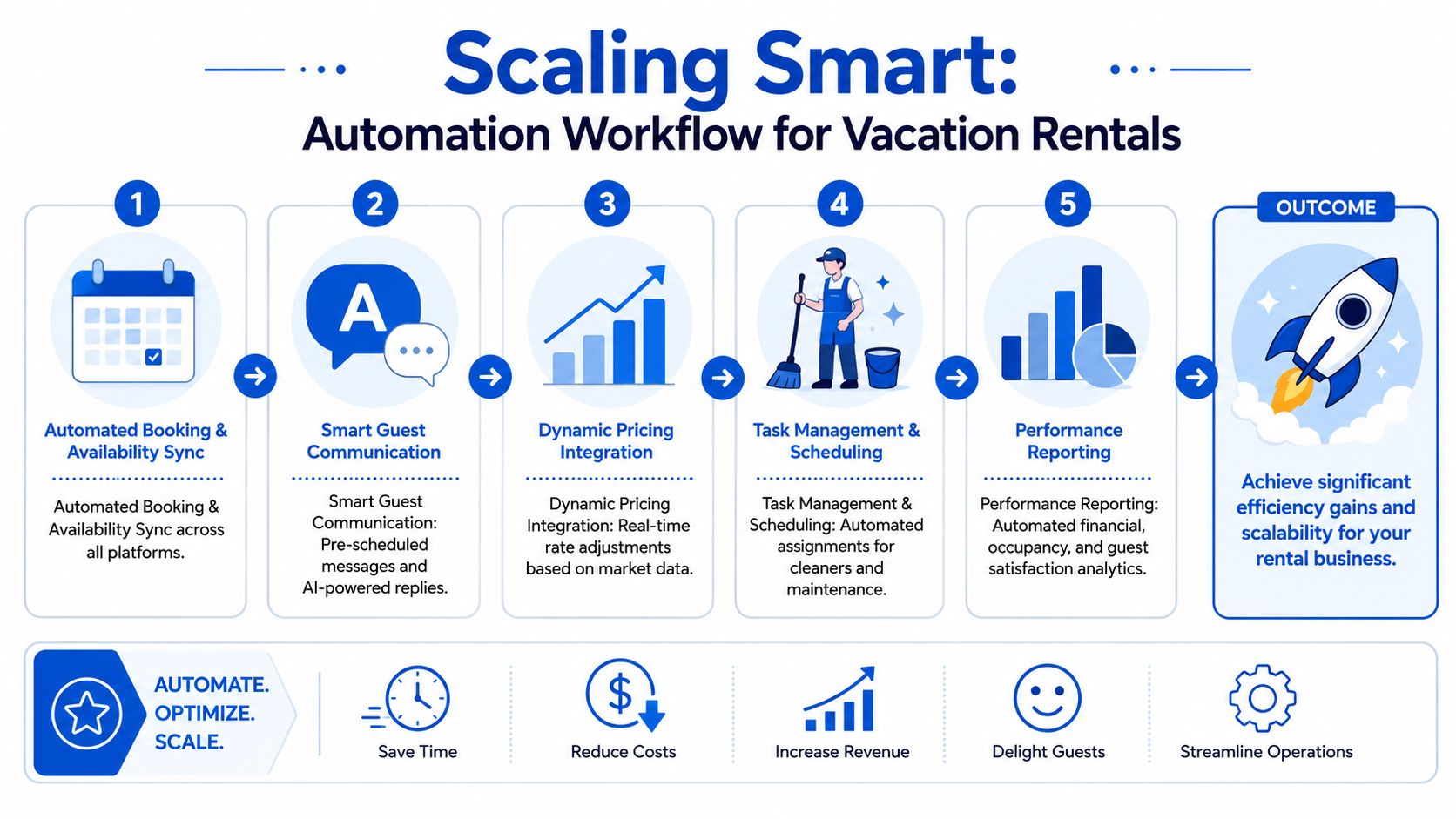
Not every task deserves software. The best automation targets repetitive work, timing-sensitive tasks, and handoff-heavy processes.
Start here:
- Access control: smart locks remove key handoffs and make code changes easier.
- Guest messaging: scheduled confirmations, check-in instructions, and checkout reminders reduce repetitive replies.
- Calendar sync: availability needs one source of truth across channels.
- Task assignment: cleaning and maintenance dispatch should happen from a booking event, not from memory.
- Reporting: income, occupancy, and issue tracking should be easy to review.
A short video can help illustrate how operators think about systems and scale in practice.
Manual versus automated workflows
The difference gets obvious as soon as the portfolio grows.
| Task | Manual Method (1-5 Properties) | Automated Method (Scalable) |
|---|---|---|
| Booking updates | Check each channel and update calendars by hand | Channel manager syncs availability automatically |
| Guest communication | Copy and paste messages individually | Scheduled workflows send timed messages |
| Check-in access | Physical keys or shared lockbox code | Unique smart-lock codes tied to reservation timing |
| Turnover coordination | Text cleaner after each checkout | Tasks trigger automatically from reservation status |
| Maintenance follow-up | Notes in phone or chat thread | Centralized tickets with status tracking |
| Performance review | End-of-month spreadsheet cleanup | Ongoing dashboards and exportable reports |
The wrong kind of automation
Bad automation creates more work. It sends robotic messages that confuse guests, stacks too many disconnected tools, or hides problems behind dashboards nobody checks.
Good automation does three things well:
- It reduces response time
- It lowers the chance of human error
- It gives the operator visibility
That's the standard I'd use before adding any tool. If it doesn't save labor, protect occupancy, or improve control, it's probably just software overhead.
For operators exploring customized automation solutions for co-living portfolios, the best fit is usually the system that connects access, messaging, pricing, and reporting instead of forcing staff to bounce between separate apps.
Scale comes from fewer handoffs
A lot of owners think they need more people to grow. Sometimes they do. Often they first need fewer fragile handoffs.
If a guest extends a stay, your system should update availability, access, and cleaning. If a checkout happens, the next task should appear without anyone chasing it down. If a room goes offline for maintenance, the calendar shouldn't keep selling it.
That's what scalable managing vacation rental property looks like. Not less work overall. Less repeated manual work, fewer mistakes, and faster recovery when something changes.
PadPulse is building toward that kind of operating model for room-by-room and co-living portfolios. If you want one place for pricing, messaging, access control, and financial visibility, you can join the interest list at PadPulse for updates on the Winter 2026 launch and early beta access.