How to Respond to Tenant Inquiries: A Complete Playbook
July 31, 2026
71% of renters expect a response within 24 hours, but only 51% say they get one. That gap is why how to respond to tenant inquiries is no longer a soft skill, it's an occupancy lever, especially in room-by-room and co-living operations where every unanswered message can turn into a lost showing, a missed application, or a vacancy that lingers longer than it should.
In practice, fast inquiry handling is one of the few parts of leasing you can control every day. The challenge is that high-volume housing doesn't fail because one message was slow, it fails because messages land in too many places, get answered inconsistently, and never make it into a trackable workflow. That's where response speed, message quality, and compliance start to overlap.
Why Response Speed Directly Impacts Your Occupancy
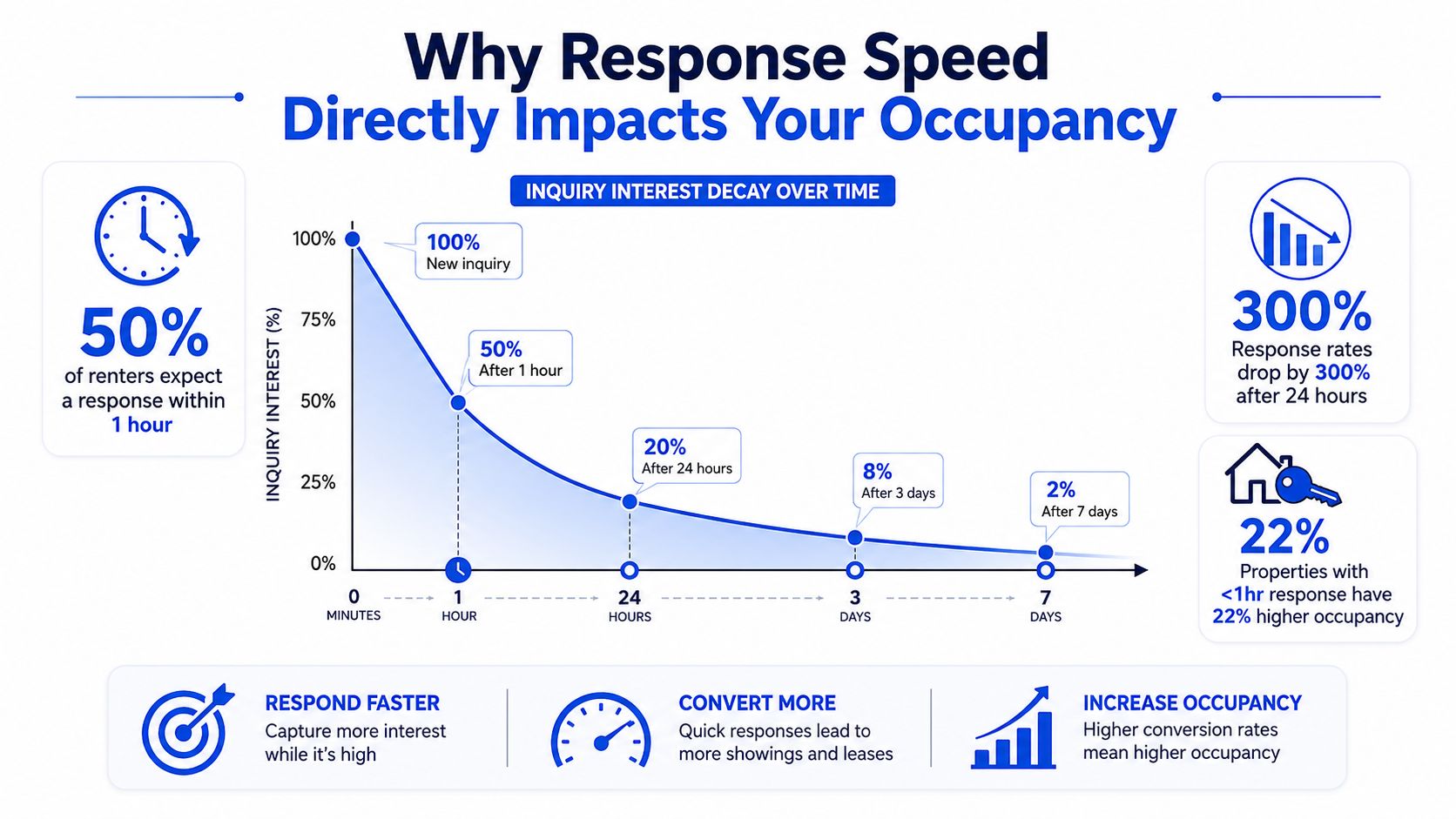
The first mistake operators make is treating inquiry response like customer service. It's not. It's a leasing KPI, because prospects compare listings in real time, and the one that replies first usually keeps the conversation alive long enough to earn the tour, the application, or the next question.
A useful benchmark makes the gap clear. In one widely cited rental management source set, 71% of renters expect a response within 24 hours, but only 51% say they get timely replies, and property management response rates collected on RentHop averaged about 70.54%, with only 52% of firms beating that average (Lethub rental inquiries benchmark). That tells you something blunt, professional operators still leave a lot of money on the table when they treat speed as optional.
Why same-day is already behind
Same-day response used to feel strong. It doesn't anymore. The National Apartment Association's 2025 resident satisfaction survey reported that 62% of renters expect a response to non-emergency inquiries within 1 hour, up from 38% in 2020 (USTech Automations summary of the NAA survey). In other words, expectations compressed from “today” to “right away.”
For co-living operators, that matters even more. A room-by-room vacancy can't wait for someone to clear a cluttered inbox after lunch. Every delayed reply gives the renter time to message another property, and if that other property confirms availability, sends the next step, and offers a tour slot, the decision window starts closing fast.
Practical rule: If a lead has asked a direct leasing question, the first reply should happen as close to real time as your workflow allows, then move into a structured follow-up sequence.
The conversion logic is supported by response-quality data as well. One benchmark found that companies responding within 5 minutes saw 38% higher lease renewal rates than those averaging 24+ hour response times, while another found that responding within 1 hour made a lead about 7 times more likely to be qualified than waiting more than 4 hours (USTech Automations). Even if your operation can't hit those exact windows every time, the direction is obvious. Speed changes outcomes.
The right takeaway isn't “answer faster at all costs.” It's “build a response system that makes speed repeatable.” That's the difference between an inbox and an operating model.
Building a Triage System That Prevents Missed Inquiries
A co-living inbox breaks down fast when every message sits in the same queue. The first operational step is to capture each inquiry in one place, then sort it before a human starts drafting a reply. A workable sequence is to log the inquiry at receipt, assess urgency, assign the owner, and track it to closure, which matches the structure recommended in property-operations guidance (DataCalculus inquiry and complaint management).
Build the workflow around the inquiry type
A maintenance issue needs urgency and escalation. A leasing question needs a complete answer and a fast next step. A fair-housing-sensitive question needs careful wording and the same process every time.
A common failure point in room-by-room leasing is one shared inbox with no routing rules. The result is predictable, maintenance gets buried under tour requests, hot leads wait while someone else sorts the queue, and sensitive questions get answered inconsistently. The fix is a simple triage map:
- Urgency first: Flag anything that affects safety, access, or an immediate move-in decision.
- Type second: Separate maintenance, leasing, general questions, and policy-sensitive inquiries.
- Owner third: Route it to the person who can resolve it, not the person who happened to open the message.
- Closure last: Don't count a message as handled until the tenant has a clear answer or next step.
That workflow also makes follow-up auditable, which matters when several team members touch the same prospect. A central digital log, assignment tracking, and resolution tracking give you a clean record of who replied, what was promised, and whether the issue was closed. The same structure also supports automated acknowledgments that include a request number, a promised response window, and status tracking (DataCalculus inquiry and complaint management).
Set response windows by category
A general inquiry can often wait a little longer than a move-in blocker, but no inquiry should disappear. Property-operations guidance commonly uses 24 hours or one business day as the acknowledgment window for general questions, with routine questions often handled in 2 to 5 business days depending on complexity and policy (DataCalculus inquiry and complaint management).
For co-living operators, the work is turning those windows into a visible workflow. Once the SLA is written down, the team can separate what needs an immediate human reply, what can be handled with a template, and what needs review before it goes out.
I've watched triage fail in a very specific way. A leasing coordinator answers the newest message in the inbox first, a maintenance request sits for hours, and a policy question gets answered by a different staff member with slightly different wording. The fix is not more effort, it is a written routing rule that forces each message into the right path before anyone responds.
Document the handoff every time. Phone calls, side texts, and social DMs are where follow-ups vanish if they are not entered into the same log as email and portal messages.
PadPulse's lead qualification process fits naturally into that routing model because it keeps inquiry handling tied to qualification instead of treating every message as a one-off conversation.
Channel-Specific Response Best Practices
The biggest mistake in multi-channel leasing is making every reply sound the same. A text message, an email, a listing inbox response, and a phone call all carry different expectations, and renters read them differently. The information should stay consistent, but the delivery needs to match the channel.
Text messages should be short and decisive
Text is where speed matters most because renters treat it like a live thread. Keep the reply compact, answer the exact question, and give one next step. A useful structure is greeting, answer, and action.
For example, if someone asks whether a room is still open, the response should confirm availability, mention the next step, and avoid a paragraph of marketing copy. Short messages get read. Long ones get saved for later, and later is where leads cool off.
Email can carry more detail
Email is the right place for attachments, policy details, and a fuller explanation of pricing, screening, or move-in steps. It's also the safest channel for a more complete written record, which helps when the same prospect asks follow-up questions later.
The key is to avoid turning email into a wall of text. Keep the first paragraph focused on the tenant's question, then add supporting details underneath. If the renter asked about an application process or required documents, put those items in a clean list so they can scan it quickly.
Listing inboxes need efficiency
Responses inside Zillow, Apartments.com, or similar inboxes should prioritize clarity and next action. Those messages are often the first touchpoint, so the answer needs to sound professional without feeling generic. If the listing platform allows it, move the conversation into a more trackable channel once the lead is qualified, so the thread doesn't get buried.
Phone calls are for higher-intent moments
A call is worth the time when the renter is close to booking, has a complex question, or seems confused by written replies. Phone also works when you need to resolve a sensitive issue fast, but it should never replace written confirmation.
Consistency beats improvisation. If the answer changes by channel, tenants notice, and compliance risk rises with every mismatch.
For teams using a wider communication stack, PadPulse's tenant communication tools are relevant because they support structured messaging across the channels operators already use, instead of forcing each reply to live in a separate silo.
Message Templates for Every Stage of the Leasing Funnel
Good templates don't sound robotic when they're written well. They sound dependable. The goal is to keep the first reply fast, complete, and easy to personalize, so you're not rewriting the same message ten times a day while leads wait.
Start with acknowledgment
Acknowledge the inquiry, answer the main question if you can, and set the next step.
Example: “Hi [Name], thanks for reaching out about [Property Name]. The room is available, and I can send over the next steps or help you schedule a viewing. What time works best for you?”
That message works because it does three things at once, confirms the lead was heard, gives a real answer, and opens a path forward.
Use screening questions without sounding abrupt
Once the lead is engaged, ask only the questions needed to qualify fit. In room-by-room housing, that often means move-in timing, desired room type, and whether they're comfortable with shared living.
Example: “Before I send over the tour details, can you confirm your move-in date and whether you're looking for a private room or shared setup at [Property Name]?”
That's faster than a long intake form and easier to answer on mobile.
Scheduling should be simple
Example: “I've got two viewing windows open for [Property Name], Tuesday at 3:00 or Wednesday at 5:30. Reply with the one that works, and I'll lock it in.”
That keeps the decision easy. Too many options slow replies down.
Application guidance should remove friction
Example: “Thanks for your interest, [Name]. The application for [Property Name] includes identity verification and screening, and I'll send the link once we confirm the room fits your needs. If you'd like, I can also walk you through the process before you apply.”
That tone is direct, respectful, and low-pressure.
Rejection or follow-up should stay professional
If the room isn't a fit or another applicant moved first, be clear and courteous.
Example: “Hi [Name], thank you for your interest in [Property Name]. That room has been taken, but I can share other options if you'd like me to keep you in mind for future openings.”
Personalization matters here. Guidance for renter inquiries consistently recommends using the tenant's name and relevant property details rather than a generic blast, because generic replies reduce engagement and weaken conversion (Apartments.com message best practices).
Fair Housing Compliance and Risk Management
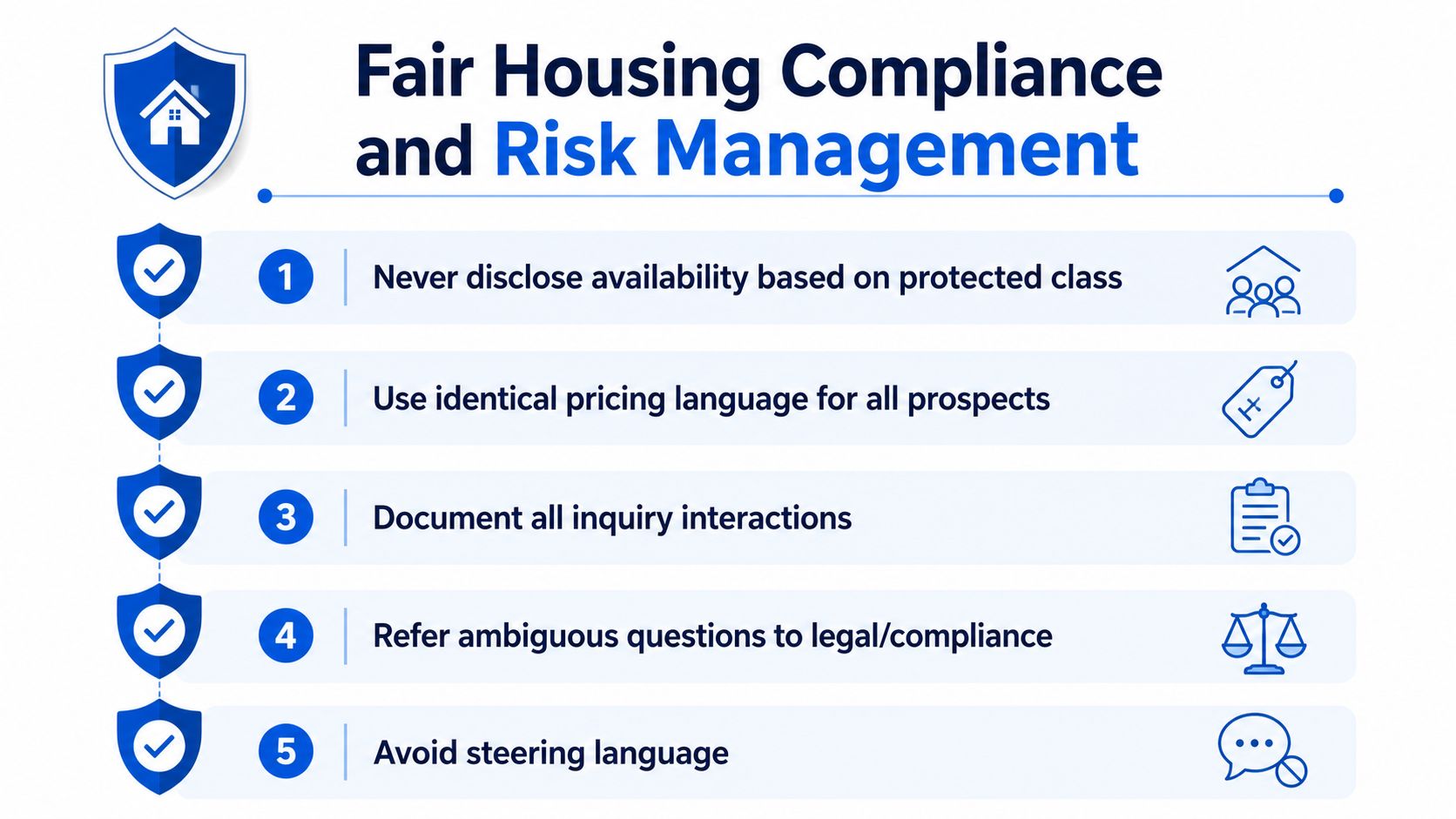
High-volume inquiry queues create the most compliance risk in the quiet moments, when a message looks routine but carries a screening question, a preference, or language that can be read the wrong way. Operators usually get into trouble through inconsistency, not intent. A text reply, an email reply, and a phone answer that do not match can create confusion fast, especially in co-living where different staff members may handle the same lead across multiple channels.
Written consistency matters because fair-housing guidance expects staff to give only accurate, time-specific information and to keep replies aligned across channels. The Fair Housing Institute written responses guidance points out that ad hoc answers raise risk when renters compare what they heard in text, email, and on the phone. That pressure gets worse when teams are moving quickly, since rushed replies are more likely to drift off-script.
Keep language factual and current
Availability, rent, and qualification questions should be answered only with information you can verify right now. If a room is available today, say so. If pricing or screening criteria may change, state that clearly in writing. Do not speculate, and do not hint that one applicant is a better fit than another.
Short, current answers are safer than clever ones. In co-living, a vague reply can create confusion across several open leads, while a precise reply gives everyone on the team the same reference point.
Avoid language that can be read as steering
Tone matters because the wrong phrasing can suggest preference, exclusion, or judgment. Responses should avoid slang, informal language, and personal opinions that could be perceived as biased, and they should stay polite, respectful, and error-free, as noted in Chainels on tenant inquiry responses. That standard is not about sounding polished for its own sake, it keeps the reply from drifting into subjective comments about who the property is or is not right for.
The same issue shows up in fast-moving inboxes. A rushed line that sounds casual in Slack can read very differently in a tenant thread, especially if it touches room assignments, roommate fit, or policy exceptions.
Build a safe escalation path
Questions that touch protected classes, ambiguous qualification language, or policy edge cases should be routed to someone trained to answer them. The workflow should make that handoff routine, so staff do not hesitate or improvise under pressure.
A written record helps here. Operators who use approved language, save the thread, and confirm decisions in writing make it easier to show that the same question got the same answer every time. Teams that rely on memory create avoidable risk, especially when inquiries arrive through different inboxes, apps, and shared phone lines.
For follow-up handling, PadPulse follow-up automation can help keep reminders, thread tracking, and handoffs visible without forcing staff to rebuild every process manually. That matters when inquiries pile up and the risk is not the first reply, but the missed follow-up or the inconsistent second reply.
Scaling Response Quality with Automation and Smart Tools
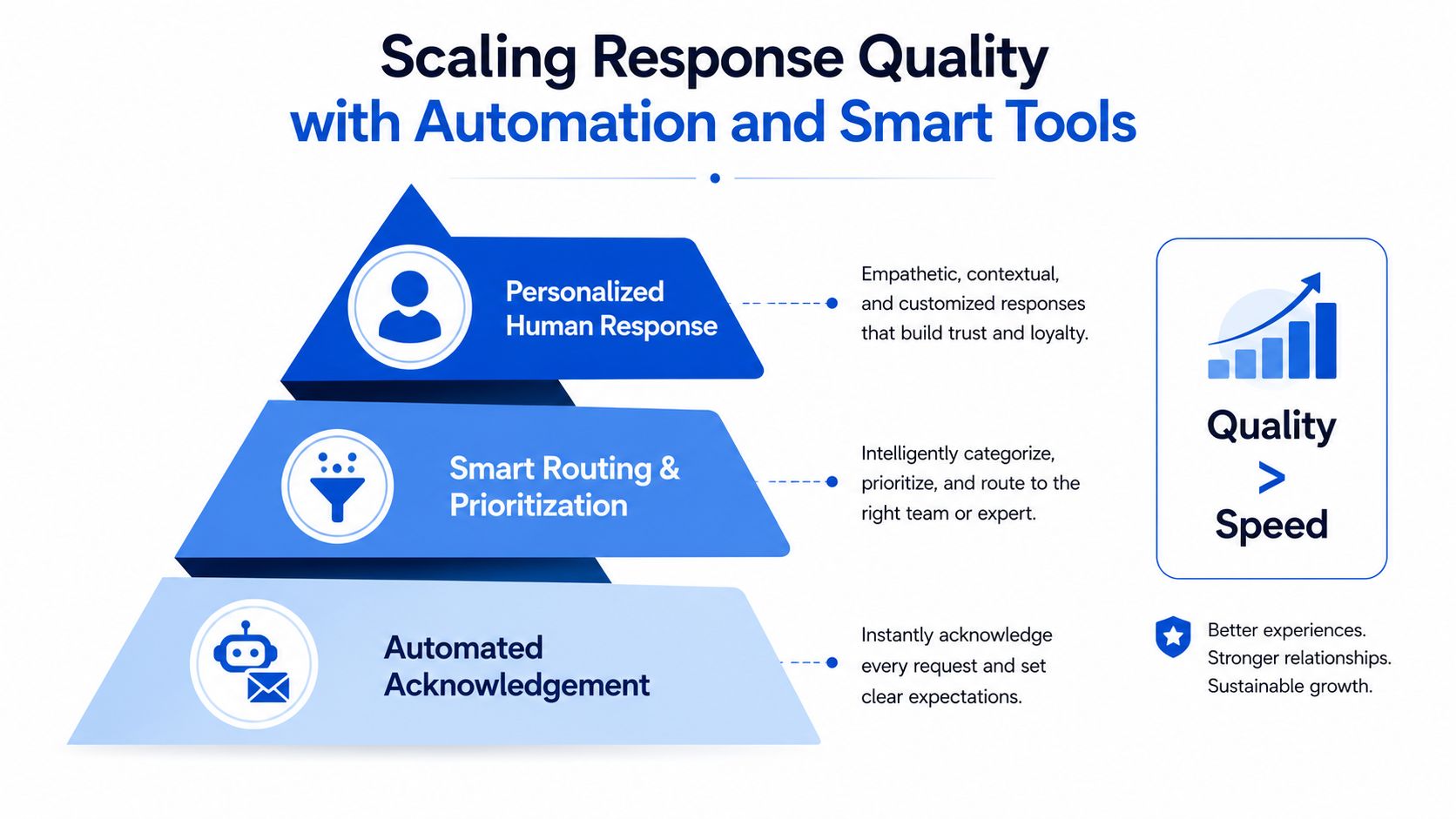
High-volume inquiry traffic exposes a simple truth, the fastest reply is not always the best operating model. A rushed answer that misses the question, skips documentation, or creates a compliance problem costs more than a careful answer that's systematized. The better approach is to automate the repetitive parts and keep the high-risk or high-intent parts human.
Automate the first touch, not the relationship
An automated acknowledgment can confirm receipt, provide a request number, and set expectations without pretending to solve the whole problem. That matters because one of the biggest failures in co-living operations is the silent lead, the person who messaged, got nothing back, and moved on.
Once the first response is in place, routing and prioritization should handle the next step. A smart filter can send maintenance issues one way, leasing questions another, and sensitive questions to a manager. The result is fewer missed handoffs and less time spent sorting the inbox manually.
Keep the human part where judgment matters
Personalized replies still matter for screening, tour coordination, pricing questions, and anything that could trigger a fair-housing issue. That's the point where a template should become a draft, not a final answer. Templates keep language consistent, but the human edit keeps it relevant.
Saved replies, follow-up tracking, and scheduled reminders are useful because they standardize the workflow without flattening the tone. The operational advantage is accuracy, not just speed. As noted in the earlier section on fair-housing risk, consistency across channels is the key safeguard.
For operators comparing tools, PadPulse's follow-up automation is one example of a system that can centralize communication, route incoming messages, and support structured follow-up alongside pricing and access workflows. The broader principle is the same whether you use one platform or several, automation should reduce friction without removing judgment.
Measuring and Optimizing Your Response Performance
The easiest metric to track is response time, but it's not the only one that matters. A team can reply quickly and still lose leases if the answer is vague, incomplete, or inconsistent. The stronger dashboard includes response time, lead qualification rate, and conversion rate, because those three numbers tell you whether speed is producing occupancy.
Start by reviewing where the slowest replies come from. In many co-living operations, the bottleneck isn't the person answering, it's the handoff between channels. If texts are fast but inbox replies stall, the issue is process design, not effort.
Watch for bottlenecks, not just averages
Averages can hide a lot. One manager can be crushing response time while another inbox keeps sitting untouched. That's why the daily review should look at who owns each message, which channel it came from, and whether it was closed out properly.
Test changes in the workflow
Small experiments matter. Try a shorter first reply, a more structured acknowledgment, or a different routing rule for a month, then compare how many leads move from inquiry to tour or inquiry to application. The point is to keep adjusting until the process feels boring, because boring usually means repeatable.
If performance slips, fix the flow before you blame the team. Missed inquiries usually come from unclear ownership, fragmented channels, or templates that don't match the question being asked.
The best operations treat tenant communication like an operating system, not a series of one-off chats. That mindset keeps responses fast, written, auditable, and easier to improve over time.
PadPulse is being built for room-by-room operators who need one place to handle pricing, messaging, and access workflows without losing track of follow-ups. If you want a more structured way to manage tenant inquiries and keep your leasing process moving, visit PadPulse and see how it's approaching communications for co-living operations.