How to Lower Utility Bills at Your Rental Properties
September 13, 2026
At month-end, a room-by-room operator often sees the same frustrating pattern: a large utility bill, full occupancy, and no clear explanation of which rooms or systems drove the cost. In a shared house, the answer usually isn't one careless resident. It's a combination of HVAC runtime, kitchen equipment, hot water, air leakage, vacant rooms being conditioned, and a billing structure that gives residents little reason to conserve.
Learning how to lower utility bills at rental properties requires more than handing tenants a list of energy tips. PadSplit hosts and other co-living operators absorb costs across multiple rooms, often in mixed-fuel buildings with shared kitchens, shared laundry, and changing occupancy. The practical playbook combines quick behavioral fixes, weatherization, equipment maintenance, smart controls, transparent billing, and disciplined return-on-investment analysis.
Why Utility Bills Hit PadSplit Hosts Differently
A host reviews a utility statement after a difficult month. The house has eight rooms, residents have come and gone, and the electric bill is much higher than expected. A quick walkthrough shows that the HVAC system and kitchen account for most of the visible activity, while several unoccupied rooms were still being heated or cooled. The bill doesn't identify which room caused the increase, so the host carries the entire cost.
That's the central difference between a conventional home and a room-by-room rental. A homeowner can change personal habits and immediately feel the financial benefit. A co-living operator manages a shared system where one resident's long shower, another resident's portable heater, and an empty room's thermostat setting all affect the same master meter.
Operator reality: A bundled utility arrangement turns every avoidable load into an operating expense, not just a resident behavior issue.
The split incentive makes the problem harder. Residents may not conserve if utilities are included, while landlords may struggle to pass costs through fairly without creating confusing fees or violating local rules. Transient occupancy adds another variable. A house can move from nearly full to partially vacant while HVAC schedules, refrigerators, water heaters, and shared-area lighting continue operating as though every room were occupied.
Start with the building shell and major equipment rather than small reminders alone. The ACEEE overview of federal efficiency standards reports that existing appliance and building standards save the average family almost $500 per year in energy and water bills. It also says a family moving into a new home saves about $260 annually in energy bills through design and equipment standards, before changing daily behavior.
For operators, the order matters:
- Behavioral controls: Reduce obvious waste without waiting for a renovation.
- Operational maintenance: Keep HVAC, water heating, laundry, and refrigeration from running inefficiently.
- Structural upgrades: Seal leaks and improve insulation where the building loses conditioned air.
- Monitoring and billing: Identify abnormal consumption and align costs with usage where legally appropriate.
- ROI discipline: Fund upgrades that improve net operating income, not upgrades that merely look modern.
Quick Wins You Can Deploy This Week
The fastest reductions usually come from settings, leaks, lighting, and equipment that runs in empty spaces. These actions don't require a major capital project, but they do require someone to verify that the change happened.
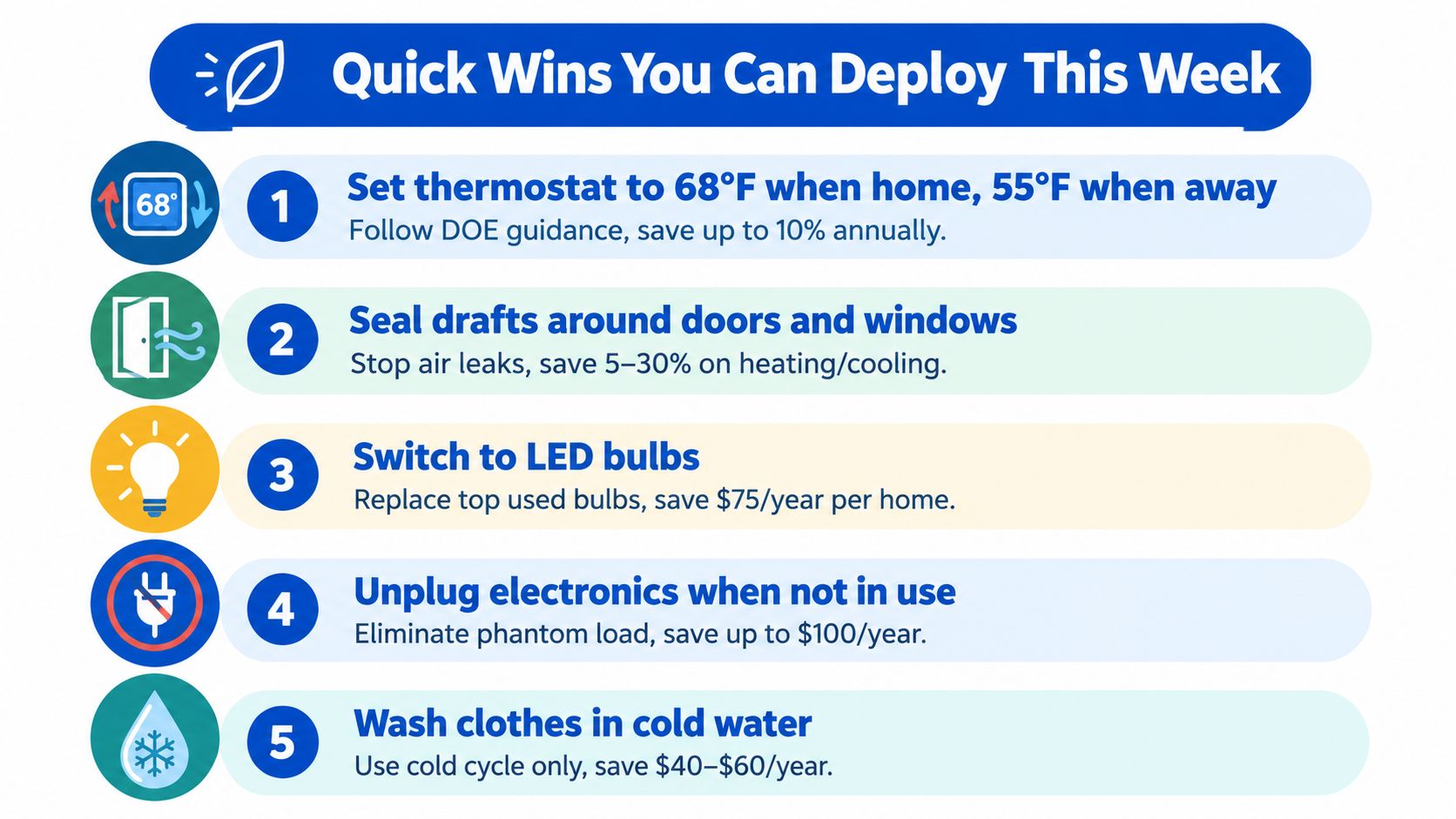
Start with thermostats. The U.S. Department of Energy recommends setting the thermostat as low as is comfortable in winter and as high as is comfortable in summer. For renters, DOE energy-saving guidance also recommends using a programmable thermostat or manually adjusting settings when residents are away or asleep. A host can create a schedule for shared areas, establish reasonable room settings, and prevent vacant rooms from conditioning at full comfort levels.
Next, walk the house at night and identify lights that stay on without a purpose. Replace the most frequently used incandescent bulbs with LEDs, beginning with hallways, kitchens, laundry rooms, exterior fixtures, and common bathrooms. Don't replace every bulb blindly. Prioritize fixtures that run for long periods, then record the date and location of each replacement so maintenance staff don't undo the work.
A seven-day operator checklist
- Inspect empty rooms: Turn off unnecessary lamps, electronics, and room-specific equipment during vacancy.
- Reduce standby loads: Check cable boxes, gaming consoles, chargers, mini-fridges, and desktop equipment. Unplug what doesn't need continuous power.
- Check water fixtures: Look for dripping faucets, running toilets, and shower leaks. A small leak can remain invisible until it appears on the bill.
- Use practical water controls: Install low-flow showerheads and faucet aerators where they preserve acceptable pressure. These measures reduce both water use and the energy needed to heat water.
- Review laundry habits: Encourage full loads and cold-water cycles where appropriate. Clean lint filters after every dryer load and verify that residents aren't using portable heaters to dry damp rooms.
On Friday, photograph thermostat settings, record vacant rooms, inspect common-area lighting, and compare the current meter reading with the prior week. Don't promise savings before the next statement arrives. The useful result is a documented baseline and a list of actions someone can verify during every turnover.
Operational Upgrades That Compound Over Time
Weatherization is where many operators find the clearest building-level improvement. Air leaks force HVAC equipment to run longer, while inadequate insulation allows heat to escape through attics, walls, ceilings, and other surfaces. The U.S. Department of Energy's National Action Plan for Energy Efficiency reports that weatherization reduces heating bills by 31% on average and cuts overall energy bills by $274 per year for an average home with annual energy costs of $2,672.
That evidence supports a simple sequence. Seal penetrations around pipes, wiring, doors, and windows first. Then inspect attic insulation, wall cavities, ductwork, and hot-water pipes in unheated areas. DOE's home energy checklist specifically recommends weatherstripping around movable joints such as windows and doors, adding attic insulation, and insulating hot-water pipes and heating ducts in spaces such as attics and crawlspaces.
Put the shell before the gadget
A co-living property has more traffic than a typical home. Doors open frequently, residents adjust settings independently, and shared spaces experience repeated temperature swings. That makes door sweeps, weatherstripping, sealed penetrations, and properly insulated attics practical priorities.
HVAC maintenance deserves the same operational attention. Use filters suited to the equipment, document replacements, clean coils when needed, and inspect ducts for leakage. In dusty shared houses, a filter that looks acceptable from the hallway may still be restricting airflow. Equipment replacement should follow measured condition and utility data, not an arbitrary age rule. A heat pump may make sense where the building envelope, electrical service, climate, incentives, and ownership horizon support it, but it isn't automatically the right answer for every property.
Water heating also rewards a whole-house view. Low-flow fixtures reduce demand at each shower and sink, while efficient water-heating equipment can reduce the energy required to serve a heavily occupied house. DOE advises that lowering a water heater from 140°F to 120°F can potentially save hundreds of dollars per year in energy costs, provided the setting remains appropriate for the property's safety and operating requirements.
| Operational Upgrade | Typical Savings | Payback Window |
|---|---|---|
| Air sealing and weatherstripping | Heating and cooling losses reduced through fewer leaks | Often shorter than major equipment replacement |
| Attic and duct insulation | Lower demand on heating and cooling systems | Depends on access, condition, and contractor cost |
| HVAC maintenance | Better airflow and fewer avoidable runtime problems | Usually tied to routine service cycles |
| Low-flow fixtures | Lower water and water-heating demand | Often suitable for phased room turnovers |
| Water-heater efficiency work | Reduced energy required for shared hot water | Varies by equipment, occupancy, and fuel |
| Envelope plus equipment planning | Larger portfolio-level operating improvement | Requires a property-specific model |
Savings compound because the HVAC system no longer has to compensate for every weakness at once. The operator's job is to measure the baseline, fix the shell, maintain the equipment, and then judge whether a larger replacement improves NOI.
Smart Thermostats and Whole-Home Energy Management
Smart controls can be valuable in shared housing, but they aren't universal savings devices. The fuel type, HVAC configuration, resident behavior, internet reliability, and vacancy pattern determine whether the device reduces consumption or becomes another maintenance ticket.
A billing analysis of 13,762 natural-gas-heated homes found an average reduction of 22 therms per year with a 56% realization rate. The same analysis found no consistent or statistically significant electricity savings in electrically heated homes, as reported in the Energy Trust smart thermostat billing analysis. That distinction matters for operators who manage gas furnaces, heat pumps, and electric resistance systems under the same brand of thermostat.
An NREL study of ENERGY STAR smart home systems found whole-house site energy savings ranging from 7% to 35%, with utility bill savings ranging from 6% to 29%, or $123 to $670 per year, depending on location and occupant behavior. The NREL study hosted by CALMAC makes the operational lesson clear: benchmark the household first, then automate the largest loads.
Match the control to the building
| System Type | Smart Thermostat Savings | Whole-Home Monitoring Savings | Best-Fit Use Case |
|---|---|---|---|
| Gas forced air | Reliable gas savings are more plausible when schedules are followed | Useful for identifying runtime and occupancy anomalies | Shared homes with central HVAC and stable connectivity |
| Heat pump | Results depend on controls, climate, and resident overrides | Helpful for tracking heating and cooling patterns | Properties where system type and baseline load are documented |
| Electric resistance | Don't assume reliable savings from a thermostat alone | Monitoring can expose high-load rooms and portable heaters | Houses with strong anomaly detection and clear room-level controls |
| Mixed or zoned systems | Device compatibility must be verified first | Portfolio monitoring helps separate system behavior | Scattered properties with different equipment profiles |
Residents override schedules for comfort, vacant rooms continue conditioning, and detached properties lose connectivity. A lockout PIN can prevent extreme settings, but it can also create resident frustration if the comfort range is too narrow. Door and window sensors may reveal open-air losses, while smart vents can introduce balancing and maintenance issues if installed without understanding the duct system.
The right test is economic, not cosmetic. Compare the installed cost with measured seasonal savings, then evaluate whether the device reduces runtime, catches anomalies, or merely moves control from one person to another. Operators comparing features and implementation considerations can review smart thermostat benefits for shared housing, but the property's fuel type and baseline bills should drive the purchase decision.
Billing Structure, Submetering, and Dynamic Pricing
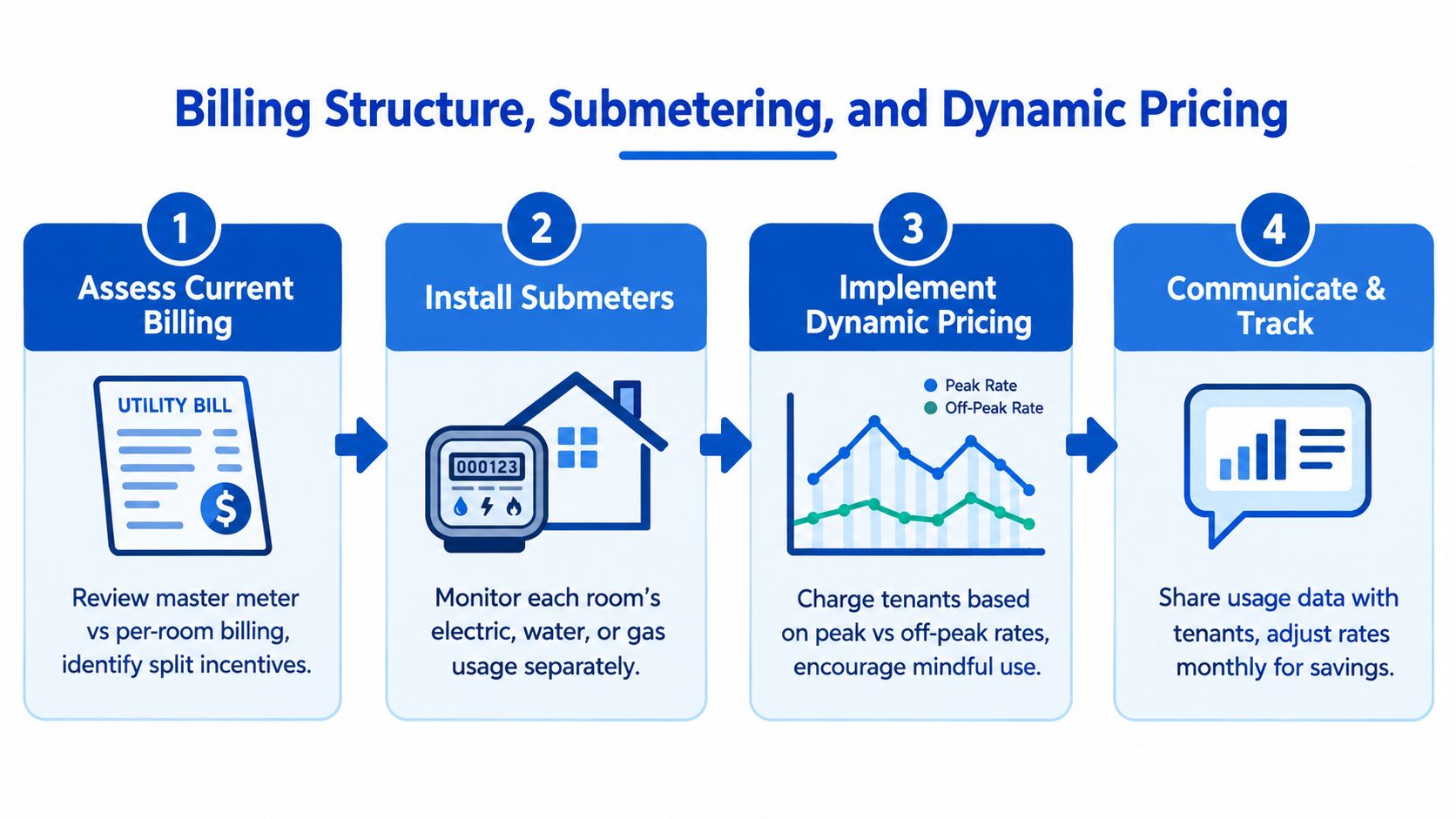
For a room-by-room operator, billing structure affects both resident behavior and NOI. A bundled utility fee can make administration simple, but efficient residents may subsidize heavy users. Passing through every cost without clear rules creates disputes, delays collections, and can erase the savings the arrangement was meant to produce.
Submetering improves visibility by measuring a room or zone separately. Its legality and setup vary by state and utility. Before charging residents, confirm local requirements, lease language, disclosure obligations, meter standards, and whether water, gas, or electric costs may legally be allocated by room. Mixed-fuel buildings require extra care because one room's usage may not correspond neatly to the property's shared infrastructure or fixed charges.
Choose a structure residents can understand
A master-metered property can use a fixed utility allowance, a transparent allocation formula, or a compliant sub-billing platform. Square-footage allocation is easy to explain, but it may ignore occupancy and equipment use. Per-room metering is more precise, while installation, calibration, data management, and regulatory review increase operating cost.
Research on household electrification affordability from UCLA's Luskin Center shows why allocation choices matter. Bill outcomes reflect consumption, rate design, infrastructure, and the way fixed costs are assigned. An efficient resident can still receive an unfair charge if shared network or fixed costs are shifted onto that room.
Dynamic pricing also needs a measured approach. Time-of-use rates may make water heating, laundry, and other flexible loads cheaper during lower-cost periods. Residents need plain explanations, and operators need the actual rate schedule before changing lease terms. Review peak demand charges, utility rebates, and available assistance as part of that decision.
Use these operating steps:
- Audit the current arrangement: Separate fixed charges, shared loads, room loads, and owner-paid services.
- Write plain-language rules: State what residents pay, how adjustments work, and how disputes are handled.
- Pilot before scaling: Test the structure across a small group of rooms, then compare consumption, collections, and resident response.
- Track usage transparently: A water-usage monitoring workflow can help identify leaks and unusual demand before the statement arrives.
The objective is a fair, understandable cost signal. Residents and operators should be able to act on the same information without turning every bill into a negotiation.
Calculating Payback and ROI on Every Upgrade
A host shouldn't approve an efficiency upgrade because the product description sounds impressive. Use the same worksheet for a lightbulb, fixture, thermostat, insulation project, or heat-pump conversion.
The basic formula is:
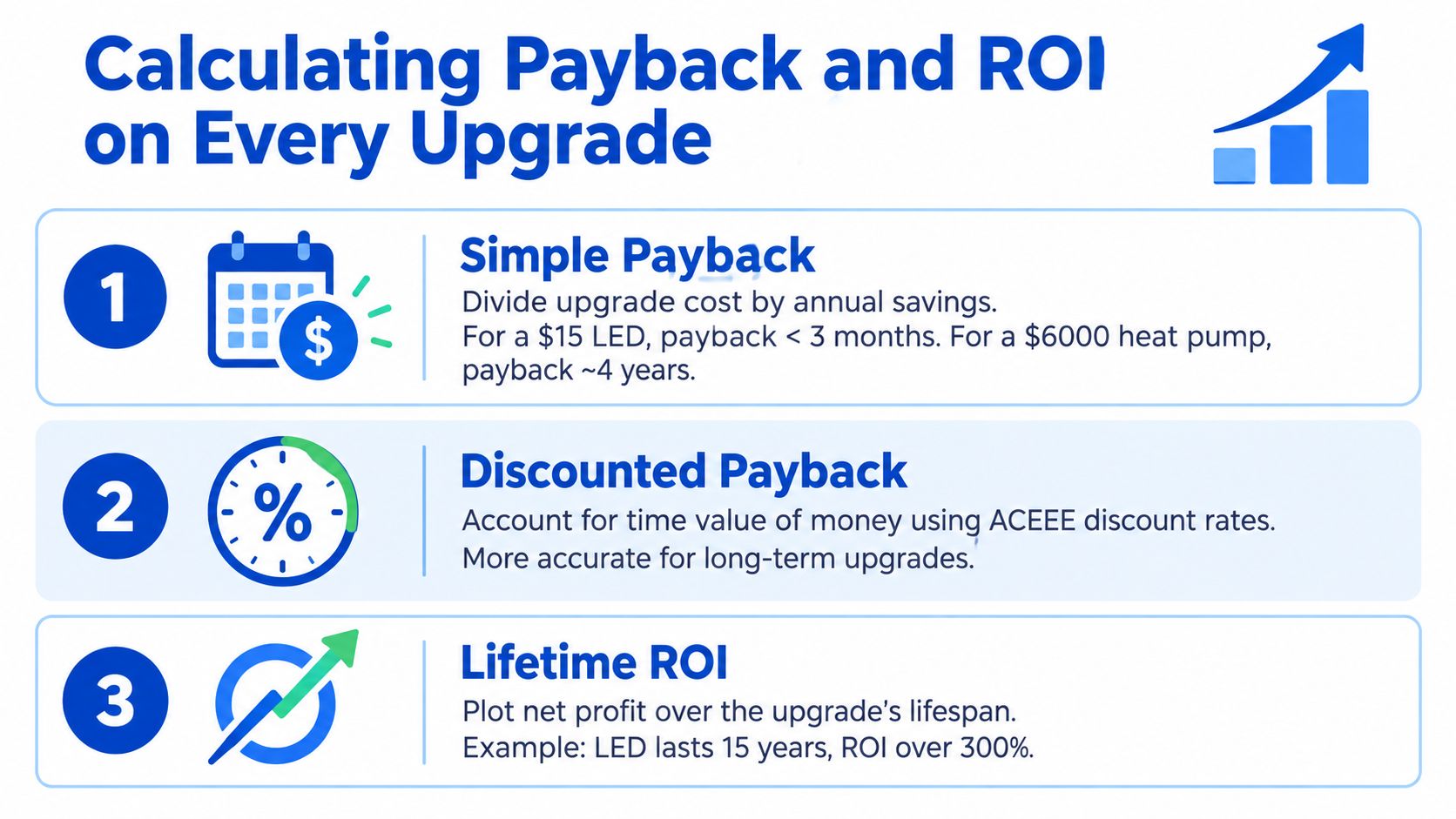
Simple payback = installed cost ÷ annual utility savings
For a more complete model, subtract rebates, tax credits, maintenance savings, and avoided service calls from the net cost. Then compare the result with the property's expected ownership period and the risk of vacancy or disruption during installation.
Build the worksheet
Track these fields for every proposed project:
- Installed cost: Equipment, labor, permits, delivery, and disposal.
- Measured baseline: Recent bills, meter readings, system runtime, and occupancy.
- Expected reduction: Use verified system-specific evidence, not a generic marketing estimate.
- Utility rate: Record the actual gas, electric, water, demand, and fixed charges that apply.
- Maintenance effect: Include avoided repairs or recurring service where supportable.
- Useful life: Estimate how long the equipment should operate under shared-house conditions.
- Resident and vacancy impact: Account for access, installation disruption, and turnover timing.
- Incentives: Apply rebates or credits only after confirming eligibility and timing.
The ACEEE standards analysis provides a useful portfolio perspective. It projected that cumulative federal standards from 2017 through 2025 would save Americans $370 billion through 2030, while also showing how recurring savings can accumulate across many households and pieces of equipment. For a property owner, the comparable question is whether a recurring reduction across multiple rooms improves NOI enough to justify the investment.
Practical rule: Treat a projected saving as a hypothesis until the utility bill confirms it.
Simple payback is useful for screening. Discounted payback accounts for the value of money over time and is more appropriate for larger projects. Lifetime ROI adds total net savings across the equipment's useful life, less capital and maintenance costs.
A practical decision rule is to prioritize measures with a short payback, especially when they can be installed during routine turnover. Give larger envelope or HVAC projects a longer evaluation horizon when they also reduce maintenance risk, improve comfort, or protect the property from rising operating costs. Skip upgrades that depend on perfect resident behavior, lack a credible baseline, or cannot be verified after installation.
For a repeatable financial model, use a return-on-investment calculator for property upgrades alongside your bill records rather than relying on averages from unrelated homes.
Your 90-Day Utility Reduction Roadmap
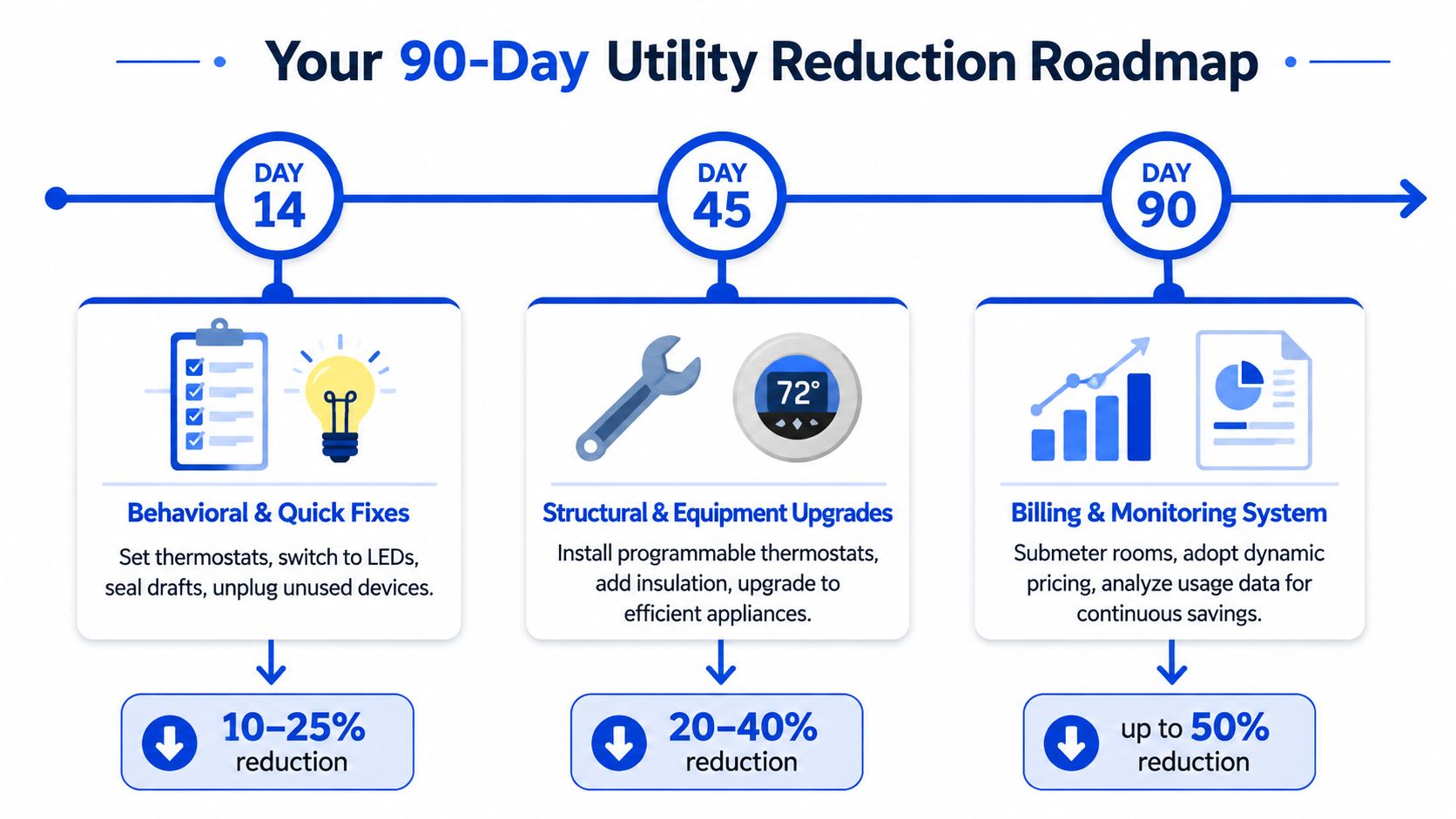
A 90-day rollout works because it separates no-cost controls from projects that require access, capital, or resident communication. The operator can keep rooms occupied while building a reliable consumption record.
Days 1 through 14
Start with actions that don't require construction. Set reasonable thermostat schedules, identify vacant-room settings, replace the highest-use bulbs with LEDs, unplug unnecessary electronics, inspect toilets and faucets, and seal obvious drafts around doors and windows. Record the date, property, room, equipment type, and observed condition for every change.
Days 15 through 45
Schedule HVAC service, replace filters, inspect coils and ducts, install weatherstripping, and add low-flow aerators where appropriate. Work through rooms during normal turnover so technicians don't create unnecessary access problems. Compare utility statements against occupancy and weather conditions, but don't attribute every bill movement to one upgrade without a controlled baseline.
Days 46 through 90
Pilot smart thermostats where the HVAC type and connectivity support them. Test room-level monitoring or compliant submetering in a limited area before changing the billing structure across the entire property. For new leases, write utility terms clearly and evaluate whether a transparent add-on or allocation method fits local requirements.
Six mistakes repeatedly erase savings in shared housing:
- Ignoring door-under-cutting drafts: Air can move through gaps beneath interior and exterior doors, especially where conditioned rooms meet unconditioned areas.
- Choosing unrealistic AC settings: Extreme settings invite overrides, portable cooling, and resident complaints.
- Neglecting dryer vent cleaning: Lint buildup can increase drying time and create a maintenance hazard.
- Allowing mini-fridges and space heaters to multiply: Unapproved equipment can create persistent loads in rooms and shared spaces.
- Skipping monthly bill reconciliation: Compare bills with occupancy, equipment status, and weather rather than filing statements without review.
- Relying only on resident behavior: Structural controls, schedules, and monitoring protect savings when residents change.
Print a one-page rollout card for the utility closet:
- Today: Record meters, bills, occupancy, HVAC type, and vacant rooms.
- This week: Seal drafts, change priority bulbs, inspect leaks, and review thermostat settings.
- By day 45: Complete HVAC maintenance and fixture work.
- By day 90: Validate smart controls, test monitoring, and review billing compliance.
- Every month: Reconcile utility costs with occupancy and investigate unexplained changes.
- Before every upgrade: Calculate installed cost, expected savings, payback, and verification method.
PadPulse offers recurring-expense tracking that can store utility bills, generate expected future payments, and support forecasting for operating costs. Visit PadPulse to follow the platform's development and explore an operating workflow that connects utility visibility with the broader financial management of room-by-room properties.