How to Improve Guest Satisfaction: Guide for PadSplit Hosts
June 8, 2026
A lot of hosts start working on guest satisfaction only after a bad review lands. By then, the damage is already public. In room-by-room rentals, the pattern is familiar: one guest can't find the front door code, another walks into a kitchen that should've been cleaned that morning, a maintenance issue sits unresolved for two days, and suddenly a room that should be easy to fill starts getting harder to rent.
That's why learning how to improve guest satisfaction matters so much for PadSplit hosts and co-living operators. In this model, you're not just managing a property. You're managing repeated arrivals, shared spaces, overlapping expectations, and a lot of small moments that shape whether a member feels settled or stressed.
The good news is that strong guest experience usually doesn't come from expensive upgrades. It comes from systems. Clear messaging. Faster access. Cleaner turnovers. Better issue tracking. A simple feedback loop. When those pieces work together, 5-star reviews stop feeling random.
The "Why" Behind 5-Star Reviews and Your Bottom Line
A minor complaint can be expensive.
A guest arrives after work, can't figure out which entrance to use, messages for help, waits too long, and starts the stay irritated. The room itself may be fine, but the tone is set. If the bathroom also isn't stocked or the Wi-Fi instructions are buried in a long message thread, that guest often doesn't think of those as separate issues. They think, “This place is poorly managed.”
That's the point many operators miss. Guest satisfaction isn't a soft metric. It's an operating metric tied to pricing power, occupancy quality, and how much friction your team has to absorb each week.
Better reviews support better revenue
A widely cited hospitality benchmark says a 1-point increase in a property's review score on a 5-point scale can support an 11% higher daily room rate. The same benchmark reports that properties with satisfaction scores above 4.5 stars can see up to 35% higher repeat bookings, while a stronger reputation score can drive roughly 14% more direct bookings without sacrificing occupancy, according to Revinate's hotel guest satisfaction benchmark summary.
For a co-living operator, the exact mechanics differ from a hotel, but the lesson is the same. Stronger reviews give you more room to hold rate, reduce vacancy friction, and spend less time defending the listing.
Practical rule: In shared housing, every recurring complaint has a financial cost twice. It hurts the current stay, then it hurts the next prospect's trust.
Guest satisfaction is really an NOI issue
If you run rooms individually, your income depends on consistency. One bad review rarely comes from one catastrophic failure. It usually comes from three or four preventable misses stacked together:
- Arrival friction: The guest can't access the property smoothly.
- Basic standards slipping: Cleanliness, supplies, or noise controls feel unmanaged.
- Slow issue resolution: A simple fix turns into a lingering frustration.
- No recovery: The guest leaves feedback and feels ignored.
That's why the best operators treat satisfaction as part of asset performance. Cleaner operations produce better reviews. Better reviews support stronger demand. Stronger demand gives you more control over pricing and less downtime between members.
If you want 5-star reviews, don't think like a host trying to be nice. Think like an operator building a repeatable service system.
Perfecting the Arrival and Check-In Experience
The first win is simple: make arrival feel easy.
Most guests will forgive a small inconvenience later in the stay if the move-in or check-in process feels smooth. They usually won't forgive a messy start. In room-by-room rentals, where guests may be arriving alone, at night, or after a long workday, clear access matters even more.
What a low-friction arrival looks like
A good arrival process answers every practical question before the guest has to ask it. That means sending the right message at the right time, not dumping everything into one long booking confirmation.
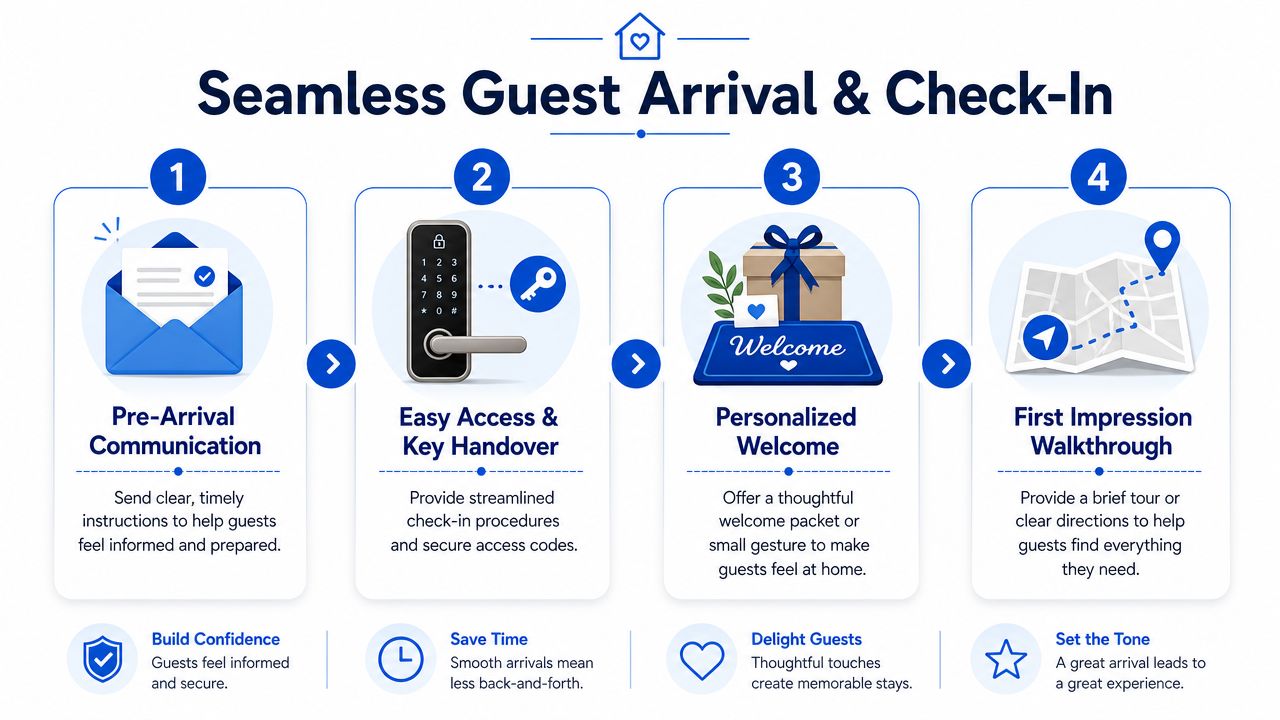
Guidance for hotels and property managers repeatedly points to clear, timely messaging and contactless operations like keypad or mobile access as core drivers of satisfaction, as outlined in RentalReady's guest satisfaction strategies.
A practical messaging sequence usually includes:
Booking confirmation Confirm the address, room type, move-in date, and what happens next. Keep it short.
Pre-arrival message Send parking details, the exact entrance, ID or onboarding steps if needed, and what to bring.
Arrival-day message Share the door code, lock instructions, Wi-Fi details, and the fastest way to reach support.
Post-arrival check Ask one simple question: “Did you get in okay?” That catches problems early.
Smart locks solve real operational problems
Keys create unnecessary failure points. They get copied, lost, handed to the wrong person, or left with the departing guest. In shared housing, that becomes a security issue and a support issue.
Smart locks work best when you use them as part of a process, not as a gadget. Set unique codes, define code windows, document backup entry steps, and make sure the guest knows exactly which door the code applies to. If you're comparing setups, this guide to smart lock setup for co-living properties is a useful starting point.
A few details matter more than hosts expect:
- Label doors clearly: “Front gate” and “main entry” shouldn't be left to interpretation.
- Match code timing to arrival reality: If a guest says they'll arrive late, don't create a code that activates too narrowly.
- Keep a backup path: A battery failure or connectivity issue shouldn't become a midnight lockout.
The best check-in is the one the guest barely remembers, because nothing about it felt confusing.
What works and what usually fails
Many hosts think responsiveness alone will save a weak check-in. It won't. If the process is unclear, you just end up answering the same questions manually over and over.
Here's the trade-off in plain terms:
| Approach | What happens |
|---|---|
| Manual texting only | Personal, but inconsistent and easy to miss |
| Fully automated with no fallback | Efficient, but brittle when something unusual happens |
| Automated basics plus human escalation | Usually the most reliable setup |
The sweet spot is automation for routine information and a fast human handoff for exceptions. Send standard instructions automatically. Step in quickly when the guest has an access issue, a language barrier, or confusion about the property layout.
A final step that pays off is a short welcome note inside the room or by message. It doesn't need to be fancy. Point the guest to the kitchen, laundry, quiet hours, and the best support channel. Small clarity beats big hospitality gestures every time.
The Pillars of a 5-Star Stay Cleanliness Safety and Maintenance
Guests might mention decor in a review. They build their trust around basics.
In co-living, those basics are even more visible because people don't just evaluate their room. They evaluate the bathroom they share, the kitchen condition, whether the locks feel secure, and whether small problems get fixed before they become part of daily life.
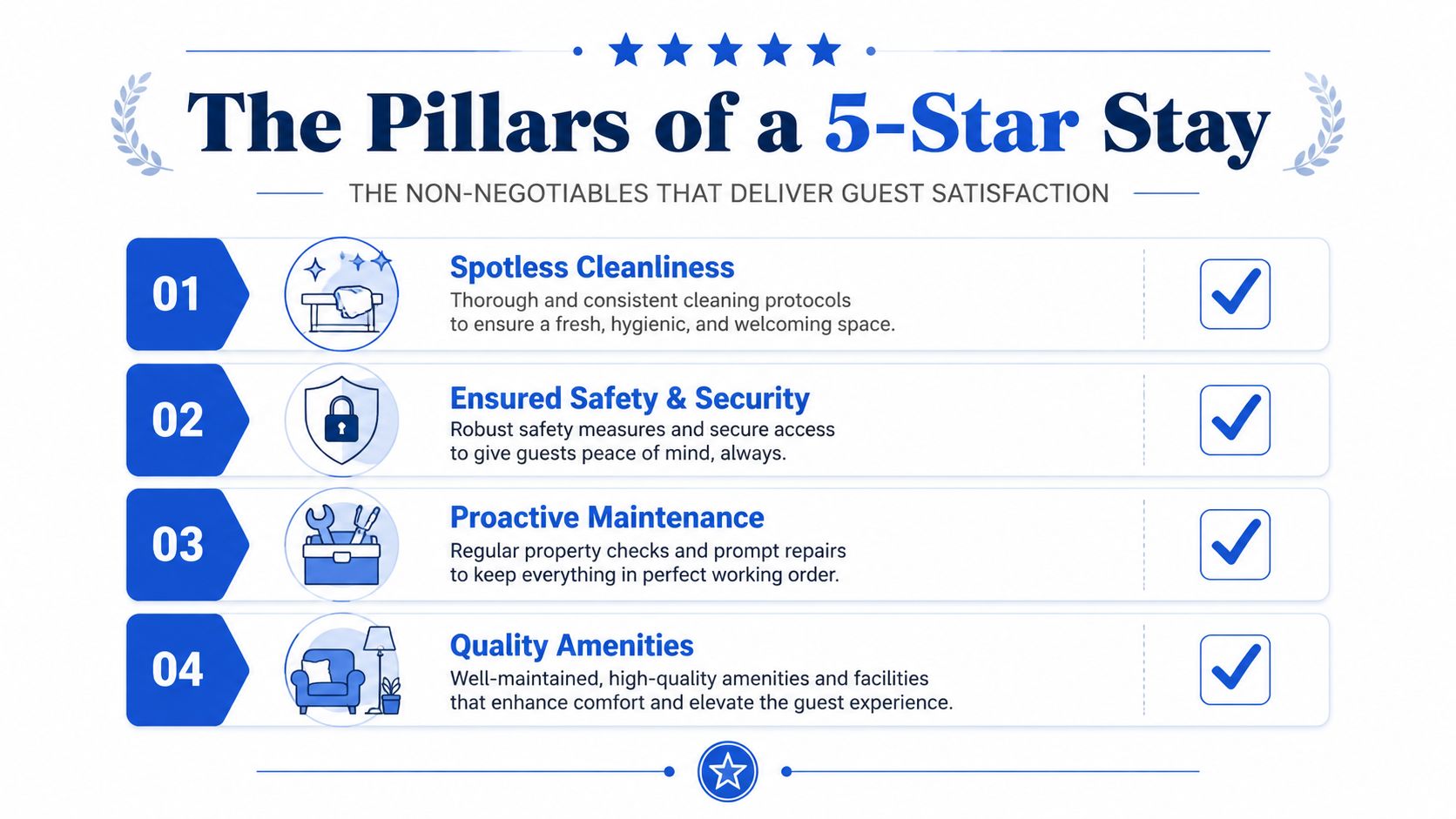
Cleanliness has to be obvious
A room can technically be cleaned and still feel neglected. Dust on blinds, hair in a shower drain, fingerprints on a door, or an overfilled trash bin in the kitchen all tell the guest the same thing: nobody is checking details.
That's why turnover cleaning and common-area cleaning should be separate systems.
For room turnovers, use a fixed checklist. For recurring shared spaces, use a schedule with visible accountability. If you need a template, these property management checklists for rentals are useful for turning “someone should handle this” into a real process.
A strong turnover checklist usually includes:
- Bed and linen reset: Fresh sheets, pillow inspection, mattress protector check.
- High-touch wipe-down: Door handles, switches, remotes, desks, and closet pulls.
- Bathroom verification: Toilet, sink, mirror, shower, drain, supplies.
- Room function check: Lights, outlets, fan, window locks, blinds, Wi-Fi instructions.
For common areas, assign frequency by traffic. Kitchens and bathrooms need far more attention than hallways or exterior paths.
Safety should feel boring
That's a good thing. Guests shouldn't have to wonder whether the lock works, whether exterior lighting is out, or whether a smoke detector is chirping.
Safety systems are often ignored because they aren't visible in reviews until they fail. The operational answer is a recurring sweep. Not a vague reminder. A real recurring task.
Use a monthly or unit-turn schedule to inspect:
- Entry points: Front door, gates, bedroom locks, strike plates
- Detection devices: Smoke alarms, carbon monoxide alarms where applicable
- Lighting: Exterior entry, hallway, bathroom, and stair lighting
- Trip and leak risks: Loose handrails, wet spots, wobbling furniture, dripping plumbing
Maintenance speed matters, but prevention matters more
Reactive maintenance keeps you busy. Preventive maintenance protects reviews.
A leaky faucet, weak door closer, unstable Wi-Fi router placement, or loose toilet seat won't always trigger an immediate complaint. But each one adds friction. In shared housing, that friction spreads. One unresolved issue affects multiple people and increases the odds that someone writes about “poor management.”
Field note: If the same issue shows up twice, stop treating it as a repair ticket and start treating it as a system failure.
A simple workflow works well:
| Maintenance stage | Best practice |
|---|---|
| Intake | Log issue by room or common area immediately |
| Triage | Separate urgent access, safety, and habitability issues from cosmetic ones |
| Assignment | Give one person ownership, even if a vendor does the work |
| Closure | Confirm the fix, then check whether the guest needs a follow-up |
What doesn't work is the informal model many hosts start with. A cleaner mentions a problem in text. A handyman says he'll stop by. Nobody documents completion. The issue reappears two weeks later.
Guests don't see your internal effort. They see whether the property feels reliably cared for. That feeling comes from routines, not heroics.
Mastering Proactive Communication and Building Community
In a private vacation rental, a guest mostly judges the property. In co-living, they judge the environment too.
That changes the communication job. You're not only answering questions about Wi-Fi or check-out. You're setting expectations between housemates, handling tension before it spreads, and making people feel that support is available without making the house feel overmanaged.

Fast replies matter, but thoughtful replies matter more
A short “sorry about that” message often isn't enough when a guest is frustrated. Research on guest engagement shows that acknowledging service failures and responding with personalized, detailed apologies can improve satisfaction on future stays. The same research found that when guests provide feedback, their probability of becoming loyal rises by almost 50%, with stronger gains when management responds, according to Cornell's summary of customer engagement research.
That's especially relevant in room-by-room rentals because many complaints are recoverable if you handle them well.
A solid recovery message usually includes four parts:
- Recognition: State the issue plainly so the guest knows you understood it.
- Ownership: Don't hide behind vague language.
- Action plan: Say what will happen next and when.
- Follow-up: Check back after the fix.
For example, if the guest reports noise from a shared area, don't reply with “We'll look into it.” Say what you're doing. Contact the relevant members, restate quiet hours, and tell the guest when you'll update them.
AI messaging helps with the repetitive layer
Many guest questions are predictable. How do I connect to Wi-Fi? Where's the laundry room? Which trash bin is for recycling? What time does quiet hours start?
That's where AI messaging and automated workflows can help. They can answer common questions immediately, deliver house information consistently, and reduce the lag that makes guests feel unsupported. But the tool has to know when to stop.
Use automation for repeatable questions. Use a human when the issue involves conflict, safety, payment, access failure, or an upset guest. A bot should never trap someone in a loop when judgment is needed.
If your team handles support by phone as well as text, these outbound call scripts for resident communication can help standardize difficult conversations without sounding robotic.
A guest usually forgives a problem faster than they forgive silence.
Community is part of the product
A clean room won't save a house with unresolved conflict.
Good co-living operators make community standards visible early. That means house rules before move-in, reminders in shared spaces, and quick intervention when one person's behavior affects everyone else. Noise, overnight guests, kitchen mess, bathroom monopolizing, and thermostat disputes are common pressure points. They don't resolve themselves.
A practical structure looks like this:
Set clear expectations from day one
Explain quiet hours, guest policies, cleaning norms, parking, and how to report concerns. Put it in the welcome flow, not in a buried PDF nobody opens.
Separate complaints from conflict narratives
When one member says another is “disrespectful,” translate that into specific behavior. Was music loud after quiet hours? Were dishes left overnight repeatedly? Specifics are easier to address and fairer to everyone.
Here's a short video that covers guest experience thinking from a hospitality angle:
Protect the house culture with consistency
If you enforce one rule for new members and ignore it for older ones, the house notices. Consistency creates trust. Inconsistent enforcement creates resentment, and resentment eventually shows up in reviews, turnover, or both.
The strongest operators communicate like property managers and mediate like community leads. That combination is hard to fake, but it can absolutely be systematized.
Turning Feedback into Your Most Powerful Growth Tool
Most hosts ask for feedback too late.
If the first real question you ask is “Can you leave a 5-star review?” after the stay is over, you've already lost the chance to fix what mattered most. Feedback works best when you collect it during the stay, sort it quickly, and use it to improve the next stay too.
Use a simple collect analyze act loop
Industry guidance points to a stepwise feedback loop that works well: collect survey responses, calculate CSAT as the share of positive ratings, and run short mobile surveys at three control points, after check-in, mid-stay, and post-stay, so issues are caught before they become review-driving complaints, as explained in Chekin's guide to guest satisfaction score improvement.
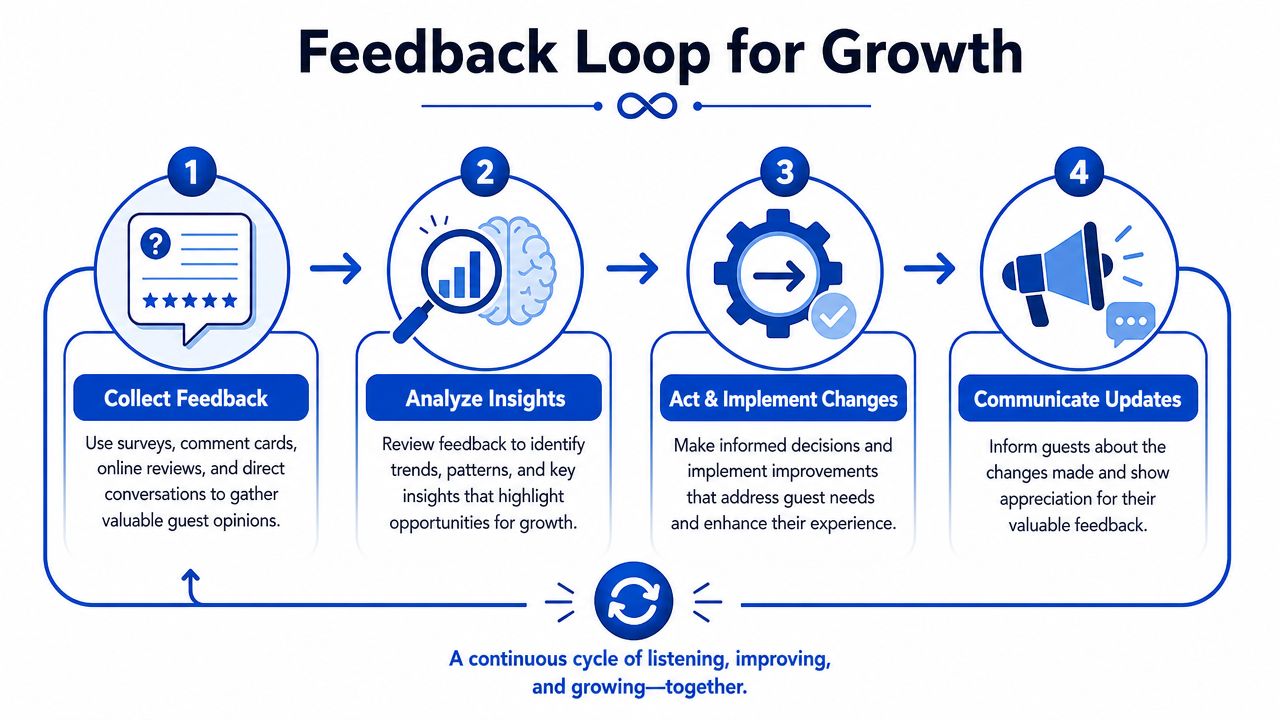
That timing matters because different problems show up at different stages:
| Feedback point | What you're likely to catch |
|---|---|
| After check-in | Access issues, room readiness, confusion, missing essentials |
| Mid-stay | Noise, shared-space friction, maintenance, communication gaps |
| Post-stay | Overall satisfaction, unresolved issues, review intent |
Keep surveys short enough to answer
Long forms get ignored or rushed.
A better approach is one or two quick prompts by text or mobile link. Ask the guest whether arrival was smooth. Ask whether anything needs attention in the room or common areas. Ask at the end whether they'd stay again or what should be improved.
The biggest mistake is collecting responses and doing nothing with them. Guests notice that quickly. So does your team.
A workable internal process looks like this:
- Tag each response by category: access, cleanliness, maintenance, communication, noise, billing, safety
- Log the exact room or area involved: Room 2, upstairs bath, rear entry, kitchen
- Assign one owner: one person should decide whether the feedback needs a fix, a reply, or both
- Review patterns weekly: if the same complaint appears repeatedly, it's no longer anecdotal
Treat repeat comments as operating data
One complaint about weak Wi-Fi may be a one-off. Repeated comments about weak Wi-Fi in the same room usually point to a setup issue, device placement problem, or equipment need.
That's where hosts improve fastest. Not by obsessing over every isolated comment, but by spotting clusters.
Operational test: If a guest mentions a problem and your team already knows it's recurring, the real failure isn't the problem. It's that the fix hasn't been systematized yet.
Here's what feedback often reveals in co-living houses:
Arrival problems that feel bigger than they are
A code that works, but only after a confusing sequence. An entry path with poor signage. Instructions that assume too much local knowledge. These are often easy fixes once identified.
Shared-space standards drifting over time
A kitchen might start strong and slide because no one owns midday resets. Bathrooms might be cleaned on schedule but still feel rough by evening. Feedback helps you adjust frequency, not just effort.
Communication gaps between teams
The cleaner knows a blind is broken. The maintenance person knows the repair is delayed. The guest knows nothing. Feedback often exposes this internal disconnect before your dashboard does.
The hosts who get better reviews consistently aren't the ones who never hear complaints. They're the ones who build a habit of collecting small signals early, then turning them into cleaner systems.
Bringing It All Together Your Satisfaction Playbook
The simplest way to think about how to improve guest satisfaction is this: remove friction before the guest has to report it.
That means the arrival is clear. Access works. The room feels ready. Shared spaces feel maintained. Messages get answered. Complaints get handled with ownership. Feedback gets turned into a better operating process, not archived in a spreadsheet nobody revisits.
The system behind the review
A 5-star review usually reflects a chain of ordinary things going right:
- Arrival felt easy
- The home felt clean and secure
- Questions got answered without delay
- House rules were clear and fair
- Problems were acknowledged and resolved
- The guest felt heard
For hosts, that same chain looks different behind the scenes. It's smart locks instead of spare keys. Automated messaging instead of memory. Cleaning checklists instead of assumptions. Maintenance logs instead of “I thought someone handled it.” In-stay surveys instead of waiting for public reviews.
What scales and what doesn't
What doesn't scale is relying on personal hustle for everything. That works with one house for a while. It breaks when you add rooms, staff, vendors, or late-night arrivals.
What does scale is a repeatable service model built around low-cost habits:
- clear pre-arrival messages
- standardized turnover checks
- recurring safety and maintenance sweeps
- fast issue triage
- short in-stay feedback requests
- documented follow-through
That's the core strategy. Guest satisfaction isn't luck, personality, or expensive hospitality flair. It's the output of a well-run operation.
As more tools bring messaging, access, and analytics into one workflow, it's getting easier for room-by-room operators to run tighter systems and protect NOI without adding constant manual work.
PadPulse is building an all-in-one platform for PadSplit hosts and co-living operators who want better systems for pricing, communication, access control, and portfolio visibility. If you're looking for a simpler way to run room-by-room rentals and improve NOI, join the early interest list at PadPulse.