How to Create an Invoice Number: A Co-Living Host's Guide
June 24, 2026
You open your rent spreadsheet to match payments, and the trouble starts right away. One resident sent money through Cash App with only “rent” in the note. Another paid late and split the balance into two transfers. A third moved rooms mid-month, so the invoice sitting in your folder doesn't line up cleanly with the ledger anymore.
That's where most co-living hosts lose time. The issue usually isn't the payment app. It's the lack of a clean invoice numbering system that tells you, at a glance, which property, room, billing date, and invoice run you're looking at.
Generic advice on how to create an invoice number usually stops at “make it sequential” or “add the date.” That's fine for a freelancer sending a few invoices a month. It breaks down fast in room-by-room rentals. A 2025 study by the National Multifamily Housing Council found that 34% of small-to-mid-sized co-living landlords reported billing confusion due to non-structured invoice numbering, leading to delayed payments and increased reconciliation time.
Your First Step to Smarter Rental Invoicing
If you run a shared house, you're not billing one tenant per property. You're often billing multiple residents inside one address, sometimes across several houses, with move-ins, transfers, credits, and partial payments happening all month.
A plain invoice number like 1042 doesn't help much in that environment. Neither does something loose like June-Rent or Invoice_23_A. Those labels force you to open the file, search the tenant name, check the date, and confirm the unit before you can answer a basic question.
That's why the first step in smarter rental invoicing is simple. Make the invoice number carry operational meaning.
What most landlords need but most guides miss
Most existing guides focus on generic sequential or chronological formats. They rarely address what co-living operators require, which is a multi-dimensional format that works across properties, rooms, and residents.
A useful invoice number in this business should help you answer questions like:
- Which property is this for
- Which room or unit does it relate to
- When was it issued
- Where does it sit in the sequence
A good invoice number should reduce the number of clicks it takes to confirm a payment.
When hosts skip that structure, small admin problems stack up. A payment gets applied to the wrong room. A resident asks for a receipt, and you spend ten minutes hunting through files. Month-end reconciliation drags because invoice names don't sort cleanly.
The shift that makes billing easier
The practical shift is to stop treating invoice numbers as random labels and start treating them as part of your operating system.
For a co-living host, the right format isn't just “professional.” It's what keeps billing usable when occupancy changes, rooms turn over, and multiple payment methods hit your account in the same week.
If you're learning how to create an invoice number for the first time, start with the assumption that your future self will need to search, sort, audit, and explain it quickly. Build for that version of your business now.
Why a Smart Invoice Number Boosts Your NOI
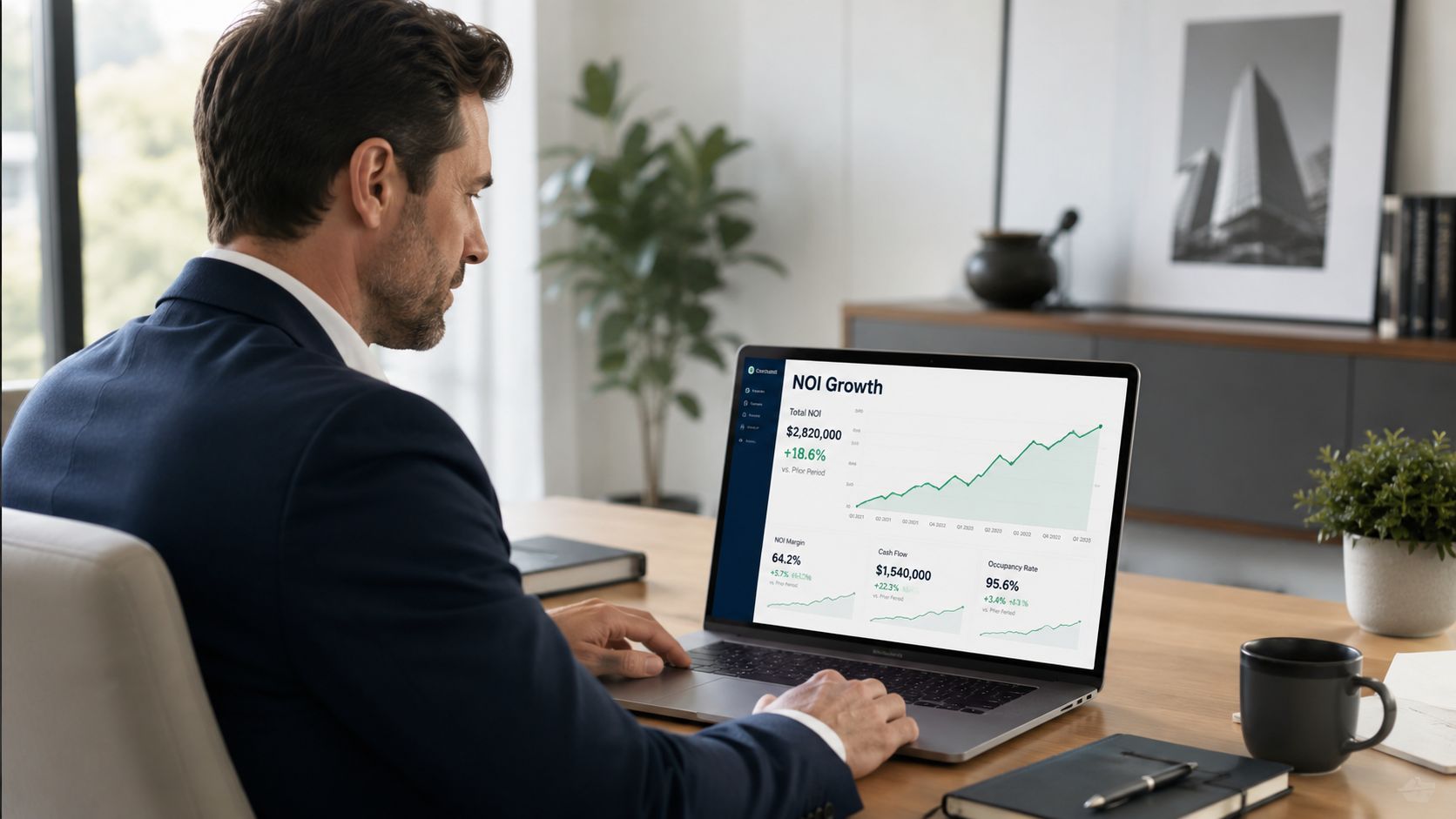
A strong invoice number doesn't just clean up bookkeeping. It protects revenue.
When billing gets messy, operators lose money in indirect ways. Staff spend extra time matching payments. Credits get missed. Duplicate invoices create confusion. Residents question charges because the paperwork looks inconsistent. None of that shows up as one dramatic error, but it chips away at net operating income.
The real value is operational control
Sequential numbering became standard for a reason. By 1920, over 85% of registered businesses in the U.S. had implemented sequential invoice numbering to ensure unique identification of each transaction. That historical standard still matters because unique invoice IDs make every downstream task easier.
For a landlord, that means:
- Faster payment matching: You can tie a transfer, receipt, and ledger entry to one clear record.
- Cleaner follow-up: When a resident asks about a balance, you can reference one exact invoice instead of describing “the one from early last month.”
- Better tax prep: Records sort consistently when your accountant asks for support.
- Lower friction during audits: Unique numbering makes it easier to show a complete billing trail.
Small format choices affect big admin tasks
A weak system usually fails in one of two ways.
The first is too little information. Numbers like 001, 002, 003 are orderly, but they tell you nothing about the property or room. The second is too much improvisation. If you manually type labels however they make sense that day, your files stop sorting properly.
Practical rule: If you can't tell what an invoice is for from the number alone, the format is too thin for co-living.
That's why the best systems balance structure and readability. They stay sequential, but they also include context.
Professional billing helps collections
Residents don't use the phrase “invoice architecture,” but they notice when billing looks sloppy. Clear numbering signals that your records are organized. That makes disputes easier to resolve because both sides can point to the same document quickly.
A smart format also helps when you grow from one house to several. If your invoices are already standardized, scaling doesn't mean rebuilding your paperwork from scratch. You just apply the same logic across more units.
For co-living operators, that consistency supports NOI in a simple way. Less time spent untangling billing means more time spent filling rooms, managing turnover, and improving the property.
Designing Your Perfect Co-Living Invoice Number
The most practical answer to how to create an invoice number for shared housing is to build a format with multiple layers of meaning. For co-living, the strongest structure is usually:
Property-Room-Date-Sequence
That format works because each part solves a different problem. The property tells you where the charge belongs. The room narrows it down further. The date tells you when the invoice was issued. The sequence keeps every invoice unique.
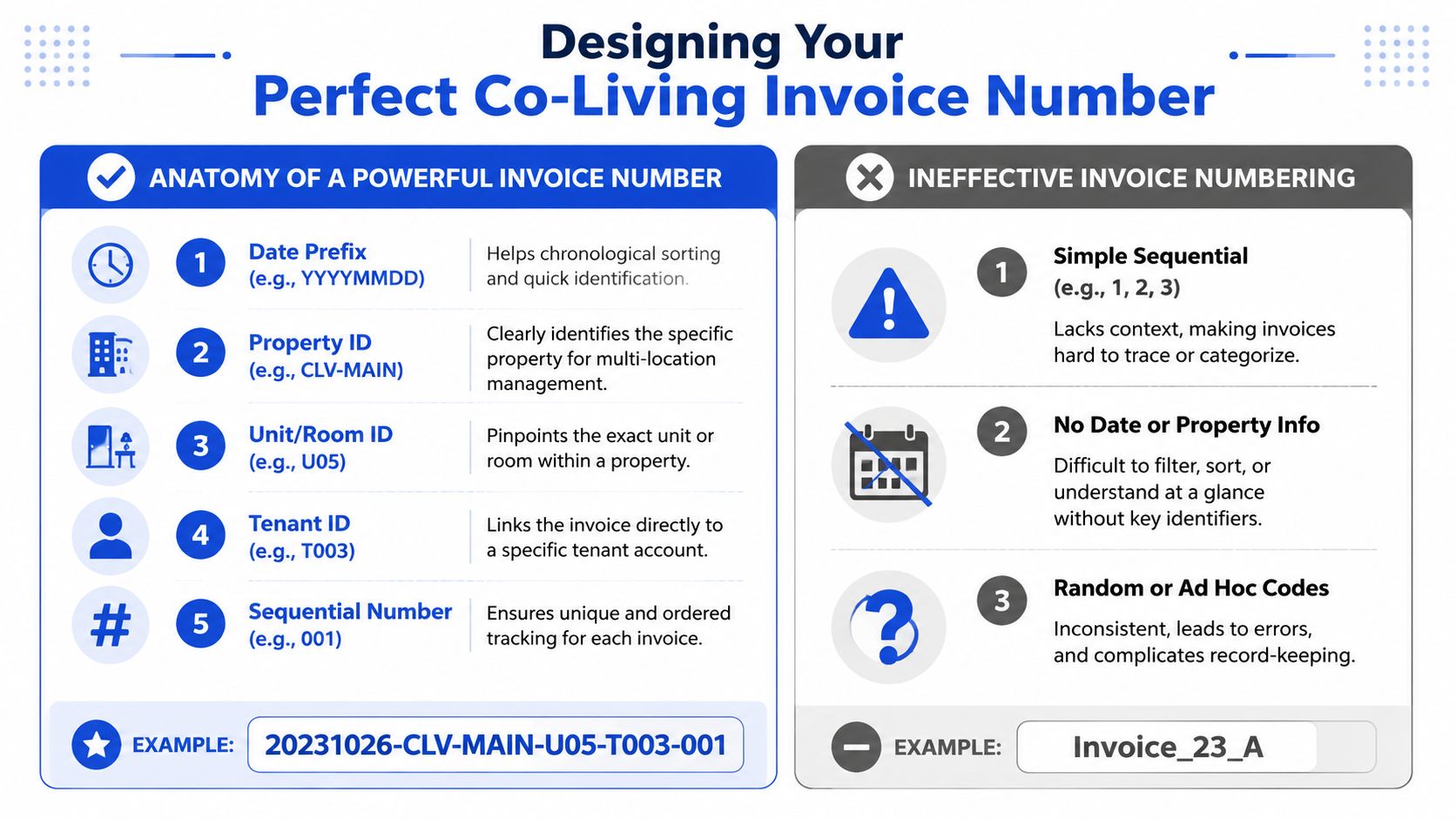
The anatomy of a useful invoice number
A solid example looks like this:
MAIN-R03-202601-01
Here's how to read it:
- MAIN identifies the property
- R03 identifies the room
- 202601 identifies the billing period or issue month
- 01 identifies the invoice sequence for that room and period
Some operators prefer a date-first version, such as 240618-APT04-001. That's also a strong approach. In fact, for multi-property co-living operators, embedding chronological data and project codes into the invoice number enhances traceability by 85% compared to pure sequential numbering, because staff can identify the property and transaction date without opening the document.
Keep every component standardized
The format only works if each piece stays consistent.
Bad examples:
- MAIN-3-20261-1
- Main-Room3-Jan-01
- APT4-R3-2401-A
Better examples:
- MAIN-R03-202601-01
- EAST-R12-202601-02
- CLV1-U05-202601-01
The difference is more important than it looks. When code lengths vary, your spreadsheet won't sort cleanly. When names drift, you'll end up with multiple labels for the same property.
Use fixed-width parts whenever possible. Room 3 should always be R03, not sometimes R3 and sometimes ROOM3.
Invoice Numbering Systems Compared
| System Type | Example | Pros | Cons for Co-Living |
|---|---|---|---|
| Sequential only | 0001 | Simple, easy to start | No property or room context |
| Date only | 202601-01 | Easy chronological sorting | Still weak for multi-room tracking |
| Property plus sequence | MAIN-001 | Better than plain sequence | Doesn't identify room or billing period |
| Property, room, date, sequence | MAIN-R03-202601-01 | Best traceability, easy sorting, clearer audits | Takes a little setup |
| Random or ad hoc | Invoice_23_A | Feels flexible at first | Hard to scale, easy to misread |
A format you can adopt today
If you manage one house, use:
PROPERTY-ROOM-YYYYMM-SEQ
If you manage several houses and frequent room turns, add a resident code only if it is indispensable:
PROPERTY-ROOM-RESIDENT-YYYYMM-SEQ
That extra layer can help when your internal records track residents by ID, but many smaller landlords can keep resident identity in the customer field and leave it out of the invoice number itself. The main priority is still property, room, date, and sequence.
Don't overcomplicate the system on day one. Make it structured enough to sort cleanly and clear enough that anyone on your team can read it without asking what it means.
How to Create Invoice Numbers in Excel or Google Sheets
If you're still using spreadsheets, you can build a reliable numbering system without special software. Excel and Google Sheets are good enough for a lot of smaller landlords, as long as you set them up with rules and don't rely on manual typing.
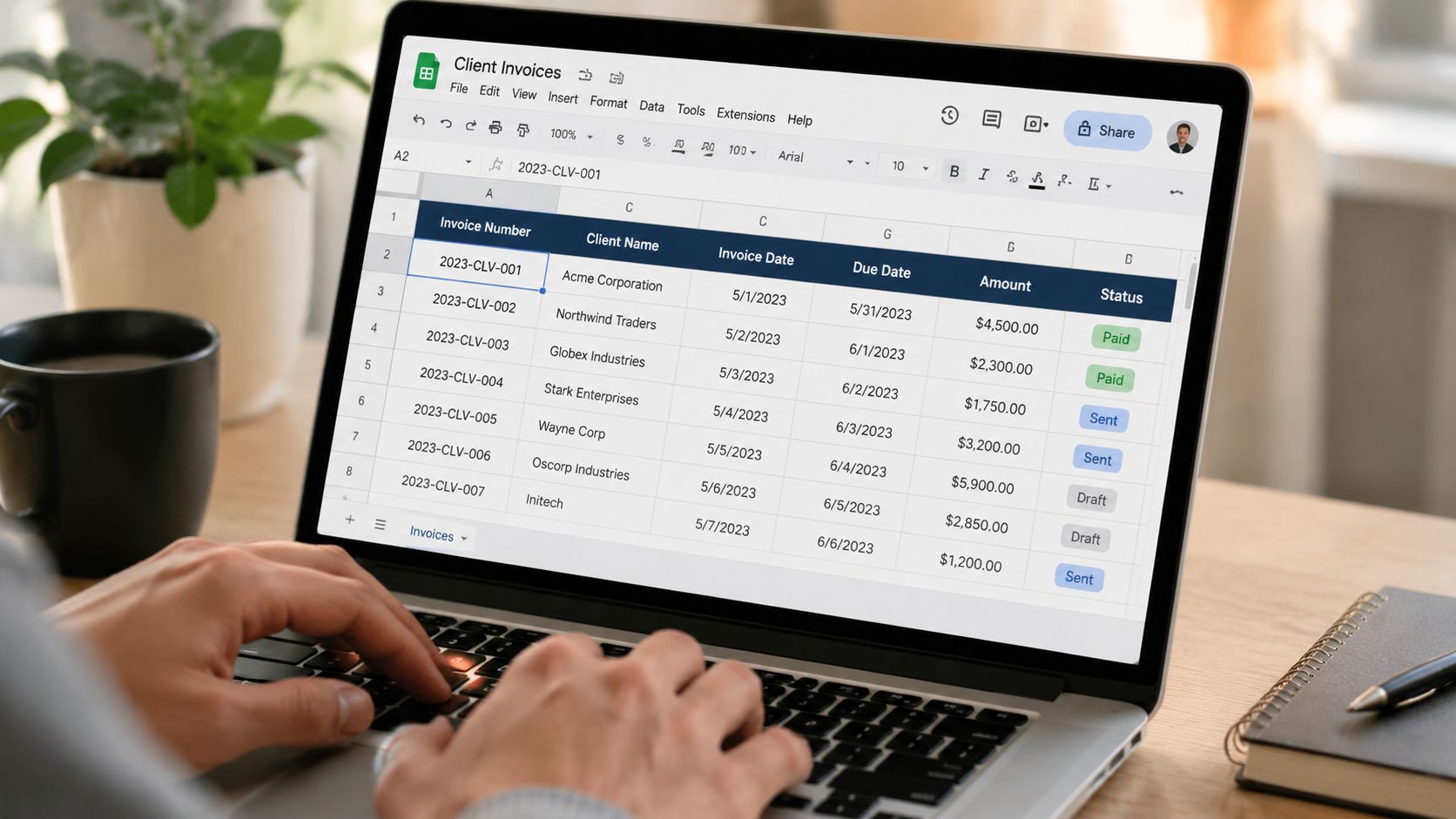
Start with the basic auto-number formula
A proven Excel formula is:
="INV-" & TEXT(ROW(A1),"000")
It produces:
- INV-001
- INV-002
- INV-003
This approach combines the ROW function with TEXT to create zero-padded sequential numbers automatically, and it reduces human error by 95% in small-to-mid-sized operations.
For a co-living setup, you'll usually want more context than a plain INV number. A practical spreadsheet version looks like this:
="MAIN-" & "R03-" & TEXT(TODAY(),"yyyymm") & "-" & TEXT(ROW(A1),"00")
That gives you an output such as:
MAIN-R03-202606-01
You can replace the hard-coded property and room values with cell references. For example, if:
- B2 contains the property code
- C2 contains the room code
your formula can look like this:
=B2 & "-" & C2 & "-" & TEXT(TODAY(),"yyyymm") & "-" & TEXT(ROW(A1),"00")
What to set up in your sheet
Your sheet should have separate columns for the parts that matter.
A simple layout:
- Property code
- Room code
- Resident name
- Invoice date
- Invoice number
- Rent amount
- Status
If you want a stronger accounting workflow, this guide to free accounting software for landlords can help you compare spreadsheet-based processes with more formal tools.
Don't type invoice numbers by hand if the sheet can generate them for you. Manual numbering is where duplicate and skipped records usually begin.
Common spreadsheet mistakes to avoid
The formula is only half the job. The bigger risk is how people use the sheet after it's built.
Watch for these issues:
- Wrong starting row: If your formula begins on row 5 and still references
ROW(A1)incorrectly, your sequence can start in the wrong place. - Deleted rows: Removing rows can create confusion if you assume the visible order is the official invoice history.
- Mixed formats: If one invoice says R3 and another says R03, sorting breaks.
- Overwritten formulas: A single manual edit can wreck the pattern for future rows.
A practical fix is to keep:
- one tab for the invoice register,
- one tab for lookup lists like property and room codes,
- locked formula cells where possible.
This walkthrough may help if you want to see spreadsheet automation in action:
A better formula for growing portfolios
Once you have more than one property, use a stable zero-padded sequence. A four-digit sequential format such as 0001, 0002 is a best practice because it scales better as your invoice count grows, as noted in Wise's guide to invoice number formats.
If you stay in spreadsheets, keep the formula simple enough that someone else can maintain it. Fancy formulas are useless if only one person understands them.
When to Automate Your Invoice Numbering
Spreadsheets work. Until they don't.
The tipping point usually comes when you're managing multiple houses, dealing with frequent move-ins and move-outs, or spending too much time correcting billing mistakes that shouldn't have happened in the first place.
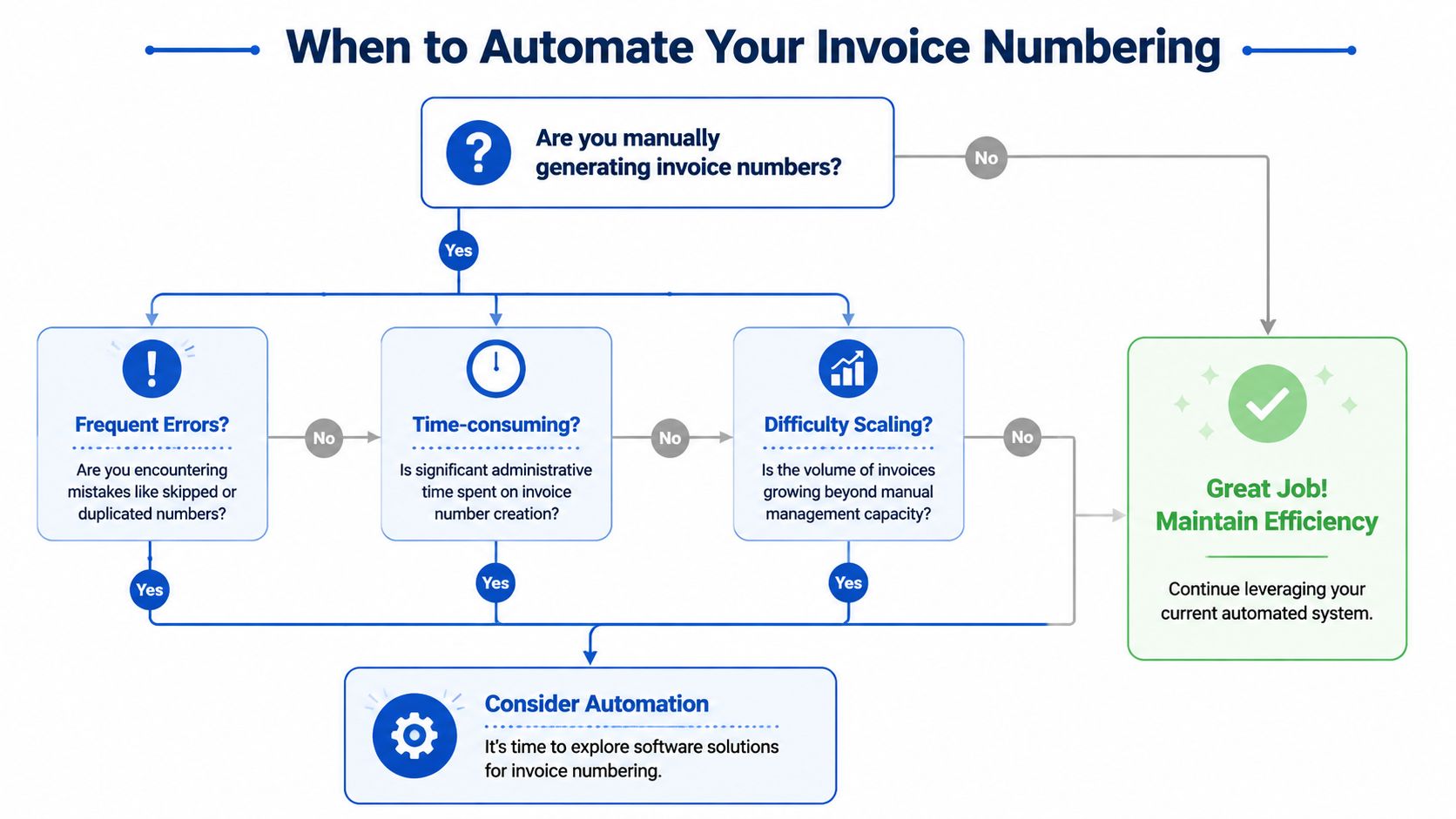
The clearest signs you've outgrown manual numbering
Manual systems tend to fail under volume and change. In co-living, both happen often. A 2025 report from the Real Estate Institute of Australia showed that 42% of small co-living landlords used manual or Excel-based invoice numbering, resulting in 18% of invoices having duplicate or missing numbers.
That doesn't mean spreadsheets are bad. It means they have a limit.
You're probably ready to automate if:
- You manage more than one property: Cross-property billing gets messy fast.
- Residents switch rooms often: Static templates don't handle occupancy changes well.
- You keep fixing duplicate or skipped numbers: The process is no longer trustworthy.
- You need cleaner reporting: Portfolio-level visibility is hard when invoice IDs aren't generated consistently.
What automation actually changes
Automation doesn't just save typing. It changes how the system behaves.
With accounting software, database tools, or property management platforms, the invoice number can be created automatically when a new charge is issued. That removes the biggest human failure points: forgetting the next number, reusing an old one, or applying the wrong format.
A good automated workflow should:
- Pull from a central sequence
- Add the right property or unit code automatically
- Prevent duplicate IDs
- Store every invoice in one searchable register
If you're rethinking back-office workflows more broadly, this article on how to automate document workflow is a useful next step.
When billing volume changes every month, static invoice numbering starts to crack. Dynamic numbering holds up better because it adapts to the workflow instead of relying on memory.
You don't need to automate everything at once
A lot of landlords assume automation means a full software migration. It doesn't have to.
You can start with one reliable source of truth for invoice numbering, then connect that to the rest of your billing process later. The important part is to stop creating identifiers in a way that depends on whoever happened to send the invoice that day.
Your Blueprint for Audit-Proof Invoicing
The strongest co-living invoice number is one you can read, sort, and trust. For most room-by-room operators, the practical standard is still:
Property-Room-Date-Sequence
That format gives you enough context to work quickly without turning the invoice number into a paragraph. It also holds up when you add more houses, more rooms, and more team members.
A short checklist worth following
Keep these rules in place:
- Stay sequential: Numbers should move forward in a predictable order.
- Never reuse an invoice number: Even if an invoice is voided, keep the record.
- Use consistent codes: Property and room labels should never drift.
- Mark special document types clearly: If you issue pro forma invoices or credit notes, add a consistent suffix.
- Keep the register separate from the invoice template: Your master log should always show what has been issued and when.
What “audit-proof” really means in practice
Audit-proof doesn't mean fancy. It means your records tell a clean story.
If someone asks you to prove what was billed for Room 5 at one property during a specific month, you should be able to find the invoice, match it to the ledger, and connect it to the payment record without digging through mismatched filenames.
For landlords who also want cleaner resident-level bookkeeping, it helps to understand how the invoice system fits into the broader record trail. This guide on rent ledger meaning is a useful companion because the ledger and invoice structure should support each other.
Clean invoicing doesn't start at tax time. It starts when you choose a numbering format that still makes sense six months later.
The best time to fix your invoice numbering system is before the next round of billing goes out. Once the format is in place, the rest of your admin gets easier.
PadPulse is building an all-in-one platform for PadSplit hosts and co-living operators who want less admin and better control across pricing, messaging, smart access, and financial reporting. If you want a simpler way to manage rent-by-the-room operations and stay updated on beta access, join the PadPulse interest list.