A Good Review for Airbnb: The Complete 2026 Guide
May 4, 2026
You’ve probably felt this already. A guest checks out, you clean the room, reset the lock, and then wait for the review. If you’re new to hosting, that moment can feel bigger than it should. It isn’t just about ego. One strong review can help the next guest book with confidence. One vague or frustrated review can slow momentum fast.
That’s even more true in co-living. In a private whole-home rental, guests judge one space. In a room-by-room setup, they judge the room, the bathroom, the kitchen, the noise level, the other people in the house, and whether expectations matched reality. Getting a good review for Airbnb takes more than sending a polite message after checkout. It takes operations that hold up in real life.
Hosts who understand that early tend to build steadier occupancy, better guest trust, and fewer unpleasant surprises.
Why Airbnb Reviews Are the Heart of Your Stay
The review starts before checkout. It starts when a guest opens the front door and decides whether the listing photos matched reality, whether the room feels cared for, and whether the host responds when something small goes wrong.
Airbnb’s review system has accumulated over 460 million reviews, and 85% of all reviews in 2024 were five-stars, according to Airbnb’s global quality report. That tells you two things. First, guests rely heavily on reviews to make decisions. Second, if your stay experience is even slightly confusing or inconsistent, you’re competing against listings that already look polished and dependable.
For hosts, reviews are operational feedback in public. For guests, they’re a shortcut to trust.
In practice, reviews also shape visibility. Better-reviewed listings get more confidence from future guests, and dependable operations behind the scenes matter just as much as the room itself. If your turnover schedule slips or booking details get messy, that usually shows up in reviews sooner or later. Good systems help. Even something as basic as keeping reservations aligned through an Airbnb calendar sync process protects the guest experience from avoidable mistakes.
Reviews don’t just describe the stay. They signal whether a host is organized, honest, and consistent.
That’s why a good review for Airbnb isn’t a lucky outcome. It’s the visible result of how the property runs.
The Anatomy of a High-Impact Airbnb Review
A useful review is specific enough to help the next person decide. “Great stay” is kind, but it doesn’t answer the questions future guests have. Was the room quiet? Was check-in smooth? Did the kitchen feel usable? In co-living, was the shared bathroom maintained and were house expectations clear?
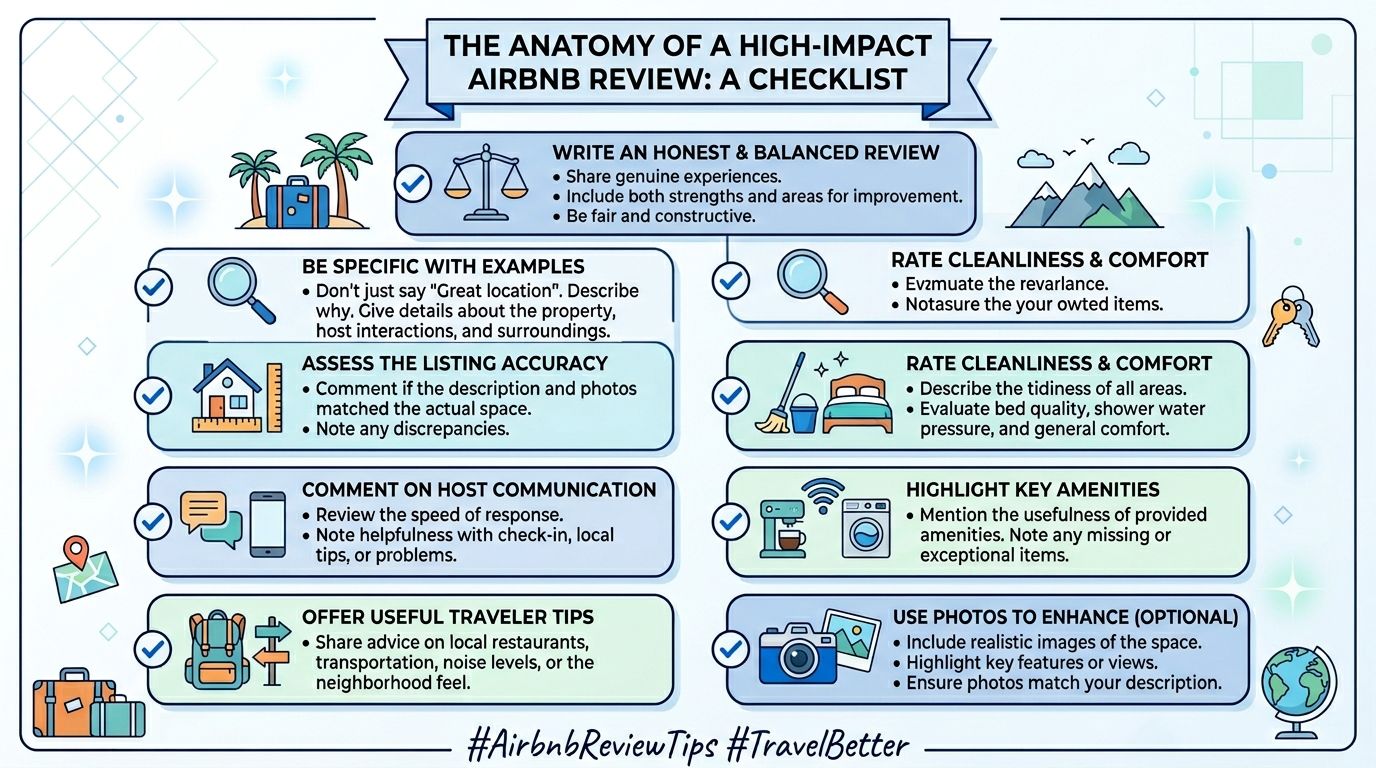
What makes a review helpful
Three qualities make a review high-impact.
- Specific detail helps future guests picture the stay. “Wi-Fi handled video calls” is better than “good amenities.”
- Balanced feedback makes the review believable. Even a very positive review feels stronger when it includes context instead of generic praise.
- Useful context tells the right guest whether the space fits their needs. A digital nomad, traveling nurse, student, or weekend traveler all read reviews differently.
Here’s the difference:
| Weak review | Strong review |
|---|---|
| Nice place, would stay again. | Clean room, easy self-check-in, and the kitchen was stocked well enough for simple meals. Shared walls were noticeable at night, so light sleepers should bring earplugs. |
| Good host. | Host replied quickly when I had a lock question and the check-in instructions matched what I found on arrival. |
| Great location. | Easy access to transit and stores, but the street had regular traffic noise during the day. |
Why cleanliness carries so much weight
If you want one area to obsess over, make it cleanliness. Breezeway reports that targeted cleanliness improvements lifted average host scores from 4.66 to 4.83 in its analysis of Airbnb review performance, and ties that directly to stronger listing outcomes like programs such as Guest Favorites in its guide to earning five-star Airbnb reviews.
That tracks with what experienced hosts see every day. Guests forgive small decor flaws. They rarely forgive dust, hair, smells, sticky counters, or a bathroom that looks half-reset.
Practical rule: Guests notice cleanliness in the first few minutes. If that first impression is bad, every later issue feels worse.
The subcategory trap many hosts miss
Hosts often focus on the final overall rating and ignore the experience pieces that produce it. That’s backward.
A guest doesn’t think in “overall score” terms during a stay. They think:
- Was it clean when I arrived
- Did the host communicate clearly
- Did check-in work without friction
- Did the room match the listing
- Did shared spaces feel respected
If one of those fails, the review usually reflects it. In co-living, common areas are where reviews swing most. A spotless bedroom won’t save you if the shared fridge smells bad or the bathroom caddy is overflowing.
The best reviews, whether written by guests or earned by hosts, are grounded in observable details. That’s what makes them credible. That’s also what makes them useful.
A Guest’s Guide to Writing Effective Reviews
Guests often want to be fair, but they get stuck between “everything was fine” and “I don’t want to sound harsh.” The easiest approach is to write the review like advice to the next traveler. That keeps it honest and useful.
A simple way to structure your review
A strong guest review usually has three parts:
- Start with the overall takeaway. Was the stay good, mixed, or disappointing?
- Add two or three specifics. Mention what stood out.
- Close with fit. Say who the stay is best for, or whether you’d stay again.
If there was a small issue, use a balanced approach. For example: mention what worked, state the issue plainly, then explain whether it changed the overall stay.
If the problem was minor, say so. If it affected sleep, safety, cleanliness, or accuracy, say that too.
That kind of review helps good hosts improve and helps future guests book with open eyes.
Quick-Start Airbnb Review Templates for Guests
| Scenario | Review Template |
|---|---|
| Excellent stay | We had a great stay. The space matched the listing, check-in was smooth, and the host communicated clearly. Everything felt clean and well prepared, and I’d gladly stay again. |
| Great stay with one minor issue | Overall, this was a very good stay. The room was comfortable and the host was responsive. The only issue was [minor issue], but it didn’t take away much from the trip. I’d still recommend it for guests who want [best fit]. |
| Good co-living experience | Good option for a room-by-room stay. My room was as described, and the shared areas were generally easy to use. If you’re comfortable with shared living and clear house rules, this can be a solid choice. |
| Best for a certain type of traveler | Clean, straightforward stay in a convenient area. I’d recommend it most for business travelers, students, or anyone who plans to be out during the day and wants a practical place to sleep and reset. |
| Mixed but fair | There were some positives here, especially [one positive]. The main issue for me was [specific issue], which affected [sleep, comfort, convenience, etc.]. This might still work for guests who are okay with [condition], but I wanted to mention it so others can decide accurately. |
| Host handled a problem well | We ran into a problem with [issue], but the host responded quickly and handled it professionally. I always appreciate that more than a perfect stay with no communication. That response improved the experience a lot. |
What guests should avoid
A review gets less helpful when it’s too vague, too emotional, or focused on things outside the host’s control.
Avoid these habits:
- Generic praise like “Amazing!!!” without any detail.
- Surprise complaints about something clearly disclosed in the listing.
- Punishing tone over a minor issue that the host fixed quickly.
- Personal attacks instead of factual feedback.
If you’re writing about co-living, mention the shared-living realities directly. Say whether noise was manageable, whether bathroom turnover felt smooth, and whether the rules were clear. That’s far more useful than pretending a shared house behaves like a boutique hotel.
A Host’s Playbook for Earning and Requesting Reviews
Hosts who consistently earn strong reviews don’t treat the review request as the main event. The stay is the main event. The request only captures what you already created.

What earns the review before you ask for it
The best review strategy is boring in the right way. The guest never has to wonder what happens next.
That means:
- Clear pre-arrival instructions that match the actual property
- Fast answers when a guest has a practical question
- A room that looks like the photos
- Shared spaces that don’t feel neglected
- A checkout process that isn’t fussy or surprising
In room-by-room rentals, friction often comes from tiny things. Missing shelf space in the bathroom. No place to label fridge items. Confusing laundry rules. A lock code that works for the front door but not the bedroom. These don’t always create complaints during the stay. They show up later in the review.
A written operating routine helps a lot. If you manage multiple rooms, a repeatable turnover and communication system matters more than memory. A solid set of property management checklists usually does more for review quality than any fancy guest gift.
How to ask without sounding needy
A good review request is short, polite, and tied to the stay.
Try something like this:
Thanks again for staying with us. If the room and house worked well for you, I’d appreciate a review. Specific feedback on the room, cleanliness, and shared spaces helps future guests know what to expect.
That wording does two smart things. It asks clearly, and it nudges the guest toward useful detail.
What doesn’t work well:
- Begging for five stars
- Sending long guilt-heavy messages
- Asking before unresolved issues are fixed
- Using stiff templates that sound automated
Where automation helps
Automation is useful when it supports hospitality instead of replacing it. According to Optimize My Airbnb’s case study on review automation, hosts using AI-powered message automation can raise review submission rates from the platform average of 70% to nearly 90%.
That doesn’t mean blasting every guest with robotic follow-ups. It means using consistent timing so guests don’t fall through the cracks.
A simple workflow usually works best:
- Arrival message that confirms access and invites questions
- Mid-stay check-in for longer stays
- Checkout message that feels calm and practical
- Post-checkout review request after the guest has left
Good automation handles timing. Good hosting handles tone.
If your messages still sound like you, automation can help. If they sound like a call center, guests feel it immediately.
Managing Reviews in Co-Living and Shared Rentals
A lot of Airbnb advice assumes the guest rented the entire place. That’s why new co-living hosts get blindsided. The operating model is different, and the review risks are different too.
Co-living listings grew 28% year over year in major US markets, yet hosts in that category face recurring review deductions tied to issues like “noisy housemates” that traditional rentals don’t deal with, according to Trustmary’s roundup of Airbnb review examples and hosting tips.

The common assumption that hurts co-living hosts
The wrong assumption is simple. If the bedroom is good, the review will be good.
That’s not how shared housing works.
Guests rate the lived system around the room:
- Who used the kitchen at midnight
- Whether the bathroom stayed stocked
- How noise travels through walls and doors
- Whether rules are enforced evenly
- How safe and private the setup feels
This is why generic short-term-rental advice often underperforms in co-living. You’re not only hosting a traveler. You’re managing a small social environment.
For operators running multiple shared homes, the challenge is even broader. That’s where specialized thinking around co-living property management becomes far more relevant than standard vacation-rental playbooks.
Review-proofing shared spaces
The strongest co-living hosts reduce conflict before it starts.
Focus on these pressure points:
- Noise control through quiet hours, door-close reminders, and clear enforcement
- Bathroom turnover with visible cleaning standards and enough storage for each room
- Kitchen use through labels, shelf assignments, and rules around dishes and fridge space
- Privacy by explaining exactly what is shared and what is private in the listing
- House culture by setting expectations early, not after conflict appears
A practical example: if your house has thin walls, don’t hide it. Set expectations in the listing and house guide, then provide solutions such as quiet hours and simple courtesy norms. Guests usually handle disclosed trade-offs better than hidden ones.
Shared housing doesn’t need to feel perfect. It needs to feel fair, clear, and well managed.
What guests in co-living actually remember
They remember whether the house felt stable.
Not luxury. Not staging. Stability.
If the sink was empty, the entry felt secure, the bathroom had supplies, and the other residents seemed to understand the rules, that often earns a stronger review than a prettier room in a chaotic house. In co-living, operational discipline is part of hospitality.
How to Respond to Every Type of Airbnb Review
Your response to a review isn’t mainly for the guest who wrote it. It’s for the next guest reading it. That’s why defensive replies do so much damage. They make future guests imagine what happens if something goes wrong during their own stay.
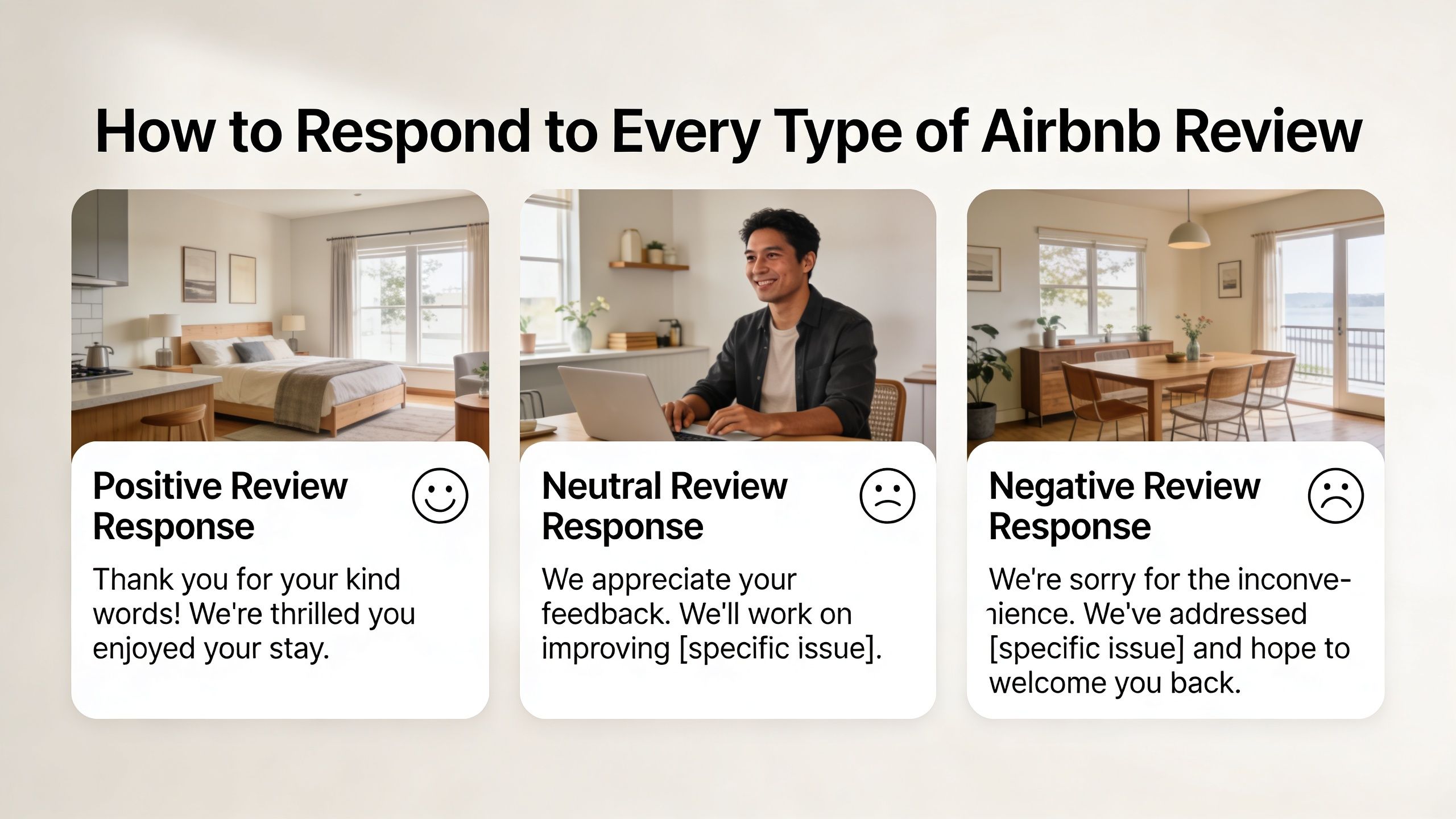
Positive reviews
When a guest leaves a glowing review, don’t waste the response with “Thanks so much.”
Use the reply to reinforce what future guests care about.
A better format:
- Thank them by name
- Echo one concrete point they mentioned
- Welcome similar guests in the future
Example:
Thanks for staying with us, Maya. I’m glad the self-check-in and quiet room setup worked well for your trip. You were a pleasure to host, and we’d be happy to welcome you back anytime.
That reply subtly confirms convenience and room quality without sounding promotional.
Mixed reviews
Mixed reviews are often the most valuable because they feel believable. They also give you a chance to show maturity.
A good response structure:
| Review type | Best response approach |
|---|---|
| Positive | Thank the guest and reinforce one strength mentioned in the review |
| Mixed | Acknowledge the issue, clarify only if necessary, and mention the adjustment you’ve made |
| Negative | Stay calm, address the concern briefly, and show future guests that you take standards seriously |
If a guest says the room was clean but the hallway got noisy at night, don’t argue about their perception. Confirm that you understand the concern and note the action taken if relevant.
Example:
Thank you for the honest feedback. I’m glad the room itself worked well for you. We took your note about evening hallway noise seriously and have since reinforced quiet-hour reminders with current guests.
That kind of reply tells future bookers you pay attention.
Negative reviews and the trust factor
A spotless wall of generic five-star praise can look less trustworthy than a profile with a few thoughtful, imperfect reviews. Pricelabs reports that listings with a perfect 5.0 can book 18% slower than those with a balanced 4.7 to 4.9 rating because guests trust nuanced feedback more, as described in its analysis of Airbnb guest review examples.
That should change how hosts think about reputation. The goal isn’t to look unreal. The goal is to look dependable.
A professional response can turn a negative review into proof that you listen, adapt, and run the property seriously.
What doesn’t work:
- blaming the guest
- writing a long rebuttal
- implying the guest is too sensitive
- revealing private details
- sounding irritated
Future guests read tone faster than they read facts. If your tone feels stable, you gain trust even when the review wasn’t perfect.
Your Quick Guide to Airbnb Review Questions
Hosts and guests usually run into the same handful of review questions.
Can a review be honest without being harsh
Yes. The best reviews are factual, specific, and proportional. If the issue affected sleep, cleanliness, safety, or listing accuracy, say that clearly. If it was minor, write it like a minor issue.
Should hosts ask every guest for a review
Yes, if the ask is polite and consistent. Don’t pressure guests for a five-star rating. Ask for honest feedback and make it easy for them to remember what to mention.
What matters most in co-living reviews
Clarity and consistency. Guests want to know whether the room matched the listing, whether shared spaces were maintained, and whether the house felt orderly.
Is a perfect profile always the goal
Not necessarily. A trustworthy profile with detailed feedback and professional host responses often feels more credible than one filled with generic praise.
What’s the easiest way to improve review quality fast
Tighten the basics first. Cleanliness, accurate listing details, reliable check-in, and clear house rules solve more review problems than clever wording ever will.
If you run PadSplit houses or other room-by-room rentals, PadPulse is worth watching. It’s being built for co-living operators who need better control over pricing, messaging, smart access, and portfolio visibility without stitching together a dozen tools. Join the interest list if you want early updates and beta access before launch.