Your Guide to Franchise Property Management in 2026
May 30, 2026
Growth in property management often breaks the business before it improves it. One month you're handling leasing, renewals, maintenance follow-up, owner updates, and bookkeeping with a system that mostly works. A few new properties later, that same setup starts leaking time everywhere.
That's when franchise property management starts to look appealing.
For an independent operator, the pitch is simple. Join an established brand, follow a proven operating system, use the franchisor's training and software, and scale with less trial and error. The harder question is whether that support is worth the loss of flexibility and the long-term cost structure, especially if you operate co-living homes, room-by-room rentals, or other models that don't fit neatly into a traditional residential management playbook.
This guide looks at franchise property management the way an operator should. Not as a glossy opportunity, but as a scaling decision with real trade-offs.
Is It Time to Grow Beyond a DIY Business
A lot of property managers hit the same wall. They don't fail because demand disappears. They stall because their business still runs like a small shop while their portfolio starts behaving like a company.
You might be at that point now if your day looks like this: leasing inquiries pile up, maintenance vendors need direction, residents want faster communication, and owners expect cleaner reporting than your current process can deliver. The business is producing revenue, but it's also consuming you.
That's the environment where franchise property management enters the conversation.
At a basic level, a property management franchise is a local business operated by an owner under a larger brand's system. The brand typically provides training, operating procedures, marketing guidance, and a required framework for how the office runs. In return, the local operator pays upfront and ongoing fees, follows brand standards, and gives up part of the freedom that comes with staying independent.
Signs your current model is under strain
A franchise model becomes worth evaluating when these problems keep repeating:
- Lead handling is inconsistent: Prospects wait too long for replies, or your team handles follow-up differently every time.
- Operations depend on you: You still make too many daily decisions that should already be systemized.
- Onboarding is messy: New staff need to learn from tribal knowledge instead of documented processes.
- Owner reporting feels patched together: Clients get reports, but the process takes too much manual work.
- Growth creates chaos: Every added property increases stress more than capacity.
Practical rule: If adding doors adds complexity faster than profit, you don't just need more business. You need a better operating model.
For some operators, franchising solves that. For others, it adds a rigid layer to a business that needs specialization, not standardization. That distinction matters most in niches like co-living, where leasing, resident communication, and turnover patterns can differ sharply from conventional property management.
Understanding the Franchise Property Management Model
Imagine the difference between opening your own neighborhood restaurant and operating a national fast-casual brand. The independent owner controls the menu, pricing, suppliers, and customer experience. The franchise owner gets a system, a name people already recognize, and a manual for how things should run.
Franchise property management works the same way.
The franchisor builds the brand, creates the processes, and packages the operating model. The franchisee buys the right to use that system in a local market and is responsible for execution. The local office still has to win clients, manage properties, retain staff, and deliver service. The difference is that it does so inside a prebuilt framework.
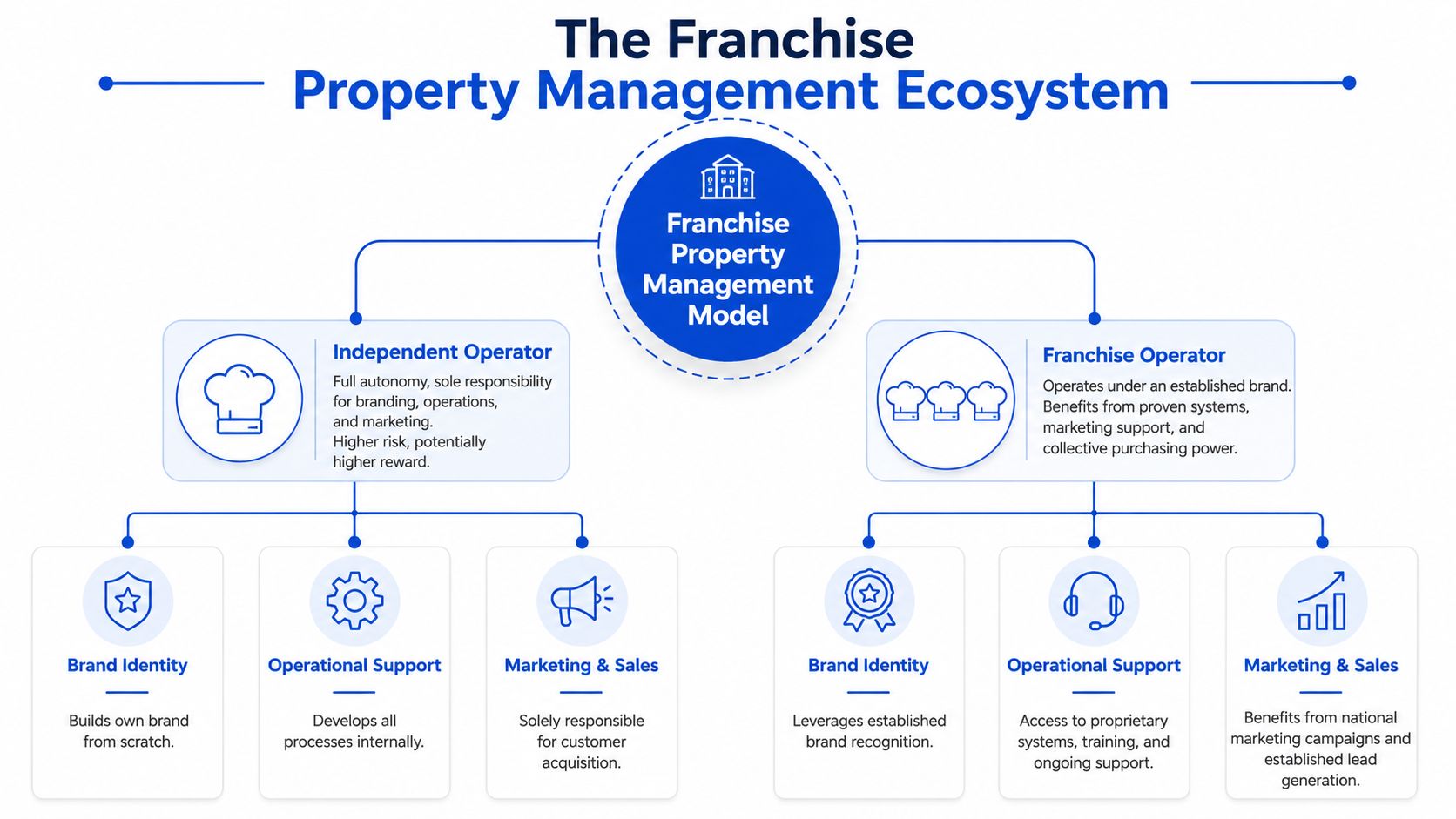
What you usually get from the brand
Most franchise systems promise some version of the same package:
- Training and onboarding: The brand shows you how it wants leasing, maintenance coordination, owner communication, and administration handled.
- Software and operating tools: Some systems include required platforms, while others bundle technology with additional fees.
- Marketing support: This can range from brand assets and templates to stronger central guidance on lead generation.
- Standard operating procedures: Scripts, workflows, checklists, and compliance expectations reduce improvisation.
- Peer network access: Operators often value the ability to compare notes with other offices using the same model.
That structure is why franchise property management appeals to owners who are good at sales or local market relationships but don't want to build every internal system from scratch.
What you give up in exchange
The trade is straightforward. You gain a playbook, but you lose some control over how your company evolves.
That can affect:
- service mix
- territory decisions
- vendor choices
- marketing style
- software flexibility
- branding
- process changes you'd otherwise make quickly on your own
For a traditional operator, that may be acceptable. For a co-living manager running per-room leasing, shared-home operations, or nontraditional occupancy workflows, those limits can become more than an annoyance. They can shape what your business is even allowed to become.
Why the model became more credible
Franchise property management became more concrete as the category matured. A useful milestone came in 2008, when Property Management Inc. was founded and began franchising. By December 31, 2023, PMI reported 408 total locations, and its average annual revenue per franchisee across all pillars was $376,421, with averages across residential ($296,389), commercial ($29,643), association ($176,972), and short-term ($211,135) rentals, according to Franchise Chatter's review of the PMI franchise disclosure data.
That matters because it shows the model isn't limited to one property type. It also shows where many operators get interested: diversified revenue streams under one brand umbrella.
A franchise isn't passive ownership. It's still an operating business. You're not buying results. You're buying a system that may improve your odds if you execute well.
The Financial Realities and Potential ROI
A common scenario looks like this. An independent manager has 80 to 150 doors, solid owner relationships, and a decent local reputation. Growth feels harder than it should. A franchise starts to look attractive because the brand promises structure, lead generation, and a faster path to scale. The mistake is treating that decision like a marketing upgrade. It is a financial model change.
You are adding fixed costs to a business that often runs on narrow margins and delayed payback. That matters even more if part of your portfolio is co-living or room-by-room rentals, where leasing volume, turnover, furnishing standards, utility coordination, and house-level operations can create more moving pieces than a conventional single-tenant portfolio.
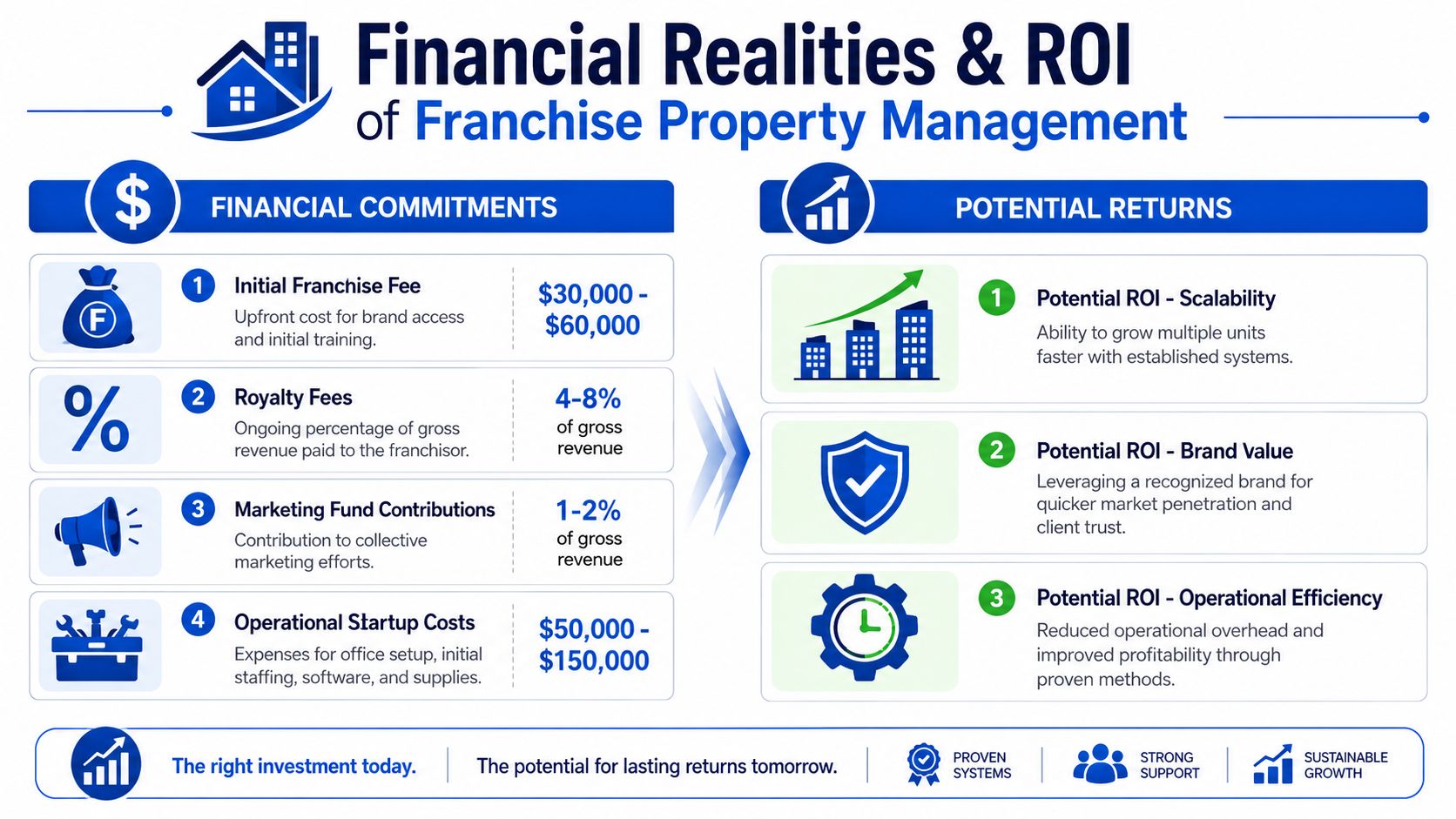
The upfront capital is real
A property management franchise rarely starts with a small trial budget. Based on franchise estimates cited by Franchise BA's review of property management franchise startup costs, Real Property Management's FDD-based estimate is $91,796 to $234,150, including a $59,900 franchise fee, while Property Management Inc. is listed at $70,125 to $148,000.
That cash requirement is only part of the picture. The harder question is how long your working capital will last while you sign clients, onboard properties, hire staff, and absorb normal operating drag. Recurring revenue sounds stable on paper, but it builds in layers. Management fees start first. Leasing fees, renewals, maintenance coordination revenue, and ancillary income follow later, and only if execution is consistent.
For co-living operators, the ramp can be less forgiving. A franchise built around standard residential management may assume one lease, one household, and one turnover cycle per unit. A rooming portfolio can produce stronger top-line revenue per property, but it also creates more leasing events, more resident communication, and more operational labor. If the franchisor's model does not fit that workload, your startup capital disappears faster than the pro forma suggests.
Ongoing fees decide whether the model works
The initial fee gets attention because it is visible. The recurring cost stack is what usually determines whether the economics hold up after year one.
Common obligations include:
- Royalties, usually tied to revenue rather than profit
- Brand marketing contributions
- Required software or platform fees
- Training and conference costs
- Renewal charges, transfer fees, and contract penalties
- Vendor or supplier constraints that raise operating cost
Those costs hit every month, whether your team is running efficiently or not. That is why I advise operators to model franchise economics from the bottom up. Start with revenue by service line. Subtract payroll, local marketing, software, overhead, and vacancy-related drag. Then add franchise obligations. Many owners do that in reverse and end up with a much cleaner spreadsheet than the business will produce.
Margin pressure is the real issue
Property management usually rewards discipline, retention, and scale. It does not leave much room for sloppy execution or extra fixed cost.
That is especially true in co-living. Room-by-room leasing can raise gross income, but it also raises exposure to vacancy gaps, collections issues, make-ready coordination, and resident churn. The right way to test a franchise model in that niche is to map revenue at the bed or room level, not just the property level. If you manage shared housing, student rentals, or workforce accommodation, it helps to build your forecast around gross effective income for rental operations, because occupancy loss, concessions, bad debt, and turnover can distort a simple rent-roll view.
One sentence matters here. A franchise fee does not care whether a rough month came from owner churn, slower leasing, or a house with three vacant rooms.
A practical comparison lens
Use a side-by-side model before you compare brands.
| Metric | Franchise Operator | Independent Operator |
|---|---|---|
| Upfront cost profile | Higher initial commitment tied to franchise structure | More flexible setup path |
| Recurring fee load | Royalties and brand-related obligations continue each month | No franchisor royalty burden |
| Technology spend | May include required systems on top of your local tools | Can assemble a lower-cost or more specialized stack |
| Operating fit for co-living | Depends on whether the system supports room-by-room workflows | Can build processes around the niche directly |
| Speed to standardization | Faster if the franchisor's model matches your business | Depends on your own systems and management depth |
| Margin protection | Requires enough scale to absorb fixed franchise costs | Requires enough discipline to build without franchise support |
The technology line deserves more attention than it used to. Ten years ago, a franchise often had a stronger case because independent operators had to assemble their processes from scratch. Today, proptech can narrow that gap. An independent firm can combine leasing automation, maintenance workflows, owner reporting, CRM, accounting, lock and access tools, and room-level operations software without joining a franchise system. That does not make franchises obsolete. It does reduce the value of paying for standardization if your niche needs tools the brand does not support well.
What ROI actually looks like
Return on investment is not just office profit. It is the difference between two paths: paying for a system that helps you grow faster, or building that system yourself and keeping more control over cost and operations.
For a newer operator, franchise support can shorten the painful trial-and-error phase. For an established manager with strong local referrals, documented processes, and a clear co-living offer, the same franchise may add expense without adding much capability.
That is the trade-off. Brand support can improve execution. High fixed costs can also trap a business that has not reached enough scale, or one that operates in a niche the franchise was not built to handle.
Weighing the Pros and Cons for Your Business
The franchise decision usually looks easier from the outside than it does in practice. Support sounds good. Systems sound good. Brand recognition sounds good. All of that can be true, and the model can still be wrong for your business.

Where franchising helps
A strong franchise can solve real operational problems.
The best advantages usually include:
- Faster structure: You don't need to invent every workflow, template, and internal standard yourself.
- Immediate credibility: Some owners respond better to a recognized brand than to a smaller independent firm.
- Operator support: Training and peer access can shorten the learning curve.
- Repeatable delivery: Standardization helps if your current service quality varies by team member or property.
This is especially useful for operators who are scaling from a handful of doors into a proper management company and feel that their back office is lagging behind the portfolio.
Where the model starts to pinch
The downside isn't only cost. It's control.
You may find yourself limited by:
- Restricted flexibility: Brand rules can affect how you market, what tools you use, and how you package services.
- Long commitments: Franchise agreements can outlast your confidence in the model.
- Operational mismatch: A system designed around standard residential management may not fit room-by-room leasing or shared housing.
- Reputation dependency: You benefit from the brand's name, but you also inherit the brand's baggage if local owners or residents dislike it.
For co-living operators, this issue is bigger than it first appears. Shared housing often requires faster lead response, more frequent resident communication, and a leasing process built around individual rooms rather than one household signing one lease.
A franchise can make a conventional business more repeatable. It can also make a specialized business less adaptable.
The hidden part of the cost stack
The most overlooked issue is total cost of ownership. Beyond the initial fee, some franchises charge separate fees for software, training, and marketing, and may impose penalties for late payments or using unapproved suppliers. A typical contract can last 10 years, which makes the long-term capital commitment much larger than many buyers expect, as described in DoorLoop's discussion of property management franchise costs and restrictions.
That's why “Can I afford the franchise fee?” is the wrong first question.
A better set of questions looks like this:
- Can your current portfolio support the recurring fee load?
- Will the operating system improve retention or lead conversion?
- Are you buying capabilities you lack, or paying for structure you've already built?
- Will your niche fit the franchisor's rules, or will you be forcing your business into the wrong box?
A short video can help frame the decision from an owner's perspective.
A practical filter for independent managers
If your growth problem is mostly discipline, weak documentation, and inconsistent service, franchising may help.
If your growth problem is that your niche requires custom operations, faster experimentation, or a more specialized tech stack, a franchise may slow you down.
That's often the dividing line for co-living. Operators in that space don't just need more process. They need the right process.
Technology, Operations, and Legal Essentials
A property management franchise is only as strong as your ability to operate inside its rules. That means the daily reality matters more than the sales pitch.
Three areas usually decide whether the model works after signing: operations, legal obligations, and technology.
Operations have to become boring
That's a good thing.
Most franchise systems aim to make the office run predictably. Leasing workflows, resident communication, maintenance handling, owner reporting, accounting routines, and escalation paths all need to happen the same way every time. The less the office depends on heroics, the more scalable it becomes.
For a traditional rental portfolio, standardization often improves service quality. For co-living, though, operations are rarely identical to standard single-tenant management. Room turns can happen more often. Shared-space issues need faster coordination. Prospects expect quick answers. Resident communication often feels closer to hospitality than to classic long-term leasing.
If the franchise playbook can't absorb that, the operator ends up maintaining two systems: the franchisor's required system and the one the niche needs.
Legal review is not optional
Before signing anything, review the Franchise Disclosure Document carefully with experienced counsel. Don't treat it like a formality.
You also need to check state-level real estate and property management requirements. Licensing rules, brokerage rules, trust accounting requirements, and leasing authority can differ by state and by service model. If you're unsure where your operation fits, start with a practical overview of when a property management license may be required.
A good legal review should clarify:
- Territory terms: What exclusivity, if any, are you getting?
- Service restrictions: Are there limits on what you can offer or how you can package services?
- Technology requirements: Must you use approved systems only?
- Termination and renewal terms: What happens if the relationship stops working?
- Transfer rights: Can you sell the business easily later?
Read the agreement as if the relationship will go wrong, not as if everything will go right. That's how you spot the clauses that matter.
Technology is no longer a franchise-only advantage
In this area, franchise property management has changed the most.
The old franchise argument was stronger when software, process, and reporting tools were harder for an independent firm to assemble. That's less true now. As Buildium's overview of franchise pros and cons notes, the modern property management stack is increasingly modular, with separate tools for accounting, marketing, portals, maintenance tracking, and taxes. That means technology capability is no longer franchise-exclusive, and that shift is especially relevant for specialized niches like co-living.
What that means for room-by-room operators
A co-living operator should evaluate technology based on fit, not prestige.
Ask practical questions:
- Can the system handle per-room availability cleanly?
- Does it support fast, repeated inquiry response?
- Can it track house-level issues separately from resident-level issues?
- Does it help coordinate access, maintenance, and turnover in shared homes?
- Can you swap tools as your model evolves?
Independent operators now have a real alternative to the old all-in-one franchise promise. They can assemble a stack that fits how the business runs.
That doesn't automatically make independence better. It just means the decision has changed. If a franchise once offered the only realistic route to mature systems, today it is one route among several. For a conventional operator, the franchise system may still be the simpler path. For a co-living manager, modular proptech may be the better one.
Your Next Steps and Co-Living Operator Checklist
You have 80 rooms under management across shared homes. Occupancy is decent. Lead flow is inconsistent, turnovers are messy, and your team still relies on tribal knowledge for half the work. A franchise pitch can sound attractive at that stage. The right question is not whether the brand is reputable. The question is whether it fixes the constraint that is slowing growth.
That decision gets sharper in co-living. A franchise built around standard single-family or small multifamily management may bring discipline, training, and brand recognition, but still fit poorly if your business depends on room turns, shared-house rules, and fast lead handling by unit and by bed.
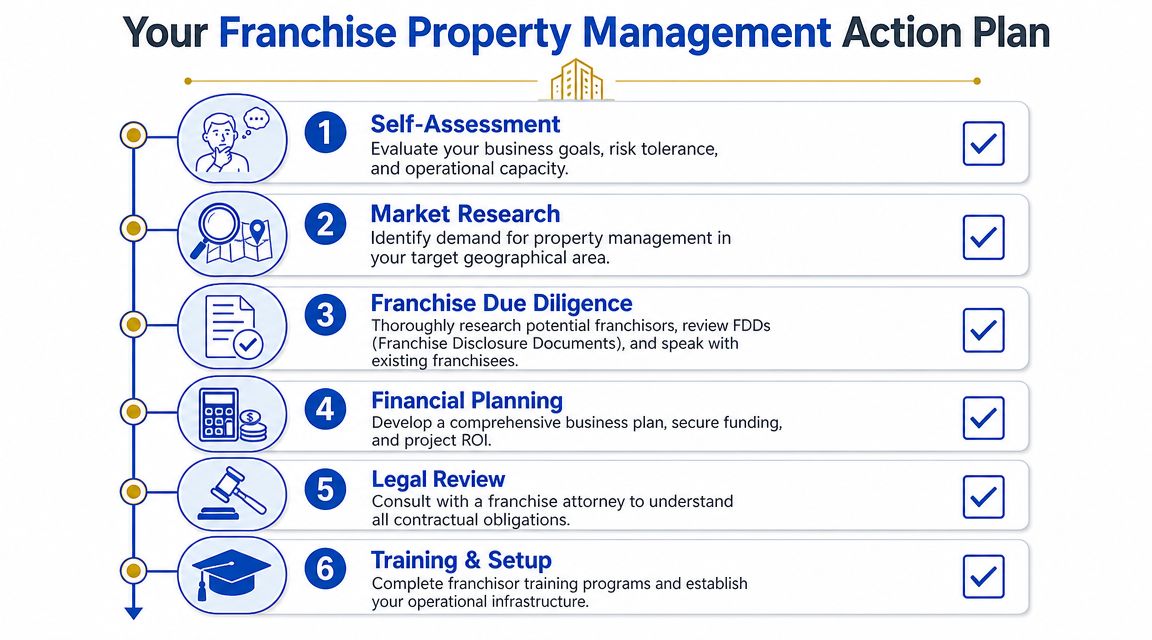
A practical due diligence process
Start with a blunt internal audit. If your growth problem comes from inconsistent follow-through, a franchise may help. If it comes from a co-living model that does not match standard property management workflows, a franchise may add cost without solving much.
Use a sequence like this before you sign anything:
Identify the bottleneck Separate brand problems from operating problems. Do you need trust with owners, better manager training, tighter leasing process, stronger supervision, or a cleaner tech stack?
Compare the operating model, not just the logo
Review more than one franchise. Compare onboarding, field support, required software, local marketing expectations, and whether the system was built for conventional leasing or can adapt to room-by-room operations.Talk to current and former franchisees
Ask what improved in the first 12 months. Ask what stayed hard. Ask where the franchisor added discipline and where local operators still had to build their own process.Review the agreement with franchise counsel
Focus on territory rights, recurring royalties, software mandates, transfer restrictions, and exit terms. In practice, those terms matter more than the sales presentation.Build a conservative model
As noted earlier, property management often runs on thin margins. Model slower lease-up, higher training costs, software overlap, and the extra coordination that shared housing creates.
The co-living and room-by-room checklist
This is the part independent operators often rush, and it is where weak franchise fit shows up first.
Use this checklist:
- Leasing model fit: Can the system handle room-by-room leasing cleanly, or does it assume one lease per household?
- Lead response speed: Can your team respond and schedule quickly enough for room inventory that turns faster than conventional units?
- Resident workflow fit: Does the process account for multiple unrelated residents living in one home?
- Shared-home operations: Is there a clear method for common-area issues, house rules, access control, and resident disputes?
- Turn management: Can the operating playbook handle frequent partial turnovers in occupied homes?
- Technology flexibility: Can you use tools that suit co-living, or are you forced into a stack designed for standard portfolios?
- Owner reporting: Will reports show room performance, house-level expenses, and vacancy patterns in a way owners can understand?
- Brand fit: Will the franchise help you win co-living owners, or will you spend half the sales call explaining why your model does not match the brand's assumptions?
One practical test helps here. Ask the franchisor to walk through a real co-living scenario: one resident gives notice, another complains about a shared bathroom issue, one room is offline for repairs, and the owner wants a house-level performance update by Friday. Their answer will tell you more than any brochure.
A final gut-check before signing
Operators usually buy a franchise for one of two reasons. They either need a repeatable operating system, or they want relief from the strain of building one alone. Those are not the same purchase.
If the franchise gives you stronger management habits, better recruiting, proven training, and a structure your current business lacks, the economics may work. If your main issue is that your co-living model needs specialized workflows and adaptable software, modern proptech may be the better investment.
Before you commit, tighten your own process and see what improves. These property management checklists for recurring workflows are a useful place to start because they expose whether the problem is missing systems, weak accountability, or poor fit between your operations and your tools.
Franchise property management can work well for an operator who wants structure and is willing to accept higher fixed costs and less flexibility. For a co-living manager, the better path is often the one that supports the business as it runs, room by room, house by house.
If you manage co-living homes, PadSplit-style rentals, or room-by-room portfolios, PadPulse is building software around that operating reality. Join the interest list to follow the Winter 2026 launch, see planned features like dynamic pricing, AI-powered messaging, smart-home integrations, and portfolio analytics, and get updates on limited beta access.