Expense Allocation Methods: A 2026 Guide
August 14, 2026
You're staring at a utility bill that looks too high, a maintenance invoice that landed mid-month, and a stack of room-by-room rents that don't seem to line up with the money going out. That's the exact moment expense allocation stops being an accounting theory topic and starts being a property management tool. For co-living operators, especially PadSplit hosts and small landlords, the question isn't whether shared costs exist. It's whether you're assigning them in a way that shows which rooms carry the property and which ones drag NOI down.
Why Expense Allocation Matters for Co-Living Operators
The first shared bill in a co-living house usually gets split evenly because that is the fastest way to get back to work. It looks tidy on paper, especially when you are balancing turnovers, repairs, and resident messages. The problem shows up later, when one room appears to carry more profit than it really does and another room absorbs costs it did not drive.
That kind of distortion affects room-level P&L decisions directly. If utilities, insurance, cleaning, and maintenance sit in one pooled bucket without a defensible allocation method, you lose sight of whether a master suite is subsidizing a smaller room or whether a lower-rent room still earns its keep after support costs. I have seen that lead to weak pricing calls, poor renovation priorities, and investor updates that do not match how the house operates.

For co-living, the right allocation method is the one that matches how the property is used. Shared costs should be assigned with a measurable driver, not guessed at. That same logic appears in broader accounting practice, where indirect costs need a fair base instead of an arbitrary split as described in cost allocation guidance.
A good allocation system also makes reserve planning easier to defend. If you already keep a reserve account for repairs or vacancies, you want to know which rooms are creating the most cost pressure over time. Operators who treat allocation as a bookkeeping task usually miss the bigger benefit, clearer pricing decisions, better turnover planning, and more grounded capital improvement calls. That is why it helps to pair this work with this guide to reserve accounts in rental accounting.
Understanding the Core Concept of Expense Allocation
A co-living house can look profitable on paper and still hide the wrong story underneath. One room may be carrying more of the support burden than another, or a shared service may be getting spread so loosely that the room-level P&L no longer reflects reality.
That is why expense allocation matters in rent-by-the-room and PadSplit-style operations. Some costs are direct costs, which belong to one room or one tenant and should stay there. Others are indirect costs, which support the whole property and need a consistent way to be assigned across rooms or units.
The basic formula behind shared cost assignment
The core structure is simple. Allocated expense = cost pool multiplied by recipient allocation driver divided by total driver as summarized in allocation guidance. In practical terms, you gather the shared cost, choose the driver that best reflects who benefited, and spread the cost across the rooms that used it.
For a co-living property, that driver can be headcount, square footage, usage, or transaction volume. Those drivers are common because they are measurable and easy to defend during an audit or an investor review. Shared utilities often track better with occupancy, while cleaning, lawn care, or other house-wide services may fit square footage or actual use patterns as noted in expense allocation references.
Practical rule: if you can trace the expense to one room, do that first. Allocation should be the second choice, not the default.
Operators often try to make every expense feel perfectly fair. That usually creates more confusion than clarity. The better goal is a method that is consistent, explainable, and close enough to actual benefit to support pricing and reporting. When exact benefit is hard to measure, a reasonable and rational basis is acceptable under the proportional-benefit guidance.
The test is whether the method survives month after month in a live property. A formula that looks tidy in a spreadsheet but takes too long to update will fall apart after the next turnover cycle, especially when a host manages multiple rooms, repairs, and utility swings at the same time.
Common Expense Allocation Methods for Co-Living Properties
In a co-living house, the right allocation method usually depends on what kind of cost you are dealing with, and how much time you can spend defending the logic later. The methods that show up most often are the ones owners, bookkeepers, and residents can understand without a long explanation. That does not make them interchangeable. In practice, flat split, square footage, occupancy-based, revenue-proportional, direct assignment, and hybrid allocation each solve a different problem, and each one can distort the numbers if you use it in the wrong place.
What each method is good at
Direct assignment is the cleanest choice when a cost clearly belongs to one room or one resident. A broken lock on Room 3 or a mini-split repair tied to one bedroom should usually stay there. That keeps the room P&L honest and avoids spreading a unique cost across people who did not create it.
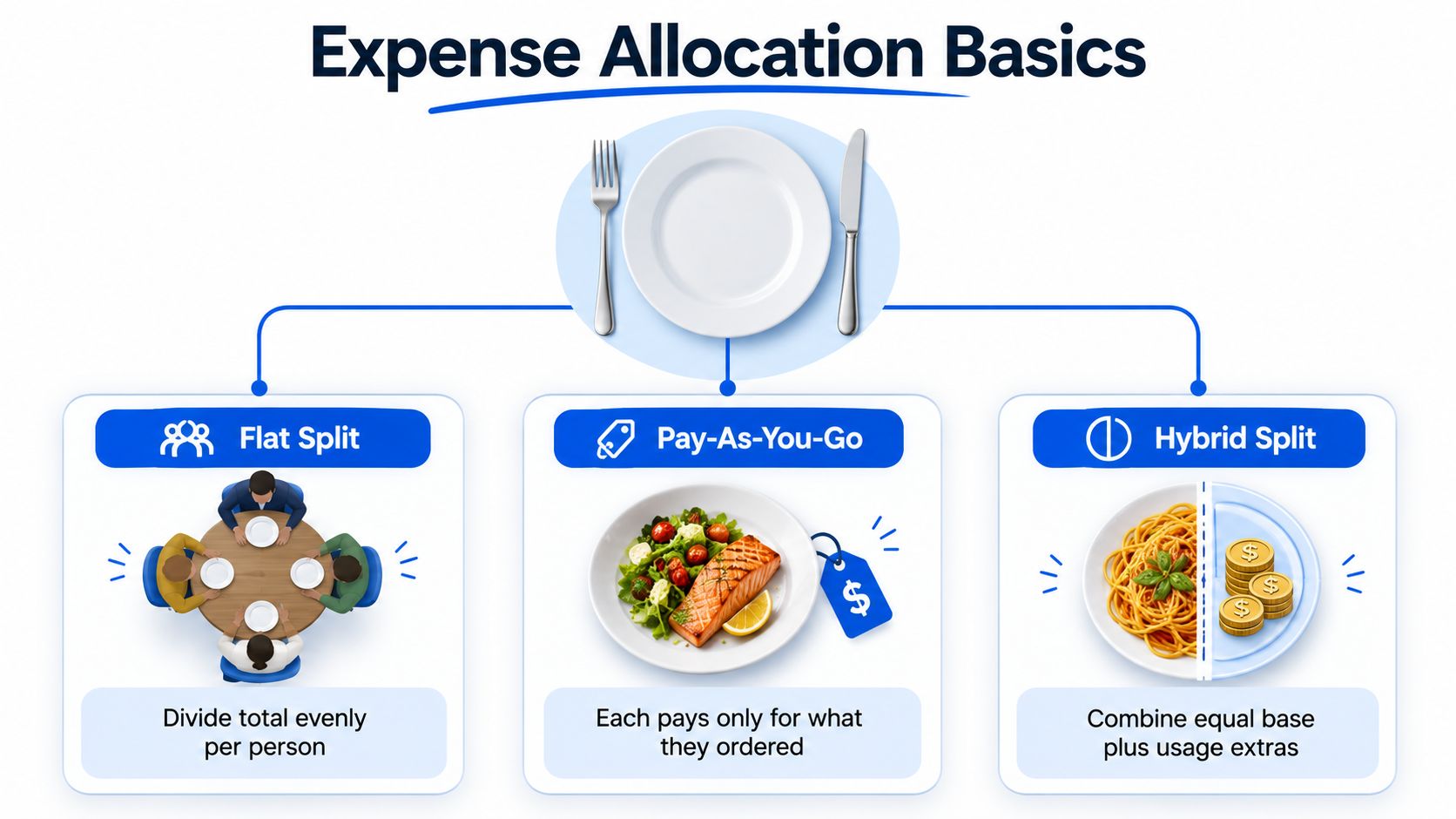
Flat split per room is the simplest approach. It works best in small houses with similar rooms and similar usage patterns, because each room takes the same share of the shared bill. It is easy to maintain, easy to explain, and often good enough for a basic operating view.
Square-footage allocation fits better when rooms differ meaningfully in size or amenity. A larger primary suite generally consumes more of the property's overall value than a smaller room, even if occupancy is the same. This method fits facility-heavy costs better than a simple per-room split, especially when the house has one room that clearly carries more footprint and more wear.
Occupancy-based allocation works when the cost follows people rather than space. Utilities, trash, or consumables often move more with headcount than with room size. In a house where one room is occupied by one person and another by two, that difference can matter, and it usually shows up in the utility line before it shows up anywhere else.
Revenue-proportional allocation ties the shared burden to rent collected. That is useful when you want room P&Ls to reflect economic contribution, not just physical size. It can help with investor reporting and room-level margin analysis, but it can also hide operational inefficiencies if you rely on it too heavily.
Hybrid allocation blends methods. A common version is a base split for shared access plus a usage or size adjustment for the rooms that consume more. That tends to work well in co-living because these properties rarely have one clean driver for every cost. It is usually the most defensible approach when a house has mixed room sizes, mixed occupancy, and a few expenses that do not fit neatly into a single formula.
| Method | Best For | Complexity | Accuracy |
|---|---|---|---|
| Direct assignment | Costs tied to one room | Low | High |
| Flat split | Small houses with similar rooms | Low | Medium |
| Square-footage based | Mixed room sizes and facility-driven costs | Medium | Medium to high |
| Occupancy based | People-driven shared costs | Medium | Medium |
| Revenue-proportional | Investor reporting and contribution analysis | Medium | Medium |
| Hybrid approach | Properties with mixed cost behavior | Higher | Higher |
The most common allocation bases are headcount, revenue share, square footage, and direct usage because they connect a shared expense to something measurable in the business. The mistake is treating one of them as universally correct. In co-living, the right method depends on how the cost behaves, and on whether you need the answer to satisfy a resident, a lender, or an investor review.
A simple rule only stays simple if it still matches the house.
Worked Examples and Formulas for Each Method
A six-bedroom co-living property makes the trade-offs easy to see. Say the property has a $1,200 monthly utility bill, and you are deciding how to assign it across rooms. The number on paper stays the same, but the room-level picture changes a lot depending on the method.
The formulas you can copy into a spreadsheet
The general allocation formula stays simple:
Allocated share = total shared cost × room driver ÷ total driver
If a room represents a larger share of the driver, it carries a larger share of the cost. Under a flat split, the driver is one room out of six. Under square footage, the driver is the room's share of the total area. Under occupancy, the driver is the resident count tied to that room or bedroom setup.
A flat split is the easiest to model.
- Formula: $1,200 ÷ 6 rooms
- Result: $200 per room
That is clean, and for some properties it is good enough. It also ignores whether one room is much larger, used by more residents, or tied to higher amenity value. In a rent-by-the-room house, that gap matters because residents compare their room charges against the shared costs they can see on the P&L.
A square-footage method changes the allocation pattern. If the master suite takes a larger share of the house, it should absorb a larger share of the utility burden. That is not about punishing bigger rooms, it is about matching the cost to how the property is physically set up.
A revenue-proportional method works differently.
- Formula: room rent ÷ total room rent × $1,200
- Use case: when you want each room to absorb shared cost in line with the income it generates
That can help with owner-facing reporting, but it is not always the best proxy for actual consumption. A room can command a higher rent because of market demand, not because it uses more water, heat, or cleaning.
The most defensible approach in a mixed house is often direct assignment for unique items and allocation only for the true shared remainder. That follows the proportional-benefit idea used in cost accounting, where a cost should be charged to the benefit it supports, and a reasonable basis should be used when exact benefit is hard to trace. If you want to see how those entries sit inside the books, this practical rental ledger guide is a useful reference.
The main lesson is straightforward. Allocation method changes apparent profitability. If you under-allocate shared costs to one room, that room looks stronger than it really is. If you over-allocate them, you may think a room is losing money when it is carrying more than its fair share of the house.
Step-by-Step Implementation Guide for Your Property
A working allocation system starts with a clean split between costs you can trace and costs you can't. That sounds obvious, but it's where most spreadsheets fall apart. Once shared and direct expenses are mixed together, every room P&L becomes harder to trust.
Build the system around your actual cost buckets
Start by identifying the shared facilities or support services in the property. That includes items like utilities, common-area cleaning, internet, lawn care, and general maintenance that benefit multiple rooms. Then list the costs you want to allocate and decide which ones should stay direct to a single room.
Next, choose the allocation factor for each bucket. A utility line might use occupancy, a common-area repair might use square footage, and a room-specific repair should stay direct. MRSC's cost allocation guidance puts the sequence clearly, identify shared services, identify costs, determine the allocation factors, allocate the costs, then update and monitor the system so it stays fair over time as outlined here.
Operational habit: review the driver whenever occupancy, room use, or property layout changes.
Use bookkeeping that matches the logic
In your chart of accounts, separate shared expense categories from direct room expenses. That makes monthly journal entries easier, because you're moving a pool of shared cost into the room-level P&Ls instead of guessing after the fact. For a small property, a spreadsheet may be enough if it includes room names, driver columns, formulas, and a clear log of each allocation run.
A good spreadsheet template should include:
- Cost bucket: utilities, cleaning, internet, repairs
- Allocation method: direct, flat, occupancy, square footage, hybrid
- Driver input: residents, room size, usage count, or revenue share
- Allocated amount: formula-driven result for each room
- Review note: anything unusual, like a repair that should stay direct
Property management software becomes more valuable when the property count grows or the methods get more complex. Manual tracking can work in a small house, but it breaks down when staff turnover, missing meter reads, or renovation changes start shifting the numbers every month. The better the recordkeeping, the easier it is to defend the allocation during an audit or investor review.
The Nebraska DHHS guidance is useful as a reference point here, because it distinguishes between a Simplified Allocation Method when indirect costs affect services roughly the same way, and a Multiple Allocation Base Method when different services are affected to different degrees in the published guideline. That distinction maps well to co-living, simple houses can often use a simpler rule, while mixed houses need separate buckets and drivers.
Choosing the Right Method for Your Property Type
The right method depends less on accounting preference and more on how the house behaves. A four-bedroom PadSplit with similar rooms, similar residents, and limited amenity spread can often live with a straightforward split. A larger co-living property with different room sizes, private baths, or uneven utility use usually needs a more layered approach.
Match the method to the house
If your rooms are nearly interchangeable, simplicity wins. A flat split or occupancy-based model can be accurate enough and much easier to maintain month after month. If your room mix is uneven, square footage or a hybrid method will usually give you a more honest room-level P&L.
If you're running investor reporting, portfolio analytics, or preparing for a refinance, consistency matters as much as precision. Owners don't just want a clean summary, they want to know which rooms, buildings, or operating habits are driving NOI. That's where a stable allocation method beats an elegant one that keeps changing.
Activity-based costing is usually the most precise option because it traces expense to the specific activities that generate it, but it needs reliable activity data and governance over the rules as noted in IBM's allocation guidance. In a co-living portfolio, that makes ABC a strong fit for larger operations with strong data discipline, and a poor fit for a one-house operator who can't maintain the inputs.
A practical decision rule:
- Choose direct assignment when the cost clearly belongs to one room.
- Choose flat split when rooms are similar and you need speed.
- Choose square footage when room size drives the cost.
- Choose occupancy when people drive the cost.
- Choose hybrid when no single driver explains the house well.
- Choose ABC-style tracking when the property is large enough to justify the data work.
There's also a behavioral factor. If a method is too complex, your team will stop using it, and then the allocation becomes a once-a-quarter guess. That's worse than a simpler rule used consistently. A rent-by-the-room business needs a method that survives turnovers, vacancies, and price changes, not just one that looks correct in a review meeting. For operators building that model, this rent-by-the-room guide is a useful companion.
Key Takeaways and Next Steps for Operators
Expense allocation isn't optional once you're serious about co-living performance. Shared costs need a method, and the right method depends on the property, the expense type, and the level of reporting you need. Direct assignment where possible, allocation where necessary, and consistency everywhere else is the cleanest operating rule.
The biggest mistake is chasing perfect fairness and ending up with a system nobody maintains. A simple method that you update every month is more valuable than a “best” method that dies after two accounting cycles. Keep the logic defensible, keep the drivers documented, and review the rules when occupancy or room mix changes.
A good next step is to audit your current shared expenses and sort them into three buckets, direct, simple allocation, and more detailed allocation. Then choose one method to implement this month and stick with it long enough to see how it changes room-level profitability. That single move can sharpen pricing, improve investor reporting, and make your property P&L much easier to trust.
PadPulse is building the kind of operating layer that helps co-living hosts stop guessing at room-level economics and start managing them cleanly. If you want pricing, messaging, access, and portfolio reporting in one place, visit PadPulse and see how it can support the way you allocate and track shared costs across your rooms.