Dynamic Pricing Using AI for Co-Living and PadSplit Hosts
September 28, 2026
Tuesday evening is when a flat room rate starts to look expensive. Three rooms in a six-bedroom PadSplit-style property are occupied, one has been vacant for nine days, and two have applicants waiting. Every room still carries the same weekly price. The problem isn't necessarily the vacant room. The problem is that one number is trying to describe six different products.
For co-living operators, dynamic pricing using AI means moving from property-level guesswork to room-level decisions. The right system doesn't just raise rates whenever demand appears. It weighs room characteristics, inquiry pace, nearby competition, move-in timing, and occupancy goals, then gives the operator a recommendation that can be reviewed, explained, and overridden.
When One Room Sits Empty and Another Turns People Away
The vacant room is on the upper floor with a shared bathroom and less attractive natural light. The two rooms with a waitlist have private bathrooms and a move-in date that matches several active applicants. Yet the listing presents them as though they're interchangeable.
That static approach creates two problems at once. The empty room produces no rent while it waits for a renter who may never accept the current price, and the popular rooms may be priced below what the market would support. The operator also absorbs the cost of slower turnover, repeated inquiries, cleaning coordination, and time spent explaining why one room is still available.
Room demand can shift because of floor location, bathroom access, furnishing, views, room size, and move-in timing. A worker looking for immediate housing may value availability more than a larger room. Another applicant may pay more for an ensuite but reject a room with a shared bathroom, even in the same house.
Operator insight: A room can be undesirable at one price and perfectly acceptable at another. Treating the room as the problem can lead to unnecessary renovations when the rate is the real variable.
The broader occupancy lesson is practical. A property can appear healthy at a glance while individual rooms perform very differently. Tracking the difference between available, occupied, and in-demand rooms is central to improving occupancy rates, especially when weekly rentals depend on steady inquiries rather than one annual leasing cycle.
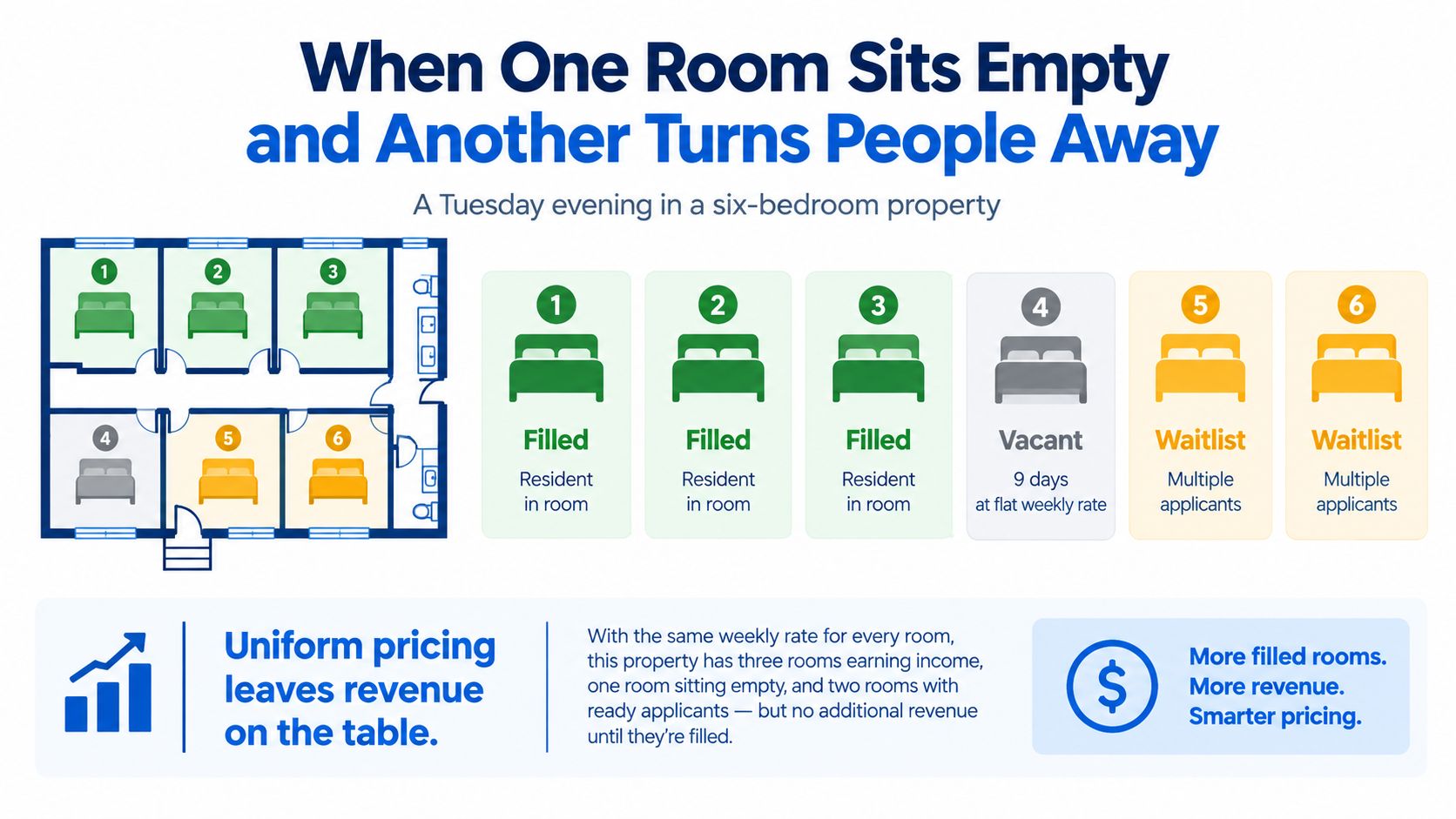
AI dynamic pricing addresses this mismatch by treating each room as its own inventory unit. It can recommend a lower rate for the vacant shared-bathroom room while protecting the rate on rooms with stronger demand. That doesn't guarantee a booking, but it gives the operator a better starting point than applying one weekly price to the whole house.
What AI Dynamic Pricing Actually Means
Think of AI pricing as a thermostat. A thermostat reads the temperature and adjusts heating toward a chosen range. A pricing system reads demand signals and adjusts the room rate toward an occupancy and revenue target.
The system isn't making a permanent judgment about a renter. It's evaluating the room, the market, and the timing. Airline pricing literature defines dynamic pricing as charging different prices for the same product according to an observable state of nature, and identifies three mechanisms, assortment optimization, dynamic price adjustment, and continuous pricing, in this airline pricing research.
The three mechanisms in plain English
Assortment optimization means offering different rates for different room types at the same time. In one house, an ensuite room may retain its rate while a smaller room with a shared bathroom receives a more competitive recommendation.
Dynamic price adjustment means moving a room's price up or down when demand conditions change. If qualified inquiries slow and comparable rooms nearby become cheaper, the system might suggest a controlled reduction.
Continuous pricing means updating recommendations frequently from live inputs instead of relying on a manual review every quarter. The operator still decides how often changes can publish, but the system can detect changes sooner than a spreadsheet review.
This isn't the same as unrestricted surge pricing. A responsible co-living setup uses published floor and ceiling bands, modest steps, and documented reasons. It changes the price attached to a room listing, not the amount charged to one renter because of that renter's identity or browsing history.
Pricing software versus occupancy reporting
A revenue management tool may show occupancy, average rent, inquiries, and vacancy. That visibility matters, but reporting alone doesn't produce a recommended rate. AI pricing connects signals to an action, such as “reduce Room 4 by a controlled amount because inquiry volume softened and comparable rooms are available.”
Operators evaluating artificial intelligence in property management should ask whether the platform recommends, explains, records, and distributes pricing changes. If it only displays occupancy, it may be useful analytics software, but it isn't a complete dynamic pricing system.
The Inputs and Models Behind the Price
A room-level recommendation starts with details an operator already knows. The system should distinguish an ensuite from a shared bathroom, a furnished room from an unfurnished one, and a ground-floor room from an upper-floor room. Size, natural light, storage, parking, and access to common areas can also affect how quickly a room attracts qualified interest.
Next comes demand evidence. The model can compare property occupancy with nearby market conditions, then look at inquiry volume, inquiry-to-fill behavior, and time-to-fill. Seasonal demand and local events add context, but weekly co-living rentals often respond more strongly to local employer hiring cycles, hospital staffing, campus activity, or other move-in patterns than to simple day-of-week changes.
Comparable listings provide another reference point. A useful system doesn't blindly copy the cheapest nearby room. It compares similar properties within a defined area, accounts for differences in amenities, and shows the price gap that influenced the recommendation.
What the model does with those signals
Machine-learning models estimate price elasticity, the relationship between a price change and the quantity of demand, as described in this AI dynamic pricing guide. In practice, the system tests historical outcomes against combinations of room attributes, demand signals, and prior rates, then produces a suggested weekly price.
Gradient-boosted trees work well for mixed, tabular inputs such as room features, competitor prices, and inquiry counts. Time-series models help separate recurring seasonal patterns from a sudden local change. The dashboard should show a recommended rate and a confidence band, rather than presenting a precise number as unquestionable truth.
For weekly room rentals, I'd rank the signals this way:
| Signal Category | Example Data | Impact Weight |
|---|---|---|
| Room fit | Ensuite, floor, furnishing, size | High |
| Inquiry conversion | Qualified inquiries and time-to-fill | Very high |
| Local employment demand | Hiring cycles near the property | High |
| Comparable listings | Similar rooms within the chosen area | High |
| Property occupancy | Available and occupied rooms | High |
| Seasonality | Recurring local demand patterns | Medium |
| Day-of-week behavior | Weekly inquiry or move-in patterns | Lower for weekly stays |
| Price elasticity | Response to earlier rate changes | High once sufficient history exists |
The practical test is whether the recommendation reflects what fills rooms. Operators can learn more from demand elasticity than from a generic market average, because a room's response to price depends on its alternatives and its audience.
Benefits and Trade-Offs for Room-by-Room Operators
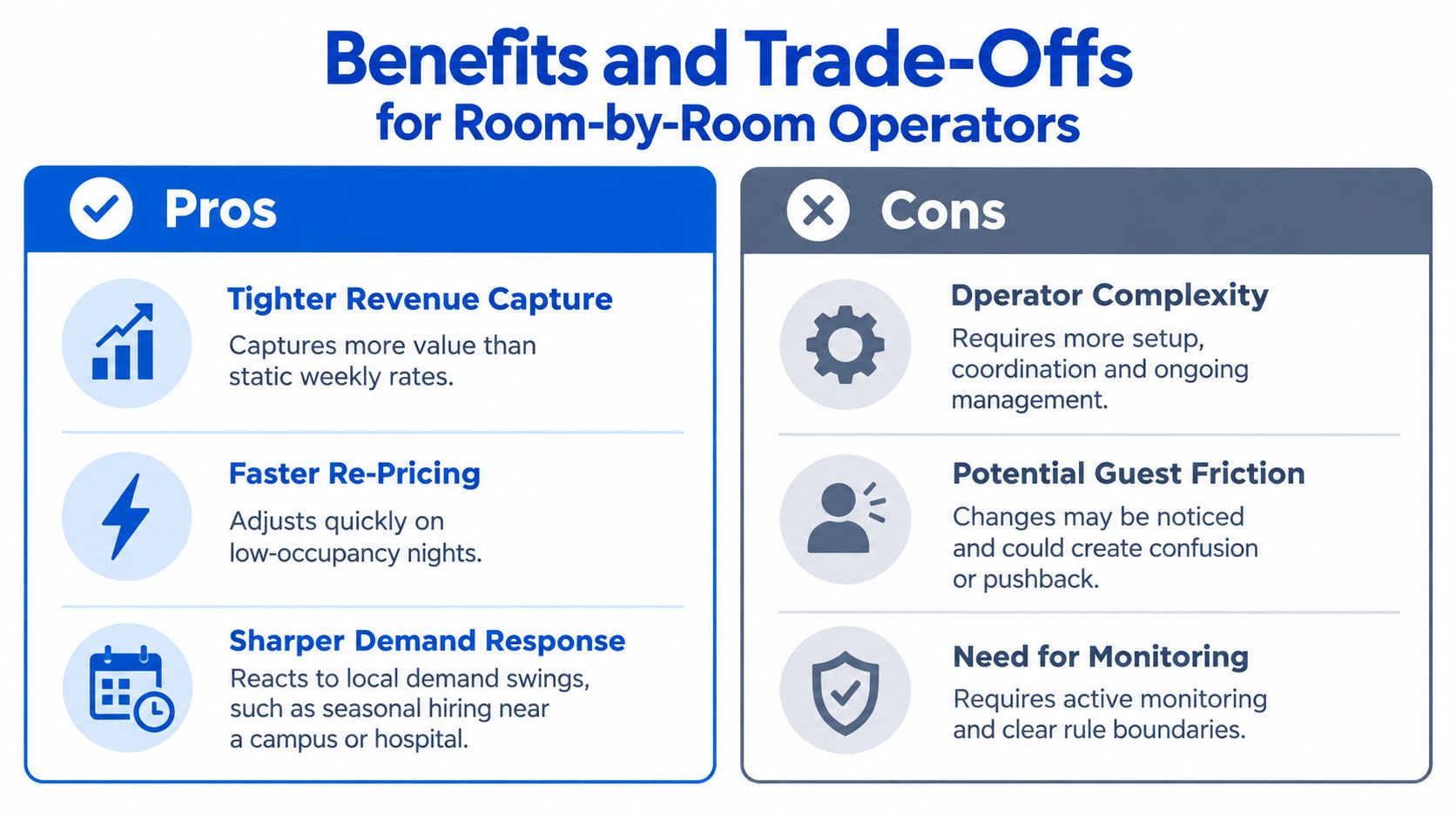
The strongest benefit is better revenue capture without treating every room alike. A system can react when one room loses momentum, preserve a stronger rate on an ensuite, and respond to local demand before a manual review catches the change.
That potential isn't theoretical in every market. In Germany's retail gasoline market, algorithmic-pricing software became widely available by mid-2017, and research using high-frequency price data found that adoption increased margins by 9% in non-monopoly markets. In duopoly markets, margins rose by 28% when both stations adopted the software, according to the study of algorithmic pricing and competition. Housing isn't gasoline, but the evidence shows that automated repricing can materially change seller outcomes and competitive conditions.
What operators may gain
- Tighter revenue capture: Room-level rates can reflect differences that a single property-wide rate hides.
- Faster response to vacancy: A slow-moving room can receive a controlled recommendation before vacancy becomes a recurring operating problem.
- Sharper local reactions: Hiring near a campus, hospital, warehouse district, or seasonal employer can change demand faster than a quarterly pricing review.
- Consistent execution: The operator can apply rules across rooms instead of relying on memory and manual edits.
What can go wrong
The product is shared housing, not an anonymous hotel room. If residents see frequent changes without a clear explanation, they may interpret the system as arbitrary or exploitative. Research and policy commentary on AI pricing describes concerns around personalized pricing, discrimination, digital redlining, group fairness, time fairness, and social-equity constraints in the discussion of AI-driven pricing fairness and regulation.
The trade-offs include model opacity, slower fills when rates rise too aggressively, operator complexity, and possible bias against longer-stay residents who provide valuable cash-flow stability. Co-living research also identifies unresolved questions around computational efficiency, fairness, acceptance, retention, inquiry conversion, and vacancy duration in trust-dependent housing markets, as discussed in this research on dynamic pricing in shared housing.
Dynamic pricing fits operators who can monitor outcomes and set boundaries. It doesn't fit a host who wants to publish one rate, ignore the reasoning, and let a black-box model make every decision.
Building Pricing You Can Explain and Defend
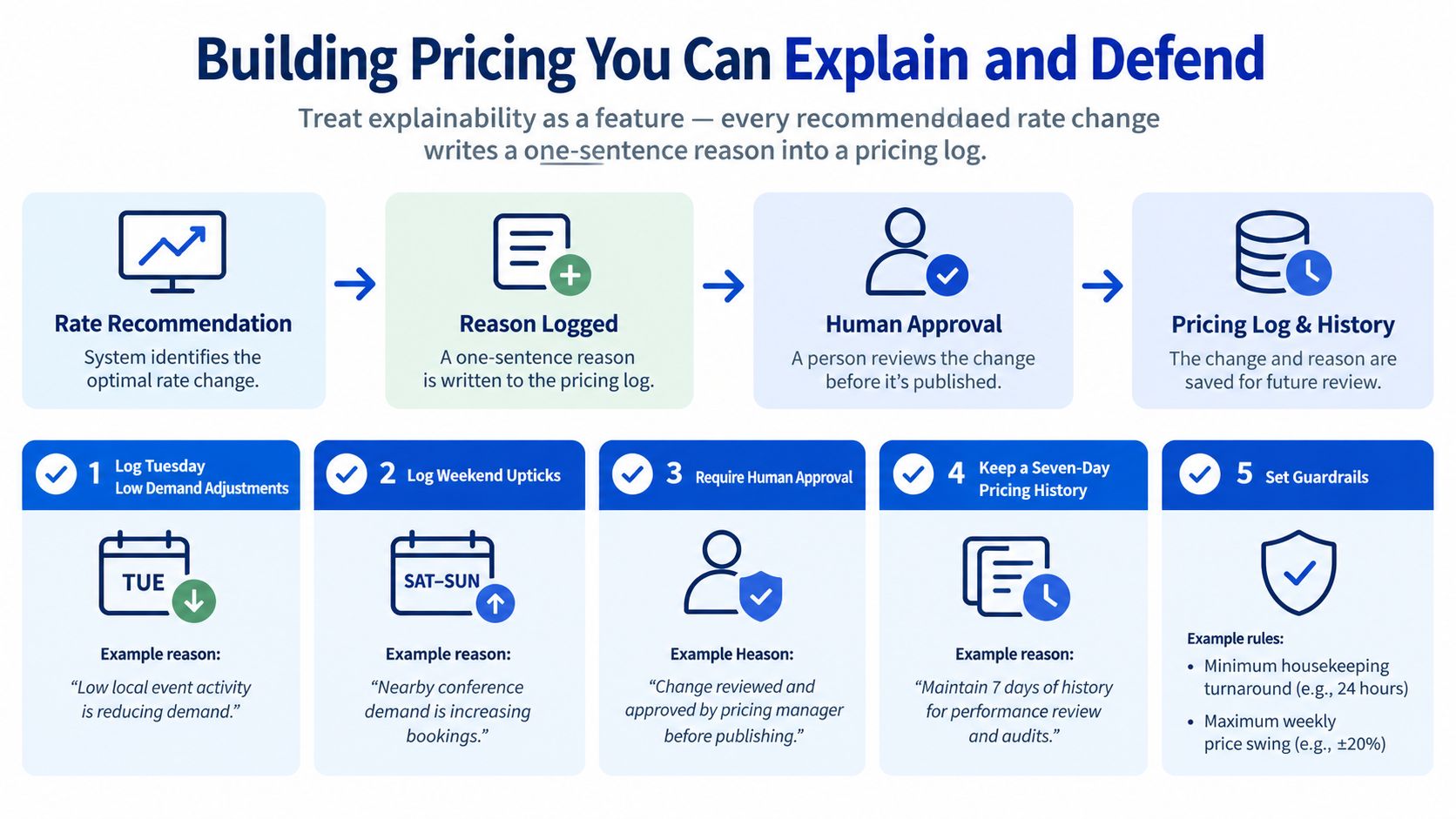
Explainability should be designed into the pricing workflow, not added after a resident challenges a rate. Every recommendation should create a plain-language record, such as “Tuesday demand softened, comparable rooms remain available,” or “three similar rooms booked, so the recommended rate moved within the approved band.”
A defensible workflow
Start with rate boundaries. Publish a minimum and maximum weekly rate for each room category, then limit how far a recommendation can move during one review. The model may suggest a change, but it shouldn't be able to bypass the operator's floor, ceiling, housekeeping constraints, or local compliance review.
Next, write the reason into a pricing log. The log should show the previous rate, recommended rate, reason code, timestamp, model confidence, and the person who accepted or rejected the suggestion. Overrides need notes too. “Held rate because a qualified applicant promised to move in after a short delay” is more useful than an unexplained manual edit.
Similar rooms should receive consistent treatment. A model must not use protected traits or obvious proxies for protected traits to set prices. Operators should also define how residents receive notifications when weekly rates change, especially where a resident is renewing, extending, or moving between rooms.
The operator's defensibility checklist
- Reason recorded: Every recommendation has a one-sentence market-based explanation.
- Guardrails enforced: Floor, ceiling, change size, and housekeeping rules apply before publication.
- Comparable rooms treated consistently: Similar room attributes lead to comparable pricing logic.
- Human review available: Operators can accept, reject, or override with a note.
- History retained: The business can reconstruct what changed, when it changed, and why.
- Customer communication defined: Residents know how rate changes affect renewals and extensions.
A transparent system may sacrifice some automation speed. That's a sensible trade when trust affects referrals, renewals, and community stability.
A Week in the Life of AI-Priced Rooms
Consider a six-room property with rooms named Cedar, Maple, Oak, Pine, Birch, and Elm. The dashboard doesn't just display a new rate. It shows the recommendation, the reason code, the projected occupancy impact, and an Accept button beside the proposed change.
On Monday, booking pace matches the forecast, so the algorithm holds every rate. The operator sees “No change, demand tracking normally” and leaves the recommendations untouched.
By Wednesday, two nearby PadSplit listings reduce their rates. Pine, a twin room, has been vacant for nine nights, so the system proposes a $12 discount. The dashboard attributes the suggestion to competitor movement and vacancy duration. The operator accepts it because the room remains above the published floor.
Thursday brings a corporate housing inquiry for two rooms. Rather than discounting every room, the model opens a multi-room tier for Cedar and Maple. The operator reviews the dates, checks the cleaning schedule, and accepts the block rate because a coordinated move-in reduces turnover work.
Saturday occupancy reaches 95%, leaving Elm as the only available room. The system proposes an 8% increase, still inside the approved band. The operator rejects the increase because Elm's shared bathroom and limited storage make it a weaker substitute for the occupied ensuite rooms.
| Day | Room | Base Rate | AI Suggested Rate | Reason Code | Operator Action | Booked Y/N |
|---|---|---|---|---|---|---|
| Monday | Cedar | $220 | $220 | Booking pace on forecast | Accept hold | Y |
| Wednesday | Pine | $220 | $208 | Two nearby listings reduced rates, room vacant nine nights | Accept | N |
| Thursday | Cedar and Maple | $220 | Multi-room tier | Corporate inquiry for two rooms | Accept after review | Y |
| Friday | Birch | $220 | $226 | Inquiry pace strengthening | Accept | Y |
| Saturday | Elm | $220 | $237.60 | Property occupancy at 95% | Reject, keep current rate | N |
| Sunday | Oak | $220 | $220 | Stable demand and no competitive shift | Accept hold | Y |
The operator's dashboard should also show whether the recommendation is expected to improve occupancy, protect revenue, or maintain position. That context prevents the common mistake of accepting every increase because the headline rate looks attractive.
Metrics That Matter and How PadPulse Fits In
Top-line rent can rise while net operating income falls. A higher rate on one room doesn't compensate for longer vacancy, extra turnover, resident churn, delayed repairs, or a weaker community experience. The operator needs a room-level view of NOI, not just a list of published prices.
Track the metrics that connect pricing to operations:
| Metric | What It Tells You | Primary Data Source |
|---|---|---|
| Realized revenue per available room | Whether available inventory produces revenue after vacancy effects | Lease, payment, and room inventory records |
| Average length of stay | Whether pricing supports stable occupancy or short, costly turnover | Lease and move-out data |
| Vacancy days per quarter | How long rooms remain unfilled across the operating period | Availability and booking records |
| Churn rate | Whether pricing or resident experience is weakening retention | Resident and lease history |
| Rate-change explainability score | Whether recommendations have usable reasons and review records | Pricing log and operator overrides |
| Inquiry-to-fill conversion | Whether changes attract qualified demand | Messaging and leasing records |
| Repair turnaround | Whether operational delays, not price, are blocking a booking | Maintenance records |
AI can move the rate and, where listings are connected, influence how competitively a room appears in search. The operator still has to protect community health, cleanliness, maintenance response, and resident communication. A model can't repair a broken lock or resolve a conflict between housemates.
PadPulse is designed to bring pricing recommendations, lease and payment information, and operator overrides into one operational view for PadSplit hosts and co-living operators. Its planned dashboard is intended to show which rooms contributed to NOI, which recommendations were accepted or rejected, and where the operator's judgment consistently differs from the model. That feedback helps the host learn the system rather than delegate blindly.
Before adopting any platform, ask:
- Rate distribution: Where do approved rates publish, and how quickly?
- Override records: Does every manual decision include a reason and history?
- Model governance: How often is the model retrained, and what data triggers a review?
- Operational context: Can pricing be checked against repairs, cleaning, leases, and payments?
- Resident treatment: How does the system separate room pricing from renter-level targeting?
The right setup makes AI a disciplined assistant. It helps the operator spot mismatches, test controlled changes, and connect pricing decisions to NOI without surrendering responsibility for fairness or trust.
PadPulse brings planned dynamic pricing, lease and payment visibility, operator overrides, and co-living performance reporting into one platform built for room-by-room operations. Visit PadPulse to join the interest list and explore early access for a more explainable way to manage rates, vacancies, and NOI.