Artificial Intelligence Property Management for Co-Living
June 1, 2026
If you're running co-living homes today, you probably feel the same pinch most room-by-room operators feel. Leads come in at odd hours. One room is vacant while the others are full. Tenants message about locks, Wi-Fi, billing, and maintenance in a steady stream. A single missed reply can cost a lease, and a single bad handoff can turn a small repair into a resident complaint.
That's where artificial intelligence property management starts to matter. Not as a flashy trend, but as a practical operating layer for high-volume housing. In co-living, the work is repetitive, time-sensitive, and fragmented across many residents in the same asset. That makes it a good fit for automation, pricing support, and workflow tools that can reduce manual effort without reducing control.
The important question isn't whether AI sounds impressive. It's whether it helps you fill rooms faster, respond faster, reduce operational drag, and protect NOI. For room-by-room operators, that's the standard that matters.
What AI in Property Management Really Means for You
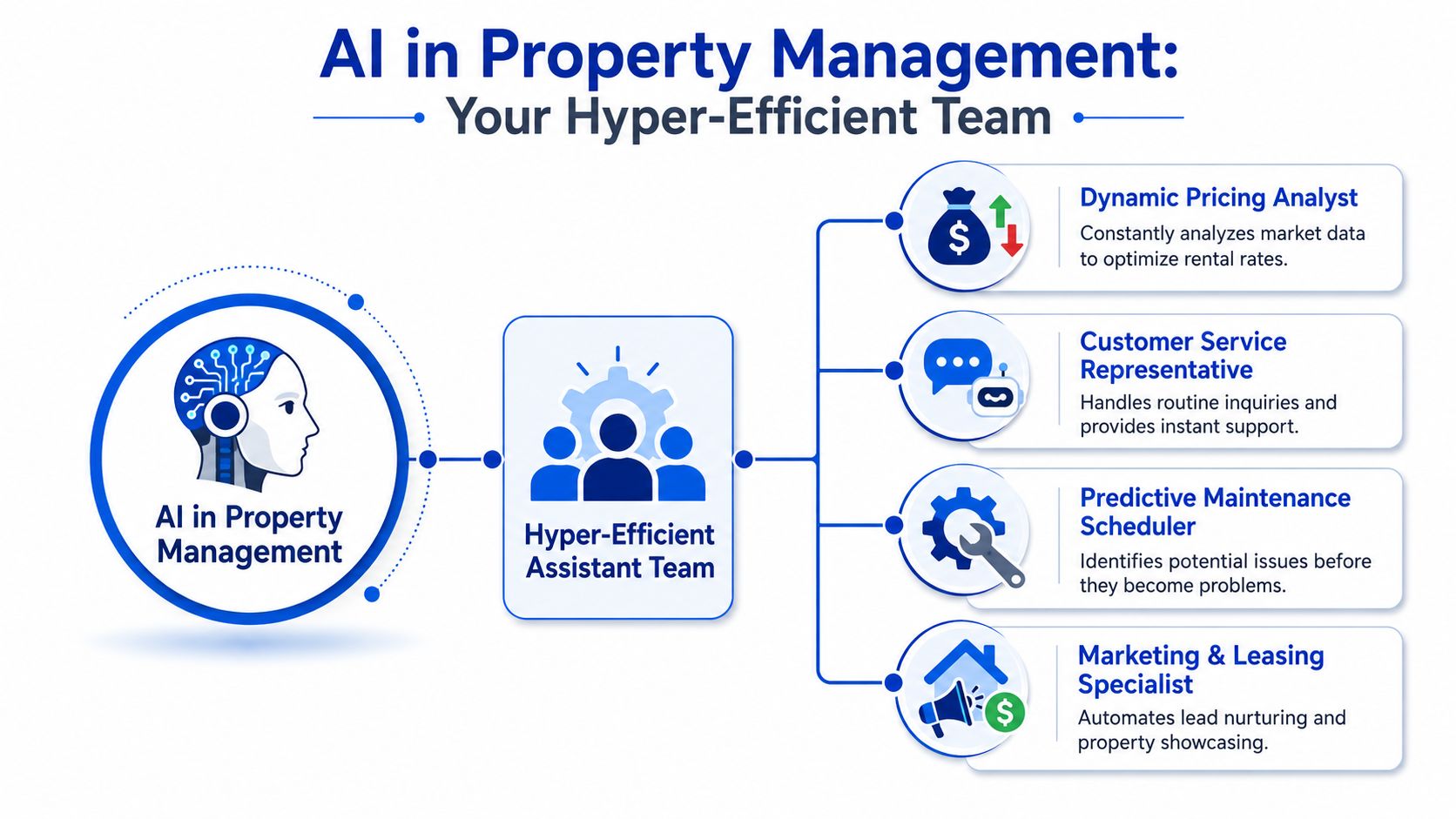
Most operators hear "AI" and think of something complex, expensive, or overhyped. In practice, it's simpler than that. The easiest way to think about artificial intelligence property management is as a team of specialized digital assistants. One assistant helps answer routine messages. Another helps with pricing. Another watches maintenance signals and flags issues before they become emergencies.
That framing matters because co-living operations are built on volume. You're not managing one lease conversation per unit. You're managing many tenant relationships, many inquiries, many turnovers, and many small operational tasks across shared homes. AI works best in exactly that environment.
Think in tasks, not in buzzwords
A lot of confusion disappears when you stop asking "Should I use AI?" and start asking "Which tasks should software handle for me?"
In a co-living portfolio, those tasks usually include:
- Lead response: Answering common questions about availability, pricing, house rules, and move-in timing.
- Pricing decisions: Adjusting room rents based on demand, seasonality, and competing listings.
- Maintenance triage: Sorting urgent issues from routine ones and routing them correctly.
- Resident communication: Sending reminders, updates, and status messages without relying on staff to type the same answer repeatedly.
Practical rule: If your team repeats the same task every day, there's a good chance AI can support it.
The larger market shift backs that up. One 2026 industry report estimates the global AI-in-real-estate market at $303 billion in 2025, with growth projected to $989 billion by 2029, which signals that AI has already moved into core workflows like pricing and leasing across real estate operations, not just experiments or pilot tools (Blott AI use cases in real estate).
Why co-living benefits sooner than conventional rentals
Traditional multifamily operators often think in units. Co-living operators think in rooms, beds, shared spaces, and constant turnover. That creates a different management load.
Three patterns make AI especially useful here:
- Higher communication volume: Multiple residents per property means more inbound messages, more status checks, and more support requests.
- Faster turnover rhythm: Rooms can open and close independently, so marketing and leasing need to move quickly.
- More operational coordination: Shared homes create recurring tasks around access, cleanings, utility monitoring, and maintenance timing.
The mistake is expecting AI to replace judgment. It won't. What it can do well is remove repetitive work so operators can spend more time on exceptions, resident quality, vendor accountability, and portfolio decisions.
That's the meaning of AI in property management today. It isn't a robot manager. It's a stack of tools that helps your team operate like a tighter one.
Key AI Features Driving Co-Living Profitability
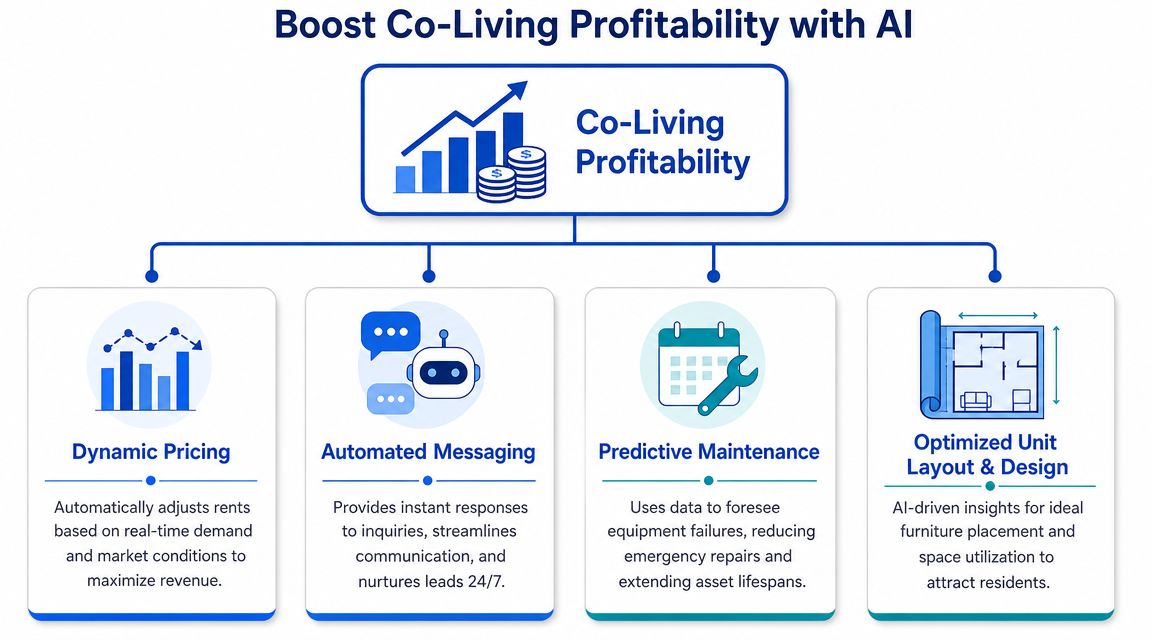
A co-living operator feels the difference between a useful AI feature and a nice demo in the monthly P&L. The features worth paying for usually do one of four things. Price rooms more accurately, cut response lag, reduce maintenance chaos, or improve control over shared-home operations.
Dynamic pricing that works at the room level
Room-by-room pricing is where generic multifamily advice usually breaks down. In a co-living house, the front bedroom with better light, a private bath, or a shorter walk to transit should not always be priced like the smallest interior room. Add different lease start dates and seasonality, and static rent tables start leaking money fast.
AI pricing tools help operators adjust room rates based on demand, room attributes, days vacant, and local comps. The practical benefit is speed and consistency. A manager no longer has to rework a spreadsheet every time one room sits too long while another gets three inquiries in a day.
That has direct ROI. Better pricing protects upside on high-demand rooms and helps stale rooms clear before vacancy days stack up. For a practical look at how operators apply this, see this guide to a dynamic pricing tool for room-by-room rentals.
Automated messaging that protects lead speed
For co-living, response time is a revenue issue, not a customer service nicety. Prospects often message several listings at once, and the first operator to answer basic questions usually gets the tour.
The useful form of AI here is not a chatbot pasted onto a website. It is workflow automation that handles repetitive front-end communication well enough that staff can focus on screening and closing. That includes answering common availability questions, sending pre-qualification prompts, scheduling tours, following up after inquiries, and delivering move-in instructions once a lease is signed.
The trade-off is real. If the system sounds robotic or gives loose answers on house rules, it can hurt trust. Good implementation means setting clear boundaries. Let the tool handle repeatable questions and data collection. Keep humans responsible for exceptions, approvals, and anything that affects resident fit.
The payoff is simple:
- Faster first response: More inquiries stay warm.
- Less admin drag: Staff stop typing the same answers all day.
- Better handoff quality: Leasing teams get leads with basic details already captured.
Predictive maintenance that reduces fire drills
In shared homes, one maintenance issue rarely affects just one resident. A failing water heater, HVAC problem, or recurring plumbing issue can trigger multiple complaints within hours, plus refunds, bad reviews, and staff distraction.
AI is most useful here when it works from real operating data. Ticket history, repeat vendor visits, utility spikes, sensor alerts, and seasonal patterns can all help flag equipment that is drifting toward failure. McKinsey has noted that AI-based predictive maintenance can reduce machine downtime by 30% to 50% and extend machine life by 20% to 40% in industrial settings, which is a useful benchmark for why proactive maintenance gets operator attention in asset-heavy environments (McKinsey on the economic potential of generative AI and analytics applications).
Residential portfolios are not factories, of course. The point is narrower. If an operator can catch recurring failures earlier, they can reduce emergency callouts, limit resident disruption, and batch work more efficiently. In co-living, those savings show up in labor hours and retention, not just repair invoices.
Optimized unit layout and smart-home coordination
This feature set gets overlooked because it is less flashy than leasing automation, but it can improve margins over time. Co-living operators are selling private-room usability inside a shared home. Small layout choices affect conversion rates, resident satisfaction, and whether a room justifies a premium.
AI can help compare listing performance across room types, identify which features correlate with faster lease-up, and show where a layout or furnishing standard may be suppressing demand. Pair that with smart locks, thermostats, and access controls, and the operator gets tighter control over turnovers and shared-home consistency.
There is a trade-off here too. More connected systems create more setup work and more vendor coordination. But in portfolios with frequent turnovers and distributed homes, better access control and standardized room design usually pay back through fewer errors, less manual coordination, and a more repeatable resident experience.
Practical AI Use Cases for Room-by-Room Operators
The most helpful way to judge AI is by following real workflows. If a tool can't improve the day-to-day mechanics of leasing and operations, it probably won't improve your business.
Filling a vacancy while the room is still warm
A resident gives notice. In a manual process, someone updates the listing, checks pricing, responds to inquiries, answers duplicate questions, schedules showings, and sends an application link. If the manager is busy, the process stalls at every step.
In a stronger workflow, the system updates marketing quickly, suggests a market-aligned price, responds to inbound questions instantly, and routes only qualified leads to a human for final review. The operator still controls standards. The software handles the repetitive front end.
That distinction matters because room-by-room economics reward speed. Housing industry reporting has pointed to a more useful lens for this segment: the key question isn't generic AI adoption, but which use cases move NOI through outcomes like vacancy-days reduced per listing, hours saved per room, and utility savings from smart thermostats (HousingWire on how AI is shaping property management).
Handling maintenance without drowning in messages
Shared homes create noisy maintenance channels. A tenant says the sink is leaking. Another says the bathroom fan is loud. Someone else says the hallway is hot. If all of that lands in one inbox, staff spend too much time sorting before solving.
AI triage helps by reading the request, tagging urgency, identifying likely trade categories, and sending the issue into the right queue. That doesn't replace your maintenance lead. It gives them a cleaner first draft of the problem.
A useful workflow often looks like this:
- Urgent issues get flagged quickly: Water leaks, lock failures, or electrical concerns rise to the top.
- Routine issues get bundled: Minor repairs can be grouped by property or vendor route.
- Residents get updates automatically: They know the request was received and what happens next.
Good automation doesn't remove humans from maintenance. It removes delay and confusion.
Managing churn in a house, not just a unit
Many generic property tools fall short. Co-living churn is layered. One resident leaves, another renews, a third asks to transfer rooms, and a fourth needs a lease extension. AI can help coordinate those moving parts if it's built around the room level, not just the property level.
Operators can also combine messaging, reminders, and workflow triggers to reduce administrative drag around renewals, notice tracking, cleaning coordination, and room readiness. If you're exploring that side of operations, these customized automation solutions for rental workflows show the type of process design that tends to work best.
The common thread is simple. The best AI use cases aren't theoretical. They shorten the gap between event and action.
A Simple Roadmap to Implementing AI in Your Portfolio
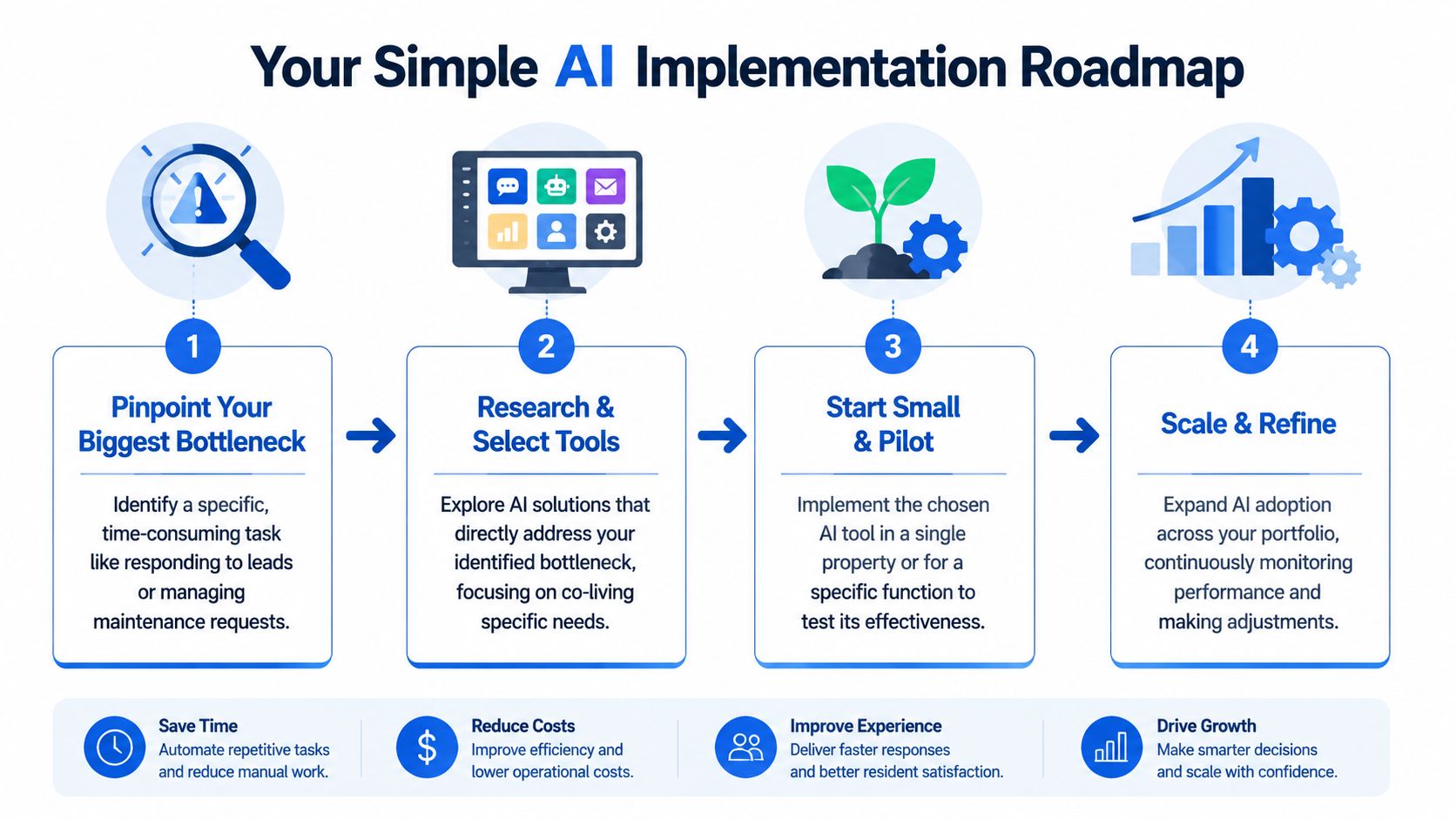
Most AI rollouts fail for a boring reason. Operators try to do too much at once. The better approach is narrower. Pick one painful workflow, get your data clean enough to support it, then expand.
Step one starts with friction, not software
Don't begin with a vendor demo. Begin with the part of your operation that repeatedly slows your team down.
For most room-by-room portfolios, the bottleneck is usually one of these:
- Lead response lag
- Manual pricing updates
- Maintenance triage
- Turn coordination across cleaners, vendors, and access systems
Write down where staff lose time, where leads get stuck, and where residents experience the most delay. That's your starting point.
Your data has to be usable
AI tools are only as good as the operating data behind them. If your rent roll is inconsistent, your ticket history is incomplete, or your occupancy records live in five different places, even a good tool will underperform.
This matters most for maintenance and forecasting. AI is most valuable when it's connected to structured operational data like leasing history, maintenance tickets, and occupancy because that's what allows models to predict equipment failures and support a shift from reactive scheduling to condition-based action (Proprli on AI and property management for technical managers).
A simple readiness check helps:
| What to organize | Why it matters |
|---|---|
| Leasing history | Supports pricing and conversion analysis |
| Maintenance tickets | Improves categorization and trend spotting |
| Occupancy records | Helps identify turnover patterns |
| Utility and equipment data | Makes proactive maintenance more realistic |
Pilot one tool in one lane
The safest rollout is a small pilot with one clear success metric. If lead response is your problem, test AI messaging first. If emergency calls are crushing your team, test maintenance triage first.
Keep the pilot scoped:
- Choose one property or one workflow
- Define what success looks like
- Document the human handoff
- Review results weekly
Start with a workflow your team already understands well. That makes it easier to spot whether the tool is actually helping or just creating more clicks.
Expand only after the process is stable
Once the first tool works, add adjacent workflows. A messaging assistant can connect naturally to tour scheduling. A pricing tool can feed listing updates. A maintenance classifier can connect to vendor dispatch and resident notifications.
What doesn't work is layering multiple AI tools over messy operations and hoping the software will create discipline for you. It won't. Good implementation still requires clean processes, clear ownership, and periodic review.
Evaluating AI Vendors and Navigating Compliance Risks
Most vendor pitches focus on convenience. The stronger question is whether the product helps you operate responsibly. In co-living, that means looking beyond features and asking how the tool handles room-level complexity, data visibility, and decision defensibility.
What to ask before you buy
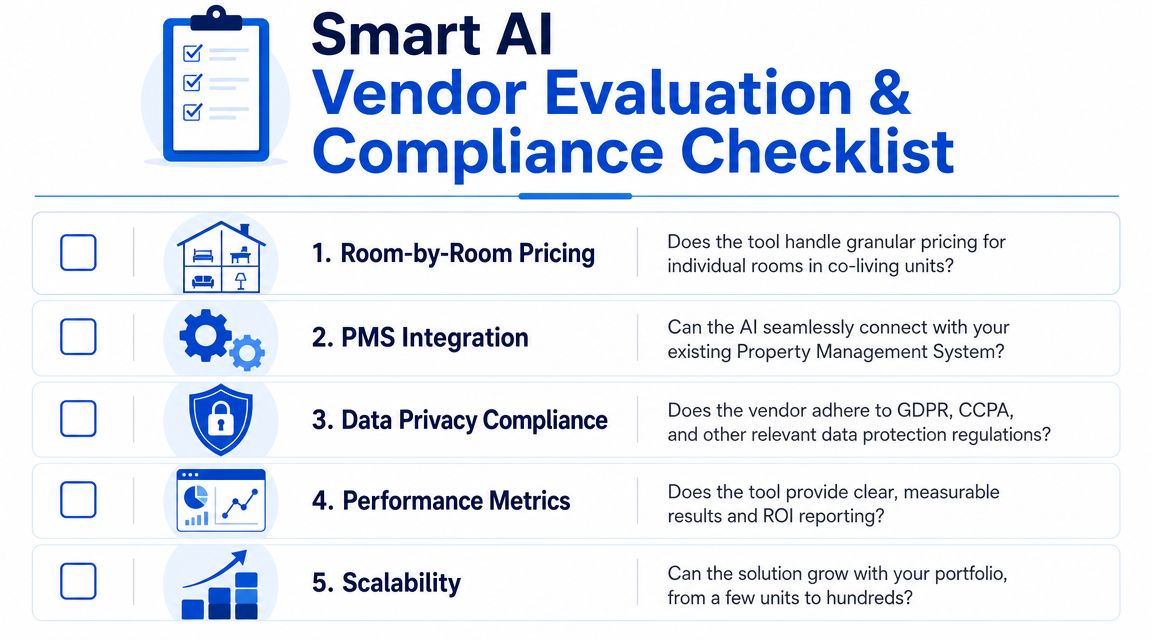
A vendor can look polished and still be a poor fit for room-by-room housing. Ask direct questions.
- Can it price by room, not just by unit? Co-living operators need more granular control than standard apartment workflows.
- Does it log communication history clearly? You need visibility into resident and prospect interactions.
- Can staff override recommendations? A useful system supports decisions. It shouldn't trap your team inside them.
- Does it integrate with your current stack? Disconnected tools create duplicate data and weak handoffs.
- Can it show why an action happened? Auditability matters for both operations and compliance.
If you're comparing systems broadly, this roundup of best property management software options can help frame what to compare before you go deep on AI-specific add-ons.
Screening and pricing need legal defensibility
This is the part too many operators skip. If you use AI in tenant-facing decisions such as screening, scoring, or pricing, you still own the outcome.
In 2024, HUD announced that software-assisted tenant screening can still trigger Fair Housing Act liability when it produces discriminatory effects. The issue is not whether AI can automate leasing. The issue is whether your process remains defensible when someone asks how a decision was made (Matterport on property management AI and compliance).
That has practical consequences for operators:
- Human review matters: Staff should review edge cases and exceptions rather than accepting every automated output blindly.
- Audit trails matter: You need records showing what data was used and how a recommendation moved into a final action.
- Adverse-action logic matters: If a decision affects an applicant, your team needs a clear process for explanation and review.
If a vendor can't explain how its screening or pricing logic should be reviewed by a housing operator, that's a warning sign.
Good governance is an operating advantage
Compliance work can sound like overhead, but in practice it improves execution. Operators who define review rules, permissions, and escalation paths usually run cleaner workflows overall.
A simple internal policy goes a long way. Decide which actions can be automated, which require staff approval, and which categories should always trigger manual review. That discipline protects the business and makes the technology more useful.
The operators who get long-term value from AI aren't the ones chasing every feature. They're the ones choosing tools that can stand up to scrutiny.
The Future Is Integrated Your Next Steps with AI
Artificial intelligence property management is no longer a side experiment for co-living. It's becoming part of how disciplined operators run pricing, communication, maintenance, and resident workflows without adding headcount every time the portfolio grows.
The practical takeaway is simple. Start with the problem that wastes the most time or costs the most money. For some operators, that's slow lead response. For others, it's inconsistent pricing or reactive maintenance. Solve one of those well first.
Then look at the bigger pattern. Operational gain doesn't come from collecting disconnected AI tools. It comes from integration. Pricing should inform listings. Messaging should connect to leasing. Smart-home systems should support access and utility control. Reporting should show whether all of it is improving occupancy, workload, and NOI.
That's where the market is heading. Not toward gimmicks, but toward tighter systems that reduce manual coordination and give operators more control over room-by-room performance.
If you're skeptical, that's healthy. The right next step isn't a full overhaul. It's a small, measurable implementation in the part of your operation where friction shows up every week. Once that works, the case for wider adoption gets much easier to prove.
PadPulse is building an all-in-one platform for PadSplit hosts and co-living operators who want tighter control over pricing, messaging, smart-home workflows, and portfolio performance. If you want to follow the launch and get early access updates, join the PadPulse interest list.