Dynamic Pricing Model for Room-by-Room Rentals
October 3, 2026
A room sits empty, the mortgage payment still arrives, utilities keep running, and the next weekly billing cycle gets closer. Then a nearby operator changes a comparable room's rate, local demand shifts, and you're left deciding whether to hold your price, offer a concession, or reduce the rate before the vacancy becomes expensive.
That's the problem a dynamic pricing model is designed to solve. Instead of treating rent as a fixed figure that only changes when a lease turns over, the model uses demand, occupancy, competition, vacancy, and timing signals to recommend a price that fits current conditions. The idea has roots in commercial aviation. Modern computerized dynamic pricing is widely traced to the airline industry after deregulation in 1978, with American Airlines' 1986 DINAMO system recognized as a major milestone in automated fare management (Business History Conference).
Why Room-by-Room Rentals Need a Different Pricing Playbook
A room-by-room host carries costs that don't wait for occupancy. The mortgage, insurance, utilities, cleaning, maintenance, and smart-lock subscription continue whether every room is filled or several beds are vacant. Each empty night also represents revenue that disappears permanently, unlike a physical product that can remain on a shelf and sell later.
Weekly payment cycles make the decision more immediate. A host can't always wait for an annual lease renewal to respond to a softening submarket, a local hiring surge, a school-term change, or a sudden increase in inquiries. The house needs a pricing process that can react without making members feel that their rent changes randomly.
Practical rule: Price the room for the operating reality of the house, not for an ideal occupancy level that may take months to reach.
A hotel revenue strategy doesn't transfer perfectly to co-living. Hotels usually sell short stays across a broad pool of guests, while a shared house may depend on a small group of members, room-by-room demand, and recurring weekly payments. A vacant room also affects the household experience. Filling it can improve cash flow, but an unsuitable price may attract poor-fit inquiries or create distrust among current members.
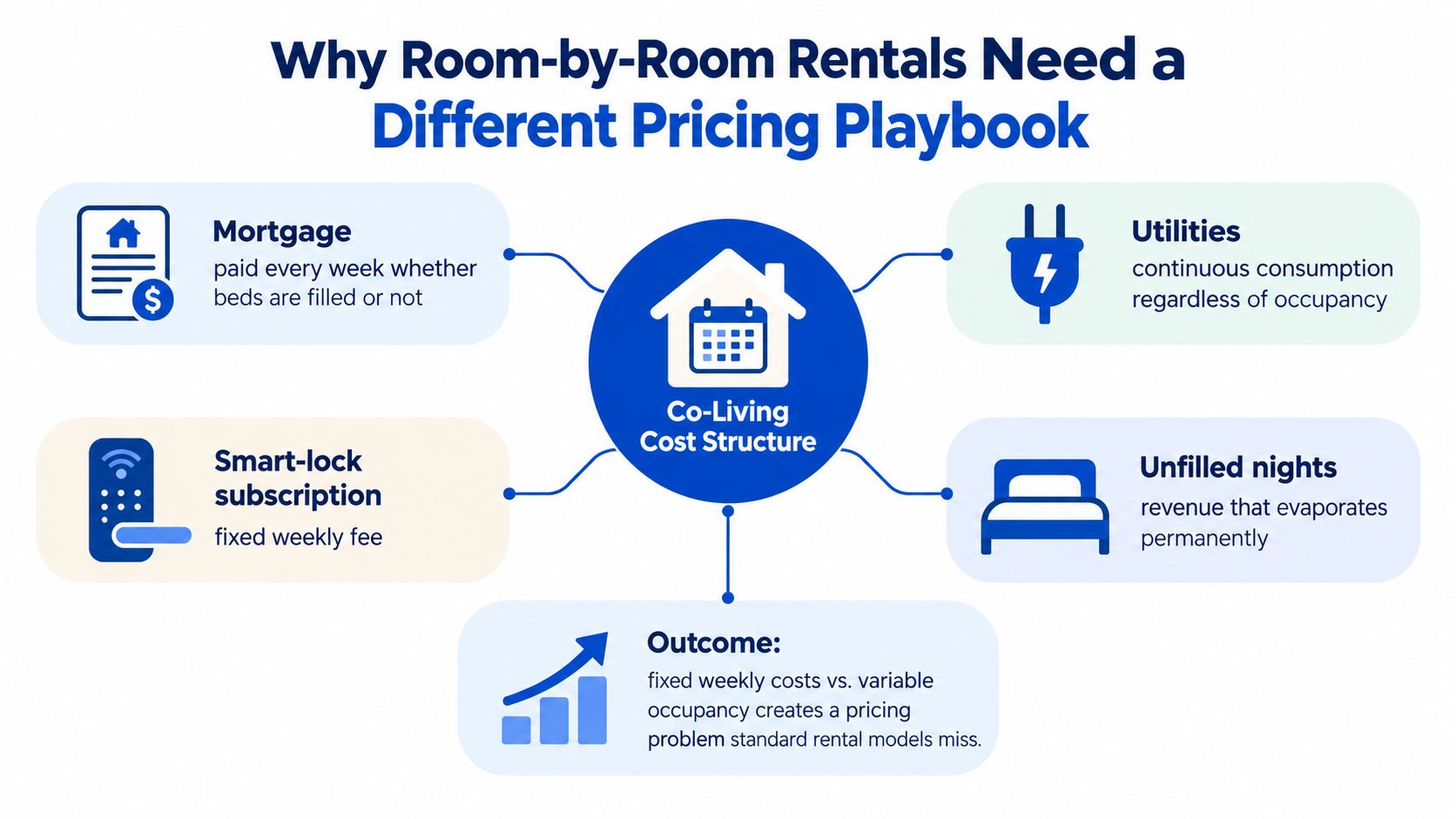
The operating tension
A useful model balances three conditions:
- Fixed costs: Mortgage, insurance, utilities, software, and property upkeep continue regardless of the number of occupied rooms.
- Perishable inventory: An unfilled room loses a revenue opportunity that can't be recovered after the week passes.
- Variable demand: Shift work, school calendars, local employers, weather, and neighborhood competition can change the number of qualified inquiries.
Your rate of occupancy is therefore more than a performance metric. It helps show whether the current rate is aligned with the demand available for that specific house. A dynamic pricing model responds with controlled, understandable moves rather than chasing the highest possible price on every day of the year.
What a Dynamic Pricing Model Actually Does
A dynamic pricing model works in two layers. The first is the principle: prices should respond to market conditions instead of staying fixed indefinitely. The second is the mechanism: software gathers signals, evaluates them against pricing rules, and recommends a current rate for each room.
For a co-living operator, the recommendation might consider:
- Current house occupancy
- How long a particular room has been vacant
- Comparable room rents in the local area
- Seasonality and local demand patterns
- Time before the next expected move-in or billing cycle
- Room characteristics, condition, furnishings, and amenities
The output shouldn't be a mysterious number with no explanation. A useful system shows the recommended weekly rate, the previous rate, the main reasons for the change, and the permitted floor and ceiling. That gives the host a reviewable decision instead of another gut-feel adjustment.
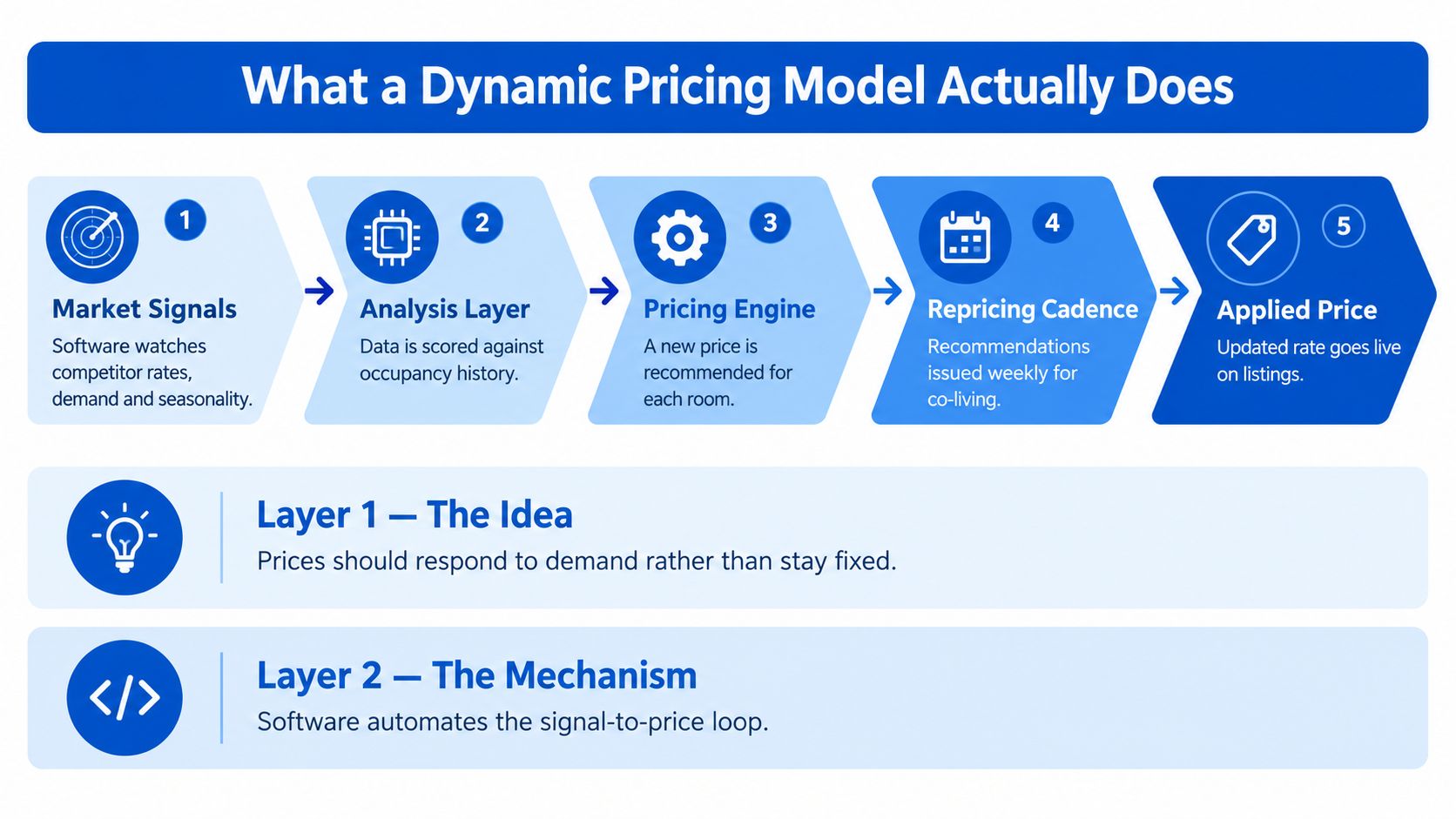
A recurring decision loop
The process is simple enough to explain to a new host:
- Collect signals: Read occupancy, vacancy, comparable rents, seasonality, and lead time.
- Analyze context: Separate a house-wide issue from a problem affecting one room.
- Recommend a rate: Calculate a weekly price within the host's approved boundaries.
- Review the change: Check whether the recommendation makes operational and fairness sense.
- Apply and monitor: Publish the rate, track the response, and record the outcome.
Hotels use similar signals, including demand, occupancy, booking pace, competitor pricing, seasonality, and time to arrival, when adjusting room rates (Hospitality Net). The co-living adaptation is slower and more deliberate. Weekly repricing is usually easier for members to understand than constant changes, and it gives the operator time to check the house, the listing, and the quality of incoming inquiries.
A short video can help visual learners connect the signals to the recommendation:
The model isn't meant to replace judgment. It turns scattered information into a consistent starting point, so you can explain why a room's rate moved and decide whether the recommendation should be accepted, adjusted, or rejected.
Rule-Based Engines vs Machine Learning Approaches
Rule-based and machine-learning engines solve the same pricing problem differently. A rule-based engine follows instructions that an operator can read and audit. A machine-learning engine identifies patterns in historical data and produces a recommendation from those patterns.
A rule might say, “If occupancy falls below the approved threshold, reduce the vacant room's recommended rate.” Another could increase a rate when local comparable rooms become more expensive, or trigger a promotional offer after a prolonged vacancy. This approach resembles the explicit if-then logic used in common dynamic-pricing systems, such as lowering a price when inventory reaches a specified threshold or increasing a room rate after occupancy reaches a specified level (Shopify).
Machine learning works differently. It studies past pricing decisions and outcomes, looking for relationships between rates, inquiry quality, signed agreements, vacancy duration, and later revenue. That can reveal patterns a host wouldn't spot manually, but the result may be harder to explain to a member or challenge when the local market changes suddenly.
| Dimension | Rule-Based Engine | Machine Learning Engine |
|---|---|---|
| Transparency | Every decision follows visible conditions | The recommendation may require model explanations |
| Data requirement | Can operate with limited, structured data | Needs reliable historical outcomes and consistent records |
| Operator control | Hosts can write, edit, and pause rules directly | Hosts usually control inputs, limits, and approval settings |
| Local adaptability | Easy to tailor to one house or neighborhood | Can generalize well, but may miss unusual local conditions |
| Best use | Early-stage operations and tightly governed pricing | Larger portfolios with clean, mature pricing data |
| Main risk | Rules can be too rigid or overlook interactions | Outputs can be difficult to defend or may learn from bad data |
For most smaller co-living operations, transparent rules with light statistical weighting are a sensible starting point. A host can see that a vacancy signal pushed the rate down while stable comparable rents held it back. A more advanced model becomes useful when the operator has enough consistent history to test whether its predictions improve occupancy and net operating income.
The important question isn't whether machine learning sounds more advanced. It's whether the engine can make a defensible decision using data you trust.
The Core Inputs That Drive a Repricing Decision
A strong dynamic pricing model doesn't react to one signal in isolation. A house can have low occupancy because the entire submarket is soft, or because one room has poor photos, a maintenance issue, or an inconvenient layout. The engine should combine inputs while still showing the host how each signal affected the recommendation.
Five signals worth tracking
Current occupancy provides the house-level context. A nearly full house may support holding or increasing the rate for a desirable vacant room, while a half-filled house usually calls for a more careful demand review before raising prices.
Days vacant applies to the individual room. A room that has been empty briefly may need better marketing rather than a lower rate. A room that has remained vacant through repeated listing exposure may need a stronger pricing response, a refreshed description, or a physical inspection.
Local seasonality captures recurring demand patterns. Job fairs, school calendars, employer hiring, weather, and local events can change inquiry volume. Seasonality shouldn't act as an automatic excuse for a sharp increase. It should help the operator anticipate when demand may strengthen or weaken.
Comparable rents show how the offer sits against nearby alternatives. Comparables need similar room features, access, utilities, furnishings, and member requirements. Stale or poorly matched listings can mislead the engine.
Lead time measures how much time remains before the next expected move-in or billing decision. A host with plenty of time can test the current rate. A host facing an imminent vacancy cost may need a faster concession or a marketing change.
| Input | Direction When Rising | Typical Weight | Host Watchout |
|---|---|---|---|
| Current occupancy | Usually supports a firmer rate when demand is also healthy | High | High occupancy may hide one room's quality or location problem |
| Days vacant | Usually pushes the recommendation lower or toward a concession | High | A pricing cut won't fix inaccurate photos or a maintenance defect |
| Seasonality | Can raise or lower the rate depending on the local pattern | Medium | Calendar assumptions may not match the current employment market |
| Comparable rents | Higher relevant comps can support a higher rate | Medium | Remove stale, unavailable, or materially different listings |
| Lead time | Shorter lead time usually increases the urgency to convert | Medium | A rushed discount may train prospects to wait for reductions |
The model normalizes these signals into a single recommendation, but the host should still see the contribution of each one. A dashboard that says “new rate recommended” without showing the reasons encourages blind acceptance. A dashboard that identifies occupancy pressure, vacancy duration, and weaker comparables helps the operator decide whether to change price, improve the listing, or investigate the room.
Use a documented market comparison analysis to keep comparable properties consistent. The goal isn't to copy the cheapest listing. It's to understand the value position of the room and respond to evidence rather than anxiety.
Two Worked Examples for a PadSplit-Style House
A worked example doesn't need complicated mathematics. The host needs to see how the inputs interact and how a recommendation stays inside approved boundaries.
Example A with soft occupancy
Consider a compact shared house with several rooms and occupancy around half of capacity during the middle of the month. One room has been vacant briefly. Comparable rooms nearby are broadly stable, and there isn't a clear seasonal reason to expect an immediate demand increase.
The engine might apply this logic:
- If house occupancy is weak, apply downward pressure to the vacant room.
- If the vacancy is recent, keep the adjustment measured.
- If comparable rents are stable, don't follow a speculative reduction.
- If the room has no quality issue, keep the listing active and test the revised rate.
The host's decision is not just “lower rent.” It is “make a controlled adjustment while preserving the evidence that the room itself is marketable.” If inquiries increase but qualified conversions don't, the operator can examine screening friction, photos, access instructions, or move-in requirements before making another price change.
Example B with seasonal demand and a long vacancy
Now consider a larger shared house entering a busier local period. One room has remained vacant for a long time, and a nearby competing property is listed at a higher rate. The higher competitor rate may suggest room to hold pricing, but the long vacancy says this particular room isn't converting under its current offer.
The engine might respond by recommending a concession path with a clear minimum floor. The host could preserve the standard rate for a well-positioned room while using a temporary incentive or a revised rate for the long-vacant room. That protects the house from treating every room identically when the inventory problems are different.
A transparent formula
A spreadsheet can represent the recommendation like this:
Recommended weekly rate = base room rate + occupancy adjustment + vacancy adjustment + seasonal adjustment + comparable adjustment
Each adjustment should be visible. For example:
- Base room rate: The approved starting price for that room type.
- Occupancy adjustment: A positive, neutral, or negative factor based on house demand.
- Vacancy adjustment: A factor tied to the room's vacancy history.
- Seasonal adjustment: A local demand factor supported by prior observations.
- Comparable adjustment: A position against relevant nearby rooms.
The final result must pass the floor and ceiling checks before publication. The formula is valuable because it lets a host reproduce the recommendation manually, challenge one input, and explain the outcome without saying, “The algorithm decided.”
Fairness, Trust, and Algorithmic Volatility Risks
Dynamic pricing becomes more sensitive when the product is a place to live. A member may accept changing hotel rates as part of travel, but a room rate affects a person's budget, stability, and sense of belonging. The operator needs to manage not only revenue but also the perception that pricing is consistent and fair.
The first risk is algorithmic feedback. If several local operators watch the same comparable listings and automatically respond to one another, each system may amplify the same movement. A soft market can trigger repeated reductions, while a hiring surge can encourage coordinated increases. Research on autonomous pricing systems highlights the lack of established precedent for these agentic models and warns that simultaneous algorithmic decisions can create unpredictable dynamics and stability concerns (International Journal of Computer Applications).
The second risk is fairness and transparency. Two members may discover that similar rooms carried different rates at different times. Even when the difference came from vacancy, seasonality, or room condition, people may interpret it as favoritism, discrimination, or bait-and-switch.
Guardrails that reduce harm
- Set a price floor: Never allow automated reductions below the level needed to support the property's operating economics.
- Use a price ceiling: Prevent sudden spikes that undermine long-term member trust.
- Limit the movement: Keep routine weekly changes modest and require review for unusual recommendations.
- Document overrides: Record who changed a recommendation, why they changed it, and what happened afterward.
- Explain the logic: Tell members that rates may reflect room attributes, local demand, vacancy, and comparable offers.
- Avoid sensitive personalization: Don't vary housing prices based on protected characteristics or opaque personal profiles.
A pricing policy should also distinguish between a new listing and a current member. A vacant room can be priced to attract demand, while a resident with a stable agreement should receive clear notice and a reasonable review process. Current industry guidance emphasizes the need for control, clear rules, and transparency, while also recognizing that legal treatment varies by region and industry (Shopify's discussion of dynamic pricing).
The safest automated price is one a host can explain before a member has to ask.
A Practical Rollout Path for Hosts and Operators
Start with governance, not automation. Before enabling repricing, write down the lowest rate the property can accept and the highest rate that still fits the room's value, local market, and member expectations. The floor should account for mortgage, insurance, utilities, and room turnover costs. The ceiling should protect against a sudden spike that makes the listing look opportunistic.
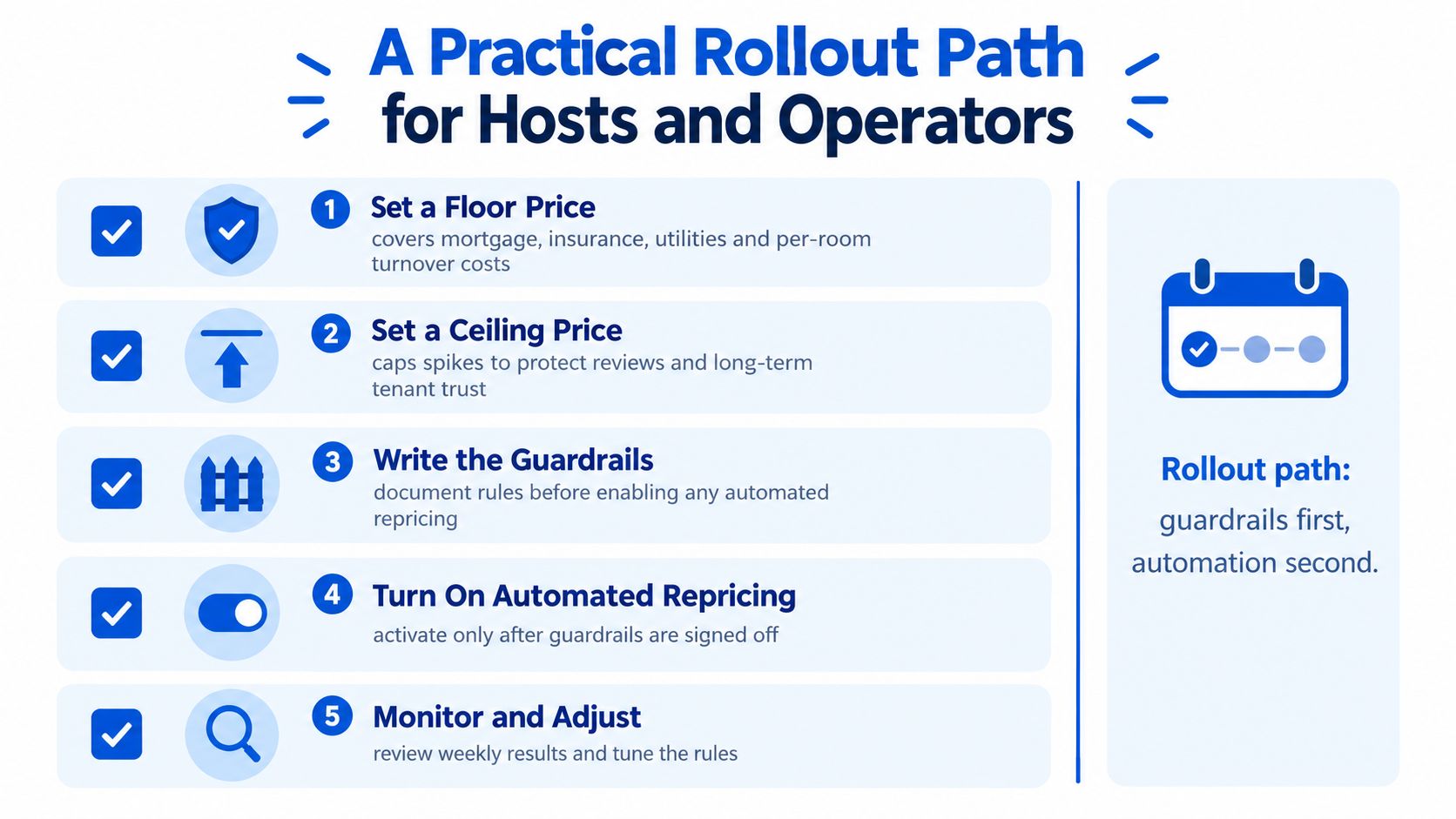
Put the controls in writing
Create a short policy that answers four questions:
- What can change automatically? Define the ordinary range for weekly movement and the signals that can trigger it.
- What requires approval? Route unusually large changes, sensitive periods, and member-facing increases to the owner or manager.
- When should automation pause? Pause repricing for maintenance issues, disputed charges, unusual market events, or a member who has been in residence for an extended period.
- Where are exceptions recorded? Keep an exception log with the original recommendation, the final decision, and the reason.
The rollout should also include a member communication script. Lead with the context, such as changes in comparable rents, occupancy, or local demand. State the new weekly rate plainly, explain when it takes effect, and provide a reasonable grace period so the member isn't surprised at the next payment.
Monitor outcomes, not just price changes
A weekly scorecard should include realized NOI per room, average vacancy duration, member tenure, turnover cost, and complaints connected to price changes. Review the scorecard on a consistent day and look for trade-offs. A higher rate isn't a success if vacancy lasts longer, turnover costs rise, or qualified members stop converting.
A practical rollout sequence is:
- Set a floor price that supports the house economics.
- Set a ceiling price that protects trust and positioning.
- Write the guardrails before automation goes live.
- Activate repricing gradually with human approval during the early period.
- Monitor and adjust using room-level financial and member experience data.
The model should earn more control over time. If the recommendations are consistently explainable and the outcomes are healthy, automation can expand. If the results are volatile, return to manual review and inspect the inputs.
Bringing Pricing, Operations, and Reporting Together
A price recommendation has limited value if the rest of the workflow remains disconnected. When a room becomes vacant, the operator should receive an alert, refresh the listing, and trigger a remarketing task. When a move-in date changes, the smart-lock credential and access instructions should reflect the new schedule. Members should be able to see the current room rate, the next scheduled review, and recent pricing history in one place.
The reporting layer should combine per-room revenue, vacancy duration, turnover cost, and realized NOI in a weekly scorecard. That prevents a host from celebrating a higher listed rate while overlooking longer vacancies or increased operating expense. A revenue optimization software workflow is most useful when pricing, communications, inventory, access, and reporting share the same room-level record.
For a newer operator, the decision frame is straightforward:
- Start with a transparent rule-based engine.
- Keep the initial inputs limited and reliable.
- Review every recommendation before it affects members.
- Connect price changes to listing, messaging, and access tasks.
- Let vacancy, NOI, and member feedback determine whether the model should become more advanced.
Dynamic pricing works best as an operating discipline, not as a button that promises perfect rent. The host still owns the judgment. The model supplies a consistent evidence base.
PadPulse is building an all-in-one toolkit for room-by-room operators, with planned dynamic pricing, vacancy and messaging workflows, smart-home integrations, market intelligence, and room-level financial reporting. Visit PadPulse to join the early-adopter interest list and follow updates toward the planned Winter 2026 launch, with no billing required before launch.